MPPT vs PWM Charge Controllers
One of the most common hurdles for folks venturing into off-grid solar is making sense of all the different components. It’s easy to feel overwhelmed, especially when you start digging into the details of things like charge controllers and see terms like "MPPT" and "PWM" flying around. These might sound like complex, intimidating acronyms, but don’t worry – this guide is here to break down exactly what they are, how they work, and most importantly, help you figure out which one is the right fit for your unique off-grid power setup.
Understanding the Crucial Role of a Charge Controller
Before we dive into the nitty-gritty of MPPT versus PWM, let's take a step back and really appreciate why a charge controller is such a vital piece of your off-grid puzzle. Think of it as the brain of your solar charging system, constantly monitoring and managing the flow of electricity to ensure everything runs smoothly and, most importantly, safely. Without one, you’re basically running blind, and that can lead to some serious headaches down the line.
What Exactly Does a Charge Controller Do
At its core, a charge controller has a few primary jobs, all centered around protecting your precious batteries and making sure they get charged efficiently and correctly. Your solar panels, bless their sunny hearts, produce varying amounts of power depending on sunlight intensity, temperature, and even the time of day. This output often doesn't perfectly match what your battery bank needs at any given moment. That’s where the charge controller steps in.
First, it regulates the voltage and current coming from your solar panels to your batteries. If you were to connect solar panels directly to batteries without any regulation, the panels could easily overcharge the batteries, leading to overheating, damage, reduced lifespan, or even a hazardous situation. Imagine trying to fill a delicate glass with a fire hose – that's what unregulated solar power can do to your battery bank. It ensures that the charging voltage stays within safe limits for your specific battery chemistry, whether you're running trusty old lead-acid or newer, more efficient LiFePO4 batteries.
Secondly, a good charge controller also prevents reverse current flow. When the sun goes down, your solar panels stop producing power. Without a charge controller, electricity could actually flow out of your batteries and back into your panels, effectively draining your battery bank overnight. This phenomenon, often called parasitic drain, would be incredibly frustrating and could leave you without power when you wake up. The charge controller acts as a one-way valve, ensuring power only flows in the right direction. It’s a seemingly small detail, but absolutely critical for the long-term health and reliability of your system. You might even want to dig into our guide on Off-Grid Solar System Components Explained to see how all these pieces fit together.
Why You Can't Skip This Component
Seriously, trying to build an off-grid solar system without a charge controller is like trying to drive a car without brakes. It might work for a little while, but eventually, you're going to crash and burn. The most immediate and expensive risk is to your batteries. Batteries are often the single most expensive component in an off-grid setup, and they are also the most vulnerable to improper charging. Overcharging can cause electrolyte boiling in lead-acid batteries, leading to plate corrosion and irreversible capacity loss. For lithium batteries, while more resilient to certain abuses, overcharging can still lead to thermal runaway, a dangerous condition that can result in fire.
Beyond battery damage, skipping a charge controller jeopardizes the entire system's stability and your personal safety. Fluctuations in power can damage sensitive electronics you're trying to run, shortening their lifespan or outright frying them. Imagine your well pump or your refrigerator suddenly getting a surge of unregulated power – it’s a recipe for disaster. Investing in a quality charge controller is non-negotiable for anyone serious about a reliable, safe, and long-lasting off-grid power solution. It protects your investment and provides peace of mind, knowing your power system is operating within its designed parameters.
The Basics of PWM Charge Controllers
Let's start our deep dive with the tried-and-true, often more budget-friendly option: the Pulse Width Modulation (PWM) charge controller. These have been a staple in smaller off-grid systems for years, and for good reason. They're simpler in design, often more robust, and incredibly reliable. However, understanding their fundamental operation is key to knowing when they are the right choice and when you might need something more sophisticated.
How PWM Technology Works
The name "Pulse Width Modulation" sounds pretty technical, but the concept is actually quite straightforward. Imagine you have a light switch. You can either turn it completely "on" or completely "off." A PWM controller works similarly, but much faster. It rapidly switches the connection between your solar panels and your batteries on and off, thousands of times per second. By varying the width of these "on" pulses – how long the connection is active during each cycle – the controller regulates the amount of power flowing into the battery.
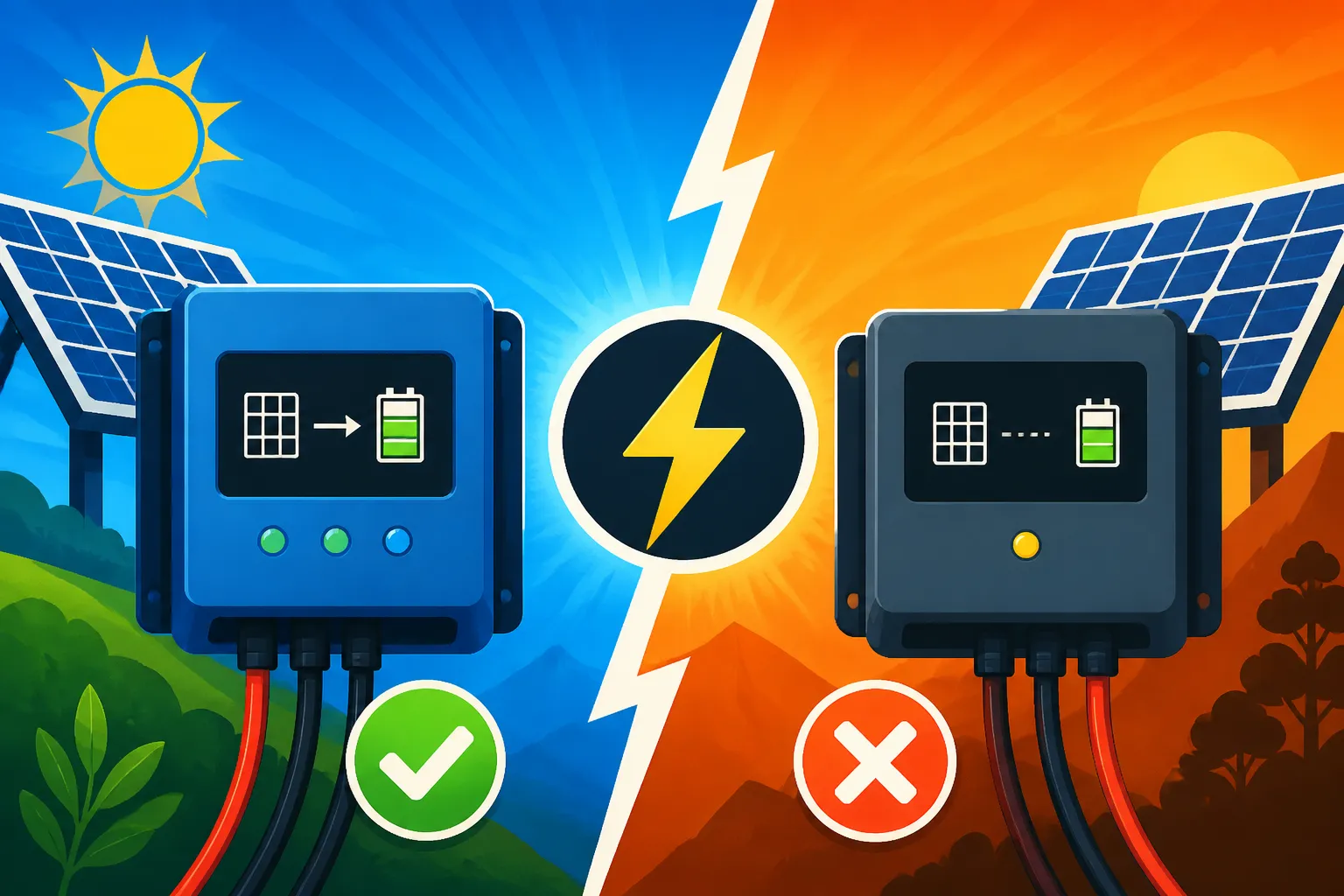
When the battery needs more charge, the "on" pulses are longer, allowing more current to flow. As the battery approaches full charge, the "on" pulses become shorter and shorter, effectively tapering off the charge. This rapid pulsing essentially "fools" the battery into seeing a lower, regulated voltage, preventing overcharging. The key characteristic of a PWM controller is that it operates your solar panels at a voltage very close to the battery's current voltage. If you have a 12V battery, the PWM controller tries to keep your panels operating near 12V (or slightly higher, like 14.4V during bulk charging). This direct relationship means that any excess voltage your panels could produce above the battery's current voltage is simply not utilized – it's essentially wasted.
Advantages of PWM Controllers
One of the biggest advantages of PWM controllers is their sheer simplicity and affordability. Because they don't have complex power conversion circuitry, they are generally less expensive to manufacture, making them a very attractive option for those building a system on a tighter budget. You can often find a good quality PWM controller, perhaps even from a reputable brand like Renogy, at a fraction of the cost of an MPPT counterpart. This makes them popular for smaller applications like charging a single 12V battery for a garden shed, a small RV setup, or a basic emergency backup system.
Another significant benefit is their reliability. With fewer complex components, there's less to go wrong. They tend to have a long lifespan and are often quite tolerant of various environmental conditions. Their robust design can handle a lot, making them a set-it-and-forget-it component for many users. For folks just dipping their toes into off-grid living or putting together a simple system for a Cost to Power a Cabin with Solar for weekend use, the ease of use and inherent stability of a PWM controller can be a huge plus. They are straightforward to install, often requiring just a few basic connections between your panels, battery, and load.
Limitations and Scenarios Where PWM Falls Short
Despite their advantages, PWM controllers do have notable limitations, primarily concerning efficiency. As mentioned, a PWM controller operates your solar panels at or very near your battery's voltage. Most modern solar panels are designed to produce their maximum power (their "maximum power point") at a voltage significantly higher than a typical 12V or 24V battery bank. For example, a "12V" solar panel actually produces its peak power around 17-18V. When a PWM controller forces that panel to operate at, say, 13V (the battery voltage), it means you're not utilizing all the power the panel is capable of producing. That extra voltage capacity is simply "clipped" or "wasted."
This efficiency loss becomes more pronounced under certain conditions. In cooler weather, solar panels tend to produce higher voltage. An MPPT controller can capitalize on this higher voltage to push more current into the battery, but a PWM controller cannot. Similarly, if your panel array voltage is significantly higher than your battery bank voltage (e.g., using a 60-cell grid-tie panel, which operates around 30V-38V, with a 12V battery), a PWM controller would be incredibly inefficient, potentially wasting 50% or more of your available power. This makes them unsuitable for larger systems or situations where maximizing every watt from your panels is crucial. For anyone looking to understand how this impacts your overall investment, our article on Off-Grid Solar Payback Period Explained dives into system efficiency and long-term savings.
Diving Deep into MPPT Charge Controllers
Now, let's turn our attention to the more advanced, and generally more efficient, option: the Maximum Power Point Tracking (MPPT) charge controller. While these typically come with a higher price tag, their sophisticated technology often justifies the investment, especially for larger, more demanding off-grid solar setups. They are designed to squeeze every last watt out of your solar panels, no matter the conditions.
The Intelligence Behind MPPT Technology
The magic of an MPPT controller lies in its name: "Maximum Power Point Tracking." Unlike PWM controllers that simply regulate voltage by switching on and off, an MPPT controller employs much more sophisticated electronics and algorithms. It constantly monitors the output of your solar panels – specifically, their voltage and current – and adjusts its internal circuitry to find the "sweet spot" where the panels are producing the absolute maximum amount of power. This sweet spot, known as the Maximum Power Point (MPP), shifts throughout the day as sunlight intensity, temperature, and even shading conditions change.
Imagine trying to find the perfect gear on a bicycle to go uphill. Too high, and you're struggling; too low, and you're spinning your wheels. An MPPT controller is like a continuously variable transmission, always finding that perfect "gear" for your solar panels. It does this by using a DC-to-DC converter (often a "buck converter") that can take a higher voltage input from the solar panels and efficiently convert it into a lower voltage output that is suitable for charging your battery bank, while simultaneously increasing the current. This conversion process is what makes it so much more efficient, as it doesn't just clip off excess voltage; it transforms it into usable current.
How MPPT Extracts More Power
The core principle behind MPPT's superior power extraction is its ability to perform voltage and current optimization. Let's say you have a solar panel rated at 300 watts, with a maximum power voltage (Vmp) of 32 volts and a maximum power current (Imp) of 9.38 amps. If you're charging a 12-volt battery, a PWM controller would essentially force that panel to operate around 13-14 volts, significantly reducing the effective wattage it's providing to the battery.
An MPPT controller, however, will take that 32 volts at 9.38 amps (resulting in 300 watts) and, through its intelligent conversion, lower the voltage to the appropriate charging voltage for your 12V battery (say, 14.4 volts for bulk charging). Critically, while the voltage is reduced, the current is increased proportionally (minus a small efficiency loss within the controller, typically 95-99%). So, 300 watts from the panel might translate to approximately 20.8 amps (300W / 14.4V ≈ 20.8A) going into your 12V battery. This conversion of "excess" voltage into additional current is the game-changer for MPPT technology, leading to significantly higher energy harvest.
This becomes especially beneficial in colder temperatures, when solar panels produce higher voltages, and in scenarios with partial shading or cloudy conditions. An MPPT controller can dynamically adjust to these fluctuating conditions, continuously re-optimizing the power point to ensure you're getting the most out of your array. This can result in a 10-30% (or even more, in ideal conditions) increase in daily energy yield compared to a PWM controller, which can really add up over time, especially for a whole-house off-grid solar system.
Key Benefits of Choosing MPPT
The primary benefit of an MPPT controller is its superior efficiency, particularly in specific environmental conditions. If you live in an area that experiences significant temperature swings, especially cold weather, an MPPT controller will outperform a PWM every single time. As solar panel voltage increases in colder temperatures, an MPPT unit can convert that higher voltage into more usable charging current for your batteries, significantly boosting your energy harvest during those crucial winter months when sunlight hours are already limited. This is a big deal for anyone relying on solar year-round.
Another huge advantage is the flexibility an MPPT controller offers in terms of solar panel configuration. With a PWM controller, your solar array's voltage needs to be very close to your battery bank's voltage (e.g., "12V" panels for a 12V battery). MPPT controllers, on the other hand, can take much higher voltage input from your panels and step it down efficiently. This means you can use higher voltage "grid-tie" panels (which are often more readily available and sometimes cheaper per watt) with a 12V, 24V, or 48V battery bank. You can also string multiple panels in series to create a high-voltage array, which reduces current in the wiring, allowing for thinner, less expensive wiring over longer distances, and minimizing voltage drop. This simplifies installation, especially for complex systems, and can reduce the Cost of Off-Grid Solar Panels and associated wiring.
Finally, MPPT controllers are the gold standard for larger off-grid systems or those aiming for maximum reliability and self-sufficiency. For a Cost to Go Off-Grid for a Family Home or a remote homestead, every watt counts. The ability to harvest more power, adapt to changing conditions, and offer greater flexibility in panel choice and wiring makes MPPT the clear winner for serious off-grid applications. Brands like Victron Energy and Outback Power are renowned for their high-quality MPPT controllers, offering advanced features and robust performance essential for critical power needs.
Comparing MPPT and PWM Head-to-Head
When you're trying to decide between an MPPT and a PWM charge controller, it really boils down to balancing efficiency, cost, and the specifics of your off-grid setup. There isn't a universally "best" option; rather, it's about choosing the right tool for your particular job. Let's break down the key differences to help you make an informed decision.
Efficiency and Power Harvest
This is arguably the most significant differentiator. MPPT controllers are inherently more efficient than PWM controllers, especially under suboptimal conditions.
-
MPPT Efficiency: These controllers can achieve efficiencies of 95% to 99% in power conversion. This means if your panels are producing 300 watts, an MPPT controller will deliver around 285-297 watts to your batteries. More importantly, they consistently track the maximum power point of your panels, which can result in a 10-30% (and sometimes even higher) increase in daily energy harvest compared to a PWM controller, especially in specific scenarios.
- Cold Weather: Panels produce higher voltage in cold weather. MPPT thrives here, converting that extra voltage into more current. For example, a crisp winter morning in Colorado will see an MPPT controller making the most of those elevated panel voltages.
- Cloudy Days/Partial Shading: While no controller can create power, MPPT's continuous tracking allows it to adapt better to fluctuating light levels, trying to pull as much power as possible from what's available.
- Mismatch in Voltages: If your panel array's optimal voltage is significantly higher than your battery bank's voltage (e.g., using typical 60-cell or 72-cell residential panels with a 12V or 24V battery), an MPPT controller is essential. It efficiently steps down that higher voltage and boosts the current, preventing substantial power loss.
-
PWM Efficiency: While technically highly efficient within its operating principle, a PWM controller is less efficient at extracting power from your solar panels if there's a significant voltage difference between the panel's Vmp and the battery's charging voltage.
- Power Clipping: If your panels produce a peak power voltage of 18V, but your 12V battery only needs 14V to charge, the PWM controller will essentially "clip" or waste that 4V difference. This isn't an inefficiency in the controller itself, but rather an inefficiency in the system's power harvest.
- Warm Weather: In very hot climates, panel voltage drops. Both controllers see reduced output, but the MPPT can still optimize what's available.
- Optimal for Matched Voltages: PWM controllers perform best when the solar panel's nominal voltage closely matches the battery bank's nominal voltage (e.g., "12V" panels with a 12V battery, where the panel's Vmp is naturally closer to the battery's charging voltage).
Here's a quick comparison table:
| Feature | PWM Charge Controller | MPPT Charge Controller |
|---|---|---|
| Efficiency (Power Harvest) | Lower, especially with voltage mismatch | Higher (10-30%+ more harvest), especially with mismatch |
| Technology | Pulse Width Modulation (rapid switching) | Maximum Power Point Tracking (voltage/current conversion) |
| Cost | Generally lower | Generally higher |
| Panel Voltage Match | Requires panel Vmp to be close to battery V | Can handle much higher panel voltage than battery V |
| Panel Configuration | Often parallel, or series for voltage match | Flexible series/parallel, higher voltage strings |
| Best Use Cases | Small systems, RVs, sheds, budget constraints | Large systems, whole homes, year-round living, max harvest |
| Cold Weather Perf. | Poor (wastes higher panel voltage) | Excellent (converts higher panel voltage to current) |
| Footprint/Heat | Smaller, less heat | Larger, can generate more heat |
Cost Considerations and Long-Term Value
When it comes to the initial investment, PWM controllers almost always win on price. You can often find a good 20A PWM controller for less than $50-$100, while a comparable MPPT controller might start at $150-$200 and go much higher for larger capacities. This cost difference is significant for anyone working with a tight budget, particularly for small-scale projects like a solar setup for a small greenhouse or a basic camp power system. You can easily find budget-friendly PWM controllers and even off-grid solar kits that include them on marketplaces like Amazon.
However, "cost" isn't just about the upfront price. It's also about long-term value.
For larger systems (say, anything over 200-300 watts of solar), the higher efficiency of an MPPT controller can quickly offset its higher initial cost through increased power harvest. If an MPPT controller helps you generate 20% more power each day, that means you might need fewer solar panels to meet your energy needs, or you'll have more reserve power for cloudy days. Over the lifespan of your system, the extra energy captured by an MPPT could translate into significant savings, either by delaying battery replacement (due to less deep cycling) or by reducing reliance on a backup generator. This is a critical point when considering the Lifetime Cost of an Off-Grid Solar System.
Let's imagine you need 1000W of solar panels. If you get 10% more output with an MPPT controller, that's like getting an extra 100W of panels for "free" every day. Over years, this efficiency gain adds up to a substantial amount of electricity. So, while the sticker price of an MPPT might make you wince, think about how much that extra power translates into real-world benefit. For critical applications like running a well pump or a refrigerator, that extra reliability and power generation can be priceless.
System Scalability and Flexibility
The ability to scale and adapt your system is another area where MPPT controllers shine.
-
MPPT Flexibility: Because MPPT controllers can handle a wide range of input voltages, they offer incredible flexibility in panel selection and array design. You can easily use common, cost-effective 60-cell (typically 30-34V Vmp) or 72-cell (typically 36-40V Vmp) panels, which were originally designed for grid-tied systems, with any 12V, 24V, or 48V battery bank. This opens up more options when you're sourcing panels and can help you optimize your Off-Grid Solar Cost by System Size. You can also wire panels in longer series strings (e.g., three 12V nominal panels in series to make a 36V array, or two 60-cell panels in series for a 60-70V array), which reduces the current and allows for smaller, less expensive wiring over longer distances from your array to your charge controller. This is hugely beneficial for large, spread-out arrays or roof-mounted systems where the distance to the battery bank is considerable. And if you decide to expand your system later, an MPPT controller often makes it easier to integrate new panels, even if they have slightly different voltage characteristics, as long as the total array voltage stays within the controller's limits.
-
PWM Limitations: PWM controllers are far more restrictive. For optimal performance, the nominal voltage of your solar array must closely match the nominal voltage of your battery bank. If you have a 12V battery bank, you need "12V nominal" panels (which have a Vmp around 17-18V). If you want to use 24V nominal panels, you'd need a 24V battery bank. This limits your panel choices and can make future expansion trickier if you want to mix and match different types of panels. You're also generally limited to shorter wiring runs due to higher currents, which can necessitate thicker, more expensive cables to prevent significant voltage drop, especially if you're trying to figure out How to Wire an Off-Grid Solar System. For small, compact systems like a small RV or a basic shed, these limitations might not be an issue, but for a growing homestead or a serious off-grid home, they can be a major headache.
Installation Complexity and Maintenance
When it comes to getting these controllers up and running, there are some differences, though neither is excessively difficult for the DIYer.
-
PWM Installation: PWM controllers are generally simpler to install. They typically have fewer settings and are more "plug-and-play." You connect your panels, then your battery, then your loads (if it has a load output). The wiring is straightforward, and there's less to configure. Many smaller Off-Grid Solar Kits for Beginners feature PWM controllers precisely because of this simplicity. Maintenance is also minimal: usually just keeping the connections clean and tight, and ensuring good ventilation.
-
MPPT Installation: MPPT controllers, being more advanced, can be slightly more involved to install and configure. They often have more customizable settings, such as battery charging parameters (bulk, absorb, float voltages), equalization settings, and sometimes even communication ports for external monitoring. While this offers greater control and optimization, it requires a bit more knowledge during setup. However, for many popular brands like Victron or EPEver, the setup process is well-documented, and they often come with user-friendly interfaces or smartphone apps that guide you through the process. For detailed instructions, you might want to check out our guide on DIY Off-Grid Solar Installation Step by Step. In terms of physical installation, MPPT controllers can be larger and might require more space, and because they are actively converting power, they can generate more heat, so proper ventilation is crucial. Maintenance is similar to PWM: keep connections clean, ensure good airflow, and occasionally check for firmware updates on more advanced units.
Choosing the Right Charge Controller for Your Off-Grid System
Deciding between a PWM and an MPPT charge controller isn't about one being inherently "better" in all situations. It's about aligning the controller with your specific energy needs, budget, and the characteristics of your solar array. Let's explore the scenarios where each type truly shines.
When a PWM Controller Might Still Be Your Best Bet
Despite the allure of MPPT's higher efficiency, there are still plenty of excellent reasons to choose a PWM charge controller, especially for smaller or less demanding applications.
- Small, Simple Systems: If you're putting together a basic system to power a few lights and charge your phone in a shed, a small RV, or a remote hunting cabin that's only used seasonally, a PWM controller is often the most cost-effective and perfectly adequate solution. For example, a 100W or 200W solar panel setup for a single 12V battery might only cost you a couple of hundred dollars total, and adding an inexpensive PWM controller won't significantly impact your overall Off-Grid Solar Cost for a Shed or Off-Grid Solar Cost for an RV. You’re not trying to run heavy loads or achieve year-round self-sufficiency here; you just need reliable basic power.
- Budget Constraints: When every dollar counts, a PWM controller helps keep your upfront costs down. This is particularly true if you already have "12V nominal" solar panels (meaning panels with a Vmp typically around 17-18V) that are well-matched to a 12V battery bank. In such a scenario, the efficiency gains from an MPPT might not be enough to justify the higher cost, especially if your total wattage is low. Many starter kits sold by brands like Renogy or available on Amazon for small RVs or boats often include PWM controllers for this very reason.
- Minimal Voltage Mismatch: If your solar panels' maximum power voltage (Vmp) is already very close to your battery bank's charging voltage, the benefits of MPPT are minimized. For instance, if you have a 12V battery and you're using panels specifically designed to have a Vmp of around 17-18V (often marketed as "12V solar panels"), a PWM controller will capture a good portion of that power, making the efficiency difference less critical. However, be wary of using higher voltage panels (like common 60-cell or 72-cell residential panels) with a PWM controller, as this scenario leads to significant power loss.
- Simple Load Requirements: For applications where you're only powering DC loads directly from the charge controller's load output (if it has one), like small LED lights or USB charging, and you don't have high peak power demands, a PWM controller keeps things simple and reliable. It’s perfect for those basic needs without overcomplicating your setup or budget.
Why an MPPT Controller is Often the Superior Choice
For most serious off-grid setups, particularly those aiming for full-time living or maximum energy harvest, an MPPT controller is almost always the superior choice. The benefits in efficiency, flexibility, and long-term performance often outweigh the initial cost.
- Larger Systems and Full-Time Living: If you're planning an off-grid solar system for a full-sized home, a substantial remote cabin, or even a large RV that you live in full-time, an MPPT controller is indispensable. These systems require consistent power, and every watt harvested makes a difference. Maximizing your power production directly translates to fewer cloudy day worries, better battery health due to more complete charging, and greater overall energy independence. When you're trying to figure out How Many Solar Panels for Off-Grid Living or How Many Batteries for an Off-Grid System, the increased efficiency of an MPPT controller can actually reduce the total number of panels or the size of your battery bank you ultimately need, potentially offsetting its own cost.
- Maximizing Energy Harvest: If your property experiences fluctuating weather conditions, cold winters, or you simply want to extract every possible watt from your solar panels, an MPPT controller is the way to go. Its ability to dynamically track the maximum power point and convert "excess" voltage into usable current means more power gets into your batteries, faster. This is crucial for maintaining proper battery charge, extending battery lifespan, and ensuring you have enough power for all your appliances, including heavy hitters like a Cost to Run A Refrigerator on Off-Grid Solar or even an Cost to Run An Air Conditioner on Off-Grid Solar.
- Future Expansion and Flexibility: Planning to expand your system down the road? MPPT controllers offer far more versatility. You can often add more panels, even if they have slightly different voltage ratings, as long as the array's total voltage and current stay within the controller's limits. This means you’re not locked into specific panel types or configurations from day one. You can also take advantage of higher voltage, often cheaper-per-watt panels designed for grid-tied systems, giving you more options in the market. Check out our guide on How to Choose an Off-Grid Solar System for more details on system design.
- Challenging Environments: For installations in areas prone to partial shading (e.g., near trees), or in regions with significant temperature variations, an MPPT controller will provide a much more robust and reliable performance. Its ability to adapt to changing conditions and optimize power output under stress makes it ideal for challenging off-grid environments.
Real-World Scenarios and Recommendations
Let's look at a few common scenarios to help solidify your choice:
-
Scenario 1: The Weekend Cabin Getaway
- Need: Basic lighting, charging phones/laptops, running a small radio. Total daily consumption is low.
- Recommendation: A PWM controller might be perfect here. If you're using a couple of smaller 100W "12V nominal" panels and a single deep-cycle battery, a basic PWM controller from a brand like Renogy (you can find many options for Renogy solar panels and kits on Amazon) would be perfectly sufficient and keep costs down. It’s reliable for intermittent use. Check out our detailed guide on Cost to Power a Cabin with Solar for more context.
-
Scenario 2: Full-Time RV or Van Life
- Need: Running a refrigerator, lights, water pump, charging multiple devices, possibly a small microwave or even a mini-split AC unit. Daily power needs are moderate to high.
- Recommendation: MPPT is highly recommended. RVs and vans often have limited roof space, so maximizing power from every square inch of panel is critical. You'll likely use multiple panels, possibly in series, and want to capture power efficiently even on partly cloudy days or in different climates. An MPPT controller allows for flexible panel configurations (e.g., higher voltage panels in series to minimize voltage drop), and its efficiency gains will be noticeable, especially when powering crucial appliances like a fridge. For more in-depth advice on this, see our article on Off-Grid Solar Cost for a Van.
-
Scenario 3: Permanent Off-Grid Home
- Need: Full household power for all appliances, including well pumps, water heaters, washing machines, and potentially heating/cooling. High daily consumption, requiring maximum reliability.
- Recommendation: An MPPT controller is virtually mandatory. For a permanent off-grid residence, you simply cannot afford to waste power. You'll likely have a large solar array (many panels, often higher voltage residential types) and a substantial battery bank (24V or 48V). An MPPT controller will ensure you're getting the most out of your investment, providing the necessary charging efficiency to keep your batteries healthy and your home powered through all seasons. Brands like Victron, Outback, and Sol-Ark offer robust MPPT solutions designed for these demanding applications. Exploring guides like How to Size an Off-Grid Solar System will highlight why MPPT is key for achieving robust power for your home.
Practical Tips for Maximizing Charge Controller Performance
Once you've made the crucial decision between a PWM and MPPT charge controller, the journey isn't over. To truly get the most out of your off-grid solar system, it's essential to properly size, configure, monitor, and maintain your charge controller and its associated components. Even the best equipment can underperform if not set up correctly.
Proper Sizing and Configuration
Getting the right size and configuring your charge controller correctly is paramount. This isn't a "one-size-fits-all" situation; it depends entirely on your solar array and battery bank.
- Matching Voltage: While MPPT controllers are forgiving with panel input voltage, you still need to ensure your total panel array's open-circuit voltage (Voc) doesn't exceed the controller's maximum input voltage. Going over this limit can damage the controller. For PWM, it's even more critical that your nominal panel voltage matches your battery bank voltage. If you have a 12V battery, you generally need 12V nominal panels. For a 24V battery, you need 24V nominal panels or two 12V nominal panels in series. This is a fundamental step in How to Size an Off-Grid Solar System.
- Matching Amperage: The charge controller's output amperage must be sufficient to handle the maximum current from your solar array. To calculate this, take your total solar array wattage and divide it by your battery bank's voltage (e.g., 500W array / 12V battery = ~42 amps). Then, add a 25% safety factor for potential cold-weather over-performance of panels. So, you'd want a charge controller rated for at least 52.5 amps in this example. This ensures the controller isn't overloaded and can safely manage the power.
- Wire Sizing: Don't skimp on wire size! Undersized wires between your panels and charge controller, or between the charge controller and batteries, will lead to voltage drop and power loss. Always use appropriate gauge wiring for the current and distance involved. This is a common oversight that significantly impacts system efficiency. Refer to our guide on How to Size Wire and Cables for detailed calculations and best practices.
- Battery Settings: For MPPT controllers especially, ensure the charging parameters (bulk, absorb, float voltages, and equalization settings if applicable) are correctly set for your specific battery chemistry (e.g., sealed lead-acid, flooded lead-acid, or LiFePO4). Incorrect settings can severely shorten battery life. Many modern MPPT controllers, like those from Victron Energy, come with pre-set profiles for common battery types, or allow for precise custom programming. This consideration for battery chemistry is deeply explored in our article on How Battery Choice Affects Off-Grid Cost.
Monitoring and Troubleshooting Common Issues
Even a perfectly installed system can run into hiccups. Regular monitoring and knowing how to troubleshoot are key to sustained performance.
- Battery Monitors: A good battery monitor (like a shunt-based system) is invaluable. It provides real-time information on your battery's state of charge, current in/out, voltage, and historical data. This lets you quickly see if your batteries are charging properly, if your loads are pulling too much power, or if there’s a drain you weren’t aware of. Many higher-end MPPT controllers integrate with battery monitors or offer their own sophisticated monitoring via Bluetooth apps or external displays, like the Victron BMV or SmartShunt.
- Check Connections: The most common cause of solar system issues is loose or corroded connections. Periodically inspect all terminals – at the panels, combiner box, charge controller, and battery bank. Ensure they are clean, tight, and free of corrosion.
- Controller Diagnostics: Most charge controllers have LED indicators or digital displays that can signal operating status or error codes. Familiarize yourself with these. If something isn't working, the first step is often to check the controller's display for any warnings. For example, a fault code might indicate an over-voltage condition on the PV input or an over-current situation.
- Performance Checks: If you suspect your system isn't performing optimally, use a multimeter to check voltages at various points: at the solar panels (open circuit and under load), at the charge controller input, at the charge controller output, and at the battery terminals. This can help pinpoint where a problem might be occurring, such as a faulty panel, a bad connection, or an issue with the controller itself.
Maintaining Your Charge Controller
Charge controllers are generally robust devices, but a little preventive maintenance can go a long way in ensuring their longevity and reliable operation.
- Ventilation: Heat is the enemy of electronics. Ensure your charge controller has adequate ventilation. If it's in an enclosed space, make sure there's enough air circulation around it. MPPT controllers, with their power conversion circuitry, can generate more heat than PWM controllers, making good airflow even more critical. Never obstruct the cooling fins or vents.
- Dust and Debris: Over time, dust and debris can accumulate on circuit boards and cooling fins, acting as an insulating layer that traps heat. Periodically (e.g., annually) gently clean the exterior of your controller with a soft, dry cloth. If it's in a particularly dusty environment, you might consider using compressed air to clear out any internal dust, but always follow the manufacturer's recommendations and disconnect all power first.
- Environmental Protection: While many charge controllers are designed for robust use, protect them from direct exposure to extreme weather elements like rain, snow, or direct scorching sunlight. If installed outdoors, ensure they are in a weather-resistant enclosure that still allows for proper ventilation. Extreme humidity can also lead to corrosion over time, so consider desiccant packs in very damp environments.
- Software Updates: For advanced MPPT controllers, especially those with smartphone apps or internet connectivity, check periodically for firmware updates. Manufacturers often release updates that improve efficiency, add features, or fix bugs. Staying current can enhance performance and reliability.
By paying attention to these practical tips, you can ensure your charge controller operates at its peak, protecting your investment and providing you with consistent, reliable off-grid power for years to come.
Future Trends in Charge Controller Technology
The world of off-grid solar isn't static; it's constantly evolving, with new technologies and integrations emerging all the time. Charge controllers, as a core component, are also seeing exciting advancements that promise even greater efficiency, intelligence, and ease of use.
Integrated Systems and Smart Features
One of the most significant trends is the move towards highly integrated systems, where the charge controller is no longer a standalone device but part of a larger, smarter power management unit.
- All-in-One Inverter Chargers: We're seeing more robust inverter chargers that combine an inverter (to convert DC battery power to AC household power), a battery charger (for generator or shore power input), and an MPPT solar charge controller into a single, compact unit. Brands like Sol-Ark, Victron MultiPlus, and Growatt are leading the way with these "all-in-one" hybrid inverter-chargers. These systems simplify wiring, reduce component count, and offer seamless power management, often automatically switching between solar, battery, generator, and even grid (if applicable) power sources. This not only makes installation easier but also provides a more cohesive and efficient power ecosystem. If you're looking into buying such a system, you might want to consider our article on Best All-in-One Off-Grid Power System.
- App Control and Remote Monitoring: Modern charge controllers, especially MPPT units, are increasingly featuring Bluetooth or Wi-Fi connectivity. This allows users to monitor their system's performance, adjust settings, and receive alerts directly from their smartphone or computer. Imagine being able to check your battery's state of charge, see how much power your panels are producing, or even tweak charging parameters from anywhere with an internet connection. This remote access is invaluable for troubleshooting, optimizing performance, and providing peace of mind, especially for remote cabin setups.
- Energy Management Systems: Beyond simple monitoring, charge controllers are integrating into more comprehensive energy management systems. These systems can optimize energy flow based on time-of-day rates (for hybrid systems), forecast weather to adjust charging, or even prioritize loads. For instance, in a system with critical loads like medical equipment, the controller could ensure these always have power, even if it means temporarily curtailing less critical loads like a water heater. This level of intelligent control is transforming how we interact with our off-grid power.
Advances in Efficiency and Durability
Beyond smart features, the core technology of charge controllers continues to improve, focusing on squeezing even more power out of our solar arrays and ensuring components can withstand the harshest environments.
- Improved MPPT Algorithms: While current MPPT algorithms are already very good, research and development continue to refine them, making them even faster and more accurate at tracking the true maximum power point, especially under rapidly changing conditions like intermittent cloud cover or complex partial shading scenarios. This means even higher power harvest rates in the future.
- Wider Voltage Ranges and Higher Capacities: As solar panels become more powerful and larger residential arrays become common, charge controllers are evolving to handle wider input voltage ranges and significantly higher current capacities. This allows for even larger series strings of panels, further reducing wiring costs and simplifying array design for very large off-grid homes or commercial applications. You'll see controllers capable of handling over 250V or even 600V input, allowing for configurations previously only seen in grid-tied systems.
- Robustness and Longevity: Manufacturers are constantly working on improving the durability and lifespan of their components. This includes better thermal management designs to dissipate heat more effectively, more resilient circuit boards to withstand voltage spikes, and enhanced environmental sealing for units designed for outdoor installation. Brands that prioritize quality, like Victron and Outback, are continually pushing the envelope in terms of product longevity and reliability, understanding that off-grid users depend on their systems working flawlessly, day in and day out, in often unforgiving conditions. This focus on durability is crucial when you consider the Off-Grid Solar Maintenance Costs over the lifetime of a system.
These trends indicate a future where off-grid solar systems are not just about raw power, but about intelligent, integrated, and incredibly efficient energy management, making off-grid living more accessible and reliable than ever before.
Disclaimer
The information provided in this guide is for general informational purposes only and does not constitute professional advice. Off-grid solar system design and installation involve electrical work and specific technical knowledge. Always consult with a qualified solar professional or electrician before undertaking any solar project to ensure safety, compliance with local codes, and optimal system performance.