How Many Batteries for an Off-Grid System
Figuring out how many batteries you truly need for your off-grid solar system can feel like trying to solve a complex puzzle with a blindfold on. It’s not just about picking a number; it’s about understanding your energy habits, the climate you live in, and the specific demands of your lifestyle. Many folks jump into buying batteries without truly doing their homework, only to find themselves constantly running out of power or spending far more than they needed to. This comprehensive guide will walk you through every step of accurately sizing your off-grid battery bank, ensuring you have reliable power when you need it most, without unnecessary expense or frustration.
Understanding Your Daily Energy Needs
Before you even think about battery specs, the absolute first step in building a resilient off-grid system is to have a crystal-clear picture of your daily energy consumption. This isn't just a suggestion; it's the bedrock upon which your entire system's success will rest. Skimping on this step is the fastest way to end up with an undersized system, constant power anxiety, and potentially damaged batteries.
Performing a Detailed Load Analysis
A load analysis is essentially an inventory of every electrical appliance and device you plan to power, noting how much electricity each uses and for how long. It's often where people get overwhelmed, but it doesn't have to be complicated. Grab a notepad or a spreadsheet and list everything, from your refrigerator to your phone charger. Think about your daily routine: when do you use lights? How long is the TV on? Do you run power tools or a well pump, and for how many hours? Don't forget those sneaky phantom loads, like clocks on appliances or device chargers even when nothing is plugged in.
For each item, you'll want to find its wattage (often listed on a label or in the owner's manual) and estimate its daily run time in hours. If you only find amperage (amps) and voltage (volts), you can calculate wattage by multiplying amps by volts (Watts = Amps x Volts). Once you have the watts and hours, multiply them to get daily watt-hours (Wh) for each appliance. Summing these up gives you your total estimated daily watt-hour consumption. For a more in-depth guide, you can check out our article on How to Calculate Daily Energy Usage.
It's crucial to be realistic, even slightly generous, with your estimates. Think about worst-case scenarios – a long movie night, an extra load of laundry, or unexpected company. It's far better to slightly overestimate your needs than to constantly worry about conserving power. Many people underestimate their usage, especially for things like well pumps or microwaves that have high surge demands but run for short periods. Don't forget these brief, heavy hitters in your calculations.
Accounting for Seasonal and Lifestyle Variations
Your energy needs aren't static; they ebb and flow with the seasons and changes in your lifestyle. A cabin used only in the summer might have very different energy requirements than a full-time off-grid home that needs to run heating systems in winter. In colder months, you might need more lighting, run resistive heaters for shorter bursts, or charge devices more frequently indoors. Conversely, summer might bring air conditioning needs, more fans, or running pool pumps.
Consider your geographic location, too. If you're in a sunny desert region, your solar panels might produce more, but your AC load will be higher. In a cloudy, northern climate, your solar production might be lower, requiring more battery capacity to bridge those long stretches of grey skies. Think about whether you're living off-grid full-time, using it for weekend getaways, or for a specific application like a remote workshop. These factors profoundly impact how many batteries you'll need.
For instance, a full-time RV dweller might have consistent daily loads but needs to account for varying sun exposure as they travel. A remote hunting cabin might only need power for a few weekends a month but needs enough capacity to handle a deep freeze and bright lights for evening activities. Factoring in these variations ensures your system is robust enough for your specific reality, not just an idealized average.
Delving into Battery Chemistry and Capacity
Once you know your daily energy budget, it's time to talk about the heart of your off-grid system: the batteries. The type of battery you choose dramatically impacts your system's performance, longevity, and overall cost. This is where many of the important decisions are made, so understanding the options is key.
Lithium Iron Phosphate LiFePO4 Battery Advantages
Lithium Iron Phosphate (LiFePO4) batteries have become the darling of the off-grid world, and for very good reason. They offer a host of advantages that make them superior to traditional lead-acid options for most applications. Their biggest selling point is their deep discharge capability, often allowing you to use 80-100% of their rated capacity without damaging the battery. This means a 100 Ah LiFePO4 battery is functionally equivalent to a much larger lead-acid battery in terms of usable energy.
Beyond depth of discharge, LiFePO4 batteries boast an incredibly long cycle life, often rated for 3,000 to 10,000 cycles compared to a few hundred for lead-acid. This translates to decades of reliable service, significantly reducing long-term replacement costs. They're also lighter, more compact, and operate more efficiently, making them ideal for mobile applications like RVs or vans. Furthermore, they maintain a consistent voltage output throughout their discharge cycle, which means your appliances run smoothly without dimming lights or struggling motors. Brands like Renogy and others offer a wide range of LiFePO4 batteries that are popular among DIY off-gridders.
The upfront cost of LiFePO4 batteries is higher than lead-acid, which can be a barrier for some. However, when you factor in their longer lifespan, higher usable capacity, and zero maintenance requirements, their total cost of ownership often proves to be lower over the system's lifetime. They also tend to charge much faster and tolerate a wider range of temperatures, although extreme cold can still impact charging performance if not properly managed. Many off-grid enthusiasts find the investment well worth it for the peace of mind and performance they deliver. You can delve deeper into the cost comparison by reading our article on LiFePO4 vs Lead-Acid Battery Cost.
Understanding Lead-Acid Battery Options
While LiFePO4 batteries are often the preferred choice, lead-acid batteries still have a place, especially for budget-conscious projects or specific applications. There are primarily two types of lead-acid batteries suitable for off-grid solar: flooded lead-acid (FLA) and sealed lead-acid (SLA), which include Absorbed Glass Mat (AGM) and Gel batteries. FLA batteries are the most affordable but require regular maintenance (checking water levels, equalizing charges) and proper ventilation to dissipate hydrogen gas. They are robust but have a limited cycle life and are typically only safe to discharge to about 50% of their capacity to prolong their life.
AGM batteries are sealed, maintenance-free, and can be mounted in more orientations, making them popular for RVs or small cabins where ventilation might be an issue. They also tolerate deeper discharges better than FLAs, often to 60-80%, but still have a shorter cycle life than LiFePO4. Gel batteries are similar to AGM but perform better in extreme temperatures and at lower discharge rates, though they are more sensitive to overcharging. Both AGM and Gel batteries tend to be more expensive than FLAs but less than LiFePO4.
The main drawback of lead-acid batteries is their significantly shorter lifespan and lower usable capacity compared to LiFePO4. If you have a 200 Ah lead-acid battery, you can realistically only use about 100-120 Ah before needing to recharge, to avoid shortening its life dramatically. This means you need a much larger physical battery bank to achieve the same usable energy as a LiFePO4 system, taking up more space and adding more weight. For permanent installations where space and weight aren't critical and a lower upfront cost is paramount, lead-acid can be an option, but be prepared for more frequent replacements and less efficient performance over time.
Calculating Your Battery Bank Size
Now we get to the numbers! Translating your daily energy needs into a specific battery bank size involves a few key calculations. This is where we bridge the gap between your estimated daily consumption and the actual battery capacity you'll need.
Converting Daily Watt-Hours to Amp-Hours
Your load analysis gave you a daily watt-hour total. Batteries, however, are typically rated in amp-hours (Ah). To convert, you need to know your system voltage. Off-grid systems commonly operate at 12V, 24V, or 48V. Higher voltages are more efficient for larger systems as they reduce current and allow for thinner wiring.
The formula is straightforward:
Required Amp-Hours (Ah) = Total Daily Watt-Hours (Wh) / System Voltage (V)
For example, if your daily consumption is 3,000 Wh and you plan on a 24V system, you'd need 3,000 Wh / 24V = 125 Ah. This 125 Ah represents the usable energy your battery bank needs to supply daily. But remember, this is just the usable amount, not the total rated capacity you need to purchase, due to factors like depth of discharge.
This calculation provides a baseline, a bare minimum. It's an important step, but it doesn't account for real-world inefficiencies or the desire for backup power during cloudy weather. Thinking about a system for a Cost to Power a Cabin with Solar or a Cost to Power an RV with Solar often starts with this fundamental calculation.
Accounting for Depth of Discharge and Inefficiencies
Here's where the nuances come in. Batteries aren't 100% efficient, and you can't (or shouldn't) drain them completely.
-
Depth of Discharge (DOD): As discussed, lead-acid batteries should ideally only be discharged to 50% DOD, while LiFePO4 batteries can handle 80-100% DOD. To find the actual battery capacity you need to buy, you'll use this:
Total Battery Capacity (Ah) = Required Usable Ah / Allowable DODSo, for our 125 usable Ah example:
- For lead-acid (50% DOD): 125 Ah / 0.50 = 250 Ah total capacity.
- For LiFePO4 (80% DOD): 125 Ah / 0.80 = 156.25 Ah total capacity.
Notice how much less capacity you need to buy with LiFePO4 for the same usable energy! This is a significant factor in How Batteries Drive Off-Grid Solar Cost.
-
System Inefficiencies: No system is perfectly efficient. You'll lose some energy during charging (charge controller inefficiency), converting DC to AC (inverter inefficiency), and through wire resistance. A good rule of thumb is to add an extra 10-20% to your calculated daily watt-hours to account for these losses. So, if your daily usage was 3,000 Wh, bump it up to 3,300-3,600 Wh before doing the Amp-Hour calculation. This ensures you're not constantly underpowering your system or overworking your batteries.
Once you have your total required amp-hours at your chosen voltage, you can then determine how many individual batteries you need. If you need 250 Ah at 12V, and each battery is 100 Ah at 12V, you'd need three 100Ah batteries (250/100 = 2.5, always round up). If you're building a 24V system with 12V batteries, you'd wire two 12V batteries in series to get 24V, and then parallel multiple strings to reach your desired amp-hour capacity. Our article on How to Size an Off-Grid Battery Bank offers more detailed calculations.
Considering Days of Autonomy and System Voltage
Designing an off-grid system isn't just about meeting your daily needs on a sunny day. It's about resilience, and that means planning for those inevitable stretches of cloudy weather or increased demand. This is where "days of autonomy" comes into play, and your system voltage choice also has a significant impact on efficiency and cost.
Planning for Cloudy Days: Days of Autonomy
"Days of autonomy" refers to how long your battery bank can power your home without any input from your solar panels (or other charging sources). This is crucial for maintaining power during extended periods of bad weather, low solar production in winter, or unexpected system issues. A common recommendation for full-time off-grid living is 3 to 5 days of autonomy. For recreational use or smaller cabins, 1 to 2 days might suffice.
To calculate the battery capacity needed for your desired days of autonomy, simply multiply your total daily usable amp-hours (after accounting for DOD and inefficiencies) by your desired number of autonomous days. For example, if you need 156.25 Ah of usable capacity per day (from our LiFePO4 example above) and want 3 days of autonomy: 156.25 Ah/day * 3 days = 468.75 Ah total battery capacity at your chosen voltage. This means your battery bank needs to be able to deliver almost 470 Ah of power over three days.
This is a critical buffer. Imagine being in a remote location during a week-long snowstorm, completely reliant on your stored energy. Having enough days of autonomy means you won't be huddled in the dark, rationing power. It's an investment in comfort and security. Building a battery bank for How Many Batteries to Run a Well Pump for several days, for instance, requires careful consideration of autonomy. Remember to account for reduced solar panel efficiency in overcast conditions, which could mean your panels are contributing some charge, but not enough to meet your full daily demand.
Choosing the Right System Voltage 12V, 24V, or 48V
The system voltage (12V, 24V, or 48V) refers to the nominal voltage of your battery bank and the rest of your DC components. This choice is usually driven by the size of your system and the distance between components.
- 12V Systems: These are common for smaller setups like RVs, vans, small sheds, or basic cabins. They are simpler to wire, and many small DC appliances are readily available in 12V. However, for larger loads or longer wire runs, 12V systems draw higher currents, which means you need thicker (and more expensive) wiring to prevent voltage drop and overheating. It's less efficient for bigger power demands.
- 24V Systems: This is a great middle-ground for many medium-sized off-grid homes, larger RVs, or cabins. You get better efficiency than 12V, allowing for thinner wiring and less voltage drop, while still having a good selection of components. Many inverters and charge controllers are optimized for 24V.
- 48V Systems: This is the gold standard for full-sized off-grid homes and larger power needs. At 48V, currents are much lower, leading to significantly reduced wire losses, enabling longer cable runs, and allowing for much thinner, less expensive wiring. High-capacity inverters and charge controllers are often designed for 48V systems, offering the best overall efficiency and scalability.
Your choice of voltage will also dictate how you wire your batteries. For example, if you have 12V batteries and want a 48V system, you'll need to wire four 12V batteries in series to achieve 48V. You would then parallel multiple strings of these series-wired batteries to reach your desired amp-hour capacity. Generally, for any significant off-grid living, a 24V or 48V system is recommended for its efficiency and capability to handle larger loads more effectively. Considering How to Choose System Voltage is a crucial early design decision.
The Crucial Role of System Components
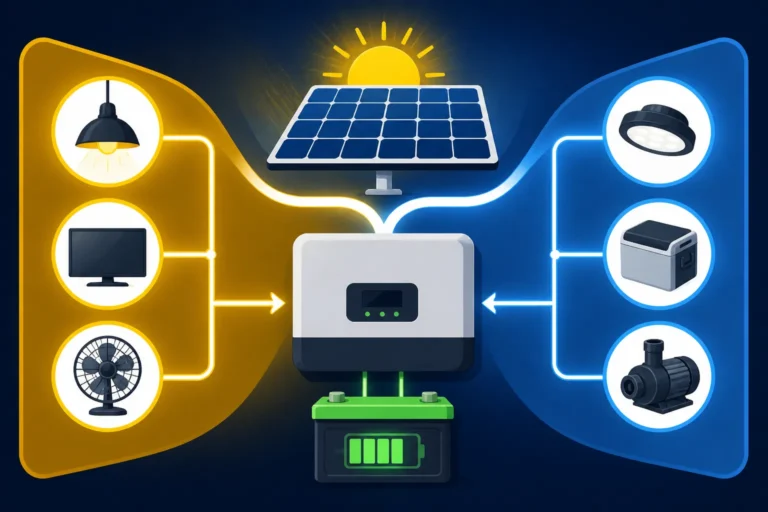
Your batteries are just one part of the equation. They need companions to function effectively and safely within your off-grid solar system. The charge controller and inverter are paramount, and their specifications must align perfectly with your battery bank and overall energy needs.
Matching Your Charge Controller to Battery and Solar Array
The charge controller is the brain that manages the flow of electricity from your solar panels to your batteries. Its primary job is to protect your batteries from overcharging, which can severely damage them, and to optimize the charging process. There are two main types: PWM (Pulse Width Modulation) and MPPT (Maximum Power Point Tracking).
- PWM Controllers: These are simpler and less expensive, essentially regulating the voltage from the panels down to match the battery voltage. They are best suited for smaller systems where the cost of the controller is a significant factor, and the voltage difference between panels and batteries isn't large. However, they are less efficient, especially in colder weather or when panel voltage is significantly higher than battery voltage.
- MPPT Controllers: These are more advanced and significantly more efficient. MPPT controllers constantly track the maximum power point of the solar array, converting excess panel voltage into additional current at the battery voltage. This means they can harvest significantly more power (10-30% more, sometimes even more in certain conditions) from your panels compared to a PWM controller, making them almost a necessity for larger, more efficient systems.
When sizing your charge controller, you need to consider the total wattage of your solar array and your battery bank's voltage. The controller must be able to handle the maximum current that your solar panels can produce. For instance, if you have 1000 watts of solar panels and a 48V system, an MPPT controller would be ideal. It's also vital to ensure the charge controller is compatible with your chosen battery chemistry (LiFePO4, AGM, etc.) as different battery types require specific charging profiles. Many modern controllers from brands like Victron Energy or Renogy come with programmable settings for various battery types. Neglecting to match these components correctly can lead to inefficient charging, reduced battery life, or even system failure.
Selecting an Inverter That Meets Your Load Demands
The inverter is what converts the DC (Direct Current) power stored in your batteries into usable AC (Alternating Current) power for your standard household appliances. Without an inverter, you'd be limited to only DC-powered devices. Selecting the right inverter is critical, as it must be able to handle both your continuous power demands and the high surge demands of certain appliances.
You need to know the total running wattage of all the AC appliances you might run simultaneously. This is your continuous inverter rating. Then, identify the appliance with the highest starting wattage (surge wattage), like a refrigerator, microwave, or well pump. This momentary surge can be 2-5 times its running wattage. Your inverter must have a surge capacity that can handle this highest peak. For example, a refrigerator might run at 150 watts but surge to 800-1200 watts for a split second when the compressor kicks on. A good inverter will have a continuous rating that exceeds your average simultaneous load and a surge rating that covers your biggest surge load.
Always opt for a "pure sine wave" inverter for off-grid systems. Modified sine wave inverters are cheaper but can damage sensitive electronics (computers, TVs) and run motors less efficiently, often causing them to heat up. Inverters also have an efficiency rating; a higher efficiency means less power is wasted during conversion. Ensure your inverter's input voltage matches your battery bank's voltage (e.g., a 48V inverter for a 48V battery bank). Choosing the correct inverter ensures your appliances run smoothly and your system isn't constantly stressed, which is a key part of designing a Reliable Off-Grid System.
Budgeting and Future Expansion
Building an off-grid solar system, especially a robust one, is a significant investment. It's essential to approach it with a clear budget in mind, but also with an eye towards the future. Planning for potential expansion from the outset can save you headaches and money down the line.
Understanding the Cost of an Off-Grid Battery Bank
The cost of your battery bank will likely be the single most expensive component of your off-grid solar system. Prices vary widely based on chemistry, brand, and capacity. As a general ballpark, expect to spend anywhere from $1,000 to $5,000 for a medium-sized LiFePO4 battery bank, and potentially $5,000 to $20,000+ for a whole-home system with substantial autonomy. Lead-acid batteries might be 30-50% cheaper upfront, but remember their shorter lifespan means you'll replace them more often, increasing the Cost to Replace Off-Grid Solar Batteries over the system's lifetime.
When budgeting, don't just look at the dollar amount per Ah. Consider the usable Ah, the cycle life, and the warranty. A more expensive battery with a longer life and higher usable capacity often represents better value in the long run. Also, factor in shipping costs, especially for heavy lead-acid batteries, and any ancillary items like battery boxes, ventilation, or specialized wiring. Websites like Amazon offer a range of batteries, but for larger investments, it's wise to consult with specialized solar suppliers.
It's also worth noting that battery technology is constantly evolving, with prices generally trending downwards while performance improves. While LiFePO4 batteries are more expensive today, their value proposition is strong. For those on a very tight budget, phasing your off-grid build or starting with a smaller, expandable lead-acid system might be an option, with plans to upgrade to lithium later. Our article on How to Budget for an Off-Grid Solar System provides more financial planning tips.
Designing for Future System Growth
One of the most common regrets among off-gridders is not designing for expansion from the beginning. Your energy needs might increase over time as you add new appliances, your family grows, or your lifestyle changes. Perhaps you initially power a few lights and charge devices, but later want to add a mini-split AC or a washing machine. Retrofitting a system to accommodate significant growth can be more complex and costly than planning ahead.
When choosing your inverter and charge controller, consider buying models that are slightly oversized for your initial needs but can handle future additions. For instance, if you project needing 2000W continuously, consider an inverter with a 3000W or 4000W continuous rating. The same applies to your charge controller; choose one that can handle more solar input than you currently plan to install. This allows you to add more solar panels and batteries later without having to replace core components.
For battery banks, it's generally best to add identical batteries to an existing bank, especially for LiFePO4. Mixing old and new batteries, or different chemistries/capacities, can lead to imbalances and reduce the lifespan of the entire bank. If you anticipate needing more storage, consider leaving physical space for additional batteries and sizing your wiring to accommodate the increased current. Thinking about scalability upfront is a smart move that protects your investment and ensures your off-grid system can grow with your needs.
Real-World Examples and Practical Scenarios
Let's ground these calculations with some real-world examples. It's often easier to grasp these concepts when applied to tangible scenarios, whether you're powering a small retreat or a full-fledged off-grid homestead. These examples will illustrate how different needs translate into different battery bank sizes.
Sizing for a Small Off-Grid Cabin or RV
Imagine a small, rustic cabin or an RV where you spend weekends. Your energy needs are relatively modest.
- Appliances: A few LED lights (20W total, 4 hours/day), a small 12V refrigerator (50W, runs 8 hours/day), phone charging (10W, 2 hours/day), and a laptop (60W, 2 hours/day).
- Daily Watt-Hour Calculation:
- Lights: 20W * 4h = 80 Wh
- Fridge: 50W * 8h = 400 Wh
- Phone: 10W * 2h = 20 Wh
- Laptop: 60W * 2h = 120 Wh
- Total Daily Usage: 80 + 400 + 20 + 120 = 620 Wh/day
- Add Inefficiencies: Let's add 15% for inefficiencies: 620 Wh * 1.15 = 713 Wh/day (usable).
- System Voltage: For a small cabin/RV, a 12V system is common.
- Required Usable Amp-Hours: 713 Wh / 12V = 59.4 Ah/day.
- Battery Type: Let's go with LiFePO4 (80% DOD) for longevity and less maintenance.
- Total LiFePO4 Capacity (1 day autonomy): 59.4 Ah / 0.80 = 74.25 Ah.
- Total LiFePO4 Capacity (3 days autonomy): 74.25 Ah * 3 days = 222.75 Ah.
For this cabin/RV, a single 100Ah 12V LiFePO4 battery might provide enough power for daily use with a little buffer, but for 3 days of autonomy, you'd be looking at two 100Ah 12V LiFePO4 batteries wired in parallel (giving you 200Ah total), or a single 200Ah 12V battery. This setup would be perfectly adequate for a weekend retreat, allowing you to run essentials comfortably. For more specific guidance on mobile setups, check out How to Size an Off-Grid System for a RV.
Powering a Full-Time Off-Grid Home
Now, consider a full-time off-grid home with more substantial needs, including some higher-draw appliances.
- Appliances: Energy-efficient refrigerator (100W, runs 12 hours/day), LED lighting throughout (100W total, 5 hours/day), TV & entertainment (150W, 4 hours/day), well pump (1000W, 30 min/day = 0.5 hours/day), washing machine (500W, 1 hour, 3 times/week), microwave (1000W, 10 min/day = 0.17 hours/day), charging various devices (50W, 6 hours/day).
- Daily Watt-Hour Calculation (Average):
- Fridge: 100W * 12h = 1200 Wh
- Lights: 100W * 5h = 500 Wh
- TV/Entertainment: 150W * 4h = 600 Wh
- Well Pump: 1000W * 0.5h = 500 Wh
- Washing Machine: (500W * 1h * 3 times/week) / 7 days = 214 Wh/day (average)
- Microwave: 1000W * 0.17h = 170 Wh
- Charging: 50W * 6h = 300 Wh
- Total Daily Usage: 1200 + 500 + 600 + 500 + 214 + 170 + 300 = 3484 Wh/day
- Add Inefficiencies: Let's add 20% for inefficiencies for a larger system: 3484 Wh * 1.20 = 4181 Wh/day (usable).
- System Voltage: For a home, a 48V system is highly recommended.
- Required Usable Amp-Hours: 4181 Wh / 48V = 87.1 Ah/day.
- Battery Type: High-quality LiFePO4 (80% DOD) for long-term reliability.
- Total LiFePO4 Capacity (5 days autonomy): (87.1 Ah / 0.80 DOD) * 5 days = 108.875 Ah * 5 days = 544.375 Ah at 48V.
To achieve roughly 545 Ah at 48V, you'd need a substantial battery bank. For example, if you're using individual 100Ah 12V LiFePO4 batteries, you'd connect four in series to make a 48V string (4 x 12V = 48V, 100Ah). Then, to get approximately 545 Ah, you'd need about 5-6 such strings in parallel (5 strings x 100Ah = 500Ah, 6 strings x 100Ah = 600Ah). So, you'd be looking at 20-24 individual 100Ah 12V LiFePO4 batteries, or fewer, larger 48V batteries like server-rack style units. This is a considerable investment but provides robust power for a full-time residence.
Common Mistakes to Avoid When Sizing Batteries
Navigating the world of off-grid solar can be tricky, and even seasoned enthusiasts can sometimes overlook critical details. When it comes to battery sizing, there are a few common pitfalls that can lead to frustration, premature equipment failure, or simply not having enough power. Being aware of these can save you a lot of grief.
Underestimating Energy Consumption
This is, by far, the most frequent and costly mistake off-gridders make. It's easy to forget about those short, high-draw appliances (like a coffee maker or a toaster) or underestimate how long you'll actually use lights or entertainment systems. People often calculate their "ideal" usage, not their "real-world" usage. The thrill of going off-grid can sometimes overshadow the practical reality of daily power needs.
Forgetting phantom loads is another common oversight. Many modern appliances draw a small amount of power even when turned off, just waiting for a remote signal or keeping a clock lit. These add up 24/7. Not accounting for guest usage or seasonal changes (more fans in summer, more heating in winter if electric) can also leave you short. Always be generous with your estimates and err on the side of slightly oversizing rather than undersizing your battery bank. It's much cheaper to have a little extra capacity from the start than to constantly struggle or have to expand later.
A truly robust load analysis often involves monitoring your actual grid consumption (if coming from grid-tied) for a few weeks or months, or using a watt-meter on individual appliances to get accurate real-world data. It’s boring, I know, but it’s critical. Trust me, the momentary boredom of detailed data collection is far better than the daily anxiety of not having enough power for your essentials.
Ignoring Temperature Effects on Battery Performance
Batteries, especially lead-acid types, are highly sensitive to temperature. Their capacity and lifespan are significantly affected by extreme heat and cold.
- Cold Weather: In freezing temperatures, lead-acid batteries lose a substantial portion of their usable capacity. A 100 Ah lead-acid battery at 0°F (-18°C) might only deliver 50-60% of its rated capacity. LiFePO4 batteries retain more capacity in the cold but cannot be charged below freezing (typically 32°F / 0°C) without risking permanent damage, though many modern LiFePO4 batteries have built-in heaters for cold charging. This means if you live in a cold climate, you need to account for this reduced capacity by oversizing your battery bank, installing heaters, or ensuring your battery enclosure is well-insulated.
- Hot Weather: While less dramatic than cold, excessive heat also reduces battery lifespan. Operating batteries consistently at high temperatures can accelerate degradation, especially for lead-acid batteries where electrolyte evaporation increases. Proper ventilation and shading for outdoor battery banks are crucial.
Many off-gridders in northern climates learn this lesson the hard way in their first winter, realizing their perfectly sized summer battery bank becomes inadequate. When you're planning your battery bank, think about the lowest and highest temperatures your batteries will experience and adjust your calculations accordingly. This might mean investing in a temperature-controlled battery box or choosing a battery chemistry specifically designed for wider temperature ranges. Our article on Off-Grid Solar Cost in Cold Climates delves into this further.
Neglecting Proper Maintenance and Monitoring
Even the best battery bank needs a little love and attention. Neglecting maintenance, especially for lead-acid batteries, will drastically shorten their lifespan and compromise system performance. Flooded lead-acid batteries need regular topping off with distilled water and occasional equalization charges to prevent sulfation and maintain cell balance. AGM and Gel batteries are maintenance-free in terms of water, but they still benefit from proper charging profiles and monitoring.
For all battery types, monitoring is key. A good battery monitor (often a shunt-based system) will give you accurate readings of your state of charge (SOC), voltage, current in/out, and even historical data. Relying solely on voltage can be misleading, especially with LiFePO4 batteries which maintain a flat voltage curve until almost empty. Without an accurate SOC, you risk over-discharging your batteries, which is a fast track to premature failure.
A quality battery monitor allows you to understand your actual consumption, verify your charge controller's performance, and ensure your batteries are operating within healthy parameters. This proactive approach to maintenance and monitoring is an investment in your system's longevity and your peace of mind, ultimately extending the life of your expensive battery bank.
Disclaimer
The information provided in this guide is intended for general informational purposes only and does not constitute professional advice. Off-grid solar system design and installation involve electrical work that can be dangerous if not performed correctly. Always consult with qualified professionals, adhere to local building codes, and prioritize safety when working with electricity and solar equipment.