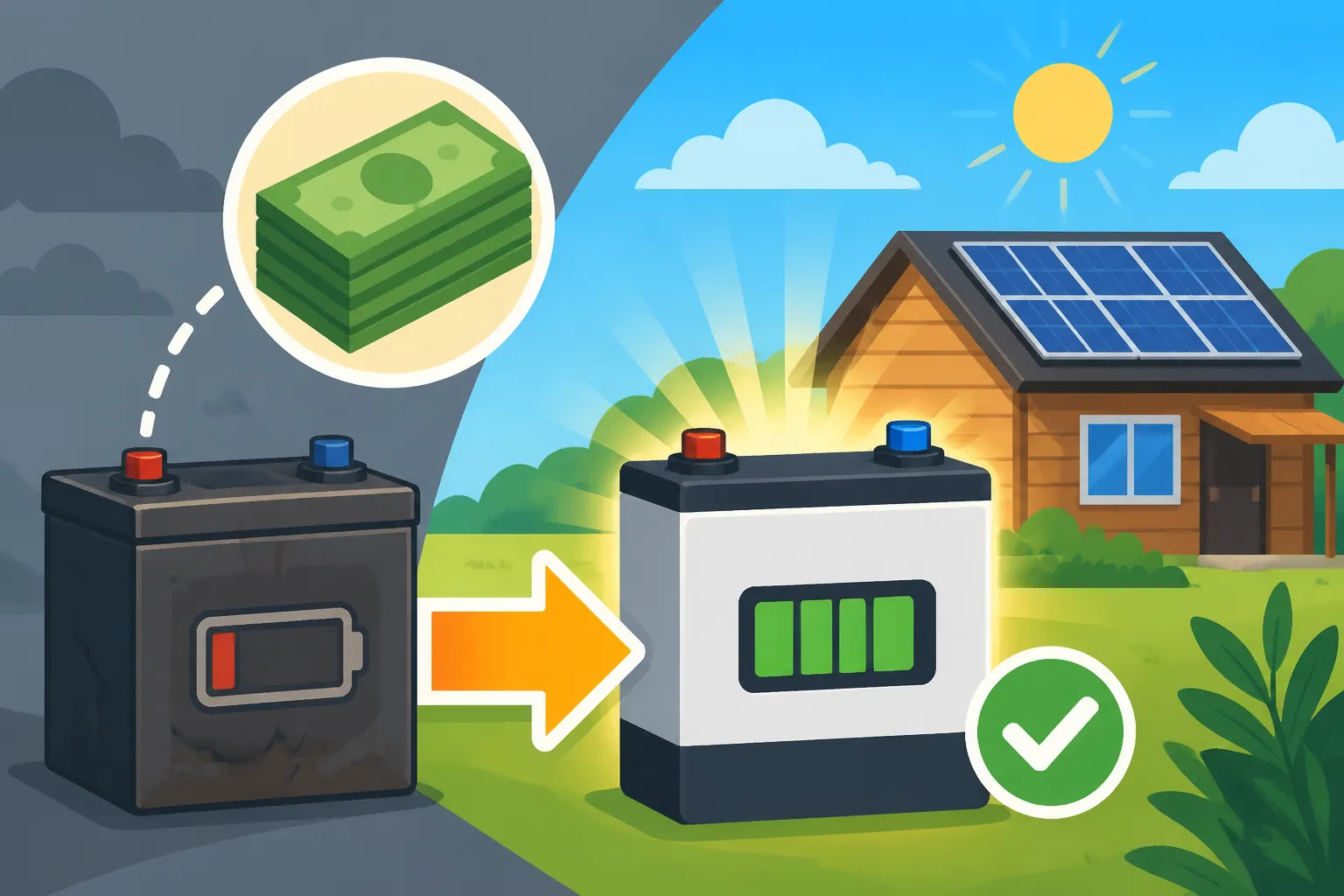
Cost to Replace Off-Grid Solar Batteries
Oh, the joy of off-grid living! There's nothing quite like the feeling of true energy independence, is there? But let's be honest, that initial investment in your solar battery bank can be a real sticker shock, and then the little voice in the back of your head whispers, "What about when these need replacing?" That thought alone can be daunting, bringing up anxieties about future expenses and the longevity of your setup. This guide is here to tackle that head-on, giving you a realistic, comprehensive look at the costs associated with replacing your off-grid solar batteries, breaking down what influences these figures, and how you can prepare for them.
Understanding Battery Lifespan and Why They Need Replacing
The heart of any off-grid solar system is its battery bank. It's what allows you to store the sunshine collected by your panels for use at night or on cloudy days. But just like any hardworking component, batteries don't last forever. They have a finite life, and understanding why and how they degrade is the first step in preparing for their eventual replacement.
The Inevitable Cycle of Battery Degradation
Every time you use energy from your battery bank, and then recharge it with solar power, that counts as a cycle. Batteries are designed to handle a certain number of these charge and discharge cycles before their capacity starts to noticeably diminish. It's a bit like your phone battery – over time, it just doesn't hold a charge as long as it used to.
Several factors contribute to this degradation. One of the biggest culprits is the depth of discharge (DoD). If you consistently drain your batteries deeply, say down to 20% or lower, they'll wear out much faster than if you only discharge them to 50% before recharging. Think of it this way: shallow sips are better than gulping down the whole glass repeatedly. Another major factor is temperature. Batteries generally perform best and last longest when kept at moderate temperatures, typically around 77°F (25°C). Extreme heat accelerates chemical reactions and degradation, while extreme cold reduces performance and can even damage certain battery types if charged incorrectly. Even the rate of charge and discharge can play a role; constantly drawing very high currents or charging too rapidly can stress the battery's internal components.
Expected Lifespans of Common Off-Grid Battery Types
When we talk about off-grid solar, two main battery chemistries typically come to mind: lead-acid and lithium iron phosphate (LiFePO4). Their lifespans vary quite a bit, and this difference is a huge factor in the long-term cost of your system.
- Lead-Acid Batteries (Flooded, AGM, Gel): These are the traditional workhorses of off-grid power, often chosen for their lower upfront cost.
- Flooded Lead-Acid (FLA): With proper maintenance (like regularly checking and topping up electrolyte levels), these can offer a decent lifespan. You might expect around 500-1500 cycles if you consistently maintain them and limit your depth of discharge to around 50%. This usually translates to about 3-7 years in an off-grid application, depending heavily on usage and maintenance.
- Absorbed Glass Mat (AGM) and Gel Batteries: These are sealed, maintenance-free versions of lead-acid. They're more convenient but often come with a slightly higher price tag and a similar or sometimes slightly shorter lifespan than FLAs under heavy cycling, usually 400-1000 cycles, or 2-6 years. They're also more sensitive to overcharging.
- Lithium Iron Phosphate (LiFePO4) Batteries: These are the rising stars in off-grid solar, and for good reason.
- LiFePO4 batteries offer a significantly longer cycle life, typically 2,000 to 7,000 cycles, sometimes even more depending on the manufacturer and specific battery design. This can mean a lifespan of 10-20 years or longer, especially if they're not routinely pushed to their limits. They are also much more tolerant of deep discharges, often allowing for 80-100% DoD without significant immediate damage, though shallower discharges still extend overall life. This extended lifespan is a major reason why many off-gridders are migrating from lead-acid to lithium, despite the higher initial investment. You can learn more about this comparison in our article on LiFePO4 vs Lead-Acid Battery Cost.
Ultimately, while batteries are designed to last, they are consumables within your off-grid system. Proactive maintenance, understanding your usage patterns, and proper system sizing are crucial for maximizing their life. Our guide on Off-Grid Solar Maintenance Costs provides deeper insights into keeping your system in tip-top shape.
Key Factors Influencing Battery Replacement Costs
When that day comes to replace your off-grid solar batteries, the final price tag isn't just about how many you need. Several critical factors will sway the total cost, and understanding these will help you budget effectively for the future.
Battery Chemistry and Technology
This is arguably the most significant factor in determining replacement costs. As we touched on earlier, the choice between lead-acid and lithium iron phosphate (LiFePO4) has profound implications for both the upfront purchase price and the long-term value.
- Lead-Acid (AGM, Gel, Flooded): While individually cheaper to buy, their shorter lifespan means you'll be replacing them more frequently. For example, if a set of lead-acid batteries lasts 5 years and a LiFePO4 bank lasts 15 years, you'll need to buy three sets of lead-acid batteries to match the lifespan of one LiFePO4 bank. This can quickly make the "cheaper" option more expensive over the lifetime of your off-grid system. Additionally, lead-acid batteries are less efficient, meaning more energy is lost during charging and discharging, which might subtly affect your overall system performance and require slightly more solar panels or a larger generator backup to compensate.
- Lithium Iron Phosphate (LiFePO4): These batteries have a higher initial cost per unit of storage, often 2-4 times that of comparable lead-acid batteries. However, their superior cycle life (often 4-10 times longer) and higher efficiency (up to 99% vs. 80-85% for lead-acid) translate into a much lower cost per cycle and a lower total cost of ownership over the long run. They also don't suffer from voltage sag as much, providing more consistent power until they're nearly depleted. When you're thinking about the Cost of an Off-Grid Solar Battery Bank, it's vital to consider these long-term factors.
System Size and Capacity Requirements
The more energy you use daily, the larger your battery bank needs to be, and naturally, the more it will cost to replace. This directly relates to your daily energy consumption (measured in Watt-hours or kilowatt-hours) and how many "days of autonomy" you want your system to provide. Days of autonomy refer to how long your batteries can power your home without any new charge coming in from your solar panels, which is critical during extended cloudy periods.
A small cabin running only lights and a few electronics might need a 5-10 kWh battery bank, while a full-time off-grid home with a refrigerator, well pump, and air conditioning could easily require a 20-50 kWh or even larger bank. Doubling your desired battery capacity doesn't just double the battery cost; it can also affect the need for heavier-gauge wiring, larger battery enclosures, and potentially more robust charge controllers and inverters to handle the increased power flow. Calculating How to Size an Off-Grid Battery Bank accurately is paramount to managing both initial and replacement costs.
Brand, Quality, and Warranty
Just like buying a car, not all batteries are created equal, and brand reputation often correlates with quality and reliability. There's a wide spectrum of options out there, from budget-friendly imports to premium, high-performance units.
- Premium Brands: Companies like Victron Energy, Battle Born, and EG4 are known for their robust, high-quality LiFePO4 batteries, often backed by impressive warranties (e.g., 10+ years). While their upfront cost is higher, the peace of mind, excellent customer support, and proven longevity can justify the investment, especially when you consider the Lifetime Cost of an Off-Grid Solar System. These brands often feature advanced Battery Management Systems (BMS) that protect against overcharge, over-discharge, and temperature extremes, further extending life.
- Mid-Range and Budget Options: Many reputable brands offer competitive solutions that strike a balance between cost and performance. You can often find a wide array of options on online marketplaces like Amazon, ranging from established names to newer players. While some budget options can be perfectly fine for less demanding applications, it's crucial to research reviews and ensure they offer adequate safety features and a reasonable warranty. A shorter or less comprehensive warranty could mean you're on the hook for replacement costs sooner if a battery fails prematurely.
Installation Complexity and Labor Costs
Unless you're planning a full DIY replacement, labor costs can be a significant addition to the price of new batteries. This cost varies widely depending on your location, the complexity of your system, and the expertise required.
- DIY Installation: If you're comfortable with electrical work and can safely manage heavy batteries, a DIY replacement will save you on labor. However, remember that handling heavy lead-acid batteries or correctly wiring a complex LiFePO4 system requires knowledge of safety protocols and electrical principles.
- Professional Installation: Hiring a qualified solar installer or electrician ensures the job is done safely and correctly, adhering to all codes and best practices. Factors that increase labor costs include:
- Battery type: Swapping out lead-acid batteries for new ones of the same type is generally straightforward. Upgrading from lead-acid to LiFePO4, however, might require adjustments to your charge controller settings, inverter programming, and potentially new cabling, which adds complexity and time.
- Accessibility: If your battery bank is in a cramped shed, a remote location, or requires heavy lifting with specialized equipment, labor costs will naturally be higher.
- System Size: A larger bank means more batteries to move, connect, and configure.
- Disposal: Professionals can often handle the proper disposal of your old batteries, which is a convenience but might be included in their labor rates or charged separately.
Considering these factors upfront will help you get a clearer picture of your potential Off-Grid Solar Installation Cost for battery replacement.
Breaking Down the Costs: Component by Component
When it comes time to replace your off-grid solar batteries, it's not always just a matter of buying new batteries. There are often other associated costs that can add up, and it's essential to account for these in your budget. Let's look at the breakdown.
The Batteries Themselves
This is, of course, the largest individual expense in a battery replacement project. The cost varies dramatically based on the chemistry, capacity, voltage, and brand.
- Lead-Acid Batteries:
- A single 100Ah 12V AGM battery might cost between $200-$400.
- Larger 200Ah 6V golf cart style FLA batteries, common in many setups, typically range from $150-$250 each.
- For a typical small cabin needing, say, a 400Ah 12V equivalent (which could be two 200Ah 6V in series or four 100Ah 12V in parallel for a 12V system), you might be looking at $600-$1000 for the batteries alone, often needing replacement every 3-7 years.
- Lithium Iron Phosphate (LiFePO4) Batteries:
- A 100Ah 12V LiFePO4 battery generally costs between $300-$1000, with prices continually becoming more competitive. High-end units from reputable brands like Battle Born or Victron will be at the higher end, while many quality options are available for less.
- For the same 400Ah 12V equivalent capacity, you could expect to pay anywhere from $1,200-$4,000 for LiFePO4, but these batteries could last 10-20 years or more.
- It's worth noting that bulk purchasing, especially from online retailers like Amazon or specialized solar suppliers, can sometimes lead to slight savings per battery.
Here's a quick comparison of approximate battery costs per kWh of usable energy, keeping in mind usable capacity for lead-acid is typically 50% DoD:
| Battery Type (Usable Capacity) | Typical Cost per kWh (Usable) | Expected Lifespan (Cycles) |
|---|---|---|
| Flooded Lead-Acid | $200 – $400 | 500 – 1500 |
| AGM Lead-Acid | $250 – $500 | 400 – 1000 |
| LiFePO4 (Lithium Iron Phosphate) | $300 – $1000 | 2000 – 7000+ |
Note: Prices are estimates and subject to market fluctuations, brand, and specific features. Usable capacity for lead-acid is calculated at 50% Depth of Discharge; LiFePO4 at 80-100% DoD.
Ancillary Costs: Cables, Connectors, and Monitoring
While the batteries are the main event, don't overlook the smaller components that might need attention during a replacement.
- Cables and Connectors: Battery cables, especially the heavy-gauge ones connecting your batteries to each other and to your inverter/charge controller, are subject to wear and tear. Over time, corrosion can build up, or insulation can degrade. When replacing batteries, it's a good practice to inspect these cables thoroughly. If they show signs of damage or wear, replacing them can add $50-$200 or more, depending on the length and gauge required. If you're upgrading from a 12V to a 48V system, or changing battery types, you might need different cable lengths or even new busbars to handle the new configuration.
- Battery Monitoring Systems: While not always strictly necessary for basic functionality, a good battery monitor is invaluable for extending battery life and understanding your system's health. If you don't have one, or if your old one isn't compatible with new battery chemistry (especially if switching to LiFePO4 with advanced communication protocols), budgeting for a new shunt-based monitor (like those from Victron Energy) is wise. These can cost $150-$400 and provide crucial data on state of charge, voltage, current, and more.
- Fuses and Breakers: Always include robust fusing and circuit breakers in your battery bank wiring for safety. If your system is being reconfigured or upgraded, you might need new fuses or appropriately sized DC breakers, which typically range from $20-$100 each.
- Ventilation and Enclosures: For lead-acid batteries, proper ventilation is critical to vent hydrogen gas. If your enclosure isn't up to par or needs an upgrade, that's another potential cost. LiFePO4 batteries don't off-gas, but still benefit from temperature control, so an updated enclosure or even just a small fan could be considered.
These "small" costs can quickly add up, so it's important to budget for them when planning for a replacement, especially if you're making a significant upgrade.
Disposal Fees for Old Batteries
Disposing of old batteries, especially lead-acid ones, isn't something you can just toss in the trash. They contain hazardous materials and must be recycled properly.
- Lead-Acid Batteries: Most battery retailers will accept old lead-acid batteries for recycling, often for a small fee or even for free if you're purchasing new ones from them. However, if you're doing a standalone disposal or have a large number of old batteries, you might encounter disposal fees, which can range from $5-$20 per battery, depending on local regulations and the recycling center. Many states have programs or regulations that ensure proper recycling.
- LiFePO4 Batteries: While less common to dispose of currently due to their longer lifespan, LiFePO4 batteries also need to be recycled responsibly. Recycling programs for lithium batteries are expanding, but options and costs can vary. Always check with specialized battery recycling centers in your area.
Budgeting for these disposal costs upfront ensures you can manage your old batteries responsibly and avoid any environmental issues or fines down the line.
Strategies to Minimize Replacement Costs and Maximize Value
Replacing off-grid solar batteries is a significant investment, but there are smart ways to approach it that can save you money in the long run and get the most out of your power storage. It's all about planning, maintenance, and making informed decisions.
Proactive Maintenance and System Monitoring
The absolute best way to minimize replacement costs is to make your current batteries last as long as possible. A little bit of TLC goes a long way.
- Regular Checks and Cleaning: For flooded lead-acid batteries, this means regularly checking electrolyte levels and topping them up with distilled water. Keep all battery terminals clean and free of corrosion. Even for sealed AGM, Gel, or LiFePO4 batteries, ensuring terminals are tight and clean helps maintain efficiency and prevents premature failure. A quick wipe-down with a damp cloth and a visual inspection for swelling or damage should be part of your routine.
- Avoid Deep Discharges: This is perhaps the most critical maintenance tip for lead-acid batteries. Consistently discharging them below 50% significantly reduces their lifespan. Set your low voltage disconnects appropriately. While LiFePO4 batteries are more tolerant of deep discharges, regularly running them down to 100% will still shorten their overall life compared to shallower cycles.
- Proper Charging Profiles: Ensure your charge controller and inverter settings are correctly configured for your specific battery chemistry. Overcharging or undercharging can both harm batteries. For example, charging a LiFePO4 battery with lead-acid settings can damage it. A good charge controller, like those from Victron Energy, allows precise customization. Getting your charge controller properly set up is key to maintaining battery health and prolonging life.
- Temperature Management: Keep your batteries in a stable, moderate temperature environment. For outdoor installations in colder climates, consider insulated battery boxes, especially for lead-acid batteries which suffer performance drops and can be damaged if charged below freezing. For hot climates, ensure adequate ventilation to prevent overheating.
By diligently following these practices, you can significantly extend the life of your existing batteries, pushing that replacement date further into the future and saving you money. Remember, proper maintenance is one of the most cost-effective ways to manage your Off-Grid Solar Maintenance Costs.
Smart Upgrades: When to Switch Battery Chemistries
The decision to replace your old lead-acid batteries with new ones or to upgrade to LiFePO4 is a major one with long-term financial implications. While the upfront cost of LiFePO4 is higher, the long-term value often outweighs it.
-
The Case for LiFePO4: If you're currently running lead-acid batteries and they're nearing their end of life, seriously consider making the switch to LiFePO4.
- Lower Lifetime Cost: Despite the higher initial price, the dramatically longer cycle life (2,000 to 7,000+ cycles vs. 500-1500 for lead-acid) means you'll replace them far less frequently. This often results in a lower cost per year or per cycle over the entire lifespan of your off-grid system.
- Higher Efficiency: LiFePO4 batteries are much more efficient (up to 99%) in their charge and discharge cycles, meaning less energy is wasted. This can effectively give you more usable power from your existing solar array and reduce reliance on a backup generator.
- More Usable Capacity: You can safely discharge LiFePO4 batteries much deeper (80-100% DoD) without significantly impacting their lifespan, whereas lead-acid batteries are best kept above 50% DoD. This means a smaller nominal capacity LiFePO4 bank can often provide the same usable energy as a larger lead-acid bank.
- Less Maintenance: LiFePO4 batteries are sealed and maintenance-free, eliminating the need for watering or terminal cleaning.
-
Compatibility Considerations: When upgrading, you'll need to ensure your existing charge controller and inverter are compatible with LiFePO4 charging profiles. Most modern charge controllers (especially MPPT types) offer customizable settings for different battery chemistries. Some older equipment might not, so this could be an additional upgrade cost. However, the long-term savings and performance benefits often justify these associated upgrades. For those researching options, our guide on Best Off-Grid Solar Batteries is a great resource.
Phased Replacement and Expansion Planning
For very large off-grid systems, replacing the entire battery bank all at once can be a monumental expense. In some scenarios, a phased approach might be feasible.
- Phased Replacement: If your system is designed with multiple, independent battery strings or modules, it might be possible to replace sections of the bank at different times. However, this is generally only recommended if you're replacing like-for-like batteries (e.g., old lead-acid with new lead-acid of the exact same type and age) to avoid imbalances that can damage newer batteries. Mixing old and new batteries, or different chemistries, in the same bank without proper isolation is usually a recipe for disaster.
- Designing for Expansion: The best strategy is to plan for expansion from the very beginning. When you first design your system or replace batteries, consider purchasing a battery bank that is modular and allows for easy additions in the future. Many LiFePO4 batteries are designed for parallel connection, making it simpler to add more capacity later without having to replace the entire bank. This allows you to spread out the cost of acquiring more capacity over time. For example, if you know you'll eventually need 20 kWh, you might start with 10 kWh and add another 10 kWh a few years down the line, rather than trying to pay for it all upfront. Understanding How to Budget for an Off-Grid Solar System includes foresight for these future expenses.
By being proactive with maintenance, strategically upgrading when necessary, and planning for modular expansion, you can significantly mitigate the financial impact of battery replacement and enjoy reliable power for years to come.
Real-World Scenarios and Budgeting for Your Next Battery Bank
Let's ground this discussion in some real-world examples to give you a clearer picture of what battery replacement costs might look like for different off-grid setups. Budgeting for this isn't just about saving money; it's about ensuring your independence is sustainable.
Small Cabin or RV System
Imagine you have a small off-grid cabin used primarily on weekends, or perhaps an RV that you live in part-time. Your energy needs are modest: running some LED lights, charging phones and laptops, a small DC refrigerator, and maybe a water pump for a few minutes a day.
- Original Setup: You might have started with a simple 200Ah 12V system, perhaps using two 100Ah AGM batteries. These likely cost you around $400-$800 initially and have served you well for 3-5 years.
- Replacement Scenario 1: Sticking with AGM: If you decide to stick with AGM, you'd likely purchase two new 100Ah 12V AGM batteries. The cost would be similar, perhaps $400-$800, plus any small ancillary costs for new cables or fuses, and disposal fees for the old batteries. The total could be around $500-$900. You'd expect to repeat this every 3-5 years.
- Replacement Scenario 2: Upgrading to LiFePO4: This is a popular move for small systems. A single 200Ah 12V LiFePO4 battery (or two 100Ah units) would provide equivalent or even greater usable capacity than your old AGM bank, last much longer, and perform more efficiently. A quality 200Ah 12V LiFePO4 battery can cost anywhere from $800-$1500. While the upfront cost is higher, you're looking at a 10-15+ year lifespan. If your charge controller can handle the LiFePO4 profile, you might just need the new battery and minimal wiring changes. For portable power needs, some people even opt for integrated solutions like a Jackery Explorer 1000 or similar portable power station as their "battery bank" for very small applications, which makes replacement as simple as buying a new unit.
- Total estimated replacement cost (small system):
- Lead-Acid: $500 – $900 every 3-5 years.
- LiFePO4: $800 – $1,800 every 10-15+ years (potentially with minor charge controller adjustments).
Whole Home Off-Grid System
Now, let's consider a full-time off-grid homestead with higher energy demands: a full-sized refrigerator, well pump, washing machine, various electronics, and possibly a mini-split AC unit or electric water heater for supplementary use.
-
Original Setup: A robust system might have started with a 48V battery bank, potentially using eight 200Ah 6V flooded lead-acid batteries, totaling around 19.2 kWh nominal (9.6 kWh usable). This initial setup might have cost $1,200-$2,000 for the batteries alone, with an expected lifespan of 5-7 years with diligent maintenance.
-
Replacement Scenario 1: Sticking with Lead-Acid: Replacing this entire bank with new FLA or AGM batteries would likely cost $1,500-$2,500 for the batteries. Add in labor for removal, installation, electrolyte top-offs if FLA, and disposal, and you could easily be looking at $2,000-$4,000 every 5-7 years.
-
Replacement Scenario 2: Upgrading to LiFePO4: This is where the long-term benefits of lithium shine. To get equivalent usable capacity, you might look at a 48V LiFePO4 bank around 10-15 kWh. High-quality server rack style LiFePO4 batteries or individual large capacity cells can range from $500-$800 per kWh. For a 10-15 kWh usable LiFePO4 bank, you're likely facing an upfront cost of $5,000-$12,000 for the batteries. However, this investment could last 15-20 years. Installation costs might be higher if there are inverter or charge controller upgrades needed, but the vastly longer lifespan makes the long-term cost much more favorable.
-
Total estimated replacement cost (whole home system):
- Lead-Acid: $2,000 – $4,000 every 5-7 years.
- LiFePO4: $5,000 – $15,000 every 15-20+ years (likely with some system upgrades).
Creating a Battery Replacement Fund
Given these substantial costs, it's clear that budgeting for battery replacement isn't an option; it's a necessity for sustainable off-grid living. Treat your battery bank like any other major appliance or vehicle – something that will need replacement at predictable intervals.
- Calculate Annual Contributions: Once you've determined your likely replacement costs and expected lifespan (e.g., $10,000 for LiFePO4 batteries every 15 years), you can easily calculate how much you need to set aside annually. In this example, $10,000 / 15 years = approximately $667 per year. That breaks down to about $55 per month.
- Leverage Savings: Consider that off-grid solar eliminates your electricity bill. The money you save by not paying a utility company can often be redirected into this battery replacement fund. This makes the long-term cost of independence more manageable. For a deeper dive into financial planning, check out How Much to Budget for Off-Grid Batteries.
- Start Early: The sooner you start setting aside funds, the less painful the eventual replacement will be. Even small, consistent contributions can grow into a substantial fund over several years.
By proactively planning and budgeting, the thought of replacing your off-grid solar batteries transforms from a looming financial burden into a manageable, anticipated expense, ensuring your energy independence for decades to come.
Disclaimer
The information provided in this article is for general informational purposes only and does not constitute professional advice. Off-grid solar system design, installation, and maintenance can be complex and involve electrical hazards. Always consult with qualified professionals and adhere to local codes and safety regulations when working with electrical systems. Battery costs, lifespans, and performance figures are estimates and can vary based on brand, quality, usage patterns, environmental conditions, and market fluctuations.