Off-Grid Solar System Components Explained
Embarking on the journey to power your life off the grid can feel like a monumental task, riddled with technical jargon and a bewildering array of equipment choices. It's easy to get overwhelmed by all the different components, wondering how they fit together and which ones are truly essential for a reliable system. This comprehensive guide is designed to demystify the core components of an off-grid solar system, helping you understand each part's role so you can build a robust and dependable power solution tailored to your needs.
Understanding the Core Purpose of Off-Grid Solar
The dream of going off-grid often starts with a desire for independence, resilience, and a closer connection to sustainable living. But what does "off-grid" truly mean in the context of electricity, and why are certain components absolutely critical to achieving that freedom? It's more than just putting up some solar panels; it's about creating a miniature power plant that can reliably meet your energy demands without a utility company in sight.
Why Go Off-Grid?
For many, the motivation to go off-grid stems from a deep-seated frustration with unreliable grid power, ever-increasing utility bills, or the sheer inaccessibility of traditional electricity in remote locations. Imagine living in a beautiful cabin tucked away in the mountains, miles from the nearest power pole. Extending utility lines could cost tens of thousands of dollars, making solar a far more practical and often more affordable solution in the long run. Or perhaps you're tired of flickering lights during every storm, longing for the peace of mind that comes with knowing your power supply is entirely within your control. This self-sufficiency is a powerful driver, pushing many to learn the ins and outs of solar technology.
It's not just about rural living, either. Van dwellers, RV enthusiasts, and even boat owners are embracing off-grid solar to power their mobile lifestyles, freeing themselves from the constant search for electrical hookups. The initial investment might seem significant, but when you consider the long-term savings on electricity bills, the avoidance of connection fees, and the sheer value of uninterrupted power, the decision often becomes clear. Understanding the fundamental reasons behind your choice will help you prioritize when selecting your system's components.
The Independent Lifestyle
Living off the grid is more than just a power setup; it's a lifestyle choice that emphasizes self-reliance and resourcefulness. When you're solely responsible for generating and managing your own electricity, you develop a much deeper understanding of energy consumption. You learn to conserve, to appreciate sunny days, and to plan for cloudy ones. This shift in mindset naturally leads to more sustainable habits, as every watt saved means less pressure on your solar array and battery bank.
This independence extends beyond just electricity. It often goes hand-in-hand with other self-sufficiency efforts, like rainwater harvesting, composting, and growing your own food. Your off-grid solar system becomes the backbone of this entire operation, providing the energy for everything from your well pump to your refrigerator. It’s a constant dance between generation and consumption, and mastering that dance requires not just good equipment, but also a thoughtful approach to how you use power.
The Heart of the System: Solar Panels
When most people think of solar power, the first image that comes to mind is solar panels. These are the workhorses of your off-grid system, capturing sunlight and converting it into usable electricity. Choosing the right panels involves more than just picking the biggest or cheapest option; it requires understanding different types, efficiencies, and how they will physically integrate into your setup.
Monocrystalline vs Polycrystalline Panels
When you're looking at solar panels, you'll primarily encounter two types: monocrystalline and polycrystalline. Monocrystalline panels are typically darker, often black, and made from a single, high-purity silicon crystal. This uniform structure allows electrons to move more freely, making them more efficient at converting sunlight into electricity. They tend to have higher power outputs for a given footprint and perform slightly better in low-light conditions, which can be a real advantage on those cloudy winter days. However, this higher efficiency and manufacturing process usually translates to a higher price point per watt.
Polycrystalline panels, on the other hand, usually have a blue hue and are made from multiple silicon fragments melted together. This manufacturing method is simpler and less expensive, making polycrystalline panels a more budget-friendly option. While they are slightly less efficient than monocrystalline panels and require a larger footprint to achieve the same power output, their performance is still robust and perfectly adequate for many off-grid applications. For larger installations where space isn't a premium, or for those aiming to keep their initial costs down, polycrystalline panels can be an excellent choice. The key is to weigh the cost-per-watt against the available space for your array.
Panel Efficiency and Wattage
Panel efficiency refers to how much of the sunlight hitting the panel is converted into electricity, typically expressed as a percentage. Modern solar panels range from about 17% to over 22% efficiency. A higher efficiency rating means you'll generate more power from a smaller area, which is crucial if you have limited roof space on your cabin or RV. For instance, a 400W panel with 22% efficiency will be physically smaller than a 400W panel with 18% efficiency.
Wattage, obviously, dictates the power output of an individual panel. You'll find panels ranging from small, portable 100W units (perfect for a small RV or charging a Jackery Solar Generator Review for Off-Grid Use or similar power station) all the way up to large 400W-500W+ panels for full-home systems. The total wattage of your solar array should be sized to meet your daily energy consumption and sufficiently charge your battery bank, even during periods of less-than-ideal sunlight. To figure out how many solar panels for off-grid living, you'll need to do a thorough energy audit, calculating your daily energy usage and factoring in your location's peak sun hours. This initial calculation is paramount to preventing under-sizing, which can lead to constant power shortages and frustration.
Mounting Options
How you mount your panels is just as important as the panels themselves. The goal is to maximize sun exposure throughout the day and year, while also ensuring structural integrity and safety. Roof mounts are common for homes and cabins, providing a secure and often aesthetically pleasing installation. You can choose fixed-tilt mounts, which are set at an optimal angle for year-round sun, or adjustable tilt mounts that allow you to change the angle seasonally to capture more sunlight, especially beneficial in areas with significant seasonal sun path variations.
For RVs and vans, low-profile roof mounts are popular, minimizing wind resistance and maintaining clearance. Flexible solar panels can also be an option for curved surfaces or when weight is a major concern, though they typically have lower efficiencies and shorter lifespans than rigid panels. Ground mounts offer the most flexibility in terms of orientation and tilt angle, allowing you to perfectly align your panels for maximum production, and they're easier to install and maintain. However, they do take up yard space and may require more robust wiring to reach your power center. Whichever method you choose, ensure it's built to withstand local weather conditions, from heavy snow loads to strong winds.
Storing Your Power: The Battery Bank
Solar panels only produce electricity when the sun shines. To have power at night, on cloudy days, or during peak usage times that exceed your panel output, you need a way to store that energy. This is where your battery bank comes in, acting as the reservoir for your off-grid system. It’s arguably the most critical and often the most expensive component.
Lead-Acid Batteries
For decades, lead-acid batteries were the go-to choice for off-grid solar systems, and they still have their place, especially for budget-conscious builders. You'll typically find two main types used in solar applications: flooded lead-acid (FLA) and sealed lead-acid (SLA), which includes AGM (Absorbed Glass Mat) and Gel batteries. FLAs are the traditional option, requiring regular maintenance like checking and refilling water levels. They are generally the cheapest upfront but have a shorter cycle life (how many times they can be charged and discharged) and require proper ventilation due to hydrogen gas emissions during charging.
AGM and Gel batteries are sealed, maintenance-free, and can be installed in a wider range of orientations, making them popular for RVs, vans, and smaller cabins. They also have a lower self-discharge rate than FLAs, meaning they hold a charge longer when not in use. However, they come with a higher upfront cost and are still sensitive to deep discharges, which can significantly shorten their lifespan. Regardless of the type, lead-acid batteries are best kept between 50-80% state of charge to maximize their cycle life, which means you'll need a larger capacity to deliver the same usable energy compared to newer battery chemistries. This is a crucial point when considering the Cost of an Off-Grid Solar Battery Bank.
Lithium Iron Phosphate LiFePO4 Batteries
In recent years, Lithium Iron Phosphate (LiFePO4) batteries have become the gold standard for off-grid solar, despite their higher initial cost. They offer a host of advantages that often outweigh the price difference over their lifespan. LiFePO4 batteries are incredibly efficient, can be discharged much deeper (typically to 80-100% of their capacity) without damaging them, and boast an impressive cycle life—often 10 times or more than lead-acid batteries. This means a smaller LiFePO4 bank can provide the same usable energy as a much larger lead-acid bank, and it will last for many more years, reducing replacement costs.
Furthermore, LiFePO4 batteries are lighter, more compact, and require virtually no maintenance. They also have a much faster charging rate, allowing you to maximize the power captured from your solar panels during short periods of good sun. While the upfront cost for a LiFePO4 vs Lead-Acid Battery Cost comparison often shows lithium as more expensive, their long-term value, superior performance, and peace of mind make them a worthwhile investment for most serious off-grid setups. Brands like Battle Born and EG4 have become synonymous with reliable LiFePO4 options for off-grid systems, offering durable solutions that can withstand the rigors of independent living.
Battery Sizing and Maintenance
Properly sizing your battery bank is one of the most critical steps in designing a reliable off-grid system. You need enough capacity to power your loads for a certain number of "days of autonomy"—meaning how long your system can run without any solar input (e.g., during prolonged cloudy weather). This calculation directly impacts your comfort and reliability. Start by accurately determining your daily energy usage in watt-hours. Then, factor in your desired days of autonomy and the usable depth of discharge for your chosen battery chemistry. For example, if you need 5,000 Wh per day and want 3 days of autonomy with lead-acid batteries (50% usable DoD), you'd need a bank with 30,000 Wh total capacity (5,000 Wh * 3 days / 0.50). For LiFePO4 (80% usable DoD), it would be 18,750 Wh total capacity. This is a key part of How to Size an Off-Grid Battery Bank.
Maintenance, while minimal for LiFePO4, is crucial for lead-acid batteries. Regularly check water levels in flooded lead-acid batteries and keep terminals clean and corrosion-free. Regardless of battery type, ensure your battery bank is housed in a well-ventilated area, protected from extreme temperatures. Cold weather can drastically reduce battery performance and capacity, while excessive heat can shorten lifespan. Installing a quality battery monitor is essential to keep tabs on your state of charge, voltage, and current flow, giving you crucial insights into your system's health and helping you avoid damaging deep discharges.
Managing the Flow: Charge Controllers
Once your solar panels are generating electricity, it doesn't simply flow directly into your batteries. That energy needs to be managed and regulated by a charge controller. This device acts as the "brain" between your solar array and your battery bank, ensuring your batteries are charged efficiently and safely, preventing overcharging which can severely damage or even destroy your expensive batteries.
PWM Charge Controllers
PWM, or Pulse Width Modulation, charge controllers are the simpler and generally more affordable option. They work by connecting the solar array directly to the battery, allowing the battery's voltage to dictate the panel's operating voltage. When the battery is low, the PWM controller allows maximum current to flow. As the battery gets closer to full, it rapidly switches the current on and off (pulse width modulation) to slowly taper the charge, preventing overcharging.
While PWM controllers are robust and cost-effective for smaller systems, especially those with 12V panels charging a 12V battery bank, they have a significant limitation: they are less efficient at converting power. If your solar panels have a much higher voltage than your battery bank (e.g., a 24V or 36V panel charging a 12V battery), a PWM controller will simply "clip" the excess voltage, wasting a good portion of the potential power. This makes them less ideal for larger systems or when you're trying to maximize every watt from your panels.
MPPT Charge Controllers
MPPT, or Maximum Power Point Tracking, charge controllers are the advanced solution and are highly recommended for most modern off-grid systems. These controllers are much more sophisticated than PWMs, constantly monitoring both the solar panel and battery voltages to find the "maximum power point" where the panels can produce the most electricity. They then convert any excess voltage from the panels into additional current at the battery's voltage, significantly improving efficiency—often by 15-30% or even more in certain conditions, especially with higher voltage panels or in colder temperatures.
This ability to efficiently convert voltage makes MPPT controllers perfect for situations where your panel array has a much higher voltage than your battery bank, or when you're connecting multiple panels in series. This often allows for smaller gauge wiring between the panels and the controller, reducing voltage drop over longer distances. While MPPT controllers come with a higher price tag, the increased energy harvest and superior charging capabilities often pay for themselves over time, especially in systems where maximizing power generation is crucial for reliability.
Choosing the Right Controller for Your System
Deciding between a PWM and MPPT charge controller boils down to a few key factors: system size, budget, and desired efficiency. For small, simple setups like a single 100W panel charging a 12V battery for occasional use in a shed or for a basic Off-Grid Solar Cost for a Rv, a PWM controller might suffice and keep costs down. However, if you're building a larger system for a cabin, tiny home, or full-time RV living, the efficiency gains of an MPPT controller are almost always worth the extra investment. You can read more about MPPT vs PWM Charge Controllers to make a truly informed decision.
An MPPT controller allows for greater flexibility in panel configuration, letting you string panels in series to achieve higher voltages, which can simplify wiring and reduce power loss over distance. When selecting an MPPT controller, ensure its maximum input voltage and current ratings exceed what your solar array can produce, especially on cold, clear days when panel voltage can be higher than rated. Investing in a high-quality MPPT controller from reputable brands like Victron Energy or MidNite Solar can significantly improve your system's overall performance and longevity, ensuring your batteries are always optimally charged.
Converting Power: The Inverter
Your solar panels and battery bank typically operate on direct current (DC) power. While some small appliances and lighting fixtures can run directly on DC, most common household electronics and larger appliances (like refrigerators, microwaves, and power tools) require alternating current (AC) power, just like what comes out of wall outlets in a grid-tied home. This is where the inverter steps in—it converts the DC power stored in your batteries into usable AC power for your devices.
Pure Sine Wave vs Modified Sine Wave Inverters
The quality of the AC power produced by an inverter is critical. You'll primarily encounter two types: modified sine wave and pure sine wave. Modified sine wave inverters are generally less expensive and produce a "choppier" AC waveform that looks like a stepped square wave rather than a smooth curve. While they can power basic devices like lights or resistive loads (heaters, toasters), they can cause issues with sensitive electronics, motors, and appliances with built-in microprocessors. Using a modified sine wave inverter with these devices can lead to buzzing noises, inefficient operation, overheating, and even premature failure of the appliance.
Pure sine wave inverters, on the other hand, produce a clean, smooth AC waveform that is identical to or even better than the power you get from the utility grid. This makes them compatible with virtually all AC devices, including sensitive electronics like laptops, medical equipment (like CPAP machines), and appliances with induction motors (refrigerators, pumps, washing machines). For any serious off-grid setup, especially one powering a home or even a well-equipped RV, a pure sine wave inverter is an absolute necessity to ensure the safe and efficient operation of your appliances and to avoid costly damage. Delve deeper into the topic of Pure Sine Wave vs Modified Sine Wave Inverters to understand the nuances.
Inverter Sizing and Features
Sizing your inverter correctly is crucial. You need to consider both the continuous power output (the maximum power it can supply constantly) and the surge power rating (the short burst of power it can provide to start up motors or compressors). Many appliances, especially refrigerators, pumps, and power tools, have a high "starting wattage" or surge requirement that is several times their running wattage. Your inverter must be able to handle this momentary surge without shutting down. You'll need to know How to Calculate Daily Energy Usage for each of your appliances, paying close attention to these surge requirements.
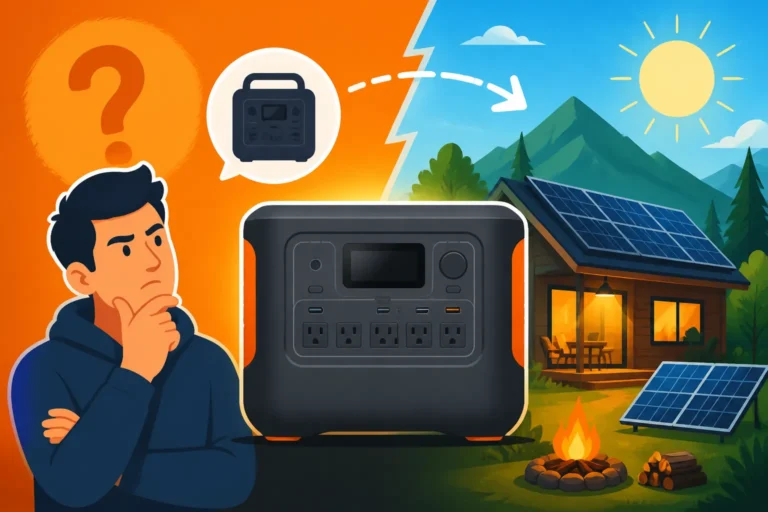
Beyond sizing, look for features that enhance reliability and usability. Remote monitoring capabilities, often via Bluetooth or Wi-Fi, allow you to check your system's status from your phone or computer. Integrated transfer switches are useful if you plan to have a backup generator. Some inverters also offer programmable settings, allowing you to fine-tune voltage, frequency, and charging parameters for your specific battery type. Brands like Victron, Sol-Ark, and Schneider Electric offer robust, feature-rich inverters designed for demanding off-grid applications. Even smaller, portable power stations like those from Jackery often have built-in pure sine wave inverters, making them great for smaller, mobile off-grid needs.
Inverter Chargers and All-in-One Units
For more complex or robust off-grid systems, you might consider an inverter charger. As the name suggests, this unit combines the functions of an inverter (converting DC to AC) and a battery charger (converting AC from a generator or grid connection back to DC to charge your batteries). This integrated design simplifies wiring and management, creating a more cohesive system. If you plan to use a backup generator, an inverter charger can automatically manage the charging process, seamlessly switching between inverter operation and charging modes.
Even more integrated are "all-in-one" hybrid inverter chargers. These units combine the solar charge controller, inverter, and sometimes an AC transfer switch into a single box. This greatly simplifies installation, reduces component count, and often offers advanced monitoring and energy management features. For example, some models can prioritize solar power, use generator power when batteries are low, or even intelligently manage excess solar to power AC loads directly. While they can be a significant upfront investment, these all-in-one units from companies like Sol-Ark or Growatt simplify system design and offer a high level of sophistication for comprehensive off-grid living.
The Often-Overlooked Essentials: Wiring, Fusing, and Safety
It's easy to get excited about panels and batteries, but the unsung heroes of any reliable off-grid system are the wires, connectors, fuses, and breakers. These components are critical for safe and efficient power transfer, protecting your expensive equipment from damage and, more importantly, protecting you from electrical hazards. Skimping on these details is a recipe for disaster.
Cabling and Connectors
Imagine trying to run water through a straw to fill a swimming pool—it would be incredibly slow and inefficient. The same principle applies to electrical wiring. Undersized cables can lead to excessive voltage drop, meaning power is lost as heat along the wire, reducing the overall efficiency of your system. Even worse, undersized wires can overheat, posing a serious fire risk. You need to properly size your wires based on the current they will carry and the distance over which they will run. DC circuits from your panels to your charge controller and from your batteries to your inverter typically carry higher currents than AC household wiring, requiring larger gauge wires.
For solar panels, MC4 connectors are the industry standard, providing a weather-tight, secure connection. Always use high-quality, UV-resistant solar cable (PV wire) for outdoor runs, as it's designed to withstand harsh environmental conditions. For battery connections, thick, flexible welding cable or dedicated battery cable with properly crimped and sealed lugs is essential. Poorly made connections can lead to resistance, heat, and power loss. Taking the time to properly size and secure your wiring is foundational to a safe and efficient off-grid system. The details are crucial for How to Wire an Off-Grid Solar System correctly.
Fuses, Breakers, and Disconnects
Electrical protection devices are non-negotiable in any off-grid solar system. Fuses and circuit breakers are designed to protect wires and components from overcurrents, which can occur due to short circuits or equipment malfunctions. Think of them as sacrificial components—they fail (blow a fuse or trip a breaker) before more expensive components or wiring are damaged. You'll need fuses or breakers on your solar array (often in a combiner box), between your charge controller and batteries, and between your batteries and inverter.
Additionally, manual disconnect switches are vital safety components. A PV (photovoltaic) disconnect allows you to completely shut off the power from your solar panels, which is essential for maintenance, troubleshooting, or in case of an emergency. A battery disconnect switch allows you to isolate your battery bank, again critical for safe servicing or if you need to completely power down your system. These components provide crucial layers of safety, allowing you to isolate different parts of your system when necessary and protecting against unexpected power surges or faults.
Grounding and System Protection
Proper grounding is not just a recommendation; it's a critical safety requirement for any electrical system, off-grid included. Grounding provides a safe path for fault currents to dissipate into the earth, preventing dangerous voltage buildup on metallic enclosures and reducing the risk of electric shock. All metallic components of your solar array, mounting racks, inverter chassis, and battery enclosures should be properly bonded and connected to a common grounding point, which is then connected to a ground rod driven into the earth.
Beyond electrical grounding, surge protection devices (SPDs) can be installed on both the DC side (between panels and charge controller) and AC side (on your inverter's output) to protect your electronics from lightning strikes or other high-voltage transients. While SPDs can't prevent a direct lightning hit, they can help mitigate damage from nearby strikes. Adhering to relevant electrical codes and best practices for Off-Grid Solar Safety and Grounding is paramount, not only for the longevity of your equipment but, more importantly, for the safety of anyone interacting with your system.
Monitoring and Beyond: System Accessories
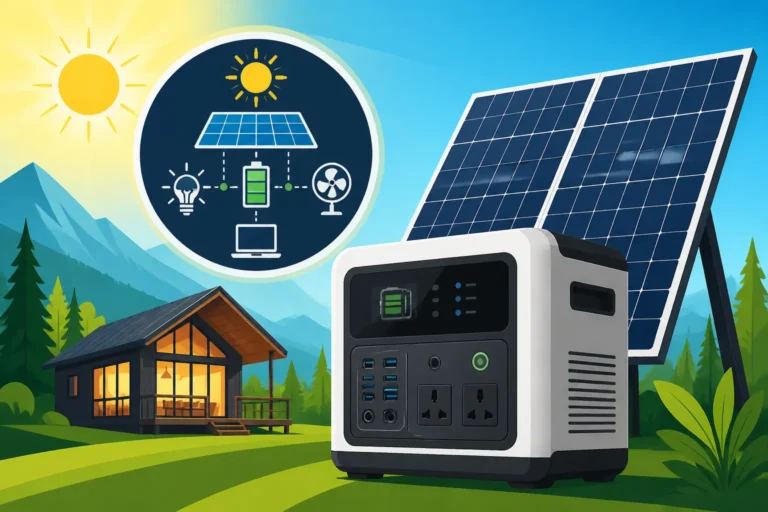
While solar panels, batteries, charge controllers, and inverters form the core of your off-grid system, there are several accessories that significantly enhance its functionality, efficiency, and your overall peace of mind. These aren't just luxuries; they provide crucial insights and backup capabilities that can make or break your off-grid experience.
Battery Monitors
A battery monitor is arguably the most important accessory you can add to your off-grid setup, especially if you're serious about protecting your battery investment. Unlike simple voltage meters, a good battery monitor (often utilizing a shunt) provides precise data on your battery's state of charge (SoC), incoming and outgoing current, cumulative amp-hours consumed, and even estimated time remaining until empty. This level of detail is invaluable for managing your power consumption effectively.
Knowing your battery's true SoC helps you avoid damaging deep discharges, which can drastically shorten the lifespan of any battery, especially lead-acid types. It also allows you to optimize your energy usage, knowing exactly how much power you have left and when you need to conserve. Brands like Victron Energy offer highly accurate battery monitors with Bluetooth connectivity, allowing you to track your battery health and performance right from your smartphone, which is incredibly convenient for a remote cabin or an RV.
System Monitoring Software
For larger, more sophisticated off-grid systems, comprehensive system monitoring software takes oversight to the next level. Many modern inverters and charge controllers from manufacturers like Sol-Ark, Victron, or Schneider Electric come with integrated Wi-Fi or Ethernet connectivity, allowing them to report real-time data to a cloud-based platform or a local server. This software can track solar production, battery performance, energy consumption, and even generator run times.
The benefits are immense: you can identify trends, troubleshoot issues remotely, and optimize your system's performance over time. Imagine getting an alert on your phone if your battery bank is unexpectedly low, or being able to analyze historical data to understand your energy patterns. This proactive management capability ensures your system runs smoothly and allows you to make informed decisions about your energy usage and potential system expansions, offering a level of control and insight that was once only available to large industrial facilities.
Backup Generators
Even the most meticulously designed off-grid solar system can face challenges, especially during extended periods of cloudy weather, heavy snow, or unexpectedly high power demands. This is where a backup generator becomes an invaluable asset. A generator provides an alternative source of AC power that can directly run your loads or, more commonly, recharge your battery bank when solar production is insufficient. This acts as a critical safety net, ensuring you never run completely out of power.
When choosing a generator, consider fuel type (propane, gasoline, diesel), noise levels, and whether it has an electric start and an automatic transfer switch if you want seamless operation with an inverter charger. A generator can be manually started when needed, or for advanced setups, integrated with your inverter system to automatically kick on when battery levels drop below a certain threshold. Brands like Champion, Generac, or even smaller portable options like those from Jackery (the larger models of solar generators often have AC inputs to be recharged by a traditional generator, or even act as a generator themselves) can provide that crucial backup power, offering peace of mind during those inevitable stretches of bad weather or unusually high consumption. A comprehensive article like Cost of Adding a Generator to Off-Grid Solar can help you budget for this important component.
Assembling Your Off-Grid System: DIY vs. Kits
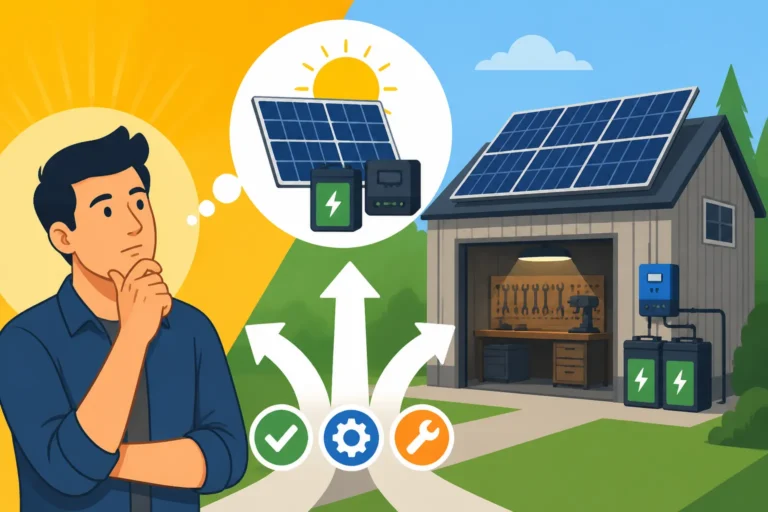
Once you understand all the individual components, the next big question is often: how do I put it all together? There are generally two paths: designing and building a DIY system from individual components or purchasing an off-grid solar kit. Each approach has its own merits and challenges, catering to different skill levels, budgets, and desires for customization.
The DIY Approach: Freedom and Learning
Building an off-grid solar system yourself, sourcing individual components, and wiring everything up offers unparalleled freedom and a deep understanding of your power setup. This path allows for complete customization, enabling you to select the absolute best components for each part of your system—the most efficient panels, the most robust batteries, and the most feature-rich inverter. If you have specific, unusual power needs or a unique installation location, DIY is often the best way to ensure everything is perfectly tailored. This also provides a profound learning experience; you'll understand every wire and connection, making troubleshooting and future expansion much easier.
However, the DIY route demands time, research, and a certain level of technical aptitude. You'll need to accurately calculate your energy needs, size each component correctly, design safe wiring schematics, and ensure everything complies with electrical codes (even if you're off-grid, local codes may still apply for safety). While the DIY vs Professional Off-Grid Solar Cost can be significantly lower, especially on labor, the potential for costly mistakes or safety hazards is higher if you're not meticulous. Resources like "Designing an Off-Grid Solar System Step by Step" can be invaluable guides, but ultimately, the responsibility for system integrity rests squarely on your shoulders.
Convenience of Off-Grid Solar Kits
For those who are less comfortable with electrical design or simply prefer a more straightforward approach, off-grid solar kits offer a compelling alternative. These kits typically come with pre-selected and pre-matched components—panels, charge controller, inverter, and sometimes batteries—that are designed to work together seamlessly. This takes a lot of the guesswork out of system design, reducing the complexity and potential for compatibility issues. Many kits also include pre-cut wiring and connectors, further simplifying the installation process.
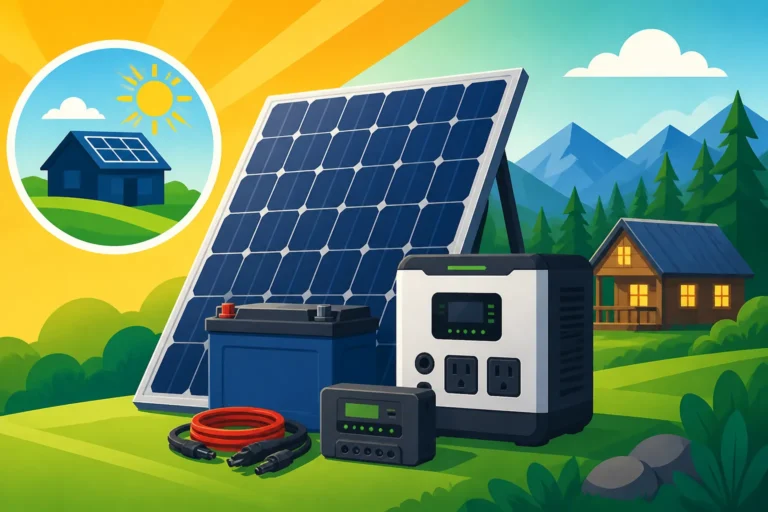
Kits come in various sizes and configurations, from small portable setups suitable for a van or small cabin to larger systems capable of powering a whole home. Brands like Renogy, EcoFlow (with their Power Kits), or even comprehensive bundles around a powerful Jackery power station can provide excellent starting points. While you might sacrifice some customization compared to a DIY build, the convenience and peace of mind that comes with a pre-engineered solution can be well worth it. They are often a great way to start your off-grid journey, and many are designed to be expandable if your needs grow. If you're wondering Off-Grid Solar Kits: What to Buy, you'll find a wide array of options to fit various budgets and power demands.
Making Smart Choices for Your Off-Grid Journey
Embarking on the off-grid solar journey is a significant undertaking, and the choices you make about your system's components will dictate its reliability, efficiency, and ultimately, your satisfaction. It's not about buying the most expensive gear, but rather the right gear for your specific situation.
Prioritizing Your Needs
Before you even start looking at specific components, take a hard look at your actual energy needs and your lifestyle. Are you powering a tiny cabin for weekend getaways, a full-time RV, or a permanent homestead with a family of four? The answer to this question profoundly impacts everything from the size of your solar array to the capacity of your battery bank. Create a detailed list of all appliances and devices you plan to use, noting their wattage and how many hours per day they'll run. This crucial "load analysis" is the foundation for How to Size an Off-Grid Solar System. Don't forget to factor in seasonal variations in sunlight and energy demand. Will you need more power for heating in winter or air conditioning in summer?
Your budget is another critical factor. While it's tempting to opt for the cheapest components, remember that reliability and longevity are paramount in an off-grid setup. A system that constantly fails or requires frequent replacements will end up costing you more in the long run, both financially and in terms of frustration. Prioritize quality for core components like batteries and inverters, as these are the most critical for consistent power. It’s better to start with a smaller, well-built system that meets your essential needs and plan for future expansion than to overspend on an unreliable, oversized system.
Long-Term Considerations and Expandability
Think beyond just your immediate power needs. The beauty of modular solar systems is their expandability. Can your chosen charge controller handle more panels if you decide to increase your solar input later? Can your inverter accommodate an expanded battery bank or additional loads? Investing in components that can grow with your needs can save you significant money and hassle down the road. For instance, choosing an MPPT charge controller with a higher input voltage limit initially might allow you to add more panels in series later without needing a new controller.
Consider the climate you'll be operating in. Extreme temperatures, heavy snow, or high humidity can impact component performance and lifespan. Ensure your panels, batteries, and electronics are rated for your specific environmental conditions. Also, think about maintenance. Some components require more attention than others. LiFePO4 batteries, for example, offer a significant advantage in terms of maintenance-free operation compared to flooded lead-acid. Ultimately, the goal is to design a system that not only meets your current demands but is also robust, adaptable, and easy to maintain for years to come, truly enabling the independent lifestyle you envisioned. The guide on How to Choose an Off-Grid Solar System offers even more nuanced considerations for your long-term success.
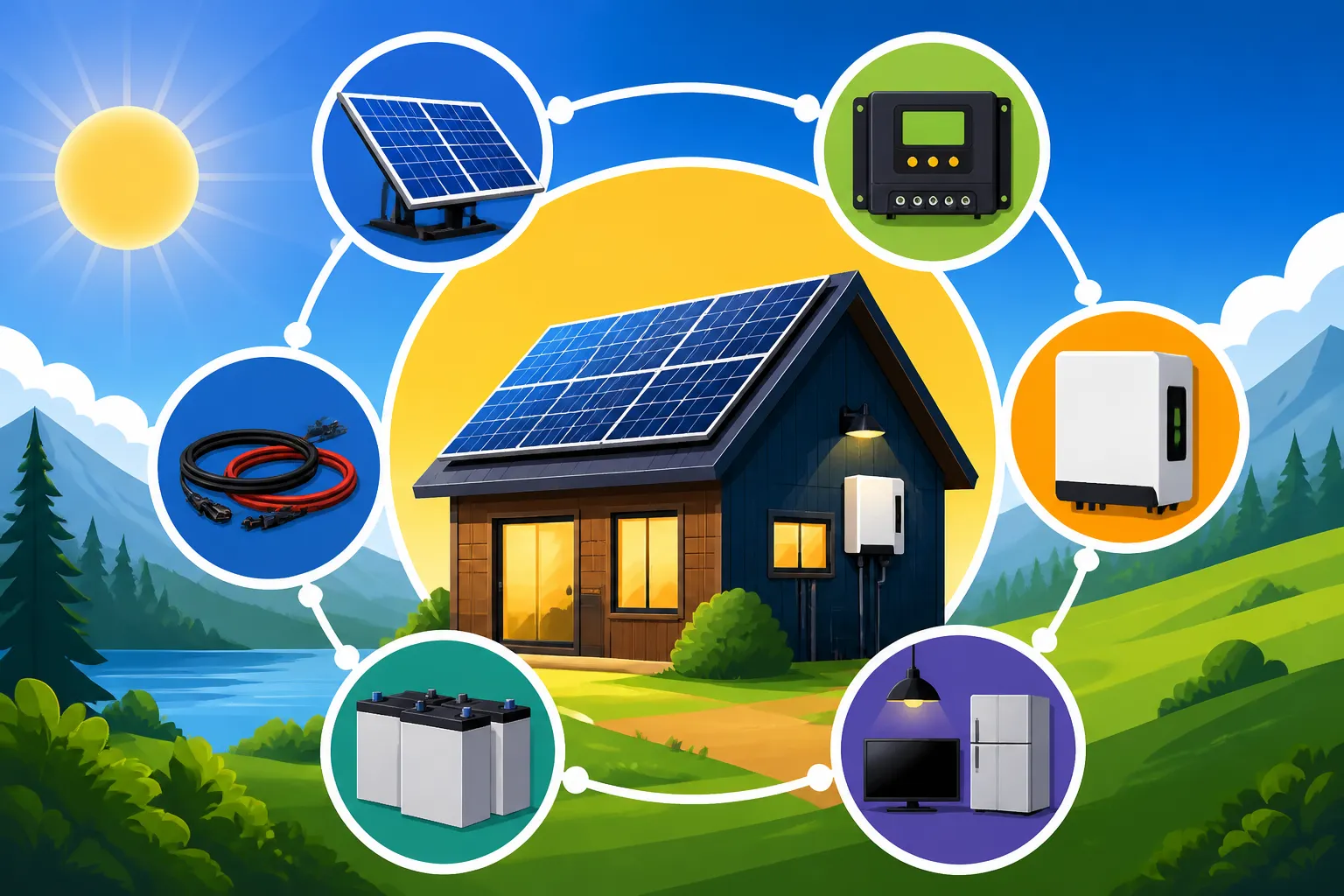
| Component Category | Key Function | Types / Considerations | Essential For? | Cost Impact (Relative) |
|---|---|---|---|---|
| Solar Panels | Convert sunlight into DC electricity | Monocrystalline (efficient), Polycrystalline (cost-effective), Flexible | Generating Power | Medium |
| Battery Bank | Store excess DC electricity for later use | LiFePO4 (long-life, high DoD), Lead-Acid (AGM/FLA – budget, specific DoD/maint.) | Nighttime / Cloudy Day Power | High |
| Charge Controller | Regulate power from panels to batteries | MPPT (efficient, voltage conversion), PWM (simpler, budget-friendly for small systems) | Battery Health & Safety | Low-Medium |
| Inverter | Convert DC battery power to AC for appliances | Pure Sine Wave (universal compatibility), Modified Sine Wave (basic loads only) | Powering AC Appliances | Medium-High |
| Wiring & Cables | Connect all components, transmit electricity | Correct gauge for current/distance, UV-resistant PV wire, battery cables, MC4 conn. | Safe & Efficient Power Flow | Low |
| Fuses & Breakers | Overcurrent protection for components/wiring | DC breakers for PV/battery, AC breakers for inverter output | System & Fire Safety | Low |
| Disconnects | Manual power shut-off for safety/maintenance | PV disconnect, Battery disconnect | System & User Safety | Low |
| Grounding | Protects against electrical shock | Ground rods, bonding wires | Personnel & Equipment Safety | Low |
| Battery Monitor | Tracks battery State of Charge & health | Shunt-based for accuracy, Bluetooth connectivity | Optimizing Battery Lifespan & Usage | Low-Medium |
| Backup Generator | Alternative power source for charging/loads | Gasoline, Propane, Diesel (manual or auto-start) | Emergency / Extended Low Solar Periods | Medium-High |
Disclaimer
The information provided in this guide is for general informational purposes only and does not constitute professional electrical or solar engineering advice. Off-grid solar system design and installation can be complex and involve significant electrical hazards. Always consult with qualified professionals and adhere to all local electrical codes and regulations. Incorrect installation or component selection can lead to equipment damage, fire, injury, or death.