LiFePO4 vs Lead-Acid Batteries for Off-Grid
One of the biggest head-scratchers for anyone venturing into off-grid living is figuring out the right battery solution. It can feel like you're caught between a rock and a hard place, with so much conflicting information out there about what's truly best for powering your home, cabin, or RV. This guide is designed to cut through the confusion, offering a realistic, in-depth comparison of LiFePO4 and lead-acid batteries for your off-grid solar system.
Understanding the Core Components of Off-Grid Battery Banks
When you're looking to achieve true energy independence, your battery bank is essentially the heart of your off-grid solar system. It's what stores all that precious solar energy captured during the day, making it available for you to use whenever you need it – even when the sun goes down or decides to take a few cloudy days off. Without a robust and reliable battery bank, your solar panels are really just fair-weather friends, and that's not what off-grid living is about.
What is a Lead-Acid Battery
Lead-acid batteries are the old guard, the tried-and-true workhorses that have been around for over a century. Think of them as the sturdy, reliable pick-up truck of the battery world – they get the job done, they're generally less expensive up front, and their technology is well understood. In the off-grid world, you'll typically encounter two main types: flooded lead-acid (FLA) and sealed lead-acid (SLA), which includes AGM (Absorbed Glass Mat) and Gel batteries. FLA batteries require regular maintenance, like checking and refilling water levels, while SLA types are "maintenance-free" in that regard, though they still have specific charging requirements.
These batteries work by a chemical reaction between lead plates and sulfuric acid. When you discharge them, lead sulfate builds up on the plates, and when you charge them, this process is reversed. They’ve powered everything from golf carts to uninterruptible power supplies (UPS) and, of course, countless off-grid homes and cabins for decades. Their reliability comes from their proven track record and a relatively simple internal chemistry, making them a common choice for those on a tighter initial budget or looking for familiar technology.
However, their age also means certain limitations compared to newer technologies. They're heavy, sensitive to being deeply discharged, and less efficient at accepting a charge. You'll often see recommendations to only discharge them to 50% of their capacity to maximize their lifespan, which effectively means you need to buy twice the rated capacity to get the usable energy you actually need.
What is a LiFePO4 Battery
Now, let's talk about LiFePO4 batteries, or Lithium Iron Phosphate. These are the newer kids on the block, often seen as the sleek, high-performance electric vehicle of the battery world. They represent a significant leap forward in battery technology, offering a different approach to energy storage that often aligns perfectly with the demands of modern off-grid systems. Unlike lead-acid, LiFePO4 batteries use lithium iron phosphate as the cathode material, providing a stable and safer chemical structure.
The beauty of LiFePO4 batteries lies in their ability to deliver consistent power throughout their discharge cycle, even when they’re nearly empty. They can also be discharged much more deeply – typically to 80% or even 100% – without significant damage, which means their usable capacity is very close to their stated capacity. This is a game-changer for anyone trying to maximize their storage in a compact footprint. Brands like Renogy and others have made significant strides in making these batteries more accessible to the DIY off-grid community, often with built-in battery management systems (BMS) that handle cell balancing and protection.
Their advanced chemistry translates into several key advantages: a much longer lifespan, lighter weight, faster charging capabilities, and virtually no maintenance. While the upfront cost might seem daunting at first glance, the total cost of ownership over their much longer lifespan often makes them a more economical choice in the long run. Many off-grid homeowners are increasingly looking at How Battery Choice Affects Off-Grid Cost when making their decisions.
The Initial Cost Showdown Lead-Acid vs LiFePO4
When you first start pricing out an off-grid solar system, the cost of the battery bank can be a real shocker. It's usually one of the most expensive individual components, and the sticker price alone can make you feel like you need a second mortgage. This is often where the battle between lead-acid and LiFePO4 truly begins in people's minds – that immediate, gut-punch number on the price tag. But, as with many things off-grid, the initial price isn't the whole story.
Upfront Investment for Lead-Acid
Let's be frank: lead-acid batteries are almost always cheaper to buy initially. If you're building a system on a shoestring budget or just need something to get you by for a few years, a set of flooded lead-acid batteries might look incredibly appealing. You can find deep cycle lead-acid batteries at most hardware stores or even automotive supply shops, making them easily accessible. For example, a 100 Ah 12V deep cycle AGM battery might set you back around $200-$300, while a comparable flooded lead-acid battery could be even less.
This lower entry point is a huge draw for many folks, especially those just dipping their toes into off-grid living with a smaller cabin or RV setup. It allows them to allocate more of their initial budget to other critical components, like solar panels or a robust inverter. However, remember that "deep cycle" for lead-acid usually means you can only safely use about 50% of that advertised 100 Ah before you start significantly shortening its life. So, to get 100 Ah of usable capacity, you'd effectively need two of those $200-$300 batteries, bringing your real upfront cost closer to $400-$600 for the same usable energy as a single LiFePO4.
Upfront Investment for LiFePO4
Now, let's talk about LiFePO4. The sticker price for these can make your eyes water at first. A 100 Ah 12V LiFePO4 battery from a reputable brand like Battle Born, or even a more budget-friendly option found on Amazon, might cost anywhere from $500 to $1000 or more, depending on the brand and features (like a low-temperature cutoff). That's a significantly higher number than its lead-acid counterpart right out of the gate.
This higher initial investment is often the biggest barrier for people considering lithium. It requires a larger chunk of capital upfront, which isn't always feasible. However, it's crucial to remember that you're paying for superior technology, longer lifespan, and better performance. When you consider that a LiFePO4 battery can typically be discharged to 80-100% of its capacity, that 100 Ah battery truly gives you almost 100 Ah of usable energy. So, you might need fewer batteries overall, slightly narrowing that initial price gap for usable capacity. Many people diving into Off-Grid Solar Cost: Complete Breakdown quickly realize the battery section is where things get serious.
Considering the True Cost Per Watt-Hour
This is where the real economic comparison comes into play, and it's where the scales often tip in favor of LiFePO4 over the long haul. The "true cost" isn't just what you pay today, but what you pay over the entire useful life of the product. This is often calculated as the cost per usable watt-hour over the battery's lifespan.
For lead-acid, while the upfront cost is low, you get fewer usable cycles. A typical deep cycle lead-acid battery might give you 300-500 cycles if you're diligent about not over-discharging it past 50%. If you push it further, that number drops dramatically. So, if you paid $250 for a 100 Ah 12V battery (1200 Wh total, 600 Wh usable) and got 400 cycles, your cost per usable Wh/cycle is roughly $250 / (600 Wh * 400 cycles) = ~$0.001 per usable Wh per cycle. That's just the battery cost, not including potential replacement costs, maintenance, or efficiency losses.
LiFePO4 batteries, on the other hand, offer thousands of cycles – often 3,000 to 5,000 cycles at 80% depth of discharge. Let's say a 100 Ah 12V LiFePO4 battery costs $700 (1200 Wh total, ~1000 Wh usable) and gives you 4,000 cycles. Your cost per usable Wh/cycle is $700 / (1000 Wh * 4000 cycles) = ~$0.000175 per usable Wh per cycle. As you can see, the cost per usable watt-hour over its lifetime is significantly lower for LiFePO4. This demonstrates why, despite the higher initial outlay, a more detailed analysis often shows that LiFePO4 vs Lead-Acid Battery Cost actually favors lithium over time.
Lifespan and Cycle Life The Long-Term Perspective
When you're investing in an off-grid solar system, you're not just buying components for today; you're building a reliable energy infrastructure for years to come. That's why considering the lifespan and cycle life of your batteries is absolutely critical. It directly impacts how often you'll need to replace your most expensive component (after panels), and therefore, the overall economic viability and hassle-factor of your off-grid setup. Nobody wants to be swapping out heavy, cumbersome batteries every few years if they can avoid it.
Durability of Lead-Acid Batteries
Lead-acid batteries, while robust in a physical sense, are quite sensitive to how they are used, which significantly affects their lifespan. The typical lifespan for a deep cycle lead-acid battery in an off-grid application is generally 2 to 5 years. This range can fluctuate wildly based on several factors, including depth of discharge (DoD), charging habits, temperature, and maintenance. If you consistently discharge them beyond 50% DoD, their cycle life plummets. For instance, a battery rated for 500 cycles at 50% DoD might only offer 200 cycles if you regularly take it down to 80% DoD.
Temperature is another silent killer for lead-acid batteries. Operating them in consistently hot environments (above 77°F or 25°C) can significantly reduce their lifespan. They also suffer from self-discharge, meaning they slowly lose charge even when not in use, which can be an issue if your off-grid system experiences periods of low sun or you leave your cabin vacant for extended periods without a trickle charge. While they've been proven technology, their shorter lifespan and sensitivity to usage patterns mean they often contribute more to the Off-Grid Solar Maintenance Costs over time.
Longevity of LiFePO4 Batteries
This is where LiFePO4 batteries truly shine and make a compelling case for their higher upfront cost. They boast a significantly longer cycle life, often rated for 3,000 to 5,000 cycles at 80% DoD, and sometimes even more at shallower depths of discharge. This means that if you're cycling your battery daily, a LiFePO4 bank could easily last 8 to 15 years, or even longer. For many off-gridders, this extended lifespan translates to peace of mind and significantly fewer battery replacements over the lifetime of their solar system.
Think about that for a moment: if a lead-acid battery lasts 3-5 years and a LiFePO4 lasts 10-15 years, you might replace the lead-acid bank three times for every one LiFePO4 bank. Not only does this save you the cost of buying new batteries multiple times, but it also saves you the considerable effort and potential professional fees associated with removing old, heavy batteries and installing new ones. Furthermore, LiFePO4 batteries are far less susceptible to damage from deep discharges and tolerate a wider range of temperatures better, thanks in part to their integrated Battery Management Systems (BMS) which protect them from abuse. This kind of robust performance contributes significantly to the How Off-Grid Solar Saves Money Long-Term.
Impact on Off-Grid Solar Payback Period
The lifespan of your battery bank directly impacts your off-grid solar payback period. The payback period is the time it takes for the savings you accumulate from not paying utility bills (or generator fuel) to offset the initial cost of your system. If a major component like your battery bank needs to be replaced frequently, it extends that payback period significantly.
Let's consider an example: If your entire off-grid system cost $15,000, and your monthly savings on electricity or generator fuel are $150, your theoretical payback period is 100 months, or about 8.3 years. But what happens if you need to spend $3,000 to replace your lead-acid batteries after just 4 years? That adds a huge chunk to your overall cost, pushing your true payback period much further out. With LiFePO4 batteries lasting two to three times as long, that major replacement cost is deferred for many more years, making the initial investment more palatable and allowing you to realize true savings much sooner. For those delving into the financial aspects, understanding Off-Grid Solar Payback Period Explained is crucial, and battery choice is a primary factor.
Performance Metrics Power, Efficiency, and Depth of Discharge
Beyond the lifespan and initial cost, how a battery performs on a day-to-day basis is paramount for a seamless off-grid experience. You need reliable power when you flip a switch, efficient charging to make the most of your solar panels, and the confidence that you're getting every drop of usable energy out of your investment. This is where LiFePO4 batteries often pull ahead, especially for those seeking high-performance and convenience.
Depth of Discharge and Usable Capacity
One of the most significant performance differences between lead-acid and LiFePO4 batteries lies in their recommended depth of discharge (DoD). This metric tells you how much of the battery's total capacity you can use without causing damage or significantly shortening its lifespan.
For lead-acid batteries, especially flooded or AGM types, it's generally recommended to limit discharge to 50% of their total capacity. Pushing them beyond this point frequently will drastically reduce their cycle life. This means if you buy a 200 amp-hour (Ah) lead-acid battery, you realistically only have about 100 Ah of usable energy. This is a crucial point many first-time off-gridders overlook, leading them to undersize their systems unintentionally. To properly calculate your needs, you really need to understand How Many Batteries for an Off-Grid System, and the DoD factor doubles your real-world requirements for lead-acid.
LiFePO4 batteries, in stark contrast, can be safely discharged much deeper – typically to 80% DoD, and often even 100% DoD, without significantly impacting their lifespan. This means a 200 Ah LiFePO4 battery provides approximately 160-200 Ah of usable energy. This huge difference in usable capacity means you need fewer LiFePO4 batteries to achieve the same amount of daily usable power compared to lead-acid, which can offset some of that higher upfront cost, especially if you're trying to figure out Off-Grid Solar Cost by System Size.
Charging Efficiency and Self-Discharge Rates
How efficiently a battery accepts and stores a charge is another critical performance factor, directly affecting how much of your hard-earned solar energy actually makes it into your battery bank.
Lead-acid batteries are not particularly efficient at accepting a charge, especially as they get closer to full. Their charging efficiency typically ranges from 70-85%. This means for every 100 watts of power your solar panels generate and send to the battery, only 70-85 watts are actually stored. The rest is lost as heat. They also have a relatively high self-discharge rate, losing around 4-6% of their charge per month even when not connected to a load. This can be problematic if your system is seasonal or experiences extended periods of low solar input.
LiFePO4 batteries are incredibly efficient at charging, often boasting efficiencies of 95% or higher. This means more of your solar power is captured and stored, reducing the need for an oversized solar array and allowing for quicker recharging times, which is incredibly valuable during cloudy spells. Their self-discharge rate is also significantly lower, typically less than 1-3% per month, meaning they hold their charge much better over longer periods. This higher efficiency translates to more usable power from your panels, maximizing the effectiveness of your How Many Solar Panels for Off-Grid Living calculations.
Voltage Stability and Power Delivery
Imagine trying to run your microwave or a power tool, and the lights flicker or the appliance struggles. This can often be due to voltage sag, where the battery's voltage drops significantly under heavy load.
Lead-acid batteries tend to experience a noticeable voltage drop as their state of charge decreases and when subjected to high current draws. This can sometimes cause sensitive electronics to malfunction or lead to inefficient operation of AC appliances, as your inverter has to work harder to maintain a stable output voltage. This means your inverter might draw more current from the battery to compensate for the voltage drop, further depleting your energy faster.
LiFePO4 batteries maintain a remarkably stable voltage output throughout nearly their entire discharge cycle. They can deliver high currents without significant voltage sag, ensuring that your appliances and electronics receive consistent, reliable power. This stable voltage makes them ideal for running high-draw appliances like well pumps, microwaves, or even small air conditioners, and it helps your inverter operate more efficiently, extending battery life and improving overall system performance. When you're trying to How to Size an Off-Grid Inverter, knowing your batteries can deliver consistent voltage is a huge plus.
Maintenance and Management Keeping Your System Healthy
Nobody wants to spend their precious off-grid time constantly fussing with their power system. The appeal of solar is often its set-it-and-forget-it nature, but batteries, as the chemical heart of your system, do require some attention. The level of ongoing maintenance is another significant differentiator between lead-acid and LiFePO4, often becoming a deciding factor for those looking for true freedom from constant upkeep.
The Demands of Lead-Acid Maintenance
If you opt for flooded lead-acid (FLA) batteries, you're signing up for a regular maintenance schedule. These batteries require periodic checks of their electrolyte levels – essentially, the distilled water inside them. As they charge, some of the water can evaporate or gas off, so you'll need to top them up, usually every 1-3 months. This isn't a complex task, but it does require access to the batteries, appropriate safety gear (gloves, eye protection), and a supply of distilled water. Failing to maintain proper water levels can expose the lead plates, leading to sulfation and permanent damage, drastically shortening their lifespan.
Beyond water levels, FLA batteries also need to be kept clean, with terminals free of corrosion, and they benefit from periodic "equalization" charges. An equalization charge is a controlled overcharge that helps balance the voltage across all the cells and breaks down sulfate crystals that can form on the plates. While AGM and Gel (sealed lead-acid) batteries are often marketed as "maintenance-free," this generally refers to not needing water top-ups. They still require careful charging, proper ventilation, and vigilance against over-discharge or overcharge, which can damage them permanently. This ongoing need for attention can make them feel like a bit of a burden, especially for a remote Off-Grid Solar Cost for a Cabin or an RV setup where easy access isn't always a given.
The Low-Maintenance Appeal of LiFePO4
This is where LiFePO4 batteries earn their "maintenance-free" reputation. For the most part, once they're installed and properly configured, you don't have to do anything to them. There's no water to check or top up, no equalization charges, and their internal chemistry is far more stable, making them less prone to issues like sulfation. The magic behind this ease of use is primarily due to the integrated Battery Management System (BMS).
The BMS is a sophisticated electronic circuit board built right into most LiFePO4 batteries. It constantly monitors the battery's voltage, current, and temperature, protecting it from overcharge, over-discharge, over-current, and short circuits. It also balances the individual cells within the battery pack, ensuring they all charge and discharge evenly. This built-in intelligence takes all the guesswork and active management out of your hands, allowing you to truly enjoy your off-grid power without constant worry. This "hands-off" approach is a huge selling point for full-time RVers, tiny home dwellers, or anyone who values simplicity and reliability in their How to Install an Off-Grid Solar System.
Battery Management Systems BMS
A Battery Management System (BMS) is a non-negotiable component for LiFePO4 batteries. While some DIYers attempt to build their own LiFePO4 battery packs from individual cells, they absolutely must incorporate a robust external BMS. However, for most off-grid consumers, readily available LiFePO4 batteries from brands like Renogy or Battle Born come with an integrated BMS, which simplifies installation and offers peace of mind.
The BMS isn't just about protecting the battery; it also plays a vital role in optimizing its performance and extending its life. By ensuring cells are balanced, it prevents individual cells from being overcharged or undercharged, which can lead to premature failure. It also communicates important data, like state of charge and fault codes, to your charge controller or inverter, allowing for smarter system management. Understanding the role of a quality BMS is key when evaluating Best Off-Grid Solar Batteries, as it’s an invisible but indispensable part of the package.
Weight, Size, and Footprint Practical Considerations
Beyond performance and cost, the physical characteristics of your battery bank – its weight and size – can have a huge impact on your off-grid setup, especially in mobile applications or where space is limited. Lugging heavy batteries around or trying to cram them into a tiny compartment is no fun, and it can dictate the overall design and even the feasibility of your system.
Space and Weight Constraints for Lead-Acid
Lead-acid batteries are notoriously heavy and bulky. This is due to the dense lead plates and electrolyte solution within each cell. A single 100 Ah 12V lead-acid battery (like an AGM type) can easily weigh 60-70 pounds, and sometimes more. If you need 400 Ah of usable capacity (which would require 800 Ah of lead-acid at 50% DoD), you're looking at a bank of four to eight batteries weighing hundreds of pounds.
This significant weight can be a major issue for RVs, vans, or boats, where every pound matters for fuel efficiency and structural integrity. Imagine trying to install multiple 70-pound batteries in a confined space – it's a back-breaking task. Their size also means they take up a considerable amount of real estate. For a small cabin or a shed, finding a dedicated, well-ventilated space for a large lead-acid bank can be a challenge. The sheer physical footprint and mass of these batteries often becomes a critical planning point when sizing out an entire system, impacting everything from Off-Grid Solar Cost for a Van to the foundation requirements for a permanent installation.
Compactness and Portability of LiFePO4
This is another area where LiFePO4 batteries truly shine, particularly for mobile off-grid applications. They are significantly lighter and more compact than their lead-acid counterparts for the same usable energy capacity. A 100 Ah 12V LiFePO4 battery often weighs only 25-35 pounds, less than half the weight of a comparable lead-acid battery.
This massive weight reduction is a game-changer for vehicles. An RV can carry more gear or achieve better fuel economy, and installation is much easier on your back. For smaller spaces like van conversions or tiny homes, the smaller footprint of LiFePO4 batteries means you can tuck them away more easily, freeing up valuable living space. This enhanced portability also makes them attractive for systems that might need to be moved or expanded over time. Their reduced weight and size are often the primary drivers for people choosing lithium for their Off-Grid Solar Cost for an RV or van life setups.
Ideal Scenarios for Each Battery Type
Given these differences, each battery type tends to find its ideal niche. Lead-acid batteries might be suitable for:
- Stationary, less weight-sensitive applications: Think a remote hunting cabin where initial budget is the absolute top priority, and you don't mind the regular maintenance.
- Infrequent use or backup power: If you only use your system a few weekends a year, or it's primarily for emergency backup, the lower cycle count and shorter lifespan might be less of a concern.
- Existing systems: If you're replacing old lead-acid batteries and your charge controller isn't compatible with LiFePO4, sticking with lead-acid might be simpler, though not necessarily more cost-effective in the long run.
LiFePO4 batteries, on the other hand, are often the superior choice for:
- Full-time off-grid living: Their long lifespan, high efficiency, and deep discharge capabilities make them ideal for daily use and maximum energy independence.
- Mobile applications: RVs, vans, boats, and overland vehicles benefit immensely from the lighter weight and smaller size.
- High-demand systems: If you're running appliances with high surge currents or need consistent power delivery, LiFePO4 performs better.
- Anyone prioritizing low maintenance and long-term value: If you want to install it and largely forget about it, lithium is the way to go.
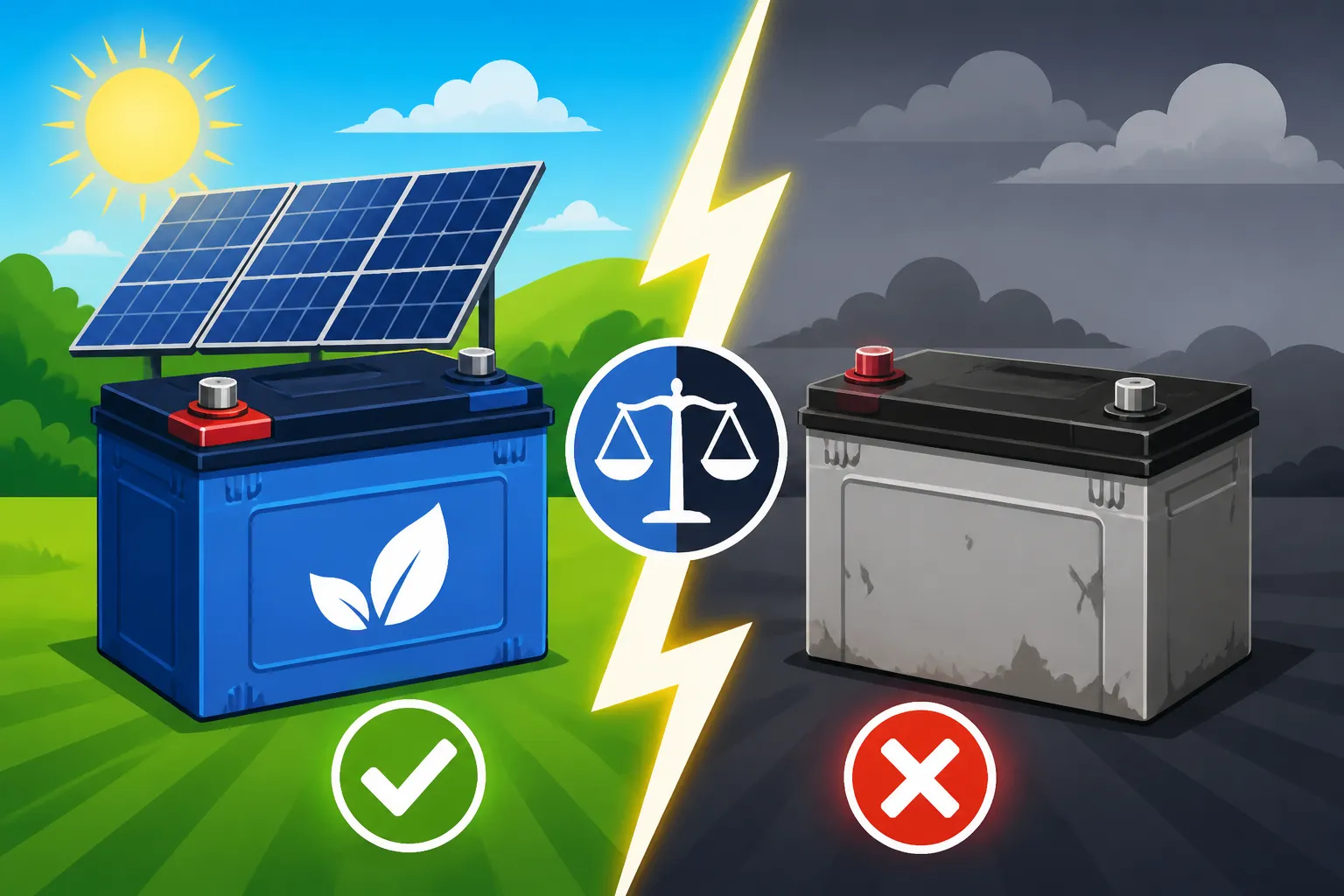
Here's a quick comparison table to help visualize the differences:
| Feature | Lead-Acid (FLA/AGM) | LiFePO4 (Lithium Iron Phosphate) |
|---|---|---|
| Upfront Cost | Lower | Higher |
| Usable Capacity (DoD) | ~50% (to preserve lifespan) | 80-100% |
| Cycle Life | 300-1,200 cycles (at 50% DoD) | 3,000-5,000+ cycles (at 80% DoD) |
| Lifespan | 2-5 years | 10-15+ years |
| Weight | Very heavy | Lightweight (1/2 to 1/3 of lead-acid for same usable Wh) |
| Size/Footprint | Bulky, requires more space | Compact, smaller footprint |
| Charging Efficiency | 70-85% | 95%+ |
| Self-Discharge Rate | 4-6% per month | <1-3% per month |
| Voltage Stability | Drops under load and with lower state of charge | Very stable throughout discharge cycle |
| Maintenance | High (water topping, equalization for FLA) | Very low (internal BMS handles management) |
| Temperature Sensitivity | Performance degrades in cold, lifespan shortens in heat | Good cold weather performance (with low-temp cutoff), handles heat better |
| Safety | Can off-gas hydrogen, requires ventilation | Very stable chemistry, built-in BMS protection |
Safety and Environmental Impact Important Considerations
When dealing with significant amounts of stored electrical energy, safety is never something to overlook. Whether you're a seasoned off-grid veteran or just starting your journey, understanding the potential risks and environmental footprint of your battery choice is vital for both your well-being and the planet. This isn't just about personal safety; it's about responsible energy stewardship.
Safety Profile of Lead-Acid Batteries
Lead-acid batteries, especially the flooded variety, come with inherent safety considerations that absolutely demand attention. They contain sulfuric acid, which is highly corrosive and can cause severe burns if it comes into contact with skin or eyes. This necessitates careful handling during installation and maintenance, always wearing appropriate personal protective equipment (PPE). Beyond the acid, they also produce hydrogen gas during the charging process, particularly when nearing full charge or during equalization. Hydrogen gas is highly flammable and explosive, requiring lead-acid battery banks to be housed in well-ventilated enclosures to prevent gas buildup. Sparks or open flames near a gassing lead-acid battery can lead to dangerous explosions.
Furthermore, lead itself is a toxic heavy metal. Improper disposal of lead-acid batteries can cause significant environmental contamination, leaching lead and acid into soil and water systems. While recycling programs are widely available for lead-acid batteries (often incentivized by a core charge when you buy a new one), ensuring proper recycling is crucial. Unfortunately, the transportation of these heavy, corrosive batteries for recycling also poses its own set of challenges and risks. This makes proper setup and Off-Grid Solar Safety and Grounding paramount when choosing lead-acid.
Safety Features of LiFePO4 Batteries
LiFePO4 batteries are generally considered one of the safest lithium-ion battery chemistries available. Unlike some other lithium technologies (like LiCoO2 found in consumer electronics), LiFePO4 has a very stable chemical structure that is less prone to thermal runaway, which is the self-heating phenomenon that can lead to fires or explosions. This inherent chemical stability provides a significant safety advantage.
Moreover, as mentioned, nearly all commercially available LiFePO4 batteries for off-grid use come with an integrated Battery Management System (BMS). This intelligent system actively monitors the battery's health, protecting it from common issues that could lead to dangerous situations, such as overcharging, over-discharging, short circuits, and overheating. The BMS will simply shut the battery down if it detects a dangerous condition, significantly reducing the risk of catastrophic failure. While any battery can be dangerous if abused, the combination of stable chemistry and smart electronics makes LiFePO4 a much safer choice in most typical off-grid applications. You can often find detailed information on these integrated safety features when comparing Best Off-Grid Solar Batteries from different manufacturers.
Environmental Footprint and Recycling
When we talk about off-grid living, we're often motivated by a desire for sustainability and a reduced environmental footprint. So, the environmental impact of our energy storage choice is a critical consideration.
Lead-acid batteries, due to their lead and sulfuric acid content, present significant environmental concerns if not handled and recycled properly. While recycling rates for lead-acid batteries are remarkably high in many regions (often over 98% in the US, making them one of the most recycled consumer products), the raw material extraction and manufacturing processes still have environmental costs. The risk of improper disposal, especially in remote off-grid locations, remains a concern, where batteries might end up in landfills, leading to soil and water contamination.
LiFePO4 batteries generally have a lower environmental impact during their operational life because they don't contain heavy metals like lead or toxic liquids. While lithium mining and battery manufacturing do have environmental costs, the materials used are generally less toxic than lead. Furthermore, their significantly longer lifespan means fewer batteries need to be manufactured and recycled over a given period, which reduces the overall resource consumption and waste generated. Recycling infrastructure for LiFePO4 is still developing compared to lead-acid but is rapidly expanding as these batteries become more prevalent. The goal of extending the lifespan and reducing waste aligns perfectly with the ethos of many choosing to live off-grid and is a factor in their decisions about Is Off-Grid Solar Worth the Cost.
Installation and System Integration Simplified Setup or Complex Wiring
Getting your off-grid system up and running isn't just about buying the components; it's about putting them all together correctly and safely. The process of installing your battery bank and integrating it with your solar panels, charge controller, and inverter can vary significantly depending on whether you choose lead-acid or LiFePO4. This impacts not only the complexity of the DIY route but also the potential cost if you decide to hire a professional.
Connecting Lead-Acid Batteries in an Off-Grid Setup
Installing a lead-acid battery bank often involves handling multiple, heavy individual batteries. If you're building a larger 12V, 24V, or 48V system, you'll likely be wiring several 6V or 12V batteries in series and/or parallel. This requires sturdy battery cables, proper terminal connections, and a clear understanding of How to Wire a Battery Bank to achieve the desired voltage and capacity. Given their weight, securely placing and physically connecting these batteries can be a physically demanding task.
Ventilation is another major consideration. As lead-acid batteries can off-gas hydrogen during charging, their enclosure must be properly vented to the outside. This usually means specific battery boxes or compartments with appropriate ducting to prevent dangerous gas buildup. Monitoring tools like hydrometers (for flooded batteries) and voltage meters are essential for keeping tabs on their health, as they don't have built-in BMS reporting. The charge controller also needs to be programmed with the correct charging parameters (bulk, absorption, float, equalization) specific to the lead-acid chemistry chosen to prevent damage and maximize lifespan. It's a system that requires careful attention to detail at every step of the Off-Grid Solar Installation Guide.
Integrating LiFePO4 Batteries with Your Solar System
Integrating LiFePO4 batteries into your off-grid solar system is often a more streamlined process. Because they are lighter and more compact, positioning them is easier. Wiring is generally simplified, especially if you're using single larger LiFePO4 batteries with internal BMS, which means fewer individual connections compared to a large bank of 6V lead-acid cells. The BMS takes care of much of the internal cell balancing and protection, reducing the complexity of monitoring and ensuring safe operation.
While they don't off-gas hydrogen, adequate ventilation is still good practice for any battery bank to manage heat, especially in enclosed spaces. A crucial aspect of LiFePO4 integration is ensuring your charge controller and inverter are compatible with lithium battery charging profiles. Most modern solar charge controllers (especially MPPT types from brands like Victron or Renogy) have pre-set or customizable lithium profiles, but older equipment might not. Setting the correct charging voltages (bulk, absorption, float) is essential for lithium batteries to ensure longevity and prevent the BMS from frequently disconnecting the battery due to overvoltage or undervoltage. This simplified setup, particularly for those building a Cost of a DIY Off-Grid Solar Build, makes LiFePO4 an attractive option.
Choosing the Right System Voltage
The choice between a 12V, 24V, or 48V system voltage is fundamental to your off-grid design, and it impacts battery bank configuration for both types.
- 12V Systems: Common for RVs, vans, and small cabins. It's simpler to wire, as many smaller appliances run directly on 12V DC. However, higher currents mean thicker wires are needed for larger systems to prevent voltage drop, increasing cable costs and potential losses.
- 24V Systems: A good middle ground for medium-sized cabins or homes. It reduces current compared to 12V, allowing for thinner wires and more efficient power transfer. Batteries are wired in series to achieve 24V.
- 48V Systems: The preferred choice for larger off-grid homes. It drastically reduces current, making wiring much more efficient and allowing for the use of smaller, more powerful inverters. Most high-capacity inverters and charge controllers are designed for 48V.
When choosing your system voltage, consider your total energy needs, the size of your inverter, and the types of appliances you'll be running. For example, a system designed to run an entire home, including a well pump and washing machine, would almost certainly benefit from a 48V setup, regardless of battery chemistry. This detailed planning is part of the broader process of How to Size an Off-Grid Solar System.
Disclaimer
The information provided in this guide is for general informational and educational purposes only and is not intended as professional advice. Off-grid solar system design and installation involve electrical work and potential hazards. Always consult with qualified professionals, adhere to local codes and regulations, and prioritize safety when working with electrical systems and batteries. Battery performance and lifespan can vary based on usage, environmental conditions, and specific product models.