Best Off-Grid Solar for Cold Climates
Living off the grid in cold climates brings a unique set of hurdles, from biting temperatures that drain batteries to short, dreary winter days that offer scant solar production. It can feel like an uphill battle just to keep the lights on and the water flowing when Mother Nature is doing her best to freeze everything solid. This comprehensive guide is dedicated to helping you navigate these challenges, offering practical advice and robust solutions for designing and implementing an off-grid solar system that stands strong against the harshest winter conditions.
Understanding the Unique Challenges of Cold Climate Solar
When you're trying to harness the sun's power in a place where winter bites hard, you're not just dealing with chilly air. You're facing a multi-faceted assault on your system's efficiency and longevity. It's not enough to simply install more panels; you need a strategic approach to overcome these specific environmental factors.
Reduced Solar Irradiance and Shorter Days
One of the most immediate and impactful challenges in cold climates is the dramatic reduction in available sunlight during winter months. This isn't just about the temperature; it's about the sun itself.
During winter, the sun's path across the sky is much lower, meaning the sunlight strikes your solar panels at a far less optimal angle. This "low sun angle" significantly reduces the intensity of the solar radiation reaching your panels, even on a perfectly clear day. Think of it like trying to catch raindrops with a plate: if you hold it flat, you catch a lot, but if you tilt it sharply, much of the rain just bounces off. Your solar panels work similarly; they are most efficient when the sun's rays hit them perpendicularly. Beyond the angle, there are simply fewer hours of daylight. In northern latitudes, winter days can be incredibly short, sometimes offering only a few hours of effective sunshine. This means your panels have a dramatically smaller window to generate power, and the power they do generate is less potent due to the lower sun angle. This combination of shorter days and weaker sunlight fundamentally changes how much energy your system can produce, often requiring you to significantly oversize your solar array to compensate.
Extreme Temperatures and Battery Performance
Batteries, the heart of any off-grid system, are notoriously sensitive to extreme cold. Their performance can plummet, and their lifespan can be severely cut short if not properly managed.
When temperatures drop, the chemical reactions inside most batteries slow down considerably. For traditional lead-acid batteries, this means a significant reduction in their usable capacity. A battery rated for 100 amp-hours at 77°F (25°C) might only deliver 60-70 amp-hours when the temperature hovers around freezing. Even more critically, charging these batteries in sub-freezing temperatures can cause permanent damage, especially for lithium-ion chemistries without protection. Lithium Iron Phosphate (LiFePO4) batteries are generally a fantastic choice for off-grid living due to their long lifespan and deep discharge capabilities, but standard LiFePO4 batteries cannot be charged below 32°F (0°C) without risking irreversible damage like lithium plating, which dramatically reduces their capacity and safety. This makes proper temperature management and choosing the right battery chemistry, such as those with internal heating elements, absolutely critical for reliable power in the cold. Understanding how batteries drive off-grid solar cost in these environments is vital.
Snow Accumulation and Panel Output
Perhaps the most obvious and frustrating challenge for cold climate solar is snow. A blanket of snow on your panels means exactly one thing: zero power generation.
Even a thin layer of frost can dramatically reduce output, but heavy snowfall can completely incapacitate your system for days or even weeks if left unattended. This isn't just an inconvenience; it can lead to critical power shortages, especially if you're relying solely on solar for essential loads like heating or water pumps. Beyond simply blocking sunlight, snow can add significant weight to your panel racking, potentially causing structural damage if not designed to handle the load. The frequent freeze-thaw cycles associated with snowy regions can also put stress on the panels themselves, affecting seals and frames over time. Strategic panel placement, steep tilt angles, and regular snow removal become non-negotiable practices to ensure your system can consistently capture whatever precious sunlight is available.
Key Components for Cold Climate Off-Grid Systems
To build an off-grid solar system that truly thrives in a cold climate, you can't just pick components off the shelf. You need to be intentional about selecting gear that is specifically designed or enhanced to withstand the rigors of low temperatures and reduced sunlight.
Solar Panels Built for the Cold
Choosing the right solar panels is more nuanced than simply looking at wattage; their performance and durability in cold, low-light conditions are paramount.
While colder temperatures can actually increase the voltage output of solar panels slightly, the real challenge in cold climates is the reduced solar irradiance and the physical stress of snow and ice. Look for monocrystalline panels, as they generally have better efficiency in lower light conditions compared to polycrystalline panels, which can be a real advantage during overcast winter days or when the sun is low on the horizon. More importantly, consider panels with a robust frame and tempered glass that can withstand heavy snow loads without cracking or deforming. A good indicator of quality for cold weather is a low-temperature coefficient; this specification tells you how much the panel's power output will decrease for every degree Celsius above 25°C. While cold temperatures aren't the primary concern here, a panel that also performs well in varying temperatures is a sign of overall quality. Some advanced panels feature anti-reflective coatings and enhanced cell designs to capture more light, making every photon count. When considering Best Off-Grid Solar Panels, prioritize those specifically rated for resilience against physical stress and superior low-light performance.
Cold-Weather Batteries
Your battery bank is the single most critical component for cold climate off-grid solar, dictating how much power you can actually store and use when the sun isn't shining.
For harsh winters, traditional flooded or AGM lead-acid batteries are often a less-than-ideal choice. While they can operate in cold, their usable capacity drops significantly, and charging them when frozen is a recipe for disaster. The real game-changer for cold climates is the advent of Lithium Iron Phosphate (LiFePO4) batteries with integrated heating elements. These smart batteries monitor their internal temperature and will draw a small amount of power (either from the solar array or the battery itself) to heat the internal cells above freezing before allowing a charge to commence. This critical feature prevents permanent damage and ensures they can accept a charge even when outside temperatures are well below freezing. Brands like Battle Born and EG4 offer excellent heated LiFePO4 options, which are far superior to standard lithium batteries if you plan to keep your battery bank in an unheated space. While the upfront LiFePO4 vs Lead-Acid Battery Cost might be higher, the longevity, deeper discharge capabilities, and cold-weather charging safety of heated LiFePO4 batteries make them invaluable for year-round reliability. You'll want to carefully assess how many batteries for an off-grid system you need, ensuring you have enough capacity to carry you through multiple cloudy, snowy days.
| Battery Type | Cold Charging | Usable Capacity @ 0°F (-18°C) | Lifespan (Cycles) | Maintenance | Cost (Relative) |
|---|---|---|---|---|---|
| Heated LiFePO4 | Yes (Internal) | ~90-100% | 3,000-7,000+ | Low | High |
| Standard LiFePO4 | No | ~80-90% | 3,000-7,000+ | Low | Medium-High |
| AGM Lead-Acid | Limited | ~50-60% | 400-1,000 | Low | Medium |
| Flooded Lead-Acid | Limited | ~50-60% | 500-1,500 | High | Low |
Robust Charge Controllers and Inverters
The electronics that manage the power flow in your system need to be just as resilient as your panels and batteries. Temperature fluctuations can be hard on them, leading to premature failure if they're not rated for extreme conditions.
For charge controllers, Maximum Power Point Tracking (MPPT) models are almost always the superior choice for off-grid systems, and particularly so in cold climates. MPPT controllers are significantly more efficient at converting the solar panel's output into usable battery charging current, especially when the solar array voltage is high (as it tends to be in cold weather) and the battery voltage is low. This efficiency gain is crucial during those precious, short winter days when every watt counts. Many high-quality MPPT controllers, like those from Victron or Outback Power, are designed to operate across a wide temperature range. Similarly, your inverter, which converts DC battery power to AC household power, needs to be robust. Look for pure sine wave inverters that can handle varying loads and have good surge capacity for starting motors in appliances or a well pump. While most inverters have a reasonable operating temperature range, ensure any components installed outdoors or in unheated sheds are specifically rated for the extreme lows your location experiences. Good ventilation for these components is still important, even in cold weather, to prevent heat buildup during operation.
Designing Your Off-Grid System for Winter Reliability
A cold climate off-grid solar system isn't just assembled; it's meticulously designed with winter's harsh realities in mind. Every calculation and component choice should anticipate the challenges ahead.
Oversizing Your Solar Array
This is perhaps the most critical design decision for cold climate off-grid living: you must build a solar array significantly larger than what you'd need for similar energy consumption in a milder climate.
The primary reason for oversizing is the drastically reduced solar irradiance and shorter daylight hours during winter. On a typical summer day, your panels might produce excess power, easily topping off your batteries. But come winter, those same panels will generate a fraction of that power. To give you some context, a location that gets 5 "peak sun hours" in summer might only get 2-3 in winter. This means your panels are only truly effective for a couple of hours a day, and the rest of the time they're limping along. Therefore, you need more panels to capture enough energy during those limited peak hours to meet your daily needs and still charge your battery bank. A common rule of thumb is to size your array to meet your winter energy needs, which often means an array 1.5 to 2 times larger than what you'd calculate for average year-round use. This extra capacity helps immensely when accounting for cloudy days or periods of heavy snow, making sure your essential loads are always covered. Thinking about how to size an off-grid solar system specifically for winter is paramount, not just for typical conditions.
Battery Bank Sizing and Protection
Even with an oversized solar array, your battery bank remains the buffer for periods of no sun. Proper sizing and, crucially, protection from the cold are non-negotiable.
Your battery bank needs to be large enough to store several days' worth of power, not just overnight. In cold, snowy climates, you might face multiple days of low production due to storms or persistent cloud cover. Aim for at least 3-5 days of autonomy – meaning your batteries can power your essential loads for that many days without any solar input. This provides a critical safety net. For instance, if your cabin consumes 5 kWh per day in winter, you'd need a battery bank capable of delivering 15-25 kWh of usable energy. Beyond capacity, protecting your batteries from freezing temperatures is paramount. As discussed, LiFePO4 batteries with internal heating are excellent if your battery bank must live in an unheated space. If you're using standard LiFePO4 or lead-acid batteries, they must be housed in a well-insulated, heated enclosure. This could be inside your home, in a dedicated insulated battery box with supplemental heat (like a small ceramic heater or a battery-specific warming pad), or even buried underground in a frost-proof vault. Remember, cold batteries perform poorly, and charging frozen batteries can destroy them. It's a key consideration for how winter affects off-grid sizing.
Optimizing Panel Angle and Placement
The physical orientation and tilt of your solar panels play a huge role in maximizing winter energy harvest and shedding snow.
For year-round off-grid living in a cold climate, a steeper panel tilt angle is generally recommended. While a summer angle might be optimal at your latitude minus 15 degrees, a winter angle would be your latitude plus 15 degrees to better catch the lower sun. A compromise angle that performs reasonably well throughout the year is often your latitude plus 5-10 degrees. For example, if you're at 45 degrees latitude, a 50-55 degree tilt is a good starting point. This steeper angle has a dual benefit: it optimizes for the low winter sun, and it encourages snow to slide off the panels more easily, minimizing accumulation. Orient your panels due south (in the Northern Hemisphere) for maximum daily exposure. If shading is an issue from surrounding trees or structures, carefully consider a ground mount system where you have more control over orientation and can easily clear snow. When planning to How to Design Off-Grid Solar for Winter, panel tilt is often overlooked but incredibly impactful.
Installation Considerations for Freezing Temperatures
Installing an off-grid solar system in cold climates isn't just about putting parts together; it's about making sure those parts can withstand constant cold, ice, and snow without failing. Every connection, every wire, and every enclosure needs to be thought through.
Wiring and Connections
Cold weather can make wires brittle, and temperature swings can lead to condensation, both of which are detrimental to electrical systems.
When you're running cables, especially those exposed to the elements, select wires rated for outdoor use and extreme temperatures. Standard PVC-jacketed wire can become stiff and prone to cracking in sub-zero conditions, so opt for more flexible, cold-weather-rated insulation like those found on PV wire. Use appropriately sized cables to minimize voltage drop, which becomes even more critical when every watt of power is precious. All connections, whether MC4 connectors for your solar panels or lugs for your battery cables, must be robust and watertight. Use dielectric grease on exposed metal contacts and invest in high-quality, weatherproof junction boxes and conduit to protect wiring from moisture, ice, and rodents. Condensation inside conduit can also be an issue; consider using liquid-tight flexible conduit or ensuring proper drainage points if water ingress is possible. These small details can prevent major headaches and costly repairs down the line. When learning how to wire an off-grid solar system, always remember to factor in climate specifics.
Enclosures and Ventilation
Protecting your sensitive electronic components from the elements is crucial, but it's a balancing act between insulation and ventilation.
Your charge controller, inverter, and battery bank (if not internally heated) need a protected home. An insulated shed, a dedicated utility room within your cabin, or even a well-built, insulated outdoor enclosure can work. The key is to keep components within their specified operating temperature range. For batteries, this often means above freezing, or at least above their minimum charging temperature. For inverters and charge controllers, while they can typically handle colder ambient temperatures, they still generate heat during operation. Overheating can be just as damaging as freezing. Therefore, even in a cold climate, proper ventilation for these components is necessary. This might mean strategically placed vents that allow airflow without letting in snow or excessive cold, or even a small fan thermostat-controlled to kick on when internal temperatures rise. During extreme cold snaps, you might need supplemental heating for your battery enclosure, perhaps a small, thermostatically controlled heater or even a passive solar design for a battery box.
Grounding and Safety
Safety should always be paramount, but in cold climates, certain aspects of grounding and electrical safety take on added importance.
Proper grounding is essential for any electrical system to protect against faults and lightning strikes. In cold climates, however, installing effective ground rods can be challenging. Frozen ground dramatically increases resistance, making it difficult to drive rods deep enough. Plan to install your grounding system before the ground freezes, or be prepared to use specialized tools or techniques, like drilling pilot holes. Ensure all metal components of your solar array, including panel frames and racking, are properly bonded and connected to your main grounding electrode. Ice can also be a safety hazard. When working on roofs or near ground-mounted panels, consider the risk of slipping and falling. Clear pathways and use appropriate safety gear. It's also wise to have easily accessible disconnects for your solar array, battery bank, and inverter, allowing you to quickly de-energize the system in an emergency or for maintenance, even with numb fingers. Don't underestimate the importance of grounding, as it's a critical part of how to install an off-grid solar system safely.
Essential Maintenance and Troubleshooting in Winter
Once your off-grid solar system is installed in a cold climate, the job isn't over. Winter brings its own set of maintenance routines and troubleshooting scenarios that you need to be prepared for to ensure continuous power.
Snow Removal Strategies
The most immediate and ongoing maintenance task in a snowy climate is keeping your solar panels clear. Without sun, there's no power, plain and simple.
Regular snow removal is crucial, especially after heavy snowfall. A specialized solar panel snow rake with a soft head can reach high panels without scratching them. For ground-mounted arrays, a soft broom or brush works well. Avoid using metal shovels or harsh chemicals, which can damage the panel surface or frame. Consider the angle of your panels as well; a steeper tilt (as discussed in design) will help shed snow naturally. Some folks even design small, sacrificial "starter" panels at the bottom of their array that are heated to melt the snow and create a channel for the rest of the snow to slide off. While manual removal is often necessary, strategic design can reduce the frequency. Always prioritize safety during snow removal, especially on icy roofs. Proper snow removal is vital to avoid a sudden dip in your Cost to Power a Cabin with Solar because you're running a generator instead.
Battery Monitoring and Care
Your batteries are working harder in winter, and careful monitoring and care are essential to maximize their lifespan and performance.
Even heated LiFePO4 batteries benefit from a stable environment. Continuously monitor your battery bank's state of charge, voltage, and temperature. A good battery monitor with a shunt is invaluable for this, giving you real-time data on how much power is going in and out. For lead-acid batteries, check electrolyte levels regularly if they are flooded, and ensure they are always kept above 50% state of charge in cold weather to prevent freezing and sulfation. If you have non-heated LiFePO4 batteries in an unheated space, ensure your charge controller is set to prevent charging when temperatures drop below freezing, or use a battery with an integrated low-temperature charge cut-off. Regularly inspect battery terminals for corrosion, which can increase resistance and reduce efficiency. Keeping your batteries healthy in winter is paramount for managing Off-Grid Solar Maintenance Costs over the long run and ensuring your system can function as intended. Properly maintaining them is key to learning how to maintain an off-grid battery bank.
System Checks and Preventative Measures
Beyond snow and batteries, a few regular checks can help prevent common winter failures in the rest of your system.
Periodically inspect all wiring and connections for signs of wear, rodent damage, or loose terminals. Cold temperatures can cause materials to contract, potentially loosening connections over time. Check your charge controller and inverter for any error codes or unusual noises. Ensure all vents are clear of snow or debris. For systems with a backup generator, run it regularly (as per manufacturer recommendations) to ensure it's ready to kick in when needed. Keep an eye on your generator's fuel levels and ensure it has fresh oil and filters. In extremely cold weather, generators may require a block heater or special cold-weather starting fluids. Proactive checks, such as testing your system's output and monitoring critical parameters, are much easier than troubleshooting a full system failure when it's -20°F outside. This proactive approach ensures system reliability, especially after how winter affects off-grid sizing has been taken into account during the initial design.
Real-World Cold Climate Off-Grid Solutions and Examples
Living off-grid in cold climates isn't just a theory; countless individuals and families successfully do it every year. Their strategies often involve combining robust solar setups with reliable backup power and smart energy management.
Integrated Solar Generators
For smaller setups, emergency backup, or supplementing a larger system, integrated solar generators (often called portable power stations) can be a fantastic tool in cold climates.
Brands like Jackery, EcoFlow, and Bluetti offer portable power stations that combine a battery, inverter, and charge controller into a single, compact unit. While they aren't meant to power an entire house for weeks on end, they can be incredibly useful for smaller, critical loads during a cold snap or an extended period of low solar production. For example, a Jackery Explorer 1000 can power a CPAP machine overnight, charge laptops, or run a few LED lights when your main system is struggling. Many of these units are designed to operate in colder temperatures, though some may still have charging limitations below freezing. Their portability means you can bring them indoors to keep them warm, ensuring they're ready to go when you need them. They can be charged via portable solar panels or even from your vehicle's 12V outlet, offering flexibility when your primary array is snow-covered. For anyone looking for best solar generators for off-grid use, especially as a supplemental or emergency power source in cold regions, these portable units are worth a close look.
Hybrid Systems with Backup Generators
For true year-round reliability in cold climates, many off-gridders opt for a hybrid system that combines solar with a fossil fuel generator. This redundancy is often the key to peace of mind.
A well-integrated backup generator acts as your ultimate safety net. During prolonged periods of heavy snow, deep cold, or extended cloud cover, when your solar array simply can't keep up, the generator automatically (or manually) kicks in to charge your batteries and power your loads. This prevents battery depletion and ensures continuous power for heating, refrigeration, and other essentials. Modern inverter chargers are designed to seamlessly integrate with generators, even offering auto-start features that can be triggered when battery voltage drops below a certain threshold. When selecting a generator, consider its fuel type (propane, diesel, or gasoline), noise level, and cold-weather starting capabilities. Propane generators, for instance, tend to start more reliably in extreme cold than gasoline models. While the goal of off-grid living is often solar independence, a robust backup generator significantly enhances reliability and reduces stress during the most challenging winter months. This approach offers a practical answer to how to design for year-round off-grid power.
Case Studies: Learning from Successful Cold-Weather Setups
Looking at real-world examples can provide invaluable insights into what works and what doesn't.
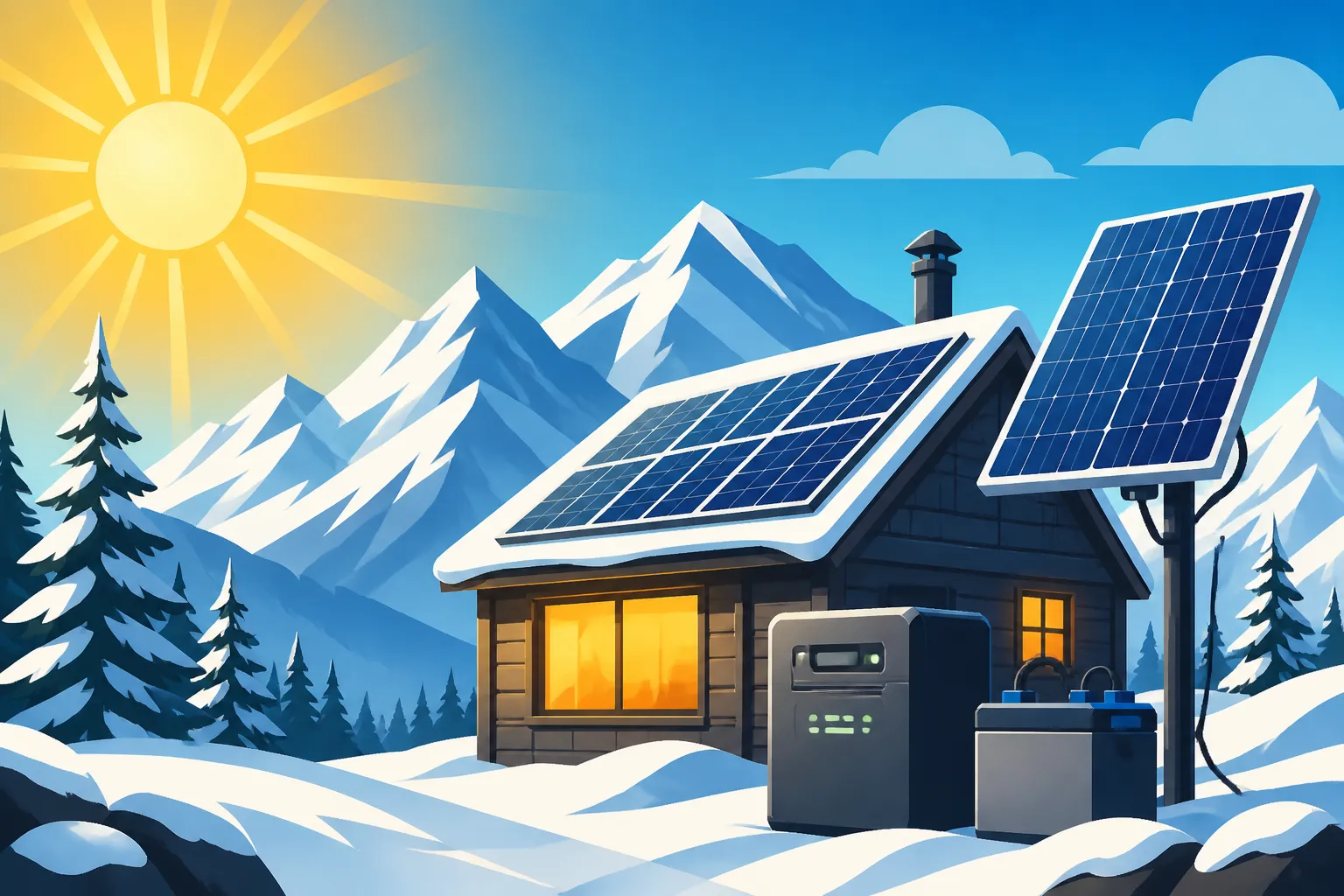
Consider the experiences of a remote cabin owner in the Canadian Rockies. Their system features a heavily oversized ground-mounted solar array with panels tilted at 60 degrees to maximize winter sun and shed snow. Their battery bank consists of heated LiFePO4 batteries, housed in a well-insulated, unheated shed, ensuring they can charge even at -30°F. For backup, they have a large propane generator with an auto-start feature, programmed to kick in if the batteries drop below 50% state of charge. They also keep a small Jackery portable power station charged for critical electronics during generator run cycles or for quick grabs. This multi-layered approach ensures they have multiple avenues for power, even during weeks of sub-zero temperatures and heavy snowfall. Another example might be a research station in Alaska, utilizing a robust ground-mounted system with active snow-melting technology on panels, combined with a large, liquid-cooled battery bank housed in a separate, climate-controlled building, and a diesel generator with an extensive fuel supply. These examples highlight the common themes: overcapacity, robust battery solutions, intelligent physical design, and reliable backup.
Disclaimer
The information provided in this guide is for general informational purposes only and does not constitute professional electrical engineering or installation advice. Off-grid solar system design and installation, especially in challenging cold climates, require specific technical knowledge and adherence to local electrical codes and safety regulations. Always consult with qualified professionals before undertaking any electrical work or designing a solar system. Working with electricity can be dangerous and improper installation can lead to property damage, injury, or death.