Off-Grid Solar for a Hunting Cabin
The dream of a remote hunting cabin often comes with a glaring reality check: how on earth do you power it when the nearest utility pole is miles away? Running electricity to a secluded property can cost an absolute fortune, making the fantasy of cozy evenings and warm meals a logistical nightmare. This comprehensive guide is here to untangle the complexities of off-grid solar, helping you design and implement a reliable power system for your hunting cabin, turning that remote dream into a comfortable reality.
Understanding Your Hunting Cabin's Power Needs
Before you even think about buying solar panels or batteries, the absolute first step is to figure out what you actually need to power. Many folks jump straight to ordering equipment only to find their system is either woefully undersized, leaving them in the dark, or vastly oversized, having wasted a good chunk of change. Don't fall into that trap! Understanding your cabin's energy consumption is the bedrock of a successful off-grid setup.
Assessing Appliance Wattage and Daily Use
This is where the rubber meets the road. Grab a notepad, or even a spreadsheet, and list every single electrical device you plan to use in your cabin. Think about the lights, a small refrigerator, a water pump, a radio, phone chargers, perhaps a laptop, or even a modest TV for winding down after a day outdoors. For each item, you need to find its wattage. This information is usually on a sticker or plate on the appliance itself, or you can find it in the user manual or online specifications.
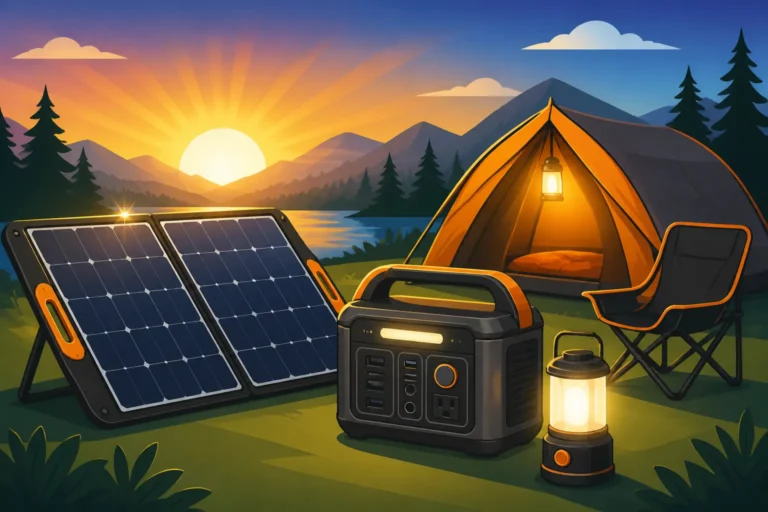
It's crucial to differentiate between running wattage and starting (surge) wattage. Many appliances, especially those with motors like a refrigerator or a well pump, require a much higher surge of power for a brief moment when they first kick on. Your inverter needs to be able to handle these surges. Once you have the wattage, estimate how many hours per day you'll use each appliance. Be honest with yourself! It's better to slightly overestimate than to be left without power. For instance, a small LED light might only draw 10 watts, but if it's on for 4 hours a night, that's 40 Watt-hours (Wh) of consumption. A mini-fridge might run intermittently, cycling on for 8 hours a day in total, drawing 60 watts while running, totaling 480 Wh. For those smaller, occasional needs, something like a portable power station, such as a Jackery unit, can be great for charging phones or running a small light without taxing your main system.
Calculating Your Total Energy Budget
Once you've listed all your appliances and their estimated daily usage in Watt-hours, it's time to add them all up. This sum gives you your total daily Watt-hour consumption. This number is arguably the most critical piece of data you'll need for sizing your entire off-grid solar system. Let's say, after a thorough calculation, you determine your cabin needs 2,500 Watt-hours per day. This is your target.
However, it's not quite that simple. You also need to consider inefficiencies in your system. Inverters aren't 100% efficient, and batteries lose a bit of energy during charging and discharging. A general rule of thumb is to add a 15-20% buffer to your total daily consumption to account for these losses. So, if your raw calculation is 2,500 Wh, you might aim for a system capable of delivering 2,875 Wh to 3,000 Wh per day to be safe. This buffer helps prevent frustration when unexpected loads pop up or when components aren't performing at peak efficiency. For a deeper dive into this initial stage, consult our guide on How to Do an Off-Grid Load Analysis.
Considering Seasonal Usage and Autonomy
Hunting cabins aren't always used year-round. This is a huge factor in your sizing. Do you only use it in the fall and spring, or do you plan on winter excursions when daylight hours are shorter and snow might cover your panels? What about extended stays? The number of "days of autonomy" refers to how many days your battery bank can power your cabin without any new input from the solar panels (i.e., during cloudy weather or heavy snow).
For a hunting cabin, you might not need the same level of autonomy as a full-time off-grid home, but you certainly don't want to be caught in the dark during a cold, cloudy stretch. Planning for 2-3 days of autonomy is a common and sensible approach for a cabin used intermittently. If you're in an area prone to long periods of overcast skies or heavy winter snowfall, you might want to increase that to 4-5 days. Remember, the more autonomy you want, the larger your battery bank will need to be, which directly impacts your budget. It's a balance between cost and convenience, and choosing the right How Many Batteries for an Off-Grid System is crucial.
| Appliance | Typical Wattage (Running) | Est. Daily Use (Hours) | Daily Wh Consumption | Surge Wattage (Approx.) |
|---|---|---|---|---|
| LED Lighting (5x) | 50 W (10W each) | 4 | 200 Wh | N/A |
| Mini-Fridge | 60 W | 8 (cycling) | 480 Wh | 300 W |
| Water Pump | 200 W | 0.5 | 100 Wh | 600 W |
| Phone Charger | 10 W | 2 | 20 Wh | N/A |
| Laptop | 45 W | 3 | 135 Wh | N/A |
| Radio | 15 W | 2 | 30 Wh | N/A |
| Small TV | 60 W | 2 | 120 Wh | N/A |
| Total Daily Usage | 1085 Wh | |||
| Add 20% buffer | ~1300 Wh |
Note: These are estimates. Always check your specific appliance labels for accurate wattage.
Key Components of an Off-Grid Solar System for a Cabin
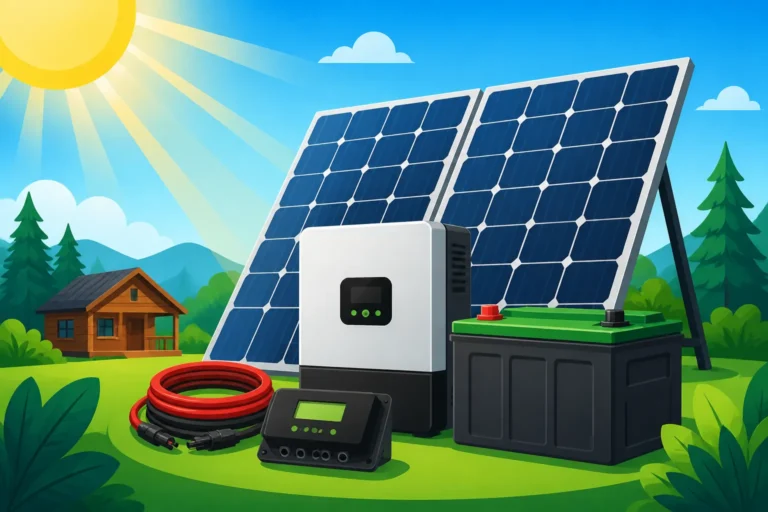
Building an off-grid solar system for your hunting cabin means understanding the main players in your power generation team. It's not just a bunch of panels slapped on a roof; it's an interconnected system where each component has a vital role. Skimping on one part can compromise the entire setup, leading to frustration and potential equipment damage.
Solar Panels: Types and Placement
Solar panels are your power collectors, the hardworking heroes soaking up the sun's rays. For a hunting cabin, you'll generally be looking at rigid monocrystalline or polycrystalline panels. Monocrystalline panels are typically more efficient, meaning they produce more power per square foot, which can be an advantage if you have limited space on your roof or a small ground mount area. Polycrystalline panels are a bit less efficient but often more budget-friendly. Given the harsh conditions often found in remote areas, durability is key, so quality panels from reputable brands are a wise investment.
Placement is critical. Panels should be mounted in a location that receives maximum direct sunlight throughout the day, year-round, ideally facing south in the Northern Hemisphere. You'll want to avoid any potential shading from trees, hills, or even parts of the cabin itself. Think about the path of the sun in both summer and winter. While summer days are long and sunny, winter days are shorter, and the sun is lower in the sky, making proper tilt angle and clear line of sight even more crucial. Many cabin owners opt for ground mounts, which offer flexibility in orientation and tilt, and can be adjusted seasonally to optimize output. This also makes them easier to clear of snow than roof-mounted panels. To figure out how many you'll need, refer to our guide on How Many Solar Panels for Off-Grid Living.
Battery Bank: Storage and Chemistry Choices
The battery bank is the heart of your off-grid system, storing the energy captured by your solar panels for use when the sun isn't shining. Without it, you'd only have power during daylight hours. The two primary battery chemistries for off-grid applications are lead-acid and lithium iron phosphate (LiFePO4).
Lead-acid batteries (like flooded lead-acid or sealed AGM) are a more traditional, lower upfront cost option. They require regular maintenance (especially flooded types, which need water top-offs) and have a shorter lifespan and lower usable depth of discharge compared to LiFePO4. AGM batteries are sealed and require less maintenance, making them popular for RVs and smaller cabins, but they still have similar lifespan limitations. On the other hand, LiFePO4 batteries have a higher upfront cost but offer significantly longer lifespans (often 10-15 years or more), a much higher usable depth of discharge (80-100% vs. 50% for lead-acid), faster charging, and are virtually maintenance-free. For a hunting cabin where you want reliable power and minimal fuss, LiFePO4 often proves to be the more cost-effective choice in the long run. Good brands like Battle Born or EG4 are popular among off-grid enthusiasts for their reliability. Understanding the specifics can really help you choose the Best Off-Grid Solar Batteries for your needs.
Inverters and Charge Controllers: The Brains of Your System
These two components are absolutely essential for managing your power flow. The charge controller acts as the gatekeeper between your solar panels and your battery bank. Its job is to regulate the voltage and current coming from the panels to prevent overcharging your batteries, which can severely damage them. There are two main types: PWM (Pulse Width Modulation) and MPPT (Maximum Power Point Tracking). MPPT controllers are more efficient, especially in fluctuating light conditions or when the panel voltage is much higher than the battery bank voltage, extracting up to 30% more power from your panels compared to PWM. For any system larger than a very small setup, an MPPT charge controller is highly recommended.
The inverter converts the DC (direct current) power stored in your batteries into AC (alternating current) power, which is what most household appliances use. You'll want a pure sine wave inverter, as modified sine wave inverters can damage sensitive electronics like laptops, medical equipment, and some motor-driven appliances. Sizing your inverter correctly is crucial; it needs to be able to handle the combined running wattage of all AC appliances you might run simultaneously, plus any surge currents from motors. For small loads or supplemental power, a portable power station like a Jackery can offer a built-in inverter for DC to AC conversion on a smaller scale, perfect for charging devices or running a camping fridge for a short period. For your main cabin power, you'll want a robust, dedicated inverter. Check out our guide on Best Off-Grid Solar Inverters for reputable options.
Sizing Your Off-Grid Solar System for Reliability
Once you understand your cabin's energy needs and the components involved, the next step is to accurately size each part of your system. This isn't just about throwing a bunch of equipment together; it's about creating a balanced system that reliably meets your power demands, even during less-than-ideal conditions. Proper sizing is the difference between a constant supply of power and frequently running out.
Determining Solar Array Size for Your Cabin
To figure out how many solar panels you need, you'll start with your total daily Watt-hour consumption (including that 15-20% buffer we discussed earlier). Let's use our example of 1,300 Wh per day. Next, you need to factor in your "peak sun hours" – the average number of hours per day your panels receive direct, effective sunlight in your specific location, considering the least sunny season you plan to use the cabin. This information can often be found through online solar radiation maps or local weather data, but a good rule of thumb is 3-5 hours for many northern regions in winter, and 5-7 hours in summer.
Let's assume your cabin is in a region that gets an average of 4 peak sun hours per day during the season you use it most.
Daily Wh consumption (with buffer) = 1300 Wh
Peak Sun Hours = 4 hours
Total required panel wattage = 1300 Wh / 4 hours = 325 Watts.
This 325 Watts is the minimum output your panels need to produce per day to meet your needs. You'll likely want to add a further buffer (say, 20-30%) to account for panel degradation, dirt, wiring losses, and less-than-perfect sun conditions. So, 325W * 1.30 = 422.5 Watts. If you're using 100-watt panels, you'd need roughly five of them (422.5 / 100 = 4.22, rounded up to 5). This ensures you have enough generation even on slightly overcast days or when the panels aren't perfectly clean. Don't forget, the voltage of your panel array also needs to be compatible with your charge controller and battery bank. We have a detailed guide on How to Size an Off-Grid Solar System that can walk you through this process more thoroughly.
Sizing Your Battery Bank for Days of Autonomy
Your battery bank size depends on your daily Watt-hour consumption and your desired days of autonomy. Let's stick with our 1,300 Wh daily consumption and aim for 3 days of autonomy.
Total stored energy needed = 1300 Wh/day * 3 days = 3900 Wh.
Now, you need to account for the battery's usable depth of discharge (DoD). For lead-acid batteries, this is typically 50%; for LiFePO4, it's 80-100%. If you choose LiFePO4 with an 80% DoD:
Required battery bank capacity = 3900 Wh / 0.80 = 4875 Wh.
Battery capacity is often expressed in Amp-hours (Ah) at a specific voltage (e.g., 12V, 24V, 48V). If you're building a 12V system:
Required Ah = 4875 Wh / 12V = 406.25 Ah.
So, you'd need roughly four 100Ah 12V LiFePO4 batteries (4 * 100Ah = 400Ah) wired in parallel, or two 200Ah batteries. Always factor in that choosing a higher system voltage (like 24V or 48V) can reduce wire size requirements and improve efficiency, especially for larger systems. When looking at portable solutions, a powerful Jackery model might list its capacity in Watt-hours, making it straightforward to compare for specific loads or backup needs.
Matching Inverter Capacity to Your Cabin's Peaks
Your inverter needs to be large enough to handle the maximum simultaneous load you'll draw, including any surge power requirements. Go back to your appliance list. Identify all the AC appliances you might run at the exact same time. Add up their running wattages. Then, identify the single largest surge load (e.g., a well pump or refrigerator compressor starting up) and add that surge wattage to the total running wattage of everything else. This gives you your absolute peak demand.
For example, if your simultaneous running load is 800W, and your well pump has a 600W surge (while running at 200W), your peak demand would be 800W – 200W (pump running) + 600W (pump surge) = 1200W. Your inverter should have a continuous rating that comfortably exceeds your total simultaneous running load, and a surge rating that can handle that peak startup demand for a few seconds. A good rule of thumb is to size your inverter at least 25% higher than your maximum calculated continuous load. For reliable performance and longevity, investing in a quality pure sine wave inverter, such as those from Victron Energy or Sol-Ark, is crucial. If you're looking for more details on this, our article on How to Size an Off-Grid Inverter provides comprehensive guidance.
Installation Considerations for Remote Cabin Setups
The actual installation process for an off-grid solar system at a remote hunting cabin has its own set of unique challenges and considerations. Unlike a residential installation in a city, you often don't have easy access to hardware stores, electrical supply houses, or even skilled labor. Planning ahead and prioritizing safety are paramount.
DIY vs. Professional Installation: Weighing the Options
For many cabin owners, the idea of a DIY off-grid solar system is appealing, both for the cost savings and the satisfaction of building it yourself. And honestly, for smaller, simpler systems (think lighting, phone charging, a small fridge), it's entirely achievable for someone with basic electrical knowledge and a willingness to learn. There are tons of online resources, detailed wiring diagrams, and pre-packaged kits that make the process more straightforward. However, a DIY approach means you are solely responsible for system design, component selection, safety, and troubleshooting. Mistakes can be costly, dangerous, or both.
For larger, more complex systems powering a full-size refrigerator, well pump, or other high-draw appliances, hiring a professional solar installer or a licensed electrician with off-grid experience is often the smarter choice. They can ensure the system is correctly sized, safely wired according to electrical codes (even if permits aren't required, best practices save lives), and optimized for performance. They can also handle any permitting that might be necessary, even for off-grid systems in some jurisdictions. While the upfront Off-Grid Solar Installation Cost will be higher, the peace of mind and long-term reliability can be invaluable. It's a real balancing act, and our article on DIY vs Professional Off-Grid Solar Cost offers a deeper comparison.
Mounting Solutions and Weather Protection
The remote nature of a hunting cabin means your solar equipment will be exposed to the elements without constant supervision. This makes robust mounting and comprehensive weather protection non-negotiable. For solar panels, ground mounts are often favored over roof mounts for cabins. They're easier to install, simpler to adjust for seasonal sun angles, and far easier to clear of snow and debris. Make sure the ground mount is sturdy enough to withstand local wind loads and heavy snowfall. Consider building a concrete foundation or using ground screws for stability.
Batteries, especially lead-acid types, need protection from extreme temperatures. Cold weather reduces their capacity and can prevent charging, while excessive heat can shorten their lifespan. A well-insulated battery box or a dedicated enclosure within the cabin, away from living spaces but still protected, is crucial. For LiFePO4 batteries, many modern units have internal heating elements for cold-weather charging, making them more resilient, but they still benefit from stable temperatures. Inverters and charge controllers also need to be protected from moisture, dust, and temperature extremes. They should be mounted in a dry, well-ventilated area, ideally inside the cabin or in a purpose-built, secure utility shed.
Wiring and Safety Essentials
Wiring an off-grid solar system requires careful attention to detail and adherence to safety standards. Use appropriately sized wires for all connections to prevent voltage drop and overheating. Larger wires are needed for longer runs and higher current loads, especially between the batteries and the inverter. All wiring should be properly secured, protected in conduit where exposed, and clearly labeled.
Fuses and circuit breakers are non-negotiable safety devices. They protect your equipment and prevent fires in case of a short circuit or overload. You'll need fuses or breakers at various points: between the solar panels and the charge controller, between the charge controller and the battery bank, and between the battery bank and the inverter. A master disconnect switch for the battery bank is also a wise addition, allowing you to safely shut down the system for maintenance or in an emergency. Proper grounding of the entire system is equally vital to protect against lightning strikes and electrical faults. Even though it's a cabin, treating it with the same respect as a residential installation is key for longevity and safety. Our guide on How to Wire an Off-Grid Solar System provides comprehensive steps.
Budgeting and Cost-Saving Strategies for Cabin Solar
The cost of setting up an off-grid solar system for a hunting cabin can vary wildly, from a few thousand dollars for a very basic setup to tens of thousands for a robust, year-round solution. It’s a significant investment, but one that offers incredible freedom and long-term savings compared to generator fuel or utility line extensions. Understanding where your money goes and how to stretch your budget is crucial. For a general overview of expenses, take a look at How Much Does an Off-Grid Solar System Cost.
Breaking Down the Initial Investment
The initial cost of an off-grid solar system is largely determined by the size and quality of its main components:
- Solar Panels: These can range from $1 to $1.50 per watt. For a 400-watt array, you might spend $400-$600.
- Batteries: This is often the most expensive component. Lead-acid batteries are cheaper upfront (e.g., $200-$400 per 100Ah 12V AGM), but LiFePO4 batteries, while more expensive initially ($600-$1000+ per 100Ah 12V), offer better long-term value. For our example 400Ah 12V LiFePO4 bank, expect to pay $2400-$4000+.
- Inverter/Charge Controller: A good quality pure sine wave inverter and MPPT charge controller combination can range from $500 for smaller, all-in-one units to $2000-$5000+ for larger, more robust integrated inverter-chargers.
- Mounting Hardware: Ground mounts or roof racking can add $200-$1000+, depending on complexity.
- Wiring, Fuses, Breakers, Disconnects: These essential safety and connection components can easily add another $300-$800.
- Miscellaneous: Conduit, junction boxes, sealants, tools, and potentially a generator for backup (if you don't already have one) will round out your budget.
For a modest hunting cabin requiring around 1-2 kWh per day, you're likely looking at an initial investment somewhere between $5,000 and $15,000, depending heavily on battery choice and desired autonomy. This might seem like a lot, but consider the alternative: the often exorbitant Off-Grid Solar vs Utility Extension Cost which can run into tens of thousands of dollars per mile to bring grid power to a remote location.
Long-Term Savings and Maintenance Costs
While the upfront cost is considerable, the long-term savings of off-grid solar are substantial. Once installed, your "fuel" (sunlight) is free. You eliminate monthly utility bills entirely. Compare this to the ongoing cost of running a gasoline or propane generator, which involves purchasing fuel, performing regular maintenance, and dealing with noise and emissions. Over the lifespan of your solar system (typically 20-25 years for panels, 10-15 for LiFePO4 batteries), the savings can easily outweigh the initial investment. You can find more details in our article on Cost to Power a Cabin with Solar.
However, "maintenance-free" is a myth for any system. Solar panels need occasional cleaning, especially in dusty or snowy environments. Batteries, particularly lead-acid, require more frequent checks and maintenance. LiFePO4 batteries are much lower maintenance, but still need monitoring. Inverters and charge controllers are generally solid-state but should be checked for proper ventilation and connections. The most significant potential long-term cost is battery replacement, as batteries have a finite cycle life. This is where the longer lifespan and deeper discharge cycles of LiFePO4 batteries like those from brands such as EG4 or Battle Born really pay off, reducing the frequency and cost of replacements. Even a portable power station like a Jackery needs its internal battery health monitored over time.
Phased Installation and Expandability
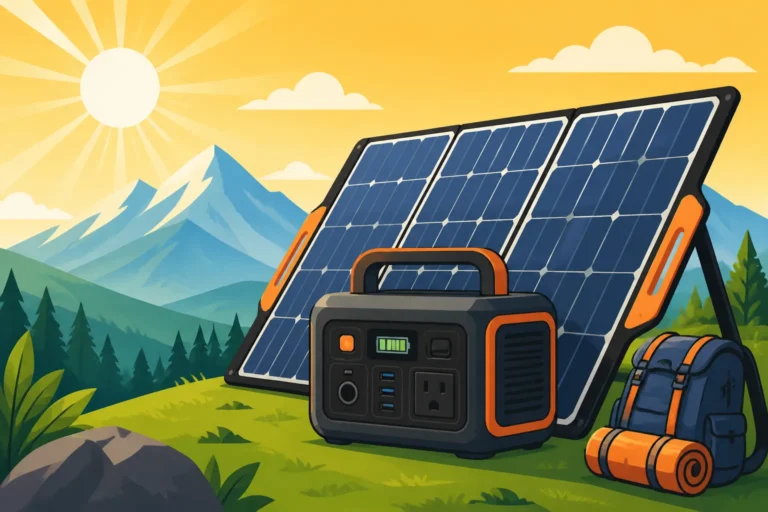
If the initial investment for a full-blown system feels daunting, consider a phased installation. Start with a smaller system that covers your absolute essential loads: lights, phone charging, and perhaps a small radio. For these initial needs, a high-capacity portable power station might even serve as your primary source, easily supplemented by a small folding solar panel array. This allows you to get comfortable with off-grid living and gradually expand as your budget allows and your needs grow.
Designing your system with expandability in mind from the start is a smart move. This means oversizing your charge controller slightly to accommodate more panels in the future, or choosing an inverter that can handle a larger eventual load. When purchasing batteries, aim for models that can be easily added to your existing bank, ensuring compatibility (especially important for LiFePO4 batteries where mixing old and new can be problematic). By planning for expansion, you can spread out the financial burden and grow your system as your cabin usage evolves, eventually moving from a basic setup to a truly robust power solution. Our guide on How to Design an Expandable System offers more insights into this strategic approach.
Disclaimer
The information provided in this guide is intended for general informational purposes only and does not constitute professional advice. Off-grid solar system design and installation can be complex and involve electrical hazards. Always consult with qualified professionals and adhere to all local codes and safety regulations. The author and publisher are not responsible for any actions taken based on the information presented herein.