Monocrystalline vs Polycrystalline for Off-Grid
When you're dreaming of escaping the grid and harnessing the sun's power, one of the first big questions that hits you is about solar panels. You might find yourself staring at product descriptions on sites like Amazon, seeing terms like "monocrystalline" and "polycrystalline," and feeling completely lost. It's frustrating when you just want to know which panel type will actually keep your lights on and your fridge running without breaking the bank or taking up too much precious space. This comprehensive guide is here to untangle the monocrystalline vs. polycrystalline debate, helping you confidently choose the right foundation for your off-grid energy system.
Understanding Monocrystalline Solar Panels: The Premium Choice
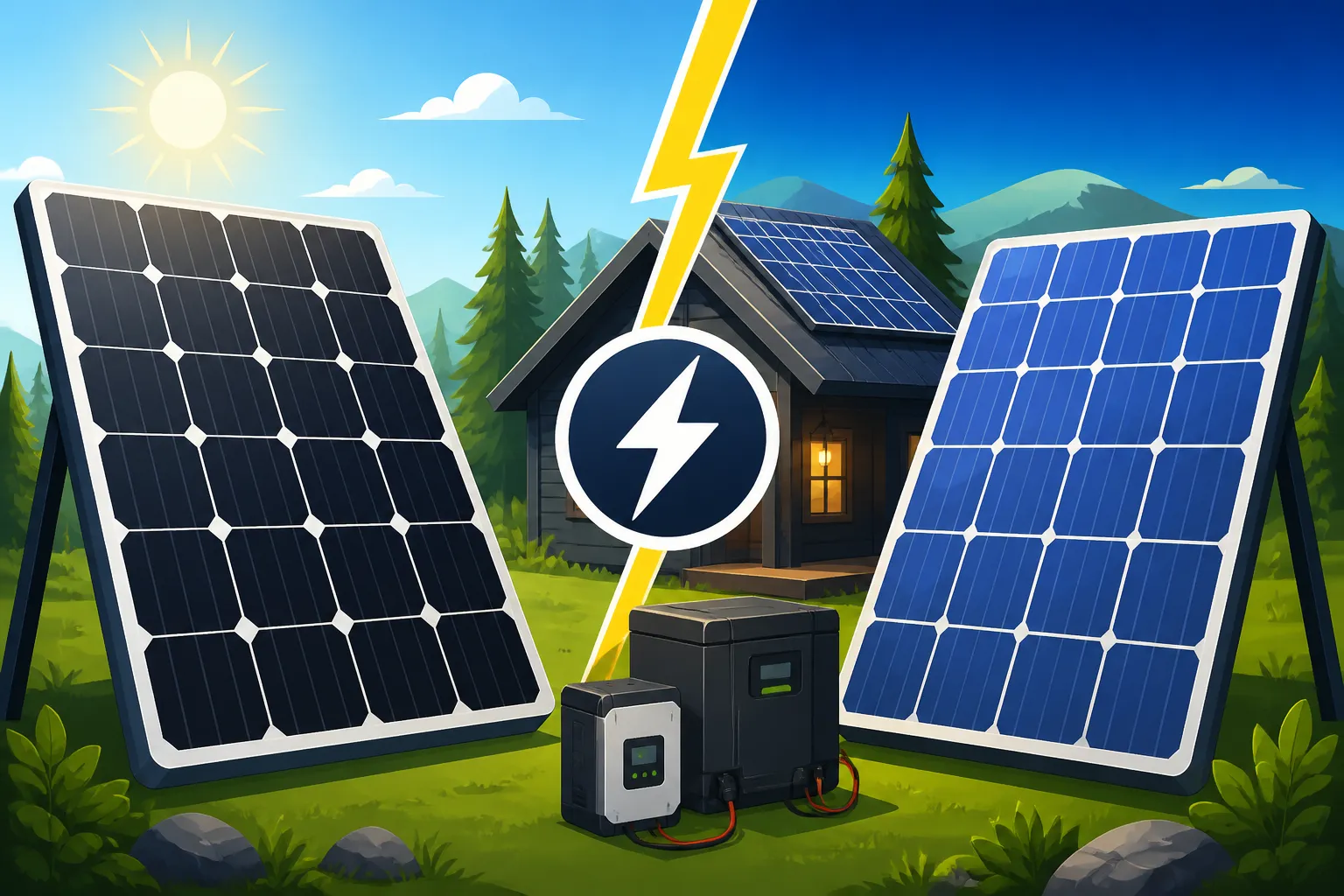
Monocrystalline solar panels have long been considered the gold standard in solar technology, revered for their efficiency and sleek appearance. When you see a deep black solar panel, chances are it's a monocrystalline one.
Construction and Appearance
The distinctive look and superior performance of monocrystalline panels come directly from their unique manufacturing process. Each cell in a monocrystalline panel is made from a single, continuous crystal of silicon. This is achieved through what's known as the Czochralski method, where a silicon seed crystal is dipped into molten silicon and then slowly drawn upwards, creating a large, cylindrical ingot of pure silicon. This ingot is then sliced into thin wafers, which become the individual solar cells. Because each cell is a single, pure crystal, electrons have more room to move, which translates into higher efficiency.
Visually, these panels are quite striking. They are typically uniformly dark black or deep blue, giving them a very clean and modern aesthetic. This uniform color is a direct result of the single-crystal structure reflecting light evenly. This isn't just about looks; the lack of grain boundaries in a single crystal structure contributes to its higher electron mobility and overall performance. When you're looking to maximize power output from a limited footprint, say on the roof of a tiny home or a compact RV, the space-saving aspect of these panels becomes a significant advantage. Brands like Renogy offer a wide array of monocrystalline panels designed for various off-grid applications, from small portable setups to larger home systems.
Advantages and Disadvantages
Like any technology, monocrystalline panels come with their own set of pros and cons, which are crucial to understand when planning your off-grid power setup.
Advantages:
The primary advantage of monocrystalline panels is their superior efficiency. They typically convert a higher percentage of sunlight into electricity, often ranging from 17% to over 22%. This means you need fewer panels to achieve the same power output compared to other types, making them ideal for installations where space is a premium. Think about an RV roof or a small cabin; every square foot counts! Their excellent performance in low-light conditions, such as cloudy days or early morning/late afternoon, is another significant benefit for off-grid living, where consistent power generation is paramount. You might not always have direct, peak sunlight, so having panels that can still pull in a decent charge when conditions aren't perfect can be a real lifesaver. Plus, their dark, uniform appearance is often preferred by those who value aesthetics. For anyone considering How to Choose an Off-Grid Solar Panels, efficiency is often a top priority.
Disadvantages:
However, these benefits often come at a higher price point. Monocrystalline panels generally have a greater upfront cost per watt compared to polycrystalline panels. This is due to the more complex and energy-intensive manufacturing process required to create those single silicon crystals. While their low-light performance is great, they can be slightly less tolerant of high temperatures than polycrystalline panels. When the panel itself gets very hot, its efficiency can dip more noticeably. If you're planning an installation in a scorching desert climate where panel temperatures can soar, this is something to factor in. Also, if a monocrystalline panel is partially shaded, its entire circuit can be affected, potentially reducing the output of the whole panel or even a string of panels, though modern panels often incorporate bypass diodes to mitigate this. Understanding these nuances is key to a successful Off-Grid Solar System Design Basics.
Exploring Polycrystalline Solar Panels: The Budget-Friendly Workhorse
Polycrystalline solar panels, often recognizable by their blue, mottled appearance, offer a more cost-effective entry point into the world of solar energy. They are a popular choice for many off-grid enthusiasts, especially those with ample space and a keen eye on their budget.
Construction and Appearance
The manufacturing process for polycrystalline panels is quite different from their monocrystalline counterparts, and it directly influences their look and performance characteristics. Instead of growing a single silicon crystal, polycrystalline cells are made by melting raw silicon fragments together in a square mold. This molten silicon is then allowed to cool and solidify slowly. As it cools, multiple silicon crystals form within the mold, creating a multi-grained structure. This block is then also sliced into wafers, which become the individual solar cells. The presence of multiple crystals and grain boundaries means that electrons have slightly less freedom to move compared to the single-crystal structure, which results in slightly lower efficiency.
Visually, polycrystalline panels are easy to spot. They typically have a mottled, bluish hue, often described as a mosaic pattern. This distinctive look comes from the visible grain boundaries of the multiple silicon crystals that make up each cell. While perhaps not as sleek as the dark black monocrystalline panels, their appearance is widely accepted, especially for installations where function outweighs pure aesthetics, such as a ground-mounted array for a remote cabin or a barn roof installation. Many reputable brands, including Renogy, offer reliable polycrystalline options that have proven their worth in countless off-grid scenarios.
Advantages and Disadvantages
When weighing your options, understanding the specific advantages and disadvantages of polycrystalline panels will help you determine if they align with your off-grid goals and constraints.
Advantages:
The most significant advantage of polycrystalline panels is their lower manufacturing cost, which translates to a more affordable price point for you. If you're on a tight budget for your off-grid setup, or if you have plenty of roof space or land for a ground mount, then polycrystalline panels offer a fantastic way to generate substantial power without the premium price tag. For those wondering How to Save Money on an Off-Grid Solar Build, these panels are often a go-to. While their efficiency is slightly lower than monocrystalline panels (typically 15-17%), it's still more than sufficient for many applications, especially when space isn't a major constraint. Furthermore, polycrystalline panels tend to handle high temperatures a bit better. Their temperature coefficient, which describes how much efficiency drops as temperature increases, is often marginally more favorable, meaning they might experience a slightly less dramatic drop in efficiency on extremely hot days compared to monocrystalline panels.
Disadvantages:
The primary trade-off with polycrystalline panels is their lower efficiency. This means that to achieve the same wattage output as a monocrystalline array, you'll need more polycrystalline panels, which consequently requires more physical space. For instance, if you need 1000 watts, you might achieve it with three 350-watt monocrystalline panels, but potentially four or five 250-watt polycrystalline panels. This increased footprint can be a limiting factor for small installations like RVs, vans, or tiny homes where every inch of roof space is critical. Their slightly less uniform, bluish appearance might also be a minor aesthetic concern for some homeowners, though for many off-gridders, practical function trumps looks. While they tolerate heat a bit better, their overall energy production per square foot will still be lower due to their base efficiency, which is a key consideration when calculating your overall Off-Grid Solar Cost Per Watt.
Performance and Efficiency: Which Panel Delivers More Watts?
The core of the monocrystalline vs. polycrystalline debate often boils down to how much electricity each type can produce and under what circumstances. It's not just about the number on the label; it's about real-world output in diverse environmental conditions.
Efficiency Ratings and Real-World Output
When you look at a solar panel's specifications, you'll almost always see an efficiency rating, usually expressed as a percentage. This number tells you how effectively the panel converts the sunlight hitting its surface into usable electricity. Monocrystalline panels typically boast efficiency ratings ranging from 17% to 22%, with some premium models even pushing beyond that. Polycrystalline panels, on the other hand, usually fall in the 15% to 17% range. What does this mean for your off-grid system?
Let's take a hypothetical example. Imagine you have a limited area on your cabin roof that can accommodate exactly 30 square feet of solar panels. If you install monocrystalline panels with an average efficiency of 20%, you'll generate more power from that 30 square feet than if you installed polycrystalline panels with a 16% efficiency. This difference becomes critical when space is a constraint, like on an RV or a tiny home. For instance, if you need 1000 watts of solar power, you might achieve it with three high-efficiency 350-watt monocrystalline panels. To get the same 1000 watts with lower-efficiency 250-watt polycrystalline panels, you might need four, which could mean an extra panel and more mounting hardware. This isn't about one being "better" overall, but about which one is better for your specific space and power needs. When you're trying to figure out How Many Watts of Solar You Need, these efficiency differences directly impact how many physical panels you'll end up installing.
Behavior in Varying Conditions
Beyond the headline efficiency numbers, how panels perform under different environmental conditions is a vital consideration for off-grid living, where the sun isn't always cooperating perfectly.
Low-Light Performance: Monocrystalline panels are generally acknowledged to perform better in low-light conditions. This means on cloudy days, during dawn and dusk, or in partial shade, they can still capture more solar energy and contribute more effectively to charging your battery bank. This superior low-light sensitivity stems from the purity and uniformity of their single-crystal silicon structure, which allows for more efficient electron excitation even with less intense photons. For an off-grid cabin in a region prone to overcast weather, this could mean the difference between having consistent power and relying more heavily on a backup generator.
High-Temperature Performance: Here's where polycrystalline panels can sometimes shine, albeit subtly. While all solar panels lose some efficiency as their temperature increases (known as the temperature coefficient), polycrystalline panels tend to have a slightly better temperature coefficient. This means their efficiency degrades a little less dramatically when they get very hot, such as on a scorching summer day in Arizona. Monocrystalline panels, while more efficient at standard test conditions (25°C or 77°F), can see a more pronounced dip in output once temperatures climb significantly higher. This doesn't make polycrystalline panels more efficient in hot weather, but rather, their efficiency drops less than a monocrystalline panel's under extreme heat. For those designing a system in an incredibly hot climate, this small difference might play a role in optimizing their array. It's an important detail when you're looking at Best Solar Panels for High Heat for your desert homestead.
Cost Implications for Your Off-Grid Budget
Let's be real, for most of us, budget is a massive consideration when building an off-grid solar system. The initial investment in panels can be substantial, and understanding the cost implications of monocrystalline versus polycrystalline is crucial for effective financial planning.
Upfront Investment
Generally speaking, monocrystalline solar panels come with a higher upfront cost per watt compared to their polycrystalline counterparts. This isn't a secret, and it's largely due to the more intricate and energy-intensive manufacturing process required to create those single-crystal silicon ingots. Imagine the precision needed to grow one perfect crystal versus melting a bunch of silicon fragments together. That extra effort and purity command a higher price.
For example, if you're browsing for panels on a site like Amazon or checking out offerings from brands like Renogy, you'll likely notice that a 100-watt monocrystalline panel often costs a bit more than a 100-watt polycrystalline panel from the same manufacturer. While the difference might seem small per panel, it can really add up when you're buying a dozen or more for a larger system. If you're building a substantial off-grid homestead and have plenty of ground space for your array, opting for polycrystalline panels could significantly reduce your initial outlay. This could free up funds for other critical components like a robust battery bank or a high-quality inverter. For a comprehensive overview of expenses, it's worth checking out resources like Cost of Off-Grid Solar Panels and How Much to Budget for Off-Grid Batteries.
Long-Term Value and Return on Investment
While the upfront cost is important, smart off-gridders also consider the long-term value and potential return on investment (ROI) of their panel choice. The lifespan of both monocrystalline and polycrystalline panels is generally quite similar, with most manufacturers offering warranties of 25 years or more for power output. The degradation rate – how much power output diminishes over time – is also comparable, typically around 0.5% to 0.7% per year. So, in terms of sheer longevity, there isn't a huge advantage to one over the other.
However, the "value" comes into play when considering efficiency and space. If you have limited space, the higher efficiency of monocrystalline panels means you can generate more electricity from fewer panels. This could lead to a quicker payback period if you're able to avoid purchasing additional land for ground mounts or can fit a larger system on your existing roof. Over the long term, that higher daily output from a compact monocrystalline array might mean less reliance on a backup generator, saving you fuel costs. On the flip side, if you have abundant space and choose polycrystalline panels, your lower initial investment means you start recouping your costs sooner. The "return" isn't always just monetary; it's also about meeting your energy needs reliably and independently. Exploring topics like Off-Grid Solar Payback Period Explained can give you a deeper understanding of these long-term considerations.
| Feature | Monocrystalline Solar Panels | Polycrystalline Solar Panels |
|---|---|---|
| Appearance | Uniform dark black/deep blue | Mottled blue, mosaic-like |
| Efficiency | High (17-22%+, some higher) | Moderate (15-17%) |
| Cost per Watt | Higher | Lower |
| Space Required | Less (more power per square foot) | More (less power per square foot) |
| Low-Light Perf. | Better | Good |
| High-Temp Perf. | Slightly more sensitive to heat (efficiency drops more) | Slightly less sensitive to heat (efficiency drops less) |
| Manufacturing | Single silicon crystal (Czochralski method) | Multiple silicon fragments melted together |
| Applications | Space-constrained setups (RVs, tiny homes, complex roofs) | Ample space (ground mounts, large cabin roofs, budget builds) |
| Aesthetics | Sleeker, often preferred | Functional, less uniform look |
Installation and Practical Considerations
Beyond the numbers and appearance, how these panels integrate into your actual off-grid system and the practicalities of installation are vital. You're not just buying panels; you're building a power plant!
Space Requirements and Mounting
This is often one of the most critical practical differences between monocrystalline and polycrystalline panels, especially for off-grid applications where space is often at a premium. Because monocrystalline panels are more efficient, they generate more power per square foot. This means you need fewer physical panels to achieve your desired wattage. For scenarios like an RV, a camper van, or a tiny home, where roof space is incredibly limited, this is a huge advantage. You might only have room for four panels, and if those four panels are high-efficiency monocrystalline, they could produce significantly more power than four polycrystalline panels in the same footprint. This allows you to meet your energy demands without compromising on other roof-mounted equipment like vents or skylights.
Conversely, if you're setting up a larger off-grid homestead with a lot of land or a spacious cabin roof, the larger physical footprint of polycrystalline panels might not be an issue. You can build a larger array without worrying about fitting it into a confined area. Ground-mounted arrays, which offer the flexibility to optimize tilt and azimuth, are excellent candidates for polycrystalline panels where space is plentiful. When you're planning your installation, it’s essential to consider How to Install Off-Grid Solar Panels and how the physical size of your chosen panels will impact your mounting structure, whether it's a Ground Mount vs Roof Mount for Off-Grid system.
Wiring, Voltage, and System Integration
Regardless of whether you choose monocrystalline or polycrystalline panels, the fundamental principles of wiring, voltage, and system integration remain largely the same. Both types use standard solar connectors (like MC4 connectors) and can be wired in series, parallel, or a combination of both to achieve the desired voltage and amperage for your charge controller and inverter.
What does change, however, is the number of panels required. If you're building a 48V system, and your chosen monocrystalline panels have a higher voltage per panel, you might need fewer panels in series to reach that 48V nominal voltage compared to lower-voltage polycrystalline panels. This can simplify wiring slightly and potentially reduce the number of components like combiner boxes. Conversely, if you're using more polycrystalline panels to achieve the same wattage, you might have more wiring runs, more connections, and need to carefully plan for voltage drop, especially over longer distances from the array to your charge controller. Understanding how to Wire Panels in Series vs Parallel is crucial, as is matching your array voltage to your charge controller's specifications. Always consult the datasheets for your specific panels, as specs can vary even within the same panel type.
Maintenance and Durability
In terms of maintenance and durability, there's very little difference between monocrystalline and polycrystalline panels. Both are built to withstand harsh outdoor elements, including rain, snow, hail, and wind. They typically feature tempered glass fronts, sturdy aluminum frames, and weatherproof junction boxes. Manufacturers often provide similar warranties for both types, reflecting their comparable long-term robustness.
Routine maintenance for either panel type primarily involves keeping them clean. Dust, dirt, pollen, bird droppings, and snow can accumulate on the surface, reducing their ability to absorb sunlight. A simple rinse with water and a soft brush can usually restore them to optimal performance. Physical inspection for damage, loose wiring, or corrosion should also be part of your regular Off-Grid Solar Maintenance Costs routine. While both panel types are durable, proper mounting and protection from extreme physical impact are key to ensuring their longevity. For instance, if you're in an area prone to severe hailstorms, ensuring your panels are securely mounted and perhaps even angled to deflect impact can be beneficial, regardless of the panel type.
Making the Right Choice for Your Off-Grid Lifestyle
So, after diving deep into the technicalities, it all comes back to you and your unique off-grid dream. There's no single "best" panel type; there's only the best panel type for you.
Matching Panels to Your Needs
The key to choosing between monocrystalline and polycrystalline panels lies in a careful evaluation of your specific off-grid requirements, constraints, and priorities. Start by asking yourself some critical questions:
- How much space do you actually have for your solar array? Is it a tiny RV roof, a small cabin porch, or a vast open field for a ground mount?
- What's your budget for the initial panel purchase? Are you looking for the most cost-effective entry point, or are you willing to invest more upfront for long-term benefits?
- What are your daily energy needs? Have you completed a thorough load analysis to determine your How Many Watt-Hours You Use Per Day? This will dictate the total wattage you need.
- What are the typical weather conditions in your location? Is it sunny year-round, or do you experience many cloudy days or extreme heat?
- Are aesthetics a concern? Does the uniform look of monocrystalline appeal to you more than the mottled blue of polycrystalline?
If you have limited space and need to squeeze every possible watt out of it, or if you want the highest efficiency for low-light performance, monocrystalline panels might be your ideal choice. Their sleek appearance is often a bonus for visible installations. However, if you have plenty of room, are working with a tighter budget, and value a lower upfront cost, then polycrystalline panels offer fantastic value and can certainly power a robust off-grid system effectively. It’s all about balancing these factors. To make a truly informed decision, it's beneficial to look at How to Budget for an Off-Grid Solar System and assess your priorities.
Specific Off-Grid Scenarios
Let's consider a few common off-grid scenarios to illustrate how these choices play out in the real world:
Van Life or RV Living: For folks living the nomadic lifestyle in a van or RV, roof space is gold. You're trying to fit solar, skylights, vents, and maybe an AC unit all on a small footprint. In this scenario, the higher efficiency of monocrystalline panels makes them incredibly attractive. You can get more watts with fewer panels, leaving room for other necessities. While the initial cost might be higher, the ability to generate sufficient power in a compact space often outweighs that. You might find great compact monocrystalline panels on Amazon or from specialized RV solar brands.
Remote Cabin or Hunting Cabin: For a smaller, seasonal cabin or a hunting cabin, your energy demands might be lower, and you might have less urgency for peak efficiency if you have ample roof space or an open clearing for a ground mount. Here, polycrystalline panels could be an excellent, budget-friendly option. You could install a slightly larger array of more affordable panels to meet your needs without breaking the bank. This also applies to structures like a shed or a remote workshop.
Full-Time Off-Grid Homestead: For a large homestead with year-round living, you'll likely have higher energy demands and potentially more space. This is where the choice can become more nuanced. You might start with a larger ground-mounted array of cost-effective polycrystalline panels, potentially expanding it later. Or, you might mix and match, using high-efficiency monocrystalline panels on your main house roof and polycrystalline panels for supplementary ground mounts or outbuildings. Some homesteaders prioritize the long-term consistent output, even in varied weather, leaning towards monocrystalline, while others prioritize the initial cost for their large system size, choosing polycrystalline. For large systems, you'll also be considering Best Off-Grid Solar Inverters to handle all that power. Ultimately, designing for year-round reliability and potential expansion is key.
No matter which path you choose, remember that the best off-grid system is the one that reliably meets your energy needs within your budget and space constraints. Do your homework, assess your site, and build a system that brings you true energy independence.
Disclaimer
The information provided in this guide is for general informational purposes only and does not constitute professional advice. Off-grid solar system design and installation can be complex and involve electrical hazards. Always consult with a qualified solar professional or electrician and adhere to all local codes and regulations before installing any solar power system.