How to Choose an Off-Grid Solar Panels
Deciding on the right solar panels for your off-grid sanctuary can feel like wading through a sea of technical jargon and endless options. It's a huge commitment, and honestly, the fear of picking the wrong thing that won't power your cabin through winter or keep your RV fridge humming on a scorching day is totally valid. This guide is here to cut through that confusion, helping you understand exactly what to look for, so you can confidently choose the best off-grid solar panels for your unique needs and truly embrace energy independence.
Understanding Your Off-Grid Power Needs
Before you even start looking at panel specs, you absolutely must have a clear picture of what you need your solar system to do. This isn't just about throwing some panels on a roof; it's about building a reliable energy ecosystem. Many folks skip this step, assuming "more is better," only to find they've either overspent or, worse, undersized their system. Let's make sure you don't fall into that trap.
Calculating Daily Energy Consumption
This is the cornerstone of your entire off-grid solar design. You need to know, with as much accuracy as possible, how much electricity you actually use on a daily basis. Grab a pen and paper, or open a spreadsheet, and list every single electrical appliance you plan to run. Think about your refrigerator, lights, phone chargers, laptop, water pump, even that beloved coffee maker. For each item, you'll need two crucial pieces of information: its wattage (how much power it uses at any given moment) and how many hours per day you'll run it.
You can usually find the wattage listed on a sticker on the appliance itself, in the user manual, or with a quick online search. If it only lists amps and voltage, remember that Watts = Amps x Volts. Once you have the wattage, multiply it by the estimated hours of daily use to get its daily watt-hours (Wh). For example, a 100-watt light bulb running for 4 hours a day consumes 400 Wh. Do this for everything. It’s a tedious exercise, I know, but it’s invaluable. This detailed calculation will give you your total daily watt-hour consumption, which is the baseline for everything else. For a deep dive, check out our guide on how to calculate daily energy usage, and if you’re wondering exactly what appliances draw how much, our article on How to Calculate Off-Grid Solar Needs can help you refine your list.
Accounting for System Losses and Days of Autonomy
Your solar panels won't magically convert every ray of sunshine into usable electricity without some loss. There are inefficiencies inherent in every component: the charge controller, the inverter (if you're converting DC to AC), and even the wiring itself. A good rule of thumb is to factor in about 15-20% system losses. So, if you calculated needing 5,000 Wh per day, you'll actually need your panels to generate closer to 6,000 Wh to compensate for these losses. It's like pouring water into a leaky bucket; you need to pour more than you want to end up with.
Beyond efficiency, you also need to think about those inevitable cloudy days or stretches of bad weather. How many days do you want your system to run purely on stored battery power without any new solar input? This is called "days of autonomy." For critical systems like a full-time off-grid home, you might aim for 3-5 days. For a weekend cabin, maybe 1-2. The more days of autonomy you want, the larger your battery bank will need to be, and consequently, the more solar panels you'll need to recharge that larger bank. This is a delicate balance, and understanding How Many Batteries for an Off-Grid System is crucial here.
Future Expansion and Scalability
One of the biggest regrets I hear from off-grid homeowners is not planning for expansion from day one. You start with the basics, maybe a few lights and a fridge, but then you decide you want a washing machine, or perhaps a mini-split AC for those hot summer nights. Suddenly, your perfectly sized system is struggling. When choosing panels, consider if you might want to add more later.
Look for panels and components that allow for modular growth. Many charge controllers, for instance, can handle a certain amount of solar input, and choosing one with a bit of overhead can save you from replacing it entirely down the line. Think about your available space for additional panels too. If you're mounting on an RV, roof space is finite. If you have a large property, ground mounts offer more flexibility. Planning for potential growth, even if it's just a vague idea, can save you a significant amount of money and headache in the long run. It's always easier (and cheaper) to add onto a well-designed, scalable system than to completely overhaul an undersized one.
Types of Off-Grid Solar Panels Available
The solar panel market isn't a one-size-fits-all situation. There are distinct types, each with its own advantages and disadvantages, making them suitable for different off-grid scenarios. Understanding these differences is key to making an informed choice.
Monocrystalline Solar Panels
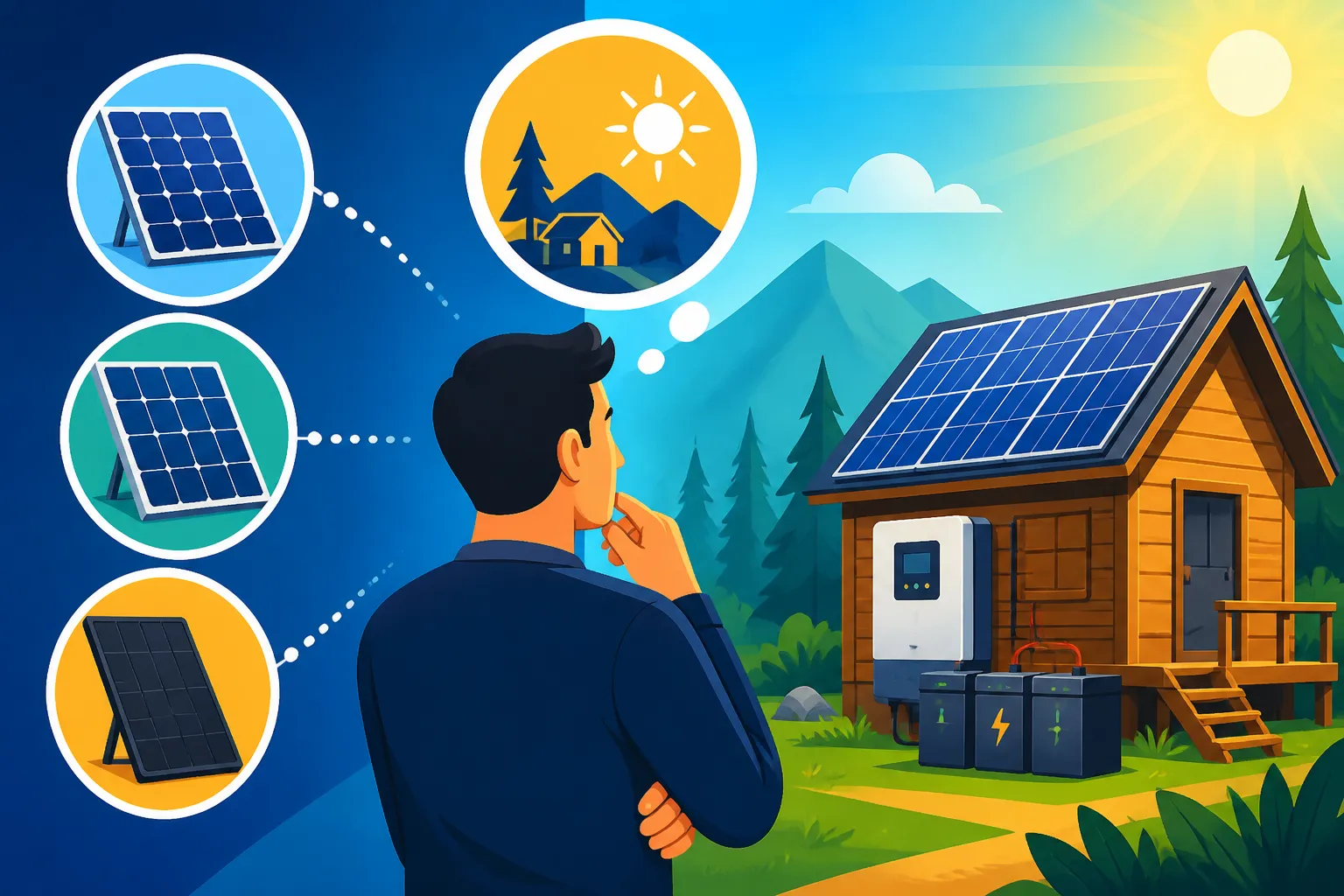
These are often considered the "premium" choice in the solar world, and for good reason. Monocrystalline panels are made from a single, pure crystal of silicon, which gives them their uniform, dark black appearance. Because of their purity and manufacturing process, they are the most efficient type of panel available today, often reaching efficiency rates between 18-22% or even higher. This means they can convert more sunlight into electricity per square foot than other types.
Their high efficiency makes them ideal for situations where space is at a premium, such as on an RV roof, a small cabin, or if you simply want to maximize power generation from a limited area. While they typically come with a higher upfront cost per watt compared to polycrystalline panels, their superior performance can sometimes offset this, especially in applications where every inch of space counts. They generally perform better in lower light conditions and have better temperature coefficients, meaning their efficiency degrades less in high heat. Many reputable brands, like Renogy, offer excellent monocrystalline panels that are popular for off-grid use due to their reliability and performance.
Polycrystalline Solar Panels
Polycrystalline panels are easily recognizable by their speckled, blue appearance. Unlike monocrystalline panels, they are made from multiple silicon crystals fused together. This manufacturing process is simpler and less energy-intensive, which translates to a lower cost per watt for the consumer. While their efficiency is slightly lower than monocrystalline panels (typically 15-17%), they still offer a robust and reliable way to generate power.
For those with ample space, such as a ground-mounted array for a larger off-grid home or a barn, polycrystalline panels can be a very cost-effective choice. You might need a few more panels to achieve the same total wattage as a monocrystalline array, but the lower per-panel cost can make them an attractive option for budget-conscious builders. They are durable and have a proven track record, making them a solid choice if maximum efficiency isn't your absolute top priority or if you're trying to manage your Off-Grid Solar Cost: Complete Breakdown.
Thin-Film Solar Panels
Thin-film panels represent a different approach to solar technology. Instead of silicon crystals, these panels use a very thin layer of photovoltaic material (like amorphous silicon, cadmium telluride, or copper indium gallium selenide) deposited onto a substrate. They are generally less efficient than both mono- and polycrystalline panels, typically ranging from 7-13% efficiency. However, they shine in areas where their unique characteristics are valuable.
Their main advantages are flexibility, lightweight design, and the ability to perform reasonably well in shaded or low-light conditions. This makes them perfect for niche applications: think flexible panels that can conform to the curved roof of a van or boat, or lightweight rollable panels for portable camping setups. They also tend to handle high temperatures better than crystalline panels. While they require a much larger footprint to generate the same amount of power, their versatility and ease of installation in specific scenarios make them an important option in the off-grid world. You can often find a variety of these specialized panels on platforms like Amazon, offering different levels of flexibility and power output to suit various mobile applications.
Here's a quick comparison of the three main types:
| Feature | Monocrystalline | Polycrystalline | Thin-Film |
|---|---|---|---|
| Efficiency | High (18-22%+) | Moderate (15-17%) | Low (7-13%) |
| Appearance | Uniform dark black | Speckled blue | Varies (often flexible, uniform) |
| Cost/Watt | Higher | Moderate | Lower (but needs more space) |
| Space Req. | Less space needed for wattage | More space needed for wattage | Significantly more space needed |
| Temp. Perf. | Good (less degradation in heat) | Moderate | Very good (handles heat well) |
| Low Light Perf. | Good | Moderate | Better (can perform in diffuse light) |
| Flexibility | Rigid | Rigid | Flexible, lightweight |
| Common Use | RVs, small roofs, maximizing power | Large ground mounts, budget systems | Vans, boats, portable, curved surfaces |
Key Panel Specifications and Features to Consider
Once you've wrapped your head around your energy needs and the general types of panels, it's time to dive into the nitty-gritty specifications. These numbers and features aren't just technical details; they tell you how a panel will perform in the real world and how it will integrate with the rest of your system. Ignoring them can lead to compatibility issues or underperformance.
Panel Wattage and Efficiency
The wattage of a solar panel (e.g., 100W, 200W, 400W) tells you its maximum power output under ideal test conditions. This is often the first number people look at, and it's certainly important as it directly relates to how much power your array can generate. However, it's crucial to understand that "ideal test conditions" (STC or Standard Test Conditions) rarely reflect real-world scenarios. Solar panels often perform slightly below their rated wattage due to factors like temperature, angle, and partial shading.
Efficiency is arguably a more telling metric, especially when space is limited. It indicates what percentage of the sunlight hitting the panel is converted into electricity. A 400W panel with 20% efficiency will take up less space than a 400W panel with 16% efficiency. For example, if you're trying to maximize the solar harvest on a small cabin roof, investing in higher efficiency panels means you can generate more power without expanding your footprint. For a great overview of sizing your array, check out our guide on How Many Solar Panels for Off-Grid Living. When comparing panels, don't just look at the wattage; consider the physical dimensions alongside the efficiency rating to understand its true power density.
Voltage (Vmp, Voc) and Amperage (Imp, Isc)
These are critical for system compatibility, particularly with your charge controller.
- Vmp (Voltage at maximum power): This is the voltage at which the panel produces its maximum power. It’s the sweet spot where your panel is most efficient.
- Voc (Open-circuit voltage): This is the maximum voltage the panel can produce when it’s not connected to a load (i.e., not producing current). This number is important because your charge controller needs to be rated to handle this voltage. If your panel's Voc is too high for your charge controller, you could damage the controller.
- Imp (Current at maximum power): This is the current (amperage) the panel produces at its maximum power point.
- Isc (Short-circuit current): This is the maximum current the panel can produce if its positive and negative terminals are directly connected. Like Voc, your charge controller and wiring need to be rated to handle this current.
When connecting multiple panels, understanding these values is paramount for proper wiring. If you're wiring panels in series, the voltages add up (Voc + Voc…), while amperage stays the same. If wired in parallel, amperage adds up (Isc + Isc…), and voltage stays the same. Incorrectly pairing panels with your charge controller based on these values is a common mistake and can prevent your system from charging properly or even damage components. Our guide on How to Choose an Off-Grid Charge Controller delves deeper into this essential compatibility.
Temperature Coefficient
This might sound like a super technical term, but it’s actually incredibly important, especially if you live in a hot climate. Solar panels, counterintuitively, perform less efficiently as they get hotter. The temperature coefficient (usually expressed as %/°C or %/°F) tells you how much the panel's power output will decrease for every degree Celsius (or Fahrenheit) above 25°C (77°F) – the standard test temperature.
For example, a panel with a temperature coefficient of -0.4% per °C means that for every degree above 25°C, its power output will drop by 0.4%. If your panels reach 45°C (a 20°C increase), their output will be 8% lower than their rated wattage. In a hot desert climate like Arizona, panels can easily reach 60-70°C. A lower (closer to zero) negative temperature coefficient is better, indicating less power loss in hot conditions. This is a critical factor often overlooked but can significantly impact your real-world power generation during peak summer months.
Durability and Construction
Off-grid panels often face harsh conditions – scorching sun, heavy snow, high winds, hailstones, and even falling debris. The quality of a panel's construction is paramount for its longevity and performance. Look for panels with sturdy aluminum frames, ideally anodized for corrosion resistance. The front glass should be high-transparency tempered glass, designed to withstand impacts.
The junction box on the back of the panel, where the cables connect, should be rated IP67 or IP68 for excellent dust and water ingress protection. This ensures critical electrical connections remain dry and free from corrosion. Cables themselves should be UV-resistant and properly sized. A well-built panel from a reputable brand like Renogy will typically come with a robust product warranty (usually 10-12 years) and a performance warranty (often 25 years at 80% or 85% of original output), giving you peace of mind that it’s built to last in challenging off-grid environments. Don't skimp on quality here; a cheap, flimsy panel might save you a few bucks upfront, but it could cost you dearly in replacements and lost power down the road.
Physical Considerations for Off-Grid Panel Selection
Beyond the electrical specs, the physical aspects of your solar panels are incredibly important for off-grid living. Where will they go? How much space do you have? How will they handle the elements? These practical questions directly influence the size, weight, and type of panels that will work best for you.
Space and Mounting Options
The amount of available space you have for your solar array is a primary determinant in panel selection. Are you outfitting a small van, a sprawling off-grid homestead, or a tiny hunting cabin? Each scenario presents unique spatial constraints and mounting possibilities. For instance, an RV or van has limited roof space, often shared with vents, air conditioners, and skylights. In these cases, you’ll prioritize higher-efficiency monocrystalline panels to squeeze the most watts out of every square foot. You might also consider flexible thin-film panels if you have a curved roof or need to keep the profile low.
For a stationary off-grid home, cabin, or workshop, you likely have more options. Roof-mounted systems are common, but you need to consider the roof's structural integrity, angle, and sun exposure throughout the day. Ground mounts or pole mounts offer greater flexibility in orientation and tilt angle, which can be critical for maximizing winter sun exposure. Pole mounts, for example, can elevate panels above snow cover or vegetation, and their adjustability allows for seasonal optimization. If you're designing for year-round living, understanding How to Design an Off-Grid Solar System Step by Step will highlight the importance of panel placement and tilt.
Weight and Portability
Weight is a significant factor, especially for mobile off-grid setups. Adding hundreds of pounds of solar panels and racking to the roof of an RV or van can impact fuel efficiency, handling, and even exceed the vehicle's gross vehicle weight rating (GVWR). For these applications, lightweight panels, including some flexible thin-film options, are often preferred. While they may be less efficient per square foot, their minimal weight makes them practical for vehicle integration.
Conversely, if you're setting up a permanent system on a cabin or ground mount, weight is less of a concern. Heavy-duty, rigid glass panels are usually the go-to here because of their superior durability and higher efficiency. For temporary or truly portable needs, like a camping setup or remote worksite, folding or rollable panels that can be easily set up and packed away are ideal. These often connect to portable power stations or solar generators. When considering your overall system, think about the total weight not just of the panels, but the entire mounting system, and whether it aligns with your structural or mobile constraints.
Aesthetics and Appearance
While functionality and performance typically take precedence for off-grid systems, the aesthetics of your solar panels can still be a consideration for some, especially if the panels are highly visible on a residential structure or a prominently placed ground mount. Monocrystalline panels, with their sleek, uniform black appearance, are often considered more aesthetically pleasing and can blend in better with darker roofing materials.
Polycrystalline panels, with their blue speckled look, are distinct and might not appeal to everyone. Thin-film panels, particularly flexible ones, offer a low-profile look that can be nearly invisible on certain surfaces. For many off-gridders, the "look" of their panels is secondary to their performance and cost-effectiveness. However, if you're building a visually integrated system, such as on a custom tiny home or a thoughtfully designed homestead, it’s worth thinking about how the panels will impact the overall visual appeal of your property.
Budgeting and Cost-Effectiveness
Let's be real, price is almost always a factor when building an off-grid system. It's not just about the sticker price of the panels; it's about the long-term value, warranties, and how it all fits into your overall How to Budget for an Off-Grid Solar System. Trying to find the cheapest option upfront can often lead to higher costs down the road through poor performance or early replacement.
Upfront Cost vs. Long-Term Value
When you're looking at solar panels, it's easy to gravitate towards the lowest price per watt. However, this isn't always the most cost-effective approach over the lifespan of your system. High-efficiency monocrystalline panels, for instance, might have a higher initial cost. But if they allow you to generate more power from a smaller footprint, they could save you money on mounting hardware or even prevent you from needing to buy additional panels later. They also often come with better temperature coefficients, meaning they lose less power in the heat, which translates to more energy production over time.
Consider the expected lifespan of the panels. Most quality panels come with a 25-year performance warranty, guaranteeing a certain percentage of their original output. A panel that costs slightly more but maintains a higher output over two decades can be a much better investment than a cheaper panel that degrades faster. It’s a bit like buying a reliable vehicle versus a fixer-upper; the upfront savings might not outweigh the ongoing costs. Investing in quality components from brands known for durability and performance will generally provide a better return on your investment.
Warranties and Support
A solar panel is a long-term investment, so understanding the warranties is absolutely crucial. There are typically two types of warranties for solar panels:
- Product Warranty (or Materials Warranty): This covers defects in manufacturing and materials. It typically ranges from 10 to 12 years, but some premium manufacturers offer 20 or even 25 years. This warranty ensures that the physical panel itself is free from defects.
- Performance Warranty: This guarantees that the panel will produce a certain percentage of its original rated power output for a specified period, usually 25 years. A common performance warranty might state 90% power output after 10 years and 80% after 25 years. This is a critical indicator of the panel's expected degradation rate.
Always read the fine print. What does the warranty actually cover? What are the conditions for a claim? Who handles the claim process? Choosing panels from companies with strong customer support and a track record of honoring their warranties, like Renogy, can save you a lot of grief if something goes wrong. Buying from well-established brands or reputable sellers on platforms like Amazon with good return policies can also add a layer of protection.
DIY vs. Professional Installation Impact on Panel Choice
Your chosen installation method can also influence your panel selection. If you're going the full DIY Off-Grid Solar Installation Step by Step, you might lean towards panels that are more forgiving to work with, or perhaps smaller, lighter panels that are easier to maneuver on a roof or attach to a custom ground mount. DIY kits often come with panels chosen for ease of installation and compatibility with included components.
If you plan to hire a professional installer, they might recommend specific panel brands or types that they are familiar with, have established supply chains for, or that they know integrate well with their preferred inverters and charge controllers. While professional installation adds to the Off-Grid Solar Installation Cost, it can ensure optimal performance and adherence to electrical codes, which might allow you to opt for larger, heavier, or more complex panel arrays without the hands-on burden. Knowing your installation route upfront can streamline your panel selection and prevent costly compatibility headaches.
Matching Panels to Your Off-Grid System Components
Choosing the right solar panels isn't just about the panels themselves; it's about how they integrate seamlessly with the rest of your off-grid power system. Think of it like building a puzzle – every piece has to fit perfectly for the whole picture to make sense. Without proper component matching, even the most expensive, high-quality panels won't perform optimally, or worse, they could damage other parts of your setup.
Compatibility with Charge Controllers
This is perhaps the most critical matching point. Your solar charge controller is the brain that regulates the power flowing from your solar panels to your battery bank, protecting your batteries from overcharging and ensuring they get a proper charge profile. There are two main types of charge controllers: PWM (Pulse Width Modulation) and MPPT (Maximum Power Point Tracking).
- PWM Controllers: These are simpler, more affordable, and effectively act as a switch, connecting and disconnecting the panels to the battery. They work best when the nominal voltage of your solar array roughly matches your battery bank's voltage (e.g., 12V panels for a 12V battery bank). If your panel's voltage is much higher than your battery's, a PWM controller will essentially waste that excess voltage.
- MPPT Controllers: These are more sophisticated and more efficient, especially with higher voltage panel arrays. An MPPT controller can take a higher voltage input from your solar panels and convert it down to the appropriate charging voltage for your batteries, all while maximizing the current. This means you can use panels with a much higher Voc (like common residential 60-cell or 72-cell panels) with a 12V, 24V, or 48V battery bank without losing significant power. For larger systems, MPPT controllers are almost always the better choice, even though they cost more upfront. Our comprehensive guide on MPPT vs PWM Charge Controllers breaks down the nuances of this choice. Always check the maximum input voltage and current ratings of your charge controller before selecting your panels or designing your array.
System Voltage (12V, 24V, 48V)
The overall voltage of your off-grid system (typically 12V, 24V, or 48V DC) significantly influences how you select and wire your solar panels.
- 12V Systems: Common for smaller applications like RVs, vans, or small cabins with minimal loads. You might use individual 12V nominal panels or wire two 6V panels in series.
- 24V Systems: Often used for medium-sized cabins or larger RVs. Panels can be wired in series or series-parallel to achieve 24V nominal output.
- 48V Systems: The standard for larger off-grid homes because higher voltage systems are more efficient, allowing for thinner wiring and reducing voltage drop over longer distances. With 48V, you'll typically wire multiple higher-voltage panels in series to create a higher voltage string that is then fed into an MPPT charge controller.
Choosing your system voltage early in the design process is critical, as it dictates the types of panels you can use and how you’ll wire them. For example, trying to create a 48V system with only 12V nominal panels would require many panels wired in series, which could create a very high voltage string that exceeds some charge controller limits. Conversely, a large 48V system trying to use PWM controllers with mismatched panel voltages would be highly inefficient. For a deeper dive into this decision, refer to our guide on 12V vs 24V vs 48V: Which to Choose.
Battery Bank Integration
Your battery bank is where all the power your panels generate gets stored for later use. The size and type of your battery bank will influence how many panels you need to ensure proper and timely recharging. An undersized solar array for a large battery bank means it will take too long to fully charge, potentially leaving your batteries in a state of partial charge, which can shorten their lifespan, especially for lead-acid batteries.
Conversely, an oversized array for a small battery bank might mean you're generating more power than your batteries can effectively absorb, leading to wasted energy. You need enough panels to not only meet your daily consumption but also to fully recharge your battery bank within a reasonable timeframe, especially considering your days of autonomy and local peak sun hours. If you have a large Cost of an Off-Grid Solar Battery Bank, you'll need ample solar input to keep it topped off. Modern lithium iron phosphate (LiFePO4) batteries can often accept higher charge currents than traditional lead-acid, which means they can benefit more from a robust solar array and efficient MPPT charging.
Disclaimer
The information provided in this guide is for general informational and educational purposes only and is not intended as professional advice. Off-grid solar system design and installation can be complex and involve electrical hazards. Always consult with qualified professionals and adhere to all local codes and regulations before making purchasing decisions or attempting any installation. The author and publisher are not responsible for any actions taken based on the information in this guide.