Cost of a 200W Off-Grid Solar System
Trying to figure out the exact cost of setting up a modest off-grid solar system can feel like deciphering a secret code, especially when you're just looking for enough power to run a few essentials. Many folks want to dip their toes into renewable energy for a cabin, a small RV, or just a reliable emergency backup, but the financial commitment seems daunting. This comprehensive guide is here to unravel the mystery, providing a realistic breakdown of what you can expect to pay for a 200W off-grid solar system, from the individual components to the final setup.
What Can a 200W Off-Grid Solar System Really Power?
Before we dive into the dollars and cents, it's crucial to have a clear picture of what a 200W off-grid solar system can realistically handle. Many people hear "200 watts" and instantly imagine powering their entire house, but in the world of off-grid living, 200 watts refers to the peak power generation capability of your solar panels, not necessarily the constant output or what it can sustain for extended periods. This size is typically perfect for small, intermittent needs or for keeping essential low-draw devices running.
Understanding Daily Energy Needs for Small Loads
To truly understand the capabilities of a 200W system, you need to think in terms of watt-hours (Wh) per day, which is a measure of total energy consumed over time. A 200W solar panel, under ideal conditions (peak sun hours, direct angle, no shading), might generate around 800-1200 Wh per day. For instance, in an area receiving 4-6 peak sun hours daily, a 200W panel could produce 200W * 4 hours = 800 Wh or 200W * 6 hours = 1200 Wh. This figure is critical because it tells you how much energy you have available to charge your batteries and run your devices.
Your daily energy usage calculation is the bedrock of any successful off-grid setup. For a 200W system, we're talking about running things like LED lights for a few hours in the evening, charging phones and laptops, or perhaps powering a small fan or a low-wattage DC refrigerator for a limited time. It's not about running a washing machine or an air conditioner; those require significantly larger systems. If you're looking for guidance on larger setups, our guide on How to Size an Off-Grid Solar System can provide more detailed insights into scaling up.
Common Appliances and Their Wattage
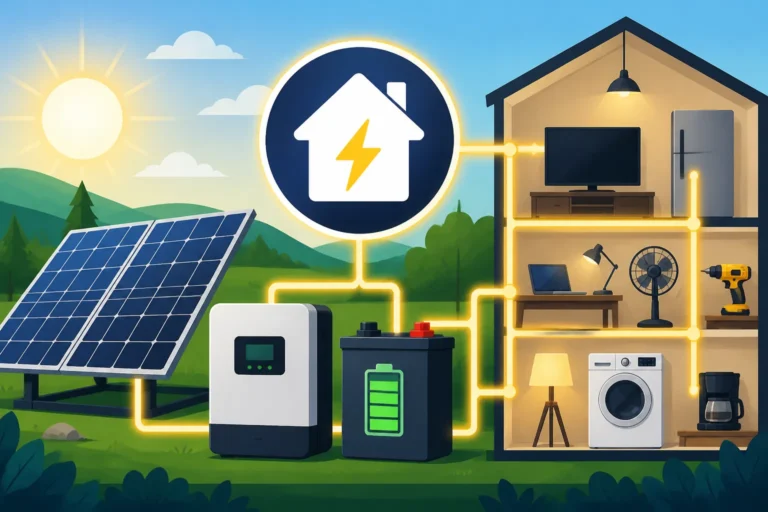
Let's put this into perspective with some common appliances you might want to power with a 200W system:
- LED Lights (5-10W each): You could run several LED bulbs for many hours.
- Phone Charger (5-15W): Easily charges multiple phones daily.
- Laptop Charger (45-90W): Can charge a laptop, but continuous use might drain your battery quickly, especially if the sun isn't shining brightly.
- Small Fan (10-25W): Provides comfortable airflow for several hours.
- Mini Fridge (40-60W running, higher surge): This is where it gets tricky. While the running wattage is low, a mini-fridge cycles on and off throughout the day and has a higher "startup" or "surge" wattage. A 200W system could maintain a small, efficient DC mini-fridge, but it would be a significant drain on your daily energy budget and battery bank.
- Small TV (30-60W): You could watch TV for a few hours, but again, plan your energy use wisely.
It's all about balancing consumption with generation. If you use a device that draws 100W for two hours, that's 200 Wh. If your panel only generates 800 Wh a day, that single activity has consumed a quarter of your available power. Understanding How Much Solar to Run Lights And Electronics is key to managing expectations for smaller systems.
Limitations and Realistic Expectations
A 200W off-grid solar system is best suited for scenarios where energy demands are minimal and consistent. Think about supplemental power for a remote shed, a small camping setup, or keeping communication devices charged during an outage. It's an excellent entry point into off-grid living or for specific, low-power applications. Don't expect to run multiple power-hungry appliances simultaneously or have unlimited power through extended cloudy periods without a much larger battery bank and potentially a backup generator.
One common mistake is underestimating battery needs. Even with 200W of panels, if you want to use power after the sun goes down or on a cloudy day, your battery bank needs to store that energy. Skimping on batteries is a common pitfall. For those interested in understanding the core components and their roles in a larger context, our guide on Off-Grid Solar System Components Explained provides a comprehensive overview.
Breaking Down the Components and Their Costs
When building any off-grid solar system, even a small 200W one, you'll encounter a few core components that are absolutely essential. The cost of these individual pieces can vary wildly based on quality, brand, and where you purchase them. We're talking about everything from the panels themselves to the tiny connectors that tie it all together.
Solar Panels: The Power Harvesters
For a 200W system, you'll typically be looking at one or two solar panels. You might opt for a single 200W panel or two 100W panels wired in series or parallel, depending on your system voltage and space constraints. The cost of solar panels has become incredibly affordable over the years. You can find decent quality monocrystalline panels from brands like Renogy or Rich Solar for anywhere from $150 to $300 for a 200W output. Flexible panels, often used on RVs or boats, tend to be a bit more expensive per watt.
When choosing panels, consider efficiency and durability. Higher efficiency panels will produce more power in a smaller footprint, which can be crucial for a small setup. Look for good reviews and warranties. For more options and details on what to look for, check out our guide on the Best Off-Grid Solar Panels. You can often find good deals on platforms like Amazon, especially for individual panels or small kits.
Charge Controller: The Brain of the System
The charge controller is the unsung hero of your solar system. Its job is to regulate the voltage and current coming from your solar panels, ensuring your batteries are charged safely and efficiently without overcharging. For a 200W system, you have two main types: PWM (Pulse Width Modulation) and MPPT (Maximum Power Point Tracking).
- PWM Controllers: These are simpler and cheaper, typically costing $20 to $50 for a unit suitable for a 200W system. They essentially connect the solar panel to the battery, allowing the panel voltage to drop to match the battery voltage, which means some power is lost.
- MPPT Controllers: These are more sophisticated and efficient, especially in cooler weather or when the panel voltage is significantly higher than the battery voltage. They can extract up to 10-30% more power from your panels compared to PWM. An MPPT controller for a small 200W system might run you $70 to $150. While more expensive upfront, the increased efficiency often makes them worth the investment, extending your power availability and battery life. Understanding the Cost of a Charge Controller can help you weigh your options.
Batteries: The Heart of Off-Grid Power
This is usually the most expensive single component in any off-grid solar system, even a small one. Batteries store the energy captured by your panels for use when the sun isn't shining. For a 200W system, especially if you want to run anything overnight, you'll need at least one good battery.
- Lead-Acid Batteries (AGM/Gel): These are the traditional choice and more budget-friendly upfront. A good 100Ah (amp-hour) 12V AGM battery, which could provide around 500-600 Wh of usable power (as you shouldn't discharge them below 50%), might cost $150 to $300. They are heavier and have a shorter cycle life than lithium options.
- LiFePO4 (Lithium Iron Phosphate) Batteries: These are quickly becoming the standard due to their longer lifespan (thousands of cycles), lighter weight, and ability to be discharged deeper (80-100%) without damage. A 100Ah 12V LiFePO4 battery, offering significantly more usable energy than an AGM, can cost anywhere from $300 to $600. While the initial investment is higher, their longevity often makes them more cost-effective in the long run. If you're comparing options, our guide on the Cost of an Off-Grid Solar Battery Bank can give you a deeper dive into battery pricing. For a 200W system, one 100Ah 12V LiFePO4 battery is a fantastic starting point. For example, brands like Battle Born or EG4 offer high-quality options, but you can find more budget-friendly alternatives from providers often sold on Amazon.
Inverter: Converting DC to AC Power
Unless you're running only DC appliances (like specific RV or marine lights and some fridges), you'll need an inverter to convert the DC (direct current) power from your batteries into usable AC (alternating current) power for standard household electronics.
For a 200W system, you likely won't need a massive inverter. A 500W to 1000W pure sine wave inverter is usually more than enough and provides clean power, safe for sensitive electronics.
- Pure Sine Wave Inverters: Recommended for virtually all electronics, these typically cost $70 to $150 for a smaller 500W-1000W model. Brands like Victron Energy or AIMS Power offer robust options, but simpler models are readily available.
- Modified Sine Wave Inverters: Cheaper ($30 to $80 for a small one), but they produce a "choppier" waveform that can damage sensitive electronics or cause motors to run less efficiently. We generally advise against them unless you're absolutely sure all your devices can handle it. Our article on the Cost of an Off-Grid Solar Inverter delves into these options further.
Wiring, Connectors, and Mounting Hardware
These often-overlooked items are crucial for safety and functionality. Don't skimp here!
- Cables: You'll need appropriate gauge solar PV cable to connect panels to the charge controller, and thicker battery cables to connect the charge controller to the batteries and the inverter. High-quality, properly sized cables minimize voltage drop and reduce fire risk. Expect to spend $30 to $80 on various lengths and gauges.
- Connectors (MC4, ring terminals): MC4 connectors are standard for solar panels, and ring terminals are used for battery connections. These are generally inexpensive, perhaps $10 to $20.
- Fuses and Breakers: Essential safety devices to protect your system from overcurrents. A small fuse block or a few inline fuses and circuit breakers could cost $20 to $50.
- Mounting Hardware: If you're permanently installing your panels, you'll need brackets or a small racking system. For an RV or cabin roof, Z-brackets or simple tilt mounts are common, costing around $20 to $60. For more robust ground mounts, the cost could be higher, but for 200W, it's usually minimal.
Factors Influencing the Total Cost
Beyond the basic components, several other elements can significantly sway the overall price tag of your 200W off-grid solar system. These are crucial considerations that will help you budget effectively and avoid unexpected expenses.
DIY vs. Pre-Built Kits
This is perhaps the biggest decision that impacts cost. Going the DIY route allows you to select individual components, often finding better deals and customizing the system exactly to your needs. This is generally the most cost-effective approach if you have the knowledge and willingness to learn. You could potentially assemble a basic 200W system for $700 to $1,500 by sourcing parts yourself.
On the other hand, pre-built off-grid solar kits offer convenience. They come with all the major components matched and often include most of the necessary wiring and connectors, reducing the guesswork. Brands like Renogy and Jackery (especially their power stations with integrated panels) offer various kits. While simpler to set up, they typically come at a premium, often costing $800 to $2,000+ for a comparable 200W system. Our article on DIY vs Professional Off-Grid Solar Cost explores these options in much greater detail, highlighting the pros and cons of each.
Component Quality and Brand Choice
Just like with anything else, there's a spectrum of quality in solar components. Opting for cheaper, no-name brands might save you money upfront, but it often comes with trade-offs in efficiency, durability, and warranty support. A low-cost charge controller might fail prematurely, or an inexpensive inverter might not deliver clean power, potentially damaging your devices.
Investing in reputable brands like Victron Energy for charge controllers and inverters, or Battle Born for LiFePO4 batteries, generally means higher initial costs but offers peace of mind through better performance, reliability, and customer service. For a 200W system, you don't necessarily need top-tier industrial-grade equipment, but finding a balance between cost and quality is key. Many mid-range brands on platforms like Amazon strike a good balance, offering decent quality at competitive prices. For further insights into kit pricing, check out Off-Grid Solar Kit Price Ranges.
Installation Complexity and Additional Needs
For a simple 200W system, installation can be quite straightforward. If you're mounting a single panel on an RV roof or setting up a portable system for camping, the complexity (and thus, additional costs) is minimal. However, if your setup requires running long cable runs, securing panels in a challenging location, or integrating with an existing electrical system (even a small one in a cabin), you might incur extra expenses.
These could include heavier gauge wire for longer runs to prevent voltage drop, specialized mounting hardware, or even the cost of an electrician if you're uncomfortable with wiring yourself. Always factor in potential unforeseen challenges, especially if you're venturing into more permanent installations. Even for a small system, having proper fusing and disconnects is critical for safety and compliance with any local regulations, although permits are generally not required for such small, portable, or temporary setups.
Real-World Cost Estimates and Examples
Let's put some numbers together and look at a few hypothetical scenarios for a 200W off-grid solar system, illustrating how your choices influence the final price. Remember, these are estimates, and actual prices can fluctuate based on sales, specific brands, and your location.
| Component | Budget DIY (PWM, Lead-Acid) | Mid-Range DIY (MPPT, LiFePO4) | Basic Kit (Portable/Entry) |
|---|---|---|---|
| Solar Panel(s) | $150 (2x100W or 1x200W) | $250 (2x100W or 1x200W) | Included ($250-400 value) |
| Charge Controller | $30 (PWM) | $100 (MPPT) | Included |
| Battery | $150 (100Ah 12V AGM) | $400 (100Ah 12V LiFePO4) | Included (e.g., Jackery/Bluetti) |
| Inverter | $50 (500W Pure Sine) | $100 (750W Pure Sine) | Included |
| Cables/Fuses/Mount | $50 | $70 | Minimal/Included |
| Total Estimated Cost | $430 – $500 | $920 – $1,000 | $800 – $1,500 |
Note: "Included" in the Basic Kit column means the power station integrates these components. The cost listed is for the combined unit.
Budget-Friendly 200W Setups
For those looking to keep costs as low as possible, a budget-friendly DIY approach is the way to go. You'd likely start with one or two basic 100W or 200W monocrystalline panels. Pair that with an affordable PWM charge controller, a single 100Ah 12V AGM deep cycle battery, and a smaller pure sine wave inverter (around 500W). You can often find decent entry-level components on Amazon.
This setup is perfect for powering LED lights, charging small electronics, and perhaps running a small fan for a few hours. It's a fantastic way to test the waters of off-grid living without breaking the bank. The total cost, including basic wiring and mounting, could hover around $400 to $600. While it works, remember AGM batteries require more maintenance and have a shorter lifespan compared to their lithium counterparts. If you're interested in really stretching your budget, our guide on How to Save Money on an Off-Grid Solar Build offers even more tips.
Mid-Range Options for Increased Reliability
Stepping up a bit in budget allows for significant improvements in efficiency and longevity. For a mid-range 200W system, you'd upgrade to an MPPT charge controller, which will extract more power from your panels, especially in varying weather conditions. The biggest upgrade here would be to a 100Ah 12V LiFePO4 battery. This significantly boosts your usable energy capacity and provides a much longer cycle life, meaning fewer battery replacements down the line.
With these upgrades, your daily power availability will be more consistent, and your system will be more robust. The total for this type of DIY setup, using quality but not necessarily top-tier components, might fall in the $900 to $1,300 range. This is a popular choice for small cabins or RVs where consistent, reliable power for essential items is important. Brands like EcoFlow and Bluetti also offer all-in-one solar generators in this power range, often bundled with a 200W foldable solar panel, offering a turnkey solution for around $1,000-$1,500. For specific recommendations, check out the Best Off-Grid Solar Batteries.
Considering Future Expansion
Even with a modest 200W system, it's wise to think about future needs. If you anticipate wanting more power down the line, consider building your initial system with components that can be expanded. For instance, investing in an MPPT charge controller that can handle more wattage than your current panels, or choosing a battery that can be easily paralleled with another of the same type.
While a 200W system is great for entry-level use, many people eventually discover they need more power, perhaps for a larger refrigerator, a microwave, or extended use of power tools. Planning for expansion upfront, even if it means a slightly higher initial cost, can save you money and headaches in the long run. Our article on the Cost of Expanding an Off-Grid System dives deep into the considerations for growing your solar setup. A good starting inverter, for example, might be a 1000W model even if you only run 200W of loads, giving you headroom for future appliances.
Disclaimer
The information provided in this article is for general informational purposes only and does not constitute professional advice. Off-grid solar system design and installation can be complex and should be approached with caution. Always consult with qualified professionals for specific system design, electrical work, and to ensure compliance with all local codes and safety regulations. Prices and product availability are subject to change.