How to Do an Off-Grid Load Analysis
One of the biggest headaches when dreaming of going off-grid is figuring out just how much power you actually need. It’s a frustrating tightrope walk, isn't it? You don't want to spend a fortune on an oversized system that's overkill, but you also dread the thought of constantly running out of juice or dimming the lights just to keep the fridge cold. This comprehensive guide is here to cut through that confusion, walking you step-by-step through the crucial process of conducting an off-grid load analysis, ensuring your future system meets your real-world energy demands.
Why a Load Analysis is the Cornerstone of Off-Grid Living
Before you even start thinking about solar panels, batteries, or inverters, you absolutely must understand your energy consumption. It’s like trying to build a house without knowing how many rooms you need or how big they should be; you’re just guessing, and guesses often lead to disappointment or massive overspending. A thorough load analysis is the foundational step that ensures your off-grid solar system is perfectly tailored to your lifestyle and energy habits.
Avoiding Common Mistakes and Budget Blunders
Many folks, in their eagerness to go off-grid, jump straight to buying a "kit" or sizing their system based on vague assumptions. This is a common pitfall that can lead to significant financial strain and endless frustration. Imagine investing thousands in an off-grid system, only to find that your morning coffee maker trips the inverter, or your battery bank is depleted by noon because you underestimated your daily usage. These scenarios are not just inconvenient; they're expensive lessons. An accurate load analysis helps you avoid these costly mistakes by providing a clear, data-driven picture of what your system truly needs. Without it, you're essentially gambling with your hard-earned money, and the stakes are pretty high when it comes to something as essential as your power supply. It also prevents the opposite problem: overspending on components you don't actually need, like an inverter that's far too large for your peak load, or a battery bank with excessive capacity. Every dollar counts when you're making such a significant investment, and precise planning keeps your budget grounded in reality.
Ensuring Reliability and Comfort
The whole point of going off-grid is often to gain independence and a sense of security, right? But that security evaporates if your power flickers out every time a cloud passes overhead, or if you have to meticulously ration every watt-hour. A well-executed load analysis is your ticket to a reliable and comfortable off-grid experience. It allows you to design a system that not only meets your everyday demands but also has enough reserve capacity to handle those cloudy days, unexpected guests, or periods when you need a little more power than usual. This means being able to run your well pump when you need water, keep your food cold in the refrigerator, and enjoy your evening lights without constantly checking the battery monitor. It’s about building a system that disappears into the background, allowing you to live your life without constant energy anxiety. Knowing your precise energy needs empowers you to choose the right How Many Batteries for an Off-Grid System and How Many Solar Panels for Off-Grid Living to ensure consistent power availability.
Future-Proofing Your System
Life changes, and so do energy demands. Perhaps you're starting with a small cabin, but envision adding a workshop in a few years. Or maybe you're planning for an RV adventure now, but know you'll eventually want to upgrade to a more permanent tiny home. A comprehensive load analysis isn't just about your current needs; it's also about anticipating future ones. By carefully documenting your baseline usage and then projecting potential additions (like an electric water heater, a small air conditioner, or power tools for a new hobby), you can design an expandable system. This foresight saves you considerable time and money down the road. Instead of having to rip out and replace undersized components, you can choose an inverter with a bit of headroom, or a charge controller that can handle more panels later. This forward-thinking approach means your initial investment continues to serve you well, even as your off-grid dreams evolve.
Deconstructing Your Daily Energy Habits
The most challenging part of a load analysis for many people is realizing just how many devices they rely on daily, and how much power each one actually draws. It’s easy to overlook things that seem insignificant, but these small drains can add up surprisingly fast when you're trying to manage a finite energy supply. This section is all about shining a light on those hidden energy consumers and getting a true picture of your power footprint.
Identifying All Your Appliances and Devices
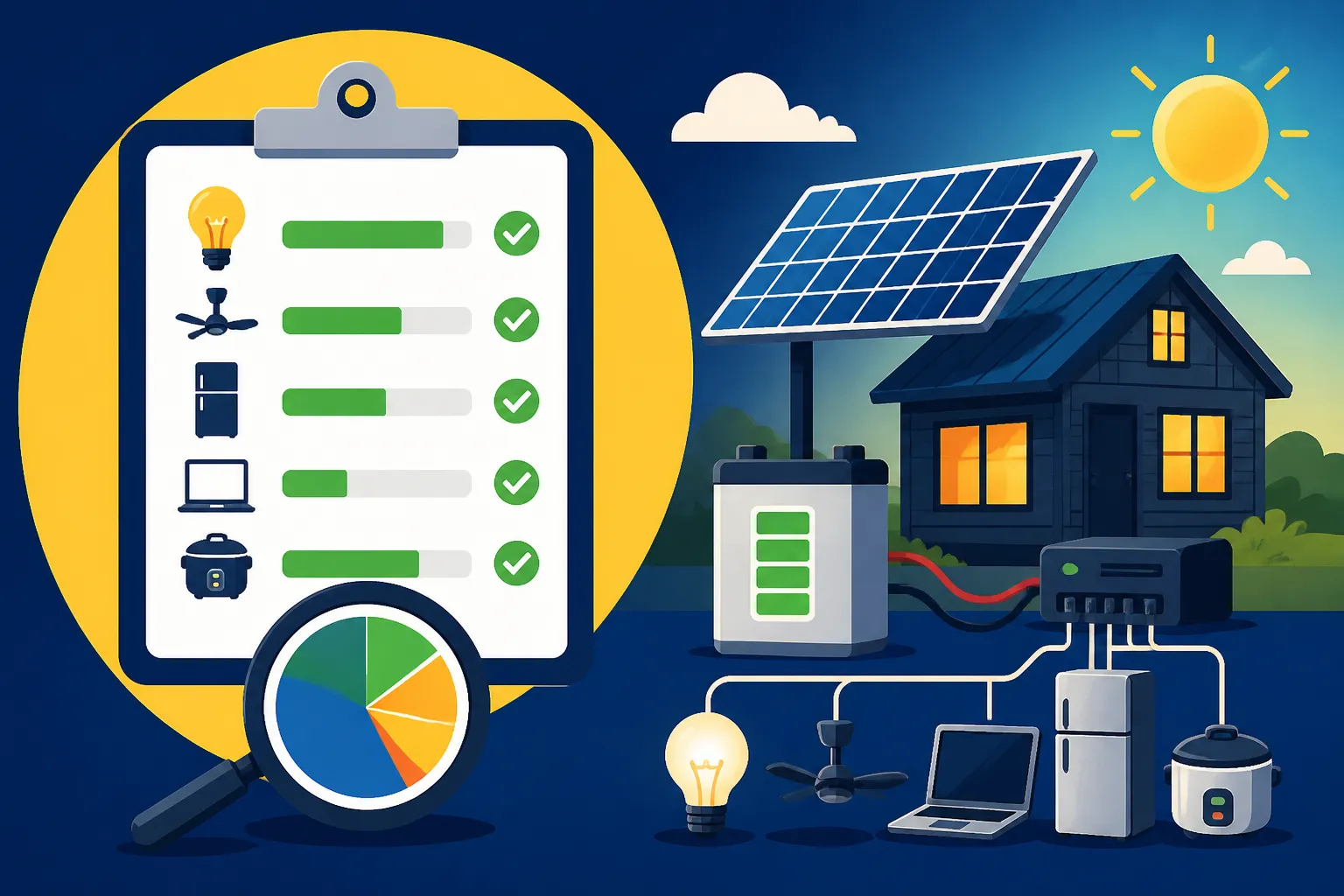
This is where the detective work truly begins. Grab a notepad or open a spreadsheet – this is going to be your inventory list. Walk through your entire living space, whether it's an RV, a cabin, or a full-sized off-grid home. Don't leave anything out, no matter how small or infrequently used it seems. Think about:
- Kitchen: Refrigerator, freezer, microwave, coffee maker, toaster, blender, instant pot, electric kettle, air fryer, dish washer.
- Living Area: Television, stereo system, gaming console, streaming devices (Roku, Apple TV), laptop, phone chargers, lamps.
- Bedroom: Alarm clock, electric blanket, CPAP machine, phone chargers, night lights.
- Bathroom: Hair dryer, electric toothbrush, curling iron, water pump for well/tanks.
- Utility/Laundry: Washing machine, dryer, vacuum cleaner, iron, water heater (if electric), furnace fan, ventilation fans.
- Workshop/Outdoor: Power tools (drills, saws, grinders), air compressor, well pump, security cameras, outdoor lighting, electric fence chargers, golf cart charger.
- Miscellaneous: Wi-Fi router, modems, medical equipment, electric vehicle chargers, electric gates.
For each item, try to find the wattage. Most appliances have a label on the back or bottom that states its power consumption in watts (W) or amps (A). If it's in amps, you'll also need to know the voltage (V) to convert it to watts (Watts = Amps x Volts). Don't forget to list things that might seem trivial, like that small fan you run all night or the charger for your laptop. Every single device contributes to your total energy draw, and missing even a few can throw your calculations off significantly. This meticulous listing is the first essential step in creating an accurate Off-Grid Solar Load Calculation Explained.
Understanding Appliance Wattage and Run Times
Once you've identified all your appliances, the next critical step is to understand not just what they draw, but how much and for how long each day. This is where the real nuance of a load analysis comes in. A high-wattage appliance might only run for a few minutes a day, while a low-wattage device could be running for hours. It’s the combination of these factors that determines your total daily energy footprint.
Take your refrigerator, for example. It's often one of the biggest energy consumers in an off-grid setup. While its compressor might only kick on for 15-20 minutes out of every hour, it does that repeatedly throughout the day and night. So, if your fridge is rated at 150 watts, and its compressor runs for a total of 8 hours over a 24-hour period, that's 150W * 8 hours = 1200 Watt-hours (Wh) per day. The trick is to estimate the actual run time for each cycle, not just the wattage on the label, and then multiply that by the number of times it runs in a day. For things like lights or a TV, it's usually simpler: estimate how many hours you use them daily. A 10W LED bulb used for 5 hours is 50Wh. A laptop charging for 3 hours at 60W is 180Wh. Being realistic about these run times is paramount. Don't sugarcoat it; if you watch 4 hours of TV on a rainy day, that's what you need to factor in. This diligent tracking helps you figure out How to Calculate Daily Energy Usage accurately.
Accounting for Phantom Loads and Peak Surges
Here's where many people get tripped up: phantom loads and peak surges. These are the sneaky energy consumers that can wreck an otherwise perfectly planned system.
Phantom Loads (Vampire Draw): These are devices that consume electricity even when they appear to be "off" or in standby mode. Think about your TV that's plugged in but not actively being watched, your phone charger that's still drawing power even when your phone isn't connected, or your microwave display. Modern electronics with digital clocks, remote sensors, or "instant-on" features are notorious phantom load culprits. While each might only draw a few watts, collectively, they can add up to a significant drain over 24 hours. A small phantom load of 5 watts running continuously is 120 Wh per day, which is equivalent to running two LED light bulbs for several hours. This is particularly critical in an off-grid system where every watt-hour is precious. You can often measure these with a Kill-A-Watt meter, and they’re a strong argument for unplugging devices or using power strips with on/off switches.
Peak Surges (Starting Watts): This is another often-overlooked factor. Many motorized appliances, like refrigerators, well pumps, power tools, or even some washing machines, draw a significantly higher amount of power for a brief moment when they start up compared to their continuous running wattage. This initial surge, known as "starting watts" or "surge watts," can be 2-3 times, or even up to 7-10 times, their running watts. For instance, a refrigerator that runs at 150W might momentarily spike to 800-1000W when the compressor first kicks on. If your inverter isn't sized to handle these surges, it will simply trip and shut down, leaving you without power. It's crucial to identify which of your appliances have significant starting surges and factor their peak wattage into your inverter sizing calculations. This is a critical distinction to understand when dealing with Watts vs Watt-Hours vs Amp-Hours Explained for your system components.
The Step-by-Step Process of Your Off-Grid Load Analysis
Now that we've covered the "why" and the conceptual "what," let's get down to the nitty-gritty of how to actually perform your off-grid load analysis. This is where you transform your energy habits into concrete numbers that will guide your system design. It requires a bit of diligence, but trust me, the effort here will save you countless headaches and potential expenses later on.
Gathering Data on Each Appliance
This is the phase of data collection. For every single item on your comprehensive list, you need to collect specific information. Don't skip this part!
- Appliance Name: Self-explanatory, e.g., "Main Refrigerator," "Laptop Charger," "LED Reading Lamp."
- Rated Wattage (W): Look for the label on the appliance itself. It might say "Input: 120V, 1.5A" or "Power: 180W." If it's in amps (A), multiply amps by voltage (V) to get watts (W = A x V). If it only lists a range (e.g., 100-240V, 0.5-1A), use the higher end for safety. For heating elements like toasters or hair dryers, these are usually their running watts.
- Starting/Surge Wattage (W): For motor-driven appliances (refrigerators, pumps, blenders, power tools), you need to estimate or measure their starting wattage. Often, this isn't listed. You can find typical surge factors online (e.g., a fridge might surge at 5x running watts). If possible, use a Kill-A-Watt meter to get a more accurate reading. This number is crucial for correctly sizing your inverter.
- Daily Run Time (Hours/Day): This is an honest estimate of how many hours (or even minutes, which you convert to decimal hours) each device will be actively consuming power in a typical 24-hour period. For intermittent appliances like a refrigerator, estimate the total time its compressor runs per day. For lights, estimate how many hours they are on. For chargers, how long are they actively charging? For power tools, how long are you actually using them?
- Frequency of Use: Is it used daily? Weekly? Seasonally? This helps put the "daily run time" into context and allows for adjustments later on.
It can be helpful to organize this data in a spreadsheet. This makes it easy to total everything up and make adjustments as you refine your understanding. Many off-grid enthusiasts rely on tools found on Amazon for this, like a simple digital scale for measuring appliance weight (just kidding, but a Kill-A-Watt meter is a serious recommendation!).
Calculating Daily Watt-Hours (Wh)
Once you have your data, the next step is to calculate the daily energy consumption for each appliance. This is expressed in Watt-hours (Wh). The formula is simple:
Daily Watt-hours (Wh) = Rated Wattage (W) x Daily Run Time (Hours/Day)
Let’s run through a few examples:
- Refrigerator: 150W (running) x 8 hours/day = 1200 Wh/day
- LED Light Bulb: 10W x 5 hours/day = 50 Wh/day
- Laptop Charging: 60W x 3 hours/day = 180 Wh/day
- Microwave: 1000W x 0.1 hours/day (6 minutes) = 100 Wh/day
- Well Pump: 750W x 0.5 hours/day (30 minutes of pumping) = 375 Wh/day
Repeat this for every single item on your list. Be diligent, even for things that seem small. Those small numbers add up. This calculation helps you determine exactly How Many Watt-Hours You Use Per Day, which is a critical piece of information for sizing your battery bank.
Summing Up Your Total Daily Energy Consumption
After calculating the daily Watt-hours for every appliance, you’ll simply add all those numbers together. This grand total is your estimated Total Daily Energy Consumption in Watt-hours (Wh). This is the single most important number you'll get from your load analysis, as it dictates the overall size of your off-grid solar system.
Let's say, after adding everything up, your total comes to 5,000 Wh per day. This is your baseline. This number will be the starting point for determining the capacity of your battery bank and the size of your solar array. It's often helpful to keep a separate column for "peak instantaneous load" – the highest possible wattage if several high-draw appliances (like the microwave and a power tool) were to run simultaneously. This helps confirm your inverter sizing.
Considering Seasonal Variations and Future Needs
This is where realism truly comes into play. Your energy consumption isn't static; it fluctuates based on the season and your evolving needs.
-
Seasonal Variations: Think about how your usage changes throughout the year.
- Winter: Shorter daylight hours mean less solar production, but often higher energy demands for heating (if electric fans are used), more indoor lighting, and perhaps more indoor activities (TV, computer). You might need to size for lower sun exposure or higher usage during this period. For example, if you live in a colder climate, you might be interested in knowing about Off-Grid Solar Cost in Cold Climates.
- Summer: Longer days mean more solar production. However, you might be running fans or even air conditioning, which are significant power hogs. Outdoor lighting and irrigation pumps might also see increased use.
- Shoulder Seasons: Spring and fall might be milder, with moderate demands.
It's wise to perform your load analysis for your highest expected usage period, usually winter or summer depending on your climate and lifestyle.
-
Future Needs: As mentioned before, think about growth. Are you planning to add more people to your household? Install a water pump for a new garden? Get a larger fridge? Buy an electric vehicle? Budgeting for a little extra capacity from the start can save you money and effort later. Consider adding 10-20% to your total daily Wh for contingencies and future expansion. This buffer ensures you have some wiggle room and don't immediately outgrow your system. This forward-thinking approach is key to designing an How to Design an Expandable System.
Tools and Techniques for Accurate Load Measurement
While guesstimating based on appliance labels and typical run times is a good starting point, nothing beats actual measurement. There are some fantastic tools available that can give you precise data on your actual power consumption, taking the guesswork out of the equation. Investing a little in these tools now can save you a lot of money and regret down the line.
Using Kill-A-Watt Meters and Smart Plugs
One of the most invaluable tools for any aspiring or current off-gridder is a Kill-A-Watt meter (or similar power meter). These simple devices plug into any standard wall outlet, and then you plug your appliance into the meter. It will display real-time information such as:
- Watts (W): The instantaneous power draw of the appliance. You can see the running wattage and, crucially, the surge wattage when a motor-driven device starts up.
- Volt-Amps (VA): Another measure of apparent power.
- Watt-Hours (Wh): The total energy consumed over a period. This is incredibly useful as you can leave it plugged in for 24 hours or longer to get an accurate daily consumption figure for intermittent appliances like refrigerators.
- Amps (A): The current draw.
- Voltage (V): The voltage supplied by the outlet.
By using a Kill-A-Watt meter on your most critical or variable appliances (fridge, freezer, microwave, well pump, TV, computer), you can get real-world data rather than relying solely on manufacturer specs, which can sometimes be optimistic. Many models are available from retailers like Amazon and are relatively inexpensive, making them a wise investment.
Smart plugs are another modern convenience that can help, particularly for tracking cumulative daily usage. Many smart plugs, often controlled via a smartphone app, offer energy monitoring features. You can plug an appliance into a smart plug, and over days or weeks, the app will log its power consumption, giving you an excellent historical record of its daily, weekly, or monthly Watt-hours. This is especially good for phantom loads or devices with inconsistent usage patterns.
Leveraging Online Calculators and Spreadsheets
Once you've gathered your raw data, whether through estimations or actual measurements, you need a way to organize and crunch those numbers. This is where spreadsheets and online calculators become your best friends.
Spreadsheets (like Google Sheets or Microsoft Excel): These are fantastic for creating a detailed and customizable load analysis. You can create columns for:
- Appliance Name
- Rated Watts (W)
- Surge Watts (W)
- Daily Run Time (Hours)
- Daily Watt-Hours (Wh) (calculated automatically:
Watts * Hours) - Notes (e.g., "Seasonal use," "Always unplug when not in use")
A well-designed spreadsheet allows you to easily total your daily Watt-hours, calculate your peak instantaneous load, and even factor in different scenarios (e.g., "winter usage" vs. "summer usage"). There are many free templates available online that you can adapt to your specific needs. This systematic approach forms the basis of How to Calculate Off-Grid Solar Needs.
Online Off-Grid Solar Calculators: While not a replacement for a detailed spreadsheet, many reputable solar companies and off-grid resources offer online calculators. These tools allow you to input your appliance list and estimated run times, and they will often output suggested system sizes for panels, batteries, and inverters. Brands like Renogy and others often provide these on their websites as a helpful starting point. While convenient, always cross-reference their suggestions with your own calculations, as these calculators sometimes use generalized assumptions that might not perfectly match your unique situation. They can, however, give you a good sanity check and help you visualize the system components.
When to Consult with an Expert
Even with all the tools and detailed steps, designing an off-grid system, especially for a full-time residence or a complex setup, can be daunting. There are nuances in wiring, component compatibility, safety codes, and optimization that might be beyond the scope of a DIY approach for some.
- Complex Systems: If you're planning a large system for a whole home with multiple circuits, high-demand appliances (like central air conditioning or electric ranges), or unique geographical challenges (heavy shading, extreme weather), a professional consultation is highly recommended.
- Safety and Code Compliance: Electrical work, particularly high-voltage DC and AC systems, carries inherent risks. An expert can ensure your system is safely designed, properly grounded, and complies with local electrical codes (even off-grid properties may have requirements).
- Optimization: Professionals can help optimize your system for maximum efficiency, considering factors like panel tilt, orientation, wire sizing, and battery cycling to extend component life and performance.
- Troubleshooting and Support: Having a professional design your system often comes with ongoing support and troubleshooting assistance, which can be invaluable.
While DIY is a rewarding path for many, knowing when to call in the pros can save you from costly mistakes or, more importantly, dangerous situations. A professional can help ensure you’re making the best choices, especially when considering the significant Off-Grid Solar Installation Cost and the intricacies of Off-Grid Solar System Design Basics.
Interpreting Your Load Analysis for System Sizing
Once you've done the hard work of meticulously tracking and calculating your energy consumption, you're sitting on a goldmine of information. This is where the numbers from your load analysis start to translate directly into the specific components you'll need for your off-grid solar system. It’s about matching your energy demand with the right supply and storage.
Translating Watt-Hours into Battery Bank Needs
Your total daily Watt-hours (Wh) is the primary number for sizing your battery bank. The battery bank is your energy reservoir, storing the power generated by your solar panels for use when the sun isn't shining.
Here’s a basic breakdown of the process to calculate How Much Battery Capacity You Need:
- Determine Days of Autonomy: This is how many days you want your battery bank to be able to power your home without any solar input (e.g., during prolonged cloudy weather or winter). A common starting point is 2-3 days, but some prefer 5+ days for ultimate peace of mind, especially in areas with frequent bad weather.
- Factor in Depth of Discharge (DoD): Batteries perform best and last longest when you don't fully drain them.
- Lead-Acid Batteries (AGM, Gel): Typically, you should only discharge these to 50% DoD to maximize their lifespan. So, if you need 5000 Wh, you'd need batteries that store 10,000 Wh.
- Lithium Iron Phosphate (LiFePO4) Batteries: These are far more forgiving and can generally be discharged to 80-90% DoD without significant harm, and sometimes even 100% (though 80% is a conservative, life-extending recommendation). If you need 5000 Wh, you'd need batteries that store around 5500-6250 Wh.
- Account for Inverter Efficiency: Your inverter, which converts DC battery power to AC household power, isn't 100% efficient. It typically operates at 85-95% efficiency. You'll need to slightly oversize your battery bank to compensate for this energy loss. Divide your total needed Watt-hours by the inverter's efficiency (e.g., 5000 Wh / 0.90 = 5556 Wh).
The Calculation:
(Total Daily Wh needed x Days of Autonomy) / (Battery DoD %) / (Inverter Efficiency %)= Usable Battery Capacity in Wh
Once you have the total Watt-hours needed for your battery bank, you'll need to convert that into Amp-hours (Ah) at your chosen system voltage (12V, 24V, or 48V).
Total Battery Wh / System Voltage (V)= Total Battery Ah
For example, if you need 10,000 Wh of usable battery capacity and are building a 48V system, you'd need approximately 208 Ah (10,000 Wh / 48V = 208.3 Ah). This is the key to knowing How to Size an Off-Grid Battery Bank.
Determining Solar Panel Array Size
Your solar panel array needs to generate enough power to recharge your battery bank fully each day, while also ideally covering any direct loads (appliances running when the sun is out). This calculation is heavily dependent on your peak sun hours, which refers to the equivalent number of hours per day when the sun's intensity averages 1,000 watts per square meter. This varies significantly by location and season.
- Identify Your Lowest Peak Sun Hours: Look up the average peak sun hours for your specific location during your lowest solar production month (usually winter). Many online resources or solar maps provide this data. Let's say it's 3 peak sun hours in December.
- Calculate Total Daily Energy Need: Use your total daily Watt-hours from the load analysis, plus the energy needed to compensate for battery and inverter losses. Let's say, after losses, you need to put 6,000 Wh into your batteries daily.
- Factor in System Losses: Solar panels aren't 100% efficient, and there are losses in wiring, charge controllers, and temperature. A general rule of thumb is to add 20-30% to your required production to account for these inefficiencies.
- Calculate Panel Watts Needed:
(Total Daily Wh needed (including losses)) / Lowest Peak Sun Hours= Minimum Solar Panel Array Watts
So, if you need 6,000 Wh and have 3 peak sun hours, and add 25% for losses:
6,000 Wh / 3 hours = 2,000 W2,000 W * 1.25 (for losses) = 2,500 W
You would need approximately 2,500 watts of solar panels. Then you simply divide that by the wattage of individual panels (e.g., 2500W / 400W panels = 6.25 panels, so 7 panels). This detailed calculation helps you determine How Much Solar to Charge Your Batteries Daily and ultimately How Many Solar Panels for Off-Grid Living.
Selecting the Right Inverter and Charge Controller
These components are the brains and brawn of your electrical system, and their sizing directly depends on your load analysis.
Inverter Sizing: The inverter converts your battery's DC power into usable AC power for your appliances. It needs to be sized for two key values:
- Continuous Power: This is the total wattage of all AC appliances you expect to run simultaneously on a regular basis. Add up the running watts of everything you might have on at the same time. If your combined running load is 2,000W, you'll want an inverter with at least a 2,000W continuous rating, but often a bit more (e.g., 2500-3000W) for a safety margin.
- Surge Power: This is critical. Your inverter must be able to handle the highest starting wattage of any single appliance, or the combined surge of a couple of major appliances that might kick on simultaneously (e.g., fridge and well pump). If your well pump surges to 3,000W, your inverter needs to have a surge rating of at least 3,000W, even if its continuous rating is lower. Many quality inverters, like those from Victron or [Sol-Ark], have robust surge capabilities. Always choose an inverter that can comfortably handle both your continuous and surge loads. This will directly inform you on How to Size an Off-Grid Inverter.
Charge Controller Sizing: The charge controller manages the power flow from your solar panels to your batteries, ensuring safe and efficient charging. Its size depends on:
- Total Panel Wattage: The controller needs to be able to handle the maximum current and voltage produced by your solar array.
- System Voltage: Your charge controller must match your battery bank's voltage (12V, 24V, or 48V).
- Panel Configuration (Series/Parallel): This affects the voltage and current coming from your array. For example, if you have a 2500W array and a 48V battery bank, and your panels are wired to produce a high voltage string, you would typically use an MPPT charge controller that can handle the higher voltage and convert it efficiently down to your battery voltage. The charge controller's current rating (amps) needs to be sufficient to handle the total current from your array. For example,
(Total Panel Watts / Battery Voltage) * 1.25 (safety factor)gives you the minimum amp rating for your charge controller. Selecting the correct charge controller is vital, and understanding How to Size a Charge Controller is a key aspect of system design.
Here's a quick reference table for common appliance wattages and estimated daily usage for a small cabin or RV scenario:
| Appliance | Rated Wattage (W) | Typical Daily Run Time (Hours) | Daily Watt-Hours (Wh) | Notes | Peak Surge (W) |
|---|---|---|---|---|---|
| Refrigerator (Energy Star) | 60-150 | 8 (intermittent) | 480-1200 | Highly variable, measure with Kill-A-Watt | 600-1500 |
| LED Lights (5 bulbs) | 50 (total) | 4 | 200 | 10W per bulb, 5 bulbs | 50 |
| Laptop (charging) | 60 | 3 | 180 | Use only while charging | 60 |
| Phone Charger (2) | 10 (total) | 4 | 40 | Phantom load when not charging | 10 |
| TV (40-inch LED) | 70 | 3 | 210 | 70 | |
| Microwave (1000W) | 1000 | 0.1 (6 min) | 100 | High surge, short run time | 1500-2000 |
| Water Pump (well/tank) | 500-1000 | 0.25 (15 min) | 125-250 | Highly variable, depending on usage | 1500-3000 |
| Coffee Maker | 800-1200 | 0.1 (6 min) | 80-120 | High wattage, short duration | 800-1200 |
| Router/Modem | 10-20 | 24 | 240-480 | Continuous load, measure for accuracy | 10-20 |
| Example Daily Total | – | – | ~1600-2700 Wh | Varies greatly by usage and specific appliances | ~3000-5000 W (peak surge) |
Note: These are estimates. Always check appliance labels and measure with a Kill-A-Watt for accuracy.
Beyond the Numbers: Practical Considerations for Your Lifestyle
While the math and calculations are essential, off-grid living is also about mindset and adapting your habits. Your load analysis gives you the technical roadmap, but truly successful off-grid power management requires a holistic approach that integrates energy awareness into your daily life. It’s not just about what you can run, but how intelligently you choose to run it.
Prioritizing Loads During Critical Times
No matter how perfectly you've sized your system, there will inevitably be times when energy is tighter than usual. Prolonged cloudy weather, an unexpected increase in guests, or a component malfunction can all lead to an energy deficit. This is when knowing how to prioritize your loads becomes invaluable.
Think of your appliances in tiers:
- Critical Loads (Tier 1): These are the absolute essentials that keep you safe and healthy. This includes your refrigerator/freezer (to preserve food), water pump (for hydration and hygiene), essential lighting, communication devices (to contact the outside world), and any critical medical equipment (like a CPAP machine). These are the first things you ensure have power, even if it means sacrificing other comforts.
- Comfort Loads (Tier 2): These improve your quality of life but aren't strictly necessary. This might include your TV, computer, extra lights, charging recreational electronics, or running a fan. You can cut these back or eliminate them if energy is scarce.
- High-Draw/Luxury Loads (Tier 3): These are appliances that consume a lot of power and can often be avoided or used sparingly during low-production periods. Think microwaves, toasters, hair dryers, vacuum cleaners, washing machines, or power tools. These are the first to go if your battery bank is running low, or you schedule their use for peak sun hours when your panels are producing abundant power.
By establishing these mental (or even written) priority tiers, you empower yourself to make smart decisions in real-time, safeguarding your most vital systems even when conditions are less than ideal. This conscious management plays a huge role in How to Design for 100% Off-Grid Reliability.
The Importance of Energy Efficiency
Your off-grid load analysis isn't just a static document; it's a living tool that should constantly remind you of the value of energy efficiency. Every watt-hour saved is a watt-hour you don't need to generate, store, or pay for.
- Choose Energy-Efficient Appliances: If you're building a new off-grid system, prioritize energy-efficient appliances. Look for Energy Star ratings on refrigerators, freezers, and washing machines. LED lighting is a no-brainer compared to incandescent bulbs. Even small changes, like swapping out an old, inefficient TV for a newer LED model, can make a surprising difference.
- Insulation and Passive Design: The biggest energy hogs in many homes are heating and cooling. Investing in good insulation, choosing appropriate windows, and employing passive solar design principles can dramatically reduce your need for active heating or air conditioning, which are notoriously difficult to power solely with off-grid solar.
- Mindful Usage: Simple habits like unplugging phantom loads, turning off lights when leaving a room, doing laundry only when you have a full load, and using manual tools instead of electric ones when possible, all contribute significantly to reducing your overall energy footprint. Sometimes, the cheapest watt-hour is the one you don't use at all. This mindful approach helps reduce the Cost to Go Off-Grid for a Family Home significantly over time.
Living with Your Energy Budget
Ultimately, conducting an off-grid load analysis is about creating an energy budget. Just like with financial budgeting, it helps you understand your income (solar production) and your expenditures (appliance usage). Living off-grid successfully means learning to live within that budget, understanding that energy isn't limitless or free.
It's a continuous learning process. You might find after a few months that your initial estimates were off – perhaps you use the blender more than you thought, or your fridge actually runs less. Your load analysis should be a dynamic document that you revisit and adjust as you gain real-world experience. Embrace the process of learning your system's rhythms, understanding how various appliances affect your battery state of charge, and adapting your habits to match.
The beauty of off-grid living is the intimate connection you develop with your energy system. You become more aware of where your power comes from, how it's used, and the direct impact of your choices. This consciousness, guided by a solid load analysis, transforms off-grid living from a constant struggle into a sustainable, empowering, and deeply satisfying experience. Knowing how to create a solid How to Budget for an Off-Grid Solar System will serve you well.
Disclaimer
The information provided in this guide is for general informational purposes only and does not constitute professional electrical engineering or financial advice. Off-grid solar system design and installation can be complex and potentially dangerous. Always consult with qualified professionals for specific design, installation, and safety requirements. Local codes and regulations may apply even for off-grid systems.