What Size Inverter to Run Power Tools
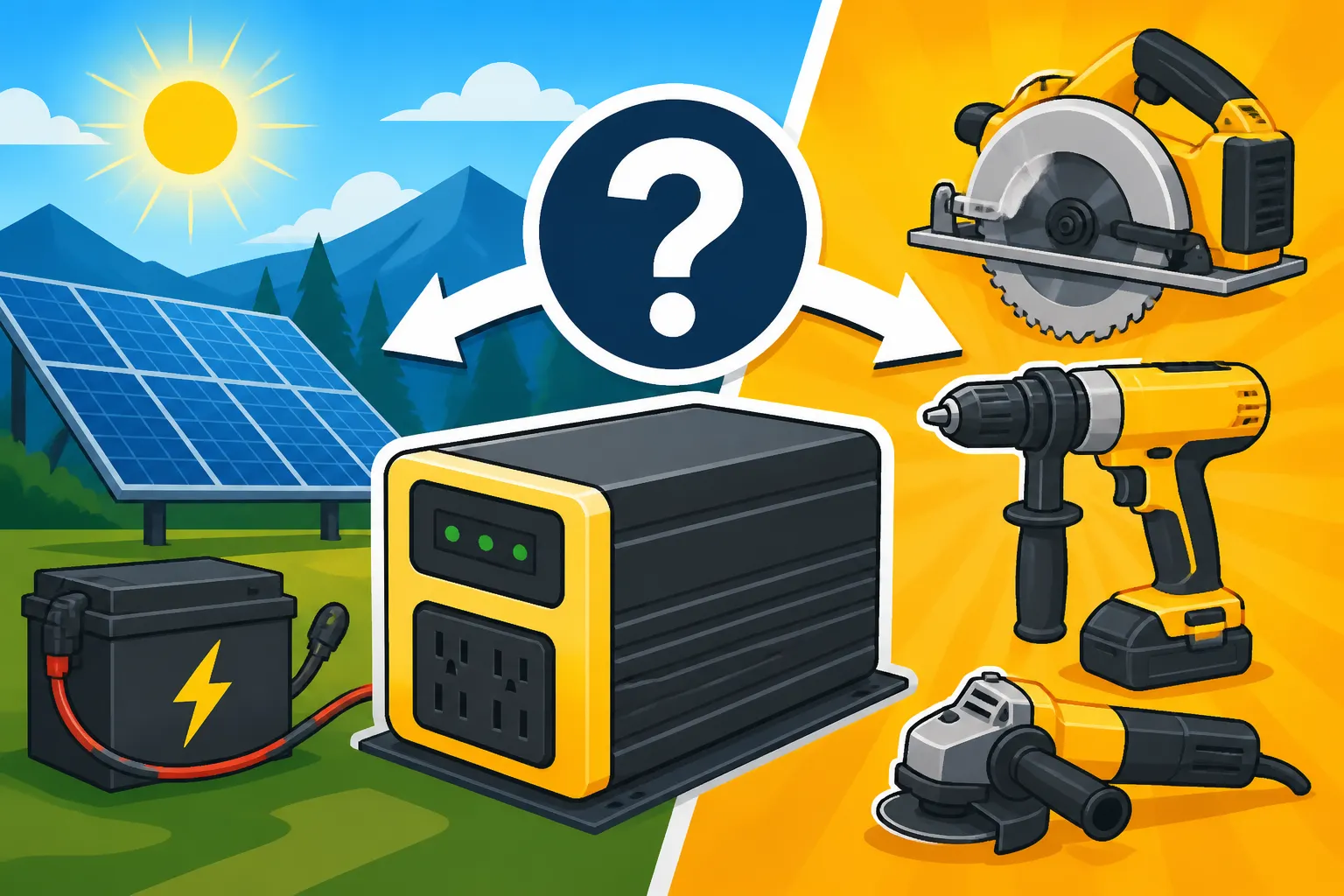
It's incredibly frustrating when you're out there, maybe building that remote cabin or tackling a big project on your homestead, and you want to use your trusty power tools, but you're not sure if your off-grid solar system can handle it. The fear of burning out an inverter or simply not having enough juice is real. This guide is all about demystifying how to size an off-grid inverter specifically for the demanding needs of your power tools, ensuring you have reliable power when you need it most.
Understanding Power Tool Demands on Your Off-Grid System
Running power tools off-grid isn’t like powering a few LED lights or charging your phone. These machines, whether it’s a circular saw, a drill, or a grinder, have very specific and often quite high power requirements. Before you even start looking at inverter specs, it’s vital to understand what your tools are actually asking for from your solar setup.
Starting Watts vs. Running Watts: The Crucial Difference
This is perhaps the single most important concept to grasp when sizing an inverter for power tools. Every motor-driven tool, when it first kicks on, draws a massive spike of electricity for a fraction of a second to overcome inertia and get the motor spinning. This initial burst is called the “starting watts” or “surge watts.” Once the motor is running smoothly, its power draw drops to its “running watts” or “continuous watts.”
Think about a typical 15-amp circular saw. Its running wattage might be around 1,800 watts (15 amps * 120 volts). But for that split second when you pull the trigger, it could demand 3 to 4 times that amount – potentially 5,400 to 7,200 watts! If your inverter isn’t capable of supplying that instantaneous surge, it will simply shut down, sometimes with an alarming error code, or worse, you could damage the inverter itself. Your off-grid system needs to be robust enough to handle these brief, but intense, power spikes. This critical factor is why you can’t just add up the running watts of all your tools and call it a day; you need to account for the highest starting surge of any single tool you plan to operate.
Many folks make the mistake of looking only at the continuous wattage listed on their tool or assuming their inverter’s continuous rating is all that matters. This oversight is a common pitfall in off-grid power design. Your inverter might be rated for 2000 continuous watts, which sounds like plenty for that 1800-watt saw, but if it only has a surge capacity of 3000 watts, it will undoubtedly trip when you try to start the saw. This is why carefully examining both the continuous and surge ratings of your inverter, and comparing them to your tools’ demands, is non-negotiable.
The Types of Tools You’ll Use and Their Power Signatures
Not all power tools are created equal when it comes to their electrical demands. Generally, we can categorize them by the type of load they present to an inverter:
- Inductive Loads (Motor-Driven Tools): These are the biggest inverter challenges. Tools like circular saws, drills, air compressors, well pumps, grinders, and vacuums all contain electric motors. These motors cause significant starting surges. The bigger and more powerful the motor, the higher the surge. For instance, a small Dremel tool will have a much lower surge than a large table saw.
- Resistive Loads: These tools typically convert electricity directly into heat. Think soldering irons, heat guns, or some older style incandescent work lights. They generally don’t have a large starting surge; their running watts are very close to their starting watts. They are usually much easier on an inverter.
- Universal Motors: Many handheld power tools, like drills, angle grinders, and chop saws, use universal motors. While they are a type of inductive load, they often have a more moderate surge compared to large induction motors found in things like air compressors or refrigerators. Still, they absolutely require a pure sine wave inverter to perform optimally and avoid damage.
Understanding these categories helps you prioritize your inverter sizing. If your primary goal is to run a small soldering iron, your inverter needs are minimal. If you’re building a timber frame cabin and need to run a heavy-duty chainsaw, miter saw, and air compressor, you’re looking at a much larger, more robust inverter capable of handling multiple, significant inductive surges. Different tools have different personalities when it comes to power, and acknowledging that is key to a smooth off-grid experience. You might want to refer to a detailed guide on How to Estimate Appliance Power Draw for a deeper dive into common off-grid appliance power draws.
The Hidden Drain: Efficiency and Duty Cycle
Beyond raw wattage, two other factors play a role: inverter efficiency and your tool’s duty cycle. An inverter isn’t 100% efficient; some power is lost as heat during the conversion from DC to AC. A good quality pure sine wave inverter might be 85-90% efficient. This means if your tool draws 1000 watts, your battery bank actually supplies closer to 1100-1175 watts DC. While this doesn’t directly impact the *sizing* of the inverter’s wattage capacity, it does affect your overall energy consumption and how quickly your batteries drain. For a detailed look at energy usage, check out our guide on How to Calculate Daily Energy Usage.
The duty cycle refers to how often and how long you’ll actually be running the tool. Are you using a circular saw for a quick cut, or are you running it continuously for an hour to rip plywood? While the inverter needs to handle the *maximum instantaneous demand*, sustained high loads can cause an inverter to heat up, potentially leading to derating (reducing its output) or even shutting down if it overheats. Most reputable inverter brands, like Victron Energy or Sol-Ark, build in thermal protection, but it’s something to be aware of if you plan on heavy, continuous use. If you’re planning for consistent heavy use, consider an inverter with active cooling or a higher continuous rating than your calculations suggest, providing an extra buffer.
It’s a nuanced dance between power, duration, and efficiency. For example, if you’re only making occasional cuts with a jigsaw, you might get away with an inverter closer to the tool’s running wattage, provided the inverter has a decent surge rating. But for an intensive session with a table saw, you’ll need something much more substantial to prevent any system shutdowns or potential damage. Thinking about how you truly intend to *use* your tools, not just their peak numbers, can help fine-tune your inverter choice.
Step-by-Step Guide to Sizing Your Off-Grid Inverter for Power Tools
Alright, let’s get practical. Sizing an inverter for power tools requires a methodical approach. It’s not just guesswork; it’s about careful calculation and understanding your specific needs. Here’s how to break it down:
Inventory Your Power Tools and Their Wattage
The very first thing you need to do is make a list of every single power tool you foresee wanting to run with your off-grid system. Don’t forget anything – from your little cordless drill charger (though chargers typically have lower demands and don’t surge much) to your heaviest corded circular saw, miter saw, or air compressor. For each tool, you need to find its running wattage and, if possible, its starting or surge wattage. This information is usually found on the tool’s label, in the owner’s manual, or with a quick search online. If you can only find amperage (e.g., “15 Amps”), multiply it by 120 (for standard US household voltage) to get the running watts (15 A * 120 V = 1800 W).
When searching for surge wattages, remember that manufacturers don’t always list this directly. You might have to use general rules of thumb (e.g., motor-driven tools often surge 2-4 times their running wattage) or look for anecdotal evidence from other off-gridders or electricians. For popular brands like DeWalt, Makita, or Milwaukee, forums and technical specs online often provide good estimates. Don’t guess; take the time to look up these numbers. This foundational step is critical for accurate sizing.
Here’s an example of what your list might look like:
| Power Tool | Running Watts (Estimated) | Starting Watts (Estimated) | Notes |
|---|---|---|---|
| Circular Saw (7.25") | 1,800 W | 5,400 W (3x running) | Heavy surge, critical for cutting |
| Corded Drill | 700 W | 2,100 W (3x running) | Moderate surge, common use |
| Angle Grinder | 1,200 W | 3,600 W (3x running) | High surge, especially on startup |
| Shop Vac (wet/dry) | 1,400 W | 4,200 W (3x running) | Inductive motor, high suction |
| Bench Grinder | 800 W | 2,400 W (3x running) | Sustained use possible |
| Miter Saw (10") | 1,600 W | 4,800 W (3x running) | Another heavy surge tool |
| Air Compressor (small) | 1,500 W | 7,500 W (5x running) | Very high surge, often highest on list |
*Note: Starting watts are often estimates and can vary based on the specific motor, age, and load. Always err on the side of caution.
Calculate Peak Surge Requirement
Once you have your list, identify the single tool with the highest *starting wattage*. This is the absolute minimum surge capacity your inverter must be able to handle. It doesn’t matter if your circular saw surges to 5,400 watts and your grinder to 3,600 watts; your inverter needs to be able to hit that 5,400-watt mark for a brief moment. If you plan to run multiple tools simultaneously, which is rare for heavy-duty tools but possible for smaller ones, you’d add up their *running* watts and then add the *highest starting surge* of any tool you might start while others are already running. For example, if you have a drill running (700W) and then start a circular saw (5400W surge, 1800W running), the peak would be 700W + 5400W = 6100W for a moment, then 700W + 1800W = 2500W continuous.
However, for most practical scenarios involving heavy power tools, you’ll only be starting and running one major tool at a time. The key here is to find that maximum surge number. Let’s say, looking at our table above, the small air compressor has the highest starting watts at 7,500W. This means you need an inverter with at least a 7,500-watt surge capacity. This is a critical component of your overall How to Size an Off-Grid Inverter strategy.
Consider Continuous Running Loads and Safety Margins
After determining your peak surge, you also need to ensure the inverter’s continuous rating can handle your chosen tool’s *running wattage*. So, if your air compressor runs at 1,500 watts, your inverter needs a continuous rating of at least 1,500 watts (preferably more for breathing room). While a single power tool will be the main draw, consider any other significant loads that might be running concurrently, like a refrigerator, lights, or a computer. These also contribute to the continuous load on the inverter.
A good rule of thumb is to add a safety margin. If your calculated peak surge is 7,500 watts, consider an inverter that can surge to 8,000 or even 9,000 watts. Similarly, if your continuous running load for your heaviest tool is 1,800 watts, an inverter with a 2,000-watt continuous rating is a safer bet. This buffer helps account for slight variations in tool performance, inverter efficiency, wire loss, and simply gives you peace of mind. Investing in a slightly larger inverter upfront can save you headaches and potential equipment damage down the road. Some larger off-grid power systems, like those from Renogy, offer inverter options with substantial surge ratings designed for demanding loads.
Inverter Types and Features for Power Tool Performance
Not all inverters are created equal, especially when it comes to the demanding characteristics of power tools. Choosing the right type and understanding its key features is just as important as the wattage calculations.
Pure Sine Wave is Non-Negotiable
If you’re planning to run any tools with electric motors, and that includes most power tools like drills, saws, grinders, and air compressors, a **pure sine wave inverter** is an absolute must. There are two main types of inverters: pure sine wave and modified sine wave (or “modified square wave”). Modified sine wave inverters are cheaper, but they produce a “choppy” approximation of AC power. This type of power is generally unsuitable for sensitive electronics and, critically, for electric motors.
Motors running on modified sine wave power tend to run hotter, less efficiently, make more noise, and can even suffer permanent damage over time. Imagine trying to make fine cuts with a saw that’s sputtering or a drill that’s struggling to maintain torque. A pure sine wave inverter, on the other hand, replicates the smooth, clean AC power you get from the utility grid. This ensures your tools run cooler, last longer, and perform exactly as they were designed to. Don’t compromise on this, especially for valuable power tools. While they might cost a bit more, the longevity of your tools and the reliability of your system are worth it. Understanding the importance of pure sine wave can prevent costly mistakes in your off-grid journey.
High Surge Capacity Inverters: Designed for the Challenge
As we’ve discussed, the surge capacity is king for power tools. When you’re shopping for inverters, look specifically for models that boast a high surge rating relative to their continuous rating. Many quality off-grid inverters are designed with this in mind because they know people will be running these types of loads. For instance, a 3000-watt continuous inverter might have a 6000-watt surge for 20 seconds, or even a 9000-watt surge for a fraction of a second. These are the specs you need to scrutinize.
Some premium inverter brands like Victron, Sol-Ark, and Schneider Electric are renowned for their robust surge capabilities. They often integrate advanced features that allow them to handle those momentary spikes without breaking a sweat. When reviewing products on sites like Amazon or specialty solar retailers, pay close attention to user reviews specifically mentioning heavy inductive loads. If an inverter repeatedly fails to start a refrigerator or a well pump, it’s a good indication it won’t fare well with your circular saw either. Checking for an inverter’s ability to handle inductive loads can give you a good benchmark.
System Voltage Matters
The voltage of your off-grid solar system (typically 12V, 24V, or 48V) also plays a significant role in inverter selection, especially for power tools. Higher system voltages are generally more efficient for larger loads because they reduce the amount of current flowing through your wires. For instance, to deliver 3000 watts to an inverter, a 12V system needs 250 amps (3000W / 12V), while a 48V system only needs 62.5 amps (3000W / 48V). High currents require much thicker and more expensive cables, and lead to greater energy losses due to resistance.
For systems designed to run demanding power tools, a 24V or, ideally, a 48V system is usually recommended. A 48V system will allow your inverter to operate more efficiently, put less strain on your battery bank (especially when hitting those surge demands), and reduce the cost and complexity of your DC wiring. If you’re planning a robust off-grid workshop, definitely consider a higher system voltage from the outset. Our guide on 12V vs 24V vs 48V: Which to Choose delves deeper into this choice.
Real-World Scenarios and Practical Tips
Let’s move beyond the numbers and talk about how this all plays out in real life. Depending on your off-grid lifestyle and how you intend to use your tools, your inverter needs will vary significantly.
The Weekend Warrior’s Setup
Imagine you have a small cabin in the woods, and you only spend weekends there. You might occasionally need to use a drill, a jigsaw, or a sander for small projects. You’re not running a full-scale construction site. In this scenario, you might get away with a moderately sized inverter, perhaps a 2000-watt continuous pure sine wave inverter with a 4000-watt surge capacity. This could handle most standard drills (700-1000W running, 2100-3000W surge) or a small jigsaw. You’d still need to be mindful of starting heavy-draw tools and probably wouldn’t run a circular saw and a shop vac at the same time.
For such lighter, intermittent use, many complete off-grid solar kits available on platforms like Amazon or directly from manufacturers like Renogy might include an inverter suitable for these demands. Just ensure you double-check the surge capacity. If you’re mainly charging batteries for cordless tools, your inverter needs become even smaller, as the charger draws much less power than the tool itself. This type of setup aligns well with the considerations found in Off-Grid Solar Cost for a Cabin for intermittent use.
The Full-Time Off-Grid Builder or Homesteader
If you’re living off-grid full-time, building your own home, or managing a homestead with ongoing construction or maintenance tasks, your demands are much higher. You might need to run a 10-inch miter saw, a heavy-duty circular saw, an air compressor for framing nailers, or even a small table saw. These require a substantial inverter. You’re likely looking at an inverter with a continuous rating of 3000-5000 watts, and crucially, a surge capacity of 9000-15000 watts or even higher for a few seconds.
In this scenario, a 48V system is almost a necessity to efficiently deliver the power without excessive current. You’d also consider an inverter with advanced features, such as multiple AC outputs, generator integration capabilities, and perhaps even parallel stacking if you foresee needing even more power down the line. Brands like Victron MultiPlus series or Sol-Ark inverter-chargers are often favored by serious off-gridders for their robust performance and reliability under heavy loads. This kind of setup aligns more with planning for Off-Grid Solar System Design Basics for a full-time residence.
Boosting Performance: Generator Backup and Smart Usage
Even with a perfectly sized inverter, there might be times when your heaviest power tools (think large welders, plasma cutters, or industrial-grade air compressors) simply exceed your solar system’s practical capacity. This is where a backup generator becomes invaluable. You can connect a generator to your inverter-charger (if it has this capability) to automatically kick in and supplement power during peak demand. This allows you to run those truly massive tools without oversizing your entire solar array and battery bank for occasional use.
Smart usage also goes a long way. Instead of trying to run a circular saw, a shop vac, and a radio all at once, operate one major power tool at a time. Plan your cuts, make them efficiently, and then turn off the tool. Chargers for cordless tools can often be run off a smaller dedicated inverter or even directly from your DC system if compatible, saving the main inverter for the heavy lifting. By being strategic with your power consumption, you can make a smaller, more cost-effective inverter stretch further and prolong the life of your entire system. This intelligent planning is also a component of How to Add a Generator to Your Design to ensure maximum power availability.
Disclaimer
The information provided in this guide is for general informational purposes only and does not constitute professional electrical or solar engineering advice. Off-grid solar system design and installation can be complex and potentially dangerous. Always consult with a qualified electrician or solar professional to ensure your system is safely and correctly sized and installed according to all applicable codes and regulations.