How to Orient Off-Grid Panels for Winter
The crisp bite of winter air and the early sunset can be beautiful, but for those of us living off-grid, it often brings a familiar dread: the looming question of whether our solar panels will pull their weight. It's frustrating to watch your battery levels dip lower and lower as the days shorten and the sun plays hide-and-seek behind clouds or casts long, unyielding shadows. This guide is here to help you tackle that challenge head-on by showing you exactly how to orient your off-grid solar panels for optimal performance through those demanding winter months.
Understanding the Winter Sun's Unique Challenges
Winter isn't just about colder temperatures; it dramatically changes how the sun interacts with our planet, and consequently, how our solar panels perform. Many off-gridders learn this the hard way when their otherwise robust summer system struggles to keep up with basic energy demands. It's not just a minor dip; it can feel like a complete system failure if you haven't prepared.
Shorter Days and Lower Sun Angle
One of the most immediate and noticeable changes in winter is the sheer reduction in daylight hours. What might have been 14-16 hours of usable sunlight in summer dwindles to a mere 8-10 hours in the deepest winter for many regions, especially in higher latitudes. This alone means less time for your panels to gather energy.
Beyond the reduced duration, the sun itself takes a much lower path across the sky during winter. Instead of arcing high overhead, it hugs the horizon, casting longer shadows and delivering its energy at a much more oblique angle. This low angle means the sunlight hits your panels less directly, reducing the intensity of the light they can capture. It's like trying to catch raindrops in a bucket held sideways—you'll catch some, but nowhere near as much as if it were upright.
For those dependent on their off-grid solar system for daily power, this combination of shorter days and a lower sun angle can be incredibly frustrating. Appliances that hummed along effortlessly in July might barely manage a whisper in December, leading to compromises on comfort and convenience. Understanding these fundamental astronomical shifts is the first step in devising a strategy to combat them.
Increased Shading and Atmospheric Obstruction
That lower sun angle doesn't just reduce direct irradiance; it also exacerbates shading issues that might be completely non-existent during other seasons. A tree that casts a short shadow in summer when the sun is high overhead can suddenly become a major obstruction in winter, blocking precious morning or afternoon sun for hours. Nearby buildings, fences, or even terrain features that were never a problem can become significant power thieves.
Beyond physical obstructions, winter often brings its own set of atmospheric challenges. Increased cloud cover, haze, fog, or even snow-filled air can significantly diminish the amount of solar radiation reaching your panels. And let's not forget the most direct obstruction: snow accumulating directly on your panels. A fresh blanket of snow can render your entire solar array useless until it melts or is manually cleared, effectively cutting off your power supply.
These combined factors—from extended shadows to snow cover and increased atmospheric interference—create a perfect storm for reduced solar production. It means that simply having panels isn't enough; strategic placement and ongoing maintenance become paramount to ensure your system can still provide reliable power when you need it most.
Strategies for Optimal Winter Panel Orientation
Optimizing your panel orientation for winter isn't about magic; it's about smart planning and making intentional adjustments to counteract the sun's seasonal shifts. It can make a tangible difference between scraping by on minimal power and enjoying a more consistent energy supply.
Adjusting Tilt Angle for Winter Performance
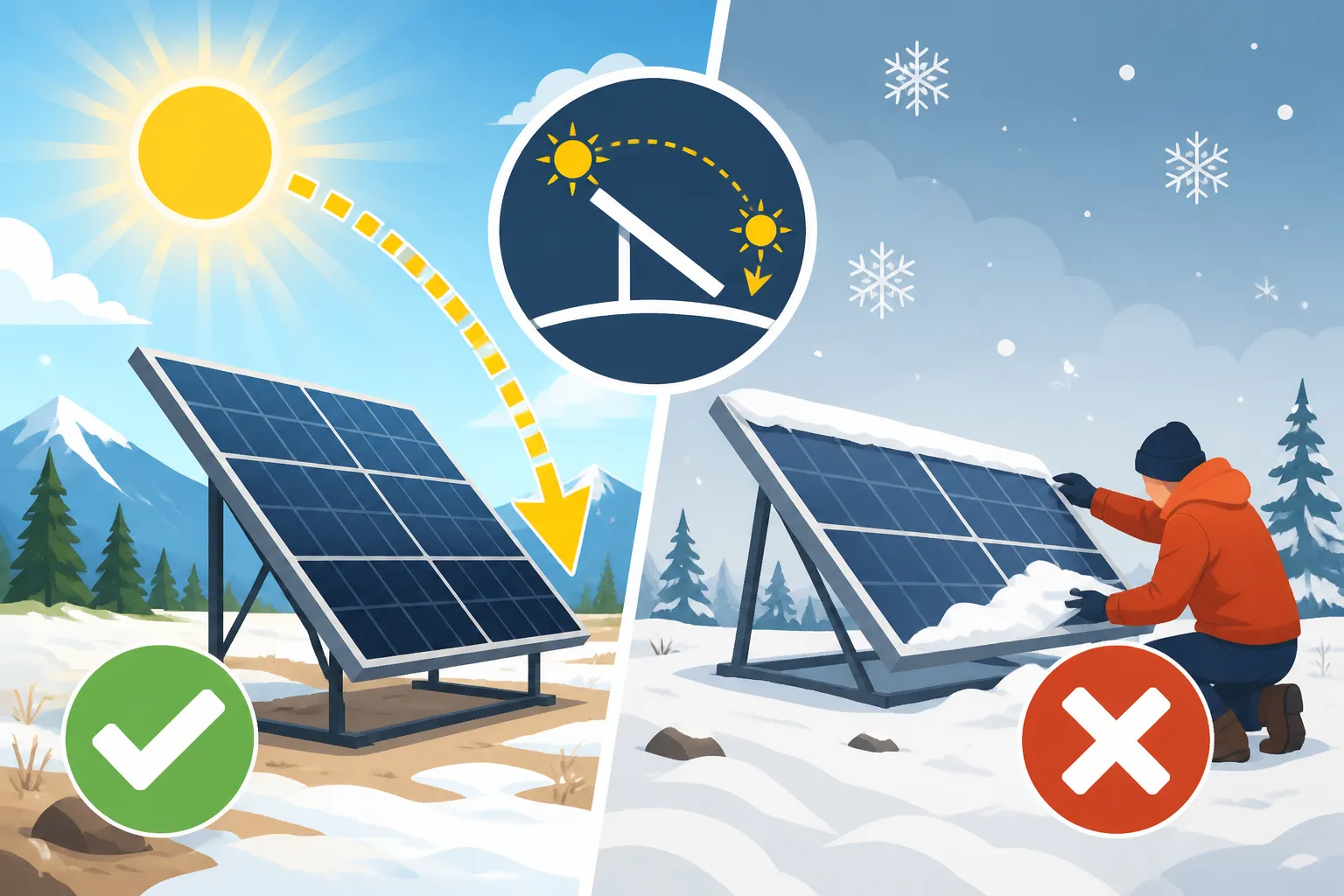
The single most impactful adjustment you can make for winter performance is to increase the tilt angle of your solar panels. In summer, a relatively flat angle is often sufficient because the sun is high. However, to effectively "catch" the low winter sun, your panels need to be tilted much more steeply towards the horizon. A common rule of thumb for optimal winter tilt is to add 15 degrees to your geographical latitude. So, if you live at 40 degrees North latitude, your optimal winter tilt angle would be around 55 degrees.
Think about it this way: the sun's rays are coming in at a flatter angle in winter, so by tilting your panels steeper, you're presenting them more directly to those rays, maximizing the surface area that receives direct sunlight. For instance, someone living in northern Maine (around 45°N latitude) might tilt their panels to about 60° from horizontal in winter, while an off-gridder in central Florida (around 28°N latitude) might aim for around 43°. These adjustments significantly improve energy capture compared to a fixed, shallower angle.
This adjustment is most easily done with adjustable ground mounts or specialized tilt brackets for roof mounts. While it might seem like extra work to adjust your panels seasonally, the increase in power production can be substantial, making it well worth the effort. It's a critical component of knowing How to Design for Year-Round Off-Grid Power A simple tilt adjustment can extend your productive hours and make cloudy days less impactful.
| Latitude Zone | Recommended Summer Tilt (Approx.) | Recommended Winter Tilt (Approx.) |
|---|---|---|
| Low Latitudes (0-25°) | Latitude – 15° | Latitude + 15° |
| Mid Latitudes (25-50°) | Latitude ± 0° | Latitude + 15° |
| High Latitudes (50-70°) | Latitude + 15° | Latitude + 20-30° |
Note: These are general guidelines. Local conditions, microclimates, and specific usage patterns may warrant slight variations.
Prioritizing South-Facing Panels
While tilt angle addresses the sun's vertical position, the azimuth angle (which direction your panels face horizontally) is equally critical. For anyone in the Northern Hemisphere, facing your panels directly true south is paramount for maximum winter solar gain. This isn't just a suggestion; it's a foundational principle of How to Orient Off-Grid Panels for Winter.
The reason for this strict adherence to south is that the winter sun's path is already limited. Any deviation from true south means your panels will be exposed to direct sunlight for even fewer hours, and the angle of incidence will be less optimal for longer periods. A panel facing even slightly southeast or southwest will capture significantly less energy than one facing due south, especially during the crucial midday peak hours when the sun is at its highest point.
Utilizing a reliable compass, or even a smartphone app that can pinpoint true south (not magnetic south), is essential during installation or adjustment. For those in the Southern Hemisphere, the same principle applies, but panels should be oriented due north. This precise orientation ensures your solar array captures every possible ray from the low winter sun, turning what could be marginal production into a much more effective system.
Mitigating Shade and Obstructions
Even with the perfect tilt and azimuth, shadows can be your off-grid system's worst enemy in winter. Because the sun is so low, objects that cast short, manageable shadows in summer can create long, persistent obstructions that severely impact your daily energy harvest. This is particularly true for morning and late afternoon sun, which is already at a premium.
Before installing new panels or when evaluating an existing setup for winter, it's vital to conduct a thorough shade analysis. Walk your property at different times of day in winter (or use a sun path calculator app) to identify any trees, buildings, or even small structures that might block the sun. Solutions can range from trimming offending tree branches – perhaps an opportune time during winter dormancy – to considering higher mounting structures. In some cases, relocating panels to an entirely different, unshaded spot, especially if using a ground mount, might be the most effective solution.
Beyond fixed obstructions, snow accumulation on the panels themselves is a universal winter problem for off-gridders. A layer of snow, even a few inches thick, can completely halt power production. Regularly clearing snow from your panels, safely, is a non-negotiable winter chore. Tools like a soft broom or a specially designed solar panel snow rake can be invaluable. Remember, panels often perform better in cold temperatures, so as long as they are clear of snow, they are still capable of producing power efficiently.
Advanced Considerations for Winter Off-Grid Solar
Beyond the fundamental adjustments of tilt and azimuth, several other aspects of your off-grid solar system design and maintenance can significantly impact its winter resilience. Thinking about these elements proactively can save you a lot of headaches when the deep freeze sets in.
Ground Mounts vs. Roof Mounts in Winter
When it comes to off-grid solar, the choice between ground-mounted and roof-mounted panels takes on added importance in winter. Each has distinct advantages and disadvantages that affect ease of optimization and maintenance during the colder months.
Ground mounts generally offer far greater flexibility for winter. They allow for easy adjustment of the tilt angle, which, as we've discussed, is crucial for catching the low winter sun. You can simply change the angle to match the season, maximizing efficiency. Furthermore, ground mounts are much easier and safer to access for snow removal. You can quickly clear any accumulation with a snow rake or broom without climbing onto a slippery, icy roof. This accessibility also makes cleaning dirt and debris, which can reduce efficiency, a simpler task. However, ground mounts do require more land space and can sometimes be more exposed to theft or damage.
Roof mounts, while often aesthetically pleasing and space-saving, present more challenges in winter. The tilt angle is usually fixed, dictated by the roof's pitch, which may not be optimal for winter sun. While some adjustable roof mounts exist, they are often more complex and costly. Clearing snow from roof-mounted panels can be dangerous, especially on steep or icy roofs, making regular maintenance difficult or impossible for many off-gridders. If your roof has a shallow pitch, snow might not slide off as easily, leading to prolonged periods of zero production. For those designing a new system or considering how to Install Solar on a Tiny Home, factoring in winter accessibility for roof-mounted panels is paramount.
Impact of System Voltage and Equipment
The very bones of your off-grid system—its voltage and the quality of its components—also play a subtle yet significant role in winter performance. While not directly related to panel orientation, these factors contribute to the overall efficiency and robustness of your power generation and storage.
Higher system voltages, such as 24V or especially 48V, often prove more efficient in colder conditions. This is because higher voltage systems operate with lower current for the same amount of power, which in turn reduces voltage drop over longer cable runs. In winter, when every watt counts and panels might be placed further away to avoid shade, minimizing voltage drop can preserve precious energy. You can learn more about choosing your system voltage in our guide on 12V vs 24V vs 48V: Which to Choose.
The type of charge controller you use is also critical. MPPT (Maximum Power Point Tracking) charge controllers are generally superior to PWM (Pulse Width Modulation) controllers, especially in varying conditions like those found in winter. MPPT controllers can dynamically adjust to find the optimal voltage and current from your solar panels, extracting significantly more power, particularly when solar input is lower or less consistent. This efficiency boost can be crucial on short, cloudy winter days, helping your batteries get a fuller charge. Brands like Victron Energy and Renogy offer excellent MPPT controllers that are highly regarded in the off-grid community for their efficiency and reliability. Choosing Best MPPT Charge Controllers can lead to noticeable gains.
Planning for Days of Autonomy and Backup
Perhaps the most crucial "advanced consideration" for winter off-grid living isn't about the panels themselves, but about ensuring you have enough stored power to weather extended periods of low or no solar input. This concept is known as "days of autonomy."
Days of autonomy refers to the number of days your battery bank can power your essential loads without any input from your solar panels or other charging sources. In summer, you might get by with 1-2 days of autonomy. In winter, especially in regions prone to long stretches of cloudy weather or heavy snowfall, you might need 3, 5, or even 7+ days of autonomy. This is because the likelihood of multiple consecutive low-production days increases dramatically. Calculating your specific needs and upsizing your battery bank accordingly is essential, as detailed in our guide on How to Calculate Days of Autonomy.
Beyond a robust battery bank, having a reliable backup power source is almost non-negotiable for winter off-grid living. A propane or diesel generator, for example, can be a lifesaver when your solar simply can't keep up, ensuring your crucial appliances like refrigerators, well pumps, or heating systems continue to run. Many off-gridders also keep a smaller, portable solar generator on hand, perhaps purchased from a retailer like Amazon, for emergencies or to power specific critical loads if the main system goes down. This layered approach to power security provides peace of mind when the sun is scarce and the temperatures plummet, giving you a chance to effectively How to Budget for an Off-Grid Solar System.
Disclaimer
The information provided in this guide is for general informational purposes only and does not constitute professional advice. Off-grid solar system design and installation can be complex and involve electrical hazards. Always consult with qualified professionals and adhere to local codes and regulations before making any decisions or undertaking any installations.