Watts vs Watt-Hours vs Amp-Hours Explained
If you've ever started researching off-grid solar systems, you've probably quickly found yourself drowning in a sea of unfamiliar electrical terms. Watts, Watt-hours, Amp-hours—it can feel like learning a whole new language just to figure out how to power a few lights and a fridge! It's frustrating when you're just trying to understand the basics, but this guide is here to demystify these core concepts, helping you confidently size and understand your off-grid power needs.
Understanding the Fundamentals: Watts and Power
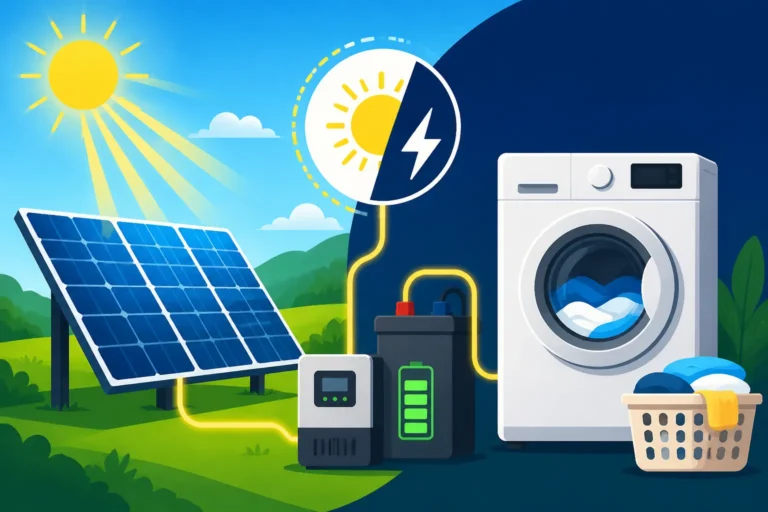
Let's start with Watts (W), because it's often the most intuitive unit for many people. Think of Watts as the instantaneous rate at which electrical energy is being used or produced. It's like the speed of a car. A higher wattage means more power is being consumed or generated at that very moment. When you look at an appliance, its wattage rating tells you how much power it needs to operate.
Instantaneous Power Versus Sustained Power Needs
It's crucial to understand that not all watts are created equal in practice. Many appliances have two wattage ratings: starting wattage (also known as surge wattage) and running wattage. The starting wattage is the brief burst of power an appliance needs to kick on, especially those with motors like refrigerators, well pumps, or power tools. This surge can be several times higher than its continuous running wattage, but it only lasts for a fraction of a second or a few seconds.
For example, a typical full-sized refrigerator might run at 100-200 watts, but it could briefly surge to 800-1200 watts when the compressor first kicks in. If your inverter isn't sized to handle these surges, it will trip or fail to start the appliance, leading to a lot of headaches and wasted time. Your inverter needs to have a surge capacity greater than the highest starting wattage of any single appliance you plan to run. This distinction is vital when you're looking at components like an inverter; you need to know its continuous power rating and its peak surge rating.
Calculating Wattage for Your Appliances
To properly plan your off-grid system, you need to know the wattage of everything you intend to power. This is the first step in determining How Many Watts of Solar You Need. Most appliances have a sticker or label on them that lists their electrical specifications. You might see "W" for watts, or sometimes "A" for amps and "V" for volts. If you only have amps and volts, you can easily calculate watts using the formula: Watts = Volts x Amps. For instance, a 120V appliance drawing 2 amps would be 240 watts (120V x 2A = 240W).
Start by making a comprehensive list of every electrical device you plan to use. Don't forget the small things like phone chargers, LED lights, and even your coffee maker. For each item, note down both its running wattage and, if applicable, its surge wattage. This detailed list will be the foundation of your entire system design, allowing you to move on to the next critical step: understanding how much energy you use over time.
Understanding Watt-Hours for Energy Storage and Consumption
While Watts tell you how much power something uses right now, Watt-hours (Wh) tell you how much energy is consumed or produced over a period of time. This is where the rubber meets the road for off-grid living, as your utility bill, if you've ever had one, is likely based on kilowatt-hours (kWh), which are simply 1,000 watt-hours. Think of Watt-hours as the "fuel" your system needs to keep running, or the "distance" your car travels.
Measuring Daily Energy Needs
Calculating your total daily Watt-hour usage is arguably the most critical step in designing an off-grid solar system. This is often referred to as a "load analysis" or "energy audit," and it forms the bedrock for determining the size of your battery bank and solar array. To get started, you'll need that appliance list you created in the previous section. For each appliance, you'll multiply its running wattage by the number of hours per day you expect to use it.
Let's say your 60-watt LED light runs for 5 hours a day. That's 60W x 5h = 300 Wh per day. Your mini-fridge, running at 80 watts but cycling on and off for roughly 12 hours total throughout the day, would consume about 80W x 12h = 960 Wh per day. Once you do this for every item, you'll sum up all these daily Watt-hour figures to get your total daily energy consumption. This figure is indispensable for performing a thorough How to Calculate Daily Energy Usage and subsequent system sizing.
Watt-Hours for Battery Sizing and Solar Array
Your total daily Watt-hour consumption directly dictates how large your battery bank needs to be and how many solar panels you require. If your daily consumption is 3,000 Wh (or 3 kWh), your batteries must be able to store at least that much energy, plus a buffer for cloudy days and depth of discharge limitations. For example, if you want two days of autonomy (power without sun), you'd need a battery bank capable of storing 6,000 Wh of usable energy.
The solar panels, in turn, must generate enough Watt-hours over the course of an average sunny day to replenish the batteries and meet your daily consumption. If your panels can generate 2,000 Wh per day, and your usage is 3,000 Wh, you're going to run into power deficits. This is why accurately calculating your energy needs in Watt-hours is fundamental for How to Size an Off-Grid Solar System. Without a clear understanding of your Watt-hour demands, you're essentially guessing, which can lead to an underpowered or unnecessarily expensive system.
Demystifying Amp-Hours: The Battery Capacity Metric
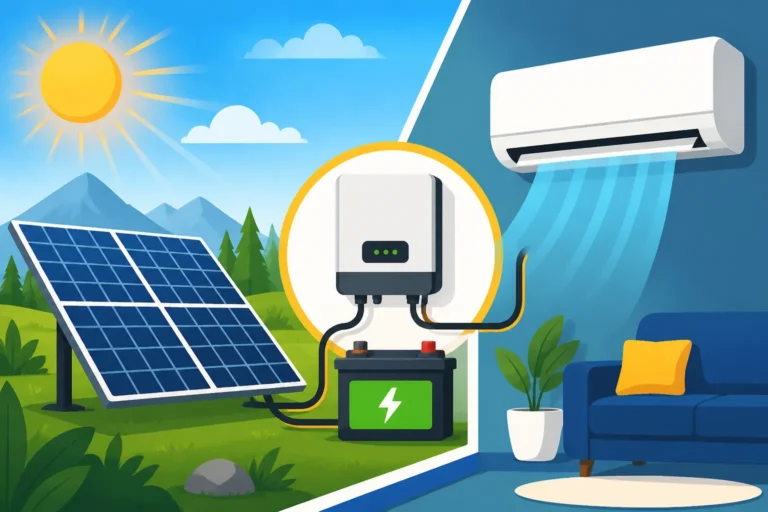
Now, let's talk about Amp-hours (Ah), which is a unit predominantly used when discussing battery capacity. While Watt-hours give you the total energy stored, Amp-hours tell you how many amps a battery can deliver for one hour at a specific voltage. It's often where the real confusion starts because it's not a direct measure of energy unless you also consider voltage. Think of Amp-hours like how much water is in a bucket, but the energy that water contains also depends on how high the bucket is (voltage).
Amp-Hours and System Voltage
This is critical: A 100 Amp-hour battery at 12 volts holds a different amount of total energy than a 100 Amp-hour battery at 48 volts. Let's crunch the numbers using our trusty formula (Watt-hours = Volts x Amp-hours):
- A 12V, 100Ah battery stores: 12V x 100Ah = 1200 Wh
- A 48V, 100Ah battery stores: 48V x 100Ah = 4800 Wh
As you can see, the 48V, 100Ah battery holds four times the energy of the 12V, 100Ah battery! This highlights why simply looking at the Amp-hour rating alone isn't enough; you must consider the battery's nominal voltage to understand its true energy capacity in Watt-hours. When you're planning your How Many Batteries for an Off-Grid System, you'll first determine your total Watt-hour storage need, and then use your chosen system voltage to figure out the required Amp-hours. For instance, if you need 4800 Wh of storage and choose a 12V system, you'd need 400Ah (4800 Wh / 12V = 400Ah). If you choose a 48V system, you'd only need 100Ah (4800 Wh / 48V = 100Ah).
Why Amp-Hours Are Crucial for Battery Purchases
When you're out there shopping for batteries, Amp-hours will be the primary rating you see advertised. Manufacturers like Renogy and others typically list their batteries by voltage and Amp-hour capacity (e.g., "12V 100Ah LiFePO4 battery"). This is fine, as long as you remember to convert that to Watt-hours to get a true comparison of energy storage across different battery voltages or even different battery types.
Beyond the raw Ah number, you also need to consider the battery chemistry and its allowable Depth of Discharge (DoD). Lead-acid batteries (like flooded or AGM) typically only allow for a 50% DoD if you want them to last, meaning a 100Ah lead-acid battery only provides 50Ah of usable capacity. On the other hand, modern LiFePO4 (lithium iron phosphate) batteries, which you can often find on platforms like Amazon or specialized solar suppliers, can be discharged to 80-100% without significant harm, giving you almost their full rated Amp-hours in usable capacity. This makes understanding How to Size an Off-Grid Battery Bank much more complex than just matching numbers. You need to factor in your usable Ah based on battery chemistry and DoD.
Bringing It All Together: Watts, Watt-Hours, and Amp-Hours in Harmony
By now, you should be seeing how these units are interconnected. Watts describe instantaneous power, Watt-hours describe energy over time, and Amp-hours describe battery capacity (which, when combined with voltage, also describes energy over time). They're all different lenses through which we view and measure electricity, and you need to understand each one to design a cohesive and functional off-grid system.
Converting Between Units for Better Planning
Being able to convert between these units is an invaluable skill for any off-grid enthusiast. It allows you to cross-check calculations, understand product specifications, and diagnose potential issues. The core relationships are:
- Watts = Volts (V) x Amps (A)
- Watt-hours (Wh) = Volts (V) x Amp-hours (Ah)
- Watt-hours (Wh) = Watts (W) x Hours (h)
Let's illustrate with a common scenario. Say you have a 12V off-grid system, and you've determined your daily energy consumption is 2500 Wh. To find out how many Amp-hours of battery capacity you need (before considering DoD), you'd calculate:
Amp-hours = Watt-hours / Volts = 2500 Wh / 12V = 208.33 Ah.
If you were looking at individual 12V 100Ah batteries, you'd know you'd need at least three of them in parallel to get approximately 300Ah, covering your 208.33 Ah need with some buffer. This flexibility in conversion is key for accurate system planning.
The Off-Grid Energy Equation
Ultimately, designing an off-grid system is about balancing this "energy equation." You need to generate enough energy (Watt-hours from your solar panels) to meet your consumption (Watt-hours from your appliances) and store enough excess energy (Watt-hours in your battery bank) to cover periods without generation (nighttime, cloudy days).
Your solar panels' rated wattage (e.g., 200W, 400W) tells you their potential output under ideal conditions. To figure out their actual Watt-hour production, you multiply their wattage by your region's "peak sun hours" – the equivalent number of hours per day when sunlight is at its strongest. So, a 400W panel in an area with 5 peak sun hours produces 400W x 5h = 2000 Wh per day. This crucial calculation is part of the broader Off-Grid Solar System Sizing Guide. If your daily consumption is 2500 Wh, and your panels only produce 2000 Wh, you'll clearly be running a deficit. This understanding forms the backbone of ensuring you have reliable power.
Practical Applications and Common Misconceptions
Now that we've broken down each term, let's look at how they apply in real-world off-grid scenarios and clear up some common misunderstandings that trip up new solar users.
Sizing Solar Panels with Wattage and Peak Sun Hours
When you're choosing your solar panels, their wattage rating is your starting point. A 100-watt solar panel, for instance, is rated to produce 100 watts of power under Standard Test Conditions (STC). However, real-world conditions vary due to temperature, shading, and the angle of the sun. The true measure of what your panels will produce daily is the Watt-hours generated, which requires knowing your local peak sun hours.
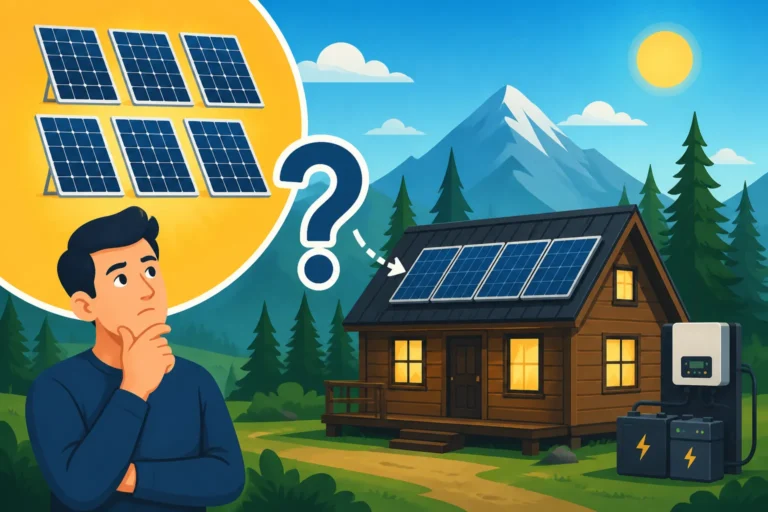
Let's say you live in Flagstaff, Arizona, which averages about 5.5 peak sun hours per day. A single 200W solar panel would produce approximately 200W * 5.5h = 1100 Wh per day. If you need 3300 Wh per day to run your cabin, you'd divide your daily Watt-hour need by the production of a single panel: 3300 Wh / 1100 Wh/panel = 3 panels. So, you'd need three 200W panels to meet your daily energy needs. This method helps you tailor your solar array to your specific location and consumption, avoiding the costly mistake of having too few panels or an unnecessarily large array. Don't forget to factor in system losses (around 10-20%) for a more realistic estimate! For detailed help on this, refer to How Much Solar to Charge Your Batteries Daily.
Estimating Battery Runtime and Autonomy
Once you have your battery bank sized in Amp-hours (and converted to Watt-hours for clarity), you can estimate how long your system can run without sun—your "days of autonomy." Let's say your battery bank provides 5000 Wh of usable energy, and your daily average consumption is 2500 Wh. In theory, your system could run for two days without any solar input (5000 Wh / 2500 Wh/day = 2 days).
However, remember that this is a simplified calculation. Real-world battery performance is affected by temperature, discharge rate, and the age of the battery. For instance, cold weather can significantly reduce battery capacity, especially for lead-acid types. When designing for autonomy, always build in a buffer. Aim for at least 2-3 days of autonomy, especially if you live in an area prone to extended periods of cloudy weather. This ensures peace of mind and prevents you from running out of power when the sun doesn't cooperate.
| Electrical Unit | What it Measures | Analogy | Primary Use in Off-Grid Solar | Key Consideration |
|---|---|---|---|---|
| Watt (W) | Instantaneous Power | Speed (e.g., mph) | Appliance power rating, Inverter output | Handles surge loads, simultaneous usage |
| Watt-hour (Wh) | Energy over Time | Distance (e.g., miles) | Daily energy consumption, Total system energy | Crucial for overall sizing and planning |
| Amp-hour (Ah) | Battery Current Capacity | Fuel Tank Size (gallons) | Battery capacity (at specific voltage) | Must be combined with voltage to get Wh, DoD |
Choosing the Right System Voltage: 12V, 24V, or 48V
System voltage is a decision that significantly impacts your off-grid design and component selection. While 12V systems are popular for smaller applications like RVs and cabins, larger homesteads often benefit from 24V or 48V systems. Understanding the implications of each voltage choice ties directly into your understanding of Watts, Watt-hours, and Amp-hours.
Impact on Wire Size and Efficiency
One of the biggest advantages of higher system voltages (24V or 48V) is reduced current (Amps) for the same amount of power (Watts). Remember, Watts = Volts x Amps. So, for a given power demand, if you increase the voltage, the amperage decreases proportionally. Lower amperage means you can use thinner, less expensive wiring, and you'll experience less energy loss due to voltage drop over longer cable runs.
For example, to deliver 1200 watts of power:
- At 12V, you need 100 Amps (1200W / 12V = 100A). This requires very thick, expensive wires to minimize loss.
- At 48V, you only need 25 Amps (1200W / 48V = 25A). This allows for much thinner wires, saving cost and reducing potential heat buildup.
This efficiency gain is a major reason why larger systems opt for higher voltages. It simplifies wiring, reduces material costs, and improves overall system performance, especially over longer distances from the solar array to the battery bank or from the battery bank to the inverter. It's a key factor when you're making decisions like How to Choose System Voltage.
When to Use Higher Voltages for Larger Systems
As your daily Watt-hour consumption grows, and you need a larger solar array and battery bank, moving to a higher voltage system becomes almost a necessity. For small setups that only power a few lights and charge devices, a 12V system might be perfectly adequate. These typically involve simpler wiring and can often utilize smaller, more readily available 12V components.
However, once you start adding appliances like refrigerators, microwaves, well pumps, or air conditioning units, your power demands quickly escalate. At this point, the benefits of 24V or 48V systems become undeniable. Not only do they allow for more efficient power transfer, but many high-power inverters and charge controllers are designed to operate more effectively at these higher voltages. You'll find a wider selection of powerful inverters for 24V and 48V systems, making it easier to manage the substantial power draws of larger loads. For a deeper dive, consider exploring the article on How to Choose Between 24V and 48V. It's a critical decision for the longevity and expandability of your off-grid setup.
Disclaimer
The information provided in this guide is for general educational purposes only and should not be considered professional electrical advice. Off-grid solar system design and installation involve electrical hazards. Always consult with a qualified electrician or solar professional and adhere to local codes and regulations.