Sizing Solar for Air Conditioning
You've decided to tackle one of the biggest power challenges in off-grid living: running air conditioning. It's a goal many off-gridders dream of, especially during those sweltering summer months, but it often feels like an insurmountable hurdle because AC units are notorious energy hogs. This guide is here to demystify the process and walk you through exactly how to size your off-grid solar system to keep you cool and comfortable without breaking the bank or constantly running out of power.
The Off-Grid Air Conditioning Conundrum: Why It's So Tricky
Let's be honest, the idea of kicking back in a cool, air-conditioned space when you're miles from the nearest power pole sounds heavenly. But for many, it feels like a pipe dream. The sheer amount of electricity an air conditioner devours is usually the first major obstacle people encounter when planning an off-grid solar setup. It's not just about running a few lights or charging your phone; we're talking about a significant, continuous power draw that can quickly drain even a generously sized battery bank.
The Energy Demands of Cooling
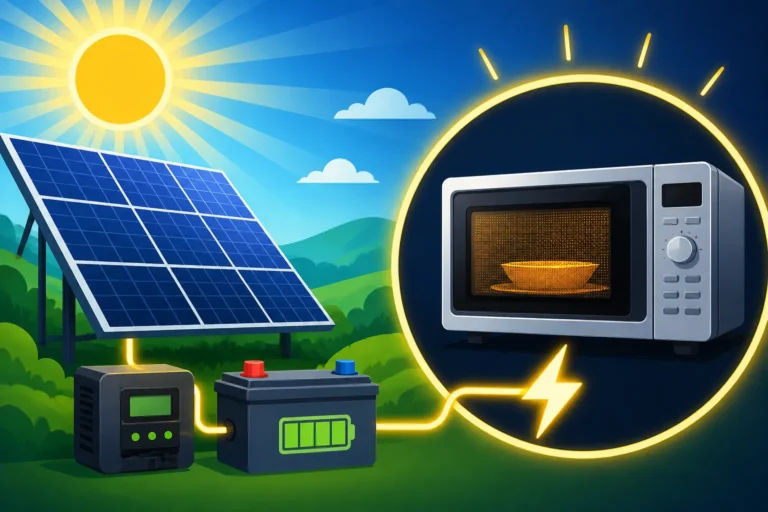
Think about your typical home AC unit. It uses a compressor and fan motors, both of which are energy-intensive. Unlike, say, a microwave that runs for only a few minutes, an AC unit might be running for hours on end, especially in hotter climates. This constant, high draw puts immense strain on your solar panels to generate enough power and your batteries to store it. Many people underestimate this demand, leading to under-sized systems that simply can't keep up when the mercury rises.
It's a common frustration to see your battery percentage plummet faster than a lead balloon when you flip on the AC. This isn't a fault with your solar system, but often a mismatch in expectations versus reality. We're used to unlimited grid power, where an AC running 24/7 barely registers as a financial blip for many homeowners. Off-grid, every watt-hour counts, and understanding this fundamental difference is the first step toward successful AC integration.
Battling the Peak Heat, Peak Power Challenge
One of the biggest headaches with off-grid AC is that its highest demand often coincides with your system's lowest supply potential, or at least its highest usage competition. When the sun is blazing and your cabin or RV is baking, that's precisely when you want the AC cranked up. While peak sun hours are ideal for solar production, they're also when every other appliance might be in use, and your batteries are working hard.
Furthermore, many off-grid locations, like desert homesteads or remote cabins, experience extreme temperature swings. You might have cool nights and brutally hot days. This means your AC needs to work extra hard during the day, creating a cycle where your panels are generating a lot, but your AC is consuming just as much, leaving little to replenish your battery bank for evening and nighttime cooling. It's a delicate balancing act that requires careful planning to avoid those uncomfortable, powerless nights.
Demystifying Your AC Unit's Power Requirements
Before you even think about buying panels or batteries, you need to understand the beast you're trying to power. Not all AC units are created equal, especially when it comes to their energy appetite. Diving into the specifics of your chosen cooling method is absolutely crucial for accurate sizing.
Reading the Labels: Watts, BTUs, and EER Ratings
When you look at an air conditioner, you'll typically see a few key numbers that tell you a lot about its power usage.
- BTU (British Thermal Unit): This is a measure of an AC unit's cooling capacity. The higher the BTU, the larger the area it can cool. A small window unit might be 5,000 BTUs, while a central AC system could be 36,000 BTUs or more. For off-grid, you generally want to find the smallest BTU unit that can effectively cool your space to conserve power.
- Watts (W): This tells you how much power the unit consumes when it's running. This is the most critical number for solar sizing. You'll often see "running watts" and "starting/surge watts." Always look for the running watts, as that's what it will consume consistently.
- EER (Energy Efficiency Ratio) or SEER (Seasonal Energy Efficiency Ratio): These ratings indicate how efficient the AC unit is. A higher EER/SEER means the unit is more efficient and will use less electricity to produce the same amount of cooling. For off-grid, prioritizing high EER/SEER ratings is paramount. Even a small increase in efficiency can translate to significant savings on your solar and battery investment.
For instance, a 5,000 BTU window AC unit might consume around 500-600 running watts, while a 12,000 BTU mini-split could be anywhere from 800-1500 running watts, depending on its efficiency. Always check the specific model's label or manual.
Surge vs. Running Watts: What Your Inverter Needs to Handle
This is a common pitfall for off-grid beginners. When an AC unit (or any motor-driven appliance like a refrigerator or well pump) first kicks on, its motor draws a much larger burst of power for a very brief moment. This is called the "startup surge" or "inrush current," and it can be 2-7 times its normal running wattage.
Your inverter, which converts your battery's DC power into usable AC power, needs to be able to handle this momentary surge without tripping or failing. If your inverter is rated for 2000W continuous but only 4000W surge for 10 milliseconds, and your AC unit has a 5000W surge, your system will likely shut down every time the AC tries to start. It's crucial to find an inverter with a robust surge capacity. Many people opt for pure sine wave inverters from reputable brands like Victron Energy or Sol-Ark, which are known for their strong surge capabilities and reliability in off-grid setups. You can learn more about how to size an off-grid inverter to ensure it can handle these demands.
Exploring Off-Grid Friendly AC Options
Not all AC units are created equal for off-grid applications. Some are far more suitable than others due to their efficiency and power profiles.
- Mini-Split Systems: These are often considered the gold standard for off-grid AC. They are incredibly energy-efficient, often boasting high SEER ratings (some even exceeding 20 or 30). They also have variable speed compressors (inverter-driven mini-splits), which means they don't constantly cycle on and off at full power, avoiding those harsh startup surges. Instead, they ramp up and down, maintaining a more consistent temperature with much lower, more continuous power draw. Brands like Senville or Pioneer offer popular and reliable mini-split options often found on platforms like Amazon.
- Window AC Units: These are generally less efficient than mini-splits but are a more budget-friendly and simpler installation option. If you opt for a window unit, look for one with an "Eco" mode or "Inverter" technology, as these will minimize power spikes and improve efficiency. Be very aware of their high startup surges.
- 12V/24V DC Air Conditioners: These are less common for residential use but are fantastic for RVs, vans, or small cabins. They run directly off your battery bank, eliminating the inverter's conversion losses. While their cooling capacity is usually lower, they are incredibly efficient for their size. These are perfect for those who want to minimize components and maximize efficiency in smaller spaces.
- Evaporative Coolers (Swamp Coolers): If you're in a dry climate, an evaporative cooler is a phenomenal, low-power alternative. They don't use a compressor and consume significantly less electricity than traditional AC, often just powering a fan and a small water pump. They won't work in humid environments, though, as they add moisture to the air.
Choosing the right type of AC unit can drastically reduce your overall system cost and improve your off-grid comfort. It's often the single most impactful decision you'll make when sizing solar for air conditioning.
Sizing Your Solar Panels to Power Air Conditioning
Once you know your AC unit's power demands, it's time to figure out how many solar panels you'll need to keep it running. This isn't just a simple calculation; it requires understanding your local sunlight conditions and planning for real-world scenarios. Many find this the trickiest part, but with a clear method, it's totally achievable.
Calculating Your Daily AC Energy Consumption
This is the foundational step. You need to estimate how many watt-hours your AC will consume in an average day.
- Determine your AC's running wattage: Let's say you've chosen an efficient mini-split that draws 800 running watts.
- Estimate daily run time: How many hours a day do you expect to run your AC? In a hot climate, it might be 8-10 hours. Let's say 8 hours for our example.
- Calculate daily watt-hours (Wh): Running Watts x Hours = Daily Wh.
- Example: 800W x 8 hours = 6400 Wh per day.
This 6400 Wh (or 6.4 kWh) is the energy your solar panels need to produce, plus a little extra to account for system inefficiencies and other loads. This number gives you a solid target for your solar array. To get more granular, you might want to review how to calculate daily energy usage for all your appliances.
Factoring in Sunlight Hours and Seasonal Variability
Solar panels don't produce their rated power all day long. They only hit peak performance during "peak sun hours" – when the sun is directly overhead and strong. This varies significantly by location and season.
- Find your peak sun hours: You can find this data for your specific location online (e.g., from the National Renewable Energy Laboratory – NREL). For instance, Phoenix, Arizona, might have 6-7 peak sun hours in the summer, while Seattle, Washington, might only have 3-4. Let's use 5 peak sun hours for our example.
- Account for worst-case scenarios: Remember, you're sizing for air conditioning, which usually means summer. However, if you plan to use your system year-round, you'll need to consider winter's shorter, weaker sun. If your goal is primarily summer AC, focus on summer peak sun hours.
- Calculate required solar panel wattage: Divide your daily Wh consumption by your peak sun hours.
- Example: 6400 Wh / 5 peak sun hours = 1280 Watts of solar panel capacity.
This means you'd need approximately 1280 Watts of solar panels to meet your daily AC demand under ideal conditions. But we're not quite done.
The Importance of Oversizing Your Solar Array
That 1280W calculation is a great start, but it assumes perfect conditions, no shading, and 100% system efficiency. The real world is rarely that cooperative. This is where oversizing comes in.
- System Inefficiencies: There are losses at every stage: panels aren't 100% efficient, wiring has resistance, charge controllers aren't perfect, and batteries have their own inefficiencies. A general rule of thumb is to add a 20-30% buffer for these losses.
- Example: 1280 Watts x 1.25 (for 25% buffer) = 1600 Watts.
- Cloudy Days and Weather: What happens if you have a few days of cloudy weather? Your panels will produce significantly less power, but you'll still want your AC. You need to oversize your array to generate more power than strictly necessary on sunny days, so you can charge your batteries more robustly and have a buffer for less-than-ideal conditions.
- This is particularly important for high-draw appliances like AC. You'll want to ensure you have enough solar to quickly replenish your battery bank after a night of cooling or a day of heavy use.
- Future Expansion: It's always a good idea to design an expandable system. You might realize later that you want to run more appliances or extend your AC run time. Adding a few extra panels upfront can save you headaches and costs down the line.
So, for our example, aiming for 1600 Watts of solar panels (e.g., four 400W panels or five 320W panels from a brand like Renogy, which are readily available) would be a more realistic target. This over-sizing helps ensure reliability and comfort. You can dive deeper into how many watts of solar you need for various scenarios.
Building a Robust Battery Bank for AC Use
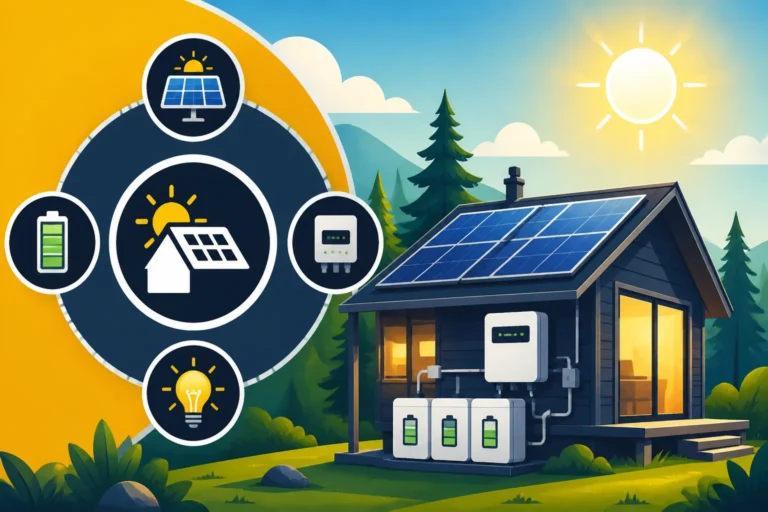
The battery bank is the heart of any off-grid solar system, especially when running something as demanding as air conditioning. It stores the energy produced by your panels and provides it when the sun isn't shining. This component often represents a significant portion of the total cost, so getting it right is crucial.
Determining Your Required Battery Capacity (Amp-Hours/Watt-Hours)
Your battery bank needs to store enough energy to power your AC and other essential loads when your solar panels aren't producing, typically at night or during cloudy periods. We'll use the daily watt-hour consumption we calculated earlier.
- Recap daily AC consumption: In our example, 6400 Wh per day for the AC.
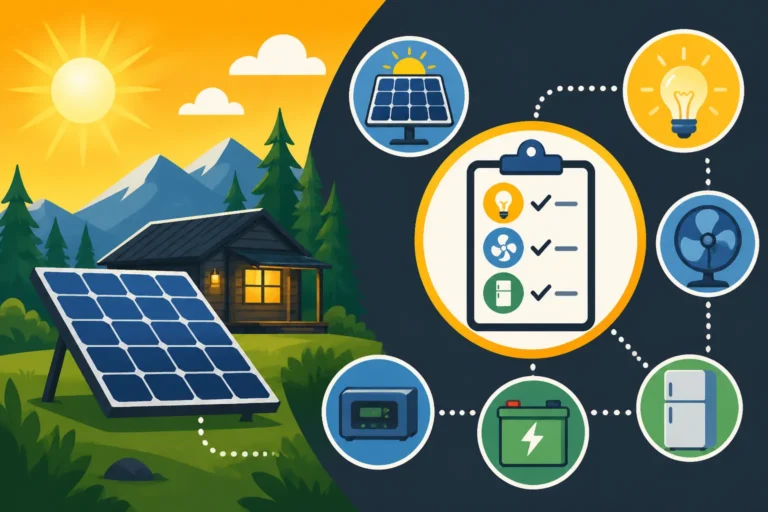
- Account for other loads: Don't forget all your other appliances! Lights, refrigerator, water pump, charging electronics. Let's say these add another 1000 Wh per day.
- Total daily consumption: 6400 Wh (AC) + 1000 Wh (others) = 7400 Wh.
- Factor in inverter efficiency: Your inverter isn't 100% efficient. Expect 85-95% efficiency. Let's use 90% for our example. You'll need to draw more from your batteries to account for this loss.
- Battery draw needed: 7400 Wh / 0.90 = 8222 Wh.
- Calculate usable battery capacity: Now, consider the type of batteries.
- Lithium Iron Phosphate (LiFePO4) batteries: These are highly recommended for off-grid due to their long lifespan, high efficiency, and ability to be deeply discharged (often 80-100% depth of discharge, or DoD). For safety and longevity, many recommend sticking to an 80% DoD.
- Lead-acid batteries (AGM, Gel, Flooded): These are cheaper upfront but have a shorter lifespan and should only be discharged to 50% DoD to maximize their life. Discharging them further dramatically reduces their cycle life.
- Let's assume LiFePO4 for our high-demand AC system and an 80% DoD.
- Required gross battery capacity (Wh): 8222 Wh / 0.80 = 10,277 Wh.
If you're working with a 48V system (highly recommended for larger off-grid systems due to lower current and thinner wires), you'd then convert this to amp-hours (Ah): 10,277 Wh / 48V = 214 Ah. So, you'd need a 48V 214Ah battery bank. You can find excellent options for lithium batteries from brands like Battle Born or EG4. For more details on calculating your needs, check out how much battery capacity you need.
Planning for Days of Autonomy
"Days of autonomy" refers to how many days your battery bank can power your system without any new input from your solar panels. For a system relying heavily on AC, this is incredibly important. If you live in an area prone to several consecutive cloudy days, you'll want more days of autonomy.
- 1-2 Days: This is often sufficient if you have a reliable backup generator or live in a very sunny climate with consistent weather.
- 3-5 Days: This is a more comfortable and realistic target for most full-time off-gridders, especially when AC is a priority, to cover extended periods of bad weather.
- Using our example of 10,277 Wh gross capacity for 1 day, for 3 days of autonomy, you'd need: 10,277 Wh x 3 = 30,831 Wh (or 30.8 kWh).
- At 48V, this would be roughly 642 Ah (30,831 Wh / 48V). That's a substantial battery bank, often consisting of multiple individual batteries wired together. This gives you a clear picture of why running AC off-grid is a significant investment in your battery storage.
Consider your local climate. If you're in the Pacific Northwest, you'll need more days of autonomy than someone in the Arizona desert. This planning helps avoid those stressful moments when your power dips to critical levels.
Choosing the Right Battery Chemistry and Voltage
The choice of battery chemistry and system voltage significantly impacts performance, lifespan, and cost.
- Battery Chemistry:
- LiFePO4 (Lithium Iron Phosphate): As mentioned, these are generally the best choice for high-demand, long-term off-grid systems. They tolerate deep discharges, have an incredibly long cycle life (3,000-6,000 cycles or more), are lighter, and more compact. While the upfront cost is higher than lead-acid, their total cost of ownership is often lower due to longevity and efficiency. They also perform better in a wider range of temperatures, though very cold weather does require careful management or heating.
- AGM/Gel Lead-Acid: These are sealed, maintenance-free lead-acid batteries. They are less expensive upfront but have a shorter cycle life (400-1000 cycles) and should not be discharged beyond 50%. They are heavy and less efficient. While they can work for smaller, less demanding AC loads or seasonal use, they're generally not ideal for full-time, high-demand off-grid AC.
- System Voltage (12V, 24V, 48V):
- 12V: Suitable for small systems like RVs or basic cabins with minimal AC use. Higher currents require thicker, more expensive wiring.
- 24V: A good middle ground for moderate systems, reducing wire size compared to 12V.
- 48V: Highly recommended for larger systems, especially those running AC. At 48V, the same amount of power moves at half the current of a 24V system, and a quarter of a 12V system. This means you can use much thinner, less expensive wiring, and your inverter runs more efficiently. Most high-power inverters and charge controllers are designed to operate optimally at 48V. You can learn more about how to choose system voltage for your setup.
Carefully considering these factors will lead to a more reliable and cost-effective battery bank. Many people start with a smaller battery bank and expand it as their budget allows, but it's important to budget for an off-grid battery bank from the outset.
Selecting the Perfect Inverter and Charge Controller
These two components are the traffic cops and power translators of your off-grid system. They ensure that the power flows correctly from your panels to your batteries and then to your appliances. Their proper sizing is as critical as your panels and batteries, especially with a power-hungry appliance like an AC unit.
Inverter Sizing for High AC Loads and Startup Surges
The inverter is responsible for taking the DC power from your batteries and transforming it into the AC power that your air conditioner and other household appliances use. Getting this wrong is a common reason for system failures or frustration.
- Continuous Power Rating: Your inverter's continuous power rating must be greater than the combined running wattage of all AC appliances you plan to run simultaneously. If your mini-split draws 800W, and you also want to run a refrigerator (150W), lights (100W), and a TV (100W) at the same time, your total continuous load is 1150W. You'd ideally want an inverter rated for at least 1500W-2000W continuous output.
- Surge Power Rating: This is where AC units truly challenge inverters. As discussed, the startup surge for an AC unit can be 2-7 times its running wattage. If your 800W mini-split has a 3000W-4000W surge, your inverter needs to be able to handle that for a short duration.
- Look for inverters with a surge rating significantly higher than your AC's highest startup surge. Many quality off-grid inverters, like the Victron MultiPlus or Sol-Ark 12K, are specifically designed with robust surge capabilities to handle these motor loads. They can typically surge at 2x their continuous rating for several seconds.
- Always aim for a pure sine wave inverter. Modified sine wave inverters are cheaper but can damage sensitive electronics and run motors (like those in AC units) less efficiently, potentially overheating them or causing humming.
- Voltage Matching: Ensure your inverter's DC input voltage (e.g., 48V) matches your battery bank's voltage.
- Integrated Inverter Chargers: Many off-grid systems, especially those with backup generators, benefit from an inverter charger. These units combine an inverter, a battery charger (for when you run a generator), and an automatic transfer switch into one device, simplifying your wiring and system management. This is very useful for charging your batteries quickly on cloudy days if your solar array isn't keeping up.
When selecting an inverter, don't skimp on quality. It's a critical component, and a cheap, underpowered inverter will lead to endless headaches. It's often the most expensive single piece of equipment, but it's where reliability truly matters. You can check out options like the AIMS Power or Outback Power inverters for robust solutions.
Matching Charge Controller to Solar Array and Battery Bank
The charge controller is the unsung hero of your solar system. It regulates the voltage and current coming from your solar panels, ensuring your batteries are charged safely and efficiently without being overcharged or damaged.
- MPPT vs. PWM:
- MPPT (Maximum Power Point Tracking) Controllers: These are highly recommended for virtually all off-grid systems, especially larger ones. They are significantly more efficient (10-30% more power harvest) than PWM controllers because they actively track the optimal power point of the solar panels, converting excess voltage into additional current. This is crucial for maximizing power harvest, particularly on partly cloudy days or when panel temperatures vary. For an AC-dependent system, every watt counts.
- PWM (Pulse Width Modulation) Controllers: These are simpler, less expensive, and less efficient. They are generally only suitable for small, basic systems where cost is the absolute primary concern and maximum efficiency isn't critical. They simply regulate the voltage by quickly turning the current on and off.
- Current Rating: Your charge controller's amperage rating must be sufficient to handle the maximum current output from your solar panel array.
- To calculate this, take your total panel wattage and divide by your system voltage (e.g., 48V), then add a 25% safety margin.
- Example: For our 1600W solar array at 48V: 1600W / 48V = 33.3 Amps. Add 25%: 33.3 Amps x 1.25 = ~42 Amps. So, you'd want at least a 40A or 50A MPPT charge controller.
- Voltage Matching: Ensure the charge controller's maximum input voltage (Voc – open circuit voltage of your panels) and output voltage (to your batteries) are compatible with your solar array configuration and battery bank. Many modern MPPT controllers can handle up to 150V or even 250V input, allowing you to string panels in series more effectively.
Brands like Victron Energy and Renogy offer excellent MPPT charge controllers that are reliable and feature-rich. Choosing the right charge controller ensures your expensive batteries are protected and your solar panels are performing at their best.
Optimizing Your Off-Grid AC System for Maximum Efficiency
Sizing your system correctly is just the first step. To truly make off-grid AC viable and sustainable, you need to think about efficiency in every aspect of your home or living space. Reducing the load is often far more cost-effective than simply adding more panels and batteries.
Smart Strategies to Reduce AC Energy Consumption
It's amazing how much you can cut down on AC run time and power draw with a few thoughtful strategies.
- Insulation and Sealing: This is hands-down the most important step. A well-insulated cabin, tiny home, or RV will retain cool air much longer. Seal every crack, gap, and leaky window. Use weatherstripping, caulk, and foam insulation around doors and windows. Good insulation means your AC cycles less frequently and runs for shorter periods. Think of it as a thermos for your living space.
- Shade Management: Plant trees, install awnings, or use reflective tarps to shade your windows and roof from direct sunlight. Blocking the sun before it hits your structure is incredibly effective. For RVs and vans, reflective window covers are a game-changer.
- Ventilation and Airflow: Use passive ventilation (cross-breeze), ceiling fans, or exhaust fans to remove hot air before resorting to AC. Running a small DC-powered fan is far more energy-efficient than an AC unit. A well-placed fan can make a 78°F room feel like 75°F.
- Thermostat Management: Set your thermostat to the highest comfortable temperature. Every degree lower significantly increases energy consumption. Using a programmable thermostat can also help, allowing you to cool the space only when you're there or before peak heat hits.
- Appliance Use: Avoid running heat-generating appliances (oven, dryer, dishwasher) during the hottest parts of the day when your AC is working hardest. These just add to the internal heat load.
- Window and Door Habits: Keep windows and doors closed when the AC is running. This might sound obvious, but it's a fundamental energy-saving habit.
By implementing these strategies, you might find that you need a smaller AC unit, or you can run your existing unit for fewer hours, significantly reducing your total energy requirements and, therefore, the size and cost of your solar system.
Integrating Supplemental Power Sources
Even with a perfectly sized and optimized system, some days (or weeks) will challenge your solar production, especially if AC is critical. Having a backup plan is smart off-grid living.
- Backup Generator: A conventional gasoline, propane, or diesel generator is a common and reliable backup for off-grid systems. It can quickly charge your batteries when solar production is low, or directly power heavy loads like AC for extended periods. When sizing a generator, ensure its output (both continuous and surge) is sufficient to power your AC and charge your batteries simultaneously. Many modern inverter chargers can automatically start a generator when battery levels drop. Remember to factor in the Cost of Adding a Generator to Off-Grid Solar.
- Wind Turbines: In windy locations, a small wind turbine can supplement your solar array, especially since wind often picks up when the sun goes down or during stormy weather. This can be an excellent way to diversify your power generation.
- Hydroelectric: If you have access to a consistent stream or river with sufficient flow and drop, micro-hydro can provide continuous, 24/7 power, making it one of the most reliable off-grid energy sources. This is a game-changer for AC as it provides consistent power regardless of sun or wind.
A multi-source approach often leads to the most resilient and comfortable off-grid setup, allowing you to run your AC even when the sun isn't cooperating.
Putting It All Together: A Step-by-Step Sizing Example
Let's walk through a hypothetical scenario to solidify these concepts. This will help illustrate the process of Off-Grid Solar System Sizing Guide for a real-world application.
Scenario: Sizing for a Small Cabin AC
Imagine you have a small, well-insulated 400 sq ft cabin in North Carolina. You primarily use it during the summer months and want to run a highly efficient mini-split AC for about 6 hours a day during the hottest part of the afternoon. You also have a small DC fridge, LED lights, and charging for phones/laptops.
Step 1: Determine AC Power Needs
- You've found a highly efficient 9,000 BTU mini-split that draws 700 running watts.
- It has a startup surge of 2,500 watts.
- Desired AC run time: 6 hours/day.
- Daily AC Watt-hours: 700W * 6h = 4200 Wh.
Step 2: Calculate Other Daily Loads
- DC Refrigerator: 50W running for 12 hours (it cycles on and off) = 600 Wh
- LED Lights: 100W for 4 hours = 400 Wh
- Phone/Laptop Charging: 100W for 2 hours = 200 Wh
- Total Other Loads: 1200 Wh.
Step 3: Total Daily Energy Consumption
- AC Wh + Other Loads Wh = 4200 Wh + 1200 Wh = 5400 Wh.
Step 4: Determine Peak Sun Hours for Your Location
- For North Carolina in summer, let's assume an average of 4.5 peak sun hours.
Step 5: Calculate Required Solar Panel Wattage
- (Total Daily Wh / Peak Sun Hours) * Inefficiency Factor (1.25 for 25% losses)
- (5400 Wh / 4.5h) * 1.25 = 1200W * 1.25 = 1500 Watts of solar panels.
- Panel Choice: You could use five 300W panels or four 375W panels.
Step 6: Size Your Battery Bank
- Total daily consumption (accounting for inverter loss, assume 90% inverter efficiency): 5400 Wh / 0.90 = 6000 Wh from batteries.
- Assume LiFePO4 batteries with 80% usable DoD.
- Gross Battery Capacity needed for 1 day of autonomy: 6000 Wh / 0.80 = 7500 Wh.
- Let's aim for a 48V system (ideal for this load).
- Battery Ah: 7500 Wh / 48V = 156.25 Ah.
- Battery Choice: You'd likely get two 48V 100Ah LiFePO4 batteries wired in parallel, giving you 200Ah, which provides a good buffer for 1-1.5 days of autonomy. If you wanted 3 days of autonomy, you'd need approximately 470Ah (3 * 156.25 Ah) at 48V, which would be five 48V 100Ah batteries. This really highlights how batteries drive off-grid solar cost.
Step 7: Select Inverter and Charge Controller
- Inverter:
- Max continuous load: 700W (AC) + 50W (Fridge) + 100W (Lights) + 100W (Charging) = 950W.
- Max surge: AC surge (2500W) + other small surges.
- You'd need an inverter with at least 1500W-2000W continuous output and a surge capability of at least 3000W-4000W. A 2000W 48V pure sine wave inverter with a 4000W surge capacity would be a good fit. Check what size inverter to run an air conditioner here.
- Charge Controller:
- Total panel wattage: 1500W. System voltage: 48V.
- Current: 1500W / 48V = 31.25 Amps. Add 25% safety margin: 31.25A * 1.25 = ~39 Amps.
- You'd need a 48V MPPT charge controller rated for at least 40-50 Amps.
This example clearly shows how all the pieces fit together. It's a significant investment, but with careful planning, running AC off-grid is absolutely achievable.
Adjusting for Different Climates and Lifestyles
The beauty of off-grid solar is its flexibility, but that also means you need to tailor your system to your unique circumstances.
- Hot, Sunny Climates (e.g., Arizona desert): You'll have abundant peak sun hours, which reduces the number of panels needed. However, your AC will run for more hours at higher intensity, demanding a larger battery bank. You might also experience extremely high daytime temperatures, which can slightly reduce panel efficiency, though modern panels handle heat fairly well. Prioritize maximum insulation and shade.
- Humid, Temperate Climates (e.g., Florida, Southeastern US): While temperatures might not always be extreme, high humidity makes cooling challenging. You might run your AC more often to dehumidify. Peak sun hours can be less consistent due to pop-up storms or extended cloud cover, necessitating more panels and a larger battery bank for autonomy.
- Northern Latitudes/Seasonal Use: If you're only using your AC seasonally (e.g., summer cabin), you can focus your sizing calculations on summer conditions, which typically have longer daylight hours. If you want year-round AC, you'll need to size for the winter's significantly fewer and weaker peak sun hours, often requiring a much larger array and more battery capacity.
- Full-Time Living vs. Weekend Use: A full-time off-grid home demands a robust system with ample days of autonomy and significant panel capacity. A weekend cabin or RV for occasional use can get away with a smaller, more budget-friendly system. Your lifestyle and comfort expectations are key drivers in your final system design.
Remember, this isn't a one-size-fits-all solution. Each off-grid setup is unique, and taking the time to truly understand your specific needs and environment will lead to a successful and comfortable outcome.
Disclaimer
The information provided in this guide is for general informational purposes only and does not constitute professional advice. Off-grid solar system design and installation can be complex and involve electrical hazards. Always consult with a qualified electrician or solar professional before installing or modifying any electrical system. Local codes and regulations regarding solar installations may vary and must be adhered to.