Sizing Solar for a Well Pump
If you're dreaming of going off-grid or simply want reliable water access at your remote cabin, powering a well pump with solar can feel like a daunting challenge. The high surge demands of pumps often catch folks off guard, leading to undersized systems and frustrating failures. This comprehensive guide is here to walk you through the precise steps to correctly size your off-grid solar system specifically for your well pump, ensuring consistent, dependable water without the headaches.
Understanding Your Well Pump and Its Power Demands
Before you even think about solar panels or batteries, you need to deeply understand the heart of your water system: the well pump itself. These aren't just any electrical loads; they have unique characteristics that demand careful consideration when designing an off-grid solar setup. Rushing this step is a common pitfall that leads to endless frustration down the line.
Decoding Your Well Pump's Specifications
The first order of business is to pull out that well pump's nameplate or manual. This little piece of information holds the keys to accurate sizing. What you're looking for, primarily, are the running watts and, crucially, the starting or surge watts.
Most electric motors, including those in well pumps, require a significant burst of power, often 2-3 times their continuous running wattage, just to kick into gear. This initial surge lasts only for a fraction of a second, but it's enough to trip an undersized inverter or cause significant voltage sag in your battery bank if not properly accounted for. For instance, a submersible well pump might run continuously at 1,000 watts, but its start-up surge could hit 3,000 watts for a moment. If your inverter can't handle that 3,000-watt peak, your pump simply won't start, no matter how many solar panels you have.
Beyond wattage, you'll want to note the pump's voltage (typically 120V or 240V AC), horsepower (HP), and flow rate (gallons per minute, GPM). The type of pump matters too. Submersible pumps, which sit deep in the well, are very common for off-grid homes and often have considerable surge demands due to the effort required to push water up long distances. Jet pumps, usually located above ground, might have slightly different characteristics but still demand that initial surge. Take the time to identify these details; they are fundamental to building a reliable system.
Factors Influencing Well Pump Energy Consumption
It's not just the pump's listed specifications that determine its energy hunger; several environmental and usage factors play a huge role. Thinking about these now will help you dial in a system that truly meets your needs, rather than just theoretically powering the pump.
Consider the depth of your well. Pumping water from 200 feet underground requires significantly more energy than pumping from a 50-foot well. The vertical lift is a major component of the pump's workload. Similarly, the diameter and length of your piping can affect resistance, with smaller diameter pipes or long runs requiring the pump to work harder. Any friction losses will translate directly to higher power consumption.
Most importantly, your actual daily water demand dictates how long your pump will run. Are you just supplying a small cabin for a single person, or a bustling homestead with a family of five, a garden, and livestock? Each of these scenarios has vastly different water requirements. A well-designed pressure tank can also be a game-changer here, as it stores pressurized water, reducing the frequency of pump cycles. Instead of the pump kicking on every time you flush a toilet or wash your hands, the pressure tank handles those small demands, meaning your pump runs less often and for longer, more efficient bursts.
Calculating Your Daily Energy Needs for the Well Pump
Now that we understand the pump itself, it's time to translate that into tangible numbers: how much energy your pump actually consumes on a daily basis. This is the bedrock of your entire solar system design. Without an accurate daily energy consumption figure, you're essentially guessing, and that's a recipe for an unreliable off-grid system.
Estimating Daily Water Usage
This is perhaps the most variable part of the equation, as it depends entirely on your lifestyle and property needs. You need to be honest and realistic about how much water you use. A common starting point for a single person living off-grid might be 20-30 gallons per day, but this can easily double or triple for a family.
Let's break it down:
- Showering: A typical low-flow showerhead uses about 1.5-2.5 gallons per minute. A 5-minute shower could be 7.5-12.5 gallons.
- Flushing toilets: Older toilets can use 3.5-5 gallons per flush, while newer, efficient models use 1.28 gallons.
- Washing dishes: Handwashing can consume a lot, while a modern dishwasher might use 4-6 gallons per cycle.
- Laundry: A high-efficiency washing machine uses around 10-20 gallons per load.
- Cooking and drinking: Factor in a few gallons here.
- Outdoor use: This is where numbers can skyrocket. A small garden could need dozens of gallons daily, while livestock (think cattle or horses) can consume vast amounts.
Once you have a rough estimate of your daily gallons needed, you can use your pump's GPM (gallons per minute) rating to figure out how many minutes your pump needs to run each day. For example, if you need 100 gallons a day and your pump delivers 5 GPM, it needs to run for 20 minutes (100 gallons / 5 GPM = 20 minutes). For a more comprehensive approach to your entire off-grid energy usage, take a look at our guide on How to Calculate Daily Energy Usage.
Converting Run Time to Watt-Hours
With your estimated daily run time in hand, converting this into watt-hours (Wh) is straightforward. This is the total amount of energy your pump will draw from your battery bank each day.
The formula is simple:
- Daily Watt-Hours (Wh) = Pump Running Watts x Daily Run Time (in hours)
Let's use our previous example: a pump that runs at 1,000 watts for 20 minutes a day.
First, convert minutes to hours: 20 minutes / 60 minutes/hour = 0.33 hours.
Then, calculate daily watt-hours: 1,000 watts x 0.33 hours = 330 Wh.
This 330 Wh is your baseline daily energy consumption for the pump. However, it's absolutely critical to add a safety margin to this number. Factors like less-than-perfect pump efficiency, voltage drops in wiring, and the inevitable "just in case" extra water use mean you should always add at least 20-30% to your calculated energy needs. So, 330 Wh plus 25% would be about 412.5 Wh. This ensures your system isn't constantly running on fumes and provides a buffer for minor inaccuracies or increased demand. Understanding Watts vs Watt-Hours vs Amp-Hours Explained can further clarify these critical distinctions.
Sizing the Solar Array for Your Well Pump
Now that we know how much energy your well pump needs daily, we can figure out how many solar panels you'll need to generate that power. This isn't just about throwing panels on a roof; it's about smart design that accounts for geography and varying conditions.
Determining Required Solar Panel Wattage
The amount of solar panel wattage you'll need depends on your daily energy demand and the "peak sun hours" available in your location. Peak sun hours represent the average number of hours per day when the intensity of sunlight is equivalent to 1,000 watts per square meter. This isn't just the time the sun is in the sky, but rather when it's strong enough to produce significant power. You can find this data for your specific location through various online resources or by consulting solar irradiance maps. For most parts of the continental U.S., peak sun hours range from 3-6 hours per day, with the lowest values in winter and the highest in summer.
The formula to calculate your minimum solar panel wattage is:
- Total Panel Wattage = (Daily Watt-Hours Needed) / (Peak Sun Hours x System Efficiency Factor)
Let's continue with our 412.5 Wh daily demand. If your location gets an average of 4 peak sun hours per day and you factor in a system efficiency factor of 0.7 (accounting for losses from wiring, temperature, dust, and inverter inefficiency), the calculation would be:
- Total Panel Wattage = 412.5 Wh / (4 hours x 0.7) = 412.5 Wh / 2.8 = 147.32 watts
So, theoretically, you'd need about 150 watts of solar panels. However, this is a minimum and doesn't account for bad weather or future expansion. It's almost always a good idea to oversize your array. When considering your options, look into reputable brands like Renogy, which offers a range of efficient solar panels suitable for off-grid applications. For a deeper dive into sizing your array, check out our guide on How Many Watts of Solar You Need.
Accounting for Seasonal Variations and Cloudy Days
Here's where many off-grid solar systems fall short: they're sized for ideal conditions, not the realities of winter or extended cloudy spells. If you want truly reliable water, you absolutely must design for your worst-case scenario. This often means sizing your solar array for the month with the fewest peak sun hours, which is typically December or January in the Northern Hemisphere.
Let's say your average peak sun hours drop from 4 in summer to 2.5 in winter. Using our previous example:
- Total Panel Wattage = 412.5 Wh / (2.5 hours x 0.7) = 412.5 Wh / 1.75 = 235.7 watts
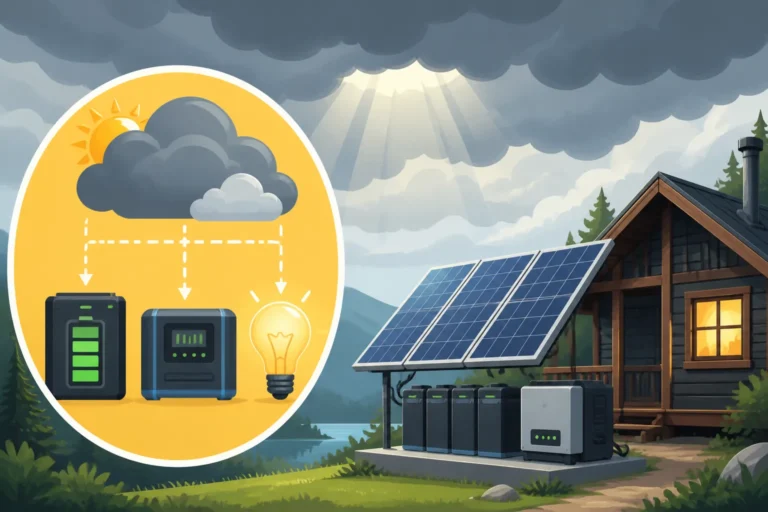
Suddenly, your 150-watt array isn't enough! This highlights the importance of using winter sun hours for your calculations, especially if you need consistent water year-round. You might choose to install a larger array (say, 300-400 watts in this example) to generate enough power even on shorter, cloudier winter days. This excess power in summer will simply recharge your batteries faster, which is never a bad thing. This concept is closely related to "days of autonomy," which we'll discuss when sizing your battery bank, but it's important to understand that a larger solar array reduces the strain on your batteries by ensuring they get topped off regularly.
Sizing the Battery Bank for Consistent Water Supply
The battery bank is the unsung hero of any off-grid solar system, especially when powering an intermittent, high-draw appliance like a well pump. It's the reservoir that stores all that beautiful solar energy, ensuring you have water even when the sun isn't shining.
Calculating Battery Capacity in Amp-Hours and Watt-Hours
Sizing your battery bank is about more than just how much power your pump needs daily; it's about how many days you want to go without sun before your water runs out. This is known as "days of autonomy." For a critical load like a well pump, most off-gridders aim for at least 2-3 days of autonomy, ideally more if you live in a particularly cloudy region.
The formula for battery capacity (in Watt-hours) is:
- Battery Bank Watt-Hours = (Daily Watt-Hours Needed x Days of Autonomy) / (Battery Depth of Discharge x Inverter Efficiency)
Let's use our 412.5 Wh daily pump demand and aim for 3 days of autonomy.
For battery chemistry, let's consider LiFePO4 (Lithium Iron Phosphate) batteries, which are increasingly popular for off-grid systems due to their high efficiency and long lifespan. LiFePO4 batteries can typically be discharged to 80-100% Depth of Discharge (DoD) without significant harm, though 80% is a conservative and healthy choice for longevity. Lead-acid batteries (like AGM or flooded) typically recommend a maximum 50% DoD to prevent premature degradation. Let's assume an 80% DoD for LiFePO4 and an inverter efficiency of 90%.
- Battery Bank Watt-Hours = (412.5 Wh x 3 days) / (0.80 x 0.90) = 1237.5 Wh / 0.72 = 1718.75 Wh
So, you'd need a battery bank capable of storing at least 1,719 Wh. If you're working with Amp-hours (Ah), you'll also need to consider your system voltage. For a 12V system: 1719 Wh / 12V = 143.25 Ah. For a 48V system: 1719 Wh / 48V = 35.8 Ah. Remember, you might need to combine multiple batteries to reach this capacity. It's always wise to round up and consider a slightly larger bank, especially if you plan on expanding your off-grid setup in the future. For more details on this, refer to our guide on How Many Batteries for an Off-Grid System and How to Size an Off-Grid Battery Bank.
Choosing the Right Battery Chemistry and Voltage
The choice of battery chemistry profoundly impacts your system's performance, cost, and longevity. The two primary contenders for off-grid well pump systems are LiFePO4 and lead-acid (which includes AGM and flooded options).
- LiFePO4 Batteries: These are the current darlings of the off-grid world. They offer a much longer cycle life (thousands of cycles vs. hundreds for lead-acid), higher usable capacity (80-100% DoD), faster charging, and are virtually maintenance-free. Their main drawback is a higher upfront cost. However, when you factor in their lifespan and efficiency, their LiFePO4 vs Lead-Acid Battery Cost often works out to be lower over the long run. Many brands like Battle Born or EG4 offer excellent LiFePO4 options.
- Lead-Acid Batteries (AGM/Flooded): These are more affordable upfront. Flooded lead-acid batteries require regular maintenance (checking water levels) and ventilation due to off-gassing, but they are robust. AGM batteries are sealed, maintenance-free, and perform better in various temperatures but still have a lower usable DoD (typically 50%) and shorter lifespan than LiFePO4. They are heavier and bulkier for the same usable energy.
Regarding system voltage, while 12V systems are common for small RVs or simple setups, for loads like well pumps, especially larger ones, a higher system voltage (24V or 48V) is almost always recommended. Higher voltage systems draw less current for the same power, which means you can use thinner, less expensive wiring, and you experience less voltage drop over longer cable runs. This translates to greater efficiency and can save you money on cabling costs, particularly for larger homes or those needing significant pump power.
| Well Pump Type | Typical Running Watts (AC) | Typical Starting/Surge Watts (AC) | Recommended Inverter Surge Capacity (Minimum) | Notes |
|---|---|---|---|---|
| Shallow Well Jet Pump (1/2 HP) | 750 – 1200 | 1500 – 3000 | 3000 W | Common for shallower wells, easy access for maintenance. Often 120V. |
| Deep Well Jet Pump (1 HP) | 1000 – 1500 | 2000 – 4000 | 4000 W | For deeper wells, still above ground. Can be 120V or 240V. |
| Submersible Pump (1/2 HP) | 700 – 1100 | 2000 – 3500 | 3500 W | Most common for off-grid, sits in water. Often 240V, higher head pressure. |
| Submersible Pump (1 HP) | 1000 – 1700 | 3000 – 5000 | 5000 W | For deeper wells or higher flow. Usually 240V, requires robust inverter. |
| Booster Pump (1/2 HP) | 500 – 900 | 1000 – 2000 | 2000 W | Used to increase pressure in a home or garden from a tank, not to draw from a well. |
Note: These are typical ranges. Always consult your specific pump's nameplate for exact figures.
Selecting the Right Inverter and Charge Controller
These two components are the brains and brawn of your off-grid system, translating raw solar power and battery juice into usable electricity for your well pump and other appliances. Get them wrong, and your system won't function effectively, no matter how many panels or batteries you have.
Inverter Sizing for Well Pump Surge Loads
The inverter is arguably the most critical component when sizing for a well pump. Remember that massive starting surge your pump needs? That's the inverter's job to provide, even if only for a split second. An inverter has two main power ratings: continuous power (what it can deliver indefinitely) and surge power (what it can deliver for a very short duration, usually milliseconds to a few seconds).
Your inverter's continuous rating must be greater than your pump's running watts. More importantly, its surge rating must be significantly higher than your pump's starting watts. As a rule of thumb, for motor loads like well pumps, you generally want an inverter with a surge capacity that's 2-3 times the pump's running wattage. So, if your pump runs at 1,000 watts and surges to 3,000 watts, you'd ideally want an inverter with a continuous rating of at least 1,000-1,500 watts and a surge rating of 3,000-4,500 watts. Some robust inverters, like those from Victron Energy or Sol-Ark, are specifically designed to handle these inductive loads gracefully.
You'll also want to choose a pure sine wave inverter. Modified sine wave inverters are cheaper but can damage sensitive electronics and run motors less efficiently, often causing them to hum, run hot, or fail prematurely. For the longevity of your well pump and peace of mind, a pure sine wave inverter is non-negotiable for off-grid well pump systems. This choice will ensure your pump runs smoothly and efficiently for years to come. For more detailed guidance, consider our article on How to Size an Off-Grid Inverter.
Charge Controller Selection and Protection
The charge controller acts as the bridge between your solar panels and your battery bank. Its job is to regulate the voltage and current from the panels, ensuring your batteries are charged safely and efficiently without overcharging. For serious off-grid systems powering well pumps, you'll almost certainly want an MPPT (Maximum Power Point Tracking) charge controller.
- MPPT Charge Controllers: These are significantly more efficient than their PWM (Pulse Width Modulation) counterparts, especially in varying weather conditions or when panel voltage is higher than battery voltage. MPPT controllers can extract up to 30% more power from your solar panels, which translates directly to faster battery charging and more available energy for your well pump. They automatically adjust to find the optimal voltage and current to maximize power harvest, making them invaluable for optimizing a system designed for critical loads. Brands like Outback Power and Victron are well-regarded for their robust MPPT controllers.
To correctly size your charge controller, you need to consider the total wattage of your solar array and the voltage of your battery bank. The controller must be rated to handle the maximum open-circuit voltage (Voc) of your solar array and the maximum current it can produce. If you have a 300-watt solar array on a 12V battery bank, you’d need a controller that can handle roughly 25-30 amps (300W / 12V = 25A). However, always check the panel's specifications and add a buffer. You can find more specific information on How to Size a Charge Controller in our other guides. Additionally, never forget critical safety components like fuses and breakers. These protect your system from overcurrents and short circuits, which can be particularly important with high-draw components like well pumps. Installing them correctly is key to a safe and reliable system.
Practical Considerations and System Optimization
Designing an off-grid solar system for a well pump isn't just about crunching numbers; it's also about smart system integration and leveraging strategies that improve efficiency and reliability. A truly robust system considers real-world use and how to maximize the lifespan of your components.
Integrating a Pressure Tank and Water Conservation
We touched on pressure tanks earlier, but their role in an off-grid well pump system cannot be overstated. A properly sized pressure tank significantly reduces the number of times your pump has to start and stop throughout the day. Each start-up is a mini-stress test on your inverter and your pump's motor due to the high surge current. By minimizing these cycles, you not only extend the life of your pump and inverter but also make your system more efficient overall.
Imagine a scenario where every time you open a faucet, even briefly, your pump kicks on. That's a lot of stressful, inefficient short bursts. With a pressure tank, the pump fills the tank until a set pressure is reached, then shuts off. Water is then drawn from the tank until the pressure drops to a lower set point, at which point the pump turns on again. This means fewer, longer, and more efficient pump runs. When you're figuring out how often your pump needs to run daily, don't forget that a well-maintained pressure tank will make a big difference in the total run time and energy required.
Beyond the hardware, practicing water conservation is your best friend off-grid. Using low-flow showerheads, composting toilets (if applicable), greywater systems for irrigation, and generally being mindful of water usage directly reduces your well pump's workload and, consequently, your solar system's required size and cost. Every gallon you save is a gallon your pump doesn't have to push, and your solar system doesn't have to power.
Backup Solutions and Monitoring
Even the most meticulously designed off-grid solar system can benefit from a backup plan, especially for something as critical as water. Prolonged cloudy weather or unexpected system issues can leave you in a bind. This is where a backup generator comes into play. Integrating a generator, even a small, efficient gasoline or propane model, can provide invaluable peace of mind. Many modern off-grid inverters (like the Outback Radian series or Sol-Ark inverters) have built-in generator start capabilities, allowing your generator to automatically kick on if your batteries fall below a certain charge level. This ensures your well pump can always run when needed. While adding a generator means an extra cost, it's a common strategy for ensuring 100% reliability for critical loads.
Furthermore, investing in a robust system monitoring solution is highly recommended. A good battery monitor, like those offered by Victron Energy, gives you real-time insights into your battery's state of charge, current draw, and historical data. This information is crucial for understanding your system's performance, identifying potential issues before they become critical, and ensuring your well pump continues to receive the power it needs. Remote monitoring capabilities, often available via apps or web portals, can also be a lifesaver if you're away from your property and need to check on your system's health. You can often find a variety of reliable monitoring equipment and other solar components on platforms like Amazon, offering convenience and competitive pricing. This kind of active management helps extend the life of your expensive equipment and makes living off-grid much less stressful.
Disclaimer
The information provided in this guide is for educational and informational purposes only and does not constitute professional advice. Off-grid solar system design and installation can be complex and involve electrical hazards. Always consult with qualified professionals and adhere to all local electrical codes and permitting requirements when designing or installing any solar power system.