Off-Grid Solar Kit Buying Mistakes to Avoid
Embarking on the off-grid solar journey is an exciting prospect, promising freedom from utility bills and reliance on the grid. However, many aspiring off-gridders, full of enthusiasm, often jump into purchasing solar kits without fully understanding the intricate details, leading to costly mistakes, frustration, and systems that simply don't deliver on their promise. This comprehensive guide will walk you through the most common off-grid solar kit buying mistakes and equip you with the knowledge to avoid them, ensuring your path to energy independence is smooth and successful.
Underestimating Your Actual Power Needs
One of the biggest pitfalls people tumble into is severely underestimating how much electricity they actually use. It’s easy to think, "Oh, I'm pretty minimalist," but then realize your daily routine involves more power-hungry gadgets than you anticipated. Your off-grid solar system's success hinges entirely on an accurate assessment of your energy demands.
The Appliance Wish List Versus Reality Check
When you start dreaming about off-grid living, you probably picture a serene cabin or a nimble RV, far from the hustle and bustle. What often gets overlooked in this idyllic vision is the sheer number of appliances we've become accustomed to, even the "small" ones. It’s not just the big fridge or the well pump; it’s the coffee maker that brews your morning cup, the hair dryer you use for ten minutes, the microwave for a quick meal, or even the charging of multiple laptops and phones for work or entertainment. Each of these draws power, sometimes a surprising amount, especially during their initial surge when they kick on.
For example, a standard residential refrigerator might only use 300-800 Watts when its compressor is running, but it can surge to over 1500 Watts for a split second when it starts. If your inverter isn't sized to handle that surge, your system could trip, leaving you in the dark or, at best, frustratingly restarting your power. People often focus on the continuous running watts of their appliances and completely forget about those crucial starting watts, particularly for motors in things like well pumps or power tools. Taking the time to do a thorough inventory of every single device you plan to use, how long you use it, and whether it has a significant surge demand is absolutely critical. You can learn more about how to accurately assess your energy consumption by reading our guide on How to Calculate Daily Energy Usage and diving deep into How to Do an Off-Grid Load Analysis. Don't just list what you think you'll use; measure what you actually use or research typical consumption figures for specific models.
Ignoring Seasonal Variations and Days of Autonomy
Imagine setting up a beautiful solar system in the peak of summer, basking in glorious sunshine, and feeling incredibly self-sufficient. Then winter rolls around. Shorter days mean fewer hours of sunlight, and the sun itself sits lower in the sky, reducing its intensity. Add to that the possibility of prolonged cloudy, rainy, or snowy periods, and your perfect summer system can quickly become inadequate. Many beginners neglect to factor in these seasonal changes when sizing their solar array and battery bank.
Days of autonomy refers to how many days your battery bank can power your essential loads without any input from your solar panels (e.g., during extended cloudy weather). If you design your system based only on sunny summer days, you're setting yourself up for disappointment in the colder, darker months. A system that provides three days of autonomy in July might only offer a single day's worth of power in December, leading to frequent battery depletion and potentially damaging your batteries over time. It’s a common mistake to size the solar array for average daily use and the battery bank for minimal backup, without considering the worst-case scenario for your specific climate. For instance, if you live in the Pacific Northwest, you'll need a much larger array and battery bank to compensate for persistent overcast skies than someone in sunny Arizona. Understanding How Winter Affects Off-Grid Sizing and How to Account for Cloudy Days are crucial steps in building a resilient system that won't leave you stranded when the weather turns.
Mismatching Components and System Incompatibilities
The allure of building your own off-grid solar system from scratch, picking and choosing individual components, can be strong. It feels like a way to save money or customize exactly what you need. However, without a deep understanding of solar electricity and component compatibility, this often leads to a mismatched system that performs poorly, if at all.
The Perils of Piecemeal Purchases
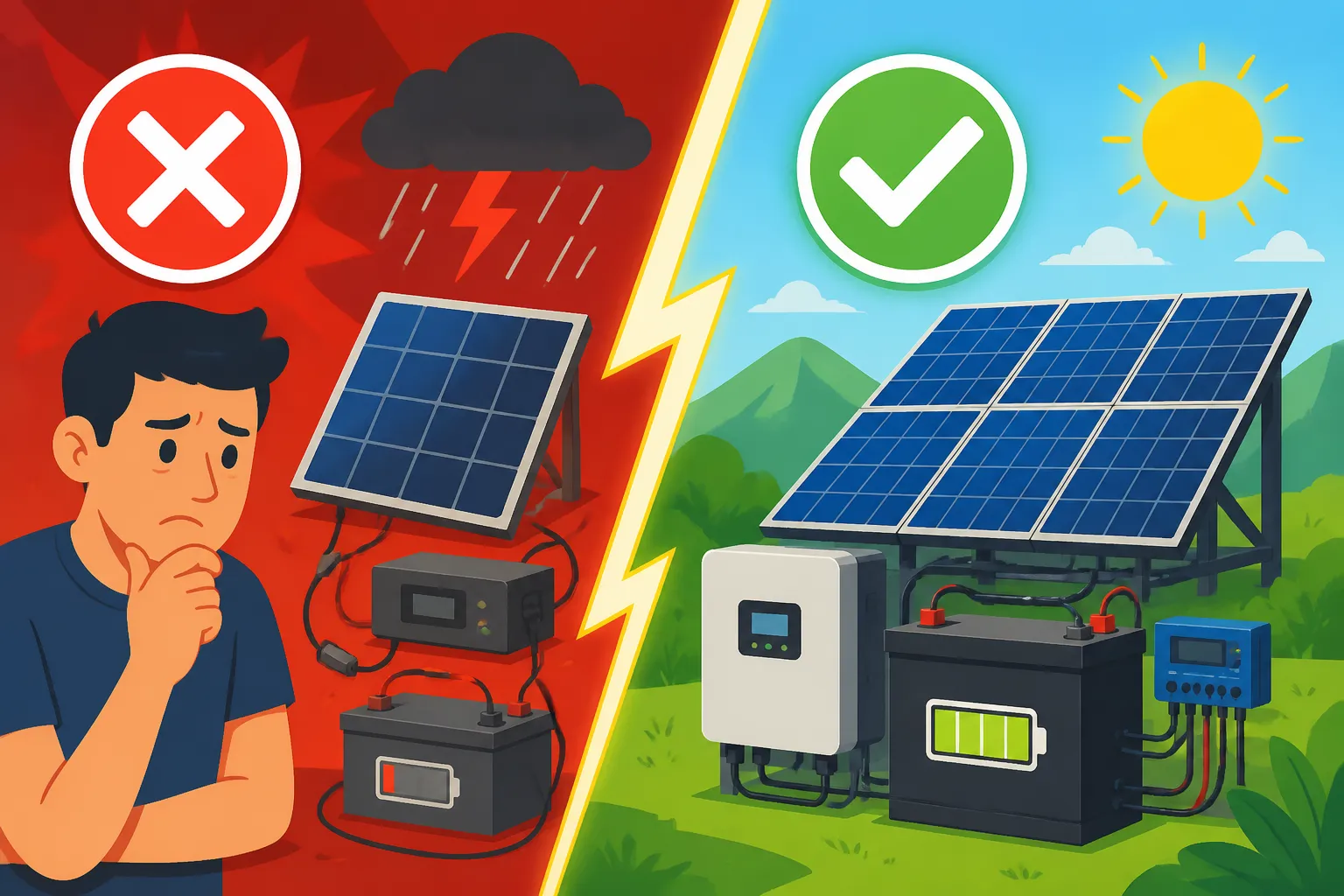
It’s tempting to find a great deal on solar panels from one supplier, a cheap battery bank from another, and an inverter from a third. On the surface, it seems like smart shopping. But in the world of off-grid solar, mixing and matching components without understanding their specific electrical characteristics and communication protocols can be a recipe for disaster. Different brands and models of charge controllers, inverters, and batteries are designed to work within specific voltage ranges, current limits, and communication standards. A 48V inverter won't work with a 12V battery bank, and a charge controller designed for lead-acid batteries won't properly charge a lithium (LiFePO4) bank without precise settings, potentially damaging it.
Even if the core components like voltage and current match, you can run into issues with system monitoring and management. Advanced off-grid systems often rely on proprietary communication buses to allow components to "talk" to each other, optimizing performance, displaying crucial data, and preventing overcharging or over-discharging. For example, a Victron Energy smart shunt might communicate seamlessly with a Victron inverter/charger, giving you a holistic view of your power system. If you've got an inverter from one brand, a charge controller from another, and batteries from a third, you might end up with three separate monitoring apps or no easy way to see the system's overall health. This disjointed approach can make troubleshooting a nightmare and diminish the overall efficiency and lifespan of your system. Many reputable brands offer integrated solutions or components designed to work together, simplifying the process. These comprehensive solutions ensure that all parts are compatible and optimized, which you can learn more about in Off-Grid Solar System Components Explained. While buying a complete kit can sometimes be more expensive upfront than hunting for individual deals, the peace of mind and seamless operation are often worth the investment, as discussed in detail in our comparison of Complete vs Component Off-Grid Kits.
Voltage Vexations and Inverter Blunders
Choosing the correct system voltage (12V, 24V, or 48V) is one of the foundational decisions in off-grid solar design, and getting it wrong can lead to serious inefficiencies or even system failure. For smaller applications like a basic RV setup or a tiny shed with minimal power needs, a 12V system might suffice. However, as your power demands grow, staying at 12V requires much thicker, more expensive wiring to handle higher currents and mitigate voltage drop, especially over longer distances. Larger systems for a full-time cabin or a whole house generally benefit immensely from a 24V or, more commonly, a 48V system. Higher voltage means lower current for the same amount of power, allowing for thinner wires and less energy loss. Understanding 12V vs 24V vs 48V: Which to Choose is critical before you purchase any components.
Another common blunder involves the inverter – the heart of your AC power supply. Many off-grid kits might include a modified sine wave inverter to keep costs down. While these can power simple resistive loads like basic lights or heating elements, they can cause problems with sensitive electronics, motors, and anything with a microchip, leading to buzzing, overheating, or even permanent damage. Your laptop, television, medical devices (like CPAP machines), or power tools generally require a pure sine wave inverter to operate correctly and safely. Skimping on the inverter quality to save a few dollars upfront is a mistake that can cost you much more in damaged appliances or poor performance down the line. Always verify that the inverter in your chosen kit is a pure sine wave model, especially if you plan to power modern electronics. Our detailed article on Pure Sine Wave vs Modified Sine Wave Inverters explains why this distinction is so vital for off-grid living.
Overlooking Battery Bank Specifics and Sizing
The battery bank is arguably the most critical and often the most expensive component of an off-grid solar system. It's where your precious solar energy is stored for use when the sun isn't shining. Making mistakes here can lead to insufficient power, short battery life, and significant unexpected costs.
Skimping on Capacity and Chemistry
Many off-grid hopefuls, looking to save money, will opt for the smallest battery bank they think they can get away with. This is a classic mistake. An undersized battery bank will be constantly cycling through deep discharges, drastically shortening its lifespan. Batteries are rated for a certain number of cycles (charge and discharge events) before their capacity significantly degrades. The deeper you discharge them, the fewer cycles they'll provide. If your batteries are consistently running low, you're going to be replacing them much sooner than anticipated, which can be a huge, unforeseen expense.
Furthermore, the choice of battery chemistry is paramount and heavily influences both upfront cost and long-term performance. Lead-acid batteries (like flooded or AGM) are cheaper initially but have a shallower usable depth of discharge (typically 50%), require more maintenance, and have a shorter cycle life. Lithium Iron Phosphate (LiFePO4) batteries, while more expensive upfront, offer a much deeper usable discharge (often 80-100%), higher efficiency, longer cycle life (thousands more cycles), and are virtually maintenance-free. While the sticker price of a LiFePO4 battery bank might make you gasp, when you consider the total cost of ownership over its lifespan, including replacement costs and efficiency gains, lithium often proves to be the more economical choice in the long run. The critical difference in cost and performance between these technologies is explored in LiFePO4 vs Lead-Acid Battery Cost. It’s easy to focus on the initial purchase price, but ignoring the true cost implications of battery choice is a major pitfall. For a deeper understanding of this, check out How Batteries Drive Off-Grid Solar Cost.
Neglecting Battery Management and Environmental Factors
A battery bank, especially a sophisticated LiFePO4 one, is not just a collection of cells. It's a complex component that requires careful management to ensure safety, longevity, and optimal performance. For lithium batteries, a robust Battery Management System (BMS) is non-negotiable. The BMS protects the battery from overcharging, over-discharging, over-current, and temperature extremes, and ensures that all cells within the battery pack are balanced. Without a proper BMS, a lithium battery can be severely damaged or even become a fire hazard. Some cheaper lithium batteries or DIY kits might skimp on the BMS, leaving you vulnerable to these issues.
Beyond the BMS, batteries are sensitive to their environment. Both lead-acid and lithium batteries perform optimally within specific temperature ranges. Extremely cold temperatures can severely reduce a battery's usable capacity and even prevent charging in lithium batteries (some even have low-temperature cut-offs). Conversely, excessive heat can accelerate degradation for all battery types. Many off-gridders overlook the need for a dedicated, temperature-controlled battery enclosure. This means not just shielding them from the elements but also ensuring adequate ventilation for lead-acid batteries (which off-gas hydrogen) and protection from extreme temperatures for all types. Failing to properly house and manage your battery bank is a shortcut that will inevitably lead to premature failure and replacement costs. Our article on How to Choose an Off-Grid Battery Bank offers more guidance on these crucial considerations.
| Mistake Category | Common Pitfall | Impact on System | Recommended Solution |
|---|---|---|---|
| Power Needs | Underestimating daily energy consumption | Frequent power outages, discharged batteries, system overload | Detailed load analysis (all appliances, surge/run watts) |
| Ignoring seasonal sun variations | Insufficient power in winter/cloudy periods | Size for worst-case sun hours, add days of autonomy | |
| Component Compatibility | Mixing incompatible components | Poor performance, communication issues, premature failure | Choose integrated kits, research component compatibility (voltage, current, communication) |
| Using modified sine wave inverters | Damage to sensitive electronics | Always opt for pure sine wave inverters for modern devices | |
| Battery Bank | Undersizing battery capacity | Short battery lifespan, frequent replacements | Calculate required amp-hours for desired autonomy and DoD |
| Choosing wrong battery chemistry for needs | Higher long-term cost, maintenance burden | Invest in LiFePO4 for longevity/low maintenance, consider lead-acid for budget/minimal use | |
| Neglecting BMS or environmental protection | Safety hazards, battery damage, reduced lifespan | Ensure robust BMS (for LiFePO4), proper ventilation, temperature-controlled enclosure | |
| Installation & Expansion | Underestimating DIY complexity | Safety risks, incorrect wiring, system malfunction | Follow detailed guides, hire professionals for critical steps if unsure |
| Not planning for future expansion | Costly system overhauls, limited growth potential | Choose modular components, slightly oversize initial capacity | |
| Quality & Cost | Buying cheap, low-quality components | Early failure, poor efficiency, unreliable power | Research reputable brands, read reviews, check warranties |
| Overlooking hidden costs | Budget overruns, unexpected expenses | Factor in wiring, mounting, permits, tools, maintenance, and potential professional labor |
Ignoring Installation Realities and Future Expansion
The dream of powering your own off-grid paradise often glosses over the nuts and bolts of installation. It's not just about buying the right kit; it's about properly putting it all together, safely and efficiently, and considering how your needs might evolve down the road.
Underestimating the DIY Challenge
For many, the appeal of an off-grid solar kit is the promise of a relatively straightforward, DIY installation. And while many kits are designed with the DIYer in mind, "straightforward" doesn't mean "easy." Off-grid solar involves significant electrical work, including high-voltage DC (from the panels) and high-current DC (from the batteries), which can be dangerous if handled improperly. You’ll need to understand wiring diagrams, proper grounding techniques, fuse and breaker sizing, and how to safely connect all the components – panels, charge controller, batteries, and inverter. Mistakes in wiring can lead to poor performance, equipment damage, or even fire.
Moreover, mounting solar panels on a roof or a ground mount requires structural considerations and weatherproofing. Running cables through walls or roofs needs to be done carefully to prevent leaks and ensure compliance with any local codes (even for off-grid, some areas have requirements). While some smaller, portable systems, like those from Jackery, are designed for plug-and-play simplicity, a larger whole-home off-grid system is a different beast entirely. It requires a specific set of tools – multimeters, wire strippers, crimpers, torque wrenches, and safety gear – and a level of electrical competency. Many people start a DIY project only to realize they're in over their heads, leading to delays, frustration, and ultimately, hiring an expensive professional to fix mistakes or complete the job. Understanding DIY vs Professional Off-Grid Solar Installation Cost can help you weigh your options realistically. Before you even unpack your first component, make sure you've thoroughly reviewed a comprehensive resource like our Off-Grid Solar Installation Guide to grasp the scope of the project.
Failing to Plan for Growth and Adaptability
Life changes, and so do energy needs. What might be sufficient for a weekend cabin today could feel restrictive if you decide to spend more time there or add more appliances tomorrow. A significant mistake is purchasing a static, non-expandable system without considering future possibilities. Imagine you start with a modest off-grid setup for a small tiny home, enough to run lights, a mini-fridge, and charge electronics. A year later, you decide to add a powerful blender, an electric well pump for a new garden, or perhaps even an air conditioning unit. If your initial system wasn't designed with expansion in mind, adding these loads could mean replacing major components like your charge controller, inverter, or even your entire battery bank – a far more expensive proposition than if you had planned for it from the start.
Look for kits and components that are modular and can be easily expanded. For example, a charge controller that can handle more solar input than your initial array, or an inverter that allows for parallel operation with another unit to double its output. Even choosing a system voltage like 48V from the get-go can make future expansion easier for larger loads. Planning for future needs, even if vague, can save you thousands of dollars and countless hours of rework. This foresight is crucial not just for your wallet, but also for the longevity and adaptability of your off-grid lifestyle. To truly build a system that can evolve with you, it's worth exploring guides like How to Design an Expandable System and understanding the Cost of Expanding an Off-Grid System before making your initial purchase.
Skipping Crucial Research and Quality Control
In the burgeoning off-grid solar market, there's a vast array of products available, from well-established brands to obscure online vendors. Navigating this landscape without thorough research is a surefire way to end up with a system that underperforms or fails prematurely.
Falling for "Too Good to Be True" Deals
We all love a bargain, but when it comes to off-grid solar, if a deal seems too good to be true, it probably is. The market is flooded with incredibly cheap solar panels, inverters, and batteries from unbranded or lesser-known manufacturers, often boasting impressive specs at rock-bottom prices. While these might save you a few hundred dollars upfront, they frequently come with hidden costs down the line. Inferior components might have shorter lifespans, lower real-world efficiency compared to their advertised ratings, or, most critically, they might lack proper safety certifications and robust quality control.
Imagine purchasing a cheap inverter only to find it constantly trips under loads it should easily handle, or worse, damages your sensitive electronics due to poor power quality. Or a battery bank that loses significant capacity after only a year or two, leaving you in a costly replacement cycle. Reputable brands invest heavily in research and development, rigorous testing, and quality materials, which is reflected in their pricing. They also offer substantial warranties and reliable customer support, providing peace of mind. While a Jackery portable power station might seem expensive, for example, its proven reliability and comprehensive warranty make it a worthwhile investment for many users. Prioritizing initial savings over long-term reliability and safety is a common mistake that almost always ends up costing more in the long run through replacements, repairs, or lost energy.
Neglecting Reviews and Expert Recommendations
In today's digital age, information is readily available, yet many still fail to tap into the wealth of knowledge shared by other off-gridders and industry experts. Neglecting to read reviews, watch comparison videos, and seek advice from experienced individuals is a major oversight. Online forums, social media groups dedicated to off-grid living, and independent review sites are invaluable resources. They offer real-world feedback on specific products, highlighting common issues, true performance figures, and the responsiveness of customer support.
For instance, while a particular solar panel might have excellent specs on paper, user reviews might reveal that its junction box is prone to cracking in certain climates, or that the manufacturer's warranty process is notoriously difficult. Conversely, you might discover that a lesser-known brand like EG4, while not as ubiquitous as Victron, offers exceptional value and performance for its price point, backed by strong community support. Don't rely solely on manufacturer claims. Dive deep into product reviews, especially those from people who have used the equipment in similar off-grid scenarios. Engage with the off-grid community; their collective experience can save you from making preventable mistakes and guide you towards reliable solutions. Experts often highlight brands known for their durability and performance, such as Victron Energy for high-end systems, Renogy for accessible kits, or Sol-Ark for versatile all-in-one inverter-chargers. A quick search can reveal a lot about a company's track record and product quality.
Not Understanding the True Cost and Long-Term Investment
Many people approaching off-grid solar fixate solely on the upfront cost of the major components – the panels, batteries, and inverter. This tunnel vision often leads to budget overruns and a skewed perception of the system's true value over time.
Hidden Costs and Unexpected Expenses
The price tag on an off-grid solar kit is rarely the total cost of getting your system up and running, let alone maintaining it. There's a myriad of "hidden" costs that can quickly add up and blow your budget if not accounted for. These include:
- Mounting Hardware: Whether it's roof mounts, ground mounts, or pole mounts, you'll need racking, rails, clamps, and fasteners that are robust and weather-resistant.
- Wiring and Connectors: High-quality solar PV wire, battery cables, MC4 connectors, and appropriate conduit for protection are essential. Don't skimp on wire gauge, as voltage drop can significantly reduce efficiency.
- Safety Devices: Fuses, breakers, disconnect switches, and proper grounding equipment are critical for system protection and safety. These aren't always included in basic kits.
- Permitting and Inspections: Depending on your location and the scale of your system, you might need electrical permits and inspections, even for off-grid installations. The associated fees and potential requirements for professional stamps can be considerable.
- Tools: If you're going the DIY route, you'll need specialized electrical tools, not just standard household ones.
- Shipping: Large, heavy components like batteries and solar panels can incur significant shipping costs, especially to remote off-grid locations.
- Professional Assistance: Even if you plan to DIY most of it, you might need an electrician for specific wiring tasks or to sign off on certain parts of the installation for safety or code compliance.
- Maintenance: While solar systems are relatively low maintenance, batteries need occasional checks (especially flooded lead-acid), and panels need cleaning. There's also the eventual Off-Grid Solar Maintenance Costs for component replacement, particularly batteries.
These costs can easily add 20-50% to the initial kit price, catching many unprepared buyers off guard. Our article on Hidden Costs of Going Off-Grid delves deeper into these often-overlooked expenses, providing a realistic view of what to budget for.
Focusing Only on Upfront Price
It's natural to compare prices when making a significant purchase, but for off-grid solar, focusing solely on the lowest upfront price is a short-sighted strategy. A cheaper system might use lower-quality components, leading to reduced efficiency, more frequent breakdowns, and a shorter lifespan for key elements like batteries and inverters. This means you'll spend more money on replacements and repairs over the system's lifetime, completely negating any initial savings.
Consider the long-term return on investment. A high-quality LiFePO4 battery bank might cost two or three times more than a lead-acid one initially, but it could last five to ten times longer, require zero maintenance, and offer much higher usable capacity. The efficiency gains from a premium inverter mean less energy wasted, translating to more usable power from your solar array. These factors contribute significantly to the overall value and operational cost of your system over its 20-25 year lifespan. The "payback period" – how long it takes for your energy savings to offset your initial investment – is also crucial. A system with higher upfront costs but superior efficiency and longevity might actually have a shorter or more favorable payback period due to fewer replacements and better performance. This long-term perspective is essential for making a truly cost-effective decision. Understanding the Off-Grid Solar Payback Period Explained and How Off-Grid Solar Saves Money Long-Term will help you evaluate systems beyond just their initial price tag.
By avoiding these common mistakes, you'll be well on your way to designing and implementing an off-grid solar system that is reliable, efficient, and perfectly tailored to your needs, bringing you the true freedom and independence that off-grid living offers.
Disclaimer
The information provided in this article is for general informational purposes only and does not constitute professional advice. Off-grid solar system design and installation can be complex and involve electrical hazards. Always consult with qualified professionals, electricians, or solar experts before making purchasing decisions or attempting any installation. Local codes and regulations may apply to your specific situation.