How to Choose an Off-Grid Battery Bank
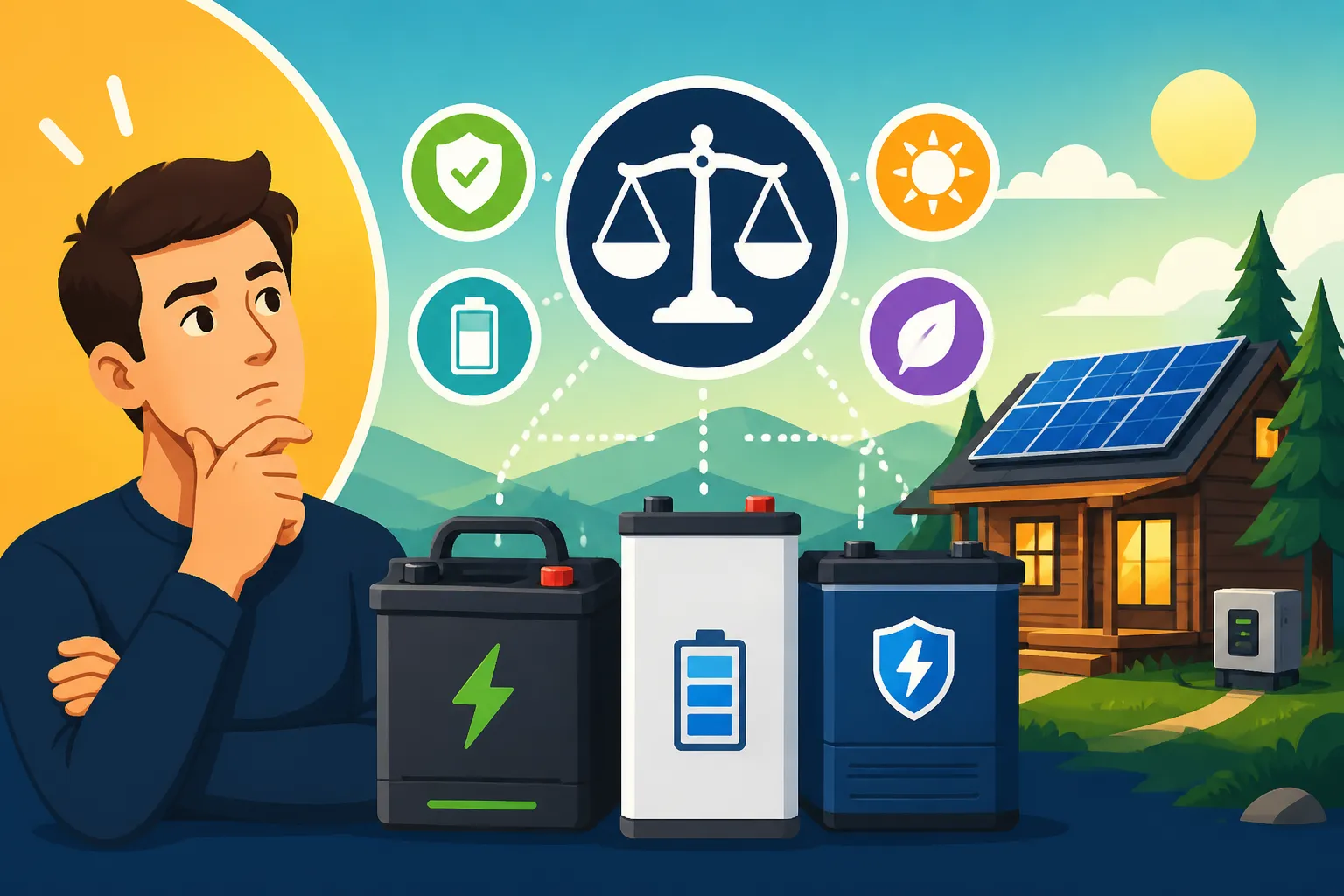
Trying to figure out which battery bank is right for your off-grid solar setup can feel like a daunting task, can't it? It’s not just about how much power you think you need; it's a deep dive into different technologies, how they perform, and what truly makes sense for your lifestyle and budget. Don't worry, you're not alone in feeling overwhelmed. This comprehensive guide will break down all the essential factors, helping you navigate the complexities and confidently choose the ideal battery bank to power your off-grid dreams.
Understanding Your Off-Grid Battery Needs
Before you even start looking at battery specs, you need to get a crystal-clear picture of your actual energy requirements. It’s like planning a road trip without knowing how far you’re going or how many passengers you’ll have – you wouldn’t just guess the fuel and snacks, right? Your off-grid power is no different. A little groundwork here saves a lot of headaches (and money) later.
Calculating Daily Energy Consumption
The very first step is to perform a thorough load analysis. This might sound intimidating, but it's really just making a detailed list of every electrical appliance and device you plan to use, how many watts each consumes, and for how many hours a day. Think about everything: your refrigerator, lights, phone chargers, laptop, water pump, microwave, TV, and even small things like electric toothbrushes.
For example, a typical off-grid cabin might have an energy-efficient refrigerator (averaging 30-50 watts, but cycling on and off for perhaps 8 hours total per day), a few LED lights (5-10 watts each for 4-6 hours), and a laptop (60 watts for 3 hours). Don't forget those sneaky "phantom loads" – devices that draw a small amount of power even when off or in standby. If you're serious about getting this right, you can even pick up a cheap Kill-A-Watt meter from a hardware store to measure the actual draw of your specific appliances. This detailed accounting helps you move from vague guesses to concrete numbers, which is essential for accurate battery sizing. For a deeper dive into this crucial first step, check out our guide on How to Calculate Daily Energy Usage.
Determining Days of Autonomy
Once you know your daily energy consumption, the next big question is: how many days do you need to power your system without any solar input? This is what we call "days of autonomy," and it's a critical factor, especially if you live in an area prone to extended cloudy weather, heavy snowfall, or simply shorter daylight hours in winter. For a remote cabin in the Pacific Northwest, where it might be overcast for a week straight, you'd want a higher number of days of autonomy (say, 5-7 days) than someone in sunny Arizona who might be fine with 2-3 days.
Your choice here directly impacts the size and cost of your battery bank. Every extra day of autonomy means more battery capacity, which means a larger investment. However, skimping on this can leave you in the dark or without critical power when you need it most. It’s a balancing act between cost and reliability. Consider your location, your usage patterns (do you only visit on sunny weekends, or is this your full-time residence?), and your tolerance for running a backup generator. To really nail down this calculation, take a look at our article on How to Calculate Days of Autonomy.
Planning for Future Expansion and Critical Loads
It's easy to get caught up in your current energy needs, but a little foresight goes a long way. Are you planning to add a new appliance in a year or two, like a small freezer, a larger TV, or perhaps a more robust workshop tool? If so, factoring in a little extra capacity from the start can save you the headache and expense of completely overhauling your battery bank later. Think of it as building a house with room to grow rather than having to add an extension every time your family expands.
Beyond future growth, it's also smart to differentiate between critical and non-critical loads. Critical loads are things you absolutely cannot live without: medical devices (like a CPAP machine), refrigeration, water pumps, and essential lighting. Non-critical loads might include a power-hungry entertainment system, a secondary air conditioner, or that rarely used bread maker. Designing your battery bank with enough capacity for your critical loads, even during extended periods of low solar input, provides a safety net. This kind of forward-thinking design ensures your system remains flexible and robust as your off-grid life evolves. For tips on building a system that can grow with you, check out How to Design an Expandable System.
Exploring Off-Grid Battery Chemistries
The heart of any off-grid solar system is its battery bank, and not all batteries are created equal. The chemistry inside those cells dictates everything from their upfront cost to their lifespan and how they perform day-to-day. Understanding the differences is crucial to making an informed decision that suits your budget and energy demands.
Lead-Acid Batteries Deep Dive Flooded, AGM, Gel
Lead-acid batteries have been the workhorse of off-grid power for decades, primarily due to their lower upfront cost and widespread availability. However, they come with a distinct set of characteristics that are important to understand. There are three main types commonly used off-grid:
Flooded Lead-Acid (FLA) Batteries: These are the traditional choice, often seen in golf carts or larger deep-cycle applications. Their main advantage is their relatively low purchase price. However, they require regular maintenance, specifically topping off electrolyte levels with distilled water, and they must be installed in a well-ventilated area because they release hydrogen gas during charging. FLAs are also sensitive to being deeply discharged; routinely taking them below 50% of their capacity significantly shortens their lifespan, which means you need a larger bank to get the usable capacity you desire.
Absorbed Glass Mat (AGM) Batteries: AGMs are a step up in convenience. They are sealed, "maintenance-free" (no watering required), and don't off-gas under normal charging conditions, making them safer for indoor installations or in enclosed spaces like RVs. They handle deeper discharges better than FLAs, often tolerating up to 80% DoD occasionally, but still perform best when kept above 50% DoD for maximum lifespan. They also have a lower self-discharge rate, meaning they hold a charge longer when not in use. Brands like Renogy and others offer various AGM options suitable for smaller to mid-sized off-grid setups, and they are widely available on platforms like Amazon.
Gel Batteries: Similar to AGMs, Gel batteries are also sealed and maintenance-free. They use a silica gel to suspend the electrolyte. Gel batteries are generally more robust in extreme temperatures and have a very low self-discharge rate. However, they typically have lower power output and require slower charging rates, which can be a drawback for solar systems that need to quickly capture energy on a sunny day. Their cycle life is often comparable to AGM batteries when kept within their recommended discharge limits.
While lead-acid batteries are initially cheaper, their shorter lifespan, depth of discharge limitations, and lower efficiency often mean a higher lifetime cost, especially when considering replacements. For a deeper cost comparison, you might find our guide on LiFePO4 vs Lead-Acid Battery Cost helpful.
Lithium-Ion Batteries LiFePO4 Deep Dive
When we talk about lithium-ion batteries for off-grid solar, we're almost exclusively referring to Lithium Iron Phosphate (LiFePO4 or LFP) chemistry. These batteries have revolutionized off-grid power with their impressive performance characteristics, though they do come with a higher upfront price tag.
Key Advantages of LiFePO4:
- Longer Lifespan: LiFePO4 batteries boast significantly longer cycle lives compared to lead-acid, often lasting 10-15 years or more, easily reaching 3,000 to 8,000 charge cycles or even beyond. This means fewer replacements over the life of your system.
- Deep Discharge Capability: You can regularly discharge LiFePO4 batteries to 80-100% of their capacity without significantly impacting their lifespan. This means a 100 Ah LiFePO4 battery provides far more usable energy than a 100 Ah lead-acid battery.
- High Efficiency: They are incredibly efficient, converting almost all the energy stored into usable power, with very little loss during charging and discharging (typically 95-99% round-trip efficiency).
- Lighter Weight and Compact Size: LiFePO4 batteries are considerably lighter and often more compact than lead-acid equivalents, making them ideal for mobile applications like RVs, vans, and boats, or anywhere space and weight are at a premium.
- Faster Charging: They can accept a much higher charge current, allowing them to recharge much faster than lead-acid batteries, which is a huge benefit on days with limited sunshine.
- Built-in BMS: Most quality LiFePO4 batteries come with an integrated Battery Management System (BMS). This essential component protects the battery from overcharging, over-discharging, over-current, and extreme temperatures, ensuring safety and longevity. It also balances the cells, which is crucial for overall battery health.
Considerations for LiFePO4:
- Higher Upfront Cost: This is the primary hurdle for many. While the lifetime cost can be lower, the initial investment is substantial.
- Cold Temperature Sensitivity: LiFePO4 batteries generally cannot be safely charged when their internal temperature is below freezing (around 32°F or 0°C). Discharging is usually fine, but charging in freezing conditions can cause irreversible damage. Many modern LiFePO4 batteries now feature low-temperature charging protection or even internal heaters (like some Battle Born or EG4 models) to mitigate this issue.
Despite the higher initial investment, the long-term benefits and superior performance of LiFePO4 often make them the preferred choice for serious off-grid applications.
Emerging Battery Technologies
While lead-acid and LiFePO4 dominate the off-grid battery market, research and development are constantly pushing the boundaries of energy storage. Emerging technologies promise even greater efficiency, safety, and sustainability, though most are still in early stages for widespread consumer off-grid use.
One area of interest is flow batteries. These batteries store energy in liquid electrolyte tanks, offering potentially very long lifespans and the ability to scale power and energy independently. They're typically larger and more complex than LiFePO4, currently seeing more application in grid-scale storage rather than individual off-grid homes. Another intriguing option gaining traction is saltwater batteries, like those offered by Aquion Energy (though the company has faced challenges), which use non-toxic, abundant materials, making them very environmentally friendly. They offer good safety but tend to have lower energy density and power output compared to lithium.
For the vast majority of off-grid enthusiasts and homesteaders today, LiFePO4 remains the most practical and efficient choice, offering a fantastic balance of performance, longevity, and a rapidly improving cost-to-benefit ratio. While it's exciting to see what the future holds, sticking with proven technologies like LiFePO4 will give you the most reliable and readily available solutions for your immediate off-grid needs.
Key Battery Specifications and What They Mean
Navigating the world of battery specifications can feel like learning a new language. You'll encounter terms like Amp-hours, Watt-hours, DoD, and cycle life, and it's essential to understand what each one means to truly compare your options. These aren't just technical jargon; they're the vital statistics that tell you how a battery will perform in the real world.
Capacity Amp-Hours and Watt-Hours
Battery capacity is arguably the most critical specification, telling you how much energy a battery can store. It's typically expressed in two ways:
Amp-hours (Ah): This measures the amount of current a battery can deliver over a certain period. For example, a 100 Ah battery can theoretically deliver 10 amps for 10 hours, or 1 amp for 100 hours. While useful, Ah by itself doesn't tell the whole story because the actual energy stored depends on the battery's voltage. A 100 Ah 12V battery stores a different amount of energy than a 100 Ah 48V battery.
Watt-hours (Wh): This is often a more practical unit for off-grid solar, as it directly relates to the power consumption of your appliances (measured in watts). Watt-hours represent the total energy stored in the battery, regardless of its voltage. To calculate Watt-hours from Amp-hours, you simply multiply the Amp-hours by the battery's nominal voltage (Wh = Ah x Volts). So, a 100 Ah 12V battery holds 1200 Wh (1.2 kWh) of energy, while a 100 Ah 48V battery holds 4800 Wh (4.8 kWh). This conversion is key to comparing apples to apples when sizing your system and understanding how much actual work your battery bank can do. Understanding Watts vs Watt-Hours vs Amp-Hours Explained is fundamental to getting your sizing right.
Depth of Discharge DoD and Cycle Life
These two specs are intertwined and incredibly important for understanding a battery's longevity and usable capacity.
Depth of Discharge (DoD): This refers to how much energy is pulled out of a battery relative to its total capacity. A 50% DoD means you've used half of the battery's stored energy. The deeper you routinely discharge a battery, the fewer charge/discharge cycles it will typically provide over its lifetime. For instance, a lead-acid battery rated for 1,000 cycles at 50% DoD might only deliver 300 cycles if consistently discharged to 80% DoD. LiFePO4 batteries, on the other hand, can often be discharged to 80-100% DoD with minimal impact on their impressively long cycle life, making more of their rated capacity usable. This distinction means that a smaller capacity LiFePO4 bank can often outperform a larger capacity lead-acid bank in terms of daily usable energy.
Cycle Life: This is the number of times a battery can be fully discharged and recharged before its capacity significantly degrades (typically to 80% of its original capacity). As mentioned, cycle life is heavily dependent on the DoD. A lead-acid battery might be rated for 500-1,500 cycles at 50% DoD, while a quality LiFePO4 battery is commonly rated for 3,000-8,000 cycles at 80-100% DoD. This huge difference in cycle life is a major reason why, despite their higher upfront cost, LiFePO4 batteries often prove to be a more economical choice over the long term, as you won't need to replace them nearly as often.
Voltage 12V, 24V, 48V and System Efficiency
Choosing the right system voltage is a foundational decision that impacts almost every other component in your off-grid system, from wire sizing to inverter efficiency.
- 12V Systems: These are common for smaller applications like RVs, vans, small cabins, or basic emergency backup setups. Many DC appliances (lights, USB chargers) are readily available in 12V, simplifying wiring. However, for higher power demands, 12V systems require much thicker (and therefore more expensive) wiring to avoid voltage drop, and larger inverters become less efficient at converting 12V to 120V AC. You can learn more about this by reading When 12V Is Enough for Off-Grid.
- 24V Systems: Stepping up to 24V is a good compromise for mid-sized systems, offering a significant improvement in efficiency and reducing wire size requirements compared to 12V. You can double the power at the same current, meaning less voltage drop over longer cable runs. Many charge controllers and inverters are readily available for 24V applications.
- 48V Systems: For larger homes, extensive workshops, or any application with substantial daily energy consumption and high-wattage appliances, 48V is generally the most efficient and cost-effective choice. At 48V, you can transmit four times the power of a 12V system with the same current, dramatically reducing wire thickness and voltage drop. High-capacity inverters and charge controllers are optimized for 48V, leading to better overall system performance and efficiency. While the initial component cost might be slightly higher for 48V equipment, the savings in wiring, increased efficiency, and reduced power loss often make it the superior long-term solution for whole-home off-grid living. Deciding between these voltages is a big deal, and our guide 12V vs 24V vs 48V: Which to Choose breaks down the pros and cons.
The higher the system voltage, the lower the current (amps) for a given power output (watts). Lower current means less heat generated in the wires and less energy lost due to resistance, leading to a more efficient and safer system. This is why large off-grid homes almost universally opt for 48V.
Sizing Your Off-Grid Battery Bank Correctly
Getting the size of your battery bank just right is a delicate balance. Too small, and you’ll constantly be running out of power, relying on a generator, and shortening your battery's life. Too large, and you've overspent on capacity you don't need, tying up valuable resources that could go elsewhere. The goal is to match your battery bank to your actual energy consumption, your solar array’s production, and your desired resilience.
Step-by-Step Calculation for Battery Capacity
Let’s walk through the process of calculating the ideal battery capacity. This isn't just theory; it's the bedrock of a successful off-grid system.
- Calculate Total Daily Watt-Hours (Wh): We covered this in the "Understanding Your Off-Grid Battery Needs" section. Let's assume, for example, your total daily energy consumption after a detailed load analysis is 4,000 Wh (4 kWh).
- Determine Days of Autonomy: How many cloudy days do you want to be able to last without solar charging? Let's say you live in an area with unpredictable weather and want 3 days of autonomy.
- Calculate Total Energy Needed for Autonomy: Multiply your daily consumption by your days of autonomy.
- 4,000 Wh/day * 3 days = 12,000 Wh (12 kWh)
- Factor in Desired Depth of Discharge (DoD): This is where battery chemistry really matters.
- For Lead-Acid Batteries: To maximize lifespan, you generally want to limit DoD to 50%. So, your usable capacity should be the total energy needed. To find the rated capacity, you'll need to divide by the usable percentage.
- 12,000 Wh / 0.50 (for 50% DoD) = 24,000 Wh rated capacity needed.
- For LiFePO4 Batteries: These can safely be discharged much deeper, often to 80% or even 90% DoD. Let's use 80%.
- 12,000 Wh / 0.80 (for 80% DoD) = 15,000 Wh rated capacity needed.
- For Lead-Acid Batteries: To maximize lifespan, you generally want to limit DoD to 50%. So, your usable capacity should be the total energy needed. To find the rated capacity, you'll need to divide by the usable percentage.
- Convert to Amp-Hours (Ah) at Your Chosen System Voltage: Let's assume you've decided on a 48V system for your home.
- For Lead-Acid: 24,000 Wh / 48V = 500 Ah
- For LiFePO4: 15,000 Wh / 48V = 312.5 Ah
So, for this hypothetical scenario, you'd need roughly 500 Ah of lead-acid batteries at 48V, or about 315 Ah of LiFePO4 batteries at 48V, to achieve 3 days of autonomy. This example clearly illustrates why LiFePO4 often requires a smaller rated capacity bank to provide the same usable energy. For a comprehensive guide on this process, delve into How to Size an Off-Grid Battery Bank.
Matching Battery Capacity to Solar Array and Inverter
A perfectly sized battery bank is only one piece of the puzzle. Your entire off-grid system needs to be harmonious. If your solar array is too small for your battery bank, those batteries will rarely get a full charge, which can lead to sulfation in lead-acid batteries or simply insufficient power generation. Conversely, if your solar array is massive but your battery bank is tiny, you'll waste a lot of potential energy on sunny days because the batteries will charge up quickly and then have nowhere else to store the excess.
Your inverter also plays a crucial role. It converts the DC power from your batteries into the AC power that most of your household appliances use. The inverter must be sized to handle the peak surge loads of your appliances – think about a well pump or a refrigerator compressor kicking on. If your inverter is too small, it could trip or fail when a high-draw appliance starts up, even if your battery bank has plenty of capacity. Therefore, your battery bank, solar array, charge controller, and inverter must all be sized in relation to each other to create a balanced and efficient system. For help with the inverter side of things, check out How to Size an Off-Grid Inverter.
Considerations for Battery Enclosures and Environment
Where and how you store your battery bank is just as important as the batteries themselves. Batteries are sensitive to environmental conditions, and proper housing ensures both safety and optimal performance.
Temperature Extremes: Both excessively hot and freezing temperatures can severely impact battery lifespan and performance. High heat accelerates degradation, while cold weather reduces usable capacity (temporarily for lead-acid, but it can make charging unsafe for LiFePO4). For lead-acid batteries in cold climates, you might see a significant drop in their usable capacity, sometimes as much as 20-30% below freezing. For LiFePO4, internal heaters or heated enclosures are essential if you plan to charge them in sub-freezing conditions. Conversely, in hot climates like the Arizona desert, shaded, well-ventilated enclosures are paramount to prevent overheating.
Ventilation: This is critical for flooded lead-acid batteries, which produce explosive hydrogen gas during charging. Their enclosure must be vented to the outside, away from any ignition sources. While AGM and Gel batteries are sealed, good airflow around them is still beneficial to prevent heat buildup. LiFePO4 batteries generally do not off-gas, but proper ventilation helps regulate their operating temperature.
Protection from Elements and Pests: Batteries should be protected from direct sunlight, rain, snow, and extreme humidity. Pests like rodents can chew through cables, leading to dangerous shorts. A sturdy, secure enclosure—whether it’s a dedicated battery box, a shed, or a well-ventilated cabinet—is a must. It keeps the elements out, maintains a more stable temperature, and prevents accidental contact or tampering. Always ensure your enclosure design prioritizes accessibility for maintenance (if required) and safety.
Installation, Maintenance, and Longevity
Installing an off-grid battery bank isn't just about dropping batteries into a box; it's a precise process that demands attention to detail for both safety and performance. Once installed, ongoing care will dramatically extend the life and efficiency of your investment.
Wiring Configurations and Safety
Connecting your batteries correctly is paramount. The wrong wiring can lead to poor performance, premature battery failure, or even dangerous electrical hazards.
- Series Wiring: This increases the voltage of your battery bank while keeping the Amp-hour capacity the same. For example, two 12V 100Ah batteries wired in series will create a 24V 100Ah bank. You connect the positive terminal of one battery to the negative terminal of the next.
- Parallel Wiring: This increases the Amp-hour capacity of your battery bank while keeping the voltage the same. Two 12V 100Ah batteries wired in parallel will create a 12V 200Ah bank. You connect positive to positive and negative to negative terminals.
- Series-Parallel Wiring: For larger, higher-voltage, higher-capacity banks (like a 48V 400Ah system built from 12V 100Ah batteries), you'll often combine both series and parallel wiring.
Regardless of the configuration, using the proper wire gauge (thickness) for the current your system will carry is critical to prevent overheating and voltage drop. Always use appropriately sized fuses and breakers on all main battery cables and circuits to protect against overcurrents and short circuits. These safety devices are non-negotiable. Always disconnect all power sources before working on your battery bank, wear appropriate personal protective equipment (PPE) like insulated gloves and eye protection, and use insulated tools to prevent accidental shorts. For detailed diagrams and best practices, our guide on Battery Bank Wiring Configurations is a must-read.
Battery Monitoring and Management Systems
Once your battery bank is installed, how do you know what's going on inside? That's where monitoring comes in.
- Battery Monitors: A good battery monitor is like the fuel gauge for your off-grid system. It provides real-time data on your battery's State of Charge (SoC), voltage, current (amps in/out), and sometimes even remaining runtime. This information is invaluable for understanding your power consumption, identifying inefficiencies, and ensuring you don't over-discharge your batteries. Many popular brands, like Victron Energy, offer sophisticated battery monitors that can integrate with other system components, giving you a complete overview of your power flow.
- Battery Management System (BMS): For LiFePO4 batteries, a BMS isn't just a recommendation; it's a necessity. The BMS is an electronic circuit board that actively manages the battery pack. It protects the cells from being overcharged or over-discharged, balances cell voltages to ensure all cells wear evenly, monitors temperature, and can disconnect the battery if a fault occurs. Without a BMS, LiFePO4 batteries can be dangerous and their lifespan significantly reduced. While many individual LiFePO4 batteries come with an internal BMS, if you're building a larger custom pack from individual cells, you'll need to install an external, robust BMS.
These systems provide peace of mind and help you optimize your battery's performance and longevity. Investing in good monitoring is investing in the health and efficiency of your entire off-grid setup.
Maximizing Battery Lifespan
Batteries are one of the most significant investments in an off-grid system, so extending their life means saving money and hassle in the long run.
- Optimal Charging Profiles: Ensure your charge controller is programmed with the correct charging parameters for your specific battery chemistry (bulk, absorption, float voltages, and temperature compensation). Incorrect charging can lead to undercharging (reducing capacity) or overcharging (damaging batteries).
- Avoid Deep Discharges (especially for Lead-Acid): As discussed, frequently discharging lead-acid batteries below 50% DoD dramatically shortens their life. While LiFePO4 can handle deeper discharges, consistently running them to 0% can still put unnecessary stress on the cells. Aim to keep a buffer whenever possible.
- Temperature Management: Keep your batteries within their optimal operating temperature range. This might mean insulation for cold weather or ventilation and shading for hot weather. For LiFePO4, avoid charging below freezing unless the battery has an internal heating system.
- Regular Inspection and Cleaning: Periodically check all battery terminals and connections for corrosion or looseness. Loose connections can cause resistance, heat buildup, and power loss. Clean terminals with a wire brush and apply an anti-corrosion spray. For flooded lead-acid batteries, regularly check and top off electrolyte levels with distilled water.
- Equalization (for Flooded Lead-Acid): Periodically performing an equalization charge (a controlled overcharge) for flooded lead-acid batteries can help desulfate the plates and balance cell voltages, extending their life. This should only be done as recommended by the manufacturer and never for sealed lead-acid or lithium batteries.
Following these maintenance tips can help your battery bank perform efficiently and reliably for many years. For a deeper dive into overall system care, consult our comprehensive Off-Grid Solar Maintenance Guide.
Where to Buy and What to Look For
So, you've done your homework, calculated your needs, and understood the technical ins and outs. Now comes the exciting part: actually getting your hands on a battery bank! But even this step comes with choices, from how you buy to who you buy from.
Purchasing Options Kits vs Individual Components
When it's time to purchase, you'll generally find two main approaches: buying a complete off-grid solar kit or sourcing individual components. Both have their merits.
Off-Grid Solar Kits: Many companies, like Renogy, offer pre-designed off-grid solar kits that include panels, a charge controller, an inverter, and often, batteries. These kits are fantastic for beginners or those who prefer a simpler, more streamlined approach. The components are typically pre-matched for compatibility, which takes a lot of the guesswork out of system design. They can be a great way to get started, especially for smaller applications like RVs, cabins, or shed power. The downside is that you might have less flexibility to customize your system or optimize individual component choices for very specific needs. You may find that some kit components aren't quite as robust as what you might choose for a completely custom build. If you're considering this route, our guide on Off-Grid Solar Kits: What to Buy offers some excellent insights.
Individual Components: This route involves selecting each component (solar panels, charge controller, inverter, and battery bank) separately. This approach offers maximum flexibility, allowing you to choose the absolute best components for your specific requirements, budget, and desired level of performance. For instance, you could pair high-efficiency solar panels with a premium inverter and a top-tier LiFePO4 battery bank. This is often the preferred method for larger, more complex off-grid homes where customization and long-term reliability are paramount. The trade-off is that it requires more technical knowledge to ensure all components are compatible and correctly sized, but it gives you ultimate control over your system's quality and capabilities.
Reputable Brands and Retailers
Choosing where to buy is almost as important as what to buy. You want reliable products, good warranties, and accessible customer support.
For Lead-Acid Batteries, trusted brands include Trojan, Crown Battery, and Rolls Battery (now Discover Battery). These companies have a long-standing reputation for producing high-quality deep-cycle lead-acid batteries. You can often find them through local battery distributors, solar supply companies, or even some larger hardware stores.
For LiFePO4 Batteries, the market has expanded rapidly. Some of the most highly regarded brands include Battle Born Batteries, known for their robust, drop-in replacement LiFePO4 units with excellent BMS systems, perfect for RVs and vans. EG4 and SOK Battery are also popular choices, often favored by those building larger, more scalable home systems due to their server-rack style batteries. Brands like Renogy, Lion Energy, and others also offer a range of LiFePO4 batteries suitable for various applications. Many of these brands, along with others, are widely available on online marketplaces like Amazon, as well as through specialized solar equipment retailers such as Northern Arizona Wind & Sun, and Maine Solar Solutions.
When purchasing, always consider:
- Warranty: What's the length and coverage of the warranty? A longer warranty often signifies confidence in product quality.
- Customer Support: Is there readily available technical support if you encounter issues during installation or operation?
- Reviews and Reputation: What are other users saying about the brand and specific product? Look for consistent feedback, both positive and negative, to get a balanced view.
Our article on the Best Off-Grid Solar Batteries provides a detailed look at various options and brands worth considering.
Budgeting for Your Battery Bank
The battery bank is typically the most expensive single component of an off-grid solar system. So, careful budgeting is essential.
Upfront Cost vs. Long-Term Value: While LiFePO4 batteries have a higher upfront cost, remember that their much longer lifespan (often 2-3 times that of lead-acid) and deeper usable capacity often translate into a lower cost per cycle or per usable kWh over their entire operational life. This is where the initial sticker shock can be misleading; a cheaper lead-acid bank might need replacing multiple times over the lifespan of a single LiFePO4 bank.
Installation Costs: Factor in whether you're planning a DIY installation (which saves on labor but requires your time and specialized tools) or hiring a professional. Professional installation can add a significant percentage to your total project cost, but it ensures code compliance and proper setup. For more on this, check out our piece on DIY vs Professional Off-Grid Solar Cost.
Hidden Costs: Don't forget about ancillary costs like proper cabling, fuses, breakers, battery enclosures, and potentially a battery monitor. Shipping costs for heavy batteries can also be substantial, so always get a clear quote. Thinking through all these details will help you create a realistic and comprehensive budget for your off-grid battery bank. For a more detailed look at budgeting, our guide How to Budget for an Off-Grid Solar System is a great resource.
| Feature | Flooded Lead-Acid (FLA) | AGM Lead-Acid | LiFePO4 (Lithium Iron Phosphate) |
|---|---|---|---|
| Upfront Cost | Lowest | Moderate | Highest |
| Lifetime Cost | Moderate to High (due to frequent replacements) | Moderate (better than FLA, but still shorter life) | Lowest (due to long lifespan & high usable capacity) |
| Usable Capacity | 30-50% DoD recommended | 50-80% DoD recommended | 80-100% DoD recommended |
| Cycle Life | 500-1,500 cycles (at 50% DoD) | 600-1,200 cycles (at 50% DoD) | 3,000-8,000+ cycles (at 80-100% DoD) |
| Efficiency | 70-85% | 85-95% | 95-99% |
| Maintenance | High (regular watering, specific gravity checks) | Low (none, sealed) | Very Low (none, sealed, BMS managed) |
| Off-Gassing | Yes (requires ventilation) | No (sealed) | No (sealed) |
| Weight | Heaviest | Heavy | Lightest |
| Charging Speed | Slow (sensitive to high charge currents) | Moderate | Very Fast (can accept high charge currents) |
| Cold Temp Charging | OK, but capacity reduced | OK, but capacity reduced | Not recommended below 32°F/0°C (unless heated/BMS protected) |
| Typical Use Cases | Budget systems, occasional use cabins | RVs, vans, small cabins, backup systems | Full-time off-grid homes, demanding applications, long-term investment |
Disclaimer
The information provided in this guide is for general informational purposes only and does not constitute professional advice. Off-grid solar system design and installation can be complex and involve electrical hazards. Always consult with a qualified solar professional or electrician and adhere to all local codes and regulations when planning and installing your system. We are not responsible for any outcomes or damages resulting from the use of this information.