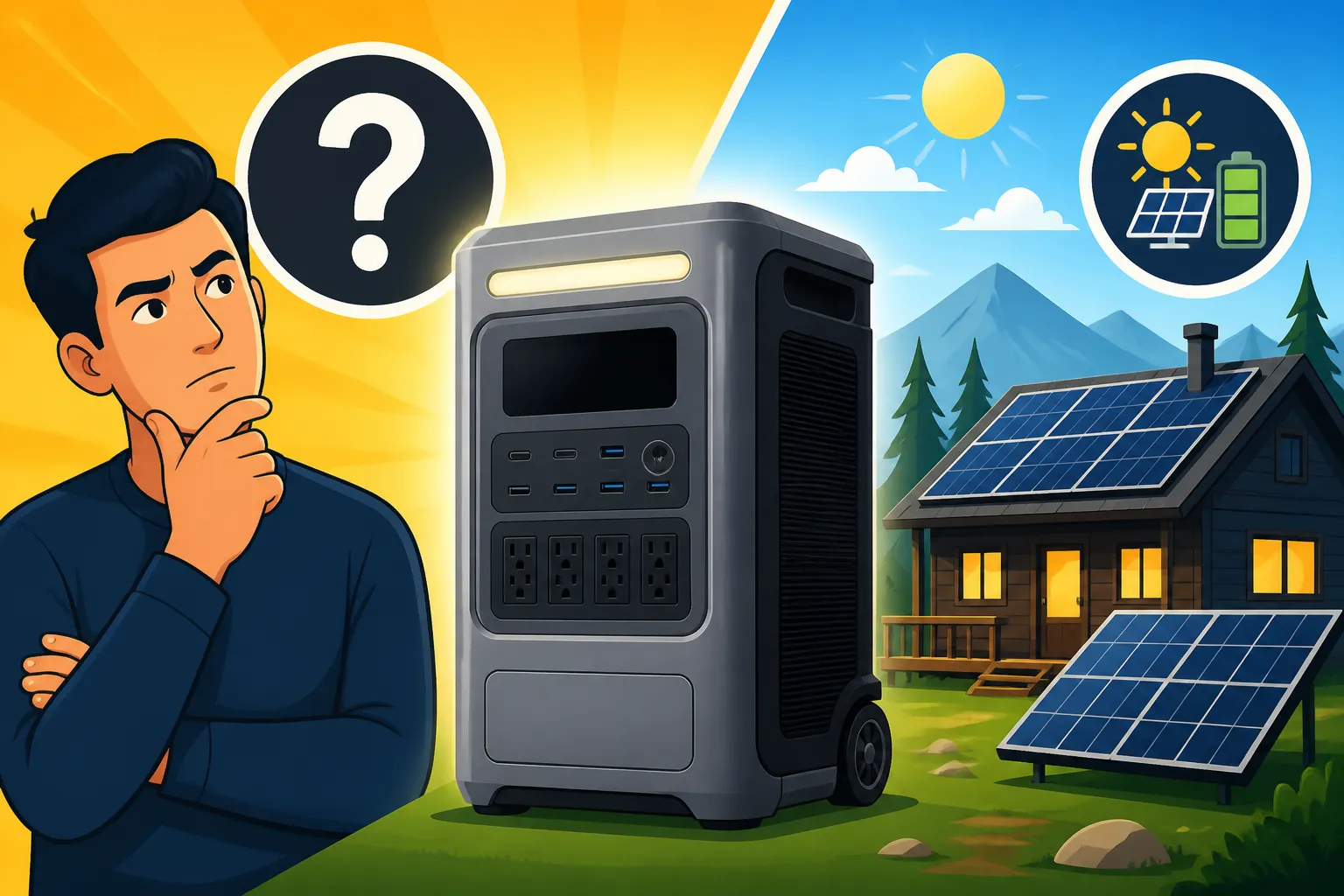
Should You Buy the Anker SOLIX F3800 for Off-Grid
Deciding to go off-grid or even just seeking robust backup power can be incredibly liberating, but the sheer number of options out there can leave you feeling overwhelmed, wondering if you're making the right investment. You want reliable power for your cabin, RV, or as a home backup, and you've likely come across the Anker SOLIX F3800, a power station that promises serious juice. This guide will meticulously break down its features, explore its real-world applicability, and help you determine if this powerhouse is truly the right fit for your off-grid dreams.
Understanding Your Off-Grid Power Needs First
Before we even begin to dissect the Anker SOLIX F3800, it's absolutely crucial to have a clear picture of your specific power requirements. Diving headfirst into any expensive piece of equipment without this foundational understanding is a common pitfall that leads to either overspending on an oversized system or, worse, being perpetually underpowered. Your off-grid lifestyle, whether it's full-time living in a remote cabin or just weekend warrior adventures in your RV, dictates everything. This initial assessment is the most critical step in figuring out if the Anker SOLIX F3800 is a smart move for you.
Daily Energy Consumption Calculation
The very first step in determining your power needs is to perform a thorough load analysis. This means figuring out exactly how much electricity your appliances and devices consume over a typical 24-hour period. Don't just guess; grab a pen and paper, or open a spreadsheet, and list every single item you plan to power. For each item, you'll need two pieces of information: its wattage (how much power it draws when running) and how many hours per day you expect to run it.
Let's take a common scenario. Imagine you're outfitting a small cabin. You might have an energy-efficient mini-fridge (around 50-80 watts, running intermittently for maybe 8-12 hours total in a day), a few LED lights (5-10 watts each, on for 4-6 hours), a laptop (60 watts, used for 3-4 hours), and perhaps a phone charger (10 watts, for 2 hours).
To calculate the daily Watt-hours (Wh) for each, you multiply wattage by hours. For the fridge, it could be 70W * 10 hours = 700 Wh. For the lights, 2 * 7W * 5 hours = 70 Wh. The laptop, 60W * 4 hours = 240 Wh. The phone charger, 10W * 2 hours = 20 Wh. Add these all up: 700 + 70 + 240 + 20 = 1030 Wh per day. That's just over 1 kWh, a relatively modest daily consumption. Understanding this number is key to sizing any off-grid system, and you can learn more about how to calculate daily energy usage to make sure you get it right.
Peak Power Draw and Surge Capacity
Beyond your daily energy consumption, you also need to consider the instantaneous power demands of your appliances. This is known as the "peak power draw" or "starting watts." Many appliances, especially those with motors like refrigerators, well pumps, microwaves, or power tools, require a significant surge of power for a brief moment when they first start up. This surge can be several times higher than their continuous "running watts."
For example, a typical full-sized refrigerator might run at 150-200 watts, but its compressor could demand 1000-1500 watts for a second or two when it kicks on. A microwave might draw 1200-1500 running watts and have a similar or even slightly higher surge. If your inverter, which is the component in a power station that converts battery power to usable AC power, can't handle this momentary surge, the appliance simply won't start, or the inverter will trip, shutting down. This is where systems like the Anker SOLIX F3800, with their high surge capabilities, really shine, as they're designed to handle these momentary spikes without breaking a sweat. If you're planning to run specific heavy loads, you should also research the Cost to Run A Well Pump on Off-Grid Solar or the Cost to Run An Air Conditioner on Off-Grid Solar to understand their specific power requirements.
How Long Do You Need Power Autonomy
Another critical factor is "days of autonomy," which refers to how many days your battery bank can sustain your power needs without any input from solar panels or other charging sources. This is especially vital for off-grid living, where you might encounter several consecutive cloudy days, heavy snow, or other conditions that reduce solar gain.
If you live in an area prone to long stretches of bad weather, you'll need more battery capacity. For a remote cabin in the Pacific Northwest, for instance, you might aim for 3-5 days of autonomy, meaning your battery bank should hold enough energy to last that long without recharging. In sunnier climates, 1-2 days might be sufficient. This directly impacts the size of your battery bank, and subsequently, your overall system cost and the suitability of a power station like the F3800, which offers expandable battery options to meet higher autonomy demands. It's a key part of how to size an off-grid solar system effectively.
A Deep Dive into the Anker SOLIX F3800's Features and Specifications
The Anker SOLIX F3800 isn't just another portable power station; it's a beast designed to tackle significant power demands. Understanding its core features and specifications will help you align its capabilities with your previously assessed power needs. This unit truly stands out in the crowded market, especially when considering systems that aim to be more than just a temporary charging solution.
Power Output and Inverter Capabilities
One of the F3800's most impressive attributes is its sheer power output. It boasts a continuous AC output of 6000 watts (6kW), with a staggering surge capacity of up to 9000 watts (9kW). To put that into perspective, most standard household wall outlets provide around 1500-1800 watts. This 6kW continuous output means it can comfortably run multiple large appliances simultaneously without breaking a sweat. Think of it: a refrigerator, microwave, coffee maker, TV, and lights, all at once. For comparison, a standard window air conditioner might draw 1000-1500 watts, and a well pump could pull 1500-2000 watts, sometimes more for a fraction of a second when it starts. The F3800's 9kW surge capability is more than enough to handle those tricky motor startup loads.
Crucially, the F3800 provides a pure sine wave output. This is vital for sensitive electronics, medical devices, and anything with a motor. Unlike cheaper "modified sine wave" inverters that can damage or degrade certain appliances, a pure sine wave output mimics grid power, ensuring your devices run smoothly and efficiently, and prolonging their lifespan. This kind of robust inverter is a key component to look for in Best Off-Grid Solar Inverters.
Battery Capacity and Chemistry
At the heart of the Anker SOLIX F3800 is its robust battery bank. Out of the box, it comes with a substantial 3.84 kilowatt-hours (kWh) of energy storage. For our small cabin example with a 1030 Wh daily usage, this means the F3800 alone could power it for almost 3.7 days (3840 Wh / 1030 Wh/day), providing significant autonomy.
Even better, this system is designed for expandability. You can link up to 6 additional battery packs (each adding 3.84 kWh), taking the total capacity to an incredible 26.88 kWh. This kind of modularity allows you to truly customize your off-grid solar system design, scaling up as your needs grow or as you desire more days of autonomy. If you're looking for solutions for a Cost to Go Off-Grid for a Family Home, this expandability becomes particularly attractive.
The F3800 utilizes LiFePO4 (Lithium Iron Phosphate) battery chemistry. This is a game-changer for off-grid applications compared to older lead-acid technologies. LiFePO4 batteries offer several distinct advantages:
- Longer Lifespan: Anker rates the F3800 for 3,000 charge cycles to 80% capacity, meaning it can be fully discharged and recharged 3,000 times before its capacity significantly degrades. This could translate to over 8 years of daily use, far outstripping lead-acid batteries which typically last only a few hundred cycles. This incredible lifespan directly addresses concerns about Off-Grid Solar Battery Replacement Cost Over Time.
- Deeper Discharge: LiFePO4 batteries can be safely discharged to 0% without significant damage, unlike lead-acid batteries which suffer if discharged below 50%. This means you have access to the entire rated capacity.
- Faster Charging: They accept a charge much more efficiently, especially from solar, maximizing the energy captured from your panels.
- Safety: LiFePO4 is known for its thermal stability, making it a safer option.
For a deeper dive into battery considerations, you can explore the Best Off-Grid Solar Batteries and compare LiFePO4 vs Lead-Acid Battery Cost.
Charging Flexibility and Speed
Anker really thought about convenience when designing the F3800's charging capabilities. It's not just about solar (though that's impressive).
- AC Charging: It can be plugged into a standard 120V (or 240V with a special adapter) wall outlet, recharging at a rapid 1800W (or up to 2400W in a 240V setup). This means a full charge from empty in about 2 hours, which is incredibly fast for its capacity. This is perfect for topping off before a trip or using grid power if it's available.
- Solar Charging: This is where it truly shines for off-grid users. The F3800 can accept up to 2400W of solar input. This is a huge advantage. Many smaller portable power stations are limited to 500W or 1000W of solar input, which means slower charging, especially on partly cloudy days or during shorter winter daylight hours. With 2400W of solar panels, you could potentially recharge the entire 3.84 kWh unit in less than 2 hours of peak sun. This high input capability makes it a strong contender for a system where you want to maximize your solar harvest.
- EV Charger (Level 2) Charging: A unique feature of the F3800 is its ability to charge from an EV charging station, reaching up to 6000W of input. While not a typical off-grid charging method, it offers an incredibly fast way to recharge if you have access to an EV charger, making it highly versatile.
Portability and Design
Despite its formidable power, Anker made efforts to enhance the F3800's portability. Weighing in at around 132 pounds (60 kg) for the base unit, it's certainly not something you'll casually toss over your shoulder. However, Anker has integrated a suitcase-style design with a retractable handle and large, durable wheels. This makes it surprisingly easy for one person to maneuver across uneven terrain, like a gravel path to a cabin or around an RV campsite. It's still a heavy unit, but the design significantly improves its practicality for relocation compared to many other high-capacity power stations that require two people or specialized dollies.
Assessing the Anker SOLIX F3800 for Different Off-Grid Scenarios
Now that we've dug into what the Anker SOLIX F3800 can do, let's explore whether those capabilities truly align with various off-grid aspirations. Your ideal power solution isn't a one-size-fits-all, so thinking about your specific lifestyle and energy demands is paramount.
Full-Time Off-Grid Living
For those serious about full-time off-grid living in a cabin, tiny home, or a permanent homestead setup, the Anker SOLIX F3800 presents a compelling, ready-to-go solution, especially when expanded. The base 3.84 kWh unit is a solid starting point for a modest individual or couple living with energy-conscious habits. It can easily power essential appliances like a modern refrigerator, LED lighting, water pump (for intermittent use), and all your electronics.
However, the real power for full-time living comes with its expandability. If you're looking to power a Cost to Go Off-Grid for a Family Home with larger loads like an air conditioner in the summer or a mini-split heat pump, you'll likely need multiple battery packs. Reaching 10-20 kWh of storage with the additional batteries allows for several days of autonomy, which is critical for consistent power through prolonged cloudy periods, especially in northern latitudes during winter. The high 6000W continuous output means you don't have to constantly juggle appliances, and the 2400W solar input helps rapidly replenish your batteries on good solar days. This makes it a strong contender for a comprehensive Off-Grid Solar Installation Guide.
Backup Power and Emergency Preparedness
This is an area where the Anker SOLIX F3800 truly shines. For homeowners who experience frequent power outages, or those preparing for emergencies, a robust portable power station is invaluable. Unlike noisy, fuel-dependent generators, the F3800 operates silently and produces no fumes, making it safe for indoor use.
Imagine a severe winter storm knocking out power to your suburban home in upstate New York. With the F3800, you could keep your refrigerator running, ensuring food doesn't spoil. You could power a few lamps, charge phones, keep a Wi-Fi router on, and even run a small electric heater or a pellet stove igniter to maintain warmth. If you have a few hundred watts of portable solar panels, you could even trickle-charge it during the day to extend your backup power indefinitely, provided the sun makes an appearance. For longer outages, especially when paired with additional batteries, it can handle more substantial loads like a well pump or even critical medical equipment, providing peace of mind during uncertain times.
RVs, Vans, and Portable Setups
For the nomadic lifestyle of RVers, van lifers, and those with portable power needs, the F3800 offers a different kind of value. While its 132-pound weight isn't "backpack portable," its integrated wheels and handle make it highly manageable for moving from vehicle to campsite or stowing in a large RV storage bay.
For smaller setups or lighter users, something like a Jackery Explorer 1000 or a smaller EcoFlow Delta 2 might suffice for charging gadgets and running minimal appliances. However, if you're looking to run a full-size RV refrigerator, a microwave, an air conditioner for extended periods, or power tools at a remote job site, the Anker SOLIX F3800 steps up to the plate. The 6kW inverter easily handles common RV appliances, and the 3.84 kWh battery capacity provides ample power for a weekend (or longer with careful management). The fast solar charging capability is a massive plus for RVers who rely on daily solar input to stay powered on the road. It means less time worrying about power and more time enjoying the open road, making it a serious contender when deciding How to Choose Off-Grid Solar for a Rv.
Specific Appliance Needs
One of the biggest frustrations for off-grid hopefuls is running high-draw appliances. Can it run an air conditioner? What about a well pump? The F3800's specifications answer these with a resounding "yes."
- Air Conditioning: A typical 10,000 BTU window AC unit consumes around 1000-1200 watts. The F3800 can run this continuously. A mini-split might be even more efficient. For a detailed breakdown, you might want to look at How much solar to run an air conditioner.
- Well Pump: Most residential well pumps (1/2 HP to 1 HP) have running wattages between 750W and 1500W, but their starting surge can jump to 2-3 times that. The F3800's 9000W surge capacity is well within the range to start most common well pumps.
- Microwave, Coffee Maker, Toaster: These are all high-wattage, short-duration appliances. The F3800 handles them easily, often simultaneously with other loads, thanks to its substantial inverter.
The key takeaway here is that the Anker SOLIX F3800 is built for demanding scenarios. It moves beyond just charging phones and laptops; it's designed to power actual living spaces and heavy-duty equipment.
Pros, Cons, and Considering Alternatives
Making a big investment in an off-grid power solution requires a balanced perspective. No single product is perfect for everyone, and the Anker SOLIX F3800 is no exception. Let's weigh its advantages against potential drawbacks and see how it stacks up against other options out there.
The Upsides of Choosing Anker SOLIX F3800
The Anker SOLIX F3800 really brings a lot to the table, making it an attractive option for many.
- Immense Power Output: The 6000W continuous AC output with a 9000W surge is a standout feature. This allows you to run almost any household appliance, including heavy-duty tools, air conditioners, and well pumps, without worry. This capability often requires much larger, more complex, and permanently installed inverter systems in traditional off-grid setups, which makes the F3800's plug-and-play nature even more appealing.
- Expandable LiFePO4 Battery: The base 3.84 kWh is already substantial, but the ability to expand up to 26.88 kWh is a game-changer for serious off-grid living. LiFePO4 chemistry guarantees a long lifespan (3,000+ cycles) and deep discharge capabilities, ensuring your investment lasts for years. This flexibility in capacity also helps you budget for an off-grid solar system over time, allowing for phased expansion.
- Ultra-Fast Charging: With 1800W AC input (up to 2400W 240V) and a massive 2400W solar input, you can recharge this unit incredibly quickly. The EV charging option is a unique and remarkably fast alternative, if available. This means less downtime and more generated power being stored efficiently.
- Portability with Wheels: While heavy, the integrated wheels and handle make it genuinely portable, allowing one person to move it around relatively easily. This is a significant ergonomic advantage over other similarly sized power stations that are essentially heavy boxes.
- Anker Reliability: Anker has a strong reputation for producing quality electronics, and this typically extends to their power stations, offering peace of mind regarding build quality and customer support.
Potential Drawbacks and Considerations
Even with its impressive features, the F3800 might not be the ideal choice for every single situation.
- Cost: The Anker SOLIX F3800 is a premium product with a premium price tag. The initial investment for the base unit, and especially for additional battery packs, can be substantial. For those on a very tight budget or with minimal power needs, this might be overkill, and a smaller, more affordable option might be a better fit. You might find a Best Budget Off-Grid Solar Kit to be more aligned with initial cost savings.
- Weight and Size: Despite the wheels, 132 pounds is still a lot of weight. It takes up significant space, which could be a concern in very small RVs, vans, or tiny cabins where every square inch counts. Moving it up stairs or lifting it into a vehicle would definitely require assistance.
- Integrated System Limitations: While convenient, an all-in-one unit like this can be less flexible than a custom-built component system where you pick and choose individual panels, charge controllers, inverters, and batteries. For advanced users who want absolute control over every parameter or plan very specific, niche setups, a modular DIY approach might offer more customization. However, for most users seeking simplicity and reliability, the integrated nature is a huge plus.
- Heat Generation: When running at its full 6000W output for extended periods, any power station will generate heat. While the F3800 has active cooling, ensure proper ventilation, especially if used in enclosed spaces.
How It Compares to Other Solutions
When considering the Anker SOLIX F3800, it's helpful to see where it fits in the broader off-grid power landscape.
- Smaller Portable Power Stations: Brands like Jackery and Goal Zero offer excellent smaller units (e.g., Jackery Explorer 1000-2000 Pro) that are fantastic for basic camping, car charging, or very light RV use. They are more affordable and truly portable, but they lack the F3800's raw power output, surge capacity, and expandable battery options. They simply can't run a full-sized air conditioner or a well pump. If your needs are minimal, these are great.
- Larger Modular Power Stations: Competitors like EcoFlow (e.g., Delta Pro) and Bluetti (e.g., EP500, AC200MAX/L) offer similar high-capacity, expandable power stations. The F3800 is very competitive in this segment, often matching or exceeding them in terms of continuous power output, surge capacity, and charging speed, especially with its unique EV charging capability. The choice between these often comes down to specific features, ecosystem compatibility (e.g., smart home integration), and current pricing. For a direct comparison, you might want to read Should You Buy the EcoFlow Delta Pro for Off-Grid.
- Traditional DIY Off-Grid Systems: A custom-built off-grid solar system using individual components (solar panels, charge controller, inverter, battery bank, wiring, safety equipment) offers maximum flexibility and scalability. For a Cost of a Turnkey Off-Grid Solar System versus a custom build, it often involves a higher initial learning curve and installation complexity. While potentially cheaper per Watt-hour in the long run for very large systems, it lacks the plug-and-play simplicity and portability of the F3800. The F3800 acts as a fantastic bridge, offering high capacity and power with a simpler setup than a full DIY build. For more on this, check out DIY vs Professional Off-Grid Solar Cost.
Ultimately, the Anker SOLIX F3800 sits at the high end of the portable power station spectrum, blurring the lines between a portable unit and a robust, semi-permanent off-grid power hub. It's ideal for those who need serious power, appreciate convenience, and are willing to invest in a high-quality, long-lasting solution that can grow with their needs. If you're tired of power limitations and want a truly capable off-grid companion, the F3800 deserves strong consideration.
| Feature | Anker SOLIX F3800 (Base Unit) | Typical Smaller Portable Power Station (e.g., Jackery 1000) | Traditional DIY Off-Grid System (Small Cabin) |
|---|---|---|---|
| Continuous AC Power | 6000W | 1000W | 2000W – 5000W |
| Surge Capacity | 9000W | 2000W | 4000W – 10000W |
| Battery Capacity | 3.84 kWh (Expandable to 26.88 kWh) | 1.0 kWh | 5 kWh – 20 kWh |
| Battery Chemistry | LiFePO4 | Li-ion or LiFePO4 (variable) | LiFePO4 or Lead-Acid |
| Solar Input Max | 2400W | 200W | Scalable (often 1000W-5000W+) |
| AC Charging Speed | 1800W | 100W | Varies with charger size |
| Portability | High (with wheels) | Very High | Low (fixed installation) |
| Complexity | Low (plug-and-play) | Very Low | High (component selection, wiring) |
| Typical Use Case | Whole-home backup, heavy RV/cabin, full-time off-grid | Camping, light RV, car power, small electronics | Custom homes, year-round remote living |
Disclaimer
The information provided in this article is for general informational purposes only and does not constitute professional advice. Off-grid solar system design and installation can be complex and involve electrical hazards. Always consult with qualified professionals and ensure compliance with all local codes and regulations before installing or modifying any electrical system. Prices, specifications, and availability of products, including the Anker SOLIX F3800, are subject to change by the manufacturer.