Cost to Run A Well Pump on Off-Grid Solar
You finally moved to your off-grid property, flipped on the kitchen tap, and heard your inverter scream as the well pump kicked on. Now you are wondering whether that pump is quietly draining your battery bank and what it is actually costing you every month. This guide breaks down how much energy a well pump uses, what that costs on solar, and how to keep the bill low.
How Much Power a Well Pump Really Uses
The scary part of a well pump is not how much energy it uses over a day. It is how much power it demands in the first second after it switches on. Once you separate those two ideas, the cost question becomes much easier to answer.
When we set up our first homestead system, I sized everything around daily energy and completely ignored the start-up surge. The first time the pump cycled while the washing machine was running, the inverter shut down and we had no water and no power. That expensive lesson is why I always start with the pump’s specifications now.
Running Watts Versus Surge Watts
Every AC well pump has two numbers that matter. Running watts is what the motor draws once it is up to speed. Surge watts, sometimes listed as locked rotor amps or starting current, is what it pulls for a fraction of a second to get the motor turning. For a typical induction motor pump, the surge can be three to five times the running load.
Here is a rough guide to common pump sizes. Your pump’s nameplate and manual are always the final word.
| Pump type | Typical running watts | Typical surge watts | Common voltage |
|---|---|---|---|
| Shallow-well jet pump, 1/2 HP | 700 to 900 W | 2,000 to 3,500 W | 120 V or 240 V |
| Submersible pump, 1/2 HP | 800 to 1,000 W | 2,500 to 4,000 W | 240 V |
| Submersible pump, 1 HP | 1,500 to 2,000 W | 4,500 to 7,000 W | 240 V |
| DC solar submersible pump | 150 to 500 W | Little or no surge | 24 V to 48 V DC |
The surge number decides what inverter you need, which is a big one-off cost. The running number, multiplied by run time, decides how much energy you use, which is the ongoing cost.
Calculating Daily Energy Use
To work out daily energy use, you need three pieces of information: the pump’s running watts, its flow rate in gallons per minute, and how many gallons you use each day.
- Find your daily water use. A typical household uses somewhere between 50 and 100 gallons per person per day. Gardens and livestock can add a lot more.
- Divide daily gallons by the pump’s flow rate to get minutes of run time.
- Convert minutes to hours and multiply by running watts to get watt-hours.
- Add roughly 15% to cover inverter losses and pressure tank cycling.
For example, a family using 250 gallons a day with a 1/2 HP submersible pumping 10 gallons per minute runs the pump for about 25 minutes. At 1,000 watts, that is about 0.42 kWh, or roughly 0.48 kWh once losses are included. Over a year, that adds up to about 175 kWh. That is surprisingly modest. A refrigerator often uses more energy than the well pump in a typical home. Our dedicated guide How Much Solar to Run A Well Pump walks through the same calculation for other pump sizes.
What It Costs to Run a Well Pump on Solar
Off-grid solar does not send you a monthly bill, but every kilowatt-hour still has a cost. It is just paid upfront in panels, batteries and inverters instead of month by month.
Understanding Your Cost per Kilowatt-Hour
The easiest way to think about the running cost is the levelised cost of energy. You take the total cost of your system, including replacement batteries over its life, and divide it by the total usable energy it produces over that life.
For example, a $15,000 off-grid system that delivers about 4,000 usable kWh per year for 15 years produces about 60,000 kWh in total. That works out to roughly $0.25 per kWh. Smaller systems, systems with lead-acid batteries that need replacing more often, or systems in cloudy regions often come in higher, around $0.40 to $0.50 per kWh. If you want a full breakdown of what drives those numbers, read Off-Grid Solar Cost: Complete Breakdown.
Using a middle value of $0.40 per kWh, here is what different pumping scenarios cost.
| Scenario | Daily run time | Daily energy with losses | Yearly energy | Yearly cost at $0.40 per kWh |
|---|---|---|---|---|
| Household, 1/2 HP pump, 250 gallons a day at 10 gpm | 25 minutes | 0.48 kWh | 175 kWh | About $70 |
| Homestead, 1 HP pump at 1,800 W, 600 gallons a day at 12 gpm | 50 minutes | 1.7 kWh | 630 kWh | About $250 |
| DC solar pump filling a storage tank in daylight | Several hours | Supplied directly by dedicated panels | Not drawn from batteries | Close to zero after purchase |
So for most households, the energy cost of running a well pump on solar is somewhere between a few dollars and a couple of dozen dollars a month. The bigger financial decision is the hardware you need to make it work reliably.
The Upfront Hardware Costs
The extra equipment a well pump forces into your system usually costs far more than the energy it uses. The main items are:
- An inverter large enough to handle the surge. A 240-volt deep-well pump usually needs a split-phase inverter, or a 240-volt transformer, with enough surge capacity. Upgrading from a small inverter to one that can start a 1 HP pump can add a substantial amount to your budget. See Cost of an Off-Grid Solar Inverter for typical price bands.
- Extra battery capacity, so pumping does not cut into what your fridge and lights need overnight. Even one extra kilowatt-hour of storage gives you comfortable headroom for a household pump. How Many Batteries to Run A Well Pump covers how to size this properly.
- A few hundred extra watts of solar panels to replace that energy each day, more in winter.
- Optional but very useful, a soft starter fitted to the pump, which cuts the start-up surge so a smaller inverter can handle it.
A soft starter is one of the most cost-effective upgrades for an off-grid well. Kits designed for submersible and jet pumps are widely sold, including on Amazon, but check that the model matches your pump’s horsepower and voltage, and have an electrician fit it if you are not comfortable working on 240-volt circuits.
Comparing Solar With Generator Pumping
Some off-grid homes run their pump only from a generator, filling a cistern once a day. It sounds simpler, but fuel and maintenance add up fast. A small generator running for an hour every day can easily cost more in fuel over a year than the entire annual solar cost of pumping in the table above, before you add oil changes, spark plugs and eventual replacement. For a side-by-side look, read Off-Grid Solar vs Generator Fuel Cost.
Ways to Cut the Cost of Pumping Water
Once you know where the costs come from, you can make some smart choices to bring them down.
Pump During Peak Sun
The cheapest energy in an off-grid system is the energy you use while the sun is shining. Power that goes straight from your panels to the pump never passes through your batteries, so it avoids conversion losses and does not add wear to the battery bank.
One of the best tricks is to add a storage tank, either a large pressure tank or a gravity-fed cistern, and do most of your pumping in the middle of the day. Run laundry and garden watering then too. In the evening, the house draws from stored water and the pump rarely has to start. This approach also makes winter much easier, which matters because short days can cut solar production sharply. How Winter Affects Off-Grid Sizing goes into detail.
Consider a DC Solar Pump
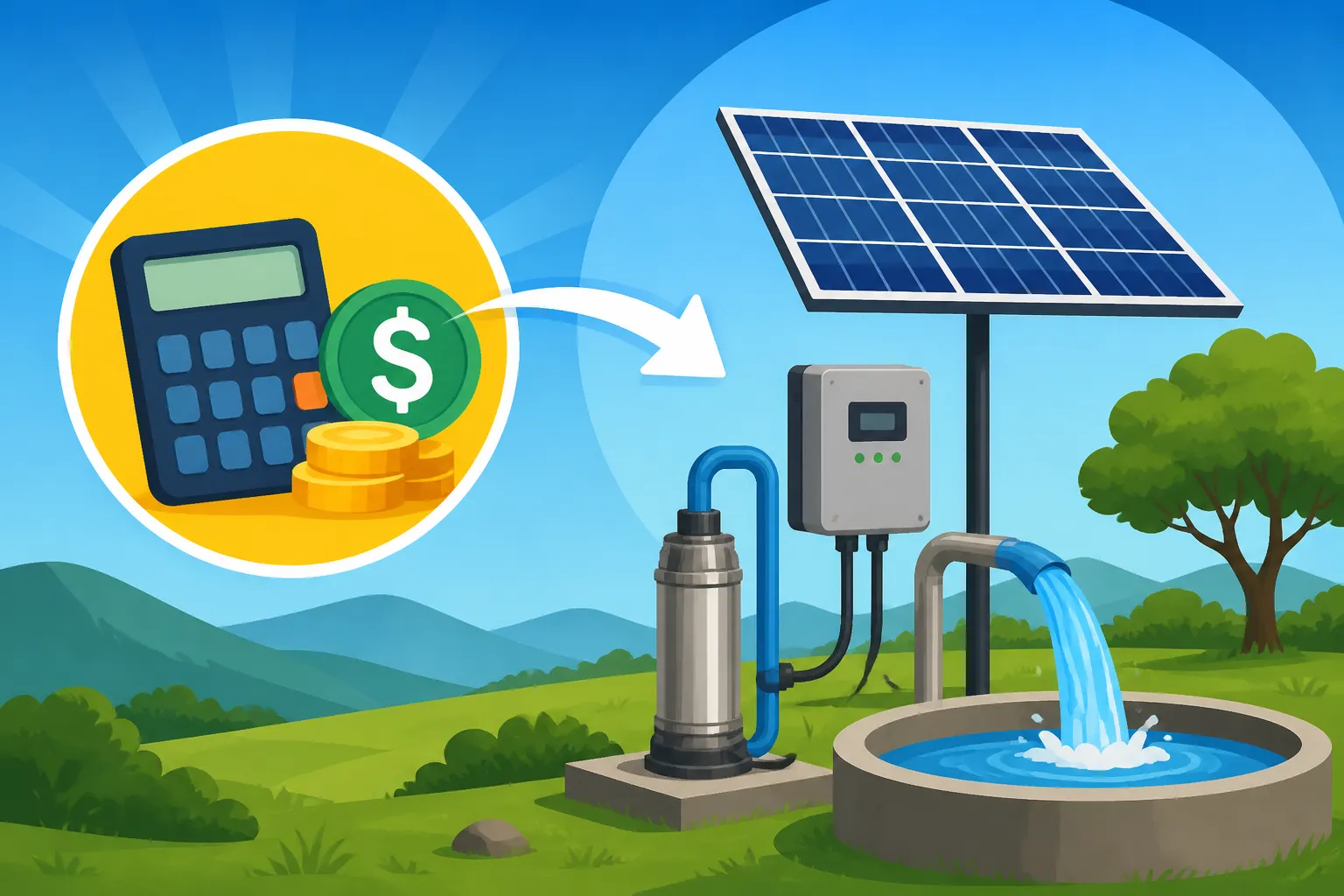
If you are drilling a new well or replacing an old pump anyway, a DC solar submersible pump is worth serious consideration. These pumps run directly from a dedicated set of panels without an inverter or batteries. They pump slowly and steadily through daylight hours into a storage tank, and a small booster pump or gravity supplies the house.
Upfront costs for a quality DC pump system can be higher than a basic AC pump, but you save on inverter size and battery capacity, and running costs are close to zero. For a comparison of complete setups, see Best Off-Grid Solar for a Well Pump.
Fix Leaks and Pressure Tank Problems
A pump that short-cycles, switching on and off every few seconds, wastes energy and wears out the motor. The usual causes are a waterlogged pressure tank, a failed bladder or a pressure switch set too narrow. Check the tank’s air pressure once or twice a year with a tyre gauge when the system is drained. A dripping tap or running toilet can also make the pump start dozens of times a day. Fixing those is the cheapest energy saving you will ever make.
Portable Power Stations and Well Pumps
Many people moving off-grid already own a portable power station and want to know if it can run their well.
When a Power Station Can Work
A large portable power station, such as a higher-capacity Jackery model, can run a small 120-volt jet pump or a shallow-well pump for short periods, especially during an outage or while you finish building a permanent system. The key is checking both the continuous output and the surge rating on Jackery’s own specification page against your pump’s nameplate. If the surge is close to the limit, a soft starter can make the difference between a working setup and an overload shutdown.
Pairing a power station with portable panels also lets you top up a water tank on a sunny day. If you are weighing this kind of setup against a fixed installation, Solar Generator vs Off-Grid Solar System lays out the trade-offs.
When You Need a Full System
Most deep wells use 240-volt submersible pumps, and most portable power stations output only 120 volts unless you link two compatible units. Running a 1 HP deep-well pump every day is also hard on smaller battery packs. If your water depends on a deep well, a permanent system with a properly sized inverter and battery bank is the reliable answer. The planning steps are in Sizing Solar for a Well Pump.
Whichever route you choose, a simple plug-in energy monitor or clamp meter, easy to find on Amazon, lets you measure your pump’s real running watts and daily run time. Real numbers beat estimates every time, and they help you see exactly what your pump costs to run.
Disclaimer
This article is for general informational purposes only and does not constitute professional advice. Laws, prices and regulations vary by location and change over time. Consult a qualified professional for guidance on your specific situation.