Best Off-Grid Solar for a Well Pump
There's nothing quite like the frustration of living off-grid, miles from the nearest power line, only to realize your well pump isn't getting the juice it needs to bring life-sustaining water into your home. It’s a common scenario that makes many aspiring off-gridders hesitate, wondering if they can truly achieve reliable water access without constant trips to refill jugs. This comprehensive guide is here to demystify the process of powering your well pump with off-grid solar, helping you design a robust and reliable system that keeps your water flowing smoothly, rain or shine.
Understanding Your Well Pump’s Power Demands
When you’re trying to figure out the best off-grid solar setup for your well pump, the first thing you absolutely need to grasp is exactly how much power your pump actually consumes. It’s not as simple as looking at a single number on the label; there are nuances that can make or break your solar system design.
Starting Watts vs. Running Watts
This is, hands down, one of the most critical distinctions for any off-grid system, especially for motor-driven appliances like well pumps. Think of it like pushing a heavy car: it takes a huge burst of effort to get it moving from a standstill, but once it’s rolling, it’s much easier to keep it going.
- Starting Watts (Surge Power): This is the massive, momentary spike in power your well pump draws for a fraction of a second when it first kicks on. Motors need this extra surge to overcome inertia and magnetic resistance. For a typical 1 HP well pump, the running wattage might be around 1,000-1,500 watts, but its starting watts could easily jump to 3,000-5,000 watts, or even higher for deeper wells or larger pumps. If your inverter isn't capable of handling this brief but intense surge, it will trip and shut down, leaving you high and dry. This is why when you're looking at an inverter for your off-grid system, you can't just consider the continuous power rating; you must look at its surge rating.
- Running Watts (Continuous Power): Once the pump is up and running, it settles into a more consistent power draw, which is its running wattage. This is the power it continuously uses to move water. While this number is lower than the starting watts, it still dictates how many solar panels you'll need to generate enough energy and how large your battery bank needs to be to sustain operation for the duration your pump runs each day. Many people underestimate this and end up with an undersized system that struggles to keep up with daily water demands.
Understanding both of these figures is paramount. You can find these ratings on your pump's label, in its manual, or by using a clamp meter to measure the actual draw during operation. It's often better to overestimate slightly to ensure reliability.
Types of Well Pumps and Their Consumption
Not all well pumps are created equal, and their power requirements vary significantly based on their design, the depth of your well, and how much water they need to move.
- Submersible Pumps: These are typically found in deep wells (often 100+ feet) and are designed to push water up from the bottom of the well. They are highly efficient but require substantial power due to the work involved in lifting water from great depths. A common 1 HP submersible pump can easily draw 1,000-1,500 running watts, with a starting surge two to three times that. For deep wells, you'll need a robust off-grid solar inverter.
- Jet Pumps (Shallow Well and Deep Well): Jet pumps sit above ground and use an impeller to create a vacuum, pulling water up. Shallow well jet pumps are for depths generally less than 25 feet, while deep well jet pumps (which use two pipes) can go a bit deeper, often up to 100 feet. They tend to be less efficient than submersibles for deep applications and can be quite noisy. Their power consumption can be similar to submersible pumps, depending on the horsepower and lift requirements.
- Booster Pumps: These pumps are used to increase water pressure within your home's plumbing system, often downstream from a well pump or a storage tank. They typically have lower power requirements than primary well pumps but still contribute to your overall daily energy usage.
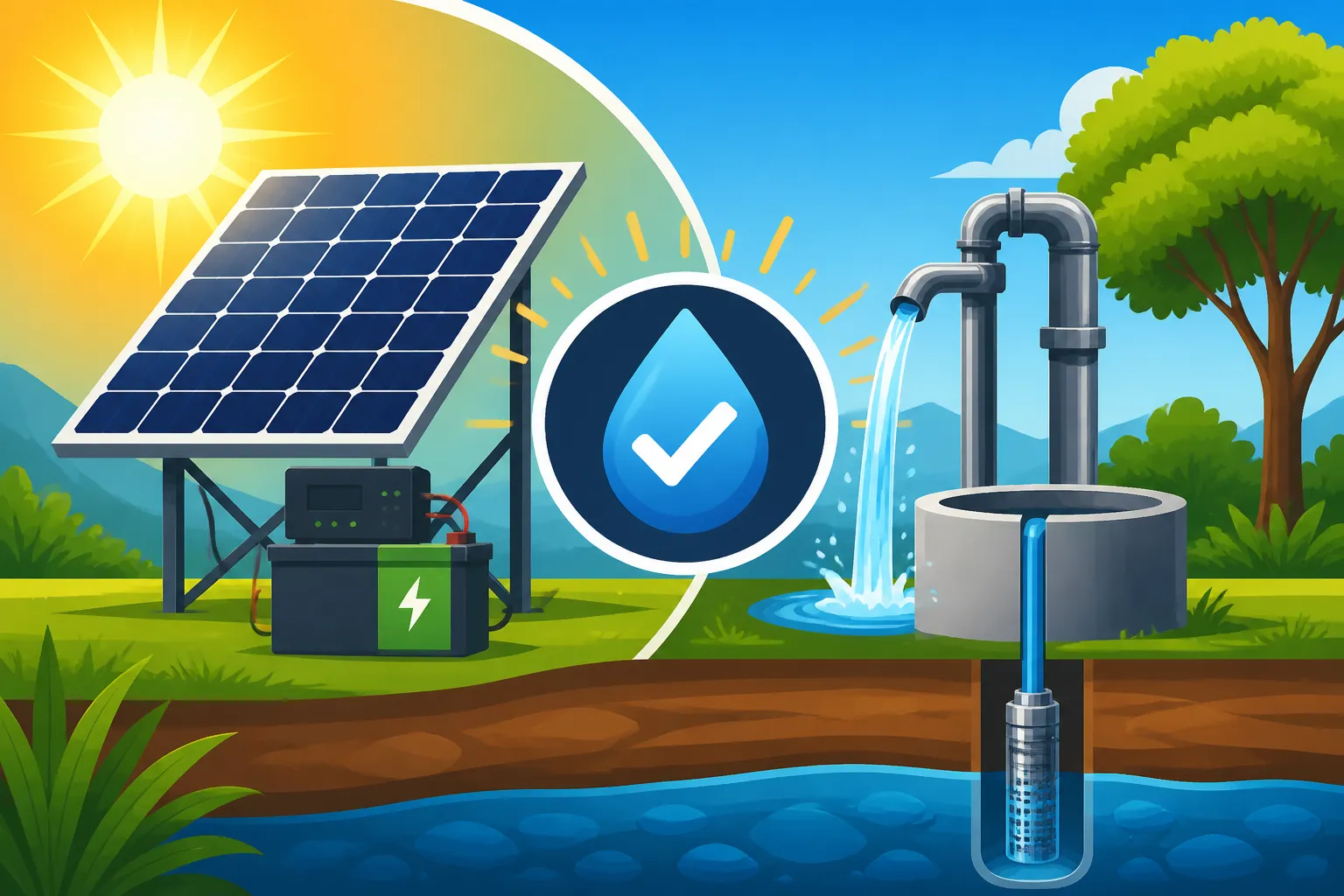
- Solar-Specific DC Pumps: There's a growing market for specialized DC well pumps designed specifically to run directly off solar panels or a small battery bank. These often have lower flow rates but are incredibly efficient and can be a fantastic choice for smaller cabins or irrigation needs where continuous, high-volume water isn't a constant necessity. They bypass the need for a large inverter, simplifying the system.
Calculating your needs effectively is the first step toward understanding How to Size an Off-Grid Solar System.
Daily Water Usage and Storage Considerations
Before you even think about panels or batteries, you need to understand your water consumption habits. How many gallons do you use daily? For what purposes? Showering, washing dishes, laundry, gardening, livestock?
- Estimating Your Needs: A good rule of thumb for off-grid living is 25-50 gallons per person per day, but this can fluctuate wildly. Track your usage for a week to get a realistic baseline. Knowing How to Calculate Daily Energy Usage for water is crucial.
- The Role of Pressure Tanks: Most conventional well pump systems use a pressure tank. The pump fills the tank, pressurizing the water, and then shuts off. When you open a faucet, the pressurized water flows until the pressure drops to a set point, at which time the pump kicks on again to refill the tank. This cycling means your pump isn't running continuously, but rather in short bursts throughout the day. This reduces the total run time, but means frequent high-surge starts.
- Alternative: Gravity-Fed Storage: For off-grid systems, many people opt for a large water storage tank (e.g., a cistern) placed at a higher elevation than their home. The well pump fills this tank when the sun is abundant, and gravity then feeds water into the house. This allows the pump to run during optimal solar hours, avoiding nighttime battery drain and minimizing those stressful surge starts on your inverter. It also acts as a fantastic buffer, ensuring you have water even during extended cloudy periods or if your pump has an issue. This approach often makes it easier to manage the Cost to Run A Well Pump on Off-Grid Solar.
Key Components for an Off-Grid Well Pump Solar System
Building an off-grid solar system for a well pump involves several crucial components, each playing a vital role in delivering reliable power. Skimping on any one of these can lead to frustration and potential system failures.
Sizing Your Solar Panel Array
The heart of your solar system is, of course, the solar panels themselves. To ensure your pump runs when needed and keeps your batteries topped up, you need enough solar generation.
- Calculating Array Size: Once you know your pump's running wattage and how many hours it runs per day (or how many gallons it pumps), you can calculate your daily energy consumption in watt-hours. Then, factor in your "peak sun hours" – the average number of hours per day your panels receive direct, unobstructed sunlight. This varies greatly by location and season. A good estimate for sizing is typically 4-5 peak sun hours in most of the US. You'll need to generate more energy than your pump consumes to also cover other household loads and ensure your battery bank recharges.
- Oversizing for Reliability: It's almost always a good idea to slightly oversize your solar array when powering critical loads like a well pump, especially if you live in an area prone to cloudy weather or want to run your pump during less-than-ideal solar conditions. This extra capacity ensures your batteries get a full charge and your system can recover quickly after heavy usage. Check out guides like How Many Solar Panels for Off-Grid Living for more detailed calculations.
- Panel Type: Monocrystalline panels are generally preferred for off-grid systems due to their higher efficiency and better performance in low-light conditions. When researching, look for Best Off-Grid Solar Panels that suit your climate and space requirements.
Choosing the Right Inverter for Surge Power
The inverter is arguably the most critical component when it comes to powering a well pump. It converts the DC power from your batteries into the AC power your pump needs. As discussed, the surge capability is paramount.
- Pure Sine Wave is Non-Negotiable: For motor loads like well pumps, you must use a pure sine wave inverter. Modified sine wave inverters can damage motors, cause them to run inefficiently, and generate excessive heat. Don't compromise here.
- High Surge Capacity: Look for an inverter with a surge rating that is at least 2-3 times your pump's continuous running wattage. Many high-quality off-grid inverters from brands like Victron Energy or Sol-Ark are specifically designed with excellent surge capabilities, making them ideal for well pump applications. For example, if your pump runs at 1500W and surges to 4500W, you'd want an inverter with a 3000W continuous rating but a surge capacity of 6000W or more for a few seconds. This extra buffer is crucial. Learn more about How to Size an Off-Grid Inverter.
- Inverter-Charger Combos: Many off-grid setups benefit from an inverter-charger, which combines the inverter function with a powerful battery charger. This is invaluable if you plan to integrate a backup generator, as the inverter-charger can automatically manage battery charging from the generator when solar input is low. This adds a layer of redundancy and convenience. When searching for Best Off-Grid Solar Inverters, prioritize those with robust surge capabilities.
Battery Bank for Consistent Water Access
Your battery bank is your energy reservoir, storing the solar power generated during the day for use whenever your pump needs to run, even at night or on cloudy days.
- Battery Chemistry: LiFePO4 vs. Lead-Acid:
- LiFePO4 (Lithium Iron Phosphate): These are the gold standard for off-grid living. They offer a much longer lifespan (often 10+ years), higher usable capacity (you can safely discharge them deeper), faster charging, and are significantly lighter and more compact. While the upfront cost is higher, their longevity and performance often make them more cost-effective in the long run. They require a Battery Management System (BMS) for safety, which is usually built-in.
- Lead-Acid (AGM, Gel, Flooded): These are a more budget-friendly option upfront but have a shorter lifespan and lower usable capacity (you shouldn't discharge them below 50% for optimal life). Flooded lead-acid batteries require regular maintenance (watering), while AGM and Gel are sealed and maintenance-free. Given the critical nature of a well pump, the reliability and deep-cycling capabilities of LiFePO4 batteries are often preferred. For a detailed comparison, see LiFePO4 vs Lead-Acid Battery Cost.
- Sizing for Autonomy: You need to decide how many "days of autonomy" you want – how many days your battery bank can power your essential loads (including your well pump) without any solar input. For a well pump, aiming for 2-3 days of autonomy is a good starting point to handle extended cloudy periods. How Many Batteries for an Off-Grid System will guide you through this calculation.
- System Voltage: For well pumps and larger off-grid systems, 24V or 48V battery banks are generally recommended over 12V. Higher voltage systems are more efficient, allow for thinner wiring (saving on cable costs), and reduce voltage drop over longer distances. Most larger inverters are designed for 24V or 48V systems. When you're looking for Best Off-Grid Solar Batteries, consider brands like Battle Born or EG4 for LiFePO4. While some portable power stations like a larger Jackery model might serve very small, temporary needs, for a dedicated well pump, you'll need a robust, expandable battery bank.
Charge Controllers and System Voltage
The charge controller is the bridge between your solar panels and your battery bank, ensuring safe and efficient charging.
- MPPT is Best: For almost all off-grid well pump systems, an MPPT (Maximum Power Point Tracking) charge controller is the superior choice. MPPT controllers are significantly more efficient than their PWM (Pulse Width Modulation) counterparts, especially in varying light conditions or when your panel voltage is much higher than your battery bank voltage. This efficiency translates directly into more usable power reaching your batteries, which is crucial for critical loads.
- Matching Voltage: Your charge controller needs to be rated for the voltage of your solar array and your battery bank. If you're building a larger system, a 48V battery bank paired with panels wired in series to achieve a higher voltage (e.g., 80-150V) will maximize the efficiency of your MPPT controller.
Designing for Reliability and Efficiency
An off-grid well pump system isn’t just about throwing components together; it’s about smart design that ensures continuous water access, even when nature isn’t cooperating.
Integrating a Generator for Backup
For a truly reliable off-grid water system, especially for a full-time residence, a backup generator is often an indispensable component.
- Why a Generator? Imagine a week of heavy rain and clouds. Your solar panels aren't producing much, and your battery bank is slowly depleting. This is where a generator shines. It can kick in to recharge your batteries and directly power your well pump, ensuring you never run out of water. This is particularly important for deep wells or systems with high daily water usage.
- Automatic Start Functionality: Many modern off-grid inverters (like those from Victron Energy or Sol-Ark) have generator auto-start capabilities. When your battery voltage drops to a preset level, the inverter signals the generator to start, recharge the batteries, and then shut down once they're full. This hands-free operation provides peace of mind. Learn more about How to Add a Generator to Your Design. Even a relatively small, efficient portable generator can be a lifesaver. While a Jackery solar generator might offer some limited backup power for very light loads or electronics, for a well pump, a traditional gas or propane generator is usually the more practical and powerful backup solution.
Water Storage as a “Thermal Battery”
As mentioned earlier, a large water storage tank can be a game-changer for off-grid water systems. Think of it not just as a reservoir, but as a “thermal battery” for your water needs.
- Shifting Load Times: Instead of relying on your pump to cycle throughout the day and night based on pressure demands, you can program your solar system to run the pump only during peak solar production hours. This means the pump draws power directly from your panels when they are generating the most, reducing the strain on your battery bank and extending its lifespan.
- Buffer Against Variability: A large storage tank (e.g., 1,000-2,500 gallons or more, depending on usage) provides a significant buffer. If you have several days of cloudy weather or experience a temporary solar system issue, you still have a substantial amount of water available, allowing you time to troubleshoot or wait for the sun to return. This significantly enhances the resilience of your off-grid setup.
Optimizing Pump Operation for Solar
Beyond the hardware, smart management of your water usage can greatly improve the efficiency and reliability of your solar-powered well pump.
- Timed Pumping: Install a smart timer or integrate your pump into your inverter's programmable relays to ensure it primarily runs during the middle of the day when solar production is highest. This aligns the heaviest load with the greatest power availability.
- Water-Saving Habits: Adopt conscious water-saving habits. Fix leaks immediately, take shorter showers, and consider greywater recycling for landscaping. Every gallon saved is a watt-hour saved, reducing the overall demand on your solar system.
- High-Efficiency Pump: If you're starting from scratch, invest in a high-efficiency well pump, possibly even a variable speed drive (VSD) pump. VSD pumps can adjust their motor speed based on demand, which can reduce surge currents and overall energy consumption. They are more complex but can offer significant long-term energy savings. For specific sizing for your pump, refer to resources like Sizing Solar for a Well Pump.
Real-World Considerations and Best Practices
Moving off-grid with your well pump isn’t just about calculations; it’s about practical application and preparing for real-world challenges.
Seasonal Adjustments and Winter Performance
The sun is not constant. Seasonal changes, especially winter, can significantly impact your solar production.
- Lower Sun Angle: In winter, the sun sits lower in the sky, reducing the effective output of your solar panels. This is exacerbated by shorter daylight hours.
- Cloudy Days: Many regions experience more frequent and prolonged cloudy weather during winter, further diminishing solar harvest.
- Snow and Ice: Snow accumulation on panels can completely block production. Regular clearing may be necessary. For best performance in winter, ensure your panels are angled appropriately (steeper tilt for winter sun) and consider over-sizing your array even further to account for reduced output. You might also consider using a portable solution like a small Jackery power station to run a few lights or charge devices if primary power is strained, but it won't power your well pump.
- Battery Performance: Extreme cold can also impact battery performance, especially lead-acid batteries. LiFePO4 batteries generally perform better in cold but may require heating elements if temperatures consistently drop below freezing to ensure optimal charging and longevity.
Cost-Effectiveness and Long-Term Savings
The upfront cost of an off-grid solar system for a well pump can seem daunting, but it’s important to look at the long-term picture.
- Initial Investment: Expect to invest anywhere from a few thousand dollars for a basic, smaller pump system to well over $15,000 for a robust whole-house well pump setup with ample battery backup and generator integration. Factors like well depth, pump horsepower, desired days of autonomy, and chosen battery chemistry (Cost of an Off-Grid Solar Battery Bank) will heavily influence the total.
- Savings Over Time: Once installed, your primary energy source is free sunshine. You eliminate monthly electricity bills for your water usage, and you gain energy independence. Over the lifespan of your system, which can be 20-25 years for panels and 10-15+ years for LiFePO4 batteries, the savings can be substantial, often making the initial investment worthwhile. Compare this to the potentially enormous cost of extending grid power to a remote well site (Off-Grid Solar vs Utility Extension Cost).
- Maintenance: Off-grid solar systems for well pumps require relatively low maintenance – occasional panel cleaning, battery checks (especially for lead-acid), and system monitoring.
DIY vs. Professional Installation
Deciding whether to tackle the installation yourself or hire a professional is a significant decision with cost and safety implications.
- DIY Approach: If you're handy, have a solid understanding of electrical systems, and are comfortable with detailed wiring diagrams and safety protocols, a DIY installation can save you a considerable amount on labor costs. There are many online resources and kits designed for the DIY enthusiast. However, working with high voltage DC and AC systems carries inherent risks, and mistakes can be costly or dangerous. For simpler systems powering small pumps, it's more feasible.
- Professional Installation: Hiring a certified electrician or solar installer ensures your system is designed correctly, safely installed, and compliant with any local codes (even for off-grid, some jurisdictions have requirements). While more expensive upfront, it provides peace of mind, often comes with warranties, and ensures optimal performance. For complex systems powering critical loads like a deep well pump for a full-time residence, professional installation is highly recommended due to the specialized knowledge required for proper grounding, fusing, and inverter setup. Your local permits and codes will often dictate if this is even an option.
| Well Pump Type | Typical Running Watts (Approx.) | Typical Starting Watts (Approx.) | Best Suited For | Key Considerations for Off-Grid |
|---|---|---|---|---|
| Submersible (1/2 – 1 HP) | 750 – 1500W | 2000 – 4500W | Deep wells (50+ ft), whole-house water supply | Requires robust inverter with high surge capacity. High daily kWh draw. |
| Jet Pump (Shallow Well, 1/2 – 3/4 HP) | 500 – 1000W | 1500 – 3000W | Shallow wells (<25 ft), boosting pressure from cisterns | Moderate surge requirements. Can be noisy. Less efficient for deeper pulls. |
| Jet Pump (Deep Well, 1/2 – 1 HP) | 750 – 1500W | 2000 – 4500W | Wells up to 100 ft | Similar to submersible in power, but less efficient. High surge. |
| Dedicated DC Solar Pump | 100 – 500W | 100 – 500W (no significant surge) | Irrigation, small cabins, remote watering, low flow rates | Highly efficient, often runs directly from panels. No inverter needed. Lower flow/pressure. |
| Booster Pump (1/4 – 1/2 HP) | 300 – 700W | 800 – 1500W | Increasing house pressure from storage tank | Lower power demands, but still requires adequate inverter surge. |
Disclaimer
Please remember that the information provided in this guide is for educational and informational purposes only and should not be considered professional advice. Off-grid solar system design and installation involve electrical work and potential hazards. Always consult with qualified professionals, adhere to local codes and regulations, and prioritize safety when working with electricity.