What to Look for in an Off-Grid Solar Kit
Stepping into the world of off-grid living can feel exhilarating, but when it comes to picking out the right solar kit, many folks quickly find themselves drowning in a sea of technical jargon and endless options. It's a real headache trying to figure out what components truly matter, how much power you actually need, and which kits are a good fit for your unique setup without making an expensive mistake. This comprehensive guide is here to cut through the confusion, helping you understand exactly what to look for in an off-grid solar kit so you can confidently choose one that powers your independent dreams.
Understanding Your Energy Needs
Before you even start gazing at shiny solar panels or hefty battery banks, the absolute first step in choosing an off-grid solar kit is to get a crystal-clear picture of your energy consumption. Without this crucial foundation, you're essentially shooting in the dark, and that can lead to either an undersized system that leaves you constantly in the dark, or an oversized one that drains your wallet unnecessarily. It's not just about what you want to power, but what you need to power and how often.
Daily Energy Consumption Calculation
This is where the rubber meets the road. You need to perform what's called a "load analysis" – essentially, a detailed inventory of every single electrical appliance and device you plan to use. Don't just think big items like a refrigerator; consider everything from your laptop charger to that tiny LED string light in your living space. For each item, you'll want to find its wattage (usually listed on a label or in the manual) and estimate how many hours per day you'll use it. Multiply the wattage by the hours to get daily Watt-hours (Wh). For instance, a 100-watt television used for 4 hours a day consumes 400 Wh daily. Do this for everything.
Once you have the daily Watt-hours for each item, sum them all up, and boom – you've got your total estimated daily energy consumption. This number is your North Star. It dictates the size of your solar array (how many panels) and your battery bank (how much storage). Don't forget to factor in seasonal changes; maybe you use a space heater more in winter or an AC unit more in summer, drastically altering your daily draw. If you're feeling overwhelmed by this step, remember that there are many resources like How to Calculate Daily Energy Usage that can walk you through it in more detail.
It’s easy to underestimate, especially when you’re used to unlimited grid power. Think about typical household routines: morning coffee, charging phones, running a well pump, evening lights, cooking with small appliances. Even intermittent items, like a power tool used for an hour every few days, need to be accounted for in your overall planning, perhaps by averaging their use over a week. Being meticulous here will save you a world of trouble and expense down the line, ensuring your chosen off-grid solar kit is truly up to the task of supporting your lifestyle.
Peak Power Requirements and Surge Loads
Beyond your average daily consumption, you also need to consider the instantaneous power demands of your appliances. This is often referred to as "peak power" or "surge load." Many electrical devices, especially those with motors like refrigerators, well pumps, or power tools, draw a much higher wattage for a brief moment when they first start up – sometimes 2 to 7 times their running wattage. Your inverter, a critical component of any off-grid solar kit, needs to be able to handle these sudden surges without tripping or failing.
Imagine you've got a well pump that runs at 1000 watts, but it needs 3000 watts for a split second to get going. If your inverter is only rated for 2000 watts peak, it won't be able to start that pump, no matter how much battery power you have. This is a common pitfall for newcomers to off-grid living, leading to frustration and unexpected upgrades. Always check the "surge rating" or "peak power" specification of the inverter in any kit you're considering and compare it against the highest surge load in your appliance list.
This distinction between continuous running watts and momentary surge watts is incredibly important for sizing your inverter correctly. If your system frequently struggles with starting certain appliances, it puts undue stress on your equipment and can shorten its lifespan. Don't just assume an inverter that covers your running loads will cover your starting loads; verify it explicitly. Understanding these nuances early on will help you pick an off-grid solar kit that truly supports your practical needs, not just theoretical ones.
Key Components of an Off-Grid Solar Kit
An off-grid solar kit isn't just a collection of panels; it's a carefully orchestrated symphony of components working together to harness the sun's energy and deliver it to your devices. Understanding each piece of this puzzle is essential for making an informed decision about your purchase. When you hear about an "off-grid solar kit," it typically refers to a bundle designed to provide all the core elements you need, but the quality and specifications of these individual parts vary wildly.
Solar Panels: Types and Efficiency
Solar panels are the sun-catchers of your system, converting sunlight into electricity. There are generally three main types you'll encounter in off-grid solar kits: monocrystalline, polycrystalline, and thin-film. Monocrystalline panels are typically the most efficient, meaning they can produce more power from a smaller footprint, often recognizable by their uniform dark black appearance. Polycrystalline panels are a bit less efficient and usually have a blue, speckled look, but they are often more budget-friendly. Thin-film panels are the least efficient but can be flexible and lightweight, making them popular for RVs or curved surfaces.
When evaluating panels in an off-grid solar kit, look at their wattage output, physical dimensions, and temperature coefficient. The temperature coefficient tells you how much the panel's efficiency drops as it gets hotter – a crucial factor in warm climates. Higher efficiency means you need fewer panels to generate the same amount of power, which can save space and simplify mounting. For more in-depth information, you might want to check out our guide on Best Off-Grid Solar Panels.
Beyond efficiency, consider the physical durability and warranty. Panels are designed to withstand harsh weather, but some are more robust than others. A good warranty, typically 25 years for power output, speaks volumes about the manufacturer's confidence in their product. Think about how many panels you'll need; for instance, if you want to power a cabin with solar, a larger array might be necessary compared to a small shed.
Battery Bank: Capacity and Chemistry
The battery bank is the heart of your off-grid system, storing the energy your panels collect during the day so you can use it at night or during cloudy weather. This is arguably the most critical and often the most expensive component in an off-grid solar kit. The capacity of the battery bank, measured in amp-hours (Ah) or kilowatt-hours (kWh), determines how long you can power your devices without sun. When considering options, you'll mainly encounter two chemistries: lead-acid (which includes flooded, AGM, and gel types) and lithium iron phosphate (LiFePO4).
Lead-acid batteries are typically cheaper upfront but have a shorter lifespan, require more maintenance (especially flooded types), and have a more limited depth of discharge (meaning you shouldn't regularly drain them below 50% without significantly shortening their life). LiFePO4 batteries, while more expensive initially, offer a much longer lifespan (often 10+ years), can be discharged deeper (80-100%), are lighter, and require virtually no maintenance. For a detailed comparison, see LiFePO4 vs Lead-Acid Batteries for Off-Grid.
The choice of battery chemistry will heavily influence the long-term cost and performance of your off-grid solar kit. While a kit with lead-acid batteries might seem appealing due to a lower sticker price, the need for replacement every few years and their specific maintenance requirements can quickly add up. Many off-gridders find the higher upfront cost of lithium batteries justified by their longevity and superior performance, offering a true "set it and forget it" experience for many years.
Inverter: Pure Sine Wave vs. Modified
The inverter is the unsung hero that takes the DC (direct current) electricity from your batteries and converts it into AC (alternating current), which is what most standard household appliances use. This conversion is crucial for any off-grid setup that isn't purely DC-powered. The type of inverter you choose, specifically whether it's a pure sine wave or modified sine wave, makes a huge difference in what you can power reliably.
A pure sine wave inverter produces a clean, smooth waveform that is identical to or often even better than the power you get from the grid. This makes it suitable for all electronics, including sensitive medical devices, computers, and appliances with motors. A modified sine wave inverter, on the other hand, produces a stepped waveform that is less efficient and can potentially damage sensitive electronics, cause motors to run hotter, and create humming noises in audio equipment. While cheaper, they are generally not recommended for anything more than basic resistive loads like incandescent lights or some heating elements. Learn more about choosing the right one in Best Off-Grid Solar Inverters.
Always prioritize a pure sine wave inverter for your off-grid solar kit, especially if you plan to run anything beyond the most basic items. The initial cost might be slightly higher, but it ensures compatibility with all your appliances, protects your electronics from potential damage, and provides a much more stable and reliable power supply. The peace of mind alone is worth the investment.
Charge Controller: MPPT vs. PWM
The charge controller is the intelligent guardian between your solar panels and your battery bank. Its primary job is to regulate the voltage and current coming from the panels, preventing overcharging and protecting your batteries from damage. Without a charge controller, you risk seriously shortening your battery's lifespan, which can be an incredibly costly mistake. There are two main types to consider: MPPT (Maximum Power Point Tracking) and PWM (Pulse Width Modulation).
PWM charge controllers are simpler and more affordable. They essentially connect the solar panels directly to the battery, allowing the battery voltage to pull down the panel voltage. This means they are less efficient at harvesting power, especially when the panel voltage is much higher than the battery voltage, or in cold weather. They are typically best suited for smaller, simpler systems where the panel voltage closely matches the battery bank voltage, and budget is a primary concern.
MPPT charge controllers are more advanced and significantly more efficient, especially in larger systems or where panel voltage is higher than battery voltage. They actively track the maximum power point of the solar array, optimizing the voltage and current to extract the most power possible, often yielding 10-30% more energy harvest than PWM controllers. While they come with a higher price tag, the increased efficiency often pays for itself over time through more reliable power generation and faster battery charging. Dive deeper into the differences with MPPT vs PWM Charge Controllers.
For most serious off-grid solar kits, particularly those designed for cabins, RVs, or full-time living, an MPPT charge controller is the superior choice. Its ability to maximize power harvest means you'll get more usable energy out of your solar panels, leading to quicker charging and more consistent power availability, which is invaluable when you're relying entirely on the sun.
System Sizing and Expandability
Once you have a handle on your energy needs and the individual components, it's time to put it all together. A truly effective off-grid solar kit isn't just about having good parts; it's about having parts that are perfectly matched and sized for your specific application, with an eye toward the future. It’s easy to get caught up in the immediate needs, but forgetting about potential future expansion can lead to costly overhauls down the line.
Matching Components for Optimal Performance
Think of your off-grid solar kit as a team: each player needs to be capable, but they also need to work seamlessly together. Your solar panels, charge controller, battery bank, and inverter must be sized in relation to each other for optimal efficiency and longevity. For instance, your charge controller needs to be able to handle the total current from your solar array, and its voltage rating must be compatible with both your panels and your battery bank. An undersized charge controller can lead to reduced power harvest or even damage.
Similarly, your inverter's continuous power rating must comfortably handle your total running wattage, and its surge rating must exceed your highest starting load. Your battery bank capacity needs to provide enough "days of autonomy" – meaning how many days your system can run without any sun – usually calculated to be 2-3 days for most residential systems. The solar array then needs to be large enough to recharge that battery bank fully within a reasonable amount of sun-hours each day, even considering factors like lower winter sun or cloudy days. To truly master this, check out our guide on How to Size an Off-Grid Solar System.
When reviewing off-grid solar kits, ensure the manufacturer clearly outlines how the components are matched. Reputable brands often design kits where all components are pre-selected to work together harmoniously, which takes a lot of guesswork out of the equation for beginners. Look for specifications that show compatibility across the board, from voltage and current ratings to charging protocols. This integrated approach ensures you get a robust and reliable system right from the start.
Planning for Future Growth and Upgrades
Many people start small with their off-grid journey, perhaps powering a shed or an RV, and then decide to expand to a full cabin or a larger mobile setup. If you think there’s even a slight chance you might want more power later, it’s wise to choose an off-grid solar kit that is designed with expandability in mind. This means looking for components that can easily accommodate additional panels, more batteries, or even a larger inverter without needing to replace the entire system.
Consider your charge controller and inverter. If you select one with a higher capacity than your immediate needs, adding more panels or batteries later often becomes a simple plug-and-play process. For example, some hybrid inverters like those from Victron or Sol-Ark are designed specifically for modular expansion, allowing you to add more units in parallel to increase power output. Similarly, a battery bank with standardized connectors and a battery management system (BMS) that can handle parallel connections makes adding more capacity straightforward.
Investing in a slightly larger charge controller or inverter than your initial calculations suggest might seem like an unnecessary expense at first, but it can save you significant money and effort if you decide to expand your off-grid capabilities down the road. It's much more cost-effective to add a few more panels or batteries than to have to rip out and replace core components because they can't handle the increased load. Thinking ahead to "How to Plan for Future Expansion" can save you from a lot of headaches.
Considering Your Environment and Location
Your geographical location and the specific environmental conditions there play a massive role in how effectively an off-grid solar kit will perform. What works perfectly in sunny Arizona might struggle in the cloudy Pacific Northwest. Ignoring these factors is a common mistake that leads to frustration and an underperforming system.
Sunlight Availability and Seasonal Variations
The amount of direct sunlight your location receives, often measured in "peak sun hours," is the single most important environmental factor for solar production. This isn't just about how many hours the sun is out, but how many hours it's intense enough to generate substantial power. These peak sun hours vary wildly by season and latitude. A system that comfortably powers your life in June might fall short in December due to shorter days and a lower sun angle.
When evaluating an off-grid solar kit, you must factor in the worst-case scenario for sun availability, typically winter, especially if you plan on year-round living. You might need to significantly oversize your solar array and battery bank to compensate for those darker months. Some kits are specifically designed or marketed for certain climates, so pay attention to those details. Don't rely solely on averages; look at the minimum sun hours for your location.
Think about shading as well. Are there trees or buildings that will cast shadows on your panels at certain times of day or year? Even partial shading on one panel can drastically reduce the output of an entire array, especially if they're wired in series. A good off-grid solar kit will often recommend a certain number of panels, but you'll need to confirm that number is sufficient for your specific site's sun exposure, particularly during the least favorable season.
Temperature Extremes and Weather Resilience
Solar equipment, like any electronic device, operates best within certain temperature ranges. Extreme heat can reduce solar panel efficiency and shorten battery life, particularly for lead-acid types. Conversely, extreme cold can decrease battery performance, increase charging times, and even damage unprotected batteries (especially lithium-ion batteries that aren't specifically designed for cold-weather charging).
If you live in a region with significant temperature swings, look for panels with excellent temperature coefficients and consider lithium batteries with built-in heaters or robust cold-weather ratings. For inverters and charge controllers, ensure they have appropriate IP (Ingress Protection) ratings if they'll be exposed to dust or moisture. High humidity can also be a factor, potentially leading to corrosion over time if components aren't adequately sealed.
Beyond temperature, consider other weather elements. Heavy snow loads can stress mounting structures and cover panels, halting production. High winds demand sturdy racking systems. Hail can damage less durable panels. Look for kits that explicitly state their components are rated for the conditions you expect to face, whether it's the intense summer heat of Arizona or the heavy snowfalls of the Sierra Nevada. Resilient equipment means fewer headaches and replacements down the line, ultimately saving you money on Off-Grid Solar Maintenance Costs.
Installation and Maintenance Considerations
The journey to off-grid living doesn't end with purchasing a kit; the installation and ongoing care of your system are just as crucial. How easy (or difficult) these steps are can significantly impact your overall experience and the long-term reliability of your power source. It's not just about the cost, but also about the time and skill involved.
DIY vs. Professional Installation
One of the biggest decisions you'll face after selecting an off-grid solar kit is whether to tackle the installation yourself or hire a professional. DIY installation can certainly save you a substantial amount of money – sometimes thousands of dollars, making your DIY vs Professional Off-Grid Solar Cost comparison quite stark. Many smaller kits, particularly those designed for RVs or small cabins, are marketed as DIY-friendly, often coming with clear instructions and pre-terminated cables.
However, DIY isn't for everyone. A full-scale home off-grid system involves significant electrical work, including wiring, grounding, and often local permitting and inspections. Mistakes can be costly, dangerous, and even void warranties. If you're not comfortable with electrical diagrams, safety protocols, and heavy lifting, or if your local regulations require licensed installers, professional installation might be the safer and more reliable route. Many larger kits from brands like Victron or Sol-Ark are complex and benefit greatly from professional expertise.
When choosing an off-grid solar kit, consider the complexity of the system and your own skill set. Some kits offer detailed wiring diagrams and customer support for DIYers, which can be invaluable. Others, especially comprehensive whole-home systems, are often best left to certified solar installers who understand the intricacies of grid code compliance, even for off-grid applications. Be honest with yourself about your capabilities; it's better to invest in professional help upfront than to deal with potential hazards or system failures later.
Ease of Maintenance and Component Longevity
Off-grid solar systems, while generally low-maintenance, do require some attention to ensure optimal performance and longevity. The design of your chosen off-grid solar kit can greatly influence how easy or difficult this ongoing care will be. For example, flooded lead-acid batteries require regular water top-offs and specific ventilation, making them more hands-on than sealed AGM or LiFePO4 batteries. Panels might need occasional cleaning, especially in dusty areas, and ensuring they are accessible for this is important.
Look for kits with components known for their durability and long lifespan. LiFePO4 batteries, for instance, typically offer thousands of charge cycles and come with long warranties, often 10 years or more. High-quality inverters and charge controllers from reputable brands are designed to last for well over a decade. Systems with good monitoring capabilities, like those offered by Victron Energy, can alert you to potential issues early, allowing for proactive maintenance rather than reactive repairs.
Consider what happens when a component eventually fails. Are parts readily available? Is troubleshooting easy? Some all-in-one power stations, like popular Jackery models or EcoFlow units, are very user-friendly but might have limitations in component-level repair or replacement compared to modular systems. Prioritizing robust, well-supported components in your off-grid solar kit contributes significantly to the overall reliability and cost-effectiveness of your independent power system over its entire lifetime.
Budgeting and Long-Term Value
Let's be realistic: going off-grid with solar is an investment. While the dream of energy independence is powerful, the practicalities often come down to dollars and cents. Understanding how to budget effectively and assess the long-term value of an off-grid solar kit is crucial to making a financially sound decision. It's not just about the initial purchase price, but the total cost of ownership over many years.
Initial Investment vs. Operating Costs
The initial price tag of an off-grid solar kit can vary dramatically, from a few hundred dollars for a small portable setup to tens of thousands for a robust whole-home system. This upfront cost includes your panels, batteries, inverter, charge controller, wiring, mounting hardware, and potentially installation fees. It’s easy to get sticker shock, but remember that this is a one-time major expense that frees you from monthly utility bills. For a comprehensive overview, consider reading about How Much Does an Off-Grid Solar System Cost.
However, the initial investment is only part of the equation. You also need to consider the long-term operating costs. This includes potential battery replacements every 3-7 years for lead-acid or 10-15+ years for LiFePO4, occasional maintenance, and the cost of any backup generator fuel if you choose to have one. High-quality components, while more expensive initially, often have lower operating costs due to their longer lifespan and greater efficiency. For example, while a budget off-grid solar kit might save you money upfront, if it uses less durable batteries, you'll be replacing them much sooner.
When you're trying to figure out How to Budget for an Off-Grid Solar System, always factor in the entire lifecycle cost, not just what you pay today. Sometimes, spending a little more on durable, efficient components will save you a lot more over the 20-25+ year lifespan of your solar array. It's about looking at the bigger picture and understanding that true savings come from reliability and longevity.
Warranty and Customer Support
An off-grid solar kit is a significant purchase, and like any major investment, you want to know that you're protected. That's where warranties and reliable customer support come in. A good warranty provides peace of mind, covering potential defects or failures in components. Panels typically come with a 25-year performance warranty, while inverters and charge controllers might have 5-10 year warranties, and lithium batteries often boast 10-year warranties.
Don't just look at the length of the warranty; also consider what it covers, the reputation of the company offering it, and the process for making a claim. A long warranty from an unknown or fly-by-night company might not be worth the paper it's printed on if they're not around to honor it. Research brands that have a solid track record in the off-grid solar community. You can also explore general guides like Best Off-Grid Solar Kits for Beginners for reputable brand recommendations.
Beyond warranties, good customer support is invaluable. When you're troubleshooting an issue in a remote off-grid location, having access to knowledgeable technical support can be a lifesaver. Look for companies that offer multiple contact methods (phone, email, chat) and have a reputation for being responsive and helpful. Reading reviews from other off-gridders about their experiences with a brand's support can give you a real sense of what to expect. This kind of backup can be just as important as the quality of the hardware itself.
Off-Grid Solar Kit Evaluation Checklist
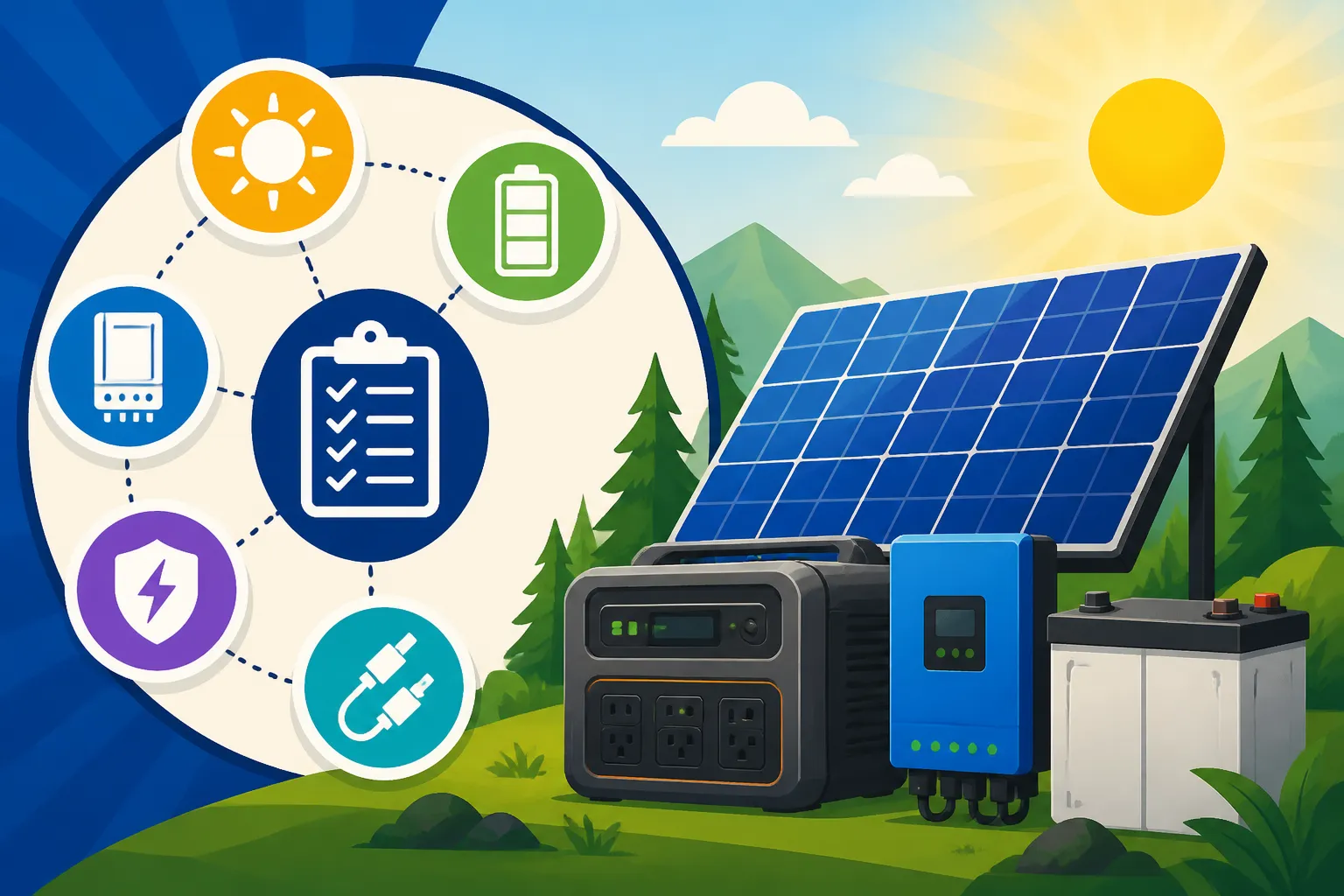
To help you navigate the choices, here's a handy checklist of what to look for when evaluating an off-grid solar kit:
| Feature/Component | Key Considerations | Why it Matters |
|---|---|---|
| Energy Needs | Calculated daily Watt-hours (Wh) | Ensures the system can actually power your appliances. |
| Peak power/surge load requirements | Prevents inverter trips and damage when motor-driven appliances start. | |
| Solar Panels | Total wattage (e.g., 400W, 1000W) | Determines daily energy generation potential. |
| Monocrystalline (high efficiency) vs. Polycrystalline (cost-effective) | Affects space required and performance in varied light conditions. | |
| Temperature Coefficient | Indicates performance in hot climates. | |
| Battery Bank | Total capacity (Ah or kWh) | Dictates days of autonomy (how long system can run without sun). |
| Chemistry: LiFePO4 (long life, deep discharge) vs. Lead-Acid (cheaper, more maintenance) | Impacts lifespan, maintenance, discharge depth, and overall long-term cost. Refer to Cost of an Off-Grid Solar Battery Bank. | |
| Depth of Discharge (DoD) | How much usable capacity you actually get from the battery. | |
| Inverter | Continuous wattage rating | Must exceed your total running load. |
| Surge wattage rating | Must exceed the highest starting load of any single appliance. | |
| Pure Sine Wave (clean power) vs. Modified Sine Wave (cheaper, limited use) | Essential for sensitive electronics and motor-driven appliances. | |
| Charge Controller | MPPT (efficient, higher cost) vs. PWM (simpler, lower cost) | MPPT maximizes power harvest, especially in larger or cold-weather systems. |
| Amperage/Voltage ratings | Must match your solar array and battery bank specifications to prevent damage. | |
| Expandability | Ability to add more panels/batteries/inverters later | Future-proofs your system, saves money on upgrades. |
| Environmental Fit | Suitability for your local peak sun hours, temperature extremes, and weather | Ensures consistent performance and longevity in your specific climate. |
| Installation | DIY-friendly instructions/support vs. requiring professional help | Determines time, skill, and potential additional cost of setup. Consider Off-Grid Solar Installation Cost. |
| Maintenance | Ease of access for cleaning, battery checks | Reduces long-term hassle and ensures system health. |
| Warranty & Support | Length and coverage of component warranties | Protects your investment from defects and premature failure. |
| Manufacturer's reputation for customer service and technical support | Crucial for troubleshooting and assistance throughout the system's life. | |
| Overall Value | Initial cost vs. long-term operating costs and expected lifespan | Provides a true measure of the system's economic benefit over time, especially considering factors like Off-Grid Solar Kit Price Ranges. |
Disclaimer
Please remember that the information provided in this guide is for educational and informational purposes only and is not intended as professional advice. Off-grid solar system design and installation can be complex and involve electrical hazards. Always consult with a qualified solar professional or licensed electrician for specific guidance regarding your particular situation and before undertaking any electrical work. Local regulations and permitting requirements vary, and it is your responsibility to ensure compliance.