How Many Batteries to Run A Cpap Machine
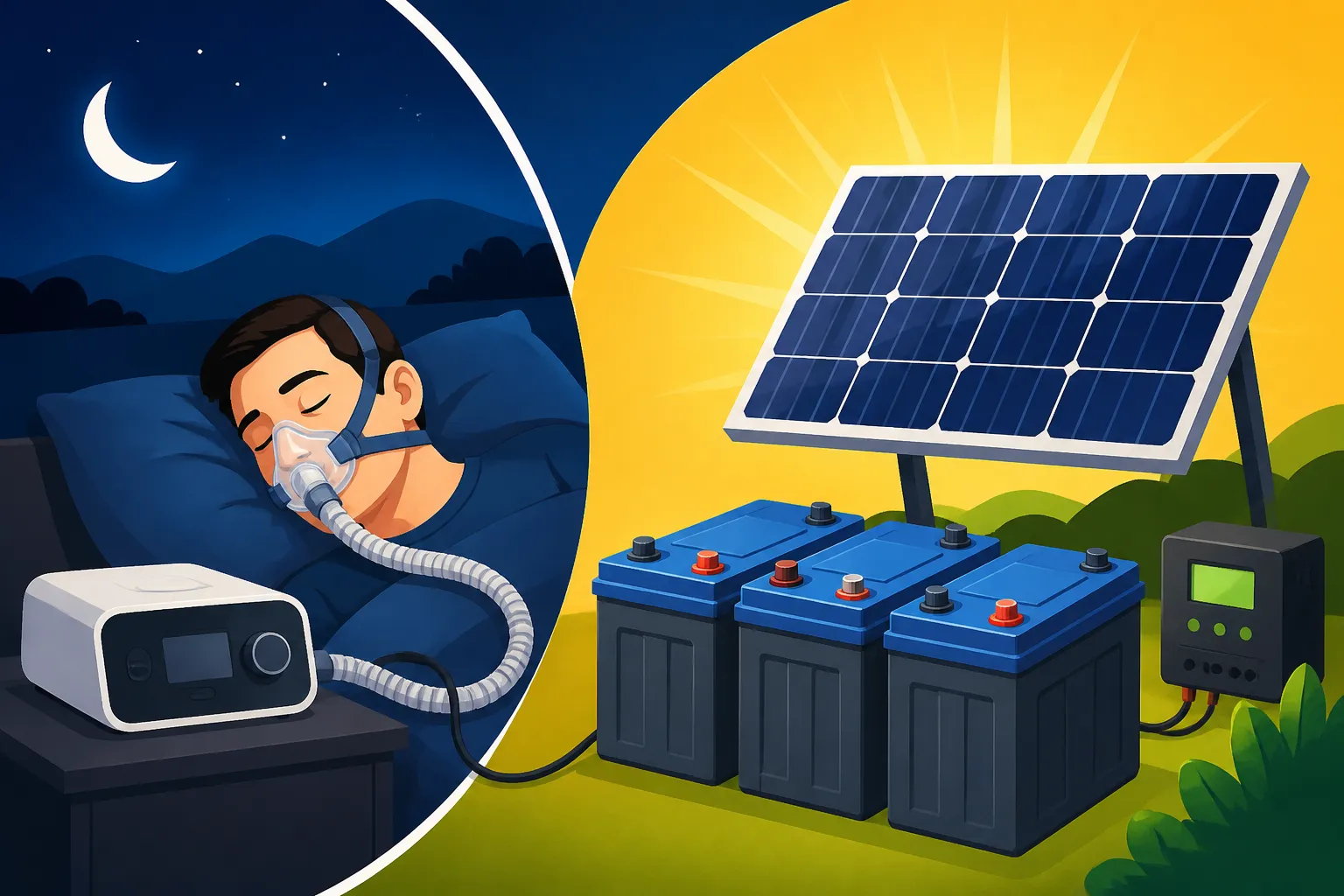
Worrying about your CPAP machine losing power when you're off-grid is a legitimate concern that keeps many people up at night. Ensuring a steady, reliable energy source is paramount for your health and peace of mind when you're relying on medical equipment in a remote setting. This comprehensive guide will walk you through exactly how to determine how many batteries you need to confidently run your CPAP machine using off-grid solar, dispelling the confusion around sizing and giving you actionable steps to power your essential device.
Understanding Your CPAP Machine's Power Needs
Before you can even begin to think about batteries, you first need to truly understand the energy demands of your specific CPAP machine. It's not just a matter of plugging it in; there's a science to it, and overlooking the details can lead to unexpected power outages right when you need it most.
Watts, Watt-Hours, and Your CPAP
Many people look at the wattage listed on their CPAP machine and assume that's all they need to know. While wattage (W) tells you how much power the device consumes at any given moment while it's running, it doesn't tell you how much total energy it will use over an entire night. For that, we need to think in terms of watt-hours (Wh).
Watt-hours are the crucial metric here, representing the amount of energy used over a period of time. Think of it like this: watts are your car's speed (how fast it's consuming fuel), and watt-hours are the total distance you travel (how much fuel you've used). A typical CPAP machine without a humidifier might draw between 30-60 watts, but that number can fluctuate. If you run that 50-watt machine for 8 hours, it uses 50 W * 8 hours = 400 Wh of energy. This is the figure we're truly interested in for battery sizing. It's vital to calculate your daily energy usage for all your off-grid appliances, but especially for critical medical devices. You'll often see batteries rated in amp-hours (Ah), so understanding Watts vs Watt-Hours vs Amp-Hours Explained is a fundamental step in off-grid living.
Humidifiers and Heated Hoses: The Hidden Drain
Here's where many people get tripped up: the humidifier and heated hose. While optional, these features significantly increase your CPAP machine's power draw. A humidifier alone can easily double or even triple the wattage, adding another 30-50 watts to the machine's consumption. A heated hose will tack on even more.
Let's consider a scenario: your base CPAP machine uses 40 watts. With a humidifier set to a medium level, it might jump to 80 watts. If you also have a heated hose, it could easily climb to 100-120 watts. Suddenly, your 40-watt device is using three times the power. Over an 8-hour night, that's the difference between 320 Wh (40W x 8h) and 960 Wh (120W x 8h)! This isn't a small margin; it's a monumental difference that directly impacts the size and cost of your battery bank. If you want to dive deeper into how much it costs to run your CPAP, you might find our guide on Cost to Run A Cpap Machine on Off-Grid Solar helpful.
Factors Affecting Battery Sizing for CPAP
Once you have a solid grasp of your CPAP's energy consumption in watt-hours, several other critical factors come into play when determining the right size battery bank for your off-grid solar system. Ignoring these can lead to frustration and, more importantly, unreliable power for your essential medical device.
Days of Autonomy: How Long Do You Need Power?
"Days of autonomy" is a fancy way of asking: how many days do you want your battery bank to power your CPAP machine without any new solar charging? This is incredibly important for off-grid systems, especially if you live in areas prone to cloudy weather, short winter days, or if you simply want a buffer against unexpected issues.
For a CPAP machine, where uninterrupted power is non-negotiable, planning for at least 2-3 days of autonomy is highly recommended. Some people, particularly those in very remote or unreliable weather areas, opt for 4-5 days. While it increases the initial battery cost, it offers invaluable peace of mind. Imagine a week of heavy rain and dense clouds; if you only planned for one day of autonomy, you'd be in a precarious situation. Considering how many cloudy days you might experience and how winter affects off-grid sizing are crucial design elements.
Battery Depth of Discharge and Efficiency
Batteries aren't 100% efficient, and they shouldn't be drained completely. The "depth of discharge" (DoD) refers to how much of the battery's total capacity you use. Different battery chemistries have different recommended maximum depths of discharge to maximize their lifespan.
For instance, traditional lead-acid batteries (like flooded or AGM) should ideally only be discharged to about 50% DoD. Pushing them beyond that significantly shortens their life. So, if you have a 100 Ah lead-acid battery, you really only have 50 Ah of usable capacity. Lithium Iron Phosphate (LiFePO4) batteries, on the other hand, can safely be discharged to 80-100% DoD without significant harm to their lifespan, making them much more efficient in terms of usable capacity. When you're looking at How Many Batteries for an Off-Grid System, this distinction is huge. Additionally, there are conversion losses. When power goes from your battery (DC) to your CPAP (AC) through an inverter, there's a small loss, usually around 5-15%. You need to factor this into your calculations, meaning you'll need slightly more battery capacity than your CPAP's raw watt-hour consumption.
Ambient Temperature and Battery Performance
Temperature plays a significant role in battery performance and longevity. Batteries, especially lead-acid types, are sensitive to extreme temperatures. Cold weather reduces their usable capacity and charging efficiency, while excessive heat can shorten their lifespan.
If you're off-grid in a cold climate, you might find that your lead-acid batteries deliver less power than their rating suggests, potentially leaving your CPAP short on juice during a chilly night. LiFePO4 batteries generally perform better in cold conditions, though extremely low temperatures can still affect their charging capabilities unless they have built-in heating elements. This is why proper battery housing and temperature regulation are essential, especially when designing for year-round off-grid power. When you're trying to figure out How to Size an Off-Grid Battery Bank, always consider your specific climate conditions.
Calculating Your CPAP Battery Bank Requirements
Now that we understand the nuances, let's get down to the actual numbers. This step-by-step process will help you accurately determine the battery capacity you need for your CPAP machine.
Step-by-Step Load Calculation for CPAP
Here’s a methodical way to figure out your exact needs:
- Determine CPAP Wattage: Check the label on your CPAP machine, humidifier, and heated hose for their individual wattage ratings. If you can't find watts, look for amps (A) and volts (V), then multiply them (W = A x V).
- Estimate Daily Run Time: Most people use their CPAP for 7-9 hours per night. Let's use 8 hours as an example.
- Calculate Daily Watt-Hours (Wh) for CPAP components:
- Base CPAP: (e.g., 40W) x (8 hours) = 320 Wh
- Humidifier: (e.g., 40W) x (8 hours) = 320 Wh
- Heated Hose: (e.g., 20W) x (8 hours) = 160 Wh
- Total Raw Daily Wh = 320 + 320 + 160 = 800 Wh
- Factor in Inverter Efficiency: If you're using an inverter (which you almost certainly will be for a CPAP), assume a 15% loss. This means you'll need 15% more power from your batteries.
- Required Wh from battery = Total Raw Daily Wh / 0.85 (assuming 85% inverter efficiency)
- Required Wh from battery = 800 Wh / 0.85 = 941 Wh
- Determine Days of Autonomy: Let's say you want 3 days of autonomy to be safe.
- Total Wh needed = Required Wh from battery * Days of Autonomy
- Total Wh needed = 941 Wh * 3 days = 2,823 Wh
- Account for Battery Depth of Discharge (DoD): This is crucial.
- For LiFePO4 batteries (80-100% DoD): If you choose LiFePO4, you can use 90% of the capacity.
- Actual battery bank capacity needed (Wh) = Total Wh needed / 0.90
- Actual LiFePO4 capacity = 2,823 Wh / 0.90 = 3,136 Wh
- For Lead-Acid batteries (50% DoD): If you choose lead-acid, you can only use 50% of the capacity.
- Actual battery bank capacity needed (Wh) = Total Wh needed / 0.50
- Actual Lead-Acid capacity = 2,823 Wh / 0.50 = 5,646 Wh
- For LiFePO4 batteries (80-100% DoD): If you choose LiFePO4, you can use 90% of the capacity.
As you can see, the battery type makes a massive difference in the nominal capacity you need to purchase. When looking at How to Calculate Daily Energy Usage, these calculations form the backbone.
Inverter Efficiency Considerations
Every time you convert power from one form to another, there are losses. Your CPAP machine runs on AC (alternating current), but your batteries store DC (direct current). An inverter converts the DC from your batteries into usable AC power for your CPAP. Even the best pure sine wave inverters are not 100% efficient.
A good quality inverter might have an efficiency of 90-95%, while cheaper ones could be as low as 80-85%. This means for every 100 watts your CPAP uses, your batteries have to supply 105-125 watts to account for the conversion loss. It’s a small detail that, when overlooked, can leave you short on power over several nights, especially if your calculations are already tight. Always factor in a conservative inverter efficiency (e.g., 85-90%) into your total watt-hour calculation to ensure you have enough juice. Our guide on How to Size an Off-Grid Inverter delves deeper into these considerations.
Practical Examples and Scenarios
Let's look at a couple of real-world scenarios to cement this understanding.
Scenario A: Minimalist CPAP Setup (No Humidifier/Heated Hose)
- CPAP machine: 40W
- Run time: 8 hours
- Daily Wh = 40W * 8h = 320 Wh
- Inverter Efficiency (85%): 320 Wh / 0.85 = 376.5 Wh from battery
- Days of Autonomy: 3 days
- Total Wh needed for autonomy = 376.5 Wh * 3 = 1129.5 Wh
- LiFePO4 battery (90% DoD): 1129.5 Wh / 0.90 = 1255 Wh
- Lead-Acid battery (50% DoD): 1129.5 Wh / 0.50 = 2259 Wh
Scenario B: Full-Feature CPAP Setup (Humidifier & Heated Hose)
- CPAP machine: 40W
- Humidifier: 40W
- Heated Hose: 20W
- Total running wattage: 100W
- Run time: 8 hours
- Daily Wh = 100W * 8h = 800 Wh
- Inverter Efficiency (85%): 800 Wh / 0.85 = 941 Wh from battery
- Days of Autonomy: 3 days
- Total Wh needed for autonomy = 941 Wh * 3 = 2823 Wh
- LiFePO4 battery (90% DoD): 2823 Wh / 0.90 = 3136 Wh
- Lead-Acid battery (50% DoD): 2823 Wh / 0.50 = 5646 Wh
This table summarizes the difference:
| CPAP Setup | Daily Wh (Raw) | Wh from Battery (after Inverter Loss) | Total Wh for 3 Days Autonomy | Usable LiFePO4 Battery (90% DoD) | Usable Lead-Acid Battery (50% DoD) |
|---|---|---|---|---|---|
| Minimalist (No Humidifier) | 320 Wh | 376.5 Wh | 1129.5 Wh | 1255 Wh | 2259 Wh |
| Full-Feature (Humidifier/Heated) | 800 Wh | 941 Wh | 2823 Wh | 3136 Wh | 5646 Wh |
As you can see, the difference is substantial! To put this into common battery terms: a typical 12V 100Ah LiFePO4 battery offers 12V * 100Ah = 1200 Wh. So, for the minimalist setup, one 100Ah LiFePO4 battery would be just enough for 3 days, assuming no other loads. For the full-feature setup, you'd be looking at three of those same 100Ah LiFePO4 batteries.
Choosing the Right Battery Type and System Voltage
Now that you know your watt-hour requirements, it's time to translate that into actual batteries. This involves selecting the right battery chemistry and ensuring your battery bank matches your overall off-grid system voltage.
Lithium Iron Phosphate LiFePO4 vs. Lead-Acid
This is often one of the biggest decisions in building an off-grid system, and for a CPAP machine, the choice can significantly impact reliability and user experience.
-
Lead-Acid Batteries (Flooded, AGM, Gel): These are the traditional choice and often have a lower upfront cost. However, they are heavy, require more maintenance (especially flooded types), and as discussed, you can only use about 50% of their rated capacity if you want them to last. They also perform less efficiently in cold weather and have a shorter lifespan (typically 3-7 years) compared to lithium. If you choose lead-acid, you'll need significantly more "nominal" capacity to get the same "usable" capacity as lithium. For example, a 100 Ah 12V AGM battery from a reputable brand might be found on Amazon, but its usable capacity for off-grid use is closer to 50Ah.
-
Lithium Iron Phosphate (LiFePO4) Batteries: These are the modern gold standard for off-grid power. While their upfront cost is higher, they offer numerous advantages:
- Higher Usable Capacity: Safely discharge to 80-100% without harming their lifespan.
- Longer Lifespan: Typically 10-15 years or more, often lasting 3,000 to 5,000 cycles.
- Lighter Weight: Much easier to handle and transport.
- Faster Charging: Can accept a higher charge current, meaning they charge quicker when the sun is out.
- Better Performance in Varying Temperatures: Many come with built-in battery management systems (BMS) that offer protection and some even have low-temperature charging cut-offs or heating elements.
- Maintenance-Free: No watering or equalization needed.
Brands like Renogy offer a range of LiFePO4 batteries that are popular in the off-grid community for their reliability.
Considering the critical nature of a CPAP machine, the higher upfront cost of LiFePO4 often translates to better long-term value, reliability, and less worry. You can dive deeper into the economics with our article on LiFePO4 vs Lead-Acid Battery Cost. Ultimately, Best Off-Grid Solar Batteries will depend on your specific needs and budget.
Matching Battery Voltage to Your Off-Grid Setup
Batteries come in different nominal voltages: 12V, 24V, and 48V being the most common for off-grid systems. The voltage you choose for your battery bank needs to match the voltage of your inverter and charge controller.
- 12V Systems: Common for smaller setups like RVs, vans, or cabins with minimal power needs. They are simpler to wire and compatible with many common DC appliances. However, for higher power draws (like a CPAP with humidifier), a 12V system requires thicker, more expensive cabling due to higher amperage, and can be less efficient over longer cable runs.
- 24V Systems: A good middle ground for medium-sized systems. They reduce the current (amps) compared to a 12V system for the same power, allowing for thinner wiring and less voltage drop.
- 48V Systems: Ideal for larger off-grid homes and substantial power needs. They are the most efficient at delivering high power over longer distances with minimal losses and allow for smaller wire gauges. Given the relatively high draw of a CPAP with a humidifier, particularly when combined with other essential loads in a home or larger cabin, a 24V or 48V system is often recommended for overall system efficiency and scalability. Our guide on 12V vs 24V vs 48V: Which to Choose can help you make an informed decision about your system voltage.
Essential Battery Bank Components Beyond the Battery
Remember, a battery bank isn't just the batteries themselves. To ensure safety, efficiency, and longevity, you'll need several other crucial components:
- Battery Management System (BMS): For LiFePO4 batteries, a BMS is vital. It protects the battery from overcharging, over-discharging, over-current, and temperature extremes, balancing the cells to ensure even performance and maximum lifespan. Most quality LiFePO4 batteries, like those from Renogy, have a built-in BMS.
- Fuses and Breakers: These are non-negotiable safety devices. They protect your wiring and equipment from short circuits and overloads. Proper sizing of fuses and breakers for your battery bank, inverter, and charge controller is critical to prevent fires and equipment damage.
- Battery Monitor: A battery monitor, often including a shunt, provides real-time information about your battery's state of charge, current draw, and how much power is going in and out. This is incredibly helpful for managing your off-grid power and ensuring you don't accidentally over-discharge your batteries, especially for critical loads like a CPAP. Knowing How to Choose an Off-Grid Battery Bank involves more than just picking a battery.
- Cabling: Use appropriately sized, high-quality copper cables for all connections within your battery bank and to your inverter and charge controller. Undersized cables can lead to voltage drop and pose a fire hazard. If you're building a battery bank, understanding How to Wire a Battery Bank correctly is absolutely crucial for safety and performance.
By carefully considering all these factors – your CPAP's actual power draw, desired autonomy, battery chemistry, system voltage, and essential components – you can confidently size and build an off-grid battery bank that reliably powers your CPAP machine and ensures your health and peace of mind.
Disclaimer
The information provided in this guide is for general informational purposes only and does not constitute professional electrical or medical advice. Off-grid solar system design and installation can be complex and involve electrical hazards. Always consult with a qualified electrician or solar professional to ensure your system is properly designed, installed, and meets all applicable codes and safety standards. Always refer to your CPAP machine's manufacturer specifications for power requirements and operational guidelines.