Best Off-Grid Solar for Full-Time Living
Moving into full-time off-grid living is an exciting dream for many, offering unparalleled freedom and self-sufficiency. However, relying solely on your own power system for all your daily needs, every single day, presents a distinct challenge compared to a weekend cabin or an occasional RV trip. This comprehensive guide will walk you through what it truly takes to build a reliable and sustainable off-grid solar setup designed specifically for the continuous demands of full-time living, helping you make informed decisions and avoid common pitfalls.
Understanding the Unique Demands of Full-Time Off-Grid Living
When you're looking at powering a home or lifestyle 24/7, 365 days a year, the approach to off-grid solar has to be fundamentally different from systems designed for intermittent use. It's not just about having some power; it's about having consistent, reliable power that can meet all your needs, day in and day out, regardless of the weather or season. This requires a much more robust and carefully planned system.
Consistent Power Needs
For full-time off-grid living, your energy consumption isn't a series of occasional peaks; it's a constant, ongoing demand. You’re not just powering a few lights and charging a phone; you're running refrigerators, freezers, water pumps, potentially air conditioning or heating, computers for work, entertainment systems, and all the other modern conveniences you'd expect in a grid-tied home.
This means your system needs to be able to handle both your baseline "always-on" loads (like refrigerators, internet routers, and security systems) and your intermittent "peak" loads (like microwave ovens, power tools, or hair dryers) without skipping a beat. The consequences of under-sizing here are not just an inconvenience; they can impact your food preservation, water supply, and overall comfort, making life significantly harder. You need a system that can deliver the power you need when you need it, consistently.
Environmental Considerations
The environment plays a huge role in how your off-grid system performs, especially when it's your only power source. You can't just count on sunny summer days; you have to plan for cloudy stretches, short winter days with low sun angles, and even extreme temperatures. A system that works perfectly in July might struggle immensely in December if not properly designed.
Consider the actual amount of sunlight your location receives throughout the year – often referred to as "peak sun hours." This metric drastically changes with seasons and geography. Beyond sunlight, temperature also affects battery and panel performance. Batteries lose efficiency in extreme cold, and panels can perform better in cooler temperatures (up to a point) but might face snow accumulation issues. Your system needs to be built with materials and components that can withstand these year-round stresses, from scorching summer heat to freezing winter winds, ensuring durability and consistent operation.
Key Components for a Robust Full-Time Off-Grid Solar System
Building a system for full-time living isn't about cutting corners; it's about investing in quality components that offer reliability, longevity, and efficiency. Each part of your system plays a critical role in its overall performance and your daily comfort.
High-Performance Solar Panels
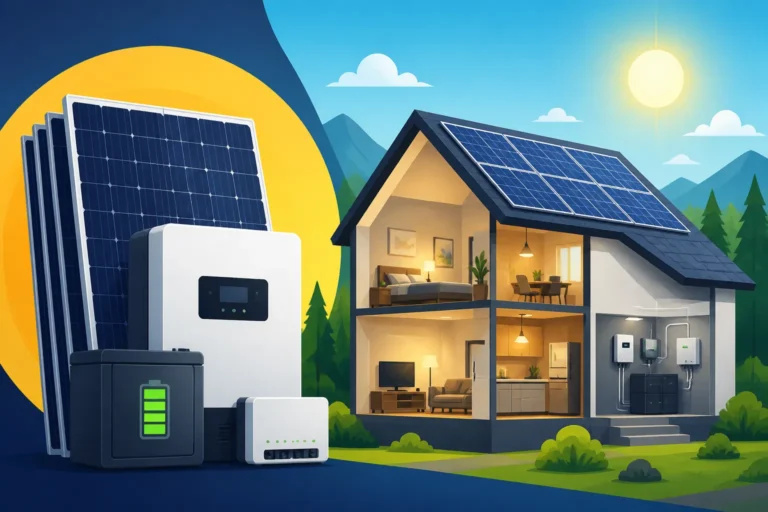
When it comes to full-time off-grid living, you want the most bang for your buck from every ray of sunshine. This means investing in high-performance solar panels. Monocrystalline panels are generally the preferred choice due to their higher efficiency ratings, meaning they can convert more sunlight into electricity in a smaller footprint compared to polycrystalline panels.
Beyond efficiency, durability is key. Your panels will be exposed to the elements constantly, so look for panels with strong frames, tempered glass, and good warranties. While flexible panels might seem appealing for certain applications, for a permanent, full-time setup, rigid panels are usually more robust and offer better long-term performance. Consider their temperature coefficient – how much their power output degrades as temperatures rise – especially if you live in a hot climate. The goal is to maximize energy harvest every day, ensuring your batteries are topped up consistently.
Deep Cycle Battery Bank for Extended Autonomy
The battery bank is the heart of any off-grid system, but for full-time living, it becomes even more critical. It’s not just a storage unit; it's your primary power reservoir for nights and cloudy days. You need a deep cycle battery bank capable of providing several "days of autonomy," meaning it can power your home for multiple days without any solar input. This is where the choice of battery chemistry really matters.
LiFePO4 (Lithium Iron Phosphate) batteries have emerged as the gold standard for full-time off-grid applications. They offer superior lifespan (thousands of cycles compared to hundreds for lead-acid), can be deeply discharged without damage (typically 80-100% depth of discharge), and maintain a stable voltage throughout their discharge cycle. While the upfront cost is higher, their longevity and performance often make them more cost-effective over the system's lifetime. When considering how many batteries for an off-grid system, remember that oversizing slightly can be a lifesaver during extended periods of poor weather, providing peace of mind and preventing power outages. You can dive deeper into the differences by exploring LiFePO4 vs Lead-Acid Batteries for Off-Grid While lead-acid options like AGM or flooded lead-acid are cheaper initially, they require more maintenance, have shorter lifespans, and can only be safely discharged to about 50%, meaning you need twice the capacity to get the same usable energy as LiFePO4.
Reliable Inverter Charger and Charge Controller
These are the brain and muscle of your off-grid system. A high-quality pure sine wave inverter is non-negotiable for full-time living. Unlike modified sine wave inverters, pure sine wave inverters produce clean, grid-quality power that is safe for all your sensitive electronics, from laptops to modern refrigerators and medical devices. An inverter charger is often ideal for full-time setups, as it integrates the inverter (DC to AC power conversion) with a battery charger (for when you need to top up with a generator). For the best performance, look for models with robust surge capacities to handle the momentary power spikes from motor-driven appliances like pumps and refrigerators. You'll find many excellent options when looking into the Best Off-Grid Solar Inverters
Equally important is an efficient charge controller. For most serious off-grid systems, an MPPT (Maximum Power Point Tracking) charge controller is the only way to go. These controllers are significantly more efficient than their PWM (Pulse Width Modulation) counterparts, especially in varying light conditions or when your panel voltage is much higher than your battery bank voltage. An MPPT controller can extract up to 30% more power from your solar panels, which translates directly to more charge going into your batteries, crucial for consistent full-time power. Understanding MPPT vs PWM Charge Controllers will further illustrate why MPPT is superior for your needs. Top brands like Victron Energy and Outback Power are popular for their reliability and advanced features in both inverters and charge controllers.
Sizing Your Off-Grid Solar System for Full-Time Living
This is arguably the most critical step in designing an off-grid system for full-time living. Get this wrong, and you'll either spend too much on an oversized system or constantly run out of power. It's a delicate balance that requires careful calculation and realistic planning.
Conducting a Thorough Load Analysis
Before you even think about buying components, you absolutely must perform a detailed load analysis. This means listing every single electrical appliance and device you plan to use, along with its wattage and how many hours per day you intend to use it. Don't forget things that are always on, like your internet router, smoke detectors, and clocks. This exercise is foundational to understanding How to Calculate Off-Grid Solar Needs and is paramount for full-time living.
Start by looking at the labels on your appliances for their wattage (W) or amperage (A) and voltage (V). If you have amps and volts, multiply them to get watts (W = A x V). Then, multiply the wattage by the average daily hours of use to get watt-hours per day (Wh/day). Sum up all these daily watt-hour figures, and you’ll have your total daily energy consumption. Remember to account for seasonal variations; you might use more lights in winter or run air conditioning more in summer. Overestimating slightly is always safer than underestimating. This comprehensive list helps you answer the question of How to Do an Off-Grid Load Analysis effectively.
| Appliance | Wattage (W) | Daily Hours Used | Daily Watt-Hours (Wh) |
|---|---|---|---|
| Refrigerator (energy efficient) | 100 | 8 | 800 |
| LED Lights (5 x 10W) | 50 | 6 | 300 |
| Laptop | 60 | 4 | 240 |
| Water Pump (intermittent) | 500 | 0.5 | 250 |
| TV (LED) | 80 | 3 | 240 |
| Internet Router | 15 | 24 | 360 |
| Phone Charger | 10 | 2 | 20 |
| Total Estimated Daily Wh | 2210 |
Note: Refrigerator wattage and hours are averages; actual consumption varies.
Determining Panel Array and Battery Bank Size
Once you have your total daily watt-hour consumption, you can start sizing your solar array and battery bank. This is where knowing How to Size an Off-Grid Solar System truly comes into play. For solar panels, you’ll need to factor in your location’s "peak sun hours" – the equivalent number of hours per day when the sun is at its most intense. This varies significantly by geographic location and time of year. For instance, northern regions will have fewer peak sun hours in winter. To ensure year-round reliability, you should always size your array based on the lowest average peak sun hours you experience, typically in winter. Then, you'll want to add a buffer, often 20-30% extra capacity, to account for cloudy days, panel degradation, and unexpected increases in usage.
For the battery bank, the calculation involves your daily watt-hour usage and your desired "days of autonomy." For full-time living, aiming for at least 3-5 days of autonomy is wise, especially if you live in an area prone to extended cloudy periods. Multiply your daily watt-hours by your desired days of autonomy, then divide by the usable depth of discharge of your chosen battery type (e.g., 0.8 for LiFePO4, 0.5 for lead-acid). This gives you the total battery bank capacity in watt-hours. Remember that you also need to factor in the inverter efficiency losses, typically 85-90%. Properly determining How Many Batteries for an Off-Grid System is crucial for uninterrupted power.
Choosing the Right System Voltage
The voltage of your off-grid system (12V, 24V, or 48V) directly impacts efficiency, component cost, and wire sizing. For small, temporary setups like RVs or sheds, 12V might suffice. However, for full-time off-grid living, especially if you have significant power needs (over 2000-3000 watts of inverter capacity), a 24V or, even better, a 48V system is highly recommended.
Higher voltage systems allow for smaller wire gauges, which means less voltage drop over longer distances and lower material costs for wiring. More importantly, they improve the efficiency of your inverter and reduce the current running through your components, making the system more robust and reducing heat buildup. Most serious off-grid setups for whole homes or cabins lean heavily towards 48V systems, which is a sweet spot for balancing efficiency, component availability, and cost-effectiveness. When you're designing for year-round reliability, higher voltage systems often simplify the overall engineering.
Essential Considerations Beyond the Core Components
While panels, batteries, inverters, and charge controllers form the foundation, a truly resilient full-time off-grid system requires attention to several other critical elements. These elements contribute to the system's longevity, safety, and your peace of mind.
Backup Power Solutions
Even the most meticulously designed solar system can face challenges, especially during prolonged periods of unusually bad weather or component failure. For full-time living, having a reliable backup power solution is not just an option; it's a necessity. This typically comes in the form of a fossil fuel generator, usually propane or diesel, which can directly charge your battery bank via the inverter/charger. This allows you to weather extended cloudy spells without compromising your power supply. When thinking about How to Add a Generator to Your Design, consider automatic start features that kick in when battery voltage drops to a certain level, offering truly seamless backup.
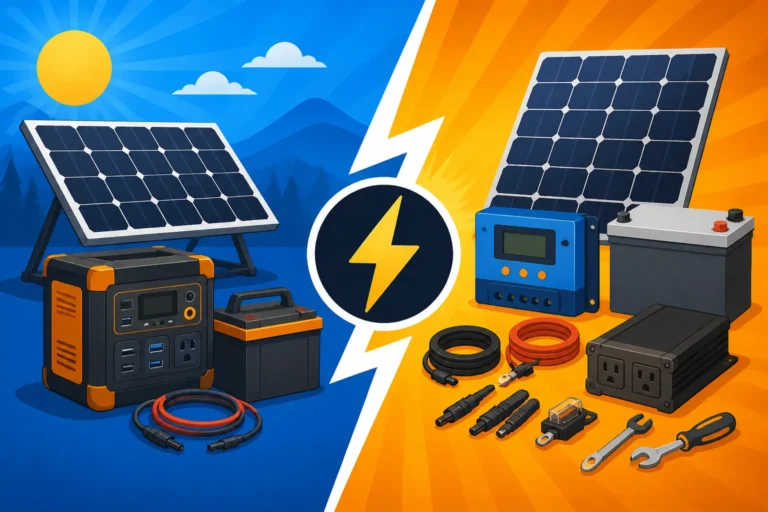
Alternatively, some people integrate smaller, portable solar generators, such as those offered by Jackery, as a secondary backup for critical loads, or to provide power when maintenance is being performed on the main system. A Jackery Explorer 1000 or 2000, for instance, can keep a few lights on, charge phones, or run a small fridge for a limited time, providing a valuable bridge during an emergency or while working on your primary setup. Having that redundancy is a key factor in ensuring uninterrupted full-time living.
Monitoring and Maintenance for Longevity
An off-grid solar system for full-time living is an investment, and like any investment, it requires ongoing care and attention to maximize its lifespan and performance. This begins with robust monitoring. A good battery monitor (shunt-based) is essential to track your battery's state of charge, voltage, current in/out, and overall health. Many modern inverters and charge controllers from brands like Victron or Sol-Ark come with sophisticated monitoring capabilities, often accessible via Bluetooth or Wi-Fi, allowing you to track system performance in real-time.
Regular maintenance is also paramount. This includes keeping your solar panels clean to ensure maximum sunlight absorption, especially in dusty or snowy environments. Inspecting all wiring for signs of wear, corrosion, or loose connections is crucial for both safety and efficiency. Batteries, particularly lead-acid ones, require periodic checks of water levels and terminal cleaning. Even LiFePO4 batteries benefit from occasional checks and ensuring their environment is within optimal temperature ranges. Adhering to an Off-Grid Solar Maintenance Guide will help you proactively address issues before they become major problems, ensuring your system runs smoothly year after year.
Expandability and Future-Proofing
One of the often-overlooked aspects when designing a full-time off-grid system is planning for future expansion. Your energy needs might grow over time as you add new appliances, increase your family size, or simply decide you want more amenities. Designing your system with expandability in mind from the outset can save you significant headaches and costs down the road.
This means choosing an inverter that can handle more panels or batteries than your initial setup, or one that can be paralleled with another unit later. Selecting a charge controller that can accommodate additional solar panel strings is also a smart move. When wiring your battery bank, leave room for additional batteries if you anticipate needing more storage. While it might seem like an extra expense upfront, a modular system that allows for easy upgrades is far more practical than having to completely overhaul your entire setup later. Think about what your life might look like in 5 or 10 years and build a system that can adapt to those changes.
Understanding the Cost to Power a Homestead Off-Grid
Let's be realistic: powering a homestead full-time off-grid isn't a cheap endeavor, but it's an investment in independence and long-term savings. The exact cost can vary wildly depending on your energy needs, location, and choice of components. However, understanding the typical ranges and what drives the cost can help you budget effectively. When you consider the Cost to Go Off-Grid for a Family Home it becomes clear that meticulous planning is necessary.
A small, minimalist off-grid cabin for one or two people, focusing on essential loads and perhaps seasonal use, might run you anywhere from $5,000 to $15,000 for a basic system with lead-acid batteries and a smaller inverter. However, for full-time living that includes modern conveniences like a full-sized refrigerator, well pump, washing machine, and consistent electronics use, you’re looking at a more substantial investment.
A robust system designed for a small family in a moderate climate, with LiFePO4 batteries and a powerful pure sine wave inverter, typically falls in the range of $20,000 to $50,000, and often more if professional installation is included. Large homesteads with significant energy demands, air conditioning, and multiple heavy-draw appliances could easily see costs climb well over $70,000 to $100,000 or more. These figures generally include panels, batteries, inverters, charge controllers, mounting hardware, and balance-of-system components like wiring, fuses, and disconnects. Installation costs can add another 10-20% if you're not going the DIY route. Remember, this is an investment in your energy independence that pays off over decades.
Disclaimer
The information provided in this guide is for general informational purposes only and does not constitute professional advice. Off-grid solar system design and installation can be complex and involve electrical hazards. Always consult with qualified professionals and adhere to all local codes and regulations when planning or installing an off-grid solar system.