How to Choose Off-Grid Solar for a Boat
The open water calls to us, doesn't it? But for many boat owners, that sense of boundless freedom is often tethered by the need for shore power or the noisy, fuel-guzzling hum of a generator. Imagine cruising into a quiet cove, dropping anchor, and knowing you have all the power you need for lights, navigation, a cold fridge, and even a steaming cup of coffee, all without a single drop of fossil fuel. This guide is here to walk you through the ins and outs of choosing and implementing an off-grid solar system specifically for your boat, helping you reclaim that true independence on the waves.
Navigating Your Boat's Power Demands for Off-Grid Solar
Before you even think about buying solar panels or batteries, the absolute first step is to truly understand your boat's energy appetite. This isn't just about what you want to run, but what you need to run, and for how long. Boats have unique power profiles compared to an RV or a cabin, with crucial systems like navigation electronics and bilge pumps that absolutely cannot fail.
Performing a Detailed Marine Energy Audit
Think of your boat as a tiny, floating home. Every appliance, every light, every electronic gadget draws power. Your job is to meticulously list every single electrical item on board, note its wattage, and estimate how many hours per day or week you plan to use it. Don't forget the essentials! This often overlooked but vital step is the bedrock of proper system design.
For instance, your chartplotter might draw a continuous 10-15 watts, but if it's on for 8 hours a day, that's a significant chunk of your daily usage. Your galley fridge, running 24/7, might cycle on and off but its total daily draw can be substantial. Even small things add up quickly—LED cabin lights, USB chargers for phones, a stereo system, and especially those power-hungry items like water pumps, anchor winches, or a small microwave. You'll need to calculate your "watt-hours per day" for each item, then sum them up to get your total daily energy consumption. For a deeper dive into these calculations, check out our guide on How to Calculate Daily Energy Usage.
Identifying Essential versus Auxiliary Loads
On a boat, certain electrical loads are non-negotiable. These are your essential systems that keep you safe and operational. Think navigation lights, bilge pumps, VHF radio, essential instruments like depth sounders or GPS, and potentially an autopilot if you're undertaking longer passages. These items need a reliable power supply, even in low-sun conditions.
Then you have your auxiliary loads – the creature comforts. This includes your galley refrigerator, cabin lights (beyond navigation), entertainment systems, charging ports, and perhaps a small fan or even a coffee maker. While important for comfort, their operation can often be staggered or reduced if power is limited. Distinguishing between these two categories helps prioritize your system design, ensuring critical systems always have juice while allowing flexibility for non-essential items during cloudy days or extended anchorages. Many boaters find that a portable power station, like a robust Jackery model, can serve as an excellent backup for auxiliary loads or as a primary source for small, intermittent needs on smaller vessels, allowing their main solar system to focus on essentials.
| Appliance/System | Typical Wattage (W) | Est. Daily Use (Hours) | Daily Watt-Hours (Wh) |
|---|---|---|---|
| LED Cabin Lights | 5-20 | 2-4 | 10-80 |
| Navigation Lights | 10-30 | 4-8 (when in use) | 40-240 |
| VHF Radio | 5 (receive), 25 (transmit) | 2 (receive), 0.1 (transmit) | 10-5 |
| Chartplotter/GPS | 10-25 | 4-8 | 40-200 |
| Autopilot | 15-60 (average) | 4-8 (when in use) | 60-480 |
| Refrigerator (12V/24V) | 40-80 (cycling) | 6-12 (compressor run time) | 240-960 |
| Water Pump | 30-100 | 0.5-1 | 15-100 |
| Bilge Pump | 50-200 | 0.1-0.5 (intermittent) | 5-100 |
| USB Device Charging | 5-10 | 2-4 | 10-40 |
| Laptop Charging | 30-60 | 2-4 | 60-240 |
| Small Inverter (idle) | 10-30 | 24 | 240-720 |
| Stereo System | 10-40 | 2-4 | 20-160 |
Note: These are approximations. Always check the specific ratings of your appliances.
Essential Components for a Marine Off-Grid Solar System
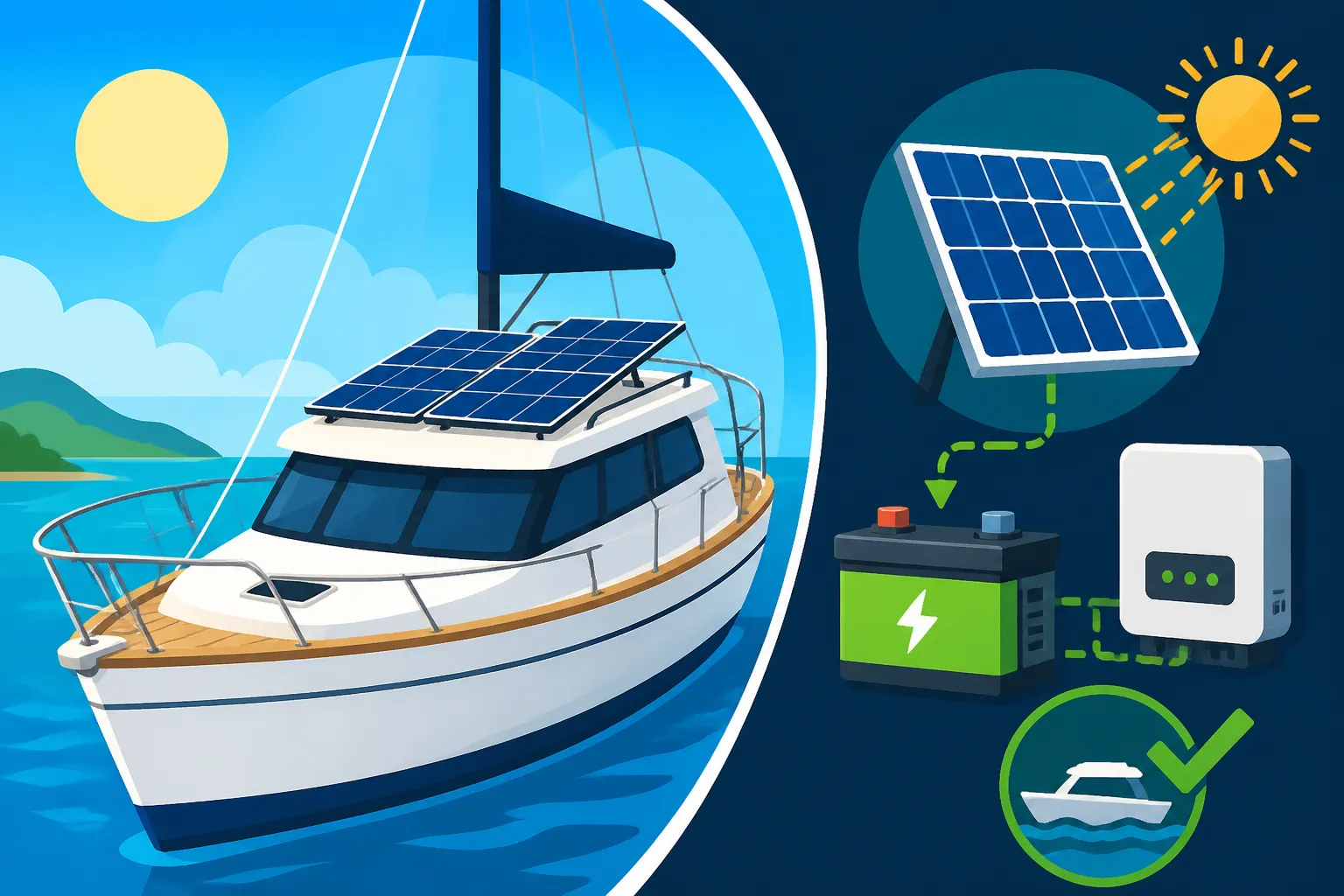
Building a reliable off-grid solar system for your boat means understanding the core components and choosing marine-grade equipment that can stand up to the harsh realities of the marine environment. Every piece plays a crucial role in converting sunlight into usable electricity. If you're new to this, a great starting point is our comprehensive overview of Off-Grid Solar System Components Explained.
Solar Panels Built for the Seas
When it comes to solar panels for boats, you have a few distinct choices, each with its own pros and cons. The primary decision often revolves around rigid versus flexible panels.
- Rigid Panels: These are your traditional glass-and-aluminum framed panels. They are highly efficient, durable, and generally offer the best watt-per-dollar value. However, they are heavy, bulky, and require robust mounting structures. On a boat, this usually means mounting them on a radar arch, a custom davit system, or sometimes on deck if space permits and shading isn't an issue. When selecting rigid panels, look for those with high efficiency ratings and strong frames, designed to withstand wind and vibrations. Brands like Renogy or Rich Solar offer reliable rigid panels often used in marine applications.
- Flexible Panels: These panels are lightweight, can conform to slightly curved surfaces, and can often be walked on (though not recommended for longevity). They are great for mounting directly on biminis, dodgers, or cabin tops where weight and space are at a premium. The downside is they are generally less efficient and can be more prone to overheating (which reduces output) if not properly ventilated underneath. They also tend to have a shorter lifespan than rigid panels. If you opt for flexible panels, ensure they have good heat dissipation properties and consider adding an air gap underneath if possible. For insights into different panel types, our guide on Best Off-Grid Solar Panels can be very helpful. Portable flexible panels, sometimes integrated into a unit like a Jackery SolarSaga, are also fantastic for supplementary charging or quick deployment.
No matter which type you choose, marine-specific considerations include UV resistance, salt-spray corrosion protection, and the ability to handle constant motion and vibration.
Robust Battery Banks for Reliable Power
The battery bank is the heart of your off-grid system on a boat, storing the sun's energy for when you need it most. Choosing the right battery chemistry is paramount.
- Lithium Iron Phosphate (LiFePO4): These are increasingly the go-to for marine applications. They offer incredible benefits: lightweight, high energy density, a much deeper depth of discharge (80-100% without damage), very long cycle life (thousands of cycles), and fast charging capabilities. While the upfront cost is higher, their longevity and performance often make them more cost-effective over time. Their lighter weight is also a huge advantage on a boat, where every pound counts towards stability and performance. Many reputable brands offer marine-specific LiFePO4 batteries, complete with integrated Battery Management Systems (BMS) for safety and longevity. For a detailed comparison, explore LiFePO4 vs Lead-Acid Batteries for Off-Grid.
- Absorbed Glass Mat (AGM): A good, more budget-friendly alternative. AGM batteries are sealed, maintenance-free, non-spillable, and perform well in various temperatures. They handle vibration better than traditional flooded lead-acid batteries and offer a decent depth of discharge (up to 50% for best lifespan). However, they are heavier, have a shorter cycle life than LiFePO4, and charge slower. They are still a solid choice for many boaters, especially those with smaller power needs or tighter budgets.
Regardless of chemistry, ensure your battery bank is adequately sized to meet your daily needs and provide at least 2-3 days of "autonomy" (power without sun) to account for cloudy weather. Our article on How Many Batteries for an Off-Grid System dives deeper into sizing.
Charge Controllers and Inverters: The Brains and Brawn
These two components are essential for managing and converting the solar energy.
- Charge Controller: This device regulates the voltage and current coming from your solar panels, preventing overcharging and damage to your batteries. For marine systems, a Maximum Power Point Tracking (MPPT) controller is almost always recommended. MPPTs are significantly more efficient than PWM (Pulse Width Modulation) controllers, especially when panel voltage differs substantially from battery voltage, which is common in many setups. This efficiency translates to more power harvested from your panels, a critical factor on a boat where space for panels might be limited. Look for marine-grade units with good environmental sealing. Brands like Victron Energy are highly regarded for their robust and intelligent charge controllers.
- Inverter: An inverter takes the DC (Direct Current) power from your batteries and converts it into AC (Alternating Current) power, which is what most household appliances use. For sensitive marine electronics and anything with a motor (like a microwave or blender), you'll absolutely need a pure sine wave inverter. Modified sine wave inverters are cheaper but can damage electronics and cause motors to run inefficiently or overheat. Size your inverter based on the maximum simultaneous AC load you anticipate running. Remember that inverters have an idle draw, so it's often wise to have a smaller inverter for continuous low loads and a larger one that can be switched on for high-demand appliances, or even rely on a portable power station like a Jackery Explorer for smaller AC needs. For more details, refer to our guide on Best Off-Grid Solar Inverters.
Critical Considerations for Installing Solar on Your Vessel
Installing solar on a boat presents unique challenges that you won't typically find in a land-based application. The marine environment is relentlessly harsh, and space is always at a premium.
Maximizing Panel Placement and Mitigating Shading
Boats offer limited real estate for solar panels, and every square inch needs to count. Common placement options include:
- Biminis and Dodgers: Often prime spots for flexible panels, as they are large, relatively flat surfaces. However, ensure the material can support the panels and that ventilation is adequate.
- Arch or Davits: Dedicated arches at the stern or davit systems for dinghies provide excellent, relatively shade-free locations for rigid panels. These can be designed to tilt for optimal sun angle.
- Cabin Top: Depending on the boat's design, the cabin top can accommodate rigid or flexible panels. Be mindful of potential shading from masts, booms, antennas, or radar.
- Deck: Less ideal due to constant foot traffic and potential for damage, but sometimes the only option for smaller vessels. Flexible walk-on panels are used here, but again, shading from people or gear is a constant challenge.
Shading is the biggest enemy of solar production on a boat. Masts, booms, sails, radar, antennas, and even people can cast shadows that drastically reduce output, especially with traditional panel wiring. Consider using panels with bypass diodes, or even micro-inverters or DC optimizers (though less common in small marine setups) to mitigate the impact of partial shading. Careful planning of panel orientation and tilt can also help maximize output throughout the day and year, as discussed in Best Tilt Angle for Off-Grid Panels.
Wiring, Protection, and Environmental Durability
The marine environment demands top-tier wiring practices and components. Saltwater, UV exposure, and constant vibration are unforgiving.
- Marine-Grade Wiring: All wiring must be marine-grade (tinned copper wire with thick insulation), properly sized for the current, and run through conduit where possible to protect against chafing and UV degradation. Voltage drop over longer runs can also be a significant issue, so proper wire sizing is critical.
- Fuses and Breakers: Every circuit must be properly fused or protected by circuit breakers to prevent fires and equipment damage. This includes the main circuit from panels to the charge controller, from the charge controller to the battery bank, and from the battery bank to the inverter and DC distribution panel.
- Corrosion Protection: All connections should be sealed and protected from moisture and salt spray. Use dielectric grease on terminals, heat-shrink tubing on connections, and ensure all electrical components are rated for marine use. Stainless steel hardware is a must for mounting.
- Grounding: A robust grounding system is essential for safety, protecting against lightning strikes and stray currents. All metal components of your solar system should be properly bonded to the boat's common grounding system. Our guide on Off-Grid Solar Safety and Grounding provides crucial information.
- Waterproofing Penetrations: Any holes drilled into the deck or cabin for wiring must be meticulously sealed to prevent water ingress. Use marine sealants like Sikaflex or 3M 5200.
Ignoring these details can lead to dangerous electrical faults, premature equipment failure, and costly repairs down the line.
Selecting the Right Off-Grid Solar System for Different Boat Types
The ideal off-grid solar system isn't a one-size-fits-all solution. What works for a small daysailer won't cut it for a liveaboard catamaran. Matching the system to your vessel and lifestyle is key to success.
Small Cruisers and Weekend Sailboats
For smaller boats used for weekend trips or day sails, the power demands are typically lower. You might just need to run navigation lights, a small cooler, charge your phone, and power a stereo.
- System Size: A small system, perhaps 100-300 watts of solar, coupled with a 100-200 Ah LiFePO4 battery (or 200-400 Ah AGM), would likely suffice.
- Panel Choice: Flexible panels on a bimini or a single rigid panel on a stern mount are common.
- Inverter: A small 300-600 watt pure sine wave inverter or even just DC charging ports for electronics. For very minimal AC needs, a high-quality portable power station like a Jackery Explorer 500 or 1000, combined with its own foldable solar panels, can act as a self-contained, easily deployable system. This reduces installation complexity significantly.
- Benefits: This size system provides basic comforts, maintains battery health, and reduces reliance on the engine for charging. It's often relatively affordable. You might find a suitable Best Off-Grid Solar Kit for a Boat tailored for these needs.
Mid-Size Cruisers and Coastal Liveaboards
These boats typically have more amenities – a larger fridge, more extensive electronics, maybe a small microwave or water maker, and a need for longer periods away from shore power.
- System Size: You're probably looking at 400-800 watts of solar, and a battery bank of 300-600 Ah LiFePO4 (or 600-1200 Ah AGM).
- Panel Choice: A combination of rigid panels on an arch or davits, plus flexible panels on a hardtop or bimini, can maximize solar harvesting.
- Inverter: A 1000-2000 watt pure sine wave inverter is often necessary to run a wider range of AC appliances.
- Considerations: Managing shading becomes even more important. You'll likely need to integrate a robust battery monitor to keep track of your state of charge, helping you understand your energy consumption patterns. This level of system starts to require more careful design, potentially moving beyond simple pre-packaged kits towards individual component selection.
Large Cruisers and Offshore Liveaboards
For those living aboard full-time or undertaking long offshore passages, reliable and abundant power is crucial. These vessels have high demands for refrigeration, communication, navigation, entertainment, and often energy-intensive systems like water makers, air conditioning, or washing machines.
- System Size: Expect 1000+ watts of solar, often pushing 1500-2000 watts, paired with a substantial LiFePO4 battery bank of 800-2000+ Ah.
- Panel Choice: Multiple rigid panels on custom arches, hardtops, or specialized structures, with careful attention to tilt and orientation. Flexible panels might supplement the main array.
- Inverter: A powerful 3000-5000 watt (or even higher) pure sine wave inverter, potentially an inverter-charger combination, to handle all household loads and integrate with a backup generator.
- Complexities: These systems often involve multiple charge controllers, robust battery monitoring, and sophisticated integration with the boat's existing electrical systems. Redundancy is key, and often a backup generator or even a secondary charging method like a wind generator is incorporated. Professional installation or at least professional consultation is highly recommended for systems of this scale. Understanding How to Design for Year-Round Off-Grid Power becomes crucial here.
Whether you're sailing the San Juan Islands for a weekend or cruising the Caribbean for months, a well-designed off-grid solar system can fundamentally change your boating experience, offering peace, quiet, and genuine energy independence.
Disclaimer
The information provided in this guide is for general informational purposes only and does not constitute professional advice. Off-grid solar system design and installation, especially in a marine environment, can be complex and potentially dangerous if not executed correctly. Always consult with qualified marine electricians or solar professionals before undertaking any major electrical work on your boat. Adherence to all applicable electrical codes, safety standards, and local regulations is paramount.