What a 1000W Off-Grid System Can Power and Cost
It’s a common scenario: you’re dreaming of powering a small cabin, an RV, or just some essential backup items, and you see "1000W off-grid solar system" mentioned. But what does that really mean for your everyday life? Many folks get caught up in the number, not fully grasping what that level of power can actually sustain or how much it's going to set them back. This guide will cut through the confusion, clearly outlining what a 1000W off-grid solar system can realistically power and the costs you can expect.
Deciphering the 1000W Off-Grid System
When someone talks about a "1000W off-grid solar system," they're usually referring to the peak output capacity of the solar panels themselves. However, the actual power you can consistently use and for how long depends heavily on every single component in that system. It's not just about what the sun can deliver, but what your batteries can store and what your inverter can convert.
The Nuance of Watts (Panels) Versus Watt-Hours (Battery Storage)
Let's clear up a common misconception: 1000 watts (W) refers to the instantaneous power your solar panels can generate under ideal conditions. Think of it like the horsepower of a car – it tells you its potential speed, but not how far it can go on a tank of gas. For off-grid solar, the "tank of gas" is your battery bank, measured in watt-hours (Wh) or kilowatt-hours (kWh). A 1000W solar array might generate 4000-5000 Wh (4-5 kWh) on a good sunny day, depending on your location and the number of peak sun hours. But if your battery bank can only store 2000 Wh, you're essentially wasting half that potential solar energy once your batteries are full.
This distinction is crucial because your panels only produce power when the sun is shining. To power anything at night, on cloudy days, or simply to ensure a steady supply, you need adequate battery storage. A system with a 1000W solar array needs a robust battery bank to truly deliver on its promise. Without sufficient storage, even a massive solar array is practically useless once the sun dips below the horizon. Understanding this fundamental difference is the first step in realistically assessing How Much Solar to Charge Your Batteries Daily.
Core Components Beyond Just Solar Panels
A "1000W off-grid solar system" is a symphony of several key components working in harmony. It's much more than just the panels.
- Solar Panels (PV Array): These are the stars of the show, converting sunlight into electricity. For a 1000W system, you might have four 250W panels, or five 200W panels, or even ten 100W panels. The choice often comes down to available space, efficiency, and budget.
- Charge Controller: This smart device sits between your solar panels and your batteries. It regulates the voltage and current coming from the panels to prevent overcharging your batteries, which can severely shorten their lifespan. There are two main types: PWM (Pulse Width Modulation) and MPPT (Maximum Power Point Tracking). MPPT controllers are more efficient, especially in varying light conditions, and are generally recommended for systems over 200-300W. Learning How to Choose an Off-Grid Charge Controller is a vital step in system design.
- Battery Bank: This is your energy reservoir. It stores the electricity generated by your panels for later use. For a 1000W system, a good starting point might be a 200-400Ah (Amp-hour) 12V lithium-ion (LiFePO4) battery, or an equivalent lead-acid setup. The type and size of your battery bank will largely dictate How Many Batteries for an Off-Grid System and how long you can power your devices.
- Inverter: Your panels and batteries typically produce direct current (DC) electricity. Most standard household appliances, however, run on alternating current (AC). The inverter's job is to convert that DC power into usable AC power. For a 1000W system, you'd want an inverter rated at least 1000W continuous output, with a surge capacity higher than that to handle initial spikes from motors (like a refrigerator or power tool). Understanding How to Size an Off-Grid Inverter for your specific loads is crucial.
- Wiring, Fuses, and Breakers: These are the unsung heroes of your system, ensuring safe and efficient power delivery. Correctly sized wires prevent voltage drop and overheating, while fuses and breakers protect your system from electrical faults. These components are essential for the overall safety and longevity of your off-grid setup.
When considering a system, remember that "1000W" often refers specifically to the solar panel capacity. The actual usable power and storage capacity of the entire system, encompassing the battery bank and inverter, is what truly determines what you can power and for how long. It's a critical component of understanding How Much Does an Off-Grid Solar System Cost.
Everyday Appliances a 1000W System Can Power
So, you have a 1000W solar array and a reasonably sized battery bank (let's assume a 200Ah 12V LiFePO4 battery, providing roughly 2.56 kWh of usable energy). What can this setup realistically handle? The key is to think about your energy needs in watt-hours per day and balance them against your system's generation and storage capacity. You might be surprised by what you can do, and equally, what you can't.
Running Small Electronics and Lights
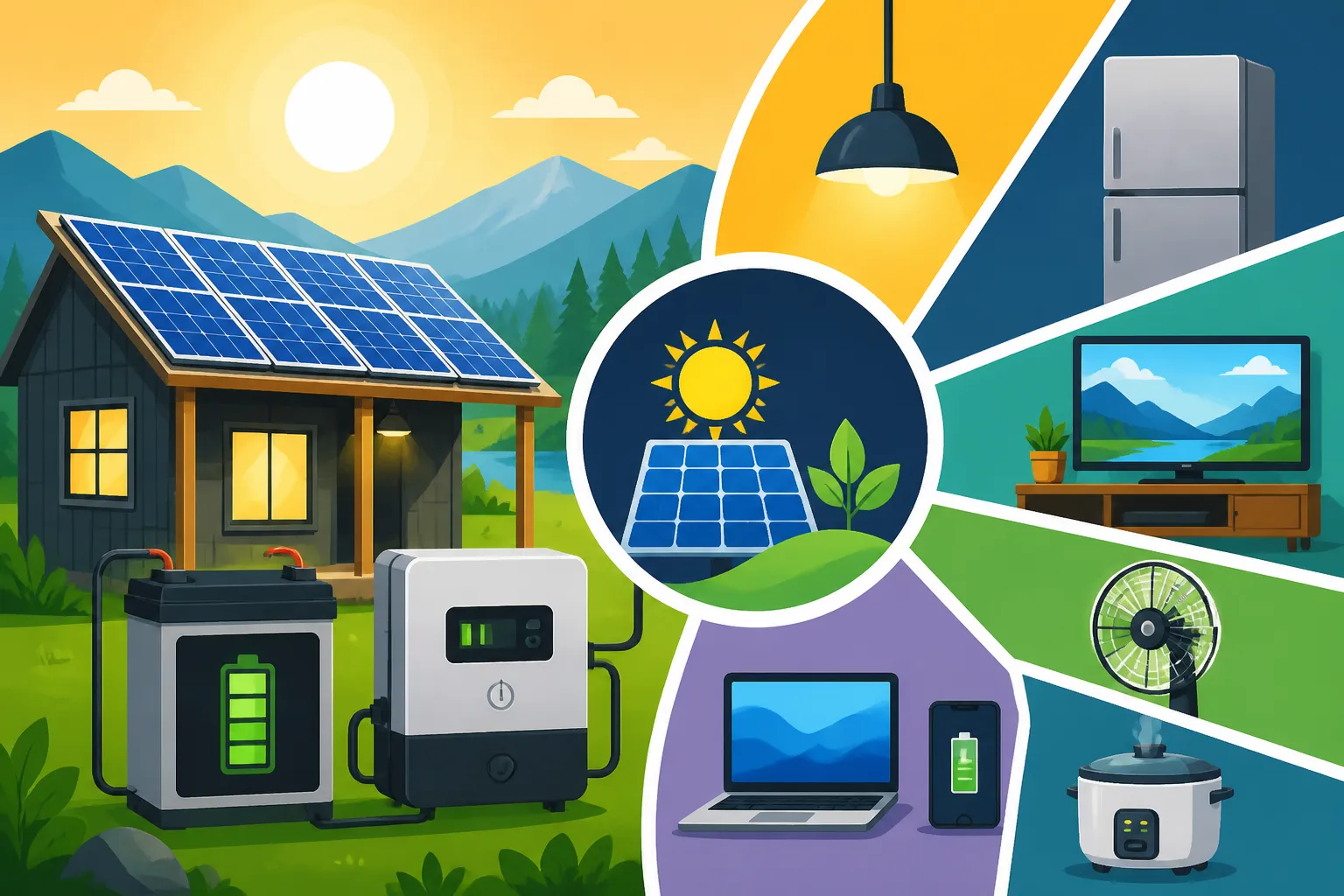
A 1000W system is quite capable of handling your everyday small electronics and lighting needs. This is where you'll find the most consistent and reliable power.
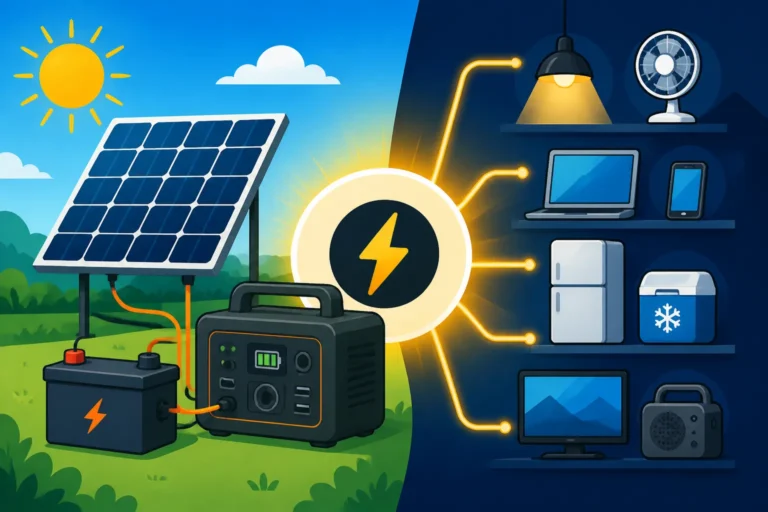
For instance, charging phones and tablets (which typically draw 5-15W) is a breeze. You could charge multiple devices simultaneously without a hiccup. Laptops, usually drawing 30-60W, can also be powered for many hours a day. Imagine being able to work remotely from your off-grid cabin, powered entirely by the sun. LED lighting, being incredibly efficient (often 5-15W per bulb), can easily light up several rooms for an entire evening. Even a small 12V fan (around 10-25W) can run for a good portion of the day and night to keep you comfortable. A 1000W system is perfect for these kinds of continuous, low-draw loads, offering a sense of normalcy and convenience away from the grid. This is a great starting point for anyone considering How to Size an Off-Grid System for a Cabin or an RV.
Handling Moderate Loads and Intermittent Appliances
When it comes to moderate loads, a 1000W system starts to show its versatility, but you need to be mindful of usage times and the combined draw. You can definitely run a mini-refrigerator (which might cycle on for 50-100W, but draws more during startup) for 24/7 operation, though it will be one of your biggest energy consumers. Running a small blender (300-600W) to make your morning smoothie is entirely feasible, but you wouldn't leave it running all day. Similarly, a coffee maker (600-1200W) or a toaster (800-1500W) can be used for short bursts.
Small power tools, like a drill (500-800W running, higher surge), can be used for quick tasks. However, operating tools that draw heavy, continuous power, like a circular saw or an angle grinder, will quickly deplete your battery bank and might exceed your inverter's capacity if not properly sized. The trick here is understanding that peak wattage isn't continuous usage. You can run these items, but you'll need to be conscious of how long and how many at once. This kind of careful Off-Grid Solar Load Calculation Explained is what separates success from frustration.
Limitations and Realistic Expectations
It's vital to set realistic expectations for a 1000W off-grid solar system. While it's great for essentials and moderate intermittent use, it's generally not designed to power an entire modern household with all its comforts.
Here's what it typically cannot power for any significant duration:
- Air Conditioning (AC): A typical window AC unit or mini-split starts at around 800-1500W running and has a much higher startup surge. Running this for even a few hours would drain your battery bank rapidly and likely stress your inverter.
- Electric Water Heaters: These are massive power hogs, often drawing 3000-4500W. They are simply too much for a 1000W system.
- Electric Stoves/Ovens: Similar to water heaters, these appliances require thousands of watts and are unsuitable for this size system.
- Large Washing Machines/Dryers: While some very efficient portable washing machines might work for short cycles, full-size laundry appliances are generally out of the question due to their high power draw during heating and motor operation.
For these larger appliances, you would need a significantly larger and more expensive off-grid system, likely 5-10kW or more. A 1000W system is best suited for scenarios like a small Off-Grid Solar Cost for a Tiny Home, a remote workshop, or for providing basic power during emergencies. The emphasis should always be on energy-efficient appliances and mindful consumption. You could find portable solar generators like a Jackery Explorer 1000 Pro that integrate a battery and inverter, perfect for running smaller loads and providing a convenient power solution on the go.
Here's a table summarizing common appliances and their typical power draw, with an estimate of how long a 1000W system (with a 2.56 kWh usable battery bank) could power them:
| Appliance | Average Wattage (W) | Est. Daily Use (Hours) | Daily Wh Consumption | Run Time on 2.56 kWh Battery (Approx.) | Notes |
|---|---|---|---|---|---|
| LED Light Bulb | 10 | 4 | 40 | 256 hours | Very efficient, can run many. |
| Laptop Charger | 50 | 4 | 200 | 51 hours | Can charge multiple laptops or run one extensively. |
| Phone Charger | 10 | 2 | 20 | 256 hours | Charge numerous devices with ease. |
| Mini Fridge (Energy Star) | 60 (cycling) | 12 (active) | 720 | 35 hours (intermittent) | Will cycle on/off, an essential but significant load. |
| Small Fan | 25 | 8 | 200 | 102 hours | Great for continuous comfort. |
| TV (LED 32-inch) | 40 | 4 | 160 | 64 hours | Enjoy movies or shows, but consider usage. |
| Blender (peak) | 500 | 0.1 (6 min) | 50 | 5 hours | Quick use only. |
| Coffee Maker (peak) | 800 | 0.25 (15 min) | 200 | 3.2 hours | Best for single-use, then turn off. |
| Microwave (peak) | 1000 | 0.1 (6 min) | 100 | 2.5 hours | Short bursts for heating food. |
| Small Power Drill | 600 | 0.25 (15 min) | 150 | 4.2 hours | Intermittent use for DIY projects. |
| Starlink Satellite Internet | 75-100 | 24 | 1800-2400 | 1.0 – 1.4 days | A significant continuous load; battery autonomy is key. |
Note: Run times are approximate and assume no solar input. Actual daily use will be replenished by solar panels.
Cost Considerations for a 1000W Off-Grid Solar Setup
Now, let's talk numbers. The cost of a 1000W off-grid solar system can vary wildly, depending on the quality of components, the type of batteries you choose, and whether you opt for a DIY installation or hire professionals. It’s not just the panels you're paying for; it's the entire ecosystem that makes reliable power possible. A thorough understanding of Off-Grid Solar Cost: Complete Breakdown is essential before you dive in.
Component Breakdown and Price Ranges
Each major component contributes significantly to the overall cost. Here’s a typical breakdown for a 1000W system, assuming quality components for longevity:
- Solar Panels (1000W): For 1000W of new, decent quality monocrystalline solar panels, you’re looking at anywhere from $500 to $1,500. Prices vary based on brand reputation, efficiency, and physical size. For example, buying individual 100W panels on platforms like Amazon might cost you a bit more per watt than a larger, bulk purchase of 200-300W panels.
- Charge Controller: An MPPT charge controller suitable for a 1000W array (e.g., a 40A 12V or 20A 24V unit) will typically run you $150 to $400. PWM controllers are cheaper but less efficient for systems of this size. Reputable brands like Victron Energy or Renogy offer reliable options, though they might be on the higher end of this range.
- Battery Bank: This is often the most expensive single component.
- LiFePO4 (Lithium Iron Phosphate): For a good 200Ah 12V LiFePO4 battery, expect to pay $700 to $1,500. These batteries offer superior lifespan, depth of discharge, and lighter weight compared to lead-acid. Many DIY enthusiasts opt for brands like EG4 or Battle Born for their reliability and performance.
- AGM Lead-Acid: If you're on a tighter budget, two 100Ah 12V AGM batteries in parallel (for 200Ah total) might cost $400 to $800. However, they have a shorter lifespan, can only be discharged to 50% without damage, and are heavier. This difference is key when considering LiFePO4 vs Lead-Acid Battery Cost.
- Inverter: A pure sine wave inverter with a continuous output of 1000W (and a decent surge rating) will typically cost $200 to $600. Look for features like low standby power consumption and good efficiency. Brands like AIMS Power or Victron offer robust options, but even more budget-friendly brands can be found on Amazon.
- Mounting Hardware: Whether you choose roof mounts, ground mounts, or portable stands, expect to spend $100 to $300 for the necessary racking and hardware. The specific type will depend on your application (e.g., an RV roof versus a fixed cabin installation).
- Wiring, Fuses, Breakers, and Connectors: Don't skimp on these safety components. Quality wiring, fuses, circuit breakers, and MC4 connectors can add another $100 to $300 to your total.
In total, a decent 1000W off-grid solar system (excluding installation labor) can range from $2,150 to $4,600 for new components, with the battery choice being the biggest swing factor. You can find pre-packaged "kits" online, sometimes from brands like Renogy, that bundle many of these components, which can simplify the buying process.
DIY Versus Professional Installation Costs
Another significant factor in the total cost is who does the installation.
- DIY Installation: If you're handy and willing to invest the time in learning How to Install an Off-Grid Solar System, you can save substantially on labor costs. For a 1000W system, this might mean a few days to a week of work, especially if it's your first time. The financial savings could be in the range of $1,000 to $3,000, depending on local labor rates. However, you'll need to purchase your own tools, understand electrical safety, and ensure all wiring and connections are done correctly to avoid hazards. This approach also gives you more control over component selection and learning the ins and outs of your system. It's an excellent way to keep your Off-Grid Solar Cost for a Rv or small setup reasonable.
- Professional Installation: Hiring a certified solar installer or electrician ensures that your system is installed safely, efficiently, and often meets local electrical codes (though off-grid systems have fewer stringent requirements than grid-tied). While this adds to the upfront cost, it provides peace of mind, professional expertise, and often warranties on the installation work. For a 1000W system, professional installation labor could add anywhere from $1,000 to $3,000 or more, depending on complexity, location, and the installer's rates. It's often worth the investment for larger or more complex setups, but for a smaller 1000W system, many find DIY to be a viable and cost-effective option. The decision between DIY vs Professional Off-Grid Solar Cost is a personal one, weighing budget against comfort and expertise.
Remember, these are general estimates. Prices can fluctuate based on market demand, technological advancements, and supplier deals. Always shop around, compare specs, and read reviews before making significant purchases.
Maximizing Efficiency and Power with Your 1000W System
Getting the most out of your 1000W off-grid solar system isn't just about the initial setup; it's also about how you manage your energy consumption and plan for the future. Every watt-hour saved is a watt-hour you don't need to generate or store, directly impacting the longevity and reliability of your system.
Strategic Energy Management
Living efficiently with off-grid solar means becoming intimately familiar with your energy usage. It's about a conscious shift in habits that can significantly extend your battery autonomy and reduce strain on your solar array.
- Prioritize Energy-Efficient Appliances: When buying new appliances, always look for the lowest wattage draw. For example, replacing old incandescent bulbs with LEDs is a no-brainer. Opt for 12V DC appliances where possible, as they avoid inverter conversion losses. Small, highly efficient 12V refrigerators, like those made by Dometic or ICECO, are specifically designed for off-grid living and consume far less power than their AC counterparts.
- Mindful Consumption: Schedule high-draw activities strategically. Run your microwave or blender during peak sun hours when your panels are producing maximum power and can directly contribute to the load, rather than drawing solely from your batteries. Turn off lights when leaving a room, unplug chargers when devices are full, and avoid "phantom loads" that draw power even when appliances are off. Every little bit truly helps.
- Monitor Your System: Installing a good battery monitor (many inverters, especially from brands like Victron, have integrated monitoring, or you can get standalone shunts) provides real-time data on your power production and consumption. This allows you to see exactly where your energy is going and make informed decisions about your usage. Knowledge is power, quite literally, when you're off-grid.
By adopting these habits, you might find that your 1000W system feels much more powerful and capable than you initially expected, providing a reliable and comfortable off-grid experience.
Future Expansion Possibilities
One of the beauties of solar power is its modularity. You don't have to get it all right the first time, and a 1000W system can be a fantastic starting point for a larger dream. Planning for Cost of Expanding an Off-Grid System from the outset can save you headaches and money down the line.
- Scalable Design: When you're initially designing your 1000W system, consider choosing components that can handle future growth. For example, purchase a charge controller with a higher amperage rating than you currently need, or an inverter that can support more wattage. Brands like Victron Energy offer integrated systems that are incredibly scalable, allowing you to easily add more panels, batteries, or even another inverter in parallel.
- Adding More Panels: If you find you need more daily energy, adding more solar panels (up to the limits of your charge controller) is often the most straightforward upgrade. This will increase your daily energy harvest.
- Increasing Battery Capacity: To increase your autonomy (the number of days you can run without sun), you'll want to add more battery capacity. This is especially true if you plan on year-round living or want to run more power-hungry appliances occasionally. Remember that matching existing battery chemistry and age is important for optimal performance if you're adding to an older bank.
- Upgrading the Inverter: If you start running heavier loads or more appliances simultaneously, you might need to upgrade to a larger inverter. This would allow you to handle higher continuous wattage and larger surge loads without tripping breakers or damaging your equipment.
Starting with a 1000W system and expanding over time is a common and financially sensible approach for many off-gridders. It allows you to learn your energy habits, validate your needs, and spread out the financial investment, gradually moving towards a fully self-sufficient setup.
Disclaimer
The information provided in this article is for general informational purposes only and does not constitute professional advice. Off-grid solar system design and installation involve electrical work that can be dangerous if not performed correctly. Always consult with a qualified solar professional or electrician and adhere to all local codes and regulations when planning or installing an off-grid solar system.