What a 400W Off-Grid System Can Power and Cost
Thinking about dipping your toes into off-grid living or perhaps just need a reliable power source for a remote shed, a weekend cabin, or even an emergency backup? It's easy to get overwhelmed by all the different system sizes out there, and a common question I hear is, "What can a 400-watt solar system actually do for me, and how much will it truly cost?" This guide is here to cut through the jargon and give you a realistic, no-nonsense look at the capabilities and budget for a 400W off-grid solar setup, helping you decide if it's the right fit for your unique needs.
Understanding What 400 Watts Really Means in the Real World
When you see "400W off-grid solar system," it sounds like a decent amount of power, right? But it's crucial to understand what that number really represents and how it translates into usable energy for your devices. It's not as simple as flipping a switch, and managing expectations is key to a successful off-grid experience.
Peak Power vs. Actual Daily Energy Output
First off, 400 watts refers to the peak power output of your solar panels under ideal conditions. Think of it like the horsepower rating on a car – you rarely drive at max horsepower all the time. These "ideal conditions" are typically referred to as Standard Test Conditions (STC): 1000 W/m² solar irradiance, 25°C cell temperature, and an air mass of 1.5. In the real world, you're almost never going to hit that perfect scenario consistently.
The actual amount of electricity your 400W system generates in a day depends heavily on factors like:
- Sunlight Hours (Peak Sun Hours): This isn't just how many hours the sun is in the sky, but how many hours per day the sun's intensity is equivalent to 1000 W/m². For instance, a bright summer day might give you 5-7 peak sun hours, while a cloudy winter day could drop that to 1-3.
- Panel Angle and Orientation: Are your panels perfectly angled towards the sun, or flat on an RV roof? Are they facing south (in the Northern Hemisphere)? Any deviation reduces efficiency.
- Temperature: Solar panels actually become less efficient as they get hotter, which is a bit counterintuitive but true.
- Shading: Even partial shading from a tree branch or an antenna can drastically reduce the output of an entire string of panels.
- Dust and Dirt: A layer of grime on your panels acts like a tiny shade, hindering performance.
So, while 400W is your theoretical maximum at any given moment, your daily energy harvest, measured in Watt-hours (Wh) or kilowatt-hours (kWh), is what truly matters. If you have, say, 4 peak sun hours per day, a 400W system could generate around 400W * 4 hours = 1600 Watt-hours (1.6 kWh) on average. This number is your daily budget for powering devices and recharging your batteries. It's a fundamental step in How to Size an Off-Grid Solar System.
The Role of Battery Storage in a 400W System
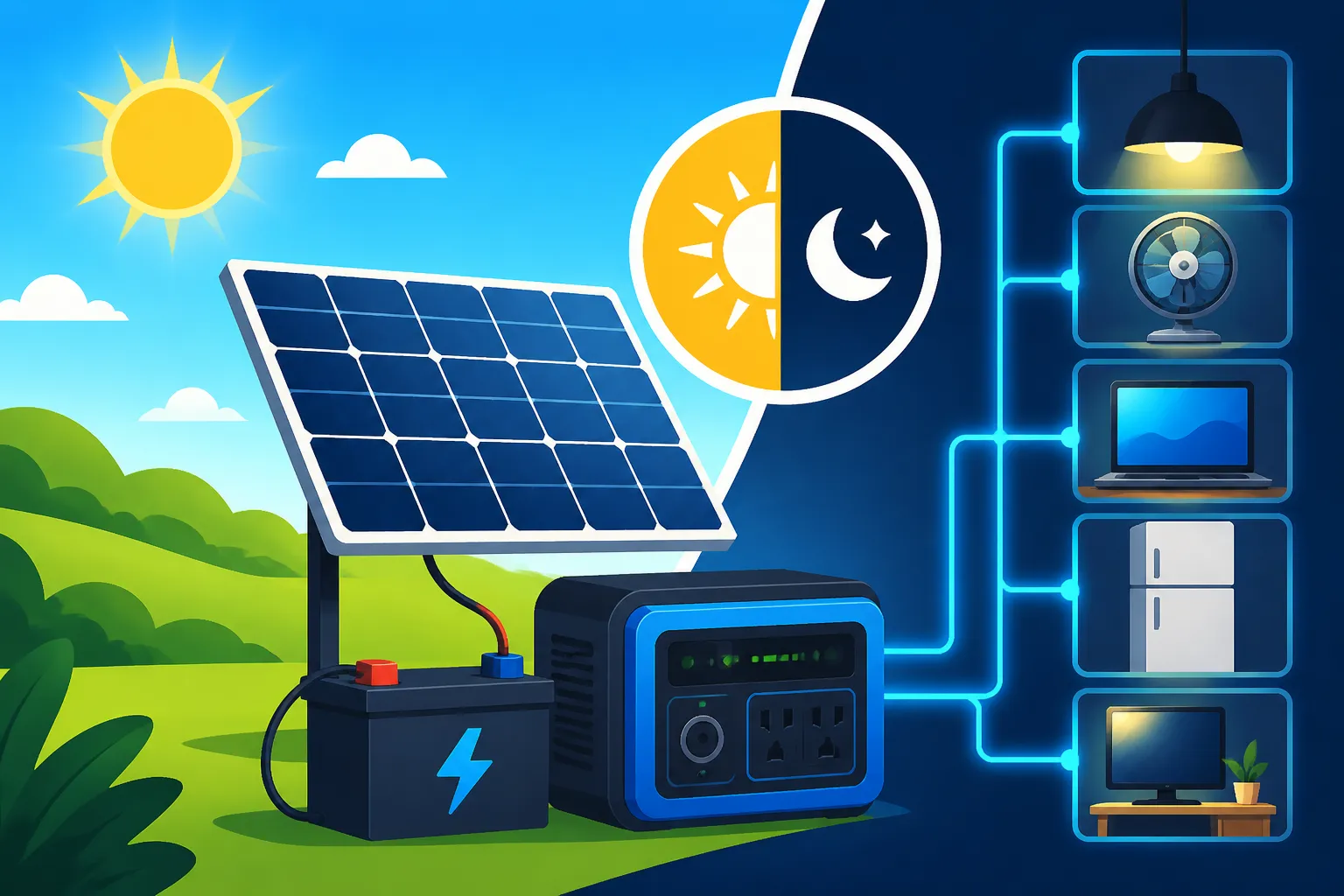
This daily energy calculation is critical because, let's face it, you're not always using power exactly when the sun is shining. That's where your battery bank comes in. The batteries store the energy generated by your panels so you can use it at night, on cloudy days, or whenever you need it.
A 400W system, producing around 1.6 kWh per day, will need a battery bank large enough to store that energy and deliver it as needed. If you consistently use 1.6 kWh a day and only get 1.6 kWh from your panels, you're living hand-to-mouth. For true off-grid independence, you'll want some "days of autonomy" – meaning enough battery storage to last through a few cloudy days without sun. This is a critical consideration for your Cost of an Off-Grid Solar Battery Bank. For a 400W system, a battery bank providing 2-3 kWh of usable capacity (e.g., a 100-200Ah 12V LiFePO4 battery, or a larger lead-acid equivalent) would be a good starting point for modest usage, but remember, the more storage, the higher the cost and the more resilience you'll have.
What Common Appliances Can a 400W Off-Grid System Actually Power?
Alright, now for the exciting part! What can you actually do with that 1.6 kWh (or so) of daily energy? It’s vital to understand that a 400W system is generally considered a smaller setup. It’s perfect for basic needs, supplemental power, or temporary setups, but it's not going to run your entire suburban home. Setting realistic expectations here will save you a lot of headaches later on.
Essential Devices for Short-Term or Basic Needs
For many folks, a 400W system is designed to keep the absolute essentials humming along. Think about things that draw relatively little power or are used intermittently.
- Charging Personal Electronics: This is where a 400W system shines. You can easily charge multiple smartphones, tablets, and even laptops throughout the day and evening. A typical smartphone might use 10-20 Wh per full charge, and a laptop 50-100 Wh. With 1600 Wh available, you've got plenty of juice for these.
- LED Lighting: Running a few LED light bulbs is very efficient. A 5-watt LED bulb can illuminate a room quite well, and you could run several of these for hours without significantly impacting your battery bank. This is often the first thing people set up when they want to run lights and electronics on off-grid solar.
- Small DC Appliances: If you've got a 12V system, you can directly run things like a 12V fan, a small water pump for a sink, or a car fridge/freezer (though a fridge will draw a continuous amount of power, so careful monitoring is needed). These DC appliances are often more efficient than their AC counterparts since you avoid inverter losses.
- Portable Radios and Small Entertainment: Keeping a radio or a small, efficient TV running for a few hours is usually well within a 400W system's capability. Just be mindful of the TV's wattage; modern LED TVs are quite efficient, but older models can be power hogs.
Many portable power stations, like those from Jackery, offer around 400-500W of continuous output and often include a built-in battery that aligns with the daily energy output of a 400W solar array. They're popular because they simplify things for these kinds of essential, short-term uses.
Small Appliances for Limited Daily Use
Now, this is where it gets tricky. Can a 400W system run a microwave or a coffee maker? Yes, but with significant caveats.
- Coffee Makers: A typical drip coffee maker uses 800-1200 watts, but only for a few minutes. Running it once in the morning will be a hefty draw on your inverter and battery, but it's possible. You'd need to ensure your inverter can handle the surge and that your battery can supply the current. This single use could eat up a good chunk of your daily energy budget.
- Microwave Ovens: Similar to coffee makers, microwaves draw a lot of power (700-1500 watts) but are used for very short bursts. Zapping a burrito for 2 minutes might be feasible, but don't plan on cooking a full meal. Again, inverter surge capacity is crucial.
- Toasters: A toaster can pull 800-1200 watts. One or two slices of toast are usually fine, but continuous use will quickly drain your battery.
The key here is "limited daily use." You can't run these high-draw appliances for extended periods or frequently. You'll need to be extremely mindful of your power consumption and generate enough energy to replenish your battery bank daily. This requires careful load analysis, something we delve into in more detail in our guide on How to Calculate Daily Energy Usage.
What a 400W System Cannot Realistically Power
Let's be realistic: a 400W off-grid solar system is generally insufficient for running large, continuous, or high-draw appliances. Trying to force it will lead to frustration, dead batteries, and potentially damaged equipment.
- Air Conditioning or Central Heating: Forget about it. Even small window AC units or mini-splits draw thousands of watts, requiring substantial solar arrays and enormous battery banks. A 400W system simply cannot support this.
- Electric Water Heaters: These are major power consumers. Heating water with electricity is one of the most energy-intensive tasks in a home, and a 400W system won't even make a dent.
- Electric Stoves/Ovens: Like water heaters, electric cooking appliances demand immense power far beyond the scope of a 400W system.
- Heavy-Duty Power Tools: While a small drill or charger for battery tools might work, continuously running a circular saw, table saw, or welder is out of the question for a 400W setup. These tools have high surge requirements and significant continuous draw.
For these larger loads, you'd be looking at systems in the multi-kilowatt range, often starting at 3000W-5000W or even 10,000W for a full home, as discussed in Off-Grid Solar Cost by System Size.
Here's a quick table to help visualize what a 400W system can handle, assuming a fully charged 200Ah 12V LiFePO4 battery (approx. 2560 Wh usable) and a modest daily production of 1600 Wh:
| Appliance | Typical Wattage | Est. Hours Run on a Full Battery (2560 Wh) | Realistic Daily Use w/ 1600 Wh Production | Notes |
|---|---|---|---|---|
| LED Light (5W) | 5W | ~512 hours | ~8-10 hours daily (multiple lights) | Very efficient. Can run multiple lights. |
| Smartphone Charger | 10W | ~256 hours | Charge several phones daily | Minimal impact. |
| Laptop Charger | 60W | ~42 hours | Charge 2-3 laptops daily | Good for daily work/entertainment. |
| Small 12V Fan | 15W | ~170 hours | Run for many hours daily | Efficient cooling for small spaces. |
| Drip Coffee Maker | 1000W | ~2.5 hours | 1-2 uses (a few minutes each) | High momentary draw. Plan carefully. |
| Microwave (Small) | 800W | ~3.2 hours | Few short bursts (1-3 minutes each) | High momentary draw. Inverter must handle surge. |
| Portable Refrigerator | 50W (avg) | ~51 hours | Run for 8-12 hours daily | Can be run continuously, but will consume significant daily energy. Consider highly efficient models. |
| Small TV (LED) | 40W | ~64 hours | 3-4 hours daily | Good for evening entertainment. |
| Hair Dryer | 1500W | ~1.7 hours | Very limited, occasional use | Very high draw. Quick bursts only, and not recommended daily. |
Note: The "Est. Hours Run on a Full Battery" column assumes 100% inverter efficiency and battery depth of discharge, which isn't entirely realistic. Real-world run times will be slightly less due to inefficiencies.
The Components of a 400W Off-Grid Solar System and Their Costs
So, you've decided a 400W system fits your needs. Great! Now, let's talk about what actually goes into one and how much you can expect to shell out. Building an off-grid system, even a smaller one, involves several key components, and understanding each one is crucial for budgeting and successful implementation. This breakdown will give you a better idea of what drives off-grid solar costs.
Solar Panels (400W Worth)
This is the most visible part of your system. To get 400 watts, you might use:
- Two 200W panels
- Four 100W panels
- One large 400W panel (less common but available)
Cost: For good quality monocrystalline solar panels, expect to pay anywhere from $0.80 to $1.50 per watt. So, for 400 watts, you're looking at roughly $320 to $600 for the panels themselves. Flexible panels, often used on RVs or curved surfaces, can be a bit more expensive per watt. Brands like Renogy and Rich Solar offer reliable, cost-effective options often found on Amazon.
Factors Affecting Cost:
- Panel Type: Monocrystalline panels are generally more efficient and slightly pricier than polycrystalline.
- Brand Reputation: Well-known brands might cost a bit more but often come with better warranties and performance.
- Physical Size: Smaller, more compact panels designed for portability can sometimes be more expensive per watt.
- Mounting Hardware: Don't forget the cost of Z-brackets for flat surfaces, tilt mounts for ground installations, or roof racking. This can add another $50-$200 depending on your setup.
Charge Controller
This little guardian sits between your solar panels and your battery bank. Its job is to regulate the voltage and current coming from the panels to ensure your batteries charge safely and efficiently, preventing overcharging.
- PWM (Pulse Width Modulation): These are simpler, more affordable, and generally less efficient. They're okay for smaller systems where cost is a primary concern. For a 400W 12V system, you'd typically need a 30-amp PWM controller.
- MPPT (Maximum Power Point Tracking): These are more advanced and significantly more efficient, especially in varying light conditions or when the panel voltage is much higher than the battery voltage. They can extract up to 20-30% more power from your panels compared to PWM controllers. For a 400W system, a 20-30 amp MPPT controller is usually suitable.
Cost:
- PWM Charge Controller: Expect to pay $30 – $80.
- MPPT Charge Controller: These range from $100 – $300, with higher-end units offering more features and better reliability. Given the relatively small size of a 400W system, a mid-range MPPT controller provides excellent value and efficiency. Victron Energy makes excellent MPPT controllers, though they are on the higher end of the price spectrum.
Battery Bank
This is often the most expensive single component in an off-grid solar system, and it's where much of your stored energy resilience comes from. For a 400W system, a common setup would be a 12V battery bank.
- Lead-Acid (AGM/Gel): These are cheaper upfront but have a shorter lifespan, require specific charging profiles, and can only be discharged to about 50% of their capacity to prolong their life. For a 400W system, you might consider a 200Ah 12V AGM battery, which gives you about 100Ah (1200 Wh) of usable power. You might need two of these for practical daily use and a bit of backup.
- LiFePO4 (Lithium Iron Phosphate): These are more expensive initially but offer a much longer lifespan (thousands of cycles), can be discharged deeper (80-100%), and are lighter. A single 100Ah 12V LiFePO4 battery offers around 1200 Wh of usable power, which is equivalent to a 200Ah AGM battery in terms of usable energy. Many off-gridders find LiFePO4 vs Lead-Acid Battery Cost comparison shows lithium is better long-term.
Cost:
- Lead-Acid (AGM): A single 100Ah 12V AGM battery can range from $150 – $250. A 200Ah battery would be around $300 – $500.
- LiFePO4: A single 100Ah 12V LiFePO4 battery (often providing more usable capacity than a similarly rated lead-acid) typically costs $300 – $600, with some premium brands like Battle Born or EG4 going higher. For a 400W system, a single 100Ah LiFePO4 is a great starting point, possibly expanding to 200Ah if your budget allows for greater autonomy.
Inverter
The inverter converts the DC (direct current) power from your batteries into AC (alternating current) power, which is what most household appliances use.
- Pure Sine Wave Inverter: This is what you want for sensitive electronics like laptops, medical equipment, and anything with a motor (refrigerators, microwaves). It produces clean power, just like your utility grid.
- Modified Sine Wave Inverter: Cheaper, but it produces a "choppy" AC waveform that can damage sensitive electronics and cause motors to run hot or inefficiently. Generally not recommended for most modern off-grid setups.
For a 400W system, your inverter size should be based on the maximum simultaneous wattage you plan to draw, plus a safety margin for surge loads (like a microwave or coffee maker turning on). A 1000W to 1500W pure sine wave inverter is usually a good fit for a 400W solar array, giving you room for those occasional higher draws.
Cost:
- Pure Sine Wave Inverter (1000W – 1500W): Expect to pay $150 – $400. Higher quality or more feature-rich inverters will be at the upper end. Brands like Renogy or Giandel offer budget-friendly options, while Victron or Outback offer premium, robust inverters.
Wiring, Fuses, and Miscellaneous Components
These are the "hidden costs" that often catch new off-gridders by surprise, but they are absolutely essential for safety and functionality.
- Cables and Connectors: You'll need appropriate gauge wire for connecting panels to the charge controller, charge controller to batteries, and batteries to the inverter. MC4 connectors are standard for solar panels.
- Fuses and Breakers: Crucial for protecting your components and preventing electrical fires. You'll need DC rated fuses/breakers for the solar array and battery bank, and potentially AC breakers for the inverter output.
- Battery Monitor: Highly recommended, especially for lead-acid batteries, to accurately track your battery's state of charge.
- Mounting Hardware: Mentioned earlier, but essential for securing your panels.
- Conduit/Cable Management: To protect your wiring from the elements and physical damage.
Cost: Budget an additional $100 – $300 for these essential items. While they seem small individually, they add up quickly. This contributes to the overall Off-Grid Solar Installation Cost, even if you're doing it yourself.
Real-World Cost Expectations for a 400W Off-Grid Solar Setup
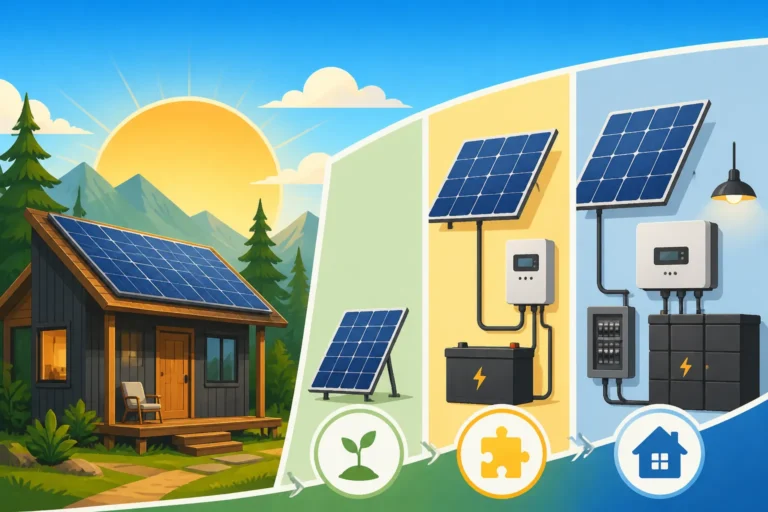
So, what's the grand total? As you can see, the price can vary significantly depending on your choices, but let's break down some realistic scenarios. It's often helpful to think of it as building blocks – you can start simple and expand later, which is a great way to manage How to Budget for an Off-Grid Solar System.
DIY vs. Pre-Built Kits: Cost and Convenience
This is a big decision point for many considering a smaller system like 400W.
-
DIY (Do-It-Yourself): Building your system from individual components often gives you the most flexibility and can be the most cost-effective if you know what you're doing and are willing to shop around. You can hand-pick each component to match your exact needs and budget. However, it requires a good understanding of electrical wiring, safety protocols, and compatibility. You might spend more time researching, but you could save a good chunk of change. This path is explored in more detail in Cost of a DIY Off-Grid Solar Build.
- Estimated DIY Cost for 400W System:
- Solar Panels (400W): $320 – $600
- Charge Controller (MPPT): $100 – $300
- Battery (100Ah-200Ah LiFePO4 or equivalent AGM): $300 – $600
- Inverter (1000W-1500W Pure Sine): $150 – $400
- Wiring, Fuses, Mounts, etc.: $100 – $300
- Total DIY Estimate: $970 – $2,200
- Keep in mind this doesn't include the value of your time or any specialized tools you might need to buy.
- Estimated DIY Cost for 400W System:
-
Pre-Built Kits / Portable Power Stations: These are designed for convenience, especially for beginners or those needing a truly portable solution. Brands like Jackery, EcoFlow, and Goal Zero offer excellent portable power stations that integrate the battery, inverter, and charge controller into a single unit. You simply connect solar panels (often sold separately or as a kit with the power station). These are fantastic for RVs, vans, camping, or emergency backup. They typically come with everything you need except sometimes the mounting for larger panels.
- Estimated Pre-Built Kit Cost for 400W-equivalent System:
- A portable power station (e.g., a Jackery Explorer 1000 or similar with 1000Wh+ capacity and ~1000W AC output) might cost $800 – $1,500.
- Adding 2x100W or 1x200W portable solar panels might add another $300 – $700.
- Total Pre-Built Estimate: $1,100 – $2,200
- These systems are incredibly user-friendly and often plug-and-play, making them a popular choice for Best Off-Grid Solar Kits for Beginners. You can often find great deals on these kits on platforms like Amazon.
- Estimated Pre-Built Kit Cost for 400W-equivalent System:
As you can see, the total cost for a 400W system can range from just under $1,000 to well over $2,000, largely depending on your battery choice, inverter quality, and whether you DIY or opt for a convenient kit.
Factors Influencing Your Total Cost and Phased Expansion
Beyond the core components, several other factors can push your total cost up or down:
- Component Quality and Brand: As with anything, premium brands generally cost more but offer better performance, reliability, and warranties. Deciding between a budget-friendly option and a high-end component is often a trade-off between initial cost and long-term durability.
- Shipping Costs: Especially for heavy items like batteries and panels, shipping can add a noticeable amount to your total.
- Installation Difficulty: If you're tackling a complex roof mount or need to run long cable lengths, your material costs for wiring and conduit will increase. If you hire someone, professional Off-Grid Solar Installation Cost will be a major factor.
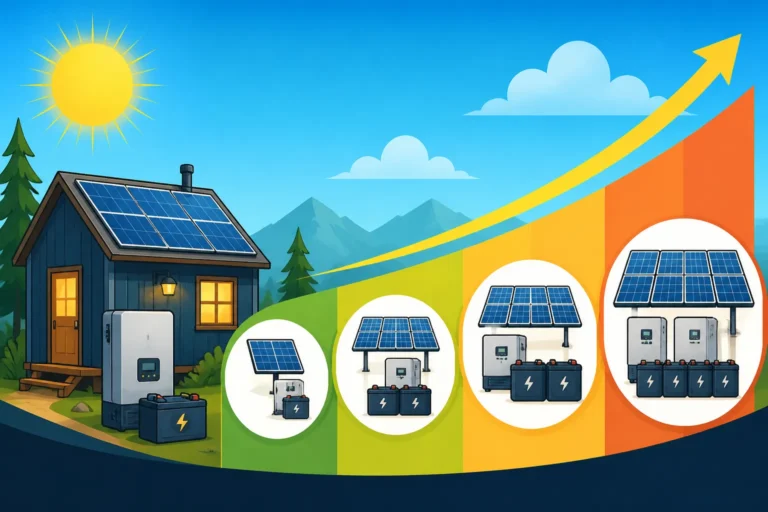
- Future Expansion: Many people start with a smaller system like 400W and plan to expand later. Choosing components (like an MPPT charge controller or an inverter) that can handle future additions can save money in the long run. This concept of designing for growth is crucial, and is explored further in Cost of Expanding an Off-Grid System. You might, for example, choose a charge controller capable of handling 800W of panels even if you only start with 400W.
For many, a 400W system is an excellent entry point into off-grid solar. It allows you to learn the ropes, understand your actual power consumption, and build confidence before investing in a larger, more complex system. By carefully considering your needs, choosing reliable components, and budgeting wisely, you can achieve a surprising amount of energy independence with this modest setup.
Disclaimer
The information provided in this article is for general informational purposes only and does not constitute professional advice. Off-grid solar system design and installation can be complex and involve electrical hazards. Always consult with qualified professionals and adhere to all local electrical codes and regulations. System costs and performance estimates are subject to market fluctuations, individual usage patterns, and geographic conditions.