How to Pick the Right Off-Grid Kit Size
Choosing the right off-grid solar kit size can feel incredibly overwhelming, a bit like trying to navigate a new city without a map. You're looking at all these watts, amp-hours, and inverter ratings, and it's easy to get lost, worrying about whether you're buying too much or, worse, too little. But don't you fret! This comprehensive guide is here to demystify the process, helping you pinpoint exactly what kind of off-grid solar setup will truly meet your unique energy needs, ensuring you invest wisely and power your independent lifestyle with confidence.
Understanding Your Energy Needs: The First Crucial Step
Before you can even begin to dream about solar panels sparkling on your roof or a sleek battery bank humming in your utility shed, you absolutely must understand your own energy consumption. This isn't just a suggestion; it's the bedrock of a successful off-grid system. Without this critical first step, you're essentially shooting in the dark, and trust me, that leads to frustration, wasted money, and often, an underperforming system.
Conducting a Detailed Load Analysis
A load analysis might sound intimidating, but it’s really just a fancy way of saying "make a list of everything you want to power and figure out how much electricity it uses." Think of it as creating a grocery list for your electrical appliances. You wouldn't go to the store without knowing what you need for dinner, right? The same principle applies here.
Start by walking through your cabin, RV, tiny home, or whatever space you're powering. List every single appliance, gadget, and light fixture. For each item, you'll need two crucial pieces of information: its wattage (how much power it consumes when running) and how many hours per day you plan to use it. You can usually find the wattage listed on the appliance's label, in the user manual, or by doing a quick online search for the model number. Don't forget those seemingly small items like phone chargers, electric toothbrushes, or even the coffee maker. Every little bit adds up!
It's also essential to distinguish between continuous loads and surge loads. Continuous loads are things that run for extended periods, like your refrigerator or an internet router. Surge loads are those appliances that require a burst of extra power to start up, even if they draw less while running. Think of your well pump, a microwave, or power tools; they might pull 3-5 times their running wattage for a few seconds. Failing to account for these surges is a common pitfall that can lead to your inverter tripping or your system struggling. A good rule of thumb is to note both the running watts and the starting (surge) watts for any motor-driven appliances.
Calculating Daily Watt-Hours Wh and Amp-Hours Ah
Once you have your detailed list, it's time to crunch some numbers. Our goal here is to arrive at a total daily energy consumption figure, usually expressed in watt-hours (Wh) or amp-hours (Ah) at your chosen system voltage. This is the magic number that will tell us how big your solar array and battery bank need to be.
To calculate the watt-hours for each appliance, simply multiply its running wattage by the number of hours you plan to use it daily. For example, a 100-watt TV used for 4 hours a day consumes 400 Wh (100W * 4h). Do this for every item on your list, then add them all together to get your total daily watt-hours. This figure is your home's total energy demand over a 24-hour period. You can learn more about these measurements in our guide on Watts vs Watt-Hours vs Amp-Hours Explained.
If you prefer working with amp-hours, which is often useful for battery sizing, you'll need to know your system's voltage (e.g., 12V, 24V, 48V). The formula is: Amp-Hours = Watt-Hours / Volts. So, if your total daily consumption is 5000 Wh and you're planning a 48V system, you'd need roughly 104 Ah (5000 Wh / 48V). It's crucial to be consistent with your voltage throughout your calculations. This systematic approach ensures you have a clear, accurate picture of your true energy appetite, setting the stage for a perfectly sized system.
Sizing Your Core Off-Grid Components
With your energy consumption firmly in hand, it’s time to translate those numbers into tangible solar equipment. This is where we start talking about panels, batteries, and inverters – the heart and soul of any off-grid setup. Each component needs to be carefully matched to your calculated needs to ensure efficiency, reliability, and longevity.
Determining Solar Panel Array Size
Your solar panel array is what generates all that lovely electricity from the sun. To figure out how many solar panels you need, you’ll take your total daily watt-hour consumption and divide it by the average number of "peak sun hours" in your location. Peak sun hours refer to the number of hours per day when the sun's intensity is roughly equivalent to 1,000 watts per square meter. This isn't just the time the sun is in the sky, but rather when it's strong enough to generate substantial power. You can easily find peak sun hour data for your specific region online.
For example, if you need 5000 Wh per day and your area gets 5 peak sun hours, you'd need a theoretical solar array capable of producing 1000 watts (5000 Wh / 5h). However, you must factor in inefficiencies and real-world conditions. Panels don't operate at 100% efficiency all the time due to temperature, dust, and cable losses. It's smart to add a buffer, often 15-25%, to this number. Also, consider seasonal variations; you'll likely get fewer peak sun hours in winter. Many experienced off-gridders choose to oversize their solar array to ensure they have enough power even during shorter, cloudier winter days. This provides peace of mind and reduces reliance on backup generators. For a deeper dive, check out our guide on How Many Solar Panels for Off-Grid Living.
Sizing Your Battery Bank for Autonomy
The battery bank is your energy reservoir, storing power generated by your panels for use when the sun isn't shining – at night, on cloudy days, or during extended periods of bad weather. When considering how many batteries for an off-grid system, the key concept here is "days of autonomy." This refers to how many days your battery bank can power your home without any input from the solar panels. Most off-grid homes aim for 3-5 days of autonomy, especially if they're in areas prone to long stretches of cloudy weather.
To size your battery bank, take your total daily watt-hour consumption and multiply it by your desired days of autonomy. Then, you'll need to account for the usable depth of discharge (DoD) of your chosen battery type. Lead-acid batteries, for instance, should ideally only be discharged to 50% to maximize their lifespan, meaning you need twice the capacity you actually plan to use. Lithium iron phosphate (LiFePO4) batteries, on the other hand, can be discharged to 80-100% without significant harm, making them more efficient in terms of usable capacity. This is why you often see mentions of brands like Jackery offering portable power stations with LiFePO4 batteries, providing significant usable power in a compact form factor.
Finally, consider your system voltage. Larger off-grid homes often opt for 24V or 48V systems, as higher voltages reduce current, allowing for thinner wiring and less power loss over distance. Smaller systems, like those for RVs or sheds, might stick with 12V. Understanding How Many Batteries for an Off-Grid System is crucial for reliable power.
Choosing the Right Inverter Size
The inverter is the unsung hero of your off-grid system, converting the DC (direct current) electricity from your batteries into AC (alternating current) power that your standard household appliances use. Getting the inverter size wrong can lead to constant tripping, damaged appliances, or simply not being able to run everything you need. When considering How to Size an Off-Grid Inverter, there are two main wattage ratings to look at: continuous wattage and surge wattage.
The continuous wattage rating is the amount of power the inverter can supply constantly without overheating. This should be equal to or greater than the sum of all the appliances you anticipate running simultaneously on a typical day. For example, if you have a refrigerator (100W), a few lights (50W), and a laptop (60W) all running at the same time, you'd need at least a 210W continuous inverter, but you'd want a significant buffer.
The surge wattage rating, as mentioned before, is the brief burst of power an inverter can provide to start up motor-driven appliances. If your well pump needs 2000 watts for a few seconds to start but only runs at 500 watts, your inverter must be able to handle that 2000-watt surge. Always ensure your inverter's surge capacity is high enough to accommodate the highest surge load from any single appliance you might use. A common mistake is to only size for continuous loads, leaving you unable to start those crucial pumps or power tools.
Practical Considerations for Kit Selection
Once you've got a handle on the technical calculations, it's time to layer in some real-world considerations. This is where your personal lifestyle, financial situation, and location really come into play. A solar kit isn't a one-size-fits-all product; it needs to fit you and your specific vision for off-grid living.
Budget and Scalability
Let's be realistic: budget is often the elephant in the room when planning an off-grid solar system. While the dream of unlimited, free power is appealing, the upfront investment can be significant. This is why understanding How to Budget for an Off-Grid Solar System is so important. Your budget will directly influence the initial size and quality of your components. It might mean starting with a smaller system and phasing in expansion later, which is a perfectly valid strategy.
Many reputable brands offer modular systems designed to be expandable. This means you can start with a basic setup that meets your essential needs, and then add more solar panels, batteries, or even a second inverter down the line as your budget allows or your energy demands grow. When looking at kits, ask about their expandability. Can you easily add more panels? Is the charge controller oversized to accommodate future additions? Is the battery management system (BMS) in your lithium batteries able to handle parallel connections? Planning for future expansion from the start can save you a lot of headaches and money compared to having to completely rebuild your system later.
Usage Patterns and Environment
Your lifestyle and the environment you live in are huge factors in kit selection. Are you planning for full-time off-grid living in a family home, where constant power is a necessity? Or is this for a weekend cabin that only sees intermittent use, or perhaps an RV where portability and lighter demands are key? A large homestead in rural Montana with a well pump and electric heat will have vastly different requirements than a small Off-Grid Solar Cost for a Cabin used only in the summer months.
Consider your geographical location's climate. Do you live in an area with abundant sunshine year-round, or do you experience long, dark winters or extended periods of cloudy, rainy weather? Systems in the Pacific Northwest, for example, might need a larger solar array and battery bank to compensate for less consistent sun compared to a desert climate. Extreme temperatures, both hot and cold, can also affect battery performance and panel output, requiring specific equipment considerations. For smaller, more flexible needs, brands like Jackery offer fantastic portable power stations that are great for weekend camping, emergency backup, or providing power to a remote workshop without the full commitment of a permanent installation. They're designed for easy use in various environments and are highly popular for their reliability.
DIY vs. Pre-Assembled Kits
The journey to off-grid independence often presents a fork in the road: do you painstakingly select each component and build your system from the ground up, or do you opt for a convenient, pre-assembled kit? Both approaches have their merits, and the "right" choice depends heavily on your technical comfort level, time commitment, and desired level of customization.
A DIY build, as explored in articles like DIY vs Professional Off-Grid Solar Cost, offers unparalleled customization and often significant cost savings on labor. You get to choose every single component – from specific brands of solar panels to the exact battery chemistry and charge controller model. This can be incredibly rewarding for those with electrical knowledge and a desire to understand every nut and bolt of their system. However, it also requires extensive research, careful planning, and a good understanding of electrical safety and wiring. Mistakes in a DIY setup can be costly, both in terms of money and safety.
Pre-assembled kits, on the other hand, streamline the process immensely. These kits, often from manufacturers like Renogy or EcoFlow, are designed with compatible components, making installation simpler and reducing the guesswork. They typically include panels, an inverter, a charge controller, and sometimes even batteries and mounting hardware. While they might be less customizable and sometimes slightly more expensive upfront than sourcing individual components, they offer peace of mind, especially for beginners. For compact, grab-and-go power, a Jackery portable solar generator with integrated battery and inverter is an excellent example of a pre-assembled, user-friendly "kit" for smaller scale needs, requiring minimal setup. The trade-off is often less raw power and expandability compared to a dedicated, custom-built system.
Common Mistakes and How to Avoid Them
Even with the best intentions and careful planning, it's easy to stumble into common pitfalls when sizing an off-grid solar kit. Learning from others' mistakes can save you significant time, money, and frustration down the road. Let's talk about some of the most frequent missteps and how you can steer clear of them.
Underestimating Energy Consumption
This is, hands down, one of the most common and frustrating mistakes newcomers make. It's so easy to forget those "little" things that add up. You remember the fridge and the lights, but do you account for the occasional vacuum cleaner use, the water pump running longer than expected, the hairdryer, or the toaster? Many people focus only on the big-ticket items and neglect the cumulative effect of smaller appliances or "phantom loads" – devices that draw power even when turned off or in standby mode (like phone chargers, TVs, and microwaves).
The solution? Be brutally honest and even slightly generous with your load analysis. Add a buffer, maybe 10-20%, to your total daily watt-hour consumption for unexpected usage or future additions. It's far better to slightly oversize your system than to constantly run out of power and have to live in the dark. Furthermore, consider that some appliances, like a refrigerator, will work harder and use more energy in hotter climates. Don't just take the label's average; think about real-world scenarios.
Ignoring Seasonal Variations
Another frequent oversight is designing a system solely based on peak summer sun hours. While it's lovely to have abundant power in July, the reality of off-grid living often means contending with shorter daylight hours, lower sun angles, and more frequent cloudy days, especially in winter. This can dramatically reduce your solar panel output. Our guide on How Winter Affects Off-Grid Sizing delves deeper into this challenge.
To avoid this, always size your solar array and battery bank for the worst-case scenario – typically the shortest, darkest days of winter or the longest stretches of cloudy weather in your region. This might mean installing more panels than you think you need during the summer, but it ensures reliable power year-round. You can also incorporate adjustable tilt mounts for your panels to optimize their angle for winter sun, or plan for a backup generator to supplement power during those leanest months. A good off-grid system provides consistent power, not just fair-weather electricity.
Overlooking System Voltage and Compatibility
This might seem like a technical detail, but it's a critical one. All the components in your off-grid system – solar panels, charge controller, battery bank, and inverter – need to be compatible in terms of voltage. Attempting to mix and match incompatible voltages is not only inefficient but can also be dangerous and damage your equipment.
Typically, smaller systems (like those for vans, small sheds, or basic RV setups) might use a 12V system. As your power needs grow, 24V or 48V systems become more efficient. Higher voltages mean lower current for the same amount of power, which allows for thinner (and less expensive) wiring and reduces power loss over longer cable runs. It also means your inverter and charge controller can operate more efficiently. When assembling your kit, ensure your charge controller can handle the voltage output from your solar array and charge your battery bank's voltage. Similarly, your inverter must be rated for your battery bank's voltage. Always double-check specifications and wiring diagrams. If you're buying a pre-packaged kit from a brand like Jackery or Renogy, the components are usually designed to be compatible, which takes some of this guesswork out, but it's still good to understand why.
Off-Grid Kit Sizing Examples
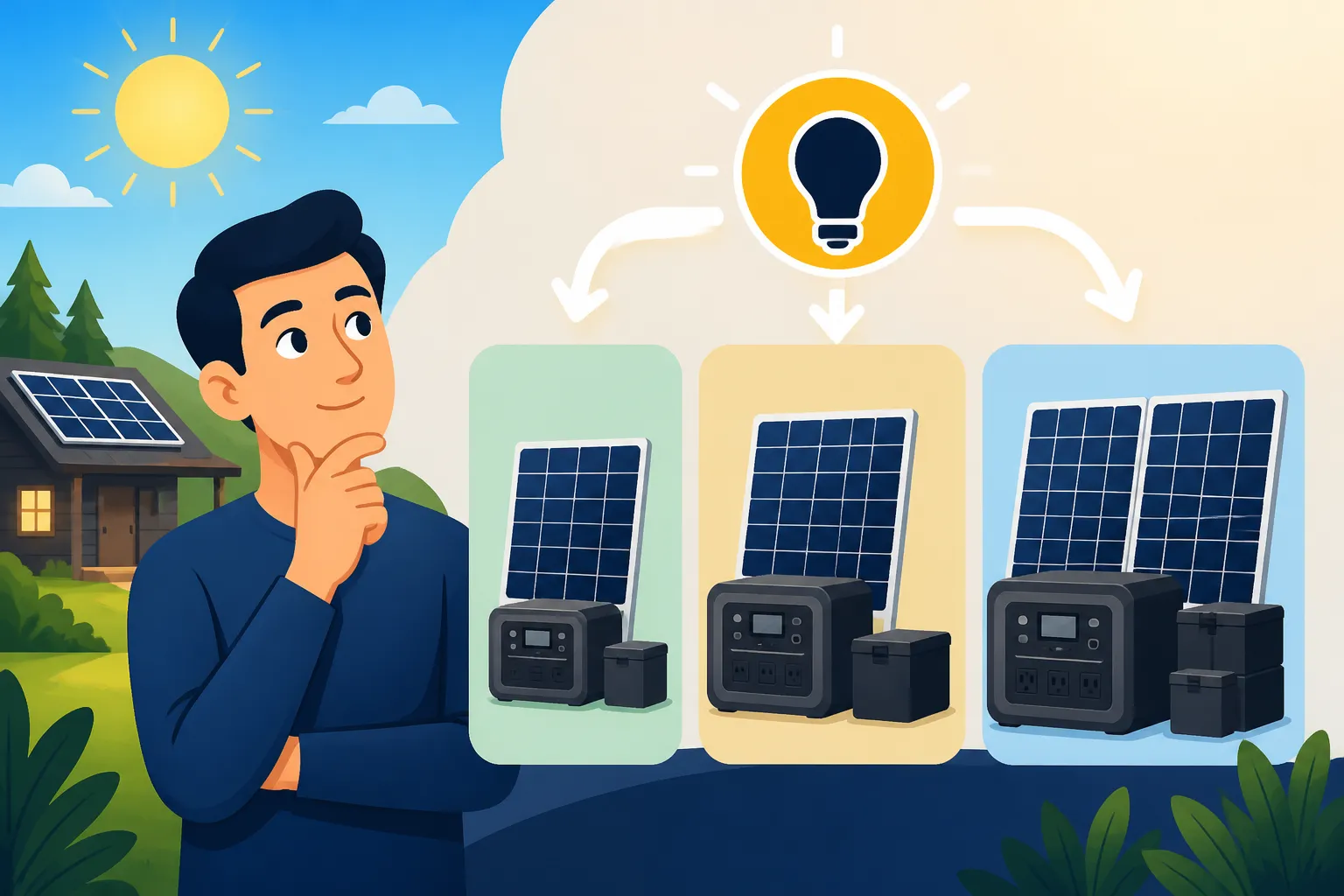
To help visualize what different system sizes look like, here's a table showing typical off-grid kit components for various common scenarios. Keep in mind these are approximations, and your specific needs will vary!
| Scenario | Daily Energy Need (Wh) | Solar Array (Watts) | Battery Bank (Usable Ah @ 12V) | Inverter (Continuous Watts) | Typical Applications |
|---|---|---|---|---|---|
| Small Portable / RV | 500 – 1500 | 200 – 400 | 50 – 100 | 500 – 1000 | Charging devices, lights, small fridge, fan. |
| Weekend Cabin / Tiny Home | 1500 – 3000 | 400 – 800 | 100 – 200 | 1000 – 2000 | Lights, mini-fridge, laptop, TV, water pump (small). |
| Full-Time RV / Medium Cabin | 3000 – 6000 | 800 – 1500 | 200 – 400 | 2000 – 3000 | All of above + microwave, larger fridge, limited AC/heating. |
| Small Off-Grid Home | 6000 – 10000 | 1500 – 3000 | 400 – 800 | 3000 – 5000 | Standard appliances, well pump, washing machine, modest AC. |
| Large Off-Grid Homestead | 10000+ | 3000 – 6000+ | 800 – 1500+ | 5000 – 8000+ | Full modern home with multiple heavy loads, workshops. |
Disclaimer
The information provided in this guide is intended for general informational purposes only. While we strive to offer accurate and up-to-date content, off-grid solar system design and installation can be complex. We strongly recommend consulting with a qualified solar professional or licensed electrician to ensure your system is safely and appropriately sized for your specific needs and local regulations. Always prioritize safety and adherence to electrical codes.