Anker SOLIX F3800 for Off-Grid: Specs and Review
Trying to piece together a reliable off-grid power solution can feel like a daunting puzzle, especially when you're looking for something that can handle more than just a few small electronics. Many folks start with smaller portable power stations, only to quickly realize they need significantly more juice and versatility for their cabins, RVs, or even as home backup. This guide is here to take a deep dive into the Anker SOLIX F3800, exploring its capabilities, how it stacks up for genuine off-grid living, and whether it could be the robust power hub you've been searching for.
Understanding the Anker SOLIX F3800
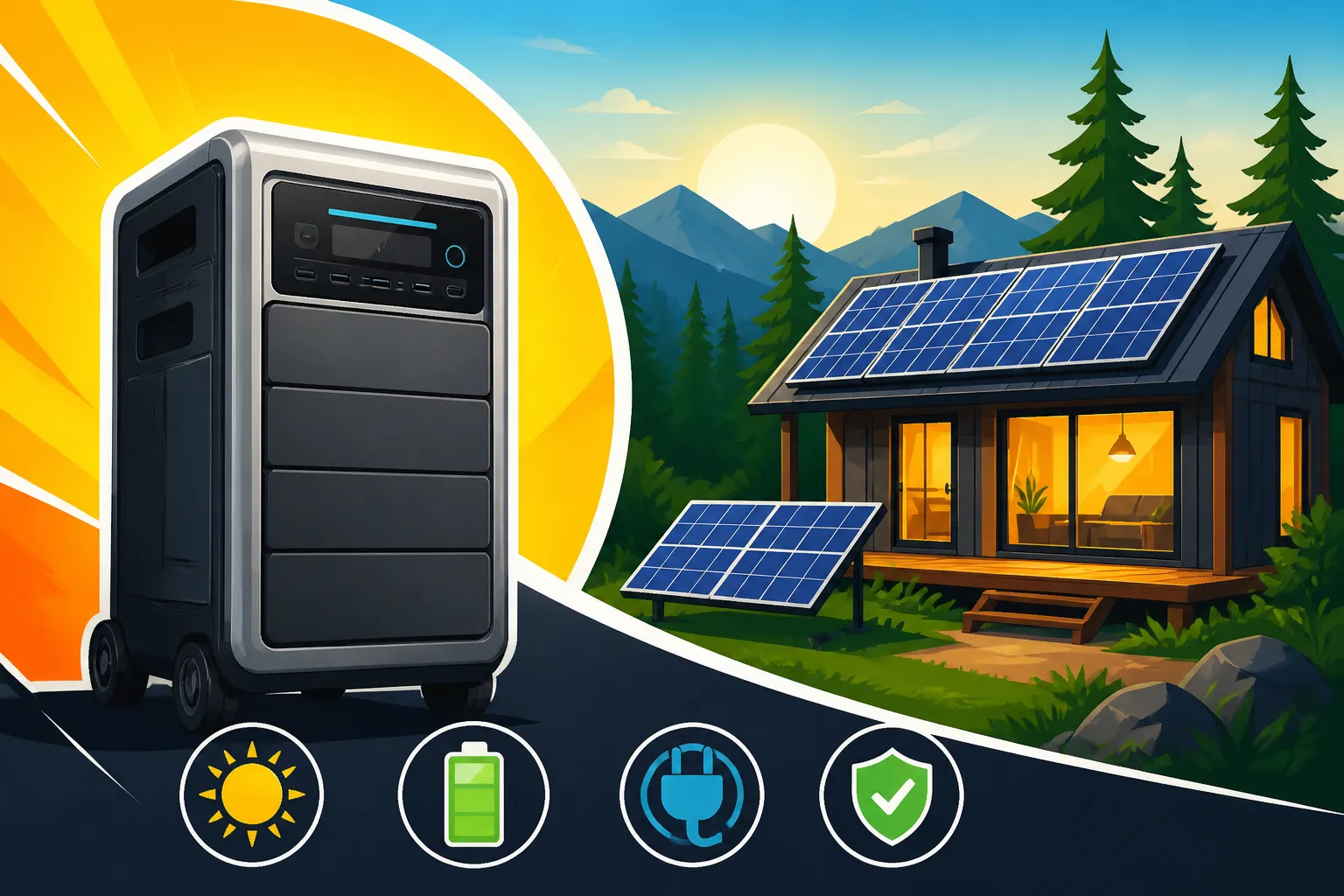
When you're looking into off-grid power solutions, the term "solar generator" often conjures images of smaller, suitcase-sized units. However, devices like the Anker SOLIX F3800 are pushing the boundaries of what these portable power stations can do, blurring the lines between a simple backup battery and a serious contender for a semi-permanent off-grid setup. It's a significant piece of equipment designed to bridge the gap for those who need substantial power without the full complexity of a custom-built system.
Core Specifications and Features
Let's talk numbers, because that's where the rubber meets the road with any power solution. The Anker SOLIX F3800 boasts an impressive 3.84 kWh (3840 Wh) LiFePO4 battery pack. This isn't your average small capacity; this is enough to run significant appliances for extended periods. When you compare this to smaller units, you start to see why it's gaining attention for more demanding off-grid scenarios. The LiFePO4 chemistry is a huge plus, offering thousands of charge cycles and excellent longevity, which is crucial for a system you'll rely on day in and day out.
But what good is a big battery if you can't use that power effectively? The F3800 comes equipped with a formidable 6000W (6kW) pure sine wave inverter, with a surge capacity that can briefly handle up to 9000W (9kW). This is a game-changer. That kind of inverter power means you're not just running lights and charging phones; you can fire up power tools, run a full-sized refrigerator, operate a microwave, and even kick-start some smaller air conditioning units or well pumps without breaking a sweat. It really puts it in a different league than many portable power stations that top out at 2000W or 3000W. The unit also features multiple AC outlets (including a 30A RV-style outlet), USB-A and USB-C ports, and a 12V car outlet, giving you plenty of options for plugging in all your gadgets and appliances.
Who It's Designed For
So, who is this powerhouse truly for? If you're currently wrestling with a smaller portable power station that just isn't cutting it for your off-grid cabin, or if your RV's existing electrical system feels constantly strained, the F3800 steps in as a serious upgrade. It’s perfect for the "glamper" who wants to bring all the comforts of home to a remote campsite, the weekend warrior with a workshop far from grid power, or those looking to add significant, easy-to-deploy backup power to their home during outages.
It’s definitely not for someone just looking to charge their phone and a tablet on a casual camping trip; it's overkill for that. Instead, think about folks living in a tiny home or a full-time RV setup who need reliable power for a refrigerator, an instant pot, a CPAP machine, and even a small heater or air conditioner. The capacity and inverter output mean fewer compromises in your off-grid lifestyle. For many, it's a stepping stone or an alternative to designing a full-blown custom solar system. If you're curious about different configurations, check out our guide on Off-Grid Solar System Design Basics.
Real-World Performance and Off-Grid Suitability
Moving beyond the spec sheet, how does the Anker SOLIX F3800 actually perform when you're relying on it to power your life away from the grid? This is where the practicalities of its design and capabilities shine, or sometimes, present challenges. Understanding its real-world application is key to knowing if it's the right fit for your unique situation.
Powering Your Off-Grid Lifestyle
Imagine you're deep in the woods at your remote cabin, far from any power lines. You want to run your energy-efficient mini-fridge, boil some water for coffee with an electric kettle, maybe watch a movie on your TV, and keep your laptop charged for work. A 3.84 kWh battery like the F3800's can handle these tasks with remarkable ease. For example, a modern energy-efficient refrigerator might draw about 50-100 watts when running, but it cycles on and off. Over a day, it might consume 1-2 kWh. This means the F3800 could keep a fridge running for at least a full day, possibly two, depending on other loads and ambient temperature.
What about those high-draw appliances that often stump smaller units? The 6000W inverter means you can run a 1500W microwave for dinner, then switch to a 1000W hair dryer, and still have plenty of headroom. You could even power a small 10,000 BTU portable air conditioner, which might draw around 1000-1200W, for a few hours to cool down your space. This kind of flexibility is a dream for many off-grid dwellers who feel limited by lower-powered systems. If you're wondering how much solar you need for an air conditioner, our article on How Much Solar to Run An Air Conditioner provides great insights. The key is understanding your total daily energy usage and sizing your power solution accordingly, which is often done by calculating your individual appliance loads to figure out How Many Watts of Solar You Need.
Charging Capabilities and Speed
One of the often-overlooked aspects of any off-grid power solution is how quickly and efficiently it can recharge. A massive battery is fantastic, but if it takes days to fill up, you'll constantly be playing catch-up, especially during cloudy spells. The Anker SOLIX F3800 addresses this with impressive charging flexibility. It supports up to 2400W of solar input via multiple MPPT (Maximum Power Point Tracking) controllers, which is a substantial amount. This means if you have enough solar panels – say, six 400W panels – you could potentially recharge the unit in about 2-3 hours of peak sunshine, given ideal conditions.
Beyond solar, it boasts ultra-fast AC charging, capable of recharging from 0-100% in roughly 2.5 hours when plugged into a standard 120V outlet. But here's where it gets really interesting for some users: it's also compatible with EV (electric vehicle) charging stations, allowing for up to 6000W of input. If you have access to a level 2 EV charger, you could top up the F3800 even faster, in under an hour. While EV charging might not be a primary off-grid method, it offers an incredible flexibility for quick recharges when you pass through civilization or have grid access temporarily. This versatility in charging is crucial for maintaining consistent power availability, especially when the sun isn't cooperating. Thinking about integrating different charging methods? Our guide on Off-Grid Solar System Components Explained could be helpful.
Portability and Durability
While "portable power station" is in its unofficial title, the Anker SOLIX F3800 is a hefty piece of equipment. At around 132 pounds, it's not something you'll be casually tossing into the back of your car every day. However, Anker has thoughtfully designed it with an integrated retractable handle and sturdy wheels, much like a large suitcase, making it manageable for one person to move across flat surfaces or load into a vehicle. This design feature is incredibly practical for moving it from your garage to your cabin, or deploying it for emergency backup in a specific room of your house.
In terms of durability, the unit feels robust and well-constructed, ready for the bumps and jostles of off-grid life. The casing is made from high-quality materials, and the internal components are designed for a long lifespan, especially with the LiFePO4 battery. While it's not necessarily designed to be left exposed to the elements, its construction gives confidence that it can handle the typical demands of being moved around and set up in various environments, from an RV compartment to a cabin utility room. If you're planning a more permanent install, you might be considering a solution that relies on separate components like those from Renogy, but for a robust, all-in-one unit, the F3800 stands out.
Pros, Cons, and Considerations for Off-Grid Use
Every piece of off-grid equipment has its strengths and weaknesses, and the Anker SOLIX F3800 is no exception. While it offers a compelling package, it's vital to weigh its benefits against its limitations to determine if it truly aligns with your specific off-grid needs and expectations. After all, making an informed decision can save you a lot of headaches (and money!) down the line.
The Upsides of the SOLIX F3800
Let's start with what makes this unit shine. First and foremost, its sheer power and capacity are major advantages. The 3.84 kWh LiFePO4 battery and 6000W inverter mean you get serious juice that can run almost any standard household appliance. This level of power integration in a relatively portable package is hard to beat. You're not just getting a battery; you're getting a fully integrated power system with a high-quality inverter, multiple charging options, and all the necessary output ports. This makes it a fantastic solution for those who want a plug-and-play experience without delving into the complexities of How to Wire an Off-Grid Solar System from scratch.
Another significant upside is its expandability. The F3800 isn't just a standalone unit; it can connect to additional expansion batteries, effectively multiplying its capacity. You can chain up to five additional 3.84 kWh batteries, bringing the total capacity to a staggering 23.04 kWh. This modularity means you can start with a single unit and scale up your power as your needs grow or your budget allows, which is a smart way to approach your off-grid journey. This ability to expand your system without completely redesigning it is a feature many off-grid enthusiasts appreciate. For those considering a full home setup, understanding the Off-Grid Solar Cost by System Size and how it scales is crucial.
Potential Drawbacks and Limitations
No system is perfect, and the F3800 has a few considerations. The most obvious is its upfront cost. While competitive for its feature set, it's a significant investment compared to smaller power stations. For budget-conscious individuals looking for the absolute cheapest way to set up off-grid solar, a DIY approach with individual components from a marketplace like Amazon or specialized suppliers might initially seem more appealing, although it comes with its own complexities.
Secondly, while "portable," its weight of over 130 pounds means it's not something you'll be moving daily without effort. It's more of a semi-permanent installation or a robust backup unit that gets moved when absolutely necessary. If your primary need is ultra-light portability for backpacking or frequent relocation, this might be more power (and weight) than you need. Finally, like all all-in-one units, if a single critical component fails (e.g., the inverter or the BMS), the entire unit might be out of commission, unlike a modular DIY system where individual components can often be replaced more easily. However, reputable brands like Anker offer warranties and customer support to mitigate these risks.
Integrating with an Existing Off-Grid System
Can the Anker SOLIX F3800 play nice with an existing off-grid setup? Absolutely, but its role would likely be as a supplemental power source or an easily deployable backup. For instance, if you already have a small solar array and battery bank for your basic needs, the F3800 could act as a robust "power on demand" unit for heavy loads or extended periods of low solar production. You could use its fast solar input capabilities to quickly charge it from a dedicated set of panels, or use its AC input to charge from a generator when needed.
It's also a fantastic solution for powering specific zones or critical loads independently. For example, if you want to ensure your workshop always has power for your tools, or you need a reliable, isolated circuit for medical equipment, the F3800 can fill that niche without taxing your main off-grid system. It allows for a degree of redundancy and flexibility that can be invaluable in remote living. If you're building a system from scratch, consider our Off-Grid Solar System Sizing Guide to ensure you account for all your loads properly.
Comparing the Anker SOLIX F3800 to Other Options
Deciding on an off-grid power solution means looking at the whole landscape of possibilities. The Anker SOLIX F3800 occupies a unique space, offering considerable power and convenience. But how does it measure up against building your own system from individual components or other popular solar generators on the market? Let's break it down.
DIY Components vs. All-in-One Power Stations
This is often the big debate for off-grid enthusiasts. Do you go with a streamlined, ready-to-use solution like the F3800, or do you meticulously select individual components – solar panels, charge controller, batteries, and inverter – and build a custom system? Both have their merits.
A DIY system, often featuring components from brands like Renogy or other specialized suppliers, offers unparalleled flexibility. You can perfectly tailor the size of your solar array, choose your preferred battery chemistry and capacity (e.g., LiFePO4 vs Lead-Acid Battery Cost), select an inverter with specific features, and design the wiring exactly to your needs. This often leads to a lower Off-Grid Solar Cost Per Watt if you do all the labor yourself, and it allows for easier repair or replacement of individual parts. However, the downside is the complexity. You need to understand electrical principles, wiring diagrams, sizing calculations (like How to Size an Off-Grid Battery Bank), and safety protocols. It's a project that requires time, knowledge, and tools.
The Anker SOLIX F3800, on the other hand, is the epitome of convenience. It's pre-engineered, pre-wired, and essentially plug-and-play. You connect your solar panels or plug it into an AC outlet, and you're ready to go. The integrated design minimizes wiring errors, reduces installation time, and provides a sleek, compact footprint. While the initial cost might be higher than the raw components for a DIY system of equivalent power, you're paying for the engineering, the convenience, the warranty, and the peace of mind. For many, especially beginners or those with limited time and expertise, this convenience is worth every penny.
Here’s a quick comparison:
| Feature | Anker SOLIX F3800 (All-in-One) | DIY Off-Grid System (Components) |
|---|---|---|
| Capacity | High (3.84 kWh, expandable to 23.04 kWh) | Highly customizable, from small to very large |
| Inverter | Integrated 6000W Pure Sine Wave | Chosen individually (e.g., 2000W to 15000W+), pure sine wave recommended |
| Complexity | Low (Plug-and-play) | High (Requires electrical knowledge, wiring, sizing) |
| Installation | Minimal (Connect panels/plug in) | Significant (Mounting, wiring, safety measures) |
| Cost | Higher upfront for integrated unit, but includes all components | Potentially lower raw component cost, but adds labor and tools |
| Repair/Expand | Module replacement, expansion batteries | Individual component replacement, easy to upgrade specific parts |
| Footprint | Compact for its power | Can be spread out or centralized, depending on components |
| Portability | Portable (with wheels) but heavy | Varies greatly by component, often less portable once installed |
Other "Solar Generators" in its Class
The market for high-capacity portable power stations, often dubbed "solar generators," has exploded, with several reputable brands vying for attention. While the Anker SOLIX F3800 stands out with its 6000W inverter and EV charging capabilities, competitors like EcoFlow (with their Delta Pro series) and Bluetti (with units like the AC300 or EP500) offer similar high-capacity options.
What often differentiates these units are the specifics: the maximum solar input, AC charging speed, battery chemistry (most now use LiFePO4), number and type of output ports, and unique features like home integration kits or smart app control. The F3800's EV charging capability is a definite differentiator, offering a unique rapid charging option not universally found. Each brand has its loyal following, and often the choice comes down to specific features that align best with your individual use case or simply brand preference. Many of these units, including Anker's, are readily available on platforms like Amazon, making comparison shopping relatively easy. Ultimately, the F3800 is a formidable player in this segment, offering robust power and innovative features for serious off-grid applications.
Disclaimer
Please remember that while off-grid solar systems offer incredible independence, they also come with inherent risks if not installed or maintained correctly. This guide provides general information and recommendations. Always consult with qualified professionals and adhere to local electrical codes and regulations when designing or installing any solar power system. Your specific energy needs, local climate, and personal skills should always factor into your decision-making.