What Size Inverter to Run A Microwave
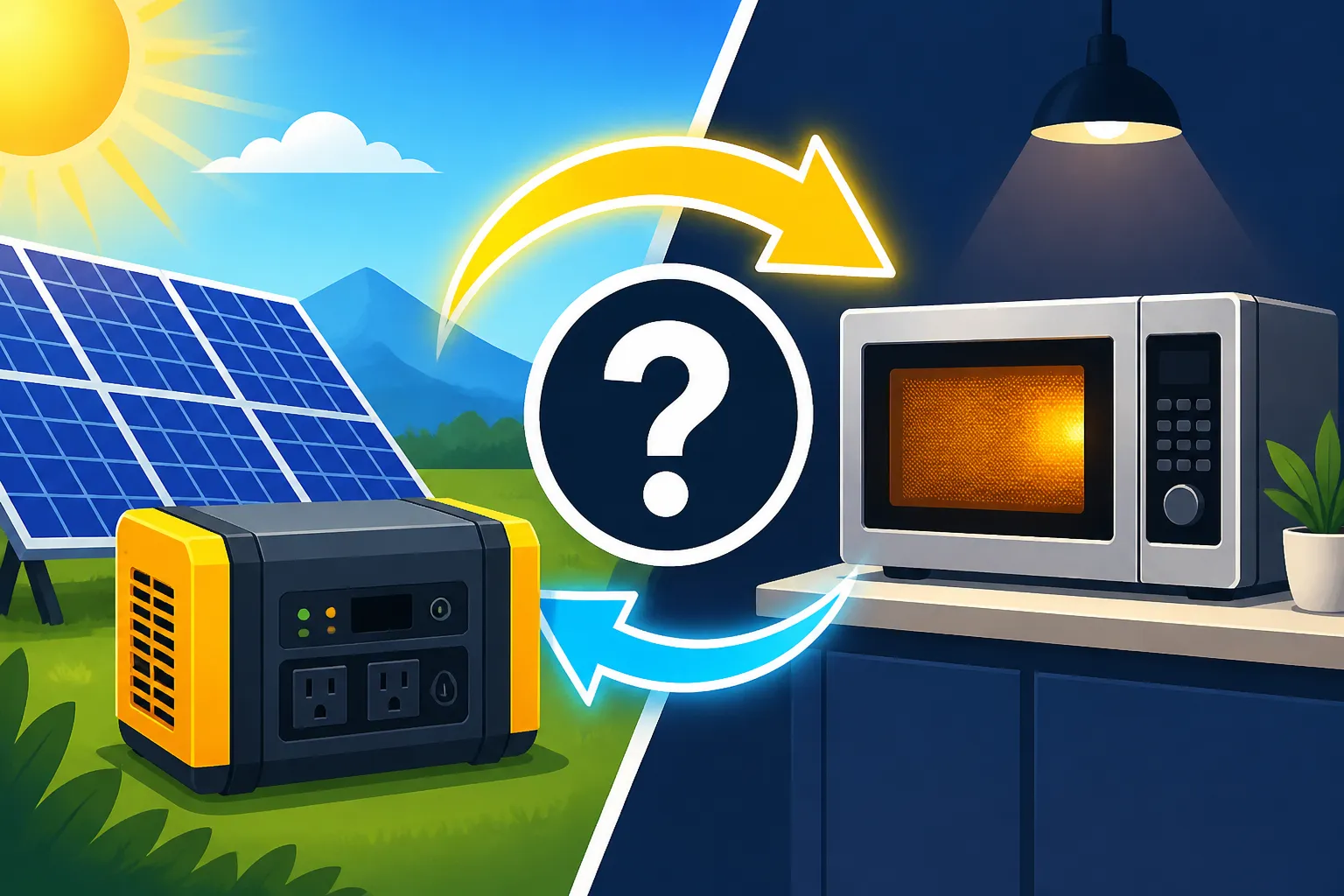
There's nothing quite like the convenience of zapping leftovers or quickly heating up a cup of coffee, even when you're living the off-grid dream. But if you've ever tried to run a microwave on an undersized solar system, you know the frustration: the inverter groans, the lights flicker, and sometimes, the whole system just shuts down. It's enough to make you wonder if a microwave is even possible off-grid. This guide is going to walk you through exactly how to determine what size inverter you'll need to reliably power your microwave, so you can enjoy those quick conveniences without stressing your solar setup.
Understanding Microwave Power Consumption
Before you can pick an inverter, you really need to get a handle on how much power your microwave actually demands. It's not as simple as looking at the wattage advertised on the box, because there are a couple of different numbers at play that are critical for off-grid systems.
Running Watts vs. Starting Watts for Microwaves
This is probably the most misunderstood aspect of powering appliances, especially high-draw ones like microwaves. Every electrical appliance has two main power ratings:
- Running Watts (or Continuous Watts): This is the power your microwave uses constantly once it's up and running. It's usually the number you see advertised (e.g., "1000-watt microwave"). This is the power it needs to cook your food.
- Starting Watts (or Surge Watts): This is the brief, but often much higher, burst of power an appliance needs for a split second when it first kicks on. For a microwave, this surge happens when the magnetron (the component that generates microwaves) first fires up. This surge can be 1.5 to 3 times its running wattage. If your inverter can't handle this initial surge, it will trip or fail to start the appliance.
Let's put this into perspective: A typical 900-watt microwave might draw around 1300-1500 watts continuously while cooking. However, when you first press "start," it might momentarily pull 2000-2500 watts for just a fraction of a second. This surge capacity is what often trips up off-grid systems, especially those built without proper sizing. It's like trying to get a heavy truck moving – it takes more initial force than it does to keep it rolling. Many off-grid solar newcomers overlook this, leading to frustrating shutdowns.
Factors Affecting Microwave Wattage
Not all microwaves are created equal, and several factors can influence their actual power draw.
- Advertised Power vs. Actual Output: It's important to differentiate between a microwave's input wattage (what it pulls from your electrical system) and its output wattage (the power it delivers to cook food). A "1000-watt microwave" usually refers to its cooking output, not its input. The input wattage will always be higher due to inefficiencies in the conversion process. Expect an additional 30-50% on top of the output wattage for the actual power draw. So, a 1000W output microwave might actually draw 1500W input.
- Age and Efficiency: Older microwaves can be less efficient, meaning they draw more power to achieve the same cooking results. Newer, more energy-efficient models might have slightly lower input wattages for the same output.
- Size and Features: A compact, basic microwave designed for a small space will naturally draw less power than a large, feature-rich over-the-range model with convection baking capabilities. The more bells and whistles, the more potential for higher wattage demands.
- Heating Element Type: Some microwaves, especially combination ovens, might have additional heating elements for grilling or convection, which will significantly increase their power draw when those features are engaged.
How to Find Your Microwave's Actual Wattage
Don't guess when it comes to off-grid power! Finding the actual wattage is crucial.
- Check the Label: Most appliances have a data plate or sticker, usually on the back or inside the door frame, that lists electrical specifications. Look for "Input Power," "Rated Power," or "Maximum Wattage." It might be listed in Watts (W) or Amps (A) at a certain voltage (V). If it's in Amps, multiply Amps by Volts (e.g., 12.5A x 120V = 1500W).
- Consult the Manual: The user manual often provides detailed specifications, including both running and sometimes even surge wattage estimates.
- Use a Kill-A-Watt Meter: This is a fantastic little device that plugs into your wall outlet, and your appliance plugs into it. It precisely measures real-time power consumption in watts, volts, amps, and kilowatt-hours. It’s an invaluable tool for any off-grid homeowner, as it allows you to see the exact running wattage and even peek at those momentary surge numbers. Just be aware that most basic Kill-A-Watt meters won't log the absolute peak surge, but they'll give you a good idea of the continuous draw. For truly accurate surge data, you might need a more advanced power meter, but a Kill-A-Watt is a great start for most people. You can find them readily available on platforms like Amazon.
For example, I once measured my 1100-watt (output) kitchen microwave with a Kill-A-Watt. It showed a consistent draw of about 1600-1700 watts while running and a brief flicker up to nearly 2500 watts when it first started. This real-world measurement is far more useful than the advertised 1100 watts for cooking.
The Role of the Inverter in Your Off-Grid System
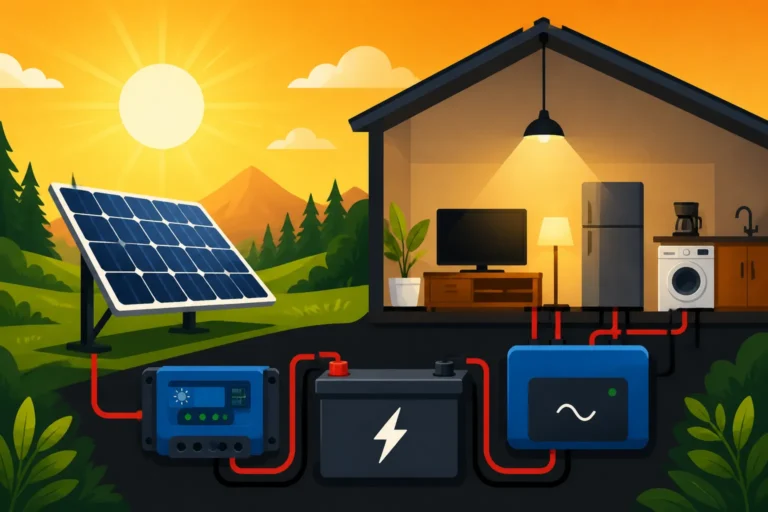
Your inverter is the heart of your off-grid system, translating the DC (direct current) power stored in your batteries into the AC (alternating current) power that your household appliances, including your microwave, use.
What an Inverter Does
In simple terms, an inverter takes the low-voltage DC power from your battery bank (think 12V, 24V, or 48V) and converts it into the higher-voltage AC power that standard home outlets provide (usually 120V or 240V in North America). Without a proper inverter, your microwave wouldn't even be able to turn on. It's a critical bridge between your solar-generated and battery-stored energy and the appliances you rely on daily. Understanding how to size an off-grid inverter correctly is paramount for system efficiency and longevity.
Pure Sine Wave vs. Modified Sine Wave
This distinction is paramount when it comes to powering sensitive electronics like microwaves, and honestly, almost any modern appliance.
-
Modified Sine Wave (or Modified Square Wave) Inverters: These are cheaper and produce a "stepped" approximation of an AC sine wave. While some simple resistive loads (like old-school incandescent light bulbs or basic heating elements) might tolerate them, they are generally not recommended for modern electronics, motors, or anything with a microprocessor. Running a microwave on a modified sine wave inverter can lead to:
- Reduced efficiency and slower cooking.
- Buzzing or humming noises.
- Overheating of the microwave's components.
- Potentially shortening the lifespan of the microwave.
- In extreme cases, damaging the appliance.
-
Pure Sine Wave Inverters: These produce a clean, smooth AC waveform, identical to what you get from the utility grid. This is what all modern electronics are designed for. For your microwave, a pure sine wave inverter is absolutely essential for optimal performance, efficiency, and to prevent any damage. Don't skimp here; the extra cost for a pure sine wave inverter is a wise investment for peace of mind and appliance longevity. If you're looking for more details, check out this guide on Pure Sine Wave vs Modified Sine Wave Inverters.
Inverter Efficiency and Overhead
When sizing your inverter, it's a common mistake to calculate the exact wattage needed and then buy an inverter rated for precisely that amount. This is a recipe for frustration.
- Efficiency Losses: Inverters aren't 100% efficient. They lose a small percentage of power during the conversion process, typically around 5-10%. This means an inverter needs to draw more DC power from your batteries than the AC power it delivers to your appliance.
- Headroom for Future Growth: It's always a good idea to slightly oversize your inverter beyond your immediate needs. You might decide to run another small appliance concurrently or upgrade your microwave in the future. Trying to figure out How to Design an Expandable System upfront can save you headaches later.
- Operating at Optimal Load: Inverters often operate most efficiently when they are running at 50-80% of their rated capacity, not at their absolute maximum. Constantly pushing an inverter to its limits can reduce its lifespan and potentially lead to thermal shutdowns.
Aim for an inverter that can comfortably handle the surge wattage of your microwave, plus a safety margin of at least 20-30% beyond that peak. This gives you buffer for efficiency, other small loads, and the health of the inverter itself.
Sizing Your Inverter for a Microwave
Now for the nitty-gritty: putting those numbers together to select the right inverter. This involves a few key steps to ensure you don't undersize or unnecessarily oversize your system.
Step-by-Step Calculation
Let's walk through this with a typical example.
Example Microwave: Let's say you have a microwave with an advertised output of 900 watts.
- Estimate Actual Input Running Watts: Assuming 40% inefficiency (a reasonable average for microwaves), your 900-watt output microwave actually draws about 1260 watts from your system (900W / 0.70 efficiency = 1285W, let's round to 1300W for simplicity, or 900W * 1.4 = 1260W). For safety, let's assume 1300W.
- Estimate Surge Watts: Microwaves typically have a surge factor of 1.5x to 2x their running watts. Let's use 1.8x for a conservative estimate.
- 1300 running watts * 1.8 surge factor = 2340 surge watts.
- Apply Safety Margin to Surge Watts: We want our inverter to handle this surge comfortably, plus a little extra for efficiency and to avoid stressing the unit. Add a 20% safety margin.
- 2340 surge watts * 1.20 (20% safety margin) = 2808 watts.
Based on this, you would need a pure sine wave inverter with a continuous rating of at least 1500-2000 watts, but with a surge capability of at least 2800-3000 watts for a few seconds.
Many inverters list both continuous and surge ratings. For instance, a 2000-watt continuous inverter might have a 4000-watt surge rating for a few seconds. This kind of inverter would be perfectly suited for our example microwave. Brands like Renogy and Victron Energy offer a range of pure sine wave inverters with excellent surge capabilities that are well-regarded in the off-grid community.
Common Microwave Sizes and Recommended Inverter Ranges
Here's a quick reference table for common microwave sizes and the inverter capacity you should generally aim for. Remember, these are estimates, and checking your specific microwave's label is always best.
| Microwave Output Wattage (Advertised) | Estimated Input Running Watts | Estimated Surge Watts (1.8x) | Recommended Inverter Continuous Rating (with ~20% buffer) | Recommended Inverter Surge Capability |
|---|---|---|---|---|
| 700W (Compact) | 1000-1100W | 1800-2000W | 1500W | 2500W+ |
| 900W (Standard) | 1300-1400W | 2300-2500W | 2000W | 3000W+ |
| 1000W (Medium) | 1500-1600W | 2700-2900W | 2500W | 3500W+ |
| 1200W+ (Large/Feature-rich) | 1700-2000W | 3000-3600W | 3000W | 4000W+ |
It's clear that even a small microwave requires a fairly substantial inverter. If you're also considering other heavy loads like a well pump or an air conditioner, your total inverter needs will increase significantly. You can find excellent options for Best Off-Grid Solar Inverters by various manufacturers that clearly state their continuous and surge capabilities.
Considering Other Loads
It's rare that a microwave is the only thing drawing power in your off-grid setup. When sizing your inverter, you absolutely must consider what other appliances might be running simultaneously.
For example, if you're running your microwave (say, 1500W running, 2500W surge) while your refrigerator (150-200W running, 700-1000W surge) kicks on, and you have some lights (50W), a laptop (60W), and a TV (100W) all powered up, your inverter needs to handle the combined running wattage of everything, plus the single largest surge at any given moment.
So, if your microwave surges to 2500W, and your fridge surges to 800W, the inverter needs to handle 2500W (the microwave's surge) plus the running watts of everything else that's on. You wouldn't add both surge numbers together unless both happened to surge at the exact same microsecond, which is highly unlikely. However, it needs to handle the microwave's running watts plus the fridge's surge, if the fridge decided to kick on while the microwave was already running. This is where a detailed How to Do an Off-Grid Load Analysis becomes critical for your entire system design, not just for the microwave. You need to map out your expected simultaneous usage.
A good rule of thumb is to calculate your total continuous load for your most power-intensive period (e.g., cooking dinner with lights, fridge, and microwave running) and then ensure your inverter's surge capacity can handle the largest individual appliance's surge on top of that continuous load. For this reason, many full-time off-gridders choose 3000W or 4000W continuous inverters to comfortably power their homes.
Practical Considerations for Microwave Use Off-Grid
Beyond just the inverter, using a microwave off-grid has implications for your entire solar power system, especially your battery bank.
Battery Bank Requirements
Running a microwave is a power-hungry endeavor, and that power has to come from somewhere: your battery bank. A microwave drawing 1500 watts for 2 minutes consumes about 50 watt-hours (Wh) of energy. While this might seem small, if you're using it frequently, those watt-hours add up quickly.
Crucially, the microwave's high wattage means a high current draw from your batteries. For example, a 1500-watt load on a 12-volt battery system means drawing 125 amps (1500W / 12V = 125A), plus inverter inefficiencies! That's a massive draw that can quickly deplete smaller battery banks and put significant strain on your batteries, especially if they aren't designed for high discharge rates.
- System Voltage: For appliances like microwaves, a higher system voltage (like 24V or 48V) is much more efficient. A 1500-watt load on a 48-volt system draws only 31.25 amps (1500W / 48V = 31.25A). Lower amperage means less heat generated, less voltage drop over your wires, and less strain on your batteries and inverter. This is why most larger off-grid systems opt for 24V or 48V.
- Battery Capacity: You'll need sufficient amp-hours (Ah) to not only run the microwave but also to store enough energy for your daily needs and any periods of low solar input. If you want to use your microwave for 5 minutes twice a day, that's roughly 10 minutes of high draw. On a 12V system, that means 10 minutes at 125A or more. This means you’ll need a robust battery bank. A guide like How Many Batteries for an Off-Grid System can help you delve deeper into this calculation. Generally, for consistent microwave use, consider a battery bank of at least 200-400Ah at 48V (or equivalent at lower voltages) using LiFePO4 batteries, which handle high discharge rates much better than lead-acid. To figure out how to calculate How to Calculate Battery Amp-Hours Needed, you'll need to look at your full load analysis.
Wiring and Safety
A high-draw appliance like a microwave also demands careful attention to your system's wiring and safety components.
- Proper Wire Sizing: The cables connecting your batteries to your inverter, and your solar panels to your charge controller, must be adequately sized to handle the peak current without excessive voltage drop or overheating. For instance, those 125 amps drawn by a 12V system for a 1500W microwave would require very thick cables (e.g., 2/0 AWG or 4/0 AWG) depending on the length. Undersized wires can lead to efficiency losses, dangerous heat buildup, and potential fire hazards. This is covered in more detail in guides like How to Size Wire and Cables and How to Prevent Voltage Drop in Off-Grid Wiring.
- Fusing and Circuit Breakers: Every major component in your off-grid system needs appropriate overcurrent protection. This includes fuses between your batteries and inverter, and circuit breakers for your AC loads. If your microwave creates an unexpected surge or fault, these devices protect your valuable equipment and prevent fires. If you're doing a DIY setup, make sure to read up on a comprehensive Off-Grid Solar Installation Guide to get all the safety details right.
- Grounding: Proper grounding of your inverter and entire electrical system is vital for safety, protecting against electrical shocks and lightning strikes. Never skip this step.
Energy Conservation Tips
While it's great to have the power to run a microwave, being off-grid often encourages us to rethink our energy consumption. Microwaves are notorious energy hogs for the short bursts they're used.
- Evaluate Your Needs: Do you really need a microwave? Could you heat food on a propane stove, a wood stove, or even a more efficient toaster oven for similar tasks? Many off-gridders find they adapt quite well without one.
- Choose Efficient Models: If a microwave is a must-have, look for models with lower input wattages. You might sacrifice a bit of cooking speed, but your solar system will thank you. Modern inverter microwaves (different from your solar inverter) often offer more precise power delivery and can be more efficient.
- Use Sparingly: Limit microwave use to essential tasks. Instead of reheating every meal in it, consider cooking larger batches on your stove and simply eating leftovers cold or gently warming them over a lower-power burner.
- Consider a DC Microwave: While rare and often expensive, true DC-powered microwaves do exist, typically for RVs or boats. These can sometimes bypass the inverter inefficiencies, though they still require a significant draw directly from your battery bank.
Ultimately, running a microwave off-grid is absolutely achievable with the right planning and appropriately sized equipment. Just remember that it's a high-demand appliance that requires a robust inverter and a well-matched battery bank to perform reliably. Don't be shy about investing in quality components from trusted brands like Renogy or considering versatile power stations available on Amazon, as they can make a significant difference in your off-grid experience.
Disclaimer
The information provided in this guide is for educational purposes only and should not be taken as professional electrical advice. Working with electricity can be dangerous. Always consult with a qualified electrician or solar professional before designing or installing any off-grid solar system to ensure safety and compliance with local codes.