How to Design Around Shading
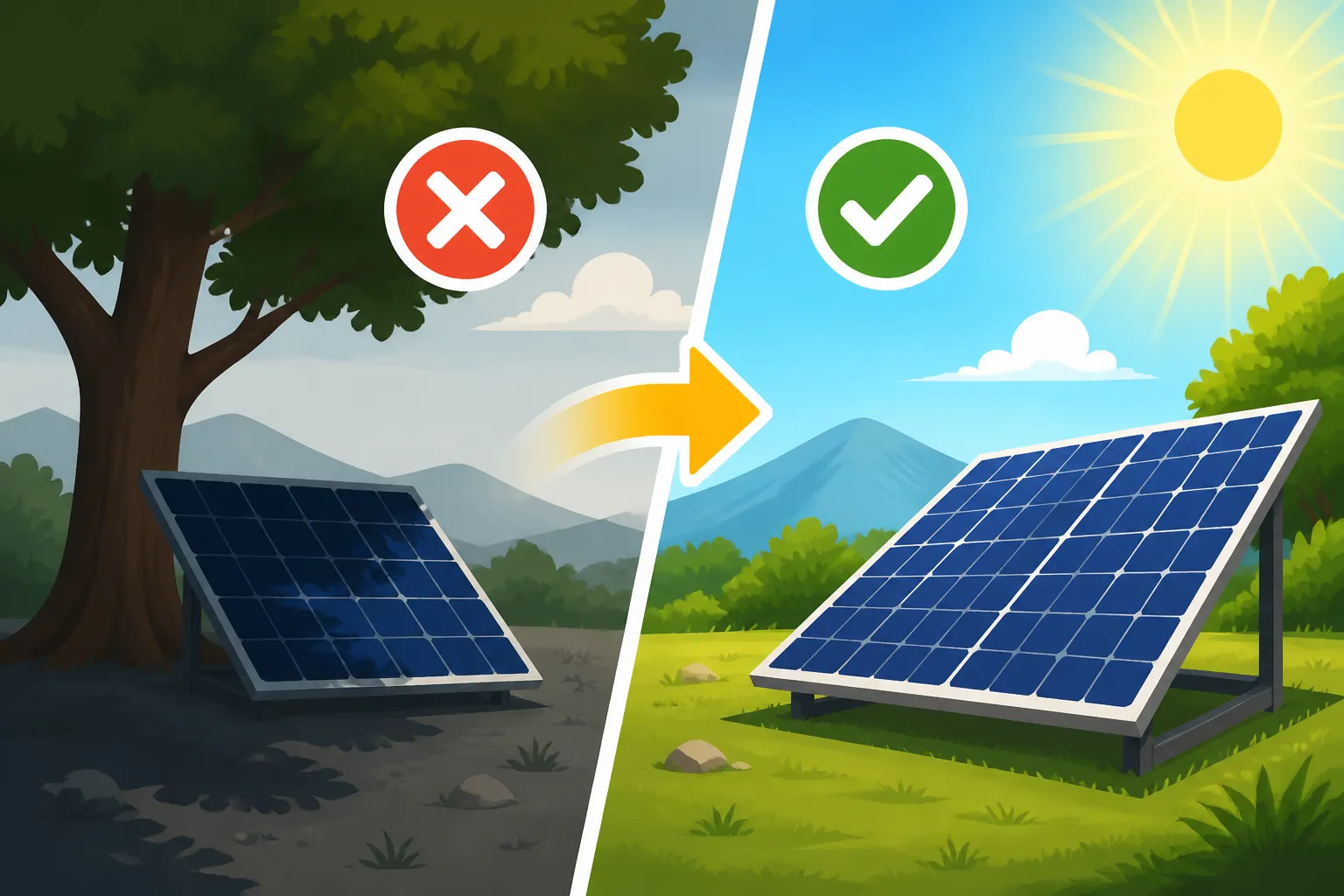
It's incredibly frustrating when you're planning your off-grid dream, picturing those beautiful solar panels soaking up the sun, only to realize that pesky oak tree in the yard or a looming ridge line might throw a wrench in your perfect energy plan. Shading is one of the biggest silent saboteurs of off-grid solar performance, often causing much more than just a proportionate loss of power. This guide is all about tackling that challenge head-on, showing you how to strategically design your off-grid solar system to minimize the impact of shading and keep your power flowing smoothly.
Understanding the Insidious Impact of Shading on Off-Grid Solar Performance
When you first think about shading, it might seem simple: "If half my panel is shaded, I lose half the power, right?" Oh, if only it were that straightforward! Unfortunately, with most traditional solar panel setups, shading is far more insidious. Even a small shadow can significantly cripple your entire system's output.
How Even Partial Shading Can Cripple Your Power Output
Imagine a chain where each link needs to be strong for the chain to hold. That's a bit like how solar cells within a panel, and panels within an array, are typically wired in series. When even one cell or a small portion of a cell gets shaded, it acts like a bottleneck. The shaded cell's resistance increases, trying to block the flow of current from the unshaded cells. This forces the entire string of cells, or even an entire array of panels, to drop its output to match the weakest link. We call this the "Christmas light effect" – if one goes out, they all go dim, or worse, out entirely.
For example, if you have a 100-watt solar panel and a small branch casts a shadow over just 10% of one cell, you might not just lose 10% of the panel's power. You could lose 50% or even more of that panel's total output, and potentially impact other panels connected in series. This happens because the shaded cells stop producing current and become resistive loads, essentially consuming power instead of generating it. Over time, this can lead to "hot spots" on the panel, where the shaded cells overheat, potentially causing permanent damage to the panel itself. That's definitely something we want to avoid when we're counting on every watt for our off-grid lifestyle!
Identifying Different Types of Shading That Affect Your System
Not all shadows are created equal, and understanding the different types can help you design more effectively.
- Fixed Shading: This is shading from permanent structures that don't move. Think about your neighbor's tall pine tree, your own chimney, a roof vent, or even a mountain range. These shadows are predictable and happen at roughly the same time and place each day, depending on the season. They're often easier to plan around during the initial design phase because their patterns are consistent. However, a "fixed" tree can still grow, slowly increasing its shaded area over the years, requiring periodic re-evaluation.
- Transient Shading: These are the moving, often unpredictable shadows. A lone cloud drifting overhead, a bird perching on a panel, or even dirt and leaves accumulating on the glass. While a cloud's shadow is fleeting, things like falling leaves or bird droppings can persist and create persistent partial shading until cleaned. These are harder to design around in the traditional sense, but good monitoring and maintenance practices can mitigate their effects.
- Seasonal Shading: This is a huge one for off-gridders. The sun's path across the sky changes dramatically throughout the year. A shadow that's completely absent in the summer might become a major problem in the winter when the sun is lower in the sky and arcs differently. What clears your panels in July might totally obscure them in December. It's crucial to assess your potential site not just for today's sun path, but for the entire year, especially during the shortest, darkest days when you need every bit of power you can get. This is why when you're thinking about How to Design for Year-Round Off-Grid Power, seasonal shading plays a critical role.
Strategic Design Approaches to Minimize Shading
The best defense against shading is a good offense: proactive design and placement. It’s often much cheaper and more effective to avoid shadows in the first place than to try and compensate for them later with expensive equipment.
The Critical Role of Site Selection and Panel Placement
Before you even think about buying a single panel, you need to thoroughly scout your location. This isn't just about finding a sunny spot; it's about finding the sunniest spot throughout the entire year.
Walk your property at different times of day and in different seasons if possible. If you're planning in spring, remember how low the sun will be in winter. Observe existing shadows from trees, buildings, and terrain. You can even use simple tools like a compass and a clinometer, or more advanced apps like Sun Surveyor or Helioscope, to map the sun's path and identify potential obstructions. Sometimes, just moving your array 20 feet to the east or west can make a world of difference.
Trimming trees is often a necessary first step. If a tree branch is going to cause consistent shading, especially during peak production hours (typically 9 AM to 3 PM), it might be worth considering if it can be safely pruned or, in some cases, removed entirely. Always check with local regulations and arborists before making major cuts. If you're building a new structure or placing a cabin, orienting it strategically to avoid casting shadows on your future solar array is paramount. Remember, the goal is unimpeded sunlight from sunup to sundown, especially when you're working on How to Size an Off-Grid Solar System for crucial loads.
Optimizing Panel Orientation and Tilt for Sun Exposure
Once you have your site, how you orient and tilt your panels becomes the next line of defense against shading.
- Orientation: For most fixed off-grid installations in the Northern Hemisphere, facing your panels due south is ideal for maximum annual energy production. This generally maximizes the total kilowatt-hours over a year. In the Southern Hemisphere, it would be due north. However, if you have unavoidable shading in the morning from an eastern obstruction, or in the afternoon from a western one, you might consider slightly shifting your array's orientation to favor the period of the day when you have the most reliable, unobstructed sunlight. For instance, if you have a big hill to the east that shades your panels until 10 AM, you might angle them slightly southwest to catch more of the strong afternoon sun.
- Tilt Angle: The optimal tilt angle for solar panels changes with the seasons. In summer, when the sun is high, a shallower angle (closer to horizontal) is best. In winter, when the sun is low, a steeper angle (closer to vertical) is better. For year-round off-grid living, many people choose a compromise angle that's roughly equal to their latitude. However, if you know shading is a particular issue during specific seasons, you might consider adjustable tilt mounts. These allow you to manually change the angle of your panels throughout the year. For example, if you have significant low-angle winter shading, you can steepen your panels to "reach" above the obstruction and maximize what little winter sun is available. Conversely, if your summer shading is from midday roof vents, you might flatten the panels slightly to avoid those specific shadows. This flexibility can be a game-changer for overall Off-Grid Solar System Design Basics.
Technological Solutions for Shading Mitigation
Sometimes, despite your best efforts in site selection and orientation, some shading is simply unavoidable. This is where modern solar technology steps in to help lessen the blow.
How Bypass Diodes Protect Panels and Maintain Flow
Almost all modern solar panels come equipped with what are called "bypass diodes." These are little electrical gates built into the panel's junction box, typically one diode for every 18-24 cells. When a string of cells gets shaded, the bypass diode for that segment automatically activates, effectively "bypassing" the shaded cells.
Instead of the entire panel's output dropping to zero because of that shaded section, the current can flow around the shaded part. This means you only lose the power from the shaded section itself, rather than the whole panel. It also prevents those problematic hot spots that can degrade your panels over time. While bypass diodes are a fantastic built-in feature, they're not a perfect solution. You're still losing some power from the bypassed section, and if an entire panel is shaded, it essentially bypasses itself out of the circuit. But for partial, temporary shading, they are incredibly effective at protecting your investment and maintaining overall system integrity.
MPPT Charge Controllers: A Game Changer for Shaded Arrays
When it comes to charge controllers, there are two main types: PWM (Pulse Width Modulation) and MPPT (Maximum Power Point Tracking). For any off-grid system, but especially one where shading might be a factor, an MPPT charge controller is highly recommended. You can learn more about this when considering Best MPPT Charge Controllers.
Here's why MPPT controllers are superior: A PWM controller simply regulates the voltage from the panels to match the battery voltage, essentially clipping excess voltage. An MPPT controller, however, is much smarter. It constantly monitors the voltage and current coming from your solar panels and adjusts itself to find the "maximum power point" – the optimal combination of voltage and current where your panels are producing the most power.
In shaded conditions, the voltage and current output from your panels can fluctuate wildly. A PWM controller might struggle to maintain efficient charging. An MPPT controller, on the other hand, can dynamically adjust to these changes, often extracting significantly more power from a partially shaded array than a PWM controller ever could. For instance, brands like Renogy offer a range of MPPT controllers that are known for their efficiency, making them a popular choice among off-gridders looking to maximize their energy harvest even when conditions aren't perfect. This efficiency can make a tangible difference in how much energy your batteries receive, especially on days with intermittent clouds or moving shadows. This is a crucial component to consider when you’re building your system and reviewing Off-Grid Solar System Components Explained.
Power Optimizers and Micro-Inverters: Advanced Solutions
For installations with complex or persistent shading issues, power optimizers and micro-inverters offer even more advanced solutions, though they typically come with a higher upfront cost.
- Power Optimizers: These are small devices installed on the back of each individual solar panel. They work in conjunction with a central string inverter. Each optimizer tracks the maximum power point for its specific panel. If one panel gets shaded, its optimizer ensures that panel continues to perform at its best possible level, without dragging down the performance of the other unshaded panels in the string. This allows each panel to operate independently at its peak, sending optimized DC power to the main inverter. They're a fantastic compromise if you want the panel-level optimization without the full cost of micro-inverters.
- Micro-Inverters: Taking the concept even further, micro-inverters convert the DC power from each individual solar panel into AC power right at the panel level. This means that if one panel is shaded, it affects only that single panel. The other panels, each with their own micro-inverter, continue to produce power at their maximum capacity. This is the most effective way to deal with shading on a panel-by-panel basis, eliminating the "Christmas light effect" entirely. The downside is that they are generally the most expensive option, and typically produce AC power, which then needs to be managed by an off-grid battery bank and charging system that can accept AC input, or rectified back to DC. For pure off-grid setups, micro-inverters are less common than optimizers or simply using a robust MPPT charge controller with DC-coupled batteries. However, for a hybrid system that might also backfeed to a small cabin's AC loads, they can be quite effective.
| Shading Mitigation Strategy | Pros | Cons | Best Use Case |
|---|---|---|---|
| Site Selection/Trimming | Most cost-effective, prevents problem at source | Limited by property, potential aesthetic impact, ongoing maintenance | Essential first step for any installation |
| Adjustable Tilt Mounts | Maximizes seasonal sun, can avoid low-angle shadows | Manual adjustment required, higher cost, potential weak points | Locations with high seasonal sun path variation or predictable shading |
| Bypass Diodes (Built-in) | Standard feature, prevents hot spots, mitigates partial cell shade | Still loses power from shaded sections, cannot optimize per panel | All modern panels, effective for minor, intermittent shading |
| MPPT Charge Controller | Significantly improves power harvest in varying conditions, good value | Does not optimize at individual panel level | Any off-grid system, especially with potential shading |
| Power Optimizers | Panel-level optimization, works with string inverter, good for complex shading | Higher upfront cost, adds complexity to DC wiring, component specific | Systems with unavoidable, varied panel shading |
| Micro-Inverters | Complete panel-level independence, excellent for extreme shading, AC output | Highest upfront cost, typically AC-coupled (complex for DC battery banks) | Grid-tied or hybrid systems where panel-level output is critical |
Long-Term Management and Adapting to System Changes
Even after careful planning and smart component choices, an off-grid solar system isn't a "set it and forget it" affair, especially when dealing with potential shading. Nature and circumstances can change, and your system needs to be ready to adapt.
Monitoring Your System's Performance for Early Detection
One of the best habits any off-grid homeowner can develop is regular system monitoring. Many modern charge controllers and inverters, especially from brands like Victron or Outback Power, come with built-in monitoring capabilities or can be connected to external battery monitors. These systems allow you to see exactly how much power your solar array is generating, how much is going into your batteries, and how much you're consuming. Many can even be accessed remotely via a smartphone app.
By consistently checking your daily power production, you can spot dips or inconsistencies that might indicate new or worsening shading. For example, if your system typically produces 5 kWh by noon on a clear day, but suddenly it's only showing 3 kWh, it's a good cue to go outside and investigate. Perhaps a new tree branch has grown out, or a pile of leaves has collected on a panel. Early detection allows you to address the issue before it significantly impacts your energy supply or battery health. This proactive approach helps keep Off-Grid Solar Maintenance Costs down in the long run.
You can often find good quality, affordable battery monitors and other system sensors on sites like Amazon, making it easier than ever to keep an eye on your energy production and consumption data. This information is also invaluable when you want to How to Calculate Daily Energy Usage for potential system expansion or troubleshooting.
Adapting to Changing Conditions and Future Proofing
The natural world is constantly evolving, and so might your property. Trees grow, new structures get built, and your energy needs might even change over time. Your off-grid solar system needs to be adaptable.
Periodically, perhaps once a year, repeat your initial shading assessment. Walk your property, especially during the winter months, and re-evaluate your solar array's exposure to sunlight. Those small saplings that didn't cast a shadow five years ago might now be a significant problem. Be prepared to trim back vegetation as needed. If removing a tree isn't an option, or if new construction creates permanent shading, you might need to consider reconfiguring your array. This could mean moving a few panels to a different section of your property or investing in optimizers or micro-inverters for the shaded portions.
When you're designing your system initially, think about modularity. Can you easily add more Best Off-Grid Solar Panels or expand your battery bank later? This "future-proofing" approach allows you to scale your system as your needs grow or as environmental factors change. For example, some homeowners design their system with spare conduit runs or extra wiring capacity, anticipating that they might add more panels in a few years. This flexibility minimizes the headache and cost of future modifications and ensures your off-grid independence remains robust, even as your world around you shifts. You can learn more about Cost of Expanding an Off-Grid System to help with this planning.
Maximizing Your Off-Grid Harvest Despite Shading Challenges
Designing around shading is a multifaceted challenge, but it's one that savvy off-gridders can absolutely conquer with careful planning and smart technology choices. Remember, the sun is your fuel source, and every bit of direct sunlight captured translates directly into usable power for your home, RV, or cabin.
Start with diligent site assessment, choosing the clearest possible location, and strategically orienting your panels. Then, leverage the power of MPPT charge controllers to maximize efficiency, even when conditions aren't perfect. For more stubborn shading, consider the benefits of power optimizers or micro-inverters. Finally, stay vigilant with regular monitoring and be prepared to adapt your system as your environment changes. By taking these proactive steps, you'll ensure your off-grid solar system delivers reliable power for years to come, keeping you independent and worry-free.
Disclaimer
Please remember that all information provided in this guide is for informational purposes only. Off-grid solar system design and installation can be complex and may involve working with high voltages. Always consult with qualified professionals and adhere to all local electrical codes and safety regulations when designing, installing, or modifying your off-grid solar system.