How Many Batteries to Run An Air Conditioner
Trying to keep your cool with an air conditioner when you're living off the grid can feel like a monumental challenge. It’s one thing to power your lights or charge your phone, but an AC unit is a whole different beast when it comes to energy consumption. Many folks dream of the comfort an AC provides, especially during those sweltering summer months, only to get overwhelmed by the sheer scale of the battery bank required. This guide is here to walk you through the nitty-gritty of determining exactly how many batteries you'll need to keep your air conditioner running comfortably without draining your entire off-grid power system.
Understanding Your Air Conditioner's Power Demands
Before you can even begin to think about batteries, you need to get intimately familiar with your air conditioner’s power appetite. AC units are notoriously power-hungry, and misunderstanding their demands is the quickest way to end up with a system that falls short.
Decoding AC Wattage and Amperage
When we talk about an air conditioner's power demands, we're really looking at two main figures: its running wattage and its starting or surge wattage.
- Running Wattage: This is the continuous power your AC unit draws once it's up and running smoothly. For example, a typical 5,000 BTU window air conditioner might consume around 500-600 watts, while a larger 12,000 BTU unit could be upwards of 1,200 watts. More efficient units, like modern mini-splits, might draw less for the same cooling capacity, but they're still significant loads. You'll often find this listed on the unit's yellow EnergyGuide label or in its owner's manual.
- Starting/Surge Wattage: This is where things get tricky. When an AC compressor first kicks on, it requires a momentary burst of power—often 2 to 3 times its running wattage—to get going. This surge lasts only for a second or two, but your inverter must be able to handle it. If your inverter can't deliver this peak power, your AC simply won't start, or it might trip a breaker. A 12,000 BTU mini-split that runs at 1,000 watts might surge to 2,500-3,000 watts for a split second. Ignoring this surge capability is a common pitfall in off-grid system design, and it’s why a careful calculation is so important when you're looking at How to Size an Off-Grid Inverter for your system.
Different types of AC units have varying power profiles. A small portable AC unit you picked up from Amazon might be rated for 8,000 BTUs and pull about 700-800 watts, while a high-efficiency mini-split like those from Mitsubishi or Daikin could deliver similar cooling with slightly less power, but still requires a robust system. It's crucial to check the specific model you intend to use.
Daily Runtime and Energy Consumption
Once you know the running wattage, the next big piece of the puzzle is how long you actually plan to run that AC. This isn't just about how many hours you turn it on, but also how consistently it will cycle.
- Continuous vs. Intermittent Use: Are you aiming to keep your off-grid cabin at a constant 72°F all day and night, or do you just want to cool it down for a few hours in the evening? The difference in total energy consumption is massive. Running an AC for 8 hours straight is vastly different from running it for 2 hours, letting the temperature rise, and then running it again for another 2 hours.
- Factors Affecting Runtime: Your climate plays a huge role. In a mild climate, your AC might cycle on and off frequently, leading to lower overall runtime. In a scorching Arizona summer, it could run almost continuously. Insulation in your home, window coverings, and even external shading will all impact how hard and how long your AC needs to work. A well-insulated tiny home will require less cooling energy than a drafty old hunting cabin.
- Calculating Total Energy (Watt-hours): This is the key metric. You take your AC’s running wattage and multiply it by the estimated number of hours it will run in a day. For instance, if your AC draws 800 watts and you plan to run it for 6 hours, that’s 800 watts * 6 hours = 4,800 Watt-hours (Wh) per day. This number is your daily energy target for your battery bank, and it forms the foundation for How to Calculate Daily Energy Usage for any off-grid appliance.
Calculating Your Off-Grid Battery Capacity for Air Conditioning
Now that we understand the AC’s demands, let's get into the actual numbers. Sizing batteries for an air conditioner involves a series of calculations to ensure you have enough stored energy to meet your cooling needs, even when the sun isn't shining.
Step-by-Step Battery Sizing Calculation
This is where the rubber meets the road. Follow these steps carefully to determine your battery needs.
Step 1: Determine Your AC's Average Running Wattage.
Check the label on your AC unit or its manual. Let’s assume, for our example, you have a high-efficiency 9,000 BTU mini-split that draws about 850 watts on average when running.
Step 2: Estimate Your Daily AC Runtime.
Decide how many hours per day you realistically need to run the AC. For a comfortable summer evening, let’s say you need it for 7 hours a day.
Step 3: Calculate Your Daily Watt-Hours (Wh) Needed.
Multiply your running wattage by your daily runtime.
- 850 watts * 7 hours/day = 5,950 Wh/day
Step 4: Account for Inverter Efficiency.
Your inverter isn't 100% efficient; some energy is lost when converting DC battery power to AC household power. A good quality pure sine wave inverter is typically 85-92% efficient. Let's use 90% (0.90) for our calculation.
- 5,950 Wh / 0.90 = 6,611 Wh/day (This is the amount of energy your batteries actually need to supply.)
Step 5: Consider Days of Autonomy.
This is crucial for off-grid living. How many days do you want your batteries to power your AC without any solar input (e.g., during cloudy weather)? Let's plan for 2 days of autonomy.
- 6,611 Wh/day * 2 days = 13,222 Wh (Total energy required from batteries for 2 days of AC).
Step 6: Choose Your System Voltage and Battery Chemistry.
- System Voltage: For an AC, especially larger ones, a 48V system is highly recommended. It reduces the current (amps) flowing through your wires, which means you can use smaller, less expensive cables and reduce energy loss. While 12V and 24V systems can power smaller ACs, they often require very thick wires and can struggle with efficiency over longer runs. When you're thinking about How to Choose System Voltage, always consider your largest loads.
- Battery Chemistry: LiFePO4 (Lithium Iron Phosphate) batteries are the gold standard for off-grid applications, especially for high-draw appliances like ACs. They offer a much higher depth of discharge (DoD) and significantly longer cycle life compared to lead-acid batteries. While the upfront LiFePO4 vs Lead-Acid Battery Cost might be higher, their longevity and performance often make them more economical in the long run.
Step 7: Calculate Required Amp-Hours (Ah) at Your Chosen Voltage.
Now, convert the total Watt-hours into Amp-hours based on your chosen system voltage (48V).
- Total Wh / System Voltage = Total Ah
- 13,222 Wh / 48V = 275.46 Ah
Step 8: Factor in Battery Depth of Discharge (DoD).
This is where battery chemistry really shines.
- LiFePO4 batteries can typically be discharged to 80-100% without significant damage to their lifespan. Let's use a conservative 80% (0.80) DoD to ensure good battery health and longevity.
- Lead-acid batteries (like AGM or flooded) should generally not be discharged below 50% (0.50) DoD if you want them to last.
For our LiFePO4 example:
- 275.46 Ah / 0.80 = 344.33 Ah (This is the usable capacity you need, accounting for DoD).
So, for our example, you would need a 48V battery bank with a nominal capacity of approximately 345 Ah to power an 850-watt mini-split for 7 hours a day, for two days of autonomy, using LiFePO4 batteries.
Real-World Example: Sizing Batteries for a Mini-Split
Let’s put it all together. You're building out your off-grid cabin in the mountains of North Carolina, and you've decided on a 9,000 BTU mini-split. You’re looking at models that run around 850 watts and surge to about 2,000 watts for a moment. You want to run it for about 7 hours in the evening and want to be safe for 2 cloudy days. You've opted for a 48V LiFePO4 battery bank.
Based on our calculations:
You'll need a battery bank that can provide roughly 13,222 Wh over two days. At 48V, that translates to a usable capacity of 345 Ah.
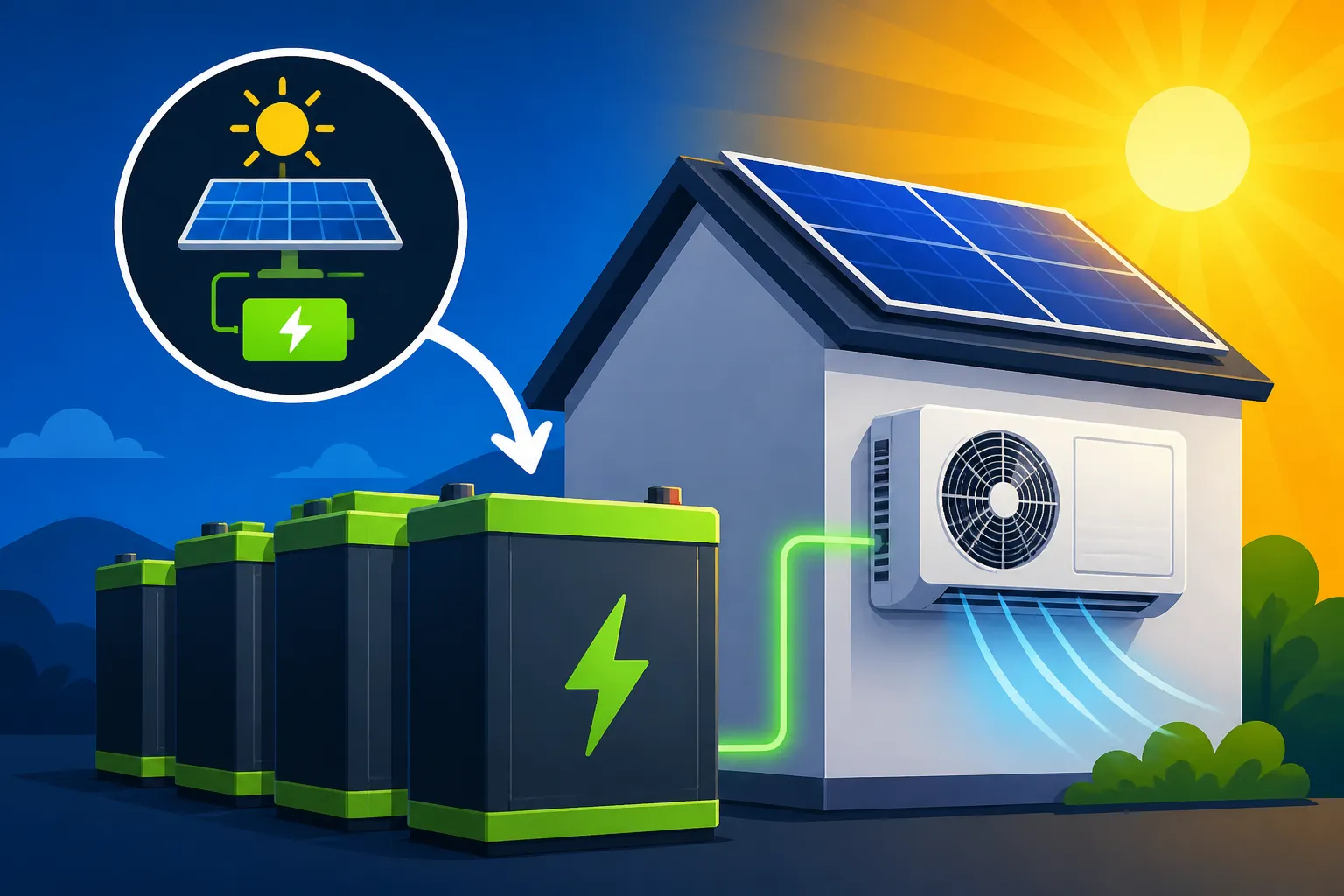
If you're looking at individual batteries, say, 48V 100Ah LiFePO4 units (which are common), you would need about 3 to 4 of these batteries wired in parallel to achieve your target (e.g., three 100Ah batteries would give you 300Ah, four would give you 400Ah). You could also opt for larger individual batteries, like a single 48V 300Ah unit, or a combination. Many reputable brands, including Renogy, offer various sizes of LiFePO4 batteries suitable for these applications. You can often find great deals on these batteries, and related components, through sellers on Amazon.
Keep in mind that this is just for the AC. If you’re also powering lights, a refrigerator, water pump, and other electronics, you'll need to calculate their consumption and add it to your total daily Watt-hour requirements, as discussed in detail in guides like How Many Batteries for an Off-Grid System.
| Appliance (Example) | Running Watts | Daily Runtime (Hours) | Daily Watt-hours (Wh) |
|---|---|---|---|
| 9,000 BTU Mini-Split | 850 | 7 | 5,950 |
| Energy for AC (with inv. loss) | – | – | 6,611 |
| Total for 2 Days Autonomy (Wh) | – | – | 13,222 |
| Battery Ah Needed (48V, 80% DoD) | – | – | ~345 |
| Equivalent 48V 100Ah Batteries | – | – | 4 |
Essential Considerations Beyond Raw Capacity
Having enough battery capacity is critical, but it's only one piece of the off-grid AC puzzle. Other components of your solar system play equally vital roles in ensuring your AC runs smoothly and reliably.
The Role of the Inverter and Charge Controller
Your batteries are the heart of your off-grid system, but the inverter and charge controller are the brains and brawn, translating that stored energy into usable power.
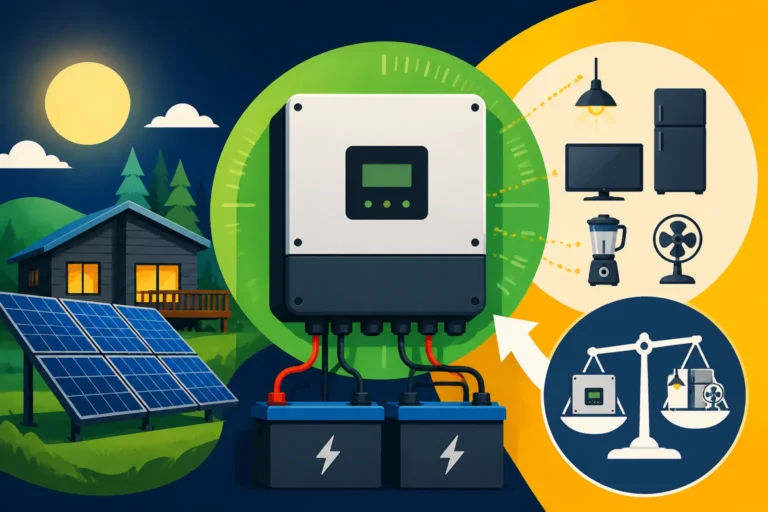
- The Inverter's Crucial Role: We briefly touched on surge wattage earlier, but it bears repeating: your inverter must be able to handle both the continuous running wattage and the momentary surge wattage of your AC. If your 850-watt AC has a 2,000-watt surge, you'll need an inverter rated for at least 2,000-2,500 watts continuous to comfortably handle that startup. Always choose a pure sine wave inverter, especially for sensitive electronics like air conditioners, which can be damaged by modified sine wave inverters. A quality inverter, such as those made by Victron or Sol-Ark, is a significant investment but essential for reliable AC operation. When selecting one, consider Pure Sine Wave vs Modified Sine Wave Inverters to ensure compatibility and longevity for your appliances.
- The Charge Controller: Keeping Batteries Fed: Your charge controller manages the power flow from your solar panels to your batteries. A larger battery bank, especially one designed to power an AC, will require a substantial solar array to recharge it daily. This, in turn, necessitates a charge controller that can handle the current and voltage from that array. You'll need to carefully consider How to Choose an Off-Grid Charge Controller to ensure it matches your panel wattage and battery voltage. An undersized charge controller will limit your charging capabilities, potentially leaving you short on power.
Solar Array Sizing and Recharge Time
It's a common misconception that if you have enough batteries, you're all set. But batteries only store power; solar panels generate it. A large battery bank for AC is useless if you don't have enough solar panels to recharge it efficiently, especially if you plan to use the AC during daylight hours.
- Matching Solar to Consumption: If your AC alone draws 6,000 Wh per day, you’ll need a solar array large enough to generate that much power plus any other daily household consumption, plus enough extra to cover system losses, plus enough to fully recharge your batteries within daylight hours. This often means a significantly larger solar array than many off-gridders initially anticipate. Guides like How Many Solar Panels for Off-Grid Living provide a detailed approach to this critical calculation.
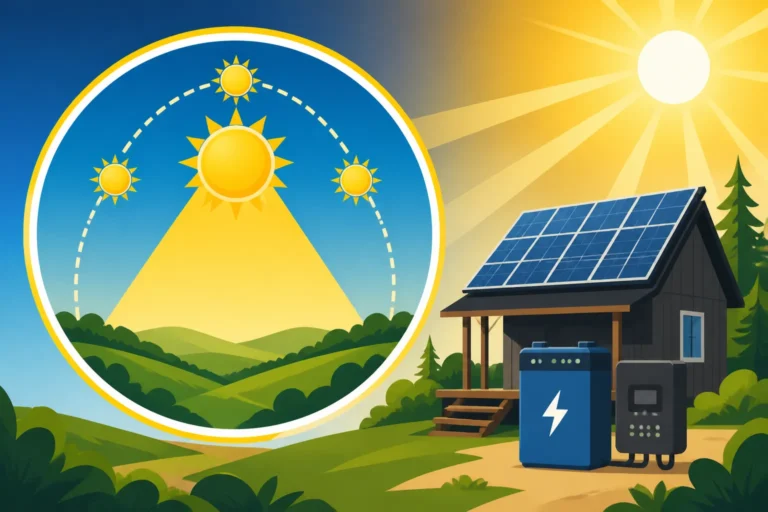
- Peak Sun Hours: The amount of effective sunlight your panels receive varies greatly by location and season. This is measured in "peak sun hours." In winter, or in areas with frequent cloudy days, your panels will produce much less power. This directly impacts how quickly your batteries can recharge, or if they can recharge at all. Understanding Peak Sun Hours Explained is crucial for accurate solar array sizing, especially when you're powering heavy loads like an air conditioner. You need to ensure your panels can generate enough power to not only run the AC during the day (if desired) but also to replenish the battery bank for nighttime use and for those inevitable cloudy days.
Managing Expectations and Energy Efficiency
Running an air conditioner off-grid is a luxury, and it comes with a significant cost and complexity.
- A Power-Intensive Luxury: Don't underestimate the scale of the system required. Running an AC for even a few hours can easily consume more energy than all your other appliances combined. This means a larger solar array, a beefier inverter, and a much more substantial battery bank. It's often one of the most expensive additions to an off-grid system.
- Prioritize Efficiency: If an AC is a must-have, invest in the most energy-efficient unit you can find. Modern mini-splits with high SEER (Seasonal Energy Efficiency Ratio) ratings are vastly superior to older window units. Look for models designed for variable speed operation, as they can ramp down their power consumption once the desired temperature is reached, rather than cycling on and off at full power. For example, a 9,000 BTU mini-split might have a SEER rating of 20+, making it much more efficient than a window AC with a SEER of 10.
- Alternative Cooling Strategies: Before committing to a massive solar investment for AC, explore other cooling methods. Excellent insulation, strategic window placement, passive ventilation (whole-house fans), shading with awnings or trees, and even simple DC-powered fans can significantly reduce your cooling needs. Sometimes, the Cost to Run An Air Conditioner on Off-Grid Solar is so high that a combination of these passive strategies and a small, occasional AC unit for peak heat is more realistic.
- Consider Generator Backup: For some off-grid setups, especially if AC use is only occasional or during extreme heat waves, supplementing your solar system with a backup generator might be a more practical and cost-effective solution. This allows you to run the AC directly from the generator when needed, saving your battery bank for essential loads. Exploring the Cost of Adding a Generator to Off-Grid Solar can help you determine if this hybrid approach makes sense for your specific situation.
Practical Tips for Off-Grid AC Battery Management
Once your system is installed, managing it effectively is key to longevity and consistent comfort. Running an AC puts a unique strain on your battery bank, so proactive management is essential.
Monitoring and Maintenance
A well-maintained battery bank performs better and lasts longer. This is especially true when dealing with high-draw appliances like air conditioners.
- Invest in a Good Battery Monitor: This isn't just a nice-to-have; it's a necessity. A reliable battery monitor, often called a "coulomb counter" or "shunt-based monitor," gives you an accurate percentage of your battery's state of charge (SoC), voltage, current in/out, and even historical data. Relying solely on voltage to determine SoC, especially with LiFePO4 batteries, can be misleading. A good monitor, like those from Victron Energy, will tell you exactly how much power your AC is drawing and how quickly your batteries are being depleted. This empowers you to make informed decisions about your power usage. Knowing How to Install a Battery Monitor correctly is vital for accurate readings.
- Regular Inspections and Connections: Periodically check all battery terminals and cable connections for tightness and corrosion. Loose connections can lead to resistance, heat buildup, and power loss, which is particularly detrimental with high-current loads like AC units. Ensure all wiring is appropriately sized for the current, following safety guidelines to prevent overheating.
- Temperature Management: LiFePO4 batteries perform optimally within a specific temperature range, typically above freezing for charging and up to around 130°F (55°C) for discharge. If your batteries are in a cold climate, you may need a heated battery box or internal heating elements within the battery itself to enable charging. Conversely, extreme heat can degrade battery life. Ensuring adequate ventilation or cooling for your battery bank can significantly extend its lifespan. For those in colder regions, understanding How to Protect Batteries from Cold is paramount for reliable year-round operation.
Phased Upgrades and Budgeting
Going off-grid is a journey, and often, not everything can be done at once. Running an AC is usually a significant financial commitment.
- Start Small, Expand Later: Many off-gridders begin with a system sized for essential loads like lights, refrigeration, and electronics. Once they've lived with that system for a while and understand their true energy consumption patterns, they might plan for an AC as a phased upgrade. This allows you to spread out the substantial Cost of an Off-Grid Solar Battery Bank over time and fine-tune your needs.
- Budget Realistically: Be honest with yourself about the costs involved. A system capable of reliably powering an AC will likely be in the higher tier of off-grid solar costs. Factor in not just the batteries, but also the larger inverter, more solar panels, heavier gauge wiring, and potentially professional installation if you're not doing it yourself. Creating a detailed plan and a realistic How to Budget for an Off-Grid Solar System will prevent unwelcome surprises down the line. It's often helpful to look at the Off-Grid Solar Cost: Complete Breakdown to understand where your money will go.
Running an air conditioner off-grid is absolutely achievable, but it demands careful planning, a robust system, and realistic expectations. By understanding your AC's true power demands and meticulously calculating your battery needs, you can enjoy the comfort of cool air even when you're completely independent from the grid.
Disclaimer
The information provided in this guide is for general informational purposes only and does not constitute professional advice. Off-grid solar system design and installation can be complex and involve electrical hazards. Always consult with qualified professionals and adhere to local codes and regulations before installing or modifying any electrical system.