How Much Solar to Run A Mini Split
One of the biggest dreams for many off-grid enthusiasts is maintaining comfortable indoor temperatures without relying on the utility grid. Running a mini-split air conditioner or heat pump, a modern marvel of efficient climate control, off-grid can seem like a monumental task due to its power demands. This guide will walk you through exactly how to calculate the solar power you'll need to keep your mini-split humming, from understanding its energy appetite to sizing your system components for year-round comfort.
Understanding Mini-Split Power Demands
Mini-splits are incredibly efficient, but they still require a substantial amount of electricity, especially when they first kick on or when working hard to change the temperature significantly. This is often the biggest hurdle for off-grid power systems, which are designed to manage finite energy resources.
The Allure and Challenge of Mini Splits for Off-Grid Living
Mini-split systems have revolutionized home climate control, offering incredibly efficient heating and cooling in a compact package. They're often hailed as one of the best choices for off-grid living due to their inverter technology, which allows them to modulate compressor speed rather than cycling on and off like traditional HVAC systems. This means they can ramp up or down, consuming only the power needed to maintain the desired temperature, making them far more efficient in continuous operation. Imagine waking up in your remote cabin to a perfectly cool space on a summer morning or stepping inside from a snowy landscape into warmth, all powered by the sun. It's a fantastic vision, but it comes with a significant power consideration.
The challenge lies in their initial power draw and sustained usage, especially during peak heating or cooling seasons. While more efficient than central air, a 9,000 BTU (0.75-ton) mini-split, a common size for a single room, can still consume anywhere from 600 to 1,200 watts per hour while running. Larger units, like a 24,000 BTU (2-ton) system for a small home, might consume 1,500 to 3,000 watts. This kind of consistent power draw requires a robust solar array and a substantial battery bank to ensure you don't run out of juice mid-day or, more critically, overnight.
Deciphering BTU, EER, SEER Ratings and Real-World Wattage
When you look at mini-split specifications, you'll encounter terms like BTU, EER, and SEER. Understanding these is crucial for accurately estimating power needs. BTU stands for British Thermal Unit and indicates the unit's cooling or heating capacity. A higher BTU means more powerful cooling or heating. EER (Energy Efficiency Ratio) is a measure of cooling efficiency under specific test conditions, while SEER (Seasonal Energy Efficiency Ratio) gives a more realistic picture of seasonal cooling efficiency, often seen for residential units. For heating, you'll see HSPF (Heating Seasonal Performance Factor). Higher EER, SEER, and HSPF numbers mean greater efficiency, which translates to lower electricity consumption for the same amount of heating or cooling.
However, these ratings don't directly tell you the wattage a unit consumes at any given moment. To get a good estimate, you'll typically look for the unit's rated power consumption in watts or amperes on its specification sheet. For instance, a mini-split rated at 9,000 BTU with an EER of 12 might consume around 750 watts (9000 BTU / 12 EER = 750 watts). This is an average running wattage. Keep in mind that modern mini-splits, especially those with inverter technology, don't run at a constant wattage. They vary their power draw based on the load. A unit might be rated for a maximum of 1,200 watts, but could happily tick along at 300-500 watts once the desired temperature is reached.
The true real-world wattage will fluctuate. Factors like outside temperature, insulation levels, room size, and desired indoor temperature all play a role. A mini-split working overtime in a poorly insulated cabin during a heatwave will draw significantly more power than the same unit maintaining temperature in a well-sealed home on a mild day. Always check the manufacturer's specifications for both nominal and maximum power consumption to get a realistic range.
Accounting for Startup Surges and Variable Operation
One critical aspect often overlooked in off-grid solar planning is the startup surge. While modern mini-splits with inverter technology are much better than older AC units at managing this, they still require a brief burst of power when the compressor first fires up. This surge, often 2-3 times the running wattage, lasts only for a fraction of a second but can be enough to trip an undersized inverter. For example, a mini-split that runs at 1,000 watts might momentarily draw 2,000-3,000 watts on startup. Your inverter needs to be able to handle this peak.
Beyond the startup surge, the variable operation of a mini-split is both a blessing and a challenge for off-grid systems. As mentioned, an inverter-driven mini-split will ramp its compressor up and down, consuming anywhere from a low idle wattage (e.g., 200-300 watts) to its maximum rated wattage (e.g., 1,500 watts) depending on the demand. This means your system needs to be robust enough to handle the maximum continuous draw, but also efficient enough to run gracefully when the mini-split is just sipping power. This dynamic load profile is why careful system sizing, especially for the inverter and battery bank, is paramount. You need an inverter that can not only handle the surge but also efficiently supply power across the mini-split's entire operating range without unnecessary losses.
Calculating Your Off-Grid Solar System for a Mini Split
Sizing your solar system for a mini-split isn't just about looking at a label; it's about understanding your lifestyle, local climate, and the specific energy demands of your chosen unit over time. This process is similar to How to Calculate Off-Grid Solar Needs but with a particular focus on the high-draw appliance.
Step-by-Step Daily Energy Consumption Calculation
The very first step in determining how much solar you need is to figure out your mini-split's daily energy consumption in Watt-hours (Wh) or kilowatt-hours (kWh). This isn't a fixed number; it depends on how many hours you plan to run it and at what intensity. Let's break it down with an example:
- Estimate Average Running Wattage: Look at your mini-split's specifications. Let's say you have a 12,000 BTU unit that averages around 1,000 watts while actively cooling or heating.
- Estimate Daily Run Time: How many hours a day do you expect to run it? This is highly variable. In a mild climate, maybe only 4-6 hours. In a scorching summer or freezing winter, it could be 12-16 hours, or even continuously. Let's assume you need it for 8 hours a day during your peak season.
- Calculate Total Daily Watt-Hours: Multiply the average running wattage by the estimated daily run time.
- Example: 1,000 watts * 8 hours/day = 8,000 Wh/day (or 8 kWh/day).
This 8 kWh/day is the minimum energy your solar system needs to generate and store just for the mini-split. Remember, this doesn't account for other appliances in your off-grid setup. You'll need to do this calculation for every electrical device you plan to run, then sum them up for your total daily energy usage. For a comprehensive overview, consider reading Off-Grid Solar Load Calculation Explained.
Sizing Your Solar Panel Array for Consistent Power
Once you know your daily energy consumption, you can begin to size your solar panel array. This step involves more than just matching watts to watt-hours; you need to consider your location's "peak sun hours" – the equivalent number of hours per day when the sun's intensity averages 1,000 watts per square meter. This factor is crucial because panels only produce their rated wattage under ideal conditions.
- Find Your Peak Sun Hours (PSH): Use resources like the National Renewable Energy Laboratory (NREL) maps or online solar calculators to find the average PSH for your location during your least sunny season when you'll be running the mini-split. For instance, if you're in the northern US and plan to use the mini-split for heating in winter, your PSH might drop to 2-3 hours. For summer cooling in the southern US, it could be 5-7 hours. Let's assume an average of 4 PSH for our example.
- Calculate Required Panel Watts: Divide your total daily Watt-hours by your PSH, then add a buffer for system losses (typically 20-30% due to factors like temperature, dirt, wiring, and inverter inefficiency).
- Required Panel Watts = (Daily Wh / PSH) / System Efficiency Factor
- Example: (8,000 Wh / 4 PSH) / 0.75 (for 25% losses) = 2,000 Wh / 0.75 = 2,667 watts.
So, for our example, you'd need approximately 2,700 watts of solar panels. Since panels typically come in sizes like 100W, 200W, or 400W, you'd need roughly seven 400W panels (2800W total) or thirteen 200W panels (2600W total) to meet this demand. For a deeper dive into panel sizing, check out How Many Solar Panels for Off-Grid Living. Remember, it's always better to slightly oversize your array to account for less-than-ideal conditions. Many find reliable solar panels from brands like Renogy or readily available online through retailers like Amazon.
Building a Robust Battery Bank for Reliable Operation
Your battery bank is the heart of your off-grid system, storing the solar energy for use when the sun isn't shining, particularly overnight or on cloudy days when your mini-split still needs to run. When How to Size an Off-Grid Battery Bank for a mini-split, you need to consider your desired "days of autonomy" – how many days your system can run without any solar input. For a mini-split, you'll want at least 1-3 days of autonomy, especially if you live in an area with frequent cloudy weather.
-
Determine Total Daily Energy Consumption (including mini-split): From our previous step, our mini-split alone consumes 8,000 Wh/day. Add this to your other daily loads (lights, fridge, electronics, etc.) to get your total system daily Wh. Let's say your total daily consumption is 12,000 Wh (12 kWh).
-
Choose System Voltage: Common off-grid system voltages are 12V, 24V, and 48V. For systems powering mini-splits and other larger loads, 48V is generally recommended as it allows for smaller wire gauges and reduces current, leading to less power loss and more efficient inverter operation. This is detailed further in How to Choose System Voltage.
-
Calculate Raw Battery Capacity Needed: Multiply your total daily Wh by your desired days of autonomy. Then, divide by the battery's depth of discharge (DoD) for lead-acid batteries or consider the usable capacity for lithium (LiFePO4) batteries. LiFePO4 batteries allow for near 100% DoD, making them a superior choice despite a higher initial Cost of an Off-Grid Solar Battery Bank. For lead-acid, aim for 50% DoD.
- Example for LiFePO4 (80% usable DoD for longevity): (12,000 Wh/day * 2 days autonomy) / 0.80 = 30,000 Wh.
- Example for Lead-Acid (50% usable DoD): (12,000 Wh/day * 2 days autonomy) / 0.50 = 48,000 Wh.
-
Convert to Amp-Hours (Ah): Divide the Wh by your system voltage to get the required Amp-hours.
- Example for 48V LiFePO4: 30,000 Wh / 48V = 625 Ah.
- Example for 48V Lead-Acid: 48,000 Wh / 48V = 1,000 Ah.
So, for our scenario, you'd need approximately 625 Ah of LiFePO4 batteries at 48V, or 1,000 Ah of lead-acid batteries at 48V. This translates to roughly six 100 Ah 48V LiFePO4 batteries (if available) or assembling a 48V bank from multiple 12V or 24V batteries. Brands like Battle Born or EG4 are popular for their reliable lithium options.
Here's a quick comparison of common mini-split sizes and their approximate daily energy consumption, based on 8 hours of use per day at average running wattage:
| Mini-Split BTU | Average Running Watts (Estimate) | Daily Watt-Hours (8 hr run) | Solar Panels Needed (250W each, 4 PSH, 25% losses) | 48V LiFePO4 Battery Ah (2 days autonomy, 80% DoD) |
|---|---|---|---|---|
| 9,000 BTU | 750W | 6,000 Wh (6 kWh) | 8 panels (2,000W total) | 312 Ah |
| 12,000 BTU | 1,000W | 8,000 Wh (8 kWh) | 11 panels (2,750W total) | 416 Ah |
| 18,000 BTU | 1,500W | 12,000 Wh (12 kWh) | 16 panels (4,000W total) | 625 Ah |
| 24,000 BTU | 2,000W | 16,000 Wh (16 kWh) | 21 panels (5,250W total) | 833 Ah |
Note: These are estimates. Actual needs vary greatly based on climate, insulation, and usage patterns. Battery Ah calculation is for mini-split only, additional loads will increase this.
Essential Components for an Off-Grid Mini Split System
Beyond panels and batteries, several other key components are crucial for a successful and efficient off-grid mini-split system. Each piece plays a vital role in converting, managing, and delivering power.
Choosing the Right Inverter for High-Power Appliances
The inverter is perhaps the most critical component when running a mini-split off-grid. It converts the DC (direct current) power from your batteries into AC (alternating current) power that your mini-split, and most other household appliances, use. For a mini-split, you absolutely need a pure sine wave inverter. Modified sine wave inverters can damage sensitive electronics, reduce efficiency, and potentially void warranties on your mini-split unit.
Beyond being pure sine wave, the inverter must have sufficient continuous wattage capacity to handle your mini-split's maximum running wattage, plus any other appliances you might run simultaneously. More importantly, it needs a surge capacity that can accommodate the mini-split's brief startup current. If your mini-split draws 1,000 watts continuously but surges to 2,500 watts on startup, your inverter should have a continuous rating of at least 1,000-1,500 watts and a surge rating of at least 3,000 watts. Many high-quality inverters from brands like Victron or Sol-Ark are designed with robust surge capabilities. Always factor in your largest surge load when selecting your inverter to prevent it from tripping offline when your mini-split starts up. You can find more detail on How to Size an Off-Grid Inverter for your specific needs.
Selecting Charge Controllers and System Voltage
A charge controller is the brain that regulates the power flowing from your solar panels to your battery bank, preventing overcharging and optimizing efficiency. For a system of this size, especially one powering a mini-split, an MPPT (Maximum Power Point Tracking) charge controller is almost always the best choice over a PWM (Pulse Width Modulation) controller. MPPT controllers are significantly more efficient, typically 15-30% more, especially in cooler weather or when panels are partially shaded, allowing you to harvest more power from your solar array. This efficiency gain is critical when you have a high-demand appliance like a mini-split.
When selecting a charge controller, ensure it's compatible with your system's voltage (e.g., 48V) and can handle the total current from your solar array. If you have 2,700 watts of panels charging a 48V system, you'll need a charge controller capable of at least (2700W / 48V) * 1.25 (safety factor) = approximately 70 Amps. Most reputable solar retailers, including those found on Amazon, will offer MPPT controllers with various amperage ratings.
As discussed earlier, a 48V system is highly recommended for powering a mini-split. It minimizes current, reduces voltage drop over longer cable runs, and allows your inverter to operate more efficiently, which is crucial for maximizing the performance and longevity of your off-grid setup. Many Best Off-Grid Solar Inverters and charge controllers are designed to work optimally with 48V systems.
Considering Hybrid Inverter-Chargers and Backup Power
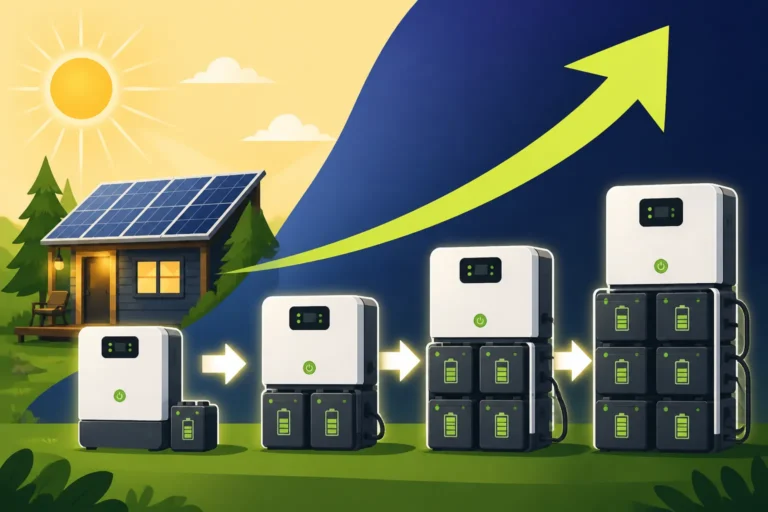
For larger off-grid systems, especially those running high-draw appliances like mini-splits, an all-in-one hybrid inverter-charger can simplify your setup considerably. These units combine the functions of an inverter, a battery charger (for when you have an AC source like a generator), and a transfer switch into a single device. This integration streamlines wiring, reduces complexity, and often provides sophisticated monitoring and control features. Brands like Outback Power, Schneider Electric, or Sol-Ark offer excellent hybrid inverter-chargers that are well-suited for comprehensive off-grid homes.
Even with a perfectly sized solar array and battery bank, there will be times when Mother Nature doesn't cooperate – extended cloudy periods, heavy snow covering panels, or simply higher-than-expected power consumption. This is where a backup generator becomes invaluable. Connecting a generator to a hybrid inverter-charger allows it to automatically kick on and charge your batteries when they get low, ensuring your mini-split (and other critical loads) continue to run uninterrupted. The inverter-charger intelligently manages the power, preventing overcharging and shutting off the generator once the batteries are topped up. This provides peace of mind and significantly enhances the reliability of your off-grid mini-split system. For more information on adding this safety net, consider reading Cost of Adding a Generator to Off-Grid Solar.
Optimizing Performance and Real-World Scenarios
Running a mini-split off-grid isn't just about the initial setup; it's also about smart usage and adapting to the realities of solar power. Understanding environmental factors and making efficient choices can make a huge difference in your day-to-day comfort and system longevity.
Factors Impacting Efficiency and Energy Savings
Several external factors can significantly impact how much energy your mini-split consumes and, by extension, how much solar power you need. The most obvious is your home's insulation. A well-insulated tiny home or cabin will retain heat or cool far more effectively than an older, drafty structure. This means your mini-split won't have to work as hard or as long, leading to substantial energy savings. Upgrading insulation, sealing air leaks, and using energy-efficient windows are often the first and most cost-effective steps before even thinking about solar sizing for climate control.
Beyond insulation, shading can be a big concern for your solar panels. Even partial shading from a tree branch or chimney can drastically reduce the output of an entire string of panels, hurting your ability to keep up with the mini-split's demands. Regular cleaning of panels is also important; dust, pollen, and bird droppings can accumulate and reduce efficiency.
Choosing an energy-efficient mini-split itself is paramount. Look for units with high SEER and HSPF ratings. Many modern mini-splits offer "eco" or "sleep" modes that can further reduce power consumption during off-peak hours. Smart thermostats specifically designed for mini-splits can also help optimize usage by learning your patterns and adjusting temperatures automatically, similar to how they would on the grid. Every watt-hour saved by the mini-split is a watt-hour less your solar system has to generate and store, making your system more robust and affordable.
Adjusting for Seasonal Changes and Environmental Conditions
One of the biggest real-world challenges for off-grid mini-split users is adapting to seasonal changes. In winter, not only are solar panels less efficient due to lower sun angles and shorter daylight hours, but mini-splits (when used for heating) may also draw more power to combat colder temperatures. The efficiency of a mini-split can decrease in extremely cold conditions, often requiring more electricity to produce the same amount of heat. This creates a double whammy: less solar input and higher energy demand.
Conversely, in summer, longer daylight hours might mean more solar production, but extreme heat will also push your mini-split to its maximum cooling capacity, increasing its consumption. Planning your system for your worst-case scenario – typically winter for heating or peak summer for cooling, depending on your climate and usage – is essential. This often means oversizing your solar array and battery bank to account for those challenging periods. Many off-gridders choose to supplement their mini-split heating in winter with a wood stove or propane heater to reduce electrical load. If you're planning for year-round comfort, especially in a cold climate, you might find it helpful to review How to Design for Year-Round Off-Grid Power or Off-Grid Solar Cost in Cold Climates.
Example Off-Grid Mini Split Sizing Scenarios
Let's look at a couple of hypothetical scenarios to tie all this together:
Scenario 1: Small Cabin, Mild Climate, Summer Cooling Only
- Need: Cooling for a 400 sq ft cabin during summer weekends (Friday evening to Sunday afternoon). Average outside temperature 85°F, inside target 75°F.
- Mini-Split: 9,000 BTU, average 750W while running.
- Usage: ~8 hours per day for 2.5 days = 20 hours total.
- Energy Consumption: 750W * 20 hours = 15,000 Wh (15 kWh) per weekend. This needs to be available from the batteries.
- Solar Array: Assuming 5 peak sun hours (PSH) per day on average over the weekend, and needing to recharge 15 kWh over 2 days (7.5 kWh/day): (7,500 Wh / 5 PSH) / 0.75 (losses) = 2,000 watts of panels. (Eight 250W panels).
- Battery Bank: For 1.5 days of autonomy on a 48V system (assuming 80% usable DoD for LiFePO4): (7,500 Wh/day * 1.5 days) / 0.80 = 14,062.5 Wh. Converted to Ah: 14,062.5 Wh / 48V = 293 Ah. (Three 100Ah 48V LiFePO4 batteries, or multiple 12V/24V in series/parallel).
- Inverter: 2,000W pure sine wave inverter with at least 4,000W surge capacity to handle the mini-split and a few lights.
Scenario 2: Full-Time Off-Grid Home, Moderate Climate, Year-Round Heating & Cooling
- Need: Year-round climate control for a 1,500 sq ft, well-insulated home.
- Mini-Split: Multiple units totaling 24,000 BTU (e.g., one 12k BTU and two 6k BTU zones), averaging 2,000W total when actively running during peak times.
- Usage: 12 hours/day on average during peak seasons (winter heating, summer cooling).
- Energy Consumption: 2,000W * 12 hours/day = 24,000 Wh (24 kWh) per day.
- Solar Array: Assuming 3 PSH in winter (worst-case), needing 24 kWh/day: (24,000 Wh / 3 PSH) / 0.75 (losses) = 10,667 watts of panels. (About twenty-seven 400W panels). This is a substantial How Many Solar Panels for Off-Grid Living for year-round comfort!
- Battery Bank: For 3 days of autonomy on a 48V LiFePO4 system (80% usable DoD): (24,000 Wh/day * 3 days) / 0.80 = 90,000 Wh. Converted to Ah: 90,000 Wh / 48V = 1,875 Ah. (Nineteen 100Ah 48V LiFePO4 batteries, or numerous smaller ones). This highlights why How Batteries Drive Off-Grid Solar Cost so much.
- Inverter: 5,000W (or even 8,000W for redundancy) pure sine wave inverter with at least 10,000W surge capacity to handle multiple mini-splits and other household appliances. A hybrid inverter-charger with generator integration would be highly recommended here.
These examples clearly illustrate that running a mini-split off-grid requires a significant investment in a robust solar power system. It's not a small undertaking, but with careful planning and smart energy management, it's absolutely achievable, offering the comfort of modern climate control even in the most remote locations.
Disclaimer
The information provided in this guide is for general informational purposes only and does not constitute professional advice. Off-grid solar system design and installation can be complex and dangerous. Always consult with qualified professionals and adhere to all local electrical codes and regulations.