How Much Solar to Run A Microwave
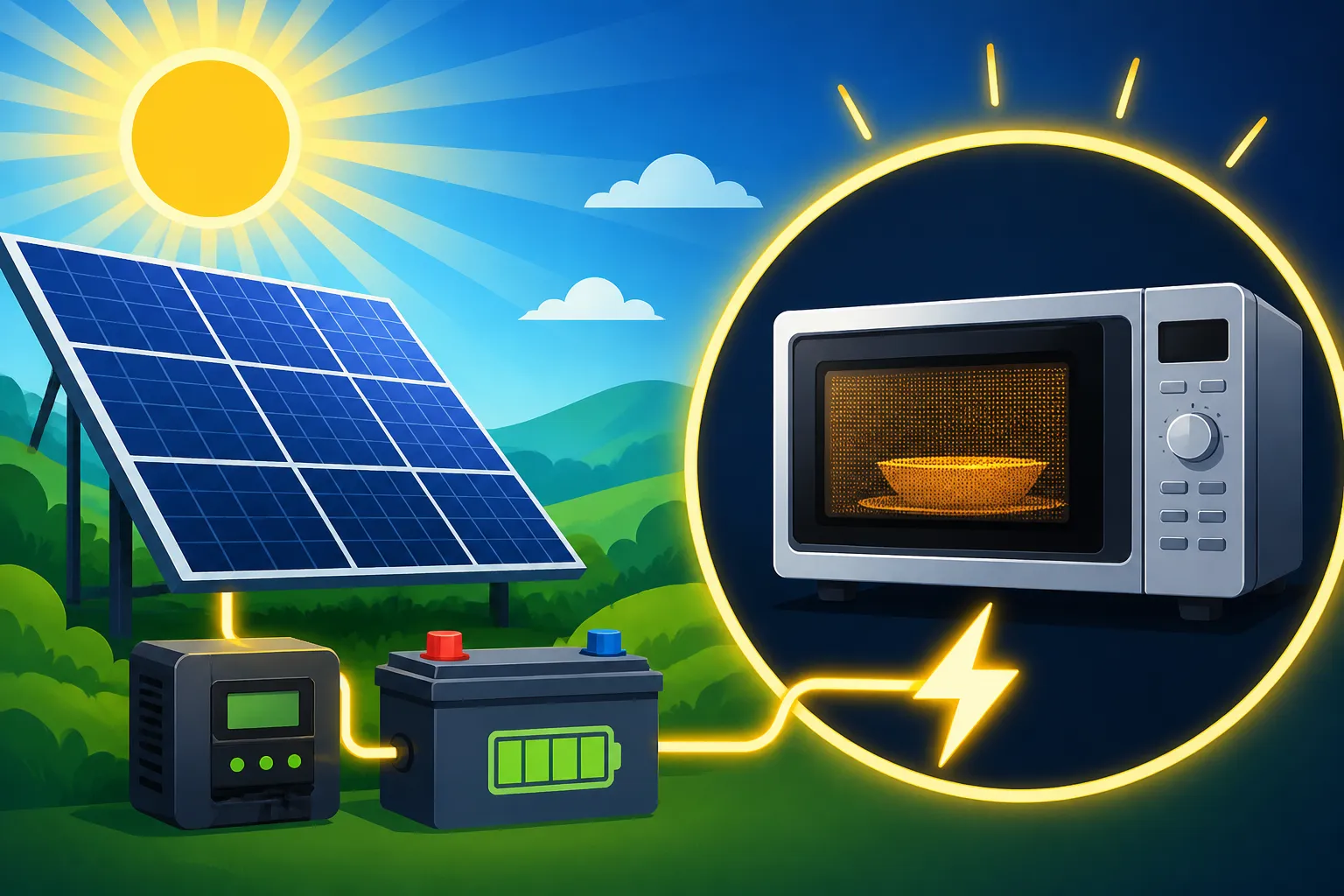
There’s nothing quite like the convenience of a microwave. Whether you’re living off-grid in a cozy cabin, traveling the country in your RV, or simply want the option for a quick warm-up without relying on the grid, the idea of ditching your stovetop for instant food can be incredibly appealing. But then reality hits: microwaves are notorious energy hogs, and figuring out how much solar power you actually need to run one can feel like trying to solve a complex puzzle. This guide will walk you through everything you need to know to reliably power your microwave with off-grid solar, breaking down the components and calculations involved so you can enjoy that hot cup of coffee or warmed-up meal with confidence.
Demystifying Microwave Power Consumption
Before you can even begin to think about solar panels and batteries, you need a solid understanding of exactly how much power your microwave demands. It’s not just about the wattage listed on the box; there are a few other critical factors at play that can trip up even experienced off-gridders.
Understanding Watts, Watt-Hours, and Surge Power
When you look at a microwave, you'll typically see its power rating in watts (W). This number, often between 700W and 1200W for household models, tells you how much electricity the appliance uses while it's running. But that's only part of the story.
- Running Watts: This is the continuous power your microwave draws during operation. If your microwave is rated at 1000 watts, it will continuously pull 1000 watts from your system as long as it's cooking.
- Starting or Surge Watts: This is the really important number for off-grid solar, and it's often overlooked. When a microwave first kicks on, its motor, magnetron, and other components demand a brief, but significantly higher, burst of power – known as surge power or starting watts. This surge can be 1.5 to 2.5 times its running wattage, sometimes even higher. So, a 1000-watt microwave might momentarily demand 1500 to 2500 watts (or more!) for a fraction of a second. If your inverter can't handle this initial surge, your microwave simply won't start, or your inverter will trip. This is a common frustration for many trying to power high-draw appliances off-grid.
- Watt-Hours (Wh): This is your total energy consumption over time. While watts tell you how much power an appliance uses at any given moment, watt-hours tell you how much energy it consumes over a period. For example, a 1000-watt microwave used for 6 minutes (0.1 hours) consumes 1000W * 0.1h = 100 Wh of energy. This is crucial for sizing your battery bank, as it represents the total amount of energy your batteries need to supply.
Typical Microwave Wattage and Usage Patterns
Microwaves come in various sizes and power levels, and your specific model will dictate your solar needs.
- Small, Compact Microwaves (600-900 Watts): These are often found in RVs, tiny homes, or small apartments. They're great for quick reheating or simple tasks. For example, a 700-watt microwave might be perfect for heating up leftovers or making popcorn, consuming about 700Wh per hour of use.
- Mid-Size Microwaves (900-1200 Watts): These are standard kitchen workhorses. A 1000-watt microwave is very common, offering a good balance of speed and efficiency for most household cooking needs. This means a quick 5-minute warm-up would use roughly 83 watt-hours (1000W * 5/60h).
- Larger, Feature-Rich Microwaves (1200-1700+ Watts): These often include convection or grill features and are typically found in larger homes. While powerful, they’re generally overkill for off-grid living due to their massive power draw.
- Inverter Microwaves: Some modern microwaves use inverter technology to deliver a continuous, consistent power level, rather than cycling on and off. While they might be slightly more energy-efficient during operation, they still have an initial surge, though it might be less aggressive than traditional models. Always check the manufacturer's specifications for both running and peak wattage.
It's also important to consider how often and how long you plan to use your microwave. Using it for a few minutes once a day is vastly different from using it several times throughout the day for extended periods. Your usage pattern directly impacts the total daily energy draw from your battery bank. If you’re consistently warming up meals and snacks, you’ll need a more robust system than someone who only uses it for a rare treat.
The Essential Solar Components for Microwave Power
Running a microwave off-grid isn't just about slapping a solar panel on your roof; it requires a carefully balanced system of components working in harmony. Each piece plays a vital role in harvesting sunlight, storing that energy, and converting it into usable power for your hungry microwave.
Solar Panels: Capturing the Sun's Energy
The solar panels are your energy collectors, converting sunlight into DC (direct current) electricity. When sizing panels for a microwave, you need to consider two main things: how much power you need to generate to recharge your batteries, and how many hours of effective sunlight you get each day.
- Matching Generation to Consumption: Your panels need to produce enough energy to replace what you pull from your batteries, plus a bit extra to account for system inefficiencies and cloudy days. For instance, if your microwave uses 100 Wh of energy for a typical use, and you use it twice a day, that's 200 Wh. But that's just the microwave! You'll have other loads too. If you only get 4 "peak sun hours" a day (the equivalent of 4 hours of full sun), a 100-watt panel could theoretically generate 400 Wh per day. So, to cover just your microwave, you'd need at least a 50W panel, assuming perfect conditions and no other loads. Realistically, you'll need significantly more to cover your entire daily usage, including the microwave.
- Panel Wattage and Quantity: Common panel sizes range from 100W to 400W or more. To power a system that can reliably run a microwave, you're likely looking at a minimum of 400-800 watts of solar panels, especially if you have other appliances. For a more robust setup, or if you live in a region with less consistent sun, you might need 1000 watts or even 2000 watts of solar panels. For a truly comfortable off-grid experience, a good starting point for a system running a microwave alongside other daily essentials might be four 200-watt panels, totaling 800 watts. You can learn more about How Many Solar Panels for Off-Grid Living in our detailed guide.
Battery Bank: Storing Your Power Reserve
Your battery bank is the heart of your off-grid system, storing the solar energy generated by your panels so you can use it anytime, day or night. For high-draw appliances like microwaves, a robust battery bank is non-negotiable.
- Capacity is King: Batteries are rated in amp-hours (Ah) or kilowatt-hours (kWh). You need enough capacity to power your microwave and all other appliances between charging cycles, typically overnight or during extended cloudy periods. Lithium iron phosphate (LiFePO4) batteries are increasingly popular for off-grid systems due to their long lifespan, deep discharge capability, and high efficiency, though they come with a higher upfront LiFePO4 vs Lead-Acid Battery Cost. Lead-acid batteries (AGM, Gel) are more budget-friendly but require more careful management and have a shorter lifespan.
- Calculating Battery Needs: Let's say your 1000W microwave runs for 5 minutes (0.083 hours) and uses 83 Wh per session. If you use it three times a day, that's 249 Wh. Add in other appliances, and your daily total might easily hit 2,000 Wh (2 kWh) or more. For a 12V system, 2 kWh is about 166 Ah. However, you rarely want to fully discharge your batteries. LiFePO4 batteries can safely be discharged to 80-90%, while lead-acid should only be discharged to 50% to maximize their lifespan. This means you need significantly more stated capacity than your daily usage. For instance, to get 166 Ah of usable power from lead-acid batteries, you’d need about 332 Ah of total capacity. A common setup to handle a microwave might involve two to four 100Ah LiFePO4 batteries in a 12V or 24V configuration, offering 200-400Ah of usable capacity. To understand this better, check out our guide on How Many Batteries for an Off-Grid System.
Inverter: Converting DC to AC Power
This is where many people run into trouble with microwaves. Your solar panels and batteries produce DC power, but your microwave and most household appliances run on AC (alternating current) power. The inverter's job is to convert DC to AC.
- Pure Sine Wave is Essential: For sensitive electronics and appliances with motors (like microwaves), you must use a pure sine wave inverter. Modified sine wave inverters are cheaper but can damage appliances, make them run inefficiently, or simply prevent them from working at all. Don't skimp here.
- Handling the Surge: Remember those starting watts we talked about? Your inverter needs to be robust enough to handle the microwave's surge power. If your 1000W microwave has a 2000W surge, your inverter needs a continuous rating of at least 1000W (preferably 1200-1500W for overhead) and a surge rating of 2000W or higher. Many inverters specify both their continuous and peak surge ratings. A 2000-watt pure sine wave inverter is often a minimum recommendation for reliably running a standard microwave, especially if you plan to run other appliances simultaneously. Brands like Victron Energy or Renogy offer reliable pure sine wave inverters that can handle these demands. You can read more about How to Size an Off-Grid Inverter for a deeper dive.
Charge Controller: The System's Brain
The charge controller regulates the voltage and current coming from your solar panels, ensuring your batteries are charged efficiently and safely, preventing overcharging.
- MPPT vs. PWM: For any serious off-grid solar setup, especially one running a microwave, an MPPT (Maximum Power Point Tracking) charge controller is almost always the superior choice. MPPT controllers are more efficient, especially in varying light conditions, which translates to more power harvested from your panels for your battery bank. PWM (Pulse Width Modulation) controllers are simpler and cheaper but less efficient.
- Sizing the Charge Controller: Your charge controller needs to be sized based on your solar panel array's voltage and current output. For example, if you have 800 watts of panels charging a 24V battery bank, and your panels operate at 40V, your maximum current would be around 20 amps (800W / 40V = 20A). You'd want a charge controller rated for at least 25-30 amps to provide a safety margin. A properly sized charge controller ensures that the precious energy you generate is safely transferred to your batteries, ready for microwave duty.
Step-by-Step: Sizing Your Solar System for Microwave Use
Sizing an off-grid solar system isn't a "one size fits all" endeavor. It's a personalized process that accounts for your specific energy needs, geographic location, and desired autonomy. Let’s walk through the calculations needed to figure out how much solar you'll need for your microwave, and then how to incorporate it into your overall system.
Performing a Detailed Load Analysis for Your Microwave and Other Appliances
The first and most crucial step is to understand your total energy consumption. This means more than just your microwave.
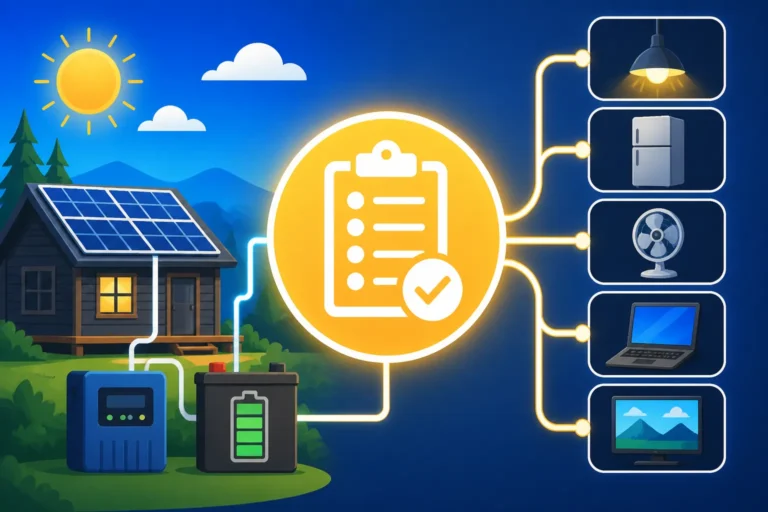
- List All Appliances: Start by listing every single electrical device you plan to use off-grid. This includes lights, phone chargers, laptops, water pump, refrigerator, fans, and, of course, your microwave.
- Find the Wattage: For each appliance, find its running wattage. This is usually on a label, in the owner's manual, or you can find it online. If you can only find amps (A), multiply amps by voltage (V) to get watts (W = A x V).
- Estimate Daily Usage Time: For each appliance, estimate how many hours per day you'll use it. Be realistic. For the microwave, this might be short bursts multiple times a day. For a fridge, it's continuous but cycles on and off.
- Calculate Daily Watt-Hours (Wh): Multiply the wattage of each appliance by its daily usage time.
- Example for a microwave:
- Appliance: Microwave
- Running Watts: 1000W
- Usage: 3 times a day, 5 minutes per use (total 15 minutes or 0.25 hours)
- Daily Wh: 1000W * 0.25h = 250 Wh
- Example for a mini-fridge:
- Appliance: Mini-Fridge
- Running Watts: 80W (but it cycles, so let's estimate 8 hours of actual run time over 24 hours)
- Daily Wh: 80W * 8h = 640 Wh
- Example for a microwave:
- Sum Your Total Daily Watt-Hours: Add up the daily watt-hours for all your appliances. This gives you your total daily energy consumption. For a modest cabin or RV, this might range from 1,000 Wh (1 kWh) to 4,000 Wh (4 kWh) per day. The microwave will be a significant, but typically short, spike in that daily total.
Calculating Your Solar Panel Array Size
Once you have your total daily watt-hours, you can figure out how many solar panels you need.
- Determine Peak Sun Hours: This is the average number of hours per day your location receives direct, effective sunlight. This varies wildly by season and geography. You can find this data for your specific location online (e.g., National Renewable Energy Laboratory – NREL data). For example, a sunny region in summer might have 5-6 peak sun hours, while a cloudy region in winter might only have 2-3. Let’s assume 4 peak sun hours for our example. You can also explore Peak Sun Hours Explained for more insights.
- Account for System Losses: No system is 100% efficient. You'll lose power due to inverter inefficiency, battery charging losses, wiring resistance, and temperature. A good rule of thumb is to add a 20-30% buffer to your calculated energy needs.
- Calculate Required Panel Wattage:
- Total Daily Wh Needed (with losses): (Your Total Daily Wh) / (1 – System Loss Percentage)
- Example: If your total daily load (including microwave) is 2500 Wh, and you assume 25% losses: 2500 Wh / 0.75 = 3333 Wh.
- Required Panel Array Size (in Watts): (Total Daily Wh Needed) / (Peak Sun Hours)
- Example: 3333 Wh / 4 peak sun hours = 833.25 Watts.
- This means you'd need an 833-watt solar panel array. If you're using 200-watt panels, you'd need about five panels (833W / 200W per panel = 4.16, round up to 5 panels).
- Total Daily Wh Needed (with losses): (Your Total Daily Wh) / (1 – System Loss Percentage)
Sizing Your Battery Bank for Days of Autonomy
Your battery bank needs to store enough energy to last you through periods without sun – like overnight or during cloudy days. This is called "days of autonomy."
- Decide on Days of Autonomy: For critical systems, 2-3 days of autonomy is recommended. For a weekend cabin, 1 day might suffice. Let's aim for 2 days.
- Calculate Total Wh for Autonomy: (Total Daily Wh) * (Days of Autonomy)
- Example: 2500 Wh/day * 2 days = 5000 Wh (5 kWh).
- Account for Depth of Discharge (DoD) and Inverter Efficiency:
- For LiFePO4 batteries, you can safely use 80-90% of their capacity. Let’s use 80% (0.8).
- For lead-acid batteries, only use 50% (0.5).
- Inverter efficiency is typically 85-95%. Let’s use 90% (0.9).
- Required Battery Capacity (in Wh): (Total Wh for Autonomy) / (Battery DoD) / (Inverter Efficiency)
- Example (LiFePO4): 5000 Wh / 0.8 / 0.9 = 6944 Wh (approx. 7 kWh).
- Convert to Amp-Hours (Ah) for a Specific Voltage: If you’re building a 12V system:
- Required Ah = (Required Battery Capacity in Wh) / (System Voltage)
- Example (12V system): 6944 Wh / 12V = 578 Ah.
- You would then look for batteries that add up to this amp-hour rating. For example, six 100Ah 12V LiFePO4 batteries would give you 600Ah.
- Required Ah = (Required Battery Capacity in Wh) / (System Voltage)
Sizing Your Inverter for Microwave Surge
This is often the most critical component for a microwave.
- Identify Microwave Running Watts: (e.g., 1000W)
- Estimate Microwave Surge Watts: Multiply running watts by 1.5 to 2.5.
- Example: 1000W * 2 = 2000W surge.
- Add Other Simultaneous Loads: Consider what else might be running at the exact moment the microwave kicks on. Even if it's just a few lights and a laptop, add their running wattages.
- Example: Microwave surge (2000W) + Lights (100W) + Laptop (60W) = 2160W peak demand.
- Choose an Inverter with Sufficient Continuous and Surge Capacity:
- Your inverter's continuous rating must be greater than your total running watts if everything were on at once (even if you don't plan for it, it's a good safety margin).
- Your inverter's surge rating must be greater than the highest possible surge (usually your microwave or a well pump).
- Example: You’d need an inverter with a continuous rating of at least 1500-2000W (to be safe for all daily running loads) and a surge rating of at least 2200W. A 3000-watt pure sine wave inverter, such as models from Victron or even a high-quality Renogy unit, often provides enough headroom for most single-microwave applications and other concurrent loads.
The Power of an Example Calculation
Let's imagine a small off-grid setup for a remote cabin, wanting to run a 1000W microwave for two 5-minute sessions a day (total 10 mins or 0.167 hours), a small fridge, LED lights, and charge a laptop.
| Appliance | Running Watts (W) | Est. Daily Use (hours) | Daily Watt-Hours (Wh) |
|---|---|---|---|
| Microwave | 1000 W | 0.167 h | 167 Wh |
| Mini Fridge | 80 W | 8 h | 640 Wh |
| LED Lights | 50 W | 4 h | 200 Wh |
| Laptop | 60 W | 3 h | 180 Wh |
| Phone Charger | 10 W | 2 h | 20 Wh |
| TOTAL | 1207 Wh |
Now, let's size the system with 4 peak sun hours and 25% system losses:
- Total Daily Wh Needed (with losses): 1207 Wh / 0.75 = 1609 Wh
- Required Panel Array Size: 1609 Wh / 4 peak sun hours = 402.25 Watts (round up to 400-500W of panels, e.g., two 250W panels).
- Battery Bank (2 days autonomy, LiFePO4 80% DoD, 90% inverter efficiency):
- Total Wh for Autonomy: 1207 Wh/day * 2 days = 2414 Wh
- Required Battery Capacity (Wh): 2414 Wh / 0.8 / 0.9 = 3353 Wh (approx 3.4 kWh)
- For a 12V system: 3353 Wh / 12V = 279 Ah (e.g., three 100Ah 12V LiFePO4 batteries in parallel, giving 300Ah total).
- Inverter Sizing:
- Microwave surge: 1000W * 2 = 2000W.
- Other running loads (if on during surge): Fridge (80W) + Lights (50W) + Laptop (60W) = 190W.
- Total potential surge: 2000W + 190W = 2190W.
- You'd need a pure sine wave inverter with a continuous rating of at least 1500W (for comfortable running of daily loads) and a surge rating of at least 2200-2500W. A 2000W continuous inverter with a 4000W surge capability would be a very safe bet. You can explore What Size Inverter to Run A Microwave for more detailed inverter sizing information.
Practical Considerations and Optimization Tips for Off-Grid Microwave Use
Successfully integrating a microwave into your off-grid lifestyle goes beyond just the numbers. There are practical choices and strategies that can significantly impact your system's performance, longevity, and your overall peace of mind.
The Impact of Other Appliances and Concurrent Use
It’s rare that your microwave is the only thing drawing power. Consider what else you might be running simultaneously. If your refrigerator cycles on at the same time you start the microwave, or if you’re running a well pump while heating up dinner, the combined surge and continuous draw can easily overwhelm an undersized inverter or quickly drain your batteries.
- Staggering Usage: A simple solution is to manually stagger your high-draw appliances. Avoid running your washing machine at the same time as your microwave, for instance. This requires a bit of mindfulness but can save you from having to massively oversize your entire system.
- Prioritizing Loads: In some off-grid setups, people implement load prioritization. This means certain "critical" appliances (like a medical device or refrigerator) get power priority, and if the system is under strain, non-essential items like a microwave might be temporarily cut off. This is a more advanced setup, often managed by smart inverter/charger units from brands like Victron.
- System Voltage Matters: For larger systems that need to handle significant loads like a microwave, choosing a higher system voltage (24V or 48V instead of 12V) can be incredibly beneficial. Higher voltages mean lower currents for the same amount of power, which leads to less voltage drop over cables, smaller wire sizes, and overall more efficient power transfer. This is why you'll often see larger off-grid homes utilizing 48V systems. For more details, consider reading about 12V vs 24V vs 48V: Which to Choose.
Efficiency Tips and Alternatives
While a microwave offers convenience, it's one of the least efficient ways to heat food in an off-grid setting when considering its peak power draw.
- Embrace Alternatives: Consider supplementing your microwave with more off-grid friendly cooking methods. A propane stove, a solar oven (for sunny days), or even an efficient 12V slow cooker or instant pot can significantly reduce your electrical load. A small toaster oven might use less surge power than a microwave, though its continuous draw over a longer cooking time could be similar or higher in terms of total watt-hours.
- Choose Energy-Efficient Microwaves: Look for microwaves with inverter technology, as they tend to be more efficient in their power delivery and sometimes have a less aggressive surge. Also, consider the physical size. A smaller microwave will generally have a lower wattage. You might find a wide range of portable microwaves on Amazon that claim lower wattages specifically for RV or small space use.
- Optimize Usage: Use your microwave strategically. Only run it for the minimum time required. Defrost food ahead of time to reduce cooking duration. Cover food to trap steam and speed up heating. These small habits can collectively save a surprising amount of energy.
DIY vs. Pre-Built Kits and Expandability
When setting up your off-grid system for a microwave, you have choices in how you acquire components.
- DIY Approach: Building your system from individual components allows for maximum customization and can often be more cost-effective if you know what you're doing. You can hand-pick the best solar panels, batteries, and inverter to perfectly match your microwave's needs and other loads. However, it requires a good understanding of electrical systems, wiring, and safety. If you're considering a DIY approach, make sure you understand How Much Cheaper Is DIY Off-Grid Solar and the technicalities of How to Wire an Off-Grid Solar System.
- All-in-One Kits: For beginners or those who prefer simplicity, many brands like Renogy offer comprehensive off-grid solar kits. These kits typically include panels, a charge controller, an inverter, and sometimes batteries, all designed to work together. While convenient, make sure the inverter in the kit is robust enough for your microwave's surge requirements. You might need to upgrade certain components within a kit or opt for a larger kit than initially planned if the microwave is a priority load. Many kits are excellent for basic power, but microwave capability often requires stepping up to a higher tier or custom solutions.
- Plan for Expandability: If your budget is tight, you might start with a smaller system and plan to add more panels or batteries later. However, the inverter is usually the most expensive component for high-draw appliances, and it's difficult to upgrade later without replacing it entirely. It's often wiser to size your inverter generously from the start if you anticipate wanting to run a microwave or other powerful appliances down the line. How to Design an Expandable System can offer more insights into future-proofing your setup.
Ultimately, powering a microwave with off-grid solar is entirely achievable, but it requires careful planning, accurate calculations, and a realistic understanding of its energy demands. By focusing on a robust inverter, sufficient battery storage, and adequate panel generation, you can enjoy the modern convenience of a microwave, even when you're far from the utility grid.
Disclaimer
The information provided in this guide is for general informational purposes only and does not constitute professional advice. Off-grid solar system design and installation can be complex and involve electrical hazards. Always consult with qualified professionals and adhere to all local codes and regulations when planning or installing your solar system. Improper installation can lead to property damage, injury, or fire.