How to Calculate Daily Energy Usage
Venturing into the world of off-grid solar can feel like stepping into a dense forest without a map. One of the very first, and often most intimidating, hurdles you'll face is figuring out exactly how much power you really need. The fear of undersizing your system and constantly running out of power, or oversizing it and blowing your budget, is completely legitimate. This comprehensive guide will walk you through the precise steps to calculate your daily energy usage, ensuring you build an off-grid solar system that perfectly matches your lifestyle and keeps your lights on, no matter what.
Why Accurate Energy Usage Calculation is Crucial for Off-Grid Living
Getting your energy usage right isn't just a suggestion; it's the bedrock of a successful off-grid solar setup. Without a clear understanding of your daily power demands, you're essentially guessing, and when it comes to living independently from the grid, guesswork can lead to frustrating blackouts, premature equipment failure, and a much lighter wallet than necessary. It’s about balance: generating enough power, storing enough power, and not wasting a single drop of precious sunlight or a single dollar on unnecessary equipment.
Avoiding Undersizing and Oversizing Your System
Imagine you've built your dream cabin deep in the woods, fired up your new solar system, and then… your refrigerator cuts out every evening because your batteries are drained. Or, worse, you can't even run your water pump for a hot shower without dimming the lights. This scenario, where your system is too small for your needs, is a common and disheartening problem for many new off-gridders. An undersized system means constant power anxiety, having to make difficult choices about what appliances to run, and the potential for expensive, last-minute upgrades. It also means your batteries will constantly be running to a low state of charge, which dramatically reduces their lifespan, especially if you're using lead-acid batteries.
On the flip side, oversizing your system can also be a significant issue, primarily impacting your finances. Solar panels, batteries, and inverters are not cheap. If you calculate that you need 5,000 watts of solar panels and a massive 20 kWh battery bank, only to find out you actually only use 2,500 watts daily, you've spent thousands of extra dollars on equipment that sits largely unused. This capital could have been invested in other essential off-grid infrastructure, like a robust water system or better insulation for your home. Finding the sweet spot ensures you get the most reliable power for the most sensible investment, allowing you to maximize your Off-Grid Solar Return on Investment
/off-grid-solar-return-on-investment).
Impact on Budget and Component Lifespan
Every component in your off-grid solar system – from the individual solar panels to the robust battery bank and the intricate charge controller – has a cost and a designed lifespan. Accurate energy usage calculations directly influence the size and quantity of these components. For example, if you know you need to power a larger homestead with a constant demand for appliances, you'll invest in high-capacity components and likely opt for Best Off-Grid Solar Panels that offer durability and efficiency. Conversely, if your needs are minimal, like powering a small shed for tools, a smaller, more budget-friendly setup might be ideal.
Beyond the initial purchase price, the way your system is used, which is dictated by your actual energy demands, significantly affects the longevity of your components. Batteries, especially, suffer from improper sizing. Consistently discharging them too deeply because your system is undersized will drastically shorten their cycle life, requiring costly replacements much sooner than anticipated. Imagine replacing a large lithium battery bank years before its expected 10-15 year lifespan because you miscalculated your needs. This can be a huge, unforeseen expense. Properly sized components, on the other hand, operate within their optimal parameters, extending their life and saving you money on maintenance and replacement costs over the long run. Understanding your daily energy usage is the first step in creating a sustainable and cost-effective off-grid solution, helping you understand the Lifetime Cost of an Off-Grid Solar System.
Understanding the Basics: Watts, Watt-Hours, and Amps
Before you can calculate your energy usage, it’s vital to grasp the fundamental electrical terms that define how power is measured and consumed. Think of it like learning to read a recipe: you need to understand what "grams" and "milliliters" mean before you can bake a cake. In the world of off-grid solar, Watts, Watt-hours, and Amps are your essential units of measurement. These terms help you understand the difference between how much power an appliance needs at any given moment and how much total energy it consumes over a period, which is the key to sizing your battery bank and solar array.
Differentiating Power (Watts) from Energy (Watt-Hours)
This is perhaps the most critical distinction to grasp. Watts (W) measure power, which is the instantaneous rate at which electricity is being consumed or produced. Think of it like speed: a car might be going 60 miles per hour at a specific moment. An appliance's wattage tells you how much power it draws when it's turned on. For instance, a typical LED light bulb might draw 10 watts, and a microwave might draw 1000 watts while it's heating food. These are momentary snapshots of power demand.
Watt-hours (Wh), on the other hand, measure energy, which is the total amount of electricity consumed over a period of time. Using the car analogy again, watt-hours are like the total distance traveled. If your 10-watt LED light bulb runs for 5 hours, it consumes 10 W * 5 hours = 50 Wh of energy. If your 1000-watt microwave runs for 15 minutes (0.25 hours), it consumes 1000 W * 0.25 hours = 250 Wh. When you calculate your daily energy usage, you're primarily aiming to find your total daily watt-hours, because this is the figure that dictates how much energy your solar panels need to generate and how much your batteries need to store. It’s how we determine How Many kWh Does an Off-Grid Home Need.
The Role of Amps and Voltage in DC Systems
While watts and watt-hours are crucial for overall energy calculations, Amps (A) and Voltage (V) are equally important, especially when dealing with the DC (Direct Current) side of your off-grid system, like batteries and charge controllers. Amps measure the electrical current – essentially, the volume or flow of electricity. Voltage measures the electrical potential difference or the "pressure" that pushes the current. In a DC system, the relationship is simple: Watts = Volts x Amps.
Why does this matter? Many DC appliances (common in RVs, boats, or smaller off-grid setups) are rated in amps, especially 12V or 24V devices. For example, a 12V fan might draw 2 amps. To convert this to watts, you'd calculate 12V * 2A = 24 Watts. When you're dealing with battery capacity, which is often listed in Amp-hours (Ah), understanding amps becomes paramount. A 100 Ah 12V battery can theoretically provide 100 amps for one hour at 12 volts (or 1200 Wh). Knowing these relationships helps you connect your appliance needs to your battery's capabilities. For a deeper dive, check out our guide on Watts vs Watt-Hours vs Amp-Hours Explained.
How to Read Appliance Labels and Specifications
Most appliances, whether they run on AC (Alternating Current, like household outlets) or DC, will have a label or a data plate that lists their electrical specifications. This is your treasure map for calculating energy usage. Look for:
- Wattage (W): This is the ideal figure to find. It's usually listed directly on the label. Sometimes it might be given as "Max Power Consumption" or "Rated Power."
- Amperage (A): If wattage isn't listed, amperage often is. You'll also see the voltage. Remember our formula: Watts = Volts x Amps. So, if a 120V AC appliance says 5A, it's 120 * 5 = 600W. For DC devices, if it says 12V, 3A, it's 12 * 3 = 36W.
- Voltage (V): Essential for the Amp-to-Watt conversion and for ensuring your appliance is compatible with your inverter's output (usually 120V AC) or your battery's DC voltage (12V, 24V, or 48V).
- Starting/Surge Watts: For motors (refrigerators, well pumps, power tools), you might see a "starting wattage" or "surge power" much higher than the "running wattage." This momentary spike needs to be accounted for when sizing your inverter to ensure it can handle the initial kick, which is crucial when you learn How to Size an Off-Grid Inverter for Surge Loads.
Sometimes, labels can be tricky or even missing. In such cases, you can use a kill-a-watt meter (easily found on Amazon) to plug your AC appliances into and directly measure their wattage. For DC devices, a multimeter can measure amperage, which you then multiply by the voltage. Don't be afraid to look up common appliance wattages online if you're stuck – there are many reputable databases available.
Step-by-Step Guide to Performing a Load Analysis
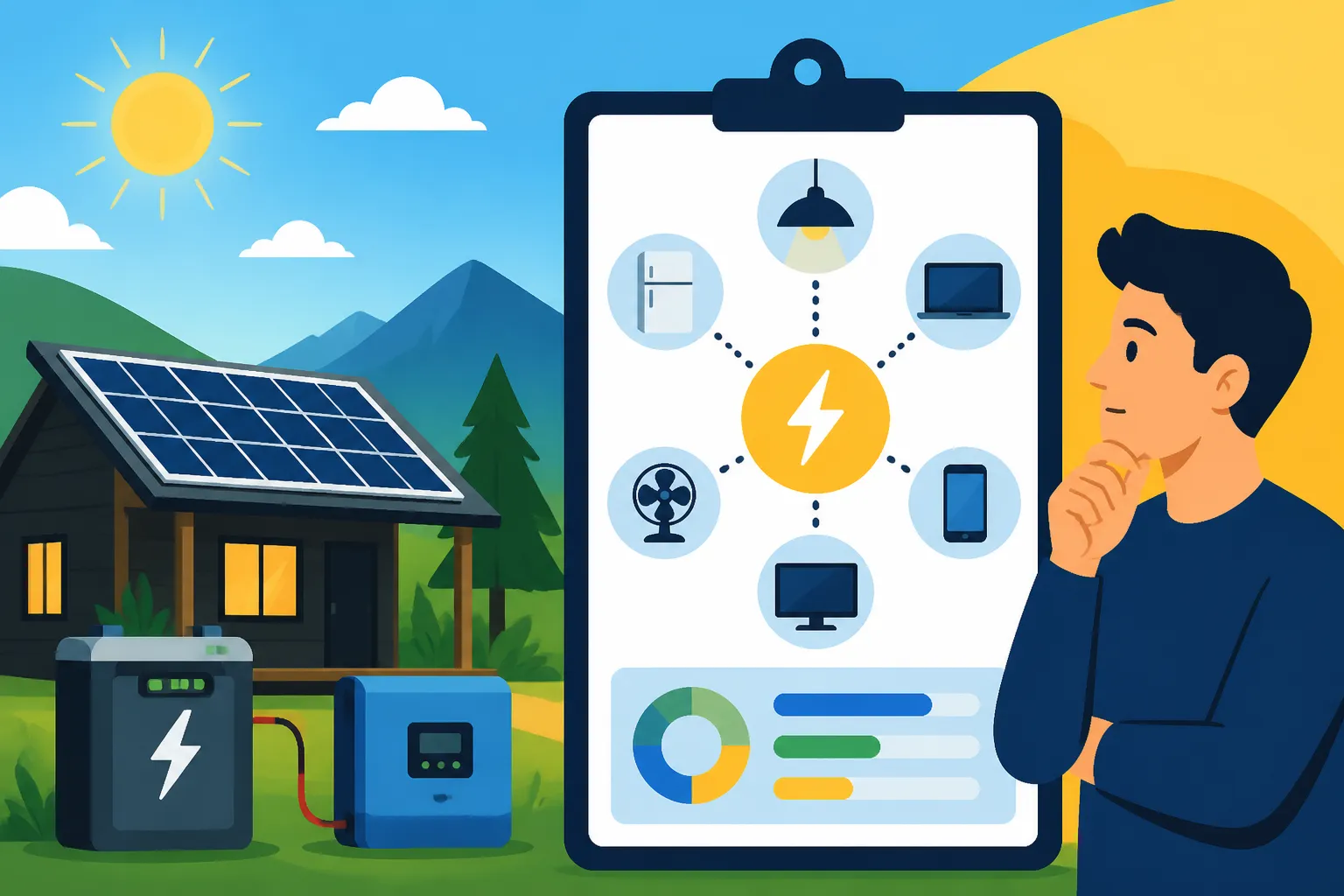
Now that you understand the basic terminology, it's time to get down to the nitty-gritty: the actual load analysis. This is where you become an energy detective, meticulously documenting every single device that will draw power from your off-grid system. This isn't just about big appliances; it's about everything from your phone charger to your coffee maker. Taking the time to do this accurately is an investment that pays off immensely in the reliability and efficiency of your solar power system.
Inventorying All Your Appliances and Devices
The first step is to grab a notebook, a spreadsheet, or even a simple piece of paper, and walk through your home or off-grid setup, making a comprehensive list of every electrical device you plan to use. Be thorough! This includes:
- Major Appliances: Refrigerator, freezer, microwave, washing machine, dryer (if electric), well pump, water heater, air conditioner, mini-split.
- Kitchen & Small Appliances: Coffee maker, toaster, blender, electric kettle, instant pot, hand mixer.
- Electronics & Entertainment: TV, stereo, laptop, desktop computer, printer, phone chargers, tablet chargers, gaming console, Wi-Fi router, satellite receiver.
- Lighting: All light fixtures, indoor and outdoor (count bulbs and their wattage).
- Heating & Cooling (supplemental): Electric blankets, fans, space heaters (be cautious with these, they're major power hogs).
- Tools & Workshop Equipment: Power tools (drills, saws), air compressor, shop vacuum, battery chargers for tools.
- Miscellaneous: Hair dryer, electric toothbrush, CPAP machine, security cameras, electric gate openers.
Don't forget items that might seem insignificant but add up, like a digital clock on a microwave or a standby light on a TV. These are often referred to as "phantom loads." Write down the actual wattage for each item if you can find it on the label. If not, make a note to look it up or measure it later. This detailed list forms the foundation of your Off-Grid Solar Load Calculation Explained.
Estimating Daily Usage Hours for Each Item
Once you have your exhaustive list, the next crucial step is to estimate how many hours each appliance will run per day. This is where realism comes into play. It's easy to underestimate, especially for intermittent loads. Be honest with yourself about your habits.
- Continuous Loads: Some appliances run 24/7, or nearly so. Your refrigerator, for example, might cycle on and off throughout the day but essentially needs power continuously. Estimate its actual run time (e.g., a modern fridge might run 8-12 hours per day in total cycles). A Wi-Fi router, security system, or even a constantly running laptop (though most laptops have batteries) would fall into this category.
- Intermittent Loads: Most appliances fall here. How long do you typically run your microwave? 5 minutes? 15 minutes? Your coffee maker? Maybe 10 minutes to brew. Your TV? 3 hours in the evening? Your laptop? 6 hours? Be specific. For something like a well pump, you might need to estimate how many times you shower, flush toilets, or use water for dishes, and then multiply by the pump's run time per activation.
- Seasonal Loads: Will you run an air conditioner heavily in summer? Or electric blankets and space heaters in winter? Factor these in, perhaps creating separate summer and winter load calculations.
It's helpful to break your day into segments (morning, afternoon, evening) and mentally walk through your routine. This helps ensure you don't forget anything. For example, you might use a toaster for 5 minutes in the morning, a laptop for 4 hours in the afternoon, and lights for 5 hours in the evening.
Accounting for Phantom Loads and Peak Surges
These two often-overlooked aspects can significantly throw off your calculations if ignored.
Phantom Loads: These are the "silent killers" of your off-grid battery bank. They are devices that draw power even when they appear to be off or in standby mode. Think of the little LED light on your TV, the clock on your microwave, phone chargers left plugged in without a phone, or even an inverter sitting idle. Individually, they might only draw 1-5 watts, but collectively, and over 24 hours, they can add up to a substantial amount of wasted energy. A good rule of thumb is to add a small buffer (e.g., 5-10% of your total calculated daily usage) for phantom loads, or be proactive and unplug devices when not in use. Some smart power strips, easily found on Amazon, can help manage these.
Peak Surges (Starting Watts): Many appliances, especially those with motors, draw a significantly higher amount of power for a brief moment when they first start up. This "surge" or "starting wattage" can be 2-7 times their continuous running wattage. A refrigerator, a well pump, or a power drill are prime examples. Your inverter needs to be able to handle this peak surge, even if it's only for a second or two, otherwise, it will trip or shut down. You don't multiply the surge wattage by daily usage hours because it's a momentary event, but you do need to identify the highest surge wattage among all your appliances that might potentially start at the same time. This maximum concurrent surge dictates the minimum continuous rating of your inverter. For example, a refrigerator running at 200W might have a 1200W surge. A well pump running at 1000W might have a 3000W surge. If they both could theoretically turn on at the same time, your inverter would need to handle 1200W + 3000W, plus the running watts of any other active devices.
Calculating Your Total Daily Watt-Hours
With your detailed inventory and estimated usage hours in hand, it's time to consolidate all that information into a single, actionable number: your total daily watt-hours. This figure is the bedrock for determining the size of your solar panel array and your battery bank. Remember, precision here translates directly to a reliable and efficient off-grid system, preventing those frustrating moments of power outages or the regret of overspending.
Separating AC and DC Loads for Precision
While your goal is a grand total in watt-hours, it can be incredibly helpful to categorize your loads into AC (Alternating Current) and DC (Direct Current) groups, especially for a more complex system or if you plan to run some devices directly off your battery bank.
- AC Loads: These are the appliances you typically plug into a standard wall outlet. They require an inverter to convert your battery's DC power into usable AC power. Examples include refrigerators, microwaves, TVs, laptops (with their power bricks), and most household appliances. Most of your daily energy consumption will likely fall into this category.
- DC Loads: These are devices that run directly off your battery bank's voltage (e.g., 12V, 24V, or 48V). Common DC loads include LED lighting specifically designed for DC systems, USB charging ports, 12V fans, water pumps in RVs or cabins, and some specialized electronics. Running DC loads directly from your battery can be more efficient because it bypasses the inverter, which always has some small energy loss (efficiency typically 85-95%).
Why separate them? Knowing your DC loads helps you understand what you could run without an inverter, potentially reducing inverter size requirements or making your system more robust against inverter failure. It also provides a more nuanced picture of your total energy flow. When you're ready to pick components, understanding this split will guide your choice of Best Off-Grid Solar Inverters and Best Off-Grid Solar Batteries.
Aggregating Individual Appliance Data
This is where the math happens. For each item on your meticulously crafted list, you'll perform a simple calculation:
Appliance Wattage (W) x Daily Usage Hours (h) = Daily Watt-Hours (Wh)
Let's take a few examples:
- Refrigerator: (Runs intermittently, but let's assume an equivalent of 10 hours/day run time)
- 200W (running wattage) x 10 hours = 2000 Wh
- LED Lights (x5): (Each 10W, used 4 hours/day)
- (10W x 5 lights) = 50W
- 50W x 4 hours = 200 Wh
- Laptop: (Used 6 hours/day)
- 60W (charging/running) x 6 hours = 360 Wh
- Microwave: (1000W, used 15 minutes/day, which is 0.25 hours)
- 1000W x 0.25 hours = 250 Wh
- Phone Charger: (10W, used 2 hours/day)
- 10W x 2 hours = 20 Wh
Once you've done this for every item, sum up all the individual daily watt-hours to get your Total Estimated Daily Watt-Hours. This number represents the total energy your off-grid solar system needs to produce and store each and every day to meet your current lifestyle demands. This crucial number is then used in more advanced calculations, such as determining How Many Watts of Solar You Need and How Much Battery Capacity You Need.
Real-World Examples and Practical Scenarios
Let's illustrate with a hypothetical small off-grid cabin scenario to show how these calculations come together.
Scenario: A Remote Hunting Cabin for Weekend Use
Our cabin dweller, let's call him Bob, wants to power basic comforts for weekend trips. He's not living there full-time, so his needs are modest.
| Appliance | Wattage (W) | Daily Usage (Hours) | Daily Watt-Hours (Wh) | Notes |
|---|---|---|---|---|
| LED Cabin Lights (x4) | 40 (10W each) | 4 | 160 | Used in the evenings. |
| Mini-Fridge (Energy Star) | 60 | 12 (compressor run time) | 720 | Only on for weekends, but calculated for daily consumption during those days. |
| Phone Charging (x2) | 20 (10W each) | 2 | 40 | Charging two phones. |
| Small Water Pump | 150 | 0.5 (30 mins total) | 75 | For a small sink, maybe 5 minutes x 6 uses. |
| Laptop | 60 | 2 | 120 | Checking weather, emails. |
| Wi-Fi Hotspot | 15 | 6 | 90 | For internet access. |
| Subtotal | 1205 Wh | |||
| Phantom Load Buffer | 120 (10% of subtotal) | Accounts for inverter idle draw, small device standby, etc. | ||
| TOTAL DAILY USAGE | 1325 Wh | Approximately 1.3 kWh per day. This is the number Bob would use to determine his solar panel array size and battery bank capacity for his cabin, ensuring enough power for a weekend stay. |
Based on this calculation, Bob would then look into resources like How Much Solar to Run A Refrigerator or How Many Batteries to Run A Refrigerator to fine-tune his system design. This kind of detailed breakdown, even for simple setups, takes the guesswork out of the equation and leads to a much more reliable power system. If Bob decided to expand his cabin's use to a full-time residence, his calculations would change dramatically, especially if he added an electric stove or larger heating/cooling options.
Refining Your Calculations for Real-World Conditions
Your initial daily watt-hour calculation is a fantastic start, but the real world isn't always perfectly sunny and predictable. To build a truly resilient off-grid system, you need to refine these numbers, taking into account factors like seasonal shifts, potential future growth, and unexpected demands. Overlooking these variables can lead to system underperformance or constant adjustments, which nobody wants when they're aiming for energy independence.
Incorporating Seasonal Changes and Lifestyle Variations
The amount of sunlight your solar panels receive varies drastically throughout the year, especially if you live in an area with distinct seasons. Winter days are shorter, and the sun is lower in the sky, leading to significantly less solar production. Cloudy weather, rain, or snow can further reduce output. Your energy consumption might also change seasonally:
- Winter: You might use more lighting due to shorter days, potentially an electric blanket for warmth, or even run a small electric heater (though these are extremely power-hungry and often require a significant solar array). Your refrigerator might also cycle less frequently if your ambient temperatures are lower, but indoor lights and possibly entertainment systems might see increased use.
- Summer: Air conditioning (even a small mini-split) can become a major load, consuming vast amounts of power. Fans will also be in heavier use. Days are longer, so less artificial lighting might be needed, but outdoor entertainment or cooking could increase.
It's a really smart idea to create at least two load analyses: one for your typical usage and one for your peak season (e.g., winter if you're in a cold, dark climate, or summer if you rely heavily on AC). Always design your system to meet the demands of your worst-case scenario (e.g., coldest, darkest winter week) to ensure year-round reliability. This is a critical factor when learning How Winter Affects Off-Grid Sizing.
Beyond seasonal changes, consider lifestyle variations. Are you a weekend warrior at your cabin, or a full-time off-grid homesteader? Do you host guests frequently, which might mean more lights, hot water, and cooking? Are you planning a new hobby that requires power tools? Factor in these patterns. If you're designing for a mobile setup like an RV, your usage might vary wildly depending on whether you're parked at a campsite with shore power or boondocking in the wilderness for extended periods.
Planning for Future Expansion and Contingencies
One of the biggest regrets off-gridders often express is not planning for future needs. It's almost inevitable that once you experience the freedom of solar power, you'll find new ways to use it. You might decide to add:
- More appliances: A small freezer, a larger TV, a washing machine.
- A workshop: Running power tools that you previously didn't consider.
- Electric vehicle charging: A huge load that requires substantial planning.
- Additional lighting or security features.
It's usually more cost-effective and simpler to design an expandable system from the outset rather than having to completely overhaul it later. Consider oversizing your conduit runs, leaving space on your roof or property for additional panels, or selecting an inverter that can handle a higher load than your initial estimate. Choosing an inverter like a Victron MultiPlus or a Sol-Ark, for example, allows for significant expandability and robust power management. Even just adding a 10-20% buffer to your calculated daily watt-hours provides a bit of wiggle room for future additions or unexpected higher usage. You can learn more about How to Design an Expandable System to save yourself headaches down the road.
Furthermore, always account for contingencies. What if you have a prolonged period of cloudy days? This is where your battery bank's "days of autonomy" come into play. Having enough stored energy to last through 2-5 days of no sun is a common design goal, depending on your risk tolerance and location. This means multiplying your daily watt-hour total by your desired days of autonomy when sizing your batteries. Also, consider a backup generator. Even a small generator can top off your batteries during extended periods of low solar production, offering peace of mind. Our guide on How to Add a Generator to Your Design provides more detail.
Using Tools and Templates for Accuracy
While a pen and paper are perfectly adequate for initial calculations, there are many tools and templates available that can streamline the process and improve accuracy.
- Spreadsheets: Programs like Microsoft Excel or Google Sheets are invaluable. You can create columns for appliance name, wattage, daily usage hours, daily watt-hours, and then easily sum everything up. You can also create separate tabs for different seasons or scenarios. This allows for quick adjustments and helps visualize the impact of adding or removing appliances. Many solar equipment manufacturers, like Renogy, offer free sizing calculators and worksheets on their websites that guide you through the process, often available directly on their product pages or in their support sections.
- Online Calculators: Numerous websites offer free off-grid solar calculators. These tools often ask for your location, desired days of autonomy, and appliance list, then provide estimates for panel, battery, and inverter sizing. While helpful, always double-check their assumptions and ensure they align with your specific needs.
- Wattage Meters (Kill-a-Watt): As mentioned earlier, a "kill-a-watt" meter (widely available on Amazon) is a small device you plug into an AC outlet, and then plug your appliance into it. It will accurately measure the real-time wattage draw and total kilowatt-hours consumed over a period. This is fantastic for getting precise usage data for your actual appliances, especially older ones where labels might be faded or inaccurate.
- Battery Monitors: Once your system is installed, a good battery monitor (like those from Victron Energy) will track your actual energy consumption in real-time. This provides invaluable feedback, allowing you to fine-tune your energy habits and confirm if your initial calculations were accurate. It can even help you pinpoint energy hogs you might not have realized you had.
Utilizing these tools ensures that your off-grid solar system is not just a collection of components, but a finely tuned machine that reliably meets your energy demands, allowing you to truly embrace the freedom of off-grid living.
Disclaimer
The information provided in this guide is for general informational purposes only and does not constitute professional electrical engineering or financial advice. Off-grid solar system design and installation can be complex and involve significant electrical hazards. Always consult with a qualified electrician or solar professional before designing, installing, or making changes to your off-grid solar system to ensure safety and compliance with all applicable codes and regulations. Individual energy consumption and solar production will vary based on location, climate, equipment, and lifestyle.