How Much Solar to Run A Refrigerator
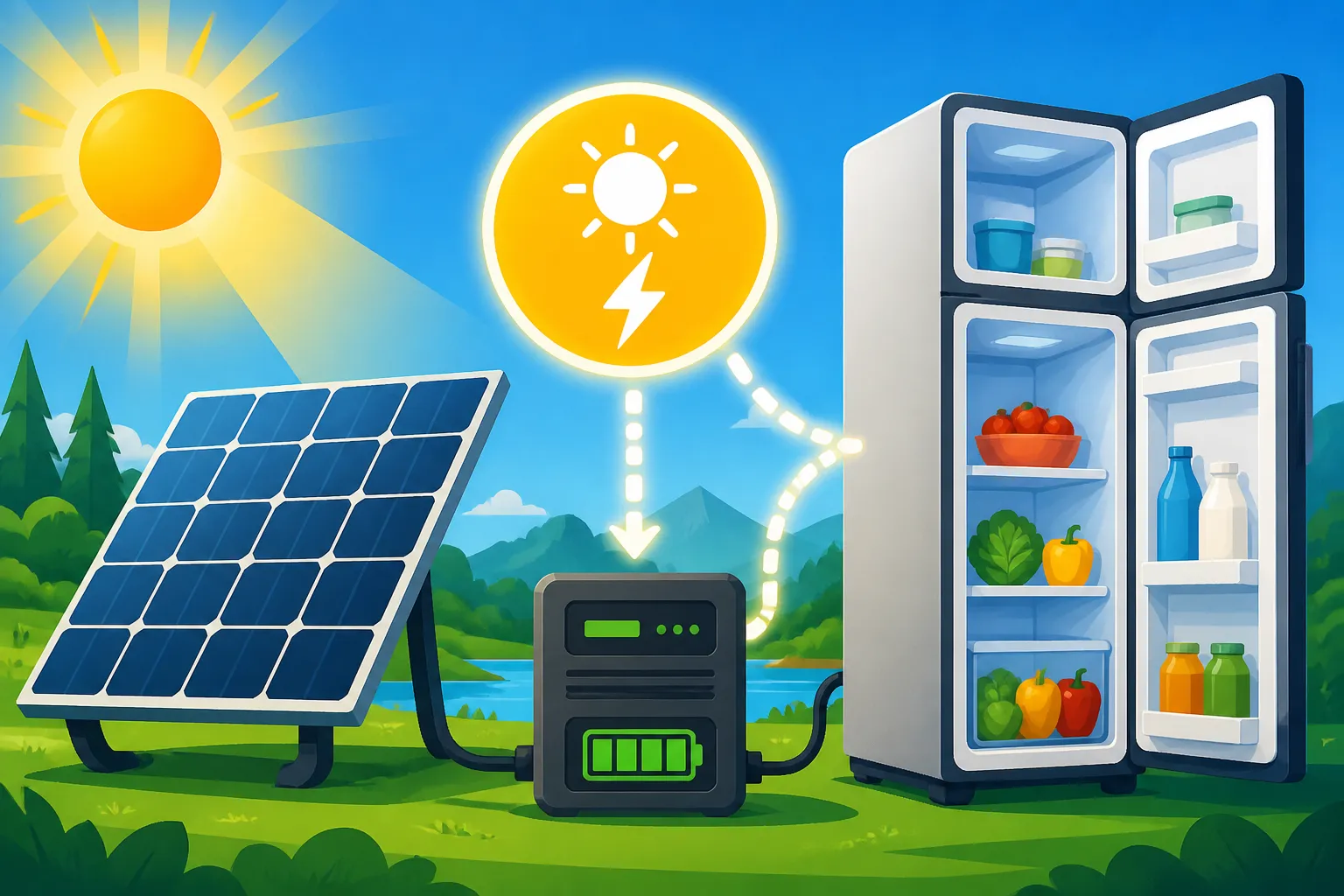
One of the biggest worries for anyone embracing the off-grid lifestyle, whether in a cozy cabin or a full-time RV, is how to keep the refrigerator running. It's not just about convenience; it's about food safety and sanity! Trying to figure out exactly how much solar power you need for this essential appliance can feel like trying to solve a complex puzzle, leaving many folks scratching their heads. This comprehensive guide is here to demystify the process, walking you through everything you need to know to reliably power your fridge with the sun.
Understanding Your Refrigerator's Power Demands
Before you can even begin to think about solar panels and batteries, you've got to get a clear picture of what your refrigerator is actually asking for in terms of electricity. It's not as simple as looking at a single number on a sticker; there are a few different aspects to its power appetite that we need to break down.
Decoding Wattage and Watt-Hours
When you look at an appliance, you often see its wattage listed. This "running wattage" (or sometimes "rated wattage") tells you how much power the appliance draws at any given moment when it's actively running. For a refrigerator, this usually means when the compressor is kicked on and doing its job. A typical household fridge might pull anywhere from 100 to 250 watts while running. But here's the catch: a refrigerator doesn't run constantly. It cycles on and off throughout the day as needed to maintain its internal temperature.
The real hero metric for off-grid solar sizing is watt-hours (Wh), which represents the total amount of energy consumed over a period, usually 24 hours. This is what you absolutely need to calculate to size your battery bank and solar array properly. For example, a refrigerator that runs for 8 hours total over a day, pulling 150 watts while running, would consume 150 watts * 8 hours = 1200 Wh (or 1.2 kWh) per day. This daily watt-hour consumption is far more critical than its instantaneous wattage, as it accounts for the appliance's on-off cycles. Don't forget the "starting wattage" or "surge wattage" either. When a refrigerator's compressor first kicks on, it can momentarily draw significantly more power – sometimes 2 to 3 times its running wattage – for a fraction of a second. Your inverter needs to be able to handle this brief surge.
Factors Affecting Refrigerator Energy Use
It's easy to assume all refrigerators are created equal, but that couldn't be further from the truth, especially when it comes to off-grid power. The type of fridge you have, and even how you use it, dramatically impacts its daily energy draw.
First, consider the type of refrigerator. A traditional, older AC-powered residential fridge designed for grid power can be a real energy hog. They're often less insulated, have less efficient compressors, and are made with the assumption that cheap, continuous grid power is always available. In contrast, modern, energy-efficient models, particularly 12V or 24V DC-specific compressor refrigerators designed for RVs, marine use, or dedicated off-grid living, are built from the ground up to conserve power. These DC fridges don't require an inverter to convert DC battery power to AC, eliminating conversion losses and making them incredibly efficient for direct battery connection. A high-quality DC fridge might use as little as 300-500 Wh per day, while an older AC model could easily suck down 1500-2000 Wh or more.
Beyond the fridge itself, how you use it and its environment play a huge role. Things like the ambient temperature in your kitchen or RV: if it's 90 degrees Fahrenheit inside, your fridge will work a lot harder and longer than if it's a comfortable 70 degrees. Frequent door openings let cold air out and warm air in, forcing the compressor to cycle more often. A fridge that's packed full actually runs more efficiently than an empty one because the food and drinks act as thermal mass, helping to maintain temperature. Make sure your fridge has good ventilation around its coils, too; restricted airflow means it has to work harder to dissipate heat. And finally, features like automatic defrost cycles and ice makers, while convenient, are significant power drains you might want to consider disabling or avoiding in an off-grid setup if every watt-hour counts.
Step-by-Step Calculation: Sizing Your Solar System
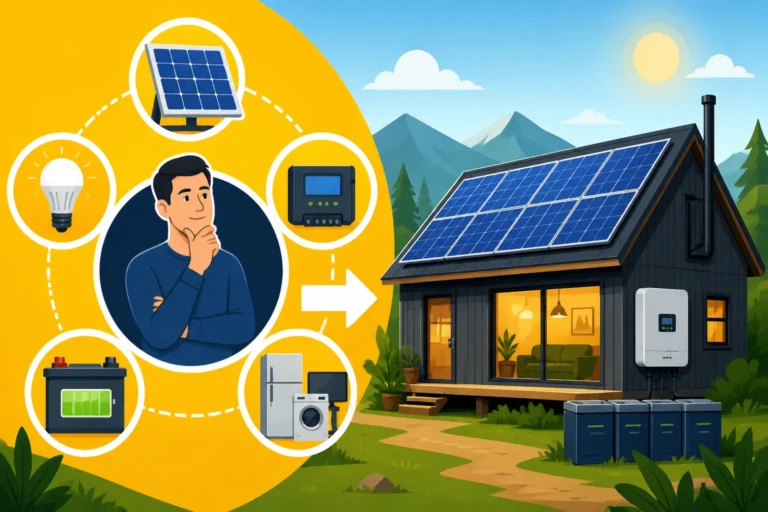
Now that we understand what our refrigerator is asking for, it's time to figure out how to give it that power using the sun. This involves carefully calculating the size of your battery bank and your solar panel array. This isn't guesswork; it's a methodical process that ensures you have reliable power when you need it most.
Measuring Your Refrigerator's Actual Consumption
The most accurate way to determine your refrigerator's daily energy consumption is to measure it directly. Don't rely solely on the yellow EnergyGuide sticker; those are estimates under specific lab conditions and rarely reflect real-world off-grid use. A simple device like a Kill-A-Watt meter, easily found on platforms like Amazon, plugs into your wall outlet, and your appliance plugs into it. It then tracks cumulative watt-hours over time. Plug your refrigerator into it for at least 24 to 48 hours (or even a full week for a more representative average, especially if your usage varies). Make sure your usage patterns during this measurement period are typical of how you'd use it off-grid.
Let's say, for example, your meter shows your fridge uses 1500 Wh over a 24-hour period. This is your baseline. If you can't measure, and you have a modern, efficient AC fridge, you might estimate 800-1200 Wh per day. An older, less efficient model could be 1500-2500 Wh. For a dedicated 12V DC compressor fridge, it might be 300-600 Wh. Always err on the side of overestimation if you're guessing; running out of power is no fun! Learning How to Calculate Daily Energy Usage for all your appliances is a crucial first step in any off-grid solar journey.
Sizing Your Battery Bank for Days of Autonomy
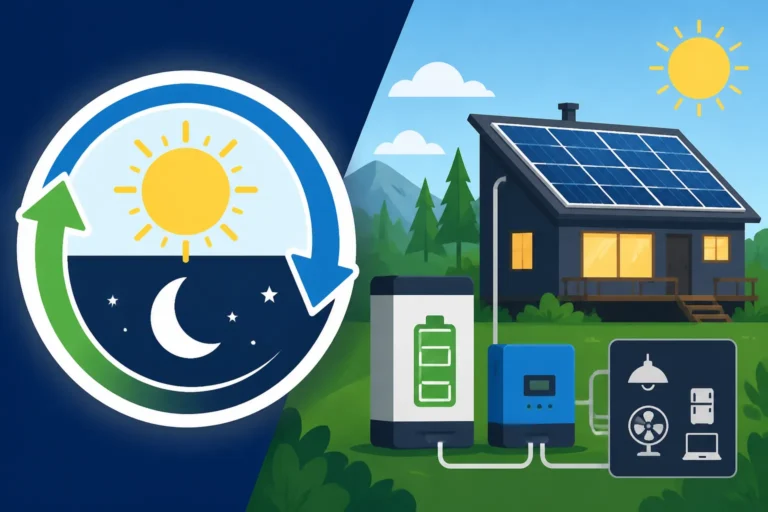
Your battery bank is the heart of your off-grid system, storing the solar energy your refrigerator needs to run overnight or during cloudy periods. The key concept here is "days of autonomy," which is how many days your battery bank can power your essential loads (like your fridge) without any solar input. For a critical appliance like a refrigerator, many off-gridders aim for 2-3 days of autonomy, sometimes more if living in a consistently cloudy region or during winter months.
Here’s a simplified calculation for battery capacity:
- Daily Fridge Consumption: Let's stick with our example of 1500 Wh per day.
- Account for Inverter Inefficiency: If you have an AC fridge, your inverter will lose some energy during conversion (typically 10-15%). So, 1500 Wh / 0.85 (for 85% efficiency) = approximately 1765 Wh needed from the battery.
- Multiply by Days of Autonomy: For 2 days of autonomy: 1765 Wh * 2 days = 3530 Wh total needed.
- Convert to Amp-Hours (Ah) based on System Voltage: Let's say you're building a 12V system. 3530 Wh / 12V = approximately 294 Ah.
- Account for Battery Depth of Discharge (DoD): If you're using lead-acid batteries, you should only discharge them to 50% to maximize their lifespan. So, you'd need 294 Ah / 0.50 = 588 Ah of lead-acid battery capacity. If you're using LiFePO4 (lithium iron phosphate) batteries, which can be safely discharged to 80-100%, you'd need 294 Ah / 0.80 = 368 Ah of LiFePO4 capacity. You can see why understanding How Much Battery Capacity You Need is so important, and how the choice between LiFePO4 vs Lead-Acid Battery Cost impacts your budget and usable power. Many off-gridders choose Battle Born or EG4 batteries for their reliability and deep discharge capabilities.
So, for our example, you'd need about 600 Ah of lead-acid batteries or around 370 Ah of LiFePO4 batteries in a 12V system to power a 1500 Wh/day fridge for two cloudy days. Remember, a 48V system will require fewer amp-hours but the same total watt-hours.
Determining the Solar Panel Array Size
Once you know your battery bank size, you need enough solar panels to recharge those batteries and continue powering your fridge on a daily basis. This calculation depends heavily on your "peak sun hours," which is the equivalent number of hours per day when the sun's intensity is at its peak (1000 watts per square meter). This varies significantly by your geographic location and the time of year. For instance, a sunny summer day in Arizona might have 6-7 peak sun hours, while a cloudy winter day in Seattle might only have 1-2. Finding accurate Peak Sun Hours Explained for your location is crucial.
Let's continue with our 1500 Wh/day fridge example.
- Daily Energy Needed (from battery output): 1765 Wh (after inverter losses for AC fridge, or 1500 Wh if DC fridge).
- Account for System Inefficiency (charge controller, wiring): Add another 20-30% for overall system losses from the panels to the batteries. Let's use 25%. So, 1765 Wh / 0.75 (for 75% efficiency) = 2353 Wh needed from the solar panels.
- Divide by Peak Sun Hours: Let's assume you have 4 peak sun hours on average (a reasonable, conservative estimate for many areas). 2353 Wh / 4 hours = approximately 588 Watts of solar panels.
- Oversize for Reality: This is where realism comes in. Panels rarely produce their rated power due to temperature, dust, angle, and partial shading. You'll want to oversize your array by at least 20-30%, especially if you want consistent power through less-than-ideal conditions or want to link to How to Account for Cloudy Days. So, 588 Watts * 1.25 (25% oversizing) = approximately 735 Watts of solar panels.
Therefore, for a 1500 Wh/day AC refrigerator, you might need around 700-800 watts of solar panels and roughly 370 Ah of LiFePO4 batteries (or 600 Ah lead-acid) in a 12V system with 2 days of autonomy. This will give you a good starting point for pricing out components.
Essential Components Beyond Panels and Batteries
While solar panels and batteries are the most visible stars of your off-grid show, a reliable system requires several other critical players working behind the scenes. Skimping on these can lead to inefficient operation, system failures, or even dangerous situations.
Choosing the Right Inverter
An inverter is the unsung hero that takes the DC (direct current) power from your batteries and transforms it into AC (alternating current) power, which is what most standard household appliances, including your refrigerator, use. Without it, your AC fridge simply won't run.
There are two main types of inverters you'll encounter: modified sine wave and pure sine wave. For any sensitive electronics or motor-driven appliances like a refrigerator, you absolutely need a pure sine wave inverter. Modified sine wave inverters produce a 'choppy' AC waveform that can cause motors to run hotter, less efficiently, make humming noises, or even damage them over time. Pure sine wave inverters replicate the smooth, clean power you get from the grid, ensuring your refrigerator operates exactly as it was designed to. When considering What Size Inverter to Run A Refrigerator, remember the starting surge we talked about. If your fridge has a running wattage of 150W but a starting surge of 600W, your inverter needs to be able to handle that 600W peak for a brief moment. A 1000W or 2000W pure sine wave inverter is usually a safe bet for a single refrigerator, providing ample headroom. Brands like Victron, Renogy, and Sol-Ark offer reliable pure sine wave inverters with excellent surge capabilities.
Selecting a Charge Controller
The charge controller is the intelligent manager of your solar power system. Its job is to regulate the voltage and current coming from your solar panels before it reaches your batteries. This is crucial for preventing overcharging, which can severely damage and shorten the lifespan of your expensive battery bank.
You'll primarily find two types: PWM (Pulse Width Modulation) and MPPT (Maximum Power Point Tracking). For a system powering a refrigerator, especially if you have more than a couple of small panels, an MPPT charge controller is the superior choice. MPPT controllers are significantly more efficient, typically 10-30% more efficient than PWM controllers, because they can track the maximum power output of your solar panels and convert it to the optimal voltage for charging your batteries. This means you extract more usable energy from your solar array, which is incredibly important for maintaining critical loads like a refrigerator, especially during less-than-ideal solar conditions. PWM controllers are simpler and cheaper but are best suited for smaller, less critical systems. Understanding the nuances of MPPT vs PWM Charge Controllers can save you a lot of grief and money in the long run by maximizing your system's efficiency.
Wiring, Fuses, and Safety
It's tempting to focus only on the big-ticket items, but the smaller components like wiring, fuses, and breakers are absolutely vital for a safe and reliable off-grid solar system. Using the correct wire gauge is paramount. Undersized wires can lead to significant voltage drop (meaning less power actually reaches your appliances and batteries), inefficiency, and dangerously overheat, posing a fire risk. Always consult wiring charts based on current (amps), voltage, and distance to determine the appropriate wire size.
Fuses and circuit breakers are your system's guardians against electrical faults and overcurrents. Every major component – from your solar panel array to your battery bank to your inverter – should be properly fused or have circuit breakers in line. These safety devices are designed to sacrifice themselves by breaking the circuit if an overload or short occurs, protecting your expensive equipment and, more importantly, preventing fires. Proper Off-Grid Solar Safety and Grounding is non-negotiable. You’ll need breakers or fuses on the DC side (between panels and charge controller, and between charge controller and batteries) and on the AC side (between inverter and AC loads/breaker panel). Never skip these critical safety measures; they are a small investment for massive peace of mind.
Real-World Considerations and Optimization
Getting your refrigerator running on solar is a fantastic accomplishment, but the journey doesn't end with installation. To ensure continuous, reliable, and efficient operation, you'll need to consider real-world factors and continuously optimize your setup.
Optimizing Refrigerator Efficiency
Even the most robust solar system can be strained by an inefficient refrigerator or poor usage habits. Small changes can make a big difference in your daily watt-hour consumption. Firstly, ensure your refrigerator's door seals are tight. A dollar bill test (if you can pull a bill out easily when it's closed, the seal is weak) can quickly reveal worn-out gaskets that are leaking cold air. Secondly, keep your fridge as full as possible. Bottles of water or even crumpled newspaper can fill empty spaces, acting as thermal mass that helps the fridge maintain its temperature with fewer compressor cycles.
Proper ventilation around the condenser coils is also critical. These coils are usually on the back or bottom of the fridge, and they need unobstructed airflow to dissipate heat efficiently. If they're dusty or blocked by walls, the fridge has to work harder. Speaking of placement, try to position your refrigerator away from direct sunlight or heat sources like ovens. For ultimate efficiency, consider upgrading to a modern, purpose-built 12V DC compressor fridge. These units, like those from Dometic or Alpicool, are incredibly energy-efficient, specifically designed for mobile and off-grid use, and often eliminate the need for an AC inverter, reducing conversion losses and simplifying your system.
Seasonal Adjustments and Backup Power
Solar power isn't a constant. Your solar panels will produce significantly less power in winter due to shorter daylight hours, lower sun angle, and potentially more cloudy or snowy days. This means your off-grid refrigerator setup needs to be designed with the worst-case scenario in mind, or you'll need to make seasonal adjustments. You might find yourself conserving power more strictly in winter, such as grouping your fridge openings, cooking in batches, or even using an outdoor cooler for less perishable items if temperatures allow.
For many off-gridders, a reliable backup power source is indispensable, especially for critical loads like a refrigerator. A small, efficient gasoline or propane generator, often connected to an inverter-charger, can kick in during extended periods of low solar production. This ensures your food stays cold even when the sun isn't cooperating. Learning How to Add a Generator to Your Design can save you from spoilage and stress during winter or prolonged bad weather. Alternatively, for smaller setups or as a temporary backup, a portable solar generator (often called a power station) from brands like EcoFlow or Bluetti can provide a few extra hours of power for your fridge, which can be a lifesaver.
Budgeting for Your Off-Grid Refrigerator Setup
The upfront cost of setting up an off-grid solar system to run a refrigerator can be a significant hurdle, but it's an investment in independence and long-term savings. Costs can vary widely based on the size of your fridge, your desired days of autonomy, and the quality of components you choose.
Here's a general breakdown of potential costs:
| Component | Estimated Cost Range (USD) | Notes |
|---|---|---|
| Refrigerator | $300 – $1,500+ | Older AC units (less efficient) to new, highly efficient 12V DC compressor fridges. |
| Solar Panels | $0.80 – $1.50 per watt | For a 700-800W array: $560 – $1,200. Prices vary by efficiency and brand. |
| Batteries | $150 – $350 per 100Ah | For 370 Ah LiFePO4 (12V): $550 – $1,300+ (depending on brand like Renogy, Battle Born, or generic). Lead-acid will be cheaper upfront but higher long-term. |
| Inverter | $200 – $1,000+ | Pure sine wave, 1000W-2000W, good surge capacity. Brands like AIMS Power or Victron offer various options. |
| Charge Controller | $100 – $500+ | MPPT controller recommended. |
| Wiring, Fuses, Mounts | $100 – $400 | Essential safety and connection components. |
| Total Rough Estimate | $1,410 – $5,900+ | This is a broad range. DIY can lower installation costs. Professional installation will add significantly more. |
As you can see, the cost can range from a budget-friendly setup for a small, efficient DC fridge to a more robust system for a larger AC unit. Many people find that starting with a smaller system and expanding it as their needs and budget allow is a great strategy. Don't forget to account for potential long-term maintenance costs, like Off-Grid Solar Battery Replacement Cost Over Time. This planning is crucial for managing your financial expectations and ensuring your off-grid dream is sustainable. For a deeper dive into financial planning, check out our guide on How to Budget for an Off-Grid Solar System.
Disclaimer
The information provided in this guide is for general informational purposes only and does not constitute professional advice. Off-grid solar system design and installation can be complex and involve electrical hazards. Always consult with a qualified electrician or solar professional before designing, purchasing, or installing any solar power system. Local codes and regulations may apply.