Is Off-Grid Solar Cost-Effective for a Greenhouse
Trying to cultivate a thriving greenhouse, whether for extending your growing season or nurturing delicate plants, often comes with a thorny question: how do you power it without breaking the bank or running an unsightly, vulnerable extension cord across your property? Many dream of self-sufficiency, but the practicalities of supplying electricity for fans, heaters, and lights in a detached structure can feel overwhelming and expensive. This guide is here to shed some light on whether off-grid solar can be a truly cost-effective solution for your greenhouse, delving into the real costs and benefits you can expect.
Understanding Your Greenhouse Energy Needs
Before we even think about solar panels and batteries, the absolute first step in determining cost-effectiveness for your greenhouse is to get a crystal-clear picture of its energy demands. This isn't just a guessing game; it's a crucial calculation that will dictate the size and, therefore, the cost, of your entire off-grid solar system. Many folks underestimate this, especially when it comes to climate control, leading to systems that are either insufficient or wildly oversized.
Identifying Your Greenhouse Appliances
Think about what you plan to run in your greenhouse. Are you just looking for a few hours of supplemental light, or are you aiming for year-round temperature control in a harsh climate? Each piece of equipment draws power, and some are far thirstier than others.
- Heating and Cooling: These are almost always the biggest energy hogs. An electric space heater, even a small one, can draw hundreds or even thousands of watts. Likewise, powerful exhaust fans for cooling can add up. If you're growing in a climate with cold winters or scorching summers, managing temperature is critical, but it comes at a significant energy cost. Many greenhouses opt for passive heating or propane heaters to mitigate this, but if electricity is your goal, be prepared for substantial power needs.
- Supplemental Lighting: Depending on what you're growing and your natural light conditions, you might need grow lights. LED grow lights are incredibly efficient these days, but older HID (High-Intensity Discharge) lights can draw a lot of power. Consider the type of light, its wattage, and how many hours a day you'll need it.
- Ventilation Fans: Beyond extreme cooling, smaller circulation fans help prevent fungal issues and improve air quality. These are generally lower wattage but might run for many hours.
- Irrigation Pumps: If you're using a hydroponic system or an automated irrigation setup, small pumps will be needed. Their energy draw is typically modest but consistent if running daily.
- Controllers and Sensors: Thermostats, humidity sensors, smart controllers for automation – these typically draw minimal power, often in the single-digit watts, but they are essential for monitoring your environment.
Calculating Daily Watt-Hour Consumption
Once you have a list of your intended appliances, you'll need to calculate their cumulative daily energy usage in watt-hours (Wh). This figure is the bedrock of your solar system design. Don't skip this step!
To calculate, find the wattage (W) of each appliance (it's usually listed on a label or in the product manual). Then, estimate how many hours per day (h) you plan to run it.
Formula: Wattage (W) x Hours Used Per Day (h) = Daily Watt-Hours (Wh)
Let's say you have:
- An LED grow light: 100W, runs 12 hours/day = 1200 Wh
- A small circulation fan: 20W, runs 8 hours/day = 160 Wh
- A thermostatically controlled electric heater: 1000W, runs intermittently, say an average of 3 hours/day in winter = 3000 Wh (this is a big one!)
- A small irrigation pump: 50W, runs 1 hour/day = 50 Wh
Your winter daily total could easily be around 4410 Wh, or 4.41 kWh. In summer, without the heater, it might drop significantly, perhaps to just 1410 Wh (1.41 kWh). Notice how dramatically the heater impacts the total! This figure is what your solar panels need to generate and your batteries need to store. To get a comprehensive understanding of your requirements, you might want to look into How to Calculate Daily Energy Usage.
Components and Costs of an Off-Grid Solar Setup for Greenhouses
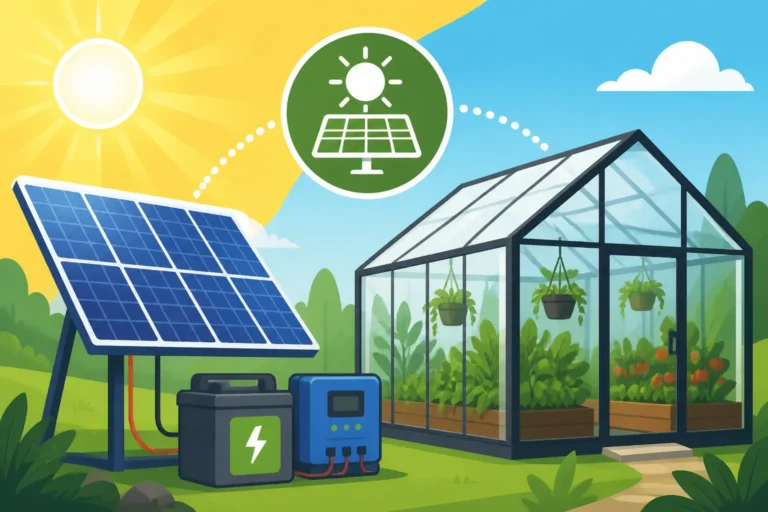
Now that you know your energy needs, let's break down the primary components of an off-grid solar system for a greenhouse and what you can expect to pay. This isn't just about slapping some panels on the roof; it's a carefully balanced ecosystem of components, each with its own cost implications.
Solar Panels
These are the most visible part of your system. The number and type of panels you need will directly correlate to your daily watt-hour consumption and the amount of sunlight your location receives.
You generally have a few options:
- Monocrystalline Panels: These are highly efficient, typically converting 15-20% of sunlight into electricity, and perform well in lower light conditions. They are a popular choice for their reliability and long lifespan, often coming with a 25-year warranty. They are usually black in appearance.
- Polycrystalline Panels: Slightly less efficient than monocrystalline (13-17%), they are also a bit more affordable per watt. They tend to have a blueish hue.
- Flexible Panels: If your greenhouse roof isn't suited for rigid panels, or you need something lighter, flexible panels are an option. They are less efficient and often more expensive per watt than rigid panels but offer installation versatility.
For a greenhouse consuming 1.5-5 kWh per day, you might need anywhere from 500W to 3000W or more of solar panels, depending on your local peak sun hours. Panels can range from $1 to $2 per watt, so a 1000W array could cost $1000-$2000. You'll need to research How Many Solar Panels for Off-Grid Living in your area to size your array correctly.
Batteries
The battery bank is often the most expensive single component in an off-grid solar system, and it's where many people experience "sticker shock." Batteries are essential because they store the energy generated during the day for use at night or on cloudy days.
Here are the main types to consider:
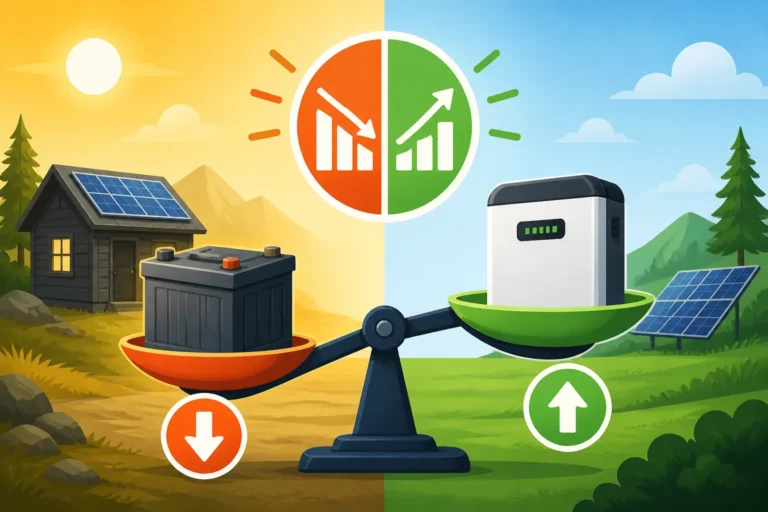
- Lead-Acid Batteries (Flooded or AGM): These are the traditional choice and are generally more affordable upfront. However, they have a shorter cycle life (how many times they can be charged and discharged) and are sensitive to being discharged too deeply. AGM batteries are sealed and maintenance-free, a step up from flooded, but still have limitations. They also perform poorly in very cold temperatures, which is a concern for many greenhouses.
- Lithium Iron Phosphate (LiFePO4) Batteries: These are the modern gold standard for off-grid applications. While their upfront cost is higher, they offer significantly longer cycle life (often 10-15 years or more), can be deeply discharged without damage, are lighter, and require no maintenance. They also perform better in a wider temperature range, though extreme cold still requires consideration for charging. For a detailed comparison, check out LiFePO4 vs Lead-Acid Battery Cost.
For a greenhouse with 4.4 kWh daily consumption and wanting 2-3 days of autonomy (power without sun), you'd need a substantial battery bank. Expect to spend anywhere from $1,500 for a small lead-acid bank to $5,000-$15,000+ for a robust LiFePO4 system, depending on capacity. When planning, understanding How Many Batteries for an Off-Grid System for your specific setup is critical.
Charge Controller and Inverter
These two components are the brains and brawn that manage the power flow from your panels to your batteries and then to your appliances.
-
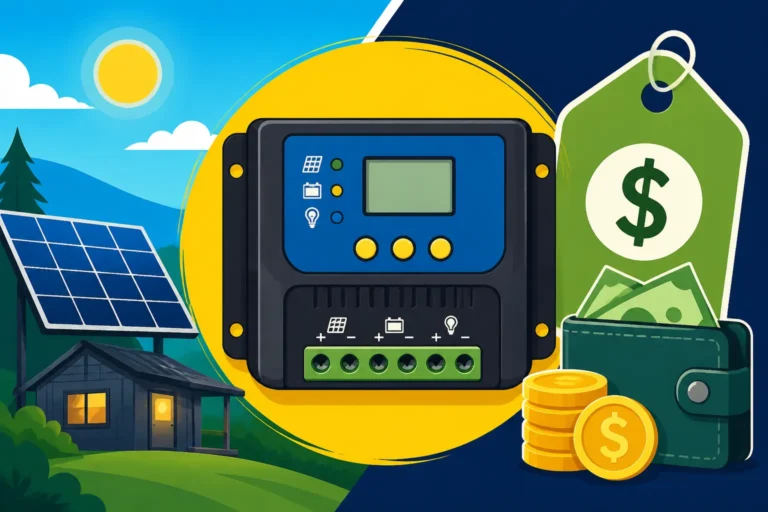
Charge Controller: This device regulates the voltage and current coming from your solar panels, ensuring your batteries are charged efficiently and safely, preventing overcharging.
- PWM (Pulse Width Modulation) Controllers: Simpler and less expensive, but also less efficient, especially for larger systems or if panel voltage doesn't closely match battery voltage.
- MPPT (Maximum Power Point Tracking) Controllers: More complex and more expensive, but significantly more efficient. They can boost power harvest from your panels by 15-30% compared to PWM, making them almost always the better choice for any substantial off-grid greenhouse system. For more information, see MPPT vs PWM Charge Controllers.
- Costs can range from $100 for a basic PWM to $500-$1,500 for a high-quality MPPT controller suitable for larger arrays.
-
Inverter: This converts the DC (direct current) power stored in your batteries into AC (alternating current) power, which is what most standard household appliances (like your greenhouse heater or fans) use.
- Pure Sine Wave Inverters: Essential for sensitive electronics and motors (like those in pumps or high-quality LED drivers), as they produce clean power similar to what you get from the grid.
- Modified Sine Wave Inverters: Cheaper but produce a "choppier" waveform that can damage sensitive electronics or cause motors to run inefficiently and heat up. Avoid these for most greenhouse applications with modern equipment. For deeper insights, refer to Pure Sine Wave vs Modified Sine Wave Inverters.
- Inverters can range from $300 for a smaller 1000W pure sine wave model to $2,000-$5,000+ for larger, more robust inverter-chargers from brands like Victron or Sol-Ark that can handle higher surge loads and integrate seamlessly with a generator.
Wiring, Mounting, and Other Essentials
Don't forget the "little" things – they add up!
- Mounting Hardware: Racks for your solar panels, whether roof-mounted or ground-mounted, need to be sturdy and able to withstand local weather conditions. Costs vary widely depending on the type and complexity.
- Cabling and Connectors: High-gauge, UV-resistant solar cables, MC4 connectors, and battery cables are necessary for safe and efficient power transfer. These aren't cheap, especially for longer runs or higher currents.
- Fuses and Breakers: Crucial safety devices to protect your system from shorts and overloads.
- Monitoring Equipment: A battery monitor (like a shunt-based system) is invaluable for knowing your battery state of charge and overall system health.
- Labor (if not DIY): While many greenhouse owners are DIY enthusiasts, complex systems may require an electrician for certain wiring aspects, particularly AC wiring to ensure safety and compliance. For a clearer picture of potential costs, consider Off-Grid Solar Installation Cost.
In total, a complete off-grid solar system for a modest greenhouse might cost anywhere from $3,000 to $10,000+, depending heavily on your energy needs, battery choice, and whether you DIY or hire professional help. A larger, more complex system for a commercial-scale greenhouse could easily exceed $20,000.
Factors Influencing Cost-Effectiveness and ROI
Is all that upfront cost worth it for your greenhouse? That's the core question, and the answer isn't a simple yes or no. The cost-effectiveness of off-grid solar for a greenhouse hinges on several specific factors unique to your situation.
Initial Investment Versus Long-Term Savings
The biggest hurdle for anyone considering off-grid solar is that substantial initial investment. It's often thousands of dollars, which can feel like a lot for a structure that isn't your primary residence. However, the long-term perspective is where the true value often lies.
- Eliminating Utility Bills: Once installed, your greenhouse will generate its own power, meaning no more electricity bills for heating, lighting, or ventilation. Over 10, 15, or even 20 years, these savings can be significant. If you're currently running power to your greenhouse from the grid, compare your monthly electricity costs to the solar system's price.
- Avoiding Grid Extension Costs: For remote greenhouses, or those far from an existing power hookup, extending grid power can be prohibitively expensive. We're talking tens of thousands of dollars to trench, run lines, and install new meters. In these scenarios, off-grid solar can be dramatically more cost-effective from day one. You'll definitely want to investigate Off-Grid Solar vs Utility Extension Cost if this applies to your situation. For instance, in rural areas of Oregon or Montana, running new power lines across acres of land can easily outstrip the cost of a comprehensive solar setup.
- Increased Crop Yield and Quality: Reliable, consistent power for lighting, heating, and ventilation can lead to healthier plants, extended growing seasons, and higher yields, especially for cash crops. This can translate to tangible financial returns if you're selling your produce.
- Payback Period: This is the time it takes for your cumulative energy savings to equal your initial investment. For a greenhouse, this can vary wildly. If you're replacing expensive grid power or avoiding massive grid extension fees, your payback period could be relatively short, perhaps 5-10 years. If you're just powering a few low-wattage lights for a hobby, it might take much longer. Calculating your Off-Grid Solar Payback Period Explained is an excellent way to evaluate its financial sense.
Scale, Specific Use Cases, and Geography
The size of your greenhouse and what you aim to achieve with it are huge determinants of cost-effectiveness.
- Small Hobby Greenhouse: For a simple 6×8 foot hobby greenhouse where you only need occasional fan use or a string of LED lights, a full-blown off-grid system might be overkill. A smaller, portable solar generator, like a Jackery or something similar found on Amazon, combined with a single solar panel, might be a more cost-effective solution for minimal needs. These can power small loads for a few hours.
- Medium-Sized Backyard Greenhouse: A 10×12 or 12×20 foot greenhouse with moderate heating/cooling needs, automated irrigation, and supplemental lighting is where a dedicated off-grid solar system really starts to make sense. The energy demands justify the investment.
- Large Commercial Greenhouse: For large-scale operations, the energy demands might be too massive for a purely off-grid solar system to be cost-effective on its own, especially for continuous, high-draw applications like large-scale heating or high-pressure sodium lights. Hybrid systems, potentially combining solar with a powerful generator, might be more practical.
- Geographic Location: Your location's sun exposure is paramount. Greenhouses in sunny states like Arizona, California, or Florida will generate more power from fewer panels than those in cloudy regions like the Pacific Northwest or New England. This directly impacts the size and cost of your solar array. Also, extreme climates (very cold winters, very hot summers) will inherently increase your climate control energy demands, driving up system costs.
Maintenance and Longevity
While off-grid solar systems are known for their durability, they aren't entirely maintenance-free.
- Battery Replacement: Batteries have a finite lifespan. Lead-acid batteries might last 3-7 years, while LiFePO4 batteries can last 10-15 years or more. However, they will eventually need to be replaced, which is a significant expense. Knowing the Cost to Replace Off-Grid Solar Batteries is an important part of calculating lifetime costs.
- Panel Cleaning and Inspection: Solar panels need occasional cleaning to remove dirt, dust, and debris that can reduce efficiency. Wires and connections should be inspected periodically for wear or damage.
- Component Lifespan: Inverters and charge controllers are electronic devices that have their own lifespans, typically 5-15 years. While generally reliable, they might need replacement or repair over time.
Considering these factors, the true cost-effectiveness comes down to whether the initial investment, coupled with eventual maintenance and replacement costs, is less than what you would pay for grid power (or grid extension) over the system's lifetime, while also providing the reliability and independence you desire for your greenhouse operations.
Practical Considerations and Alternatives
Deciding on off-grid solar for your greenhouse involves more than just crunching numbers; it's about making smart choices in design and exploring all your options. Sometimes, the most cost-effective solution is a combination of strategies.
Optimizing Greenhouse Design for Solar
No matter how robust your solar system, reducing your greenhouse's overall energy consumption will always be the most cost-effective strategy. Every watt you don't need to generate or store is money saved.
- Insulation is King: This cannot be stressed enough, especially if you plan to heat or cool your greenhouse. Double-wall polycarbonate, inflated double poly, or even adding bubble insulation during winter can drastically reduce heat loss. A poorly insulated greenhouse is an energy black hole for any heating system, electric or otherwise.
- Passive Solar Design: Orient your greenhouse to maximize winter sun exposure and minimize summer heat gain. Use thermal mass (water barrels, rocks) to absorb heat during the day and release it slowly at night.
- Efficient Appliances: Always opt for the most energy-efficient versions of fans, lights, and heaters. LED grow lights are a prime example of technology that has revolutionized greenhouse lighting by offering incredible efficiency. Look for Energy Star ratings where applicable. Using a smart thermostat can also ensure your heating and cooling only kick on when absolutely necessary.
- Zoning: If your greenhouse is large, consider heating or lighting only specific zones for delicate plants, rather than the entire structure.
Hybrid Approaches and Backup Options
Sometimes, a pure off-grid solar system isn't the only answer, or even the best one. Blending technologies can provide the perfect balance of cost, reliability, and performance.
- Generator Backup: For periods of extended cloudiness or exceptionally high energy demands (like a deep cold snap requiring constant heating), a backup generator can be a lifesaver. These can be run on propane or gasoline and can quickly recharge your batteries or directly power critical loads. While you'll still have fuel costs, it allows you to size your solar system for average needs rather than extreme outliers, saving significant upfront costs. Many off-grid inverters, especially from brands like Victron or Sol-Ark, have built-in generator integration. Exploring Cost of Adding a Generator to Off-Grid Solar can help you budget for this safeguard.
- Solar Generators for Minimal Needs: For smaller greenhouses or those with very limited electrical needs, a standalone solar generator (a portable power station with an integrated inverter and battery) might suffice. Brands like Jackery, Bluetti, or EcoFlow offer various sizes that can be charged by a few solar panels. They are relatively plug-and-play, widely available on platforms like Amazon, and much less expensive than a full component system. They might be perfect for running a small fan, a few LED lights, or charging hand tools.
- Manual Solutions: Don't overlook low-tech, manual solutions that don't require electricity. Manual vents for cooling, passive solar water heaters, or even simply opening and closing the greenhouse door can save power. A water barrel painted black placed inside can absorb a lot of heat during the day and release it at night.
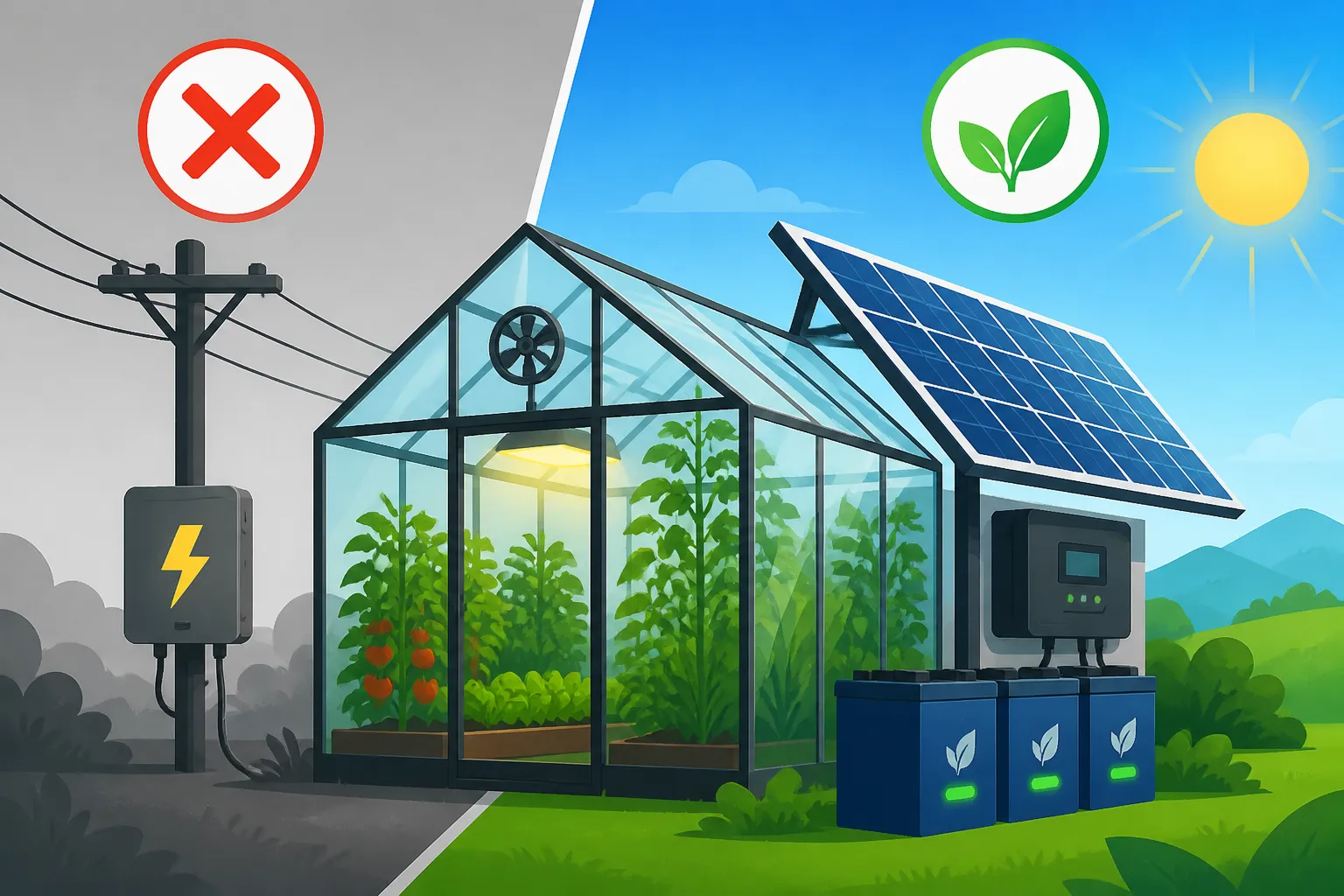
In conclusion, off-grid solar can absolutely be cost-effective for a greenhouse, especially if you're in a remote location facing high grid extension costs or if your primary goal is long-term energy independence and consistent growth conditions for valuable crops. However, it requires careful planning, a realistic assessment of energy needs (especially for climate control), and a willingness to invest upfront. By optimizing your greenhouse design and considering hybrid solutions, you can tailor a system that perfectly balances cost with performance, ensuring your green thumb thrives without unnecessary strain on your wallet or the environment.
Disclaimer
Please remember that the information provided in this guide is for general informational purposes only and should not be considered professional financial, electrical, or engineering advice. Off-grid solar system design and installation can be complex and involve electrical hazards. Always consult with qualified professionals for specific system design, local regulations, permitting, and safe installation practices. Energy consumption and costs can vary significantly based on location, climate, specific appliance usage, and market prices.