Is Off-Grid Solar Cost-Effective for a Van
The allure of van life is undeniable – the open road, new horizons, and the freedom to wake up to a different view every day. But as you dream of converting that trusty cargo van into a cozy, self-sufficient home, one question inevitably looms large: "Is off-grid solar actually cost-effective for a van?" It's a valid concern, because while the idea of free power from the sun sounds fantastic, the upfront investment can feel daunting. This comprehensive guide will break down the true costs and long-term savings, helping you determine if a solar setup is the smart financial move for your particular van life adventure.
Understanding the True Costs of Van Life Solar
When you first start looking into off-grid solar for a van, it’s easy to get overwhelmed by the sheer number of components and price tags. It’s not just a few panels and you’re done; there’s a whole ecosystem of equipment that works together to keep your lights on and your fridge cold. Thinking of it as a single, large expense rather than a collection of interconnected parts can make the prospect feel more intimidating than it needs to be.
Initial Investment Beyond the Sticker Price
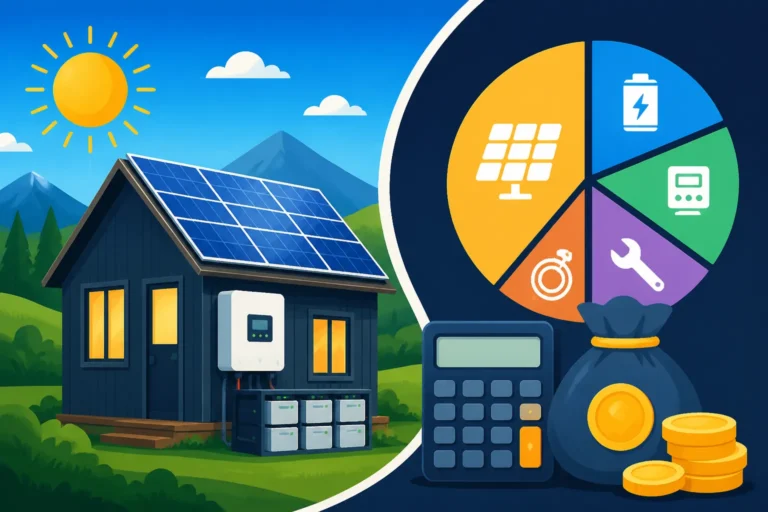
The sticker price for a solar panel or an inverter often gives you only a glimpse of the total financial commitment. You're building a miniature power plant, and each piece plays a crucial role. First, you'll need the solar panels themselves. These convert sunlight into electricity. Prices vary wildly depending on wattage, efficiency, and whether they are rigid, flexible, or portable. A flexible 100-watt panel might cost under $100, while a robust 400-watt rigid panel could easily run you $300-$500 or more.
Then comes the heart of any off-grid system: the batteries. This is often the single most expensive component, but also the most critical for storing power when the sun isn't shining. You could opt for traditional lead-acid batteries, which are cheaper upfront but have a shorter lifespan and require more maintenance. Or you could choose lithium iron phosphate (LiFePO4) batteries, which are a significant investment but offer superior cycle life, deeper discharge capabilities, and lighter weight – all huge advantages for a mobile setup. For a deeper dive into battery costs, you might want to explore our article on the Cost of an Off-Grid Solar Battery Bank. Remember, you might need multiple batteries depending on your energy needs, and connecting them properly adds to the complexity and cost.
Next up, the inverter. This magical device transforms the DC (direct current) electricity from your batteries into AC (alternating current) power, which is what most of your household appliances like laptops, blenders, and microwaves use. Inverters also come in a wide range of prices and capabilities, from basic modified sine wave models suitable for simple electronics to pure sine wave inverters that can handle sensitive equipment and high-draw appliances like induction cooktops or small air conditioners. Understanding the nuances of these can truly impact your budget, and our guide on the Cost of an Off-Grid Solar Inverter provides more detail. Don't forget the charge controller, which sits between your solar panels and your batteries, regulating the power flow to prevent overcharging. MPPT (Maximum Power Point Tracking) controllers are more efficient than PWM (Pulse Width Modulation) controllers, especially in varying light conditions, but they also come at a higher price point.
Finally, there are all the bits and pieces that often get overlooked but are absolutely essential: wiring (various gauges for different sections of the system), fuses and circuit breakers for safety, mounting hardware for your panels, connectors, and possibly a battery monitor to keep tabs on your power usage. These can quickly add up, easily tacking on hundreds of dollars to your total bill. While you can find many of these components on platforms like Amazon, ensuring you're getting quality, appropriately-sized parts is crucial for safety and performance.
Operational Expenses and Lifespan Considerations
The initial build cost is just one side of the coin. Like any complex system, off-grid solar in your van will have ongoing operational expenses and eventually, replacement costs. Thankfully, these are generally quite low compared to, say, fueling a generator daily.
Maintenance for a solar setup is relatively straightforward. You'll need to keep your panels clean, especially if you're traveling dusty roads or parking under trees. A simple wash with water and a soft brush a few times a year usually does the trick. You should also periodically check all your connections to ensure they're secure and free from corrosion. If you have lead-acid batteries, you'll need to check water levels and equalize them regularly, adding a bit more hands-on maintenance. LiFePO4 batteries, on the other hand, are largely maintenance-free, which is a big part of their appeal for van dwellers.
The bigger picture involves the lifespan of your components. Solar panels are incredibly durable and typically come with warranties lasting 20-25 years, meaning they'll likely outlast your van. Charge controllers and inverters are also quite robust, often lasting 10-15 years or more with proper installation and care. The primary component you'll eventually need to replace is your battery bank. Lead-acid batteries might last 3-7 years, while high-quality LiFePO4 batteries can last 10-15 years or even longer, especially if not consistently discharged too deeply. The Off-Grid Solar Battery Replacement Cost Over Time is a significant factor to budget for down the line, so choosing durable, long-lasting batteries upfront can lead to substantial savings in the long run. Thinking about the total lifetime cost rather than just the initial purchase price is a key part of determining true cost-effectiveness.
The Financial Payback: Where Off-Grid Solar Shines (or Doesn't)
Now for the million-dollar question: does all this investment actually save you money? For many van lifers, the answer is a resounding yes, but the "payback" isn't always purely monetary. There's immense value in the freedom and convenience off-grid solar provides, which can be hard to put a price tag on.
Comparing Solar to Other Power Sources for Vans
To truly understand if solar is cost-effective, we need to compare it to the alternatives you'd rely on in a van.
First, let's talk about generators. Many van lifers carry a small portable generator for backup power or to run high-draw appliances. While handy, generators are noisy, produce exhaust fumes, and require fuel. Depending on how often you run it and the price of gasoline, those fuel costs can add up quickly. A small generator might consume half a gallon of gas per hour, and if you're running it for a few hours daily, you're looking at significant recurring expenses. Plus, there's the cost of maintenance, oil changes, and eventually, replacement. This is where Off-Grid Solar vs Generator Fuel Cost comparisons really highlight solar's economic advantage over time.
Then there's the option of relying on shore power hookups. If you're frequently staying at campgrounds or RV parks, you'll be paying daily or nightly fees, which often include electricity. These fees can range from $20 to $70+ per night, and if you’re living in your van full-time, those costs will quickly eclipse the investment in a solar system. Solar frees you from these fees, allowing you to park and stay wherever you find a spot, as long as it's legal and safe.
Finally, some van lifers rely on their vehicle's alternator to charge a "house" battery while driving. While this can top up your batteries, it's generally not efficient for supplying all your daily power needs, especially if you have significant loads. You'd need to drive a lot to fully charge a large battery bank, which means burning more fuel for the vehicle itself, simply to make electricity. This isn't ideal for stationary living or for truly minimizing your carbon footprint. Solar, by contrast, generates power passively while your van is parked, using a free, abundant resource.
Quantifying the Savings Over Time
The real cost-effectiveness of off-grid solar becomes apparent when you look at the long-term savings. Once your system is installed, the "fuel" (sunlight) is free. Your daily energy consumption, which might otherwise cost you a few dollars in generator fuel or campground fees, now comes at no direct ongoing cost.
Let's do a hypothetical example. Say your van consumes an average of 1.5 kWh (kilowatt-hours) per day, which is enough for a fridge, lights, charging devices, and some occasional use of a microwave or water pump.
Scenario 1: Relying on a Generator
If a generator consumes 0.5 gallons of gas per hour to produce 1.5 kWh, and gas costs $4 per gallon, you might be spending $2 per day just for fuel. Over a year, that's $730. Over five years, $3,650. This doesn't even account for the generator's purchase price, maintenance, and eventual replacement.
Scenario 2: Relying on Shore Power
If you average just three nights a week at a campground costing $35/night, that's $105 per week, or $5,460 per year. Over five years, that's a staggering $27,300.
Scenario 3: Off-Grid Solar
Let's say your complete solar setup costs $3,000-$6,000 upfront. After the initial investment, your daily operational cost for electricity is essentially zero.
Here's a simplified breakdown of how solar compares financially over time:
| Power Source | Initial Cost (Estimate) | Daily Op. Cost (Estimate) | Annual Cost (Estimate) | 5-Year Cost (Estimate) | 10-Year Cost (Estimate) |
|---|---|---|---|---|---|
| Off-Grid Solar | $3,000 – $6,000 | ~$0.10 (battery wear) | ~$36.50 – ~$100 | $3,180 – $6,500* | $3,365 – $7,000** |
| Gas Generator | $400 – $1,500 | $2 – $5 (fuel) | $730 – $1,825 | $4,050 – $10,625*** | $7,700 – $20,000**** |
| Shore Power (3x/week) | $0 | $35 (per night) | $5,460 | $27,300 | $54,600 |
*Includes initial cost + 5 years battery wear. Does not include potential battery replacement within 5 years for lead-acid, but likely not for LiFePO4.
**Includes initial cost + 10 years battery wear + potential battery replacement (e.g., one LiFePO4 replacement or multiple lead-acid replacements).
***Includes initial cost + 5 years fuel + potential generator maintenance/replacement.
****Includes initial cost + 10 years fuel + multiple generator maintenance/replacements.
As you can see, the break-even point for a solar setup compared to consistent generator use or campground fees can be surprisingly short – often within 1-3 years, depending on your usage and the cost of your system. Beyond that, it's pure savings. This long-term perspective is crucial for understanding that Off-Grid Solar Payback Period Explained isn't just theory, but a real financial benefit for many van dwellers. The feeling of energy independence, the quiet of not running a generator, and the ability to travel without constantly seeking plug-ins or fuel stations add an immeasurable value that goes beyond mere dollars and cents.
Factors Influencing Cost-Effectiveness for Your Van
The "cost-effectiveness" of off-grid solar isn't a one-size-fits-all answer. It's deeply personal and depends heavily on how you plan to use your van and what your priorities are. What works for a minimalist traveler might be insufficient or overkill for someone who wants all the comforts of home on wheels.
Your Energy Consumption Habits
This is perhaps the biggest determinant. Are you planning a simple setup where you just need to charge your phone, laptop, and run a few LED lights? Or do you envision a full "glamping" experience with an electric fridge, a microwave, an espresso machine, a Starlink internet dish, and even a small air conditioner? The more power-hungry appliances you want to run, the larger and more expensive your solar system will need to be.
A minimalist setup, powering just basic electronics and an efficient 12V fridge, might only require 200-400 watts of solar panels and a 100-200Ah LiFePO4 battery bank. This could cost anywhere from $1,500 to $3,000 for components if you're doing a DIY installation. On the other hand, if you want to run an air conditioner, especially in hot climates like Arizona summers, you're looking at a significantly larger investment. Air conditioners are power hogs, often requiring 1,000-2,000 watts of continuous power. This would necessitate a much larger solar array (800-1200+ watts), a beefier inverter, and a substantial battery bank (400-600Ah or more), pushing your system cost well into the $5,000-$10,000+ range.
Understanding How to Calculate Daily Energy Usage is fundamental here. Take an inventory of every electrical item you plan to use, note its wattage, and estimate how many hours per day you'll run it. This will give you your daily watt-hour (Wh) or kilowatt-hour (kWh) needs, which is the starting point for sizing your system and, by extension, budgeting for it. Also, consider the seasonal usage. If you're only a fair-weather traveler in sunny regions, you might need less solar than someone planning year-round travel, especially in areas with shorter, cloudier winter days. Our guide on Off-Grid Solar Cost in Cold Climates highlights how environmental factors can influence system design and, consequently, cost.
DIY vs. Professional Installation
The method of installation is another major factor in the overall cost-effectiveness. Many van lifers embrace the DIY spirit, tackling their solar installation themselves. This can save you thousands of dollars in labor costs, potentially making the system much more cost-effective from the outset. If you're comfortable with basic electrical wiring, interpreting diagrams, and doing some handy work, a DIY approach can be incredibly rewarding. You'll gain a deep understanding of your system, making troubleshooting and future upgrades much easier. Resources like our guide on How to Install an Off-Grid Solar System can walk you through the process step-by-step. However, going DIY means you're responsible for sourcing all components, ensuring they are compatible, and guaranteeing the system is installed safely and correctly. Mistakes can be costly, both in terms of damaged equipment and potential safety hazards.
On the flip side, hiring a professional for all or part of your installation adds a significant labor cost, often 20-50% of your component costs. While this increases the upfront expenditure, it also provides peace of mind that the system is installed safely, efficiently, and up to code (though permits are less common for vans, proper electrical standards are still important). For those who lack the time, skills, or confidence to tackle electrical work, a professional install can be money well spent, preventing costly errors down the road. Our article on DIY vs Professional Off-Grid Solar Cost dives deeper into this trade-off, helping you weigh the pros and cons. Ultimately, the more you can do yourself, the lower your overall system cost will be, and the faster your financial payback period. Many opt for a hybrid approach: doing the physical mounting and running wires themselves, but consulting with an electrician for the final connections and system commissioning.
Making Off-Grid Solar More Affordable and Effective
So, you're leaning towards off-grid solar for your van, but still want to be smart about your investment. There are definitely ways to optimize your setup for both cost and effectiveness, ensuring you get the most bang for your buck without compromising your mobile lifestyle.
Smart Equipment Choices and Sizing
One of the most impactful ways to make your off-grid solar system more affordable and efficient is by making smart choices in your equipment and how you size everything. It starts with your appliances. Opting for highly energy-efficient 12V DC appliances (like specific van fridges) can drastically reduce your overall power consumption compared to running standard 120V AC household appliances through an inverter. Every watt saved at the appliance level means you need fewer panels and a smaller battery bank, leading to significant cost reductions across the board. For example, a dedicated 12V compressor fridge uses far less power than a standard dorm fridge running off an inverter.
Next, it's all about right-sizing your system. It's a common mistake to either drastically undersize a system (leading to constant power anxiety and dead batteries) or wildly oversize it (wasting money on capacity you'll never use). The key is to accurately calculate your daily energy needs – remember that deep dive we mentioned into How to Calculate Daily Energy Usage? – and then match your solar array and battery bank to those needs, with a slight buffer for cloudy days. Don't just throw on as many panels as your roof can fit or the largest battery you can afford; aim for balance. A well-sized system means every component is working optimally without unnecessary expense. Our comprehensive guide on How to Size an Off-Grid Solar System offers a detailed walkthrough to help you avoid common pitfalls.
When it comes to specific brands, research is your friend. You'll find a wide spectrum of quality and price points. Brands like Victron Energy are known for their robust, high-quality, and often integrated components (though they come at a premium). Renogy offers a good balance of affordability and reliability for many components, especially for panels and charge controllers, making them popular among DIY van builders. If you're considering a more portable or "all-in-one" solution, companies like Jackery offer integrated solar generators and portable power stations that can be a great starting point for smaller setups or as a supplementary power source, and they are readily available on platforms like Amazon. Don't shy away from comparing specs, reading reviews, and understanding warranties. Sometimes paying a little more upfront for a reputable brand with excellent customer support can save you headaches and costs down the road.
Strategies for Long-Term Value
Maximizing the long-term value of your off-grid solar system for your van involves a combination of planning, care, and smart financial decisions. One excellent strategy, especially if the initial upfront cost feels prohibitive, is a phased installation. You don't have to build your dream system all at once. You could start with a basic setup – perhaps a couple of panels, a modest battery, and a smaller inverter – to cover your essential needs like lighting and device charging. As your budget allows and your energy needs evolve, you can expand the system by adding more panels, increasing battery capacity, or upgrading your inverter. This approach, which we detail in How to Phase an Off-Grid Solar Build to Spread Cost, allows you to spread the financial burden over time while still enjoying the benefits of solar from day one.
Proper maintenance, as we touched on earlier, isn't just about cleanliness; it's about extending the life of your expensive components. Regularly checking connections, ensuring good ventilation for batteries and inverters, and keeping an eye on your battery's state of charge will significantly prolong the life of your system. A well-maintained LiFePO4 battery, for instance, can provide reliable power for over a decade, which is exceptional value.
Finally, while federal tax credits like the Investment Tax Credit (ITC) are generally geared towards grid-tied residential systems, it's always worth checking if there are any specific state or local incentives that might apply to off-grid solar components, especially if they're part of a larger, permanently affixed installation in a recreational vehicle. While van setups are less likely to qualify than a home system, it never hurts to explore if Do Off-Grid Systems Qualify for Any Tax Credit for portable or mobile applications has any specific carve-outs in your area. Any little bit of financial assistance can improve your overall cost-effectiveness.
Is Off-Grid Solar Cost-Effective for a Van?
Ultimately, the question of whether off-grid solar is cost-effective for a van doesn't have a simple yes or no answer. It’s profoundly individual and hinges on your lifestyle, your energy demands, and your long-term vision for van life.
If you're someone who plans to live in your van full-time, frequently venturing off the beaten path, or if you simply despise paying for campground hookups and the noise of a generator, then off-grid solar is almost certainly a cost-effective solution. The initial investment, while significant, quickly pays for itself through the elimination of fuel costs and campground fees. Beyond the financial savings, the priceless value of true energy independence, quiet operation, and the freedom to park and enjoy nature without a constant reliance on external power sources makes it an unbeatable choice for many. The ability to charge your laptop or run your fridge in a remote wilderness spot, powered solely by the sun, offers a profound sense of self-reliance that's hard to quantify in dollars.
However, if your van is primarily for weekend trips where you stick to established campgrounds with shore power, or if your energy needs are so minimal that a small power station (like a basic Jackery model) and occasional car charging suffices, a full solar installation might be an overinvestment. In these scenarios, the payback period would be much longer, and the convenience factor less critical.
For most aspiring and current van lifers, the long-term financial benefits, coupled with the unparalleled freedom and environmental advantages, make off-grid solar an incredibly smart and cost-effective decision. It’s an investment in your independence, your comfort, and your ability to truly embrace the open road.
Disclaimer
Please remember that all information provided in this guide is for informational purposes only. Costs and savings can vary significantly based on individual circumstances, equipment choices, geographic location, and market fluctuations. Always consult with qualified professionals for specific advice regarding your off-grid solar system design, installation, and financial planning.