Is Off-Grid Solar Worth It for a Garage
It’s a common scenario: you’ve got a detached garage, a workshop out back, or even a remote shed that’s just far enough from the main house that running grid power feels like an expensive, disruptive nightmare. The thought of trenching, dealing with permits, and paying for utility extensions can be utterly daunting. This guide is all about helping you unpack whether cutting the cord and going with an off-grid solar setup for your garage is truly a smart and worthwhile investment, exploring everything from costs to practical benefits.
Understanding Your Garage's Power Needs
Before you can even begin to consider if off-grid solar is "worth it" for your garage, you absolutely have to know what you’re trying to power. It's like trying to pack for a trip without knowing where you're going or for how long – you'll either overpack or forget essentials. Your garage's power appetite dictates everything from the size of your solar panels to the capacity of your battery bank.
Common Garage Appliances and Their Power Draw
Garages aren't usually energy hogs like a main residence, but they still house a variety of tools and conveniences that draw power. Think about everything you use in there, even if it's just occasionally. Are you running a few LED lights for an hour or two? Or are you planning on spending full days grinding metal with a heavy-duty angle grinder, firing up a chop saw, or perhaps running a small refrigerator for cold drinks during your projects?
Let’s look at some typical items. Simple LED shop lights might draw as little as 10-20 watts each. A battery charger for your power tools could pull 50-100 watts when actively charging. Handheld power tools like drills or sanders might spike to several hundred watts during use. Larger tools, such as table saws, air compressors, or even a small garage heater, can easily demand over 1000 watts, sometimes much more, and have significant "starting surge" requirements. Even a small mini-fridge can be a silent energy consumer, cycling on and off throughout the day. Getting a clear picture of these demands is the first, most critical step.
Calculating Daily Energy Consumption
Once you've identified all the appliances and tools, the next step is to quantify their energy use. This isn't as complicated as it sounds, but it requires a bit of detective work and honest assessment. For each item, you need to find its wattage (often listed on a label or in the user manual) and estimate how many hours per day you'll actually use it.
To calculate daily energy consumption, you'll multiply the appliance's wattage by the number of hours it's used per day. For example, if you have two 20-watt LED lights that you use for 3 hours a day, that's (20W * 2 lights) * 3 hours = 120 Watt-hours (Wh) per day. Do this for every item. For items with motors, like a compressor or a saw, remember they might have a higher "starting wattage" (surge) than their "running wattage." The inverter you choose will need to handle those surges. Don't forget parasitic loads, like standby power for chargers, or devices that are always plugged in. This detailed calculation is the bedrock of understanding how big your off-grid system needs to be. For a deep dive, check out our guide on How to Calculate Daily Energy Usage
The Cost of Off-Grid Solar for a Garage
Let's be real: for many, the "worth it" question boils down to dollars and cents. The initial outlay for an off-grid solar system can feel substantial, but when you compare it to the alternatives, especially for remote locations, it often starts to make a lot more sense. It's not just about the sticker price; it's about what you're getting for your investment over the long haul.
Component Breakdown and Estimated Costs
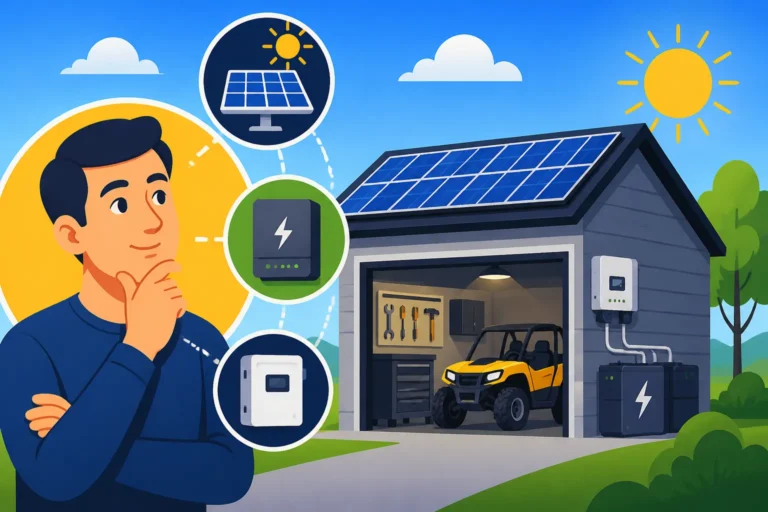
An off-grid solar system for a garage typically consists of several key components, and each comes with its own price tag.
- Solar Panels: These are what convert sunlight into electricity. Prices vary based on wattage, efficiency, and brand. For a typical garage setup, you might need anywhere from 200 watts to several kilowatts. Expect to pay roughly $0.70 to $1.50 per watt for panels. A 400-watt array, suitable for modest use, might run you $280-$600. For more on what these cost, see Cost of Off-Grid Solar Panels
- Batteries: This is where the energy is stored for use when the sun isn't shining. Batteries are often the most expensive single component in an off-grid system. Lithium iron phosphate (LiFePO4) batteries are popular for their longevity and depth of discharge, but they come at a higher upfront cost than lead-acid options. A decent 100Ah (amp-hour) 12V LiFePO4 battery might cost $300-$1000, and you’ll likely need several of these, or a larger 24V/48V battery bank, depending on your needs. Our article on the Cost of an Off-Grid Solar Battery Bank
- Inverter: This converts the DC (direct current) power from your batteries into AC (alternating current) power, which is what most standard household appliances use. The inverter's size (wattage rating) needs to match your maximum simultaneous power draw, plus a buffer for surge loads. A good quality pure sine wave inverter can range from $200 for a small 1000W unit to $1000+ for larger 3000W-5000W models capable of handling heavy tools.
- Charge Controller: This device regulates the power flowing from your solar panels to your batteries, preventing overcharging and optimizing efficiency. MPPT (Maximum Power Point Tracking) controllers are generally more efficient than PWM (Pulse Width Modulation) controllers but are also more expensive. Expect to pay $100-$500 for a suitable MPPT controller.
- Mounting Hardware, Wiring, and Safety Gear: Don't forget the bits and pieces that hold it all together and keep it safe. This includes panel mounting racks, heavy-gauge wiring, fuses, breakers, disconnect switches, and conduit. These can add another few hundred dollars to your total.
For a small, light-use garage system (e.g., lights, phone charging, occasional small power tool), you might be looking at a total cost of $1,000 to $3,000 for components. For a more robust workshop powering larger tools and potentially a small fridge, the cost could easily climb to $5,000 to $10,000 or even more, depending on battery bank size and desired autonomy.
DIY vs. Professional Installation Costs
Another massive factor in the "worth it" equation is how you plan to install the system. Are you a handy DIY enthusiast ready to tackle the wiring and mounting yourself, or will you hire professionals?
Going the DIY route can significantly reduce your overall expenses, often saving you thousands of dollars in labor costs. If you have a good understanding of electrical systems, are comfortable with tools, and are willing to put in the time for research and execution, a DIY off-grid garage setup is entirely feasible. There are tons of resources available, and many component manufacturers, like Renogy or Victron, offer comprehensive kits and diagrams to guide you. However, it requires a commitment to learning about How to Install an Off-Grid Solar System
On the flip side, hiring a professional solar installer or a licensed electrician ensures the job is done correctly, safely, and to code. This peace of mind comes at a cost, with installation labor potentially adding 20% to 50% (or even more) to your total project budget. For complex setups or if you're uncomfortable with electrical work, this expense can be well worth it to avoid costly mistakes or safety hazards. Ultimately, the choice between DIY vs Professional Off-Grid Solar Cost depends on your skills, budget, and comfort level with electrical systems.
Benefits of Off-Grid Solar for a Garage
Moving beyond the numbers, there are some very tangible benefits that make off-grid solar for your garage a truly appealing prospect. It's not just about saving money; it's about gaining control and embracing a different way of thinking about power.
Energy Independence and Lower Operating Costs
This is often the primary driver for going off-grid. If your garage is remote, extending grid power can be incredibly expensive – think thousands, even tens of thousands of dollars, just to run a trench and wires. With off-grid solar, you eliminate those astronomical connection fees and trenching costs entirely. Once your system is installed, your "fuel" (sunlight) is free. This means no monthly utility bills for your garage's power consumption.
Over the lifetime of your system, which can be 20-25 years for panels and 10-15+ years for quality lithium batteries, these savings can really add up. Imagine never having to worry about peak-hour charges or escalating electricity rates for your workshop. It offers true energy freedom, allowing you to power your tools, lights, and any other amenities without a thought to the utility company. This freedom also means you can often situate your garage or workshop wherever it makes the most sense on your property, without being limited by grid accessibility.
Environmental Impact and Backup Power
Beyond personal savings, choosing solar for your garage means you’re significantly reducing your carbon footprint. You’re utilizing a clean, renewable energy source that produces no emissions during operation. For many, this aligns with their personal values and contributes to a healthier planet.
Furthermore, an off-grid solar system provides an invaluable source of backup power. When the main grid goes down, as it inevitably does during storms, outages, or other unforeseen events, your garage remains powered. This can be a huge advantage for critical operations, maintaining security lighting, or simply having a reliable place to charge tools and devices when the rest of your property is dark. For those with essential garage appliances, like a well pump if it's connected to the garage, or a freezer for game meat, this backup capability isn't just a convenience – it's a necessity. Even a smaller portable solar generator, like a Jackery, can be an excellent emergency backup solution for critical items, ready to be deployed instantly.
Challenges and Considerations
While the benefits are compelling, it’s only fair to present the full picture. Off-grid solar for a garage isn't without its challenges, and being aware of them upfront will help you make a more informed decision and avoid potential frustrations down the road.
System Sizing and Maintenance
Getting the system sizing right is absolutely paramount, and frankly, it's where many people stumble. Undersizing your system means you'll constantly run out of power, especially during periods of low sunlight or high demand. This leads to dead batteries, frustration, and potentially shortened battery life due to excessive deep cycling. Oversizing, while safe, means you've spent more money than necessary on components you don't truly need. It's a delicate balance that requires careful calculation of your energy needs, considering factors like peak sun hours in your location, seasonal variations, and desired days of autonomy (how long your system can run without sun). Our detailed guide on How to Size an Off-Grid Solar System can walk you through this process step-by-step.
Beyond initial setup, off-grid solar systems do require some ongoing attention. This isn't a "set it and forget it" solution. You'll need to periodically clean your solar panels to ensure maximum efficiency, especially if they accumulate dust, pollen, or leaves. Batteries, even modern LiFePO4 ones, benefit from monitoring to ensure they're performing optimally. Wiring connections should be checked for corrosion or looseness. While these tasks aren't overly demanding, they are essential for the longevity and reliability of your system. Neglecting maintenance can lead to reduced performance or costly repairs down the line. To learn more about this, check out Off-Grid Solar Maintenance Costs.
Initial Investment and Payback Period
As discussed, the upfront cost of an off-grid solar system for a garage, especially one with significant power needs, can be a considerable investment. While you save on utility bills, it can take time to recoup that initial expense through avoided costs. This is known as the payback period. For a garage, if the alternative is simply having no power or running a small generator intermittently, the payback might be quick in terms of convenience and functionality gained. However, if your garage is close to grid access and your power needs are truly minimal, the financial payback might be quite long.
It's important to differentiate between monetary payback and value. The "worth it" factor isn't always purely financial. The independence, reliability during outages, and environmental benefits also hold significant value that isn't easily quantified in dollars. Still, if your primary motivation is purely financial return, calculating the Off-Grid Solar Payback Period Explained can help you set realistic expectations.
Space Requirements and Panel Placement
Solar panels need sunlight, and batteries need a safe, protected place to live. Do you have sufficient, unobstructed roof space on your garage or a clear area on your property for a ground mount? Panels need to be oriented correctly (typically south-facing in the Northern Hemisphere) and at an optimal tilt angle to maximize energy harvest throughout the year. Shading from trees or other buildings can severely impact performance.
The battery bank and inverter also require space, usually indoors or in a weatherproof enclosure. They need to be protected from extreme temperatures and, in the case of some battery chemistries, require ventilation. While a garage often offers more space than, say, an RV, it's still a consideration, especially if you have a compact workshop. You need to plan for the physical footprint of all components, ensuring they are accessible for maintenance and safely installed.
Scenarios Where Off-Grid Solar for a Garage is Worth It (and When It's Not)
Now for the heart of the matter: when does off-grid solar for a garage truly shine, and when might it be overkill or simply not the best fit? It's all about matching the solution to your specific circumstances and goals.
Remote Garages or Workshops
This is arguably the most compelling scenario where off-grid solar is unequivocally worth it. If your garage, shed, or workshop is located far from your main residence, or on a property without any grid access at all, the cost of extending utility lines can be astronomical. We're talking tens of thousands of dollars for trenching, poles, and connection fees – costs that might never truly pay for themselves.
In these situations, a well-designed off-grid solar system becomes not just a viable alternative, but often the most economical and practical solution. It provides power exactly where you need it, without the immense infrastructure costs and the ongoing monthly bills. Imagine a hunting cabin's remote workshop in the woods, or a hobby mechanic’s garage at the back of a large rural property. For these scenarios, the freedom and cost savings (compared to grid extension) make off-grid solar an absolute game-changer. It’s worth every penny to get reliable power in a place where it would otherwise be a monumental undertaking.
Light-Use vs. Heavy-Use Garages
The scale of your garage power needs also heavily influences the "worth it" factor.
-
Light-Use Garages: If your garage mainly needs power for occasional LED lighting, charging cordless tool batteries, or maybe a radio, a smaller, more affordable off-grid system can be incredibly cost-effective. In some cases, a robust portable solar generator with a couple of portable panels, like those offered by Jackery or EcoFlow, might even suffice. These units are easy to set up, require minimal installation, and offer immediate power for small loads. For example, a 1000W portable power station with 200W of panels could cover these needs for around $1,000-$2,000. In this instance, the convenience and independence gained often far outweigh the relatively modest cost. Our article What a 1000W Off-Grid System Can Power and Cost delves deeper into this size range.
-
Heavy-Use Garages/Workshops: If you're running heavy machinery, welders, air compressors, or even HVAC in your garage for extended periods, you're looking at a much larger, more complex, and more expensive off-grid system. The upfront investment will be significant, potentially $10,000 or more. In these cases, you need to carefully weigh the cost against your alternatives. If grid extension is feasible and reasonably priced, it might be cheaper in the long run. However, if grid extension remains prohibitively expensive, or if you prioritize complete energy independence and resilience against outages, then the investment in a robust off-grid system for a heavy-use garage becomes perfectly justified.
Budget Constraints and Future Expandability
Sometimes, the "worth it" question is constrained by your immediate budget. The good news is that off-grid solar systems can often be built in phases. You don't have to buy everything all at once. You could start with a smaller array and battery bank to cover your most essential needs, then expand as your budget allows or as your power demands grow.
For example, you could initially purchase enough panels and batteries to run your lights and charge small tools. Later, you could add more panels, expand your battery bank, or upgrade your inverter to handle heavier loads like a table saw or an air compressor. Planning for expandability from the outset (e.g., choosing an inverter and charge controller that can handle future additions) is a smart way to manage costs. This phased approach can make the initial investment more manageable and ultimately make off-grid solar "worth it" even on a tighter budget. For ideas on smart budgeting, read How to Budget for an Off-Grid Solar System.
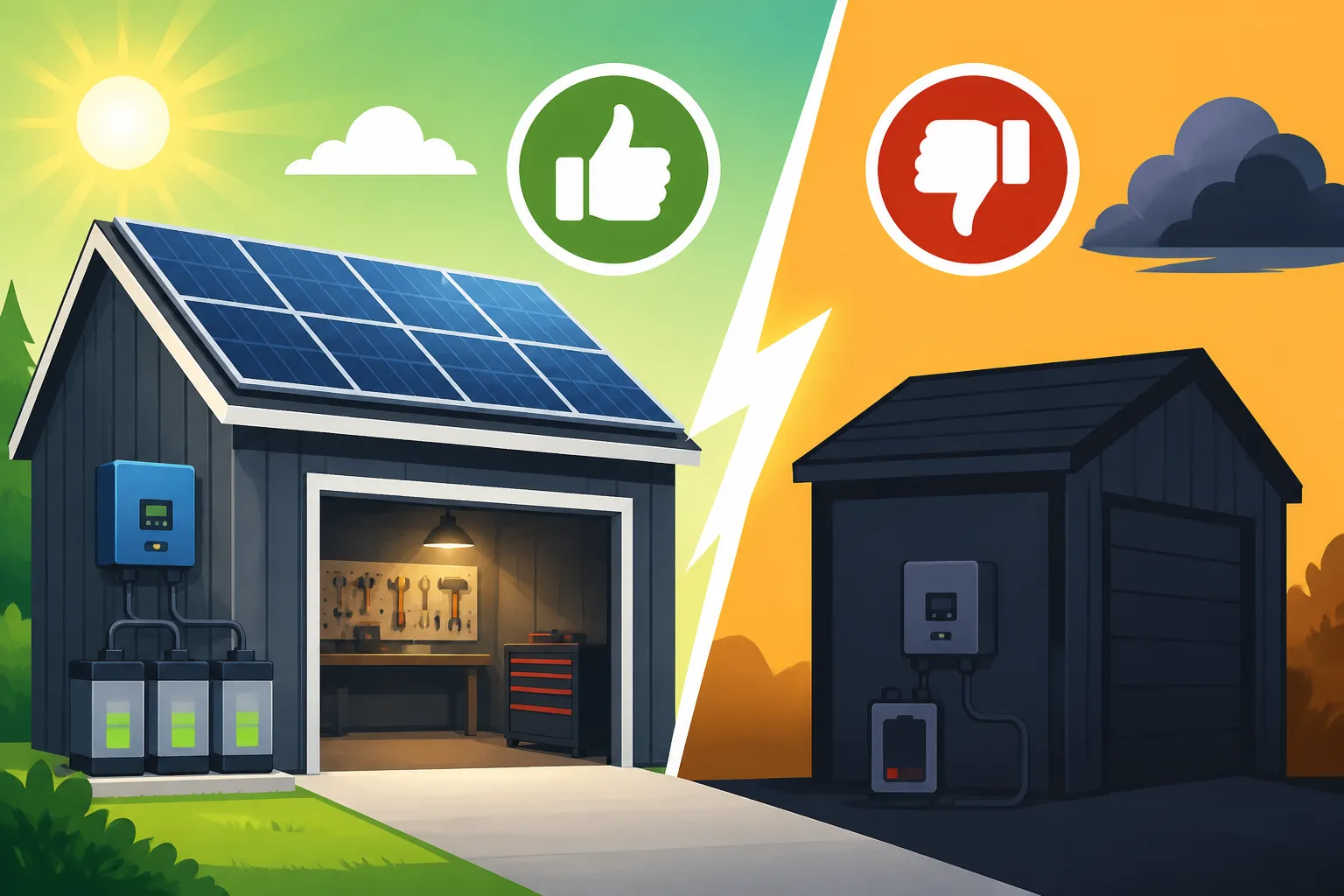
Ultimately, if you value energy independence, reliable power during outages, and are located where grid power is expensive to access, then off-grid solar for your garage is almost certainly worth it. If your garage is already grid-tied, or your needs are extremely minimal and close to grid access, then a full off-grid system might be overkill, and a simpler, smaller solution like a portable power station (like a Jackery) could be a better, more cost-effective choice.
| Garage Use Case | Typical Power Needs | Is Off-Grid Solar Worth It? | Considerations | Estimated Component Cost Range (DIY) |
|---|---|---|---|---|
| Remote, Light Use | LED lighting, phone charging, small hand tool use | Absolutely! | Grid extension too expensive. High value on independence. Portable solar generator (e.g., Jackery) or small DIY kit. Minimal ongoing costs. | $500 – $2,500 |
| Remote, Hobby Workshop | Lights, medium power tools, small fridge, radio | Highly Likely | Grid extension still expensive. Need more consistent power than light use. Good value for functionality. Requires more substantial panels/batteries/inverter. Ensure proper sizing for surges. | $2,500 – $7,000 |
| Remote, Heavy Workshop | Lights, heavy power tools (welder, compressor), HVAC | Likely, Depending on Grid Cost | Grid extension often cost-prohibitive. Significant investment required. Careful sizing for high surge loads. High value on operational continuity. May require generator backup for peak loads/extended cloudy periods. | $7,000 – $20,000+ |
| Grid-Tied, Light Use | Occasional lights, battery charging | Maybe, for Backup Only | Grid already present. Primary value is backup power or environmental choice. Financial payback is slower. A portable solar generator might be a more cost-effective backup solution. | $500 – $2,000 (for backup) |
| Grid-Tied, Heavy Use | Consistent use of heavy tools, welding, HVAC | Less Likely, Unless Prioritizing Independence | Grid power is usually more economical for high, consistent loads when already connected. High upfront cost for off-grid. Value would be solely on complete independence or resilience to outages rather than cost savings over grid. Consider hybrid systems if you want both. | $7,000 – $20,000+ |
Disclaimer
The information provided in this guide is for general informational purposes only and does not constitute professional advice. Off-grid solar system design and installation can be complex and involve electrical hazards. Always consult with qualified professionals and adhere to local codes and regulations when planning or installing any solar electric system.