EcoFlow Delta Pro Review for Off-Grid Use
One of the biggest headaches for anyone dipping their toes into the off-grid lifestyle or simply looking for reliable backup power is finding a system that can handle real-world demands without breaking the bank or requiring a degree in electrical engineering. Many folks want a robust, expandable power solution that's still relatively portable and simple to set up, but separating the marketing hype from practical reality can be tough. This guide is here to cut through the noise and give you a thorough, honest look at the EcoFlow Delta Pro, specifically examining how it stacks up for actual off-grid use.
Unpacking the EcoFlow Delta Pro for Off-Grid Scenarios
When you're talking about off-grid power, the EcoFlow Delta Pro often comes up in conversation, and for good reason. It's a powerhouse in the portable solar generator market, designed to bridge the gap between small emergency power banks and full-blown residential solar setups. But is it truly built for the sustained demands of living off the grid, or is it more suited for temporary fixes? Let's peel back the layers and see what makes this unit tick and where it truly shines, or perhaps falls short, in a genuine off-grid context.
Core Features and Specifications
The EcoFlow Delta Pro is a beast, plain and simple. At its heart, you're looking at a substantial 3.6 kilowatt-hour (kWh) LiFePO4 battery, which is a significant chunk of energy storage in a portable form factor. This isn't your average weekend camping battery; this is designed for heavier lifting. The magic truly happens with its AC output capabilities. It boasts a continuous 3600 watts (W) of pure sine wave AC power, which is impressive enough. But then EcoFlow throws in their X-Boost technology, temporarily pushing that output to an astounding 4500W to handle those high-surge appliances that typically trip smaller inverters, like well pumps or some power tools.
What makes it particularly appealing for off-grid use is its versatility in charging and output. You can juice it up from AC wall outlets (with an incredibly fast 3000W X-Stream charge, filling it in under two hours), car chargers, dedicated EV charging stations, and, most importantly for us off-gridders, solar panels. It supports up to 1600W of solar input, which means you can really pack on the panels to replenish that large battery quickly on sunny days. You'll find a plethora of output ports, including multiple AC outlets, USB-A, USB-C, and DC ports, ensuring you can power almost anything you throw at it. The inclusion of a robust LiFePO4 battery chemistry is a huge plus, promising thousands of charge cycles and a much longer lifespan compared to older lithium-ion or lead-acid alternatives.
Target Use Cases and Ideal Candidates
So, who exactly is the EcoFlow Delta Pro made for in the off-grid world? It really shines for folks who need a flexible, powerful solution that can move with them or serve as a robust primary power source for smaller, mobile applications. Think RVers who want to run their air conditioner for more than an hour, or van lifers with demanding power needs for cooking appliances, laptops, or even mini-splits. For those with a cabin in the woods, it can provide ample power for lights, refrigeration, and electronics, becoming a crucial component in their overall Cost to Power a Cabin with Solar For remote workshops or sheds, it offers a clean, quiet alternative to noisy gasoline generators, providing reliable power for tools and lighting.
However, it's important to set realistic expectations. While it’s powerful, it's still a portable power station. For a full-time, energy-intensive off-grid home, the Delta Pro might serve as an excellent component within a larger system or as backup, but it's not a one-stop shop for everything a typical grid-tied home demands day in and day out. It's perfectly positioned for moderate consumption, seasonal use, or for those transitioning into a larger off-grid setup and wanting a reliable, scalable base to build upon.
The EcoFlow Delta Pro's Advantages and Disadvantages for Off-Grid Life
Deciding on any major piece of off-grid equipment means weighing the good against the not-so-good. The EcoFlow Delta Pro is no exception. While it brings a lot to the table, it also has considerations that might make it a perfect fit for some, and less so for others, depending on their specific off-grid dreams and demands.
The Upsides: Where the Delta Pro Truly Shines
One of the most compelling advantages of the EcoFlow Delta Pro is its incredible ease of setup. Unlike a traditional off-grid solar system, which might involve complex wiring diagrams, mounting heavy components, and potentially navigating local permits, the Delta Pro is essentially plug-and-play. You unbox it, charge it, and you're powering appliances. This simplicity is a huge draw for beginners or those who prefer not to embark on an extensive DIY Off-Grid Solar Installation Step by Step
Its portability, despite its weight (around 99 pounds), is another major win. Integrated wheels and a retractable handle make it surprisingly easy to move around your property, into your RV, or wherever power is needed. This mobility means you're not tied to a fixed installation, which is a game-changer for mobile living or for powering different areas of a homestead at different times. The rapid X-Stream AC charging is unparalleled in the market; being able to fully charge such a large battery in a couple of hours means less downtime and more flexibility. Furthermore, its expandability is stellar. You can add up to two Delta Pro Smart Extra Batteries, pushing the total capacity to a massive 10.8 kWh. This kind of modularity allows you to scale your power as your needs grow, or as your budget allows, effectively creating a more comprehensive system without needing to start from scratch. For those looking at Best Off-Grid Solar Generators for backup or primary power, the Delta Pro is consistently at the top of the list for its feature set.
The Downsides: Critical Considerations to Ponder
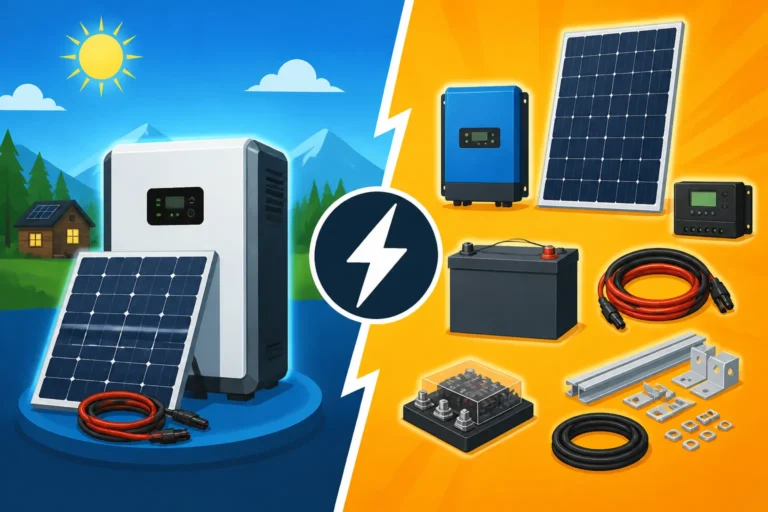
No single solution is perfect for everyone, and the Delta Pro has its limitations, especially when considering long-term, intensive off-grid living. The initial cost is significant. While you're getting a lot of features and power, the price point for the base unit, and especially with extra batteries, can quickly approach what you might spend on a custom-built system with comparable capacity. For some, the Off-Grid Solar Cost: Complete Breakdown will show that piecing together individual components might offer better value per kilowatt-hour, especially if you're comfortable with DIY.
Another point to consider is the all-in-one design. While convenient, if one major component (like the inverter or battery management system) fails, the entire unit might be out of commission, potentially requiring professional service or replacement. In contrast, a component-based system allows for easier troubleshooting and individual part replacement. While its 3600W output is high, prolonged running of multiple large appliances might stress the system, especially if it's operating near its peak continuous output. While the X-Boost feature helps with surges, it's not meant for sustained high loads. For a true whole-home setup with consistent high-demand appliances, a dedicated inverter like a Victron or Sol-Ark might offer more robust, long-term performance and efficiency. Lastly, while it handles up to 1600W of solar input, if you live in a region with extended cloudy periods, even that might not be enough to fully replenish its large battery in a day, necessitating a backup generator or alternative charging methods.
Real-World Performance and Practical Application
Understanding the specifications is one thing, but seeing how the EcoFlow Delta Pro performs in real-world off-grid scenarios is where the rubber truly meets the road. It’s about how it handles the daily grind, the sudden surges, and the need for consistent, reliable power, whether you’re parked in your RV, nestled in a cabin, or preparing for an emergency.
Powering Common Off-Grid Appliances
Let’s talk about the big question everyone asks: can it run my stuff? The good news is, for many common household and recreational appliances, the EcoFlow Delta Pro is more than capable. A standard residential refrigerator (around 100-200W running, but with higher startup surges) can easily be powered for a day or two on a single charge, depending on its efficiency and how often it cycles. For example, a modern, energy-efficient fridge might use 1 kWh per day, meaning the Delta Pro’s 3.6 kWh capacity could theoretically run it for over three days. However, real-world usage varies.
What about bigger loads? A well pump, notorious for its high starting wattage (often 2-3 times its running wattage), is where the Delta Pro's 3600W continuous output and 4500W X-Boost really shine. Many standard 1/2 HP well pumps can run off the Delta Pro, but you’ll want to check your specific pump’s surge requirements. Air conditioners are another high-demand item. A 13,500 BTU RV AC unit, which might draw around 1500-2000W, could run for 1.5 to 2 hours on a single charge of the Delta Pro, making it suitable for cooling down your space before bed or during peak heat. For running things like a microwave, toaster, or power tools, the Delta Pro handles short bursts of high wattage with ease. It's far superior to many smaller portable power stations, which often struggle with anything over 1500W.
| Appliance | Average Running Watts | Est. Surge Watts | Run Time on EcoFlow Delta Pro (3.6kWh) |
|---|---|---|---|
| Refrigerator (Energy Star) | 80-150W | 500-1000W | 24-45 hours |
| Microwave (1000W) | 1000-1500W | – | 2.4-3.6 hours (cumulative) |
| Well Pump (1/2 HP) | 750-1500W | 1500-3000W+ | 2.4-4.8 hours (cumulative) |
| RV AC (13,500 BTU) | 1500-2000W | 3000-4000W | 1.8-2.4 hours |
| Laptop | 40-70W | – | 50-90 hours |
| LED Lights (10 bulbs) | 50-100W | – | 36-72 hours |
| Coffee Maker | 800-1200W | – | 2-3 hours (cumulative) |
Note: Run times are estimates and depend on appliance efficiency, usage patterns, and battery degradation over time.
Charging Strategies and Solar Integration
For true off-grid living, relying solely on AC charging isn't practical. This is where the EcoFlow Delta Pro's robust solar charging capabilities become crucial. It can accept up to 1600W of solar input, which is a fantastic feature. This means you can hook up multiple solar panels, either portable or permanently mounted, to recharge the unit. For example, four 400W solar panels could, in ideal conditions, fully recharge the Delta Pro in just a few hours.
When considering how many solar panels for off-grid living you might need, especially with the Delta Pro, it's about balancing daily consumption with recharge capability. If you consume 2 kWh a day and have a 3.6 kWh battery, you'll ideally want enough solar to put back at least that 2 kWh. In regions with good peak sun hours, 800-1000W of solar panels might be sufficient for daily top-ups, while in cloudy climates or during winter, you'd need more. The unit uses MPPT (Maximum Power Point Tracking) technology, which is essential for efficient solar charging, maximizing the power harvested from your panels even in less-than-ideal conditions. The flexibility to charge from a range of sources, including EV charging stations if you happen to be passing one in a pinch, really sets the Delta Pro apart as a versatile off-grid companion.
Comparing with Other Portable Power Stations
In the world of portable power stations, the EcoFlow Delta Pro sits firmly in the high-end, high-capacity segment. It often goes head-to-head with other premium brands, like certain Jackery models or Bluetti's larger offerings. For instance, while a Jackery 2000 Plus for Off-Grid: Specs and Review might offer a slightly different form factor or feature set, the Delta Pro consistently impresses with its sheer output wattage and its remarkable expandability through extra batteries and the Smart Home Panel.
Many competing units, while offering decent capacity, fall short on continuous AC output, struggling with appliances that the Delta Pro handles with relative ease. The X-Stream charging technology, which allows for extremely fast wall charging, is another differentiating factor that isn't commonly found in this class of device. While a Jackery Explorer might be fantastic for smaller loads or shorter trips, when it comes to powering a significant portion of an off-grid cabin or a full-sized RV’s electrical system, the Delta Pro’s capabilities often push it ahead for those with higher demands. The choice often comes down to your specific power needs, budget, and desired level of integration into a larger system.
Is the EcoFlow Delta Pro the Right Fit for Your Off-Grid Needs?
Ultimately, the decision to invest in an EcoFlow Delta Pro for your off-grid adventure comes down to your individual circumstances, energy consumption, budget, and how you envision your power setup evolving over time. It's a significant investment, so let's think critically about its place in your long-term off-grid strategy.
Budgeting and Long-Term Value
Let's not sugarcoat it: the EcoFlow Delta Pro is an investment. The base unit, before any solar panels or extra batteries, represents a substantial upfront cost. When considering How to Budget for an Off-Grid Solar System, it's crucial to compare this all-in-one solution with building a modular system from scratch. A custom system, perhaps using individual components like Best Off-Grid Solar Panels, a dedicated inverter, and a Cost of an Off-Grid Solar Battery Bank made up of LiFePO4 vs Lead-Acid Battery Cost options, might offer a better cost-per-watt-hour over its lifetime, especially if you're handy and can do much of the installation yourself, saving on DIY vs Professional Off-Grid Solar Cost.
However, the Delta Pro's value isn't just in its raw capacity or output; it's in its convenience, reliability, and integrated features. For those who prioritize simplicity, portability, and a robust warranty without the hassle of complex wiring, the premium might be worth it. It significantly reduces the learning curve and installation complexity, which can be invaluable for someone new to off-grid living or those who need a deployable solution quickly. The long lifespan of its LiFePO4 battery also contributes to its long-term value, as it will likely outlast many cheaper lead-acid alternatives.
Scalability and Future-Proofing Your Power
One of the most appealing aspects of the EcoFlow Delta Pro is its expandability. If your energy needs grow, or you decide to move from weekend trips to full-time off-grid living, you don't necessarily have to ditch your entire investment. The ability to add up to two Smart Extra Batteries is a huge bonus, allowing you to increase your capacity significantly. This modularity means that the Cost of Expanding an Off-Grid System can be managed over time, rather than a single, massive initial outlay.
Furthermore, EcoFlow offers a Smart Home Panel, which can integrate the Delta Pro directly into your home's electrical system, allowing it to act as a seamless backup power source, even managing your critical loads during grid outages. While this pushes the boundaries of "portable," it showcases how the Delta Pro can evolve from a mobile power source to a more integrated part of a fixed off-grid or grid-tied backup setup. This forward-thinking design, allowing for both standalone use and integration, makes it a compelling option for those who aren't entirely sure what their off-grid future holds, but want a flexible system that can adapt. It's truly a power station that can grow with you.
Disclaimer
The information provided in this article is for general informational purposes only and does not constitute professional advice. Off-grid solar system design and installation can be complex and involve electrical hazards. Always consult with qualified professionals and adhere to local codes and regulations before installing or modifying any electrical system.