How to Size Fuses and Breakers
One of the biggest anxieties for anyone diving into off-grid solar is undoubtedly electrical safety. You've invested good money, time, and effort into building a system, and the last thing you want is a short circuit leading to damaged equipment, or worse, a fire. Properly sizing and implementing fuses and circuit breakers isn't just about protecting your gear; it's about safeguarding your home, your RV, or your cabin, and ensuring everyone around it remains safe. This comprehensive guide will walk you through the essential steps to accurately size these critical protection devices for every part of your off-grid solar system.
Why Fuses and Breakers are Non-Negotiable in Off-Grid Solar
Imagine running a marathon without proper shoes or going hiking without a first-aid kit. Fuses and circuit breakers are the essential safety gear for your off-grid solar setup. They're not optional add-ons; they are fundamental components that protect your investment, extend the life of your equipment, and, most importantly, prevent dangerous electrical incidents. Without them, your meticulously designed system could become a serious hazard, turning a minor fault into a catastrophic event.
Protecting Your Investment and Preventing Disasters
The primary role of fuses and circuit breakers is to act as sacrificial components, designed to fail before your expensive equipment does. Think about it: a solar panel array can generate significant current, and a large battery bank holds immense stored energy. If a wire chafes, an accidental short occurs, or a component malfunctions, you get an overcurrent situation. Without protection, this surge of electricity can quickly overheat wires, melt insulation, damage sensitive electronics like your charge controller or inverter, and even ignite nearby flammable materials, leading to a fire.
For instance, consider a scenario where the wiring between your solar charge controller and your battery bank develops a short circuit. The battery, being a high-current source, would immediately dump all its available power into that short. If there's no fuse or breaker in place, the wire itself becomes the fuse, rapidly heating up to dangerous temperatures, potentially melting through its insulation, and causing a fire. A correctly sized fuse, however, would blow instantly, severing the connection and preventing any further damage or hazard. This small, relatively inexpensive component saves you from replacing costly equipment and facing a potentially devastating situation.
Understanding the Difference: Fuses Versus Circuit Breakers
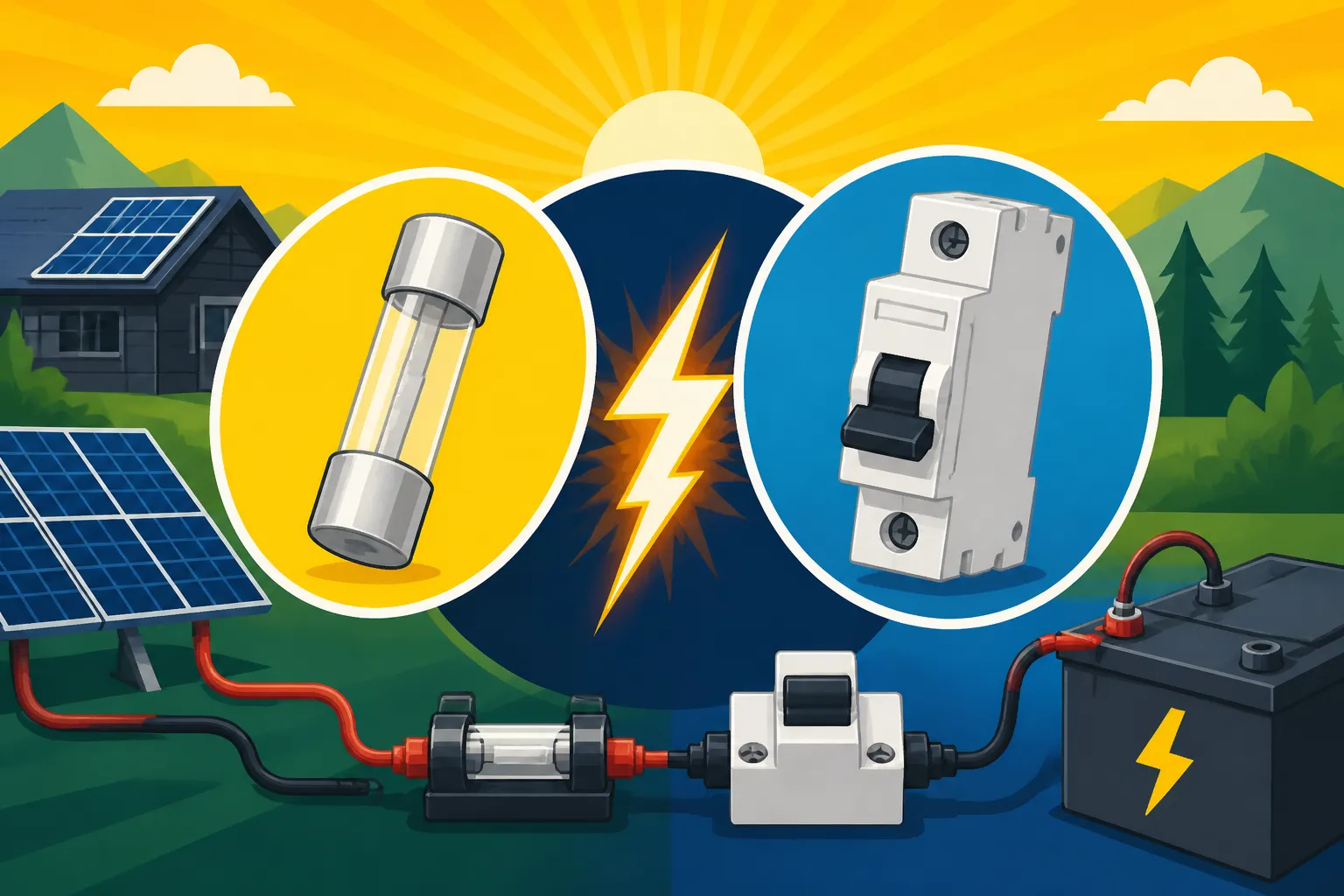
While both fuses and circuit breakers serve the same crucial purpose—to interrupt current flow during an overcurrent event—they achieve this in slightly different ways, and each has its place in an off-grid system. Understanding their distinctions helps you choose the right tool for the job.
Fuses are essentially a piece of wire or metal strip designed to melt and break the circuit when too much current flows through it. They are a one-time use device; once they blow, they must be replaced. This characteristic means you'll need spares on hand, especially for critical circuits. Fuses are often preferred in situations where a very fast response time is needed, or where the circuit isn't expected to fault frequently, like protecting a main battery bank connection. They're typically very reliable, have no moving parts, and can be quite compact. Common types used in off-grid systems include ANL fuses for high-current applications, MIDI/MAXI fuses for moderate currents, and sometimes even smaller ATC/ATO blade fuses for lighter loads.
Circuit breakers, on the other hand, are electro-mechanical switches that trip open when an overcurrent is detected, breaking the circuit. Unlike fuses, they can be reset and reused after the fault has been cleared. This reusability makes them convenient for circuits where faults might occur more frequently, such as AC output circuits from an inverter, or for branch circuits feeding various loads in a cabin. Breakers come in various forms, including thermal, magnetic, or thermal-magnetic types, and are typically rated for either DC or AC applications (it's crucial to use the correct type for your specific circuit). While they offer the convenience of resetting, some high-end DC breakers can be more expensive than their fuse counterparts, especially those with high interrupt ratings suitable for large battery banks. Both types are indispensable, but knowing when to use which can optimize both safety and convenience in your off-grid setup.
Essential Components Requiring Overcurrent Protection
When you're building an off-grid solar system, it's not enough to just throw a fuse on the main line and call it a day. Every major component, and indeed most significant wiring runs, needs its own specific protection. Neglecting even one part of the system can create a weak link, jeopardizing the entire setup. This layered approach to safety ensures that if a fault occurs in one section, it doesn't cascade into a system-wide failure.
Solar Panel Array (PV Array) Protection
Your solar panels are the heart of your generation, and they need robust protection. Sunlight hitting your panels is constant energy, and if a fault occurs within the array or its wiring, that energy needs a safe path to be interrupted. Protection typically involves two main areas: individual string fusing and overall array protection.
For larger arrays, especially those with multiple strings of panels wired in parallel, it's a best practice to fuse each individual string. If you have, say, three strings of panels, and one string develops an internal short or a ground fault, the other two strings could backfeed current into the faulty one. This backfeeding can cause serious overheating in the damaged string, potentially leading to melted cables or even fire. By installing appropriately sized fuses in a combiner box for each string, you ensure that if one string faults, its fuse blows, isolating it while the rest of the array continues to operate safely. These fuses are typically rated for the maximum reverse current capability of the panels and are always DC-rated. Furthermore, the main output from your entire PV array, before it reaches your charge controller, also requires a dedicated fuse or circuit breaker. This component, often integrated into a disconnect switch, provides a critical point of safety, allowing you to completely de-energize the PV array for maintenance or in an emergency. Remember, understanding How to Wire an Off-Grid Solar System properly is key to implementing these safety measures effectively.
Battery Bank Protection
The battery bank is arguably the most critical component to protect due to the immense amount of stored energy it contains and its ability to deliver very high currents in a fault condition. A short circuit on a large battery bank can discharge hundreds or even thousands of amps almost instantly, leading to explosive events or severe fires if not properly protected.
The most important fuse or circuit breaker in your entire off-grid system is the one located as close as possible to your main battery positive terminal. This main battery fuse must be sized to protect the largest load connected to the battery, typically your inverter. It also needs to have a very high interrupt current rating (AIC or Interrupting Rating), significantly higher than what a typical house breaker would have, because batteries can deliver extremely high short-circuit currents. This means you can't just pick up any fuse; you need specialized DC-rated fuses like ANL, Class T, or MIDI fuses that are designed for high-current DC applications. For larger systems, particularly those using advanced lithium iron phosphate (LiFePO4) batteries, the battery management system (BMS) integrated within the battery also offers internal protection, but an external main fuse is still an absolute necessity as a last line of defense. Proper protection for your batteries is foundational to Off-Grid Solar Safety and Grounding.
Inverter and Charge Controller Safeguards
Both your charge controller and inverter are sensitive electronic devices that facilitate the flow of power in your system, and they require diligent protection on both their input and output sides.
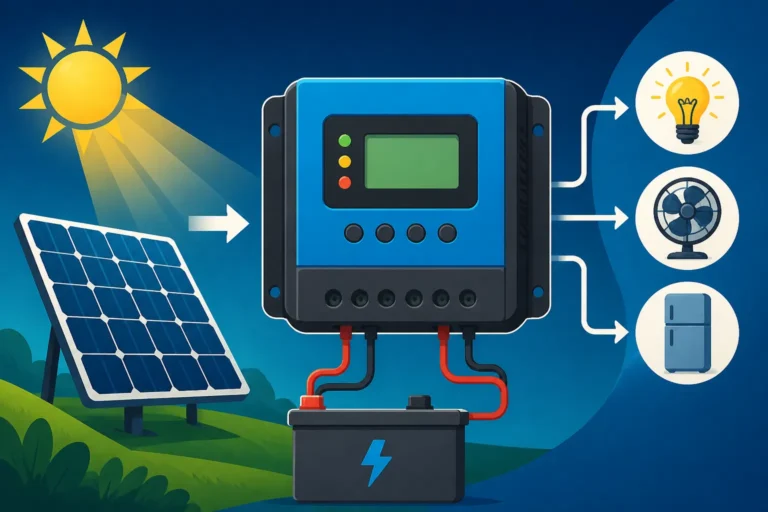
The charge controller, which regulates the power flow from your solar panels to your batteries, needs protection on both its input (from the solar array) and its output (to the battery bank). The input fuse/breaker should be sized according to the maximum input current rating of the charge controller and the maximum current from your solar array. The output fuse/breaker, between the charge controller and the battery, protects the controller from any reverse current from the battery or overcurrent during charging, and should be sized based on the charge controller's maximum output current. Often, manufacturers like Renogy will provide specific recommendations for these fuse sizes in their manuals, which are always the best place to start.
The inverter, which converts your battery's DC power into usable AC household power, also requires dual-sided protection. On the DC input side, a large fuse or breaker is needed between the battery bank and the inverter to protect the inverter from overcurrents from the battery. This is usually the largest fuse in your system and should be sized to handle the inverter's maximum continuous DC input current, considering its peak surge capabilities. On the AC output side, standard AC circuit breakers are used to protect your AC wiring and appliances from overloads or short circuits coming from the inverter. These breakers are sized just like those in a traditional home electrical panel, according to the National Electrical Code (NEC) standards and the inverter's AC output rating. A good understanding of How to Size an Off-Grid Inverter is essential before tackling its overcurrent protection.
The Science Behind Sizing Fuses and Breakers
Sizing fuses and circuit breakers isn't just about guessing; it's a careful calculation based on electrical principles and safety standards. Get it wrong, and you risk either nuisance trips (if undersized) or, far more dangerously, inadequate protection (if oversized). The goal is to choose a protection device that allows normal operational current but trips quickly when a dangerous overcurrent occurs, without damaging the associated wiring or components.
Understanding Current Ratings: Amps, Watts, and Voltage
At the heart of all electrical sizing is the relationship between power (Watts), voltage (Volts), and current (Amps). The fundamental formula, often called Ohm's Law or the Power Law, is P = V * I (Power = Voltage * Current). This simple equation is your best friend when determining current draw for sizing purposes.
For instance, if you have a 1000-watt appliance running on a 120-volt AC system, the current draw (I) would be 1000W / 120V = 8.33 Amps. You'd then select a breaker slightly larger than this, typically 10 or 15 amps, depending on the wire gauge. However, in off-grid DC systems, voltages can vary (12V, 24V, 48V, etc.), which significantly impacts current. A 1000-watt load on a 12V DC system draws 1000W / 12V = 83.3 Amps – a much higher current that requires much thicker wires and larger fuses than the same load on a 120V AC system. It's also vital to distinguish between continuous current (the current drawn for extended periods) and surge current (a brief, higher current draw, like when a motor starts). Fuses and breakers need to handle continuous current without tripping, but trip quickly on sustained overcurrents or severe surges. Keep in mind that for sizing, the continuous current rating must be derated, typically by 20%, meaning your chosen device should be rated for at least 125% of the continuous load. This is a crucial detail often overlooked by beginners and ties directly into How to Calculate Daily Energy Usage.
Conductor Ampacity and Wire Gauge
The wire connecting your components is just as important as the components themselves. Every wire gauge (thickness) has a maximum current it can safely carry without overheating, known as its ampacity. If you put a 100-amp fuse on a wire only rated for 50 amps, the wire will melt long before the fuse ever blows. This is a recipe for disaster.
The general rule is that the fuse or circuit breaker must always protect the wire. You determine the required wire gauge based on the expected maximum current and the length of the run (to account for voltage drop), then select a fuse or breaker that is rated below or equal to that wire's ampacity. The National Electrical Code (NEC) provides detailed tables for conductor ampacities based on wire material (copper or aluminum), insulation type, and installation method (e.g., in conduit, direct burial, free air). For most off-grid applications, especially DC wiring, it's wise to be conservative. Factors like high ambient temperatures can also derate a wire's ampacity, meaning it can carry less current safely. For example, a wire run inside a hot engine compartment or tightly packed in conduit will have a lower effective ampacity than the same wire run in open air. This complex but critical topic is thoroughly covered when discussing How to Size Wire and Cables.
Device Ratings and Manufacturer Recommendations
While calculations based on current, voltage, and wire gauge are fundamental, you can never ignore the specific ratings and recommendations provided by the manufacturers of your solar panels, charge controllers, batteries, and inverters. These ratings often include maximum input current, maximum output current, and recommended fuse sizes.
Think of each component as having its own "safe operating limits." Your fuse and breaker selections should always respect these limits. For example, a charge controller will have a maximum input current from the solar panels and a maximum output current to the batteries. The fuses on these circuits must be sized to protect the charge controller itself, as well as the wiring. The same applies to your inverter; it will specify a maximum DC input current. If you have, say, a 3000-watt inverter on a 24V battery bank, its maximum DC input current will be around 125 amps (3000W / 24V, plus a safety margin). Your DC input fuse for that inverter needs to be sized accordingly, likely a 150A ANL or Class T fuse. Always consult the user manual for your specific model – this is where you'll find the most accurate and safe parameters for overcurrent protection. Ignoring these can lead to voiding warranties or, more seriously, component failure.
Step-by-Step Guide to Sizing Your Off-Grid Fuses and Breakers
Now that we understand the 'why' and the foundational 'how,' let's get into the practical application. Sizing fuses and breakers is a methodical process. By breaking it down component by component, you can ensure every part of your off-grid solar system is adequately protected. Remember to consult your component manuals at every step, as they often have specific recommendations that override general rules.
Sizing for the Solar Panel Array
Protecting your solar array starts with understanding its maximum potential current output. Solar panels are rated by their Short-Circuit Current (Isc) and their Maximum Power Current (Imp). For fuse sizing, we're primarily interested in Isc, as this represents the absolute maximum current a panel can produce under ideal conditions.
Here's the calculation process:
-
Determine the String Short-Circuit Current (Isc_string): If you have multiple panels wired in series to form a string, the Isc for that string is simply the Isc of a single panel (current in series remains the same).
-
Apply the Safety Factor: According to typical electrical codes, you must multiply the Isc_string by 1.25 for continuous operation and then by another 1.25 for overcurrent protection sizing. So, the effective current for sizing is Isc_string * 1.25 * 1.25 (or Isc_string * 1.56). This gives you the maximum overcurrent protection rating for that string.
-
Fuse Each String: If you have multiple strings wired in parallel, each string needs a fuse in its positive line within a combiner box. This fuse should be rated at or below the calculated maximum overcurrent protection rating for the string, but also high enough to not blow under normal operating conditions. The fuse rating should also be less than the maximum series fuse rating specified by the panel manufacturer (this protects the panel itself from reverse current). For example, if a panel has an Isc of 10A and a max series fuse rating of 20A, your string fuse calculation might be 10A * 1.56 = 15.6A. You'd likely use a 15A or 20A fuse, ensuring it's still below the panel's 20A max.
-
Main PV Array Disconnect (Combined Strings): After all the individual strings are combined, the main output from the combiner box to your charge controller also needs overcurrent protection. This main fuse or breaker should be sized to handle the sum of the calculated overcurrent protection ratings for all parallel strings. For example, if you have three strings, each requiring a 15A fuse, your main array disconnect fuse would be 3 * 15A = 45A. Again, apply the 1.25 factor to the sum of the actual operating currents. It's often helpful to refer to a detailed Off-Grid Solar Wiring Diagram Explained to visualize these connections.
Sizing for the Battery Bank
The battery bank is your system's power reservoir, and its protection is paramount. The main battery fuse or breaker is designed to protect your entire battery bank from severe overcurrents, most commonly from your inverter.
Here’s how to size it:
- Determine Maximum Inverter DC Input Current: Your inverter's specifications will list its maximum continuous DC input current. If not, you can calculate it using the inverter's maximum continuous AC output power (VA or Watts) and your battery bank's nominal voltage.
- Formula: Max DC Amps = (Inverter Max AC Output Watts / Inverter Efficiency) / Battery Bank Voltage.
- Example: A 3000W (VA) pure sine wave inverter with 90% efficiency on a 48V battery bank.
- (3000W / 0.90) / 48V = 3333W / 48V = 69.44 Amps.
- Apply the Safety Factor: Just like with solar panels, continuous loads require a 125% safety factor.
- 69.44 Amps * 1.25 = 86.8 Amps.
- Select Fuse/Breaker Size: You'll choose the next standard fuse or breaker size above your calculated value. In this case, an 80A or 100A DC-rated fuse (like an ANL or Class T) would be appropriate, provided the wire connecting the inverter to the battery can handle it.
- Consider Battery BMS Limits (for LiFePO4): If you're using LiFePO4 batteries, their internal Battery Management System (BMS) often has its own overcurrent protection. Your external fuse should still be sized to protect the wiring and inverter, but it's good practice to ensure it's not significantly larger than the battery's or BMS's continuous discharge rating.
- Wire Gauge First: Always remember that the wire gauge connecting your battery to your inverter (and other loads) must be able to safely carry this calculated current. The fuse protects the wire, so the fuse rating must be less than or equal to the wire's ampacity. This aspect is vital when considering How to Size an Off-Grid Battery Bank.
Sizing for the Charge Controller and Inverter
These components are central to your power management and require specific attention.
Charge Controller Protection:
- PV Input Protection (from panels to charge controller):
- This fuse/breaker protects the charge controller from overcurrents coming from the solar array.
- It should be sized at 1.25 times the maximum array current (sum of Isc for parallel strings, or Isc for a single string if only one).
- Example: If your combined solar array output after the main PV array disconnect is 45 Amps (as calculated above), then 45A * 1.25 = 56.25 Amps. You would use a 60A DC breaker or fuse. Make sure the charge controller can handle this current (e.g., a 60A MPPT charge controller).
- Battery Output Protection (from charge controller to batteries):
- This fuse/breaker protects the charge controller's internal circuitry from any backfeed or overcurrent to the battery.
- It should be sized at 1.25 times the charge controller's maximum output current to the battery.
- Example: For a 60A MPPT charge controller, the output fuse/breaker would be 60A * 1.25 = 75 Amps. A 70A or 80A DC breaker or fuse would be suitable.
- It's important to use DC-rated fuses or breakers for both inputs and outputs of the charge controller. Many prefer using well-regarded brands like Renogy for their charge controllers, which often come with clear sizing guidelines.
Inverter Protection:
- DC Input Protection (from batteries to inverter):
- This is the same as the main battery fuse we discussed earlier, as the inverter is typically the largest DC load on your battery bank.
- Recap: Calculate 1.25 times the inverter's maximum continuous DC input current.
- Example: For a 3000W inverter on 48V (70A continuous DC draw), the fuse would be 70A * 1.25 = 87.5 Amps. A 90A or 100A DC fuse (e.g., ANL or Class T) would be appropriate, assuming the battery cables are sized for it.
- AC Output Protection (from inverter to AC loads/panel):
- This breaker protects your household AC wiring and appliances from overcurrents originating from the inverter.
- It should be sized at 1.25 times the inverter's maximum continuous AC output current.
- Example: For a 3000W inverter at 120V AC, the continuous output current is 3000W / 120V = 25 Amps.
- The AC output breaker would be 25A * 1.25 = 31.25 Amps. A 30A or 35A standard AC circuit breaker would be selected.
- Remember, this breaker limits the amount of AC power the inverter can deliver and protects your downstream AC wiring. This links closely to How to Size an Off-Grid Solar System for your overall power needs.
Practical Considerations and Best Practices
Sizing is just one piece of the puzzle. The effectiveness of your overcurrent protection also heavily relies on the type of protection devices you choose, where you install them, and how you think about your system's long-term needs. Overlooking these practical details can negate all your careful calculations.
Choosing the Right Type of Protection
Not all fuses and breakers are created equal, especially in the unique environment of an off-grid solar setup. It's not uncommon for new solar enthusiasts to grab standard household AC breakers for their DC circuits, thinking they're interchangeable. This is a dangerous mistake.
DC-Rated vs. AC-Rated: The most critical distinction is between DC (Direct Current) and AC (Alternating Current) components. DC circuits require DC-rated fuses and circuit breakers. AC current naturally crosses zero volts multiple times per second, which helps extinguish the arc that forms when a circuit is interrupted. DC current, however, flows in one direction and doesn't naturally extinguish its arc. A standard AC breaker attempting to interrupt a high-current DC fault can fail spectacularly, leading to sustained arcing, heat, and fire. Always ensure your fuses are specifically labeled for DC use (e.g., "12VDC," "48VDC," or a specific DC voltage rating like 250VDC or 600VDC for PV arrays) and that your breakers are clearly marked as DC circuit breakers, often with specific voltage and amperage ratings.
Fuse Types:
- ANL Fuses: Widely used for battery banks and inverters in 12V, 24V, and 48V systems. They're robust and readily available.
- Class T Fuses: Excellent for high-power inverters and large battery banks due to their very high interrupt current ratings (AIC) and fast-acting characteristics. They are compact for their capacity but can be more expensive.
- MIDI/MAXI Fuses: Often found in smaller RV or vehicle solar setups for charge controller or smaller load protection.
- PV Fuses: Specifically designed for solar PV strings, rated for high DC voltage (e.g., 1000VDC) and relatively low current.
Breaker Types:
- DIN Rail Mount DC Breakers: Common for charge controller inputs/outputs and smaller DC load circuits, easily mounted in electrical enclosures.
- Panel Mount DC Breakers: Used for main battery disconnects or larger DC loads.
- AC Breakers: Standard household breakers for the AC output of your inverter.
High Interrupt Current Rating (HICR): For battery circuits, where immense short-circuit currents can occur, fuses and breakers must have a sufficiently high HICR (sometimes called AIC – Amperage Interrupting Capacity). This rating specifies the maximum fault current that the device can safely interrupt without being destroyed or failing to clear the fault. Batteries can deliver tens of thousands of amps in a short circuit, so ensure your main battery fuse's HICR exceeds the potential short-circuit current of your battery bank. Leading brands like Victron Energy often integrate high-quality fuses and breakers into their system designs, providing peace of mind. You can often find a wide variety of these specialized components on platforms like Amazon.
Placement and Accessibility
The location and accessibility of your fuses and breakers are just as important as their proper sizing. A perfectly sized fuse that's buried behind a wall or difficult to reach in an emergency is almost as bad as no fuse at all.
Proximity to Source: The general rule of thumb is that overcurrent protection should be located as close to the power source as possible, typically within 7-12 inches of the positive terminal. For your solar panels, this means string fuses are in a combiner box near the array, and the main PV array disconnect is between the array and the charge controller. For the battery bank, the main battery fuse should be directly on the positive terminal of the battery bank, or within a very short, protected run of wire. This minimizes the length of unprotected wire, which is the most vulnerable part of any electrical circuit.
Safety Disconnects: Beyond overcurrent protection, you also need manual disconnects for safe maintenance. Each major power-generating or storage component should have an easily accessible way to disconnect its power. This includes a PV array disconnect, a battery disconnect (often integrated with the main battery fuse), and an AC output breaker for the inverter. These allow you to safely de-energize sections of your system for troubleshooting, upgrades, or in emergencies, preventing accidental shocks or damage.
Appropriate Enclosures and Environmental Protection: Fuses and breakers should be housed in appropriate enclosures that protect them from dust, moisture, and physical damage. NEMA-rated enclosures are designed for different environmental conditions (e.g., indoor dry locations, outdoor wet locations). For battery fuses, ensuring proper ventilation and preventing accidental contact with conductive materials is crucial. All wiring should be secured, strain-relieved, and protected from abrasion. This comprehensive approach is central to any sound Off-Grid Solar Installation Guide.
Common Mistakes and How to Avoid Them
Even seasoned DIYers can make mistakes when it comes to electrical safety. Being aware of the most common pitfalls can save you a lot of headache, and potentially a lot more. This relates directly to the broader topic of Common Off-Grid Sizing Mistakes.
1. Oversizing or Undersizing:
* Oversizing: Using a fuse or breaker that is too large means it won't trip when it should, allowing dangerous overcurrents to flow, leading to overheated wires, damaged equipment, or fire.
* Undersizing: Using a fuse or breaker that is too small will lead to nuisance trips under normal operating conditions, interrupting your power unnecessarily and potentially damaging the protection device itself over time. Always adhere to the 1.25x rule for continuous loads and verify against wire ampacity and component ratings.
2. Using AC Components for DC Circuits: As discussed, this is a major safety hazard. Always double-check that your fuses and breakers are rated for the correct voltage (DC or AC) and type of current.
3. Ignoring Manufacturer Specifications: While general guidelines are helpful, the manufacturer's manual for your specific solar panels, charge controller, battery, and inverter often provides the most accurate and safe sizing recommendations for their particular equipment. These should always take precedence.
4. Neglecting Wire Gauge: Remember, the fuse protects the wire. If your wire is too thin for the chosen fuse, the wire will become the weak link and melt before the fuse blows. Always size your wire first, then choose a fuse or breaker that protects that wire.
5. Not Planning for Future Expansion: If you anticipate adding more panels or increasing your battery bank size later, consider oversizing conduits and leaving some space in your combiner boxes and electrical panels. While individual component protection should always be sized for current capacity, having room to expand your protective devices without redoing entire runs can save time and effort. When thinking about How to Size a Charge Controller or How Many Watts of Solar You Need, always factor in future growth if possible.
By meticulously following sizing calculations, selecting the correct types of protection, ensuring proper placement, and avoiding these common errors, you can build an off-grid solar system that is not only efficient but also supremely safe and reliable for years to come.
Fuse and Breaker Sizing at a Glance
To help consolidate all this information, here's a quick reference table for common off-grid solar components and their general fuse/breaker sizing guidelines. Remember, these are general guidelines and should always be cross-referenced with your specific component manuals and local electrical codes.
| Component / Circuit | Typical Sizing Rule | Type of Protection (DC/AC) | Common Fuse/Breaker Type | Critical Note |
|---|---|---|---|---|
| Solar Panel String Fuse | 1.56 x Isc (Short-Circuit Current) of a single panel (for a string). Must be less than panel's max series fuse rating. | DC | PV string fuse (e.g., 15A/20A 1000VDC) | Protects individual strings from backfeed. Located in a combiner box near panels. The fuse rating should be high enough to not blow during normal operation but low enough to protect the panel from reverse current. Ensure high DC voltage rating suitable for your string voltage. |
| Main PV Array Disconnect | 1.25 x (Sum of Isc for all parallel strings), or 1.25 x Charge Controller Max Input Current, whichever is lower. | DC | DC Breaker (e.g., 60A/80A 150VDC) | Protects charge controller input and wiring from the combined array current. Must be placed between array and charge controller. Crucial for system shutdown for maintenance. Ensure it can handle the maximum open-circuit voltage (Voc) of your array. |
| Charge Controller Output | 1.25 x Charge Controller Max Output Current. | DC | DC Breaker or ANL/MIDI Fuse (e.g., 40A/60A 48VDC) | Protects the charge controller from reverse current from the battery and the wiring to the battery. Located between charge controller and battery. The rating must not exceed the wire's ampacity. |
| Main Battery Fuse (to Inverter) | 1.25 x Inverter Max Continuous DC Input Current. (Inverter Max AC Watts / Inverter Efficiency / Battery Voltage) x 1.25. |
DC | ANL Fuse, Class T Fuse (e.g., 100A/200A 48VDC) | CRITICAL PROTECTION! Located within 7-12 inches of the battery positive terminal. Must have a high Interrupt Current Rating (HICR/AIC) exceeding the battery's potential short-circuit current. Protects the inverter and the main battery cables. This is usually the largest fuse in the system and is key for How to Size an Off-Grid Battery Bank. |
| Inverter AC Output | 1.25 x Inverter Max Continuous AC Output Current. (Inverter Max AC Watts / AC Voltage) x 1.25. |
AC | Standard AC Breaker (e.g., 20A/30A 120VAC) | Protects the AC wiring and connected loads from overcurrents from the inverter. Located on the AC output side of the inverter, often in an AC sub-panel. Sized similar to standard household breakers. |
| DC Loads (e.g., Lights, Fans) | 1.25 x Continuous Load Current. | DC | ATC/ATO Blade Fuse, Small DC Breaker (e.g., 5A/10A 12VDC) | Protects individual DC appliances and their wiring. Sized to the specific load and wire gauge. Many smaller systems use fuse blocks for these circuits. |
Final Thoughts on Overcurrent Protection
Stepping into the world of off-grid solar is a journey of independence and learning, and while it might seem daunting at times, especially with topics like electrical safety, it's incredibly rewarding. Proper fuse and breaker sizing isn't just a technical detail; it's a fundamental commitment to the safety and longevity of your entire system, and indeed, to the safety of anyone who interacts with it. By taking the time to understand these principles, making careful calculations, and selecting the right components for each unique circuit, you're building a foundation of reliability and peace of mind.
Remember, every wire, every connection, and every component in your off-grid system represents a pathway for energy. Your fuses and breakers are the guardians of these pathways, ready to sacrifice themselves to prevent a minor fault from becoming a major disaster. Don't cut corners here. Invest in quality components, consult your manuals, and when in doubt, always err on the side of caution or seek advice from experienced professionals. A safe off-grid system is a happy off-grid system, allowing you to enjoy the freedom of independent power without worry.
Disclaimer
The information provided in this guide is for general informational purposes only and does not constitute professional electrical advice. Working with electricity can be dangerous and should only be performed by qualified individuals. Always consult with a certified electrician or solar professional and adhere to all local and national electrical codes (such as the NEC) before installing or modifying any electrical system, including off-grid solar setups. The author and publisher are not liable for any personal injury, property damage, or other loss that may result from the use or misuse of the information contained herein.