How to Design for Low Sun Regions
If you're dreaming of going off-grid but live in a region that doesn't exactly bask in endless sunshine, you know the frustration. The idea of relying on solar power can feel like a distant fantasy when gray skies are more common than clear ones. But don't despair! Designing a reliable off-grid solar system for low sun regions is absolutely achievable; it just requires a more thoughtful and robust approach than systems in sun-drenched locales. This guide will walk you through the essential considerations to ensure your off-grid dreams don't get clouded out.
Understanding the Unique Challenges of Low Sun Regions
Living off-grid in an area with fewer peak sun hours, like the Pacific Northwest, the Great Lakes region, or mountainous areas prone to cloud cover, presents a distinct set of hurdles that folks in Arizona or California might never encounter. It's not just about getting some sun; it's about getting enough consistent solar energy to meet your daily power needs and keep your battery bank topped up, especially during those extended cloudy spells.
Defining "Low Sun" in Solar Terms
When we talk about "low sun regions" in the context of off-grid solar, we're really talking about peak sun hours (PSH). This isn't just how many hours the sun is visible in the sky; it's the equivalent number of hours per day when solar irradiance averages 1,000 watts per square meter (W/m²). For example, a location might have 10 hours of daylight, but if it's consistently cloudy or winter, its PSH might only be 2 or 3 hours. In contrast, a sunny desert might see 5-7 PSH.
The biggest challenge here is that your solar panels' output is directly proportional to these peak sun hours. Fewer peak sun hours mean less electricity generated over the course of a day. This directly impacts how quickly your batteries can recharge and how much energy you can reliably draw from your system. It also means that a system designed for a high-sun area would be severely undersized and prone to constant power shortages if placed in a low-sun environment.
The Impact on Your Off-Grid System Components
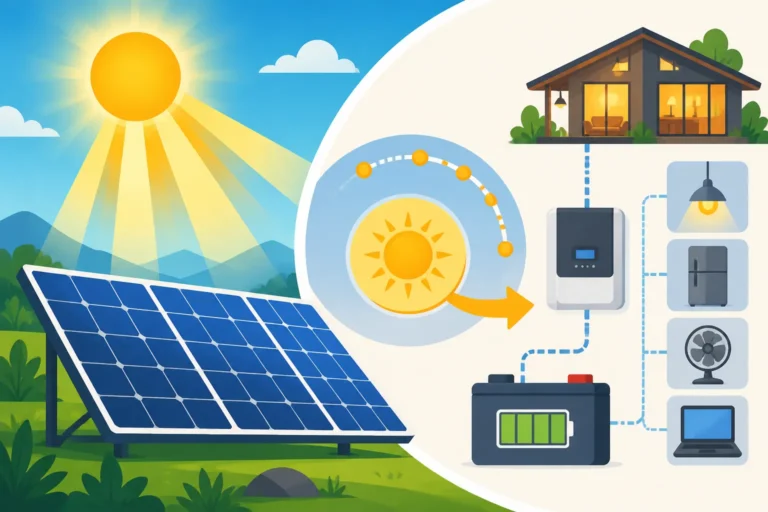
Low sun conditions stress every part of your off-grid solar system. Imagine trying to fill a bucket with a leaky faucet – it takes longer, and you might never get it full if the leak is too big. Similarly, with less incoming solar energy:
- Solar Panels: They'll produce less power, requiring you to install a larger array to capture sufficient energy. This means more physical space, more mounting hardware, and a higher upfront cost for the panels themselves.
- Battery Bank: Your batteries become the true heroes, needing to store enough energy to carry you through multiple days of low production. This demands a significantly larger battery capacity, which is often the most expensive component in an off-grid system. You'll need to think about how many batteries for an off-grid system in these conditions.
- Charge Controller: While a charge controller's job remains the same (managing power flow), in low sun conditions, it needs to efficiently harvest every watt available. An MPPT (Maximum Power Point Tracking) charge controller becomes almost essential, as it's far more efficient at converting varying panel voltages into usable battery charge than a PWM (Pulse Width Modulation) controller.
- Inverter: The inverter needs to be robust enough to handle your peak AC loads, regardless of sun conditions, as it draws directly from the battery bank. While not directly affected by low sun production (that's the panel and battery's job), a larger overall system often means larger inverter needs.
Ignoring these challenges will lead to constant anxiety about running out of power, shortening the lifespan of your batteries due to deep cycling, and ultimately, an unreliable and frustrating off-grid experience.
Critical Sizing Adjustments for Low Sun Regions
The bedrock of a successful off-grid system in a low sun region is a meticulously oversized design. You can't just take a standard sizing calculator and plug in average numbers; you need to account for the worst-case scenarios and build in significant reserves.
Conducting a Comprehensive Load Analysis
Before you even think about panels or batteries, you need a crystal-clear picture of your energy consumption. This is even more crucial in low sun regions. Don't just estimate; measure or look up the exact wattage and daily run-time for every single appliance and device you plan to use. This detailed look at your energy habits helps you to How to Calculate Daily Energy Usage with precision.
Think about the "big three" power hogs: heating, cooling, and water heating. If these are electric, they will dramatically increase your required system size. For example, running an air conditioner on off-grid solar in a low sun region might be prohibitively expensive. Consider propane or wood alternatives where possible. Also, factor in seasonal variations. Your lighting and heating needs will be much higher in winter, often coinciding with the lowest sun availability. Don't forget parasitic loads from inverters, charge controllers, and always-on electronics.
Calculating Your Required Solar Array Size
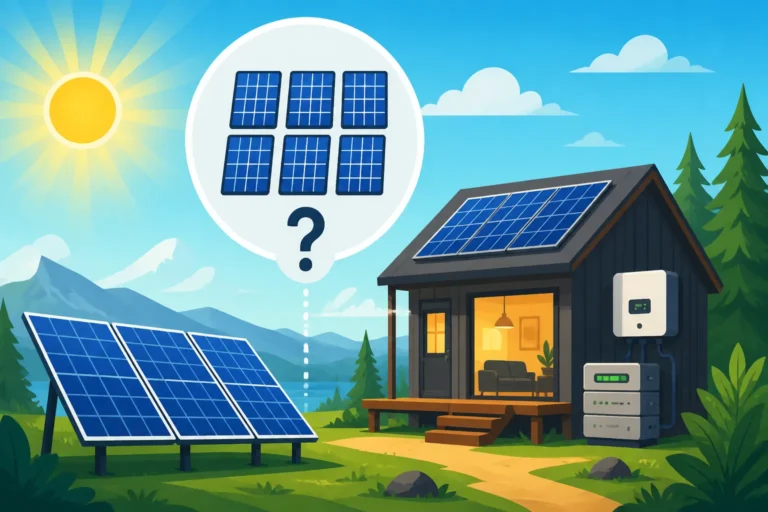
Once your load analysis is solid, it's time to figure out how many solar panels for off-grid living you'll need. This is where the lower peak sun hours really hit home. You'll need more panels than someone in a sunnier climate to generate the same amount of daily energy.
Let's say your home needs 5 kWh (5000 Wh) per day. If you're in a region with only 3 average peak sun hours in winter, your calculation looks different:
- Total Watt-hours needed per day: 5000 Wh
- Divide by average daily peak sun hours: 5000 Wh / 3 PSH = 1667 Watts (minimum panel array size)
This calculation gives you the bare minimum needed to generate your daily usage on an average low-sun day, assuming perfect efficiency and no losses. However, you also need to account for:
- System Losses: Expect 15-30% losses from wiring, temperature, dust, inverter inefficiency, and battery charging. So, you'd multiply your minimum array size by 1.2 or 1.3. For our example: 1667W * 1.3 = ~2167 Watts.
- Days of Autonomy: This is how many days your battery bank can power your home without any solar input. In low sun regions, you often need 3-5 days of autonomy, rather than the 1-2 days often recommended for sunnier climes. This means your panels need to generate enough extra power on sunny days to fully recharge a much larger battery bank.
- Future Expansion: It's always wise to slightly oversize or design for expandability. You never know when your energy needs might subtly increase.
So, instead of a 1667W array, you're realistically looking at 2kW or more just to cover daily use and minor losses. If you factor in recharging a multi-day battery bank, that number goes up significantly. This means purchasing more individual panels, like those from a reputable brand like Renogy, known for their durable monocrystalline options, to ensure you maximize energy capture.
Sizing Your Battery Bank for Extended Autonomy
Your battery bank is your energy reservoir, and in low sun areas, you need a much bigger one. How many batteries for an off-grid system depends heavily on how many "dark days" you want to be prepared for.
If your daily energy usage is 5 kWh and you want 4 days of autonomy, you need to store:
- Daily Use: 5 kWh
- Desired Autonomy: 4 days
- Total Storage Needed: 5 kWh/day * 4 days = 20 kWh
Now, you also need to factor in the depth of discharge (DoD) of your batteries. Lead-acid batteries should only be discharged to about 50% to maximize their lifespan, while lithium iron phosphate (LiFePO4) batteries can safely go down to 80-100% (though 80% is often recommended for longevity).
- For Lead-Acid (50% DoD): 20 kWh / 0.50 = 40 kWh usable capacity. You need batteries that total 40 kWh.
- For LiFePO4 (80% DoD): 20 kWh / 0.80 = 25 kWh usable capacity. You need batteries that total 25 kWh.
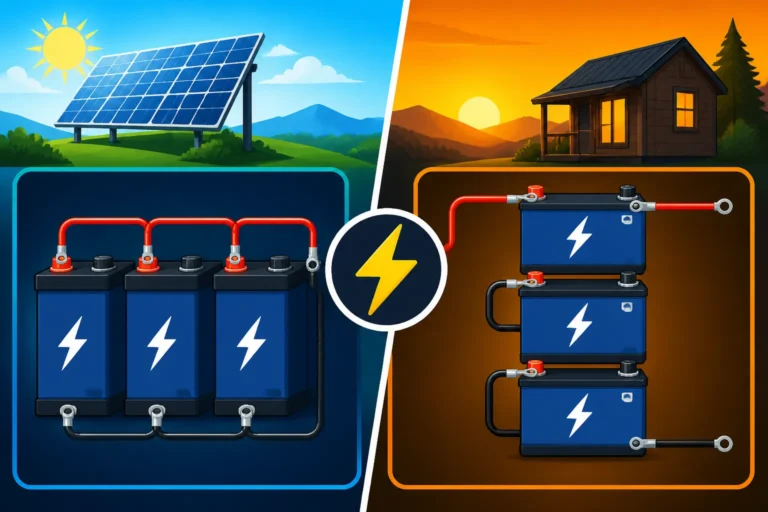
As you can see, the battery chemistry significantly impacts the required capacity and, by extension, the cost and weight. LiFePO4 batteries, while more expensive upfront, often offer a lower lifetime cost due to their higher DoD, longer cycle life, and greater efficiency. Remember that your system voltage (e.g., 12V, 24V, 48V) will also play a role in how you configure your battery bank. Larger systems typically benefit from higher voltages (48V) to reduce current and wire sizes, which ultimately means less voltage drop and more efficient power transfer.
| Component | Sunny Region (e.g., AZ) | Low Sun Region (e.g., PNW) | Rationale for Difference |
|---|---|---|---|
| Peak Sun Hours | 5-7 PSH | 2-4 PSH | Less direct sunlight, more cloud cover |
| Solar Array | 1.2 – 1.5x Daily Load | 1.8 – 2.5x Daily Load | Compensate for fewer PSH and system losses |
| Battery Bank | 1-2 Days Autonomy | 3-5 Days Autonomy | Carry through longer periods of low production |
| Charge Controller | MPPT preferred, PWM okay for small systems | MPPT highly recommended | Maximize efficiency in low light conditions |
| Generator Backup | Optional / Smaller | Essential / Larger | Critical for extended cloudy periods and emergencies |
Optimizing Components for Low Sun Performance
When sunshine is a precious commodity, every component in your off-grid system needs to pull its weight efficiently. Skimping on quality or choosing less efficient options can lead to significant power deficits and frustration.
Choosing High-Efficiency Solar Panels
In low sun regions, the quality of your solar panels truly matters. You want panels that can capture as much energy as possible from diffuse light and perform well even in less-than-ideal conditions.
- Monocrystalline Panels: These are generally the most efficient type of solar panel available. They are excellent at converting sunlight into electricity, even when the sun isn't directly overhead or when light levels are lower. Look for panels with higher efficiency ratings (typically 18-22% or more). Brands like Renogy and Rich Solar offer reliable monocrystalline options that are popular among off-gridders.
- Temperature Coefficient: Solar panel performance decreases as temperature increases. While low sun regions might not always be hot, understanding this coefficient is important. A lower (more negative) temperature coefficient means the panel loses less efficiency in warmer conditions, which can still occur during summer months or on bright, cold days.
- Shade Tolerance: While you should always aim to minimize shading, some panels are designed with half-cut cells or bypass diodes that help them perform better when a portion of the panel is shaded. This can be beneficial in areas with intermittent cloud cover or surrounding trees. Remember, even a small amount of shade can drastically reduce a panel's output. To ensure maximum efficiency, you need to know how to install off-grid solar panels with optimal placement and tilt.
Selecting the Right Battery Chemistry and Capacity
As discussed, your battery bank is your backup powerhouse. The choice of battery chemistry and ample capacity is paramount in low sun environments.
- Lithium Iron Phosphate (LiFePO4): These are overwhelmingly the best choice for low sun regions, despite their higher upfront cost. They offer a much deeper depth of discharge (80-100% usable capacity), a longer cycle life (3,000-6,000 cycles), and maintain a more stable voltage throughout their discharge cycle. This means you can draw more usable power from them, and they'll last significantly longer than lead-acid batteries, offering a better Off-Grid Solar Return on Investment. Their faster charging capability is also a huge advantage when precious sun hours are limited. You'll find many reputable LiFePO4 options available on platforms like Amazon.
- Absorbed Glass Mat (AGM): If LiFePO4 batteries are truly out of your budget, AGM lead-acid batteries are a step up from flooded lead-acid. They are sealed, maintenance-free, and can handle deeper discharges than flooded batteries (though still limited to 50% DoD for good lifespan). They perform better in colder temperatures than flooded batteries, which can be a factor in some low sun regions. However, their lifespan is shorter than LiFePO4, and they are heavier and bulkier for the same usable capacity.
- Capacity: Always, always err on the side of oversizing your battery bank in low sun regions. The goal is to have enough stored energy to comfortably last through multiple days of zero or minimal solar input. This significantly reduces stress on your system and on you.
High-Efficiency Charge Controllers and Inverters
Every watt counts, so your charge controller and inverter need to be top-notch.
- MPPT Charge Controllers: An MPPT (Maximum Power Point Tracking) charge controller is virtually non-negotiable for low sun regions. Unlike PWM controllers, MPPTs can vary their input voltage to match the optimal output voltage of the solar panels, extracting significantly more power (often 10-30% more) from your array, especially in fluctuating light conditions or colder temperatures. This extra efficiency translates directly into more charge for your batteries during those precious sunny windows. Brands like Victron Energy and Renogy offer excellent MPPT controllers.
- Pure Sine Wave Inverters: For an off-grid setup, a pure sine wave inverter is essential. It produces clean power identical to what you get from the utility grid, which is crucial for sensitive electronics, appliances with motors (like refrigerators and well pumps), and anything that relies on precise AC power. Modified sine wave inverters are cheaper but can damage or shorten the life of many modern devices. When you're dealing with limited power, you don't want to risk your appliances. Make sure you understand How to size an off-grid inverter correctly to handle your peak loads and surge requirements.
Installation and Management Strategies for Consistent Power
Beyond choosing the right components, how you install and manage your system can make or break its performance in low sun environments. It's about maximizing every ray of sunshine and having a robust backup plan.
Optimal Panel Placement and Angle
Even with the best panels, poor placement will cripple your system. In low sun regions, this means meticulous planning for solar panel installation.
- South-Facing Orientation: In the Northern Hemisphere, your panels absolutely need to face true south (or north in the Southern Hemisphere). Any deviation means lost production. Use a compass, or better yet, a solar pathfinder tool or app, to ensure precise orientation.
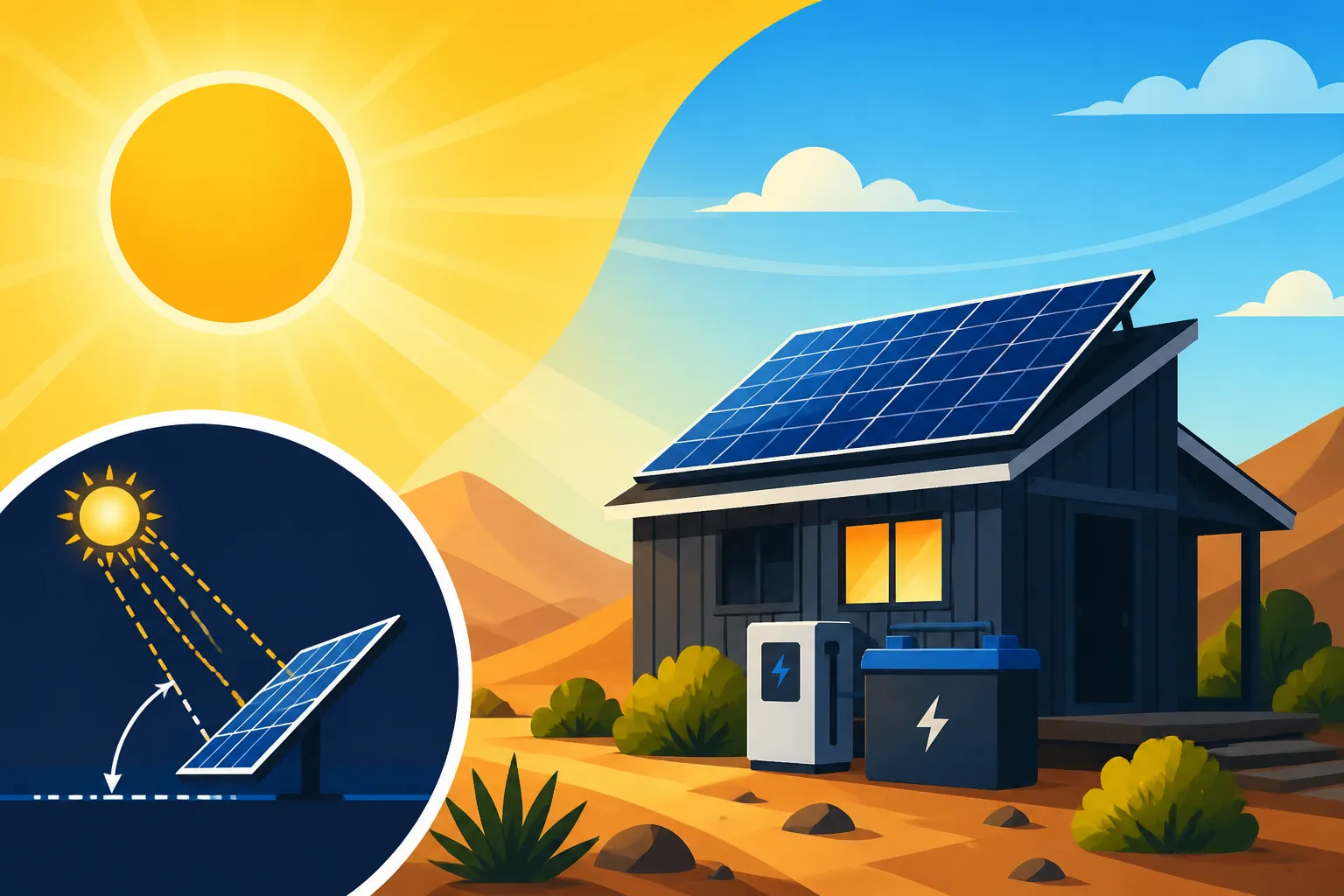
- Optimal Tilt Angle: This is where it gets tricky for low sun areas, which often coincide with significant seasonal changes.
- Winter Boost: To maximize winter production (when sun is lowest and needs are often highest), a steeper tilt angle is beneficial. A common rule of thumb is your latitude plus 10-15 degrees. For example, if you're at 45 degrees latitude, a 55-60 degree tilt might be ideal for winter.
- Adjustable Mounts: If possible, investing in adjustable tilt mounts is highly recommended. This allows you to change the angle seasonally to capture more direct sunlight. While it requires manual effort, the gains in production can be substantial, especially when sunshine is scarce.
- Shading Mitigation: This is paramount. Even a small shadow from a tree branch, chimney, or neighboring building can drastically reduce the output of an entire string of panels. Do a thorough shade analysis for all seasons and times of day. Trim trees, avoid obstructions, or choose a ground mount in an unshaded area.
Consider how crucial panel placement and angle are when you're learning How to Install Off-Grid Solar Panels to get the most out of your setup.
The Role of Backup Generation
In low sun regions, a reliable backup generator is not a luxury; it's a necessity. There will be extended periods of heavy cloud cover, snow, or short winter days when your solar array simply cannot keep up with demand, no matter how well it's designed.
- Generator Sizing: Your generator should be sized to run your most critical loads and efficiently charge your battery bank. It doesn't need to power everything simultaneously, but it should handle your essentials (refrigerator, well pump, lights) and provide enough wattage to send a healthy charge current through your inverter/charger to the batteries.
- Fuel Type and Storage: Consider propane, diesel, or gasoline. Propane can be stored indefinitely and cleanly, making it a popular choice for off-grid living. Diesel is also good for long-term storage but can gel in extreme cold. Gasoline has a shorter shelf life. Factor in sufficient fuel storage for several weeks of backup power.
- Integration: Ideally, your generator should be integrated into your off-grid system via an automatic transfer switch or an inverter/charger with generator input capabilities. This allows for seamless transitions and can even automate charging cycles when battery voltage drops. This helps you avoid the hidden costs of going off-grid when you have to run your generator constantly.
Smart Energy Management and Monitoring
Even with an oversized system and a generator, proactive energy management is key to thriving off-grid in low sun areas.
- Battery Monitoring: Install a good battery monitor (shunt-based) that gives you real-time information on your battery's state of charge (SOC), current flow, and historical data. Knowing your precise battery levels helps you make informed decisions about energy consumption. Brands like Victron Energy offer excellent battery monitoring solutions.
- Load Shedding: Learn to prioritize loads. On cloudy days, consciously reduce non-essential power consumption. Can you skip the microwave and use the stove? Can you delay laundry? Can you reduce lighting? This practice of "load shedding" is vital to stretch your battery bank.
- Energy-Efficient Appliances: Invest in the most energy-efficient appliances possible. Look for Energy Star ratings and check the actual wattage draw. A modern, efficient refrigerator can use significantly less power than an older model, making a huge difference in your daily energy budget. This includes DC-specific appliances where feasible, as they avoid inverter losses.
- System Monitoring: Beyond individual component gauges, a comprehensive system monitor (like those often integrated into hybrid inverters or separate data loggers) allows you to track solar production, battery health, and consumption patterns over time. This data is invaluable for troubleshooting and fine-tuning your system. You can often connect these to a smartphone app or computer for remote monitoring, especially useful if you're not always on-site.
By diligently applying these design principles, from your initial load analysis and component selection to thoughtful installation and ongoing management, you can create a resilient and reliable off-grid solar system even in the most challenging low sun regions. It's an investment, but one that grants true energy independence.
Disclaimer
The information provided in this guide is for general informational purposes only and does not constitute professional electrical or solar engineering advice. Off-grid solar system design and installation can be complex and involve significant electrical hazards. Always consult with a qualified solar professional or licensed electrician when designing, installing, or servicing any off-grid solar system to ensure safety and compliance with all local codes and regulations.