How to Size Solar for a 5kWh Day
Figuring out how much solar power you really need can feel like trying to solve a complicated puzzle, especially when you’re staring at electrical specs and trying to translate them into real-world comfort. Many folks get stuck wondering, "What does '5 kilowatt-hours per day' actually look like in terms of panels and batteries?" It's a valid question, and it's easy to get overwhelmed. This guide is here to break down exactly how to size an off-grid solar system specifically for a 5kWh daily energy consumption, ensuring you have reliable power without overspending or undershooting your needs.
Understanding Your 5kWh Daily Energy Goal
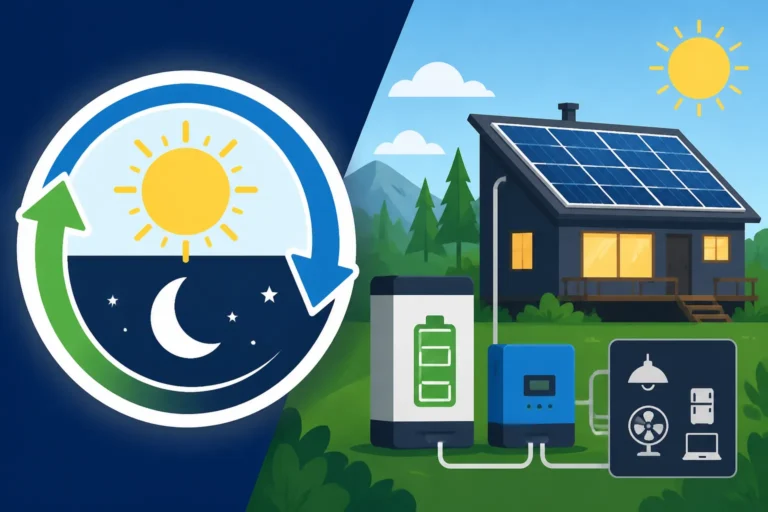
When you start talking about "5kWh a day," it's easy for your eyes to glaze over. But at its heart, this is the foundation of your entire off-grid solar system. Knowing your daily energy target is the first, most critical step to achieving energy independence.
What Does 5kWh Really Mean?
Let's demystify 5 kilowatt-hours (kWh). One kilowatt-hour is simply 1,000 watt-hours. So, 5kWh means you're aiming to use 5,000 watt-hours of electricity over a 24-hour period. To put that into perspective, the average U.S. home consumes about 28 kWh per day, so 5kWh is significantly less – making it suitable for a modest cabin, a small RV, a tiny home, or a highly energy-efficient small family home.
Think about it this way: a typical modern refrigerator might use 300-600 watt-hours per day. A laptop charger might consume 50-70 watts for a few hours. A few LED lights running for several hours might only be 20-50 watt-hours. When you add up all those smaller devices, and perhaps a well pump that runs for 15 minutes, or a microwave for a few minutes, you can quickly see how 5,000 watt-hours can be reached. It's enough to run essential appliances, some lighting, and charging for devices, but you'll need to be mindful of heavy power users like electric water heaters, air conditioners, or large electric ovens. These often push daily consumption well past the 5kWh mark unless used very sparingly.
Why an Accurate Load Analysis is Crucial
Even if you have a target of 5kWh, understanding how you reach that number is paramount. It’s not just about the total; it’s about the individual pieces of the puzzle. An accurate load analysis involves listing every appliance or device you plan to run, noting its wattage, and estimating how many hours per day you'll use it. This helps you calculate your total watt-hours per day, but also identifies peak loads and surge requirements. For instance, a well pump might only run for 20 minutes a day, contributing perhaps 500-1000 watt-hours to your 5kWh total, but it might momentarily draw 2,000 watts to start up. This "starting wattage" or "surge" is vital for correctly sizing your inverter.
Don't forget the hidden culprits – phantom loads. These are devices that draw power even when turned "off" or in standby mode, like TVs, coffee makers, or phone chargers. While individually small, they can add up over 24 hours and silently chip away at your precious 5kWh budget. Taking the time to perform a detailed load analysis, as explained in our guide on How to Do an Off-Grid Load Analysis, is the bedrock of a successful and reliable system, preventing frustrating power shortages down the line.
Sizing Your Solar Panel Array for 5kWh
Once you know you need to generate 5,000 watt-hours per day, the next big question is: how many solar panels will it take? This isn't a simple one-to-one calculation because the sun isn't always shining, and various factors influence how much power your panels actually produce.
Calculating Required Panel Wattage
To figure out your required panel wattage, we need to consider your daily energy goal (5,000 Wh), the average "peak sun hours" in your location, and system losses. Peak sun hours refer to the number of hours per day when the intensity of sunlight is equivalent to 1,000 watts per square meter. This varies significantly by geography and season. For example, a sunny region like Arizona might see 5-7 peak sun hours, while a cloudier northern state like Washington might only get 2-3 in winter.
Let's use an example: if your location averages 4 peak sun hours per day.
Your daily energy need: 5,000 Wh
System efficiency losses (wiring, inverter, temperature): typically 20-30%, so let's aim for 75% efficiency (or divide by 0.75).
Required panel output (before losses) = 5,000 Wh / 0.75 = 6,667 Wh per day
Required panel array size = 6,667 Wh / 4 peak sun hours = 1,667 Watts.
So, in this scenario, you'd need roughly 1,600 to 1,700 watts of solar panels. If you're using 400-watt panels, you'd need about four to five of them (1600W / 400W = 4 panels; 1700W / 400W = 4.25 panels, so round up to 5). Remember, this is a simplified calculation. For a truly robust system, you'll often want to oversize your array slightly to compensate for less-than-ideal days. Check out our detailed guide on How Many Watts of Solar You Need for more in-depth calculations.
Accounting for Real-World Conditions
The theoretical panel wattage often needs a boost in the real world. Shading, even partial, can significantly reduce the output of an entire string of panels. Trees, chimneys, or even accumulated dirt can cast shadows, dramatically impacting efficiency. Panel orientation and tilt angle are also critical. In the Northern Hemisphere, panels ideally face true south (not magnetic south) to maximize year-round production, with a tilt angle roughly equal to your latitude. However, for winter-heavy loads, you might tilt them steeper.
Temperature also plays a role. Solar panels are rated at Standard Test Conditions (STC), which assume a panel temperature of 25°C (77°F). On a hot summer day, a panel sitting on a roof can easily reach 50-70°C, reducing its efficiency by 10-20% compared to its rated output. Seasonal variations are perhaps the biggest challenge for off-grid living. Your 4 peak sun hours average might be 6 hours in summer and only 2 in winter. If you plan to live off-grid year-round, you must size your system for the worst-case scenario (usually winter) or plan for significant generator backup. This often means oversizing your solar array by a good 20-50% compared to summer needs, or even more, to ensure sufficient power even on those gloomy, short winter days. Planning for winter is extensively covered in our guide on How Winter Affects Off-Grid Sizing.
Sizing Your Battery Bank for 5kWh Daily Use
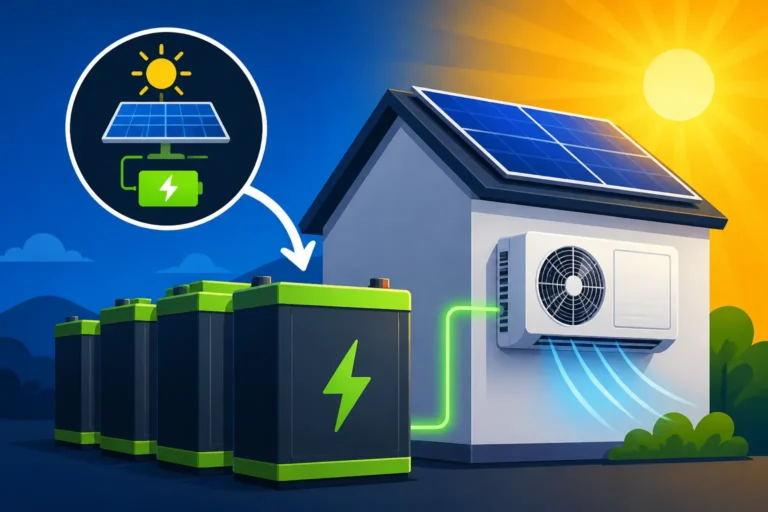
Solar panels are great, but they only make power when the sun shines. For continuous, 24/7 power, you need a reliable energy storage solution: a battery bank. Sizing this component correctly is crucial for a 5kWh daily usage, especially if you want to avoid running out of power after dark or during a stretch of cloudy weather.
Determining Usable Battery Capacity
When we talk about battery capacity, we often see a rating in amp-hours (Ah) or kilowatt-hours (kWh). However, not all of that capacity is "usable." The usable capacity depends heavily on the battery chemistry.
- Lead-Acid Batteries (Flooded, AGM, Gel): These batteries generally recommend a Depth of Discharge (DoD) of no more than 50%. Discharging them further significantly shortens their lifespan. So, if you have a 100Ah 12V lead-acid battery (1200 Wh), you can realistically only use about 600 Wh before needing to recharge it.
- Lithium Iron Phosphate (LiFePO4) Batteries: These are the darlings of the off-grid world for good reason. They can be safely discharged to 80-100% DoD without significant impact on their cycle life. A 100Ah 12V LiFePO4 battery (1200 Wh) can provide 960-1200 Wh of usable energy. This huge advantage means you need fewer LiFePO4 batteries compared to lead-acid for the same usable capacity.
For a 5kWh daily usage, you need 5,000 Wh of usable energy.
If using lead-acid (50% DoD): 5,000 Wh / 0.50 = 10,000 Wh nominal capacity needed.
If using LiFePO4 (80% DoD): 5,000 Wh / 0.80 = 6,250 Wh nominal capacity needed.
You can immediately see the significant difference. This is why many off-gridders choose LiFePO4 batteries despite their higher upfront cost, as they often offer a better lifetime value and performance. Popular brands like Renogy offer excellent LiFePO4 battery options, often found readily available on platforms like Amazon. Our guide on LiFePO4 vs Lead-Acid Battery Cost delves deeper into this comparison.
Calculating Days of Autonomy
"Days of autonomy" refers to how many days your battery bank can power your essential loads without any input from your solar panels (e.g., during prolonged cloudy weather or winter). For a 5kWh daily consumption, most off-grid setups aim for 2-3 days of autonomy as a minimum, with 5+ days being ideal for more critical or remote applications.
Let's calculate for 3 days of autonomy, still aiming for 5kWh per day:
Total energy needed for 3 days = 5,000 Wh/day * 3 days = 15,000 Wh.
Now, apply your battery's usable DoD:
For LiFePO4 (80% DoD): 15,000 Wh / 0.80 = 18,750 Wh nominal capacity.
If you're building a 48V system (which is generally more efficient for larger systems like one supplying 5kWh/day), you'd divide this by 48V to get the amp-hours: 18,750 Wh / 48V = 390.6 Ah. So, you'd look for LiFePO4 batteries that add up to around 400Ah at 48V. This might be four 100Ah 48V batteries, or eight 100Ah 24V batteries wired in series to create a 48V bank.
The choice between a 12V, 24V, or 48V system is also important, as higher voltages reduce current, allowing for thinner, less expensive wiring and reducing power loss. This is thoroughly explained in our article 12V vs 24V vs 48V: Which to Choose.
Selecting the Right Inverter and Charge Controller
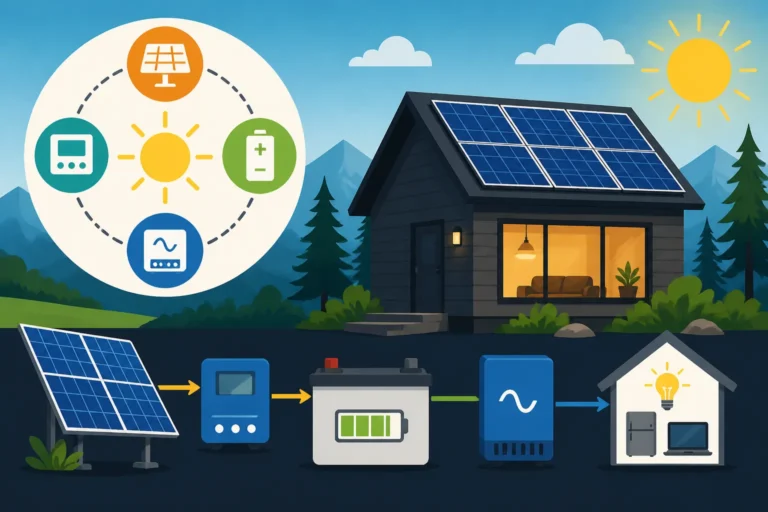
The panels and batteries are the heart of your system, but the inverter and charge controller are the brains and muscle, ensuring the power flows correctly and safely to your appliances.
Inverter Sizing for Peak Loads
Your inverter's job is to convert the DC power from your batteries into the AC power that most of your household appliances use. When sizing an inverter for a 5kWh daily system, you need to consider two main ratings: continuous wattage and surge wattage.
- Continuous Wattage: This is the maximum amount of power the inverter can supply continuously without overheating or shutting down. You'll determine this by adding up the wattage of all the AC appliances you anticipate running simultaneously at any given time. Even with a 5kWh daily total, you might have moments where a microwave (1,000-1,500W), a refrigerator (100-200W), and a few lights (50-100W) are all running at once. If your peak simultaneous load is, say, 1,800 watts, you'd want an inverter with a continuous rating of at least 2,000 watts, providing a little headroom.
- Surge Wattage: Many appliances, especially those with motors (refrigerators, well pumps, power tools), draw a much higher amount of power for a very brief moment when they first start up. This "surge" can be 2-6 times their running wattage. If your well pump needs 2,500 watts to start, and your inverter only has a 2,000-watt surge rating, it simply won't turn on. Therefore, your inverter's surge rating must be high enough to handle the largest single surge load in your system. For a 5kWh system with a few motor loads, an inverter with a 3,000-watt continuous rating and a 6,000-watt surge rating is often a good choice, like the offerings from Victron or Sol-Ark, which are popular for their reliability.
Always err on the side of slightly oversizing your inverter. It provides flexibility for future additions and ensures smoother operation of your existing appliances. For more details on this, explore our guide on How to Size an Off-Grid Inverter.
Charge Controller Sizing and Type
The charge controller is the unsung hero that manages the power flow from your solar panels to your battery bank, preventing overcharging and optimizing efficiency. There are two main types:
- PWM (Pulse Width Modulation) Charge Controllers: These are simpler and less expensive, essentially acting like a switch to regulate charging. They are less efficient, especially when the panel voltage significantly exceeds the battery voltage. They are generally only suitable for smaller systems where the cost savings are a priority, or for panel arrays that closely match the battery voltage.
- MPPT (Maximum Power Point Tracking) Charge Controllers: These are more advanced and significantly more efficient, especially for larger systems like one designed for 5kWh per day. An MPPT controller can "track" the optimal voltage and current point of the solar panels to extract maximum power, even in varying light conditions. They are also much better at converting higher panel voltages down to battery voltage with minimal loss, which means you can wire panels in series for longer runs without much voltage drop, simplifying wiring.
To size your charge controller, you need to consider the total wattage of your solar array and your battery bank voltage.
If you have a 1,700-watt solar array and a 48V battery bank:
Maximum current = Array Wattage / Battery Voltage = 1,700W / 48V = 35.4 Amps.
You should choose a charge controller rated for at least 25% more than this calculated maximum current to provide a safety margin and account for cold weather voltage spikes. So, you'd look for a 45-50 Amp MPPT charge controller. Renogy, for example, offers various MPPT charge controllers suitable for different system sizes. Understanding MPPT vs PWM Charge Controllers is essential for making the right choice.
Putting It All Together: A Sample 5kWh System Configuration
Let's combine all these elements into a hypothetical system designed to meet a 5kWh daily energy demand in a location with moderate sun exposure, aiming for reliability and efficiency.
Example Component Breakdown
For a practical 5kWh off-grid solar system designed for year-round use in a region with about 4-5 average peak sun hours (like parts of the Pacific Northwest or New England, if adequately oversized for winter):
- Solar Panels: You'd be looking at approximately 2,000 – 2,500 watts of solar panels. Let's say you opt for six to seven 380-watt monocrystalline panels. This provides around 2,280 – 2,660 watts of power, giving you some buffer for less-than-ideal conditions and system losses.
- Why this size? The initial calculation suggested 1,600-1,700W for 4 peak sun hours. By bumping this up to 2,000-2,500W, we're proactively addressing real-world inefficiencies, potential cloudy days, and the lower sun angles during winter. This oversizing is a smart move for ensuring consistent power. You can often find great value panels on Amazon or directly from manufacturers like Renogy.
- Battery Bank: For 3 days of autonomy (15kWh total storage needed), using LiFePO4 batteries (80% DoD) in a 48V system:
- Required nominal capacity: 18,750 Wh or approximately 390 Ah at 48V.
- You could achieve this with four 100Ah 48V LiFePO4 batteries or by wiring eight 100Ah 12V LiFePO4 batteries in series-parallel to create a 48V 200Ah bank, then doubling that with another identical bank for 400Ah total. This configuration gives you a substantial energy reserve, allowing your system to comfortably handle periods without sun.
- Inverter: A 3,000-watt continuous pure sine wave inverter with a 6,000-watt surge capability would be a solid choice. This allows you to run most common household appliances, including a microwave or small power tools, while still having enough headroom for starting surges. Brands like Victron Energy MultiPlus or Sol-Ark offer integrated inverter/charger units that simplify your system design.
- Charge Controller: Given our 2,280-watt array and a 48V battery bank:
- Maximum current: 2,280W / 48V = 47.5 Amps.
- Adding a 25% safety margin: 47.5A * 1.25 = 59.375 Amps.
- A 60 Amp MPPT charge controller would be appropriate. If you're using multiple strings of panels, you might consider two smaller charge controllers (e.g., two 30-40A MPPTs) for added redundancy and flexibility, or a single large one.
Here’s a summary table for this example 5kWh off-grid system:
| Component | Specification | Rationale |
|---|---|---|
| Solar Panels | 6-7 x 380W panels (2,280 – 2,660W total) | Oversized for winter/cloudy days, 4-5 peak sun hours average |
| Battery Bank | 400 Ah @ 48V LiFePO4 (approx. 19.2 kWh nominal) | Provides ~3 days of autonomy (15.3 kWh usable @ 80% DoD) |
| Inverter | 3000W Continuous / 6000W Surge Pure Sine Wave | Handles peak simultaneous loads and motor surges |
| Charge Controller | 60A MPPT | Efficiently charges 48V battery from 2.5kW array with safety margin |
| System Voltage | 48V DC | Recommended for higher power loads, reduces current and wire size |
Considerations for Expansion and Reliability
When designing your 5kWh system, always think a few steps ahead. What if you decide to add an electric fan in the summer, or a small chest freezer? Can your system handle it? Designing an expandable system from the start is much more cost-effective than overhauling everything later. This might mean installing a slightly larger charge controller than immediately needed, or choosing an inverter that can operate in parallel with another unit for future power increases.
Reliability isn't just about component sizing; it's about quality. Investing in reputable brands for critical components like inverters and batteries can save you headaches and costs in the long run. Also, consider the importance of proper wiring, fusing, and grounding, which are essential for safety and optimal performance, as detailed in our guide on Off-Grid Solar Wiring Best Practices. Building a robust and reliable system for your 5kWh daily needs will bring you peace of mind and true energy independence.
Disclaimer
The information provided in this guide is for general informational purposes only and does not constitute professional advice. Off-grid solar system design and installation can be complex and involve electrical hazards. Always consult with qualified professionals, adhere to local electrical codes, and follow manufacturer instructions for all components. The author and publisher are not liable for any losses or damages resulting from the use of this information.