How Many Watts of Solar You Need
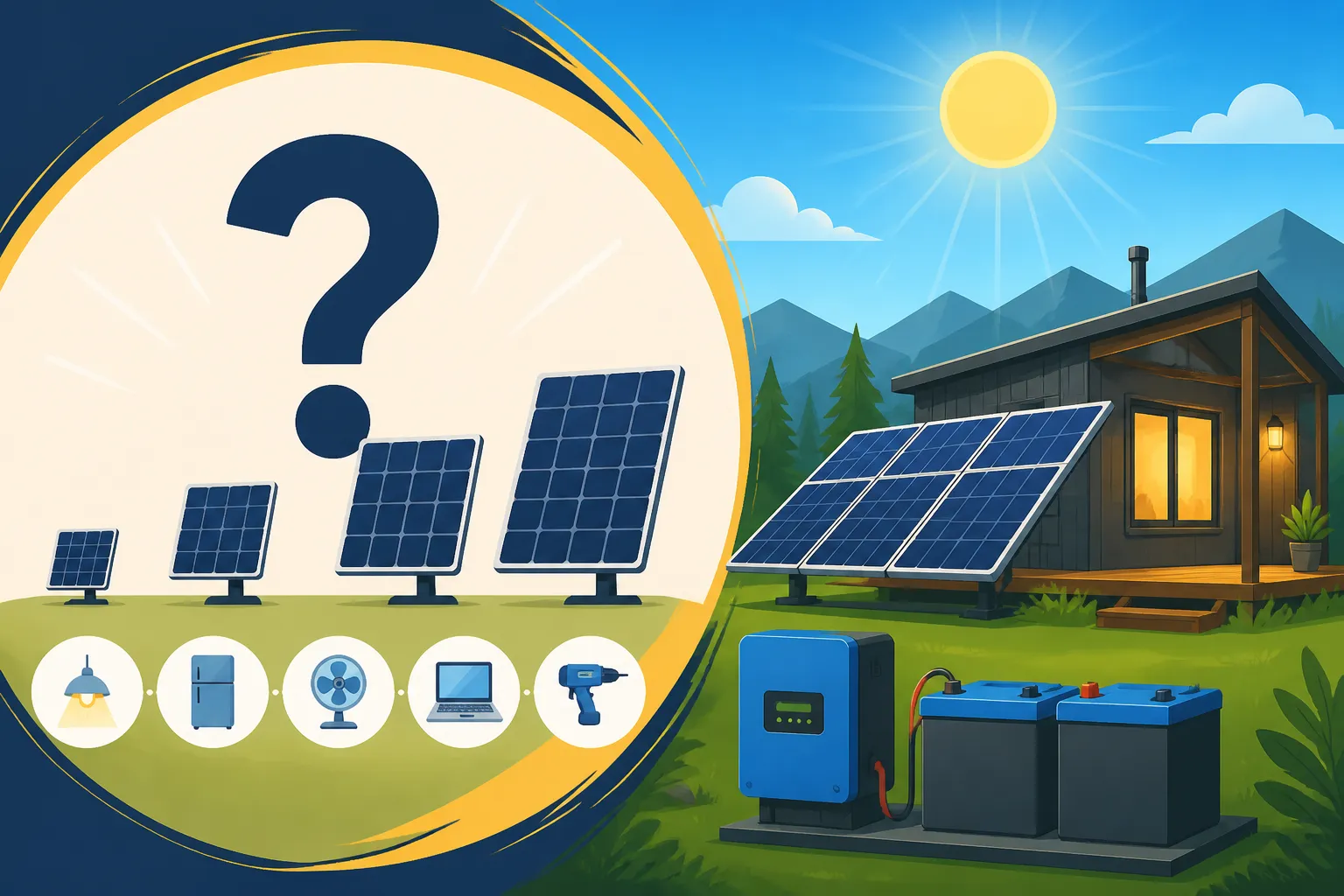
Figuring out exactly how many watts of solar you truly need for an off-grid setup can feel like trying to hit a moving target while blindfolded. It's one of the biggest hurdles and sources of anxiety for folks looking to cut the cord, whether for a cozy cabin, a full-time RV, or even just a trusty shed. Nobody wants to invest in a system only to find they're constantly running out of juice or, conversely, have spent a small fortune on an oversized array they don't really need. This comprehensive guide will walk you through the essential steps to accurately determine your solar wattage requirements, ensuring you build a system that perfectly matches your lifestyle and energy demands.
Understanding Your Daily Energy Appetite
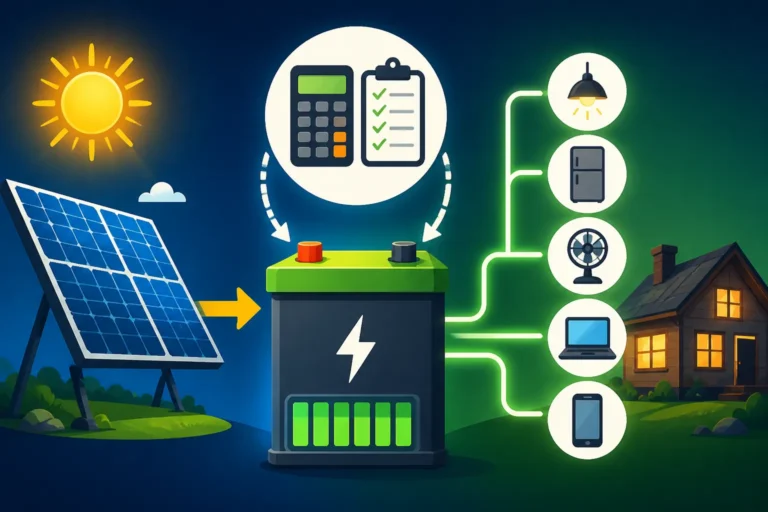
Before you can even begin to think about solar panel wattage, you absolutely must get a firm grasp on your daily energy consumption. This isn't just about the peak power (watts) an appliance draws, but the total energy (watt-hours) it uses over a typical 24-hour period. Think of it like mapping out your personal energy footprint.
Why Watt-Hours are More Important Than Watts
Many newcomers to off-grid living get caught up looking at the "watts" listed on an appliance and think that's all they need. But watts only tell you the instantaneous power draw – how much electricity an appliance needs at that moment it's running. What really matters for sizing your entire off-grid system, especially your battery bank and solar array, is the total amount of energy consumed over time, measured in watt-hours (Wh) or kilowatt-hours (kWh).
For instance, a coffee maker might pull 1000 watts, but you only use it for 10 minutes (about 0.17 hours) in the morning. That's 1000 watts * 0.17 hours = 170 watt-hours. A small LED light, on the other hand, might only draw 10 watts, but if it's on for 8 hours a day, that's 10 watts * 8 hours = 80 watt-hours. See how the little light, despite its low wattage, might end up consuming a significant chunk of your daily power budget? This is why understanding your total daily energy usage is paramount to prevent shortfalls or overspending. You can dive deeper into these calculations with our guide on How to Calculate Daily Energy Usage.
Creating a Detailed Load Analysis
This is arguably the most critical step in designing any off-grid solar system. You need to list every single electrical device you plan to power, estimate how many hours per day (or week) each device will run, and find its wattage. Don't forget devices that draw standby power, like internet routers or even some "off" TVs.
Start by grabbing a notepad or firing up a spreadsheet. Go room by room, or if you're in an RV, go through each area. For each item:
- Identify the Appliance: Laptop, phone charger, refrigerator, microwave, LED lights, water pump, TV, electric toothbrush, starlink dish – everything!
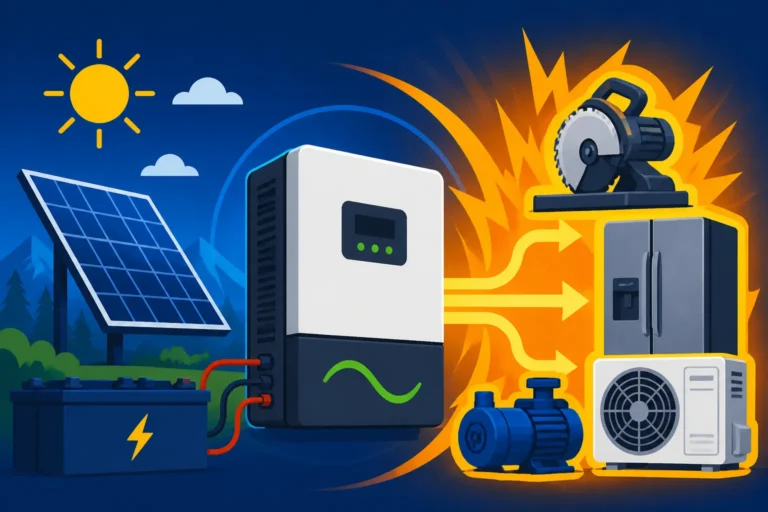
- Find its Wattage (W): This can usually be found on a label on the device itself, in the owner's manual, or with a quick online search. For devices that cycle on and off, like refrigerators or well pumps, you'll need to consider their "running watts" and their "starting watts" (the brief, higher surge they draw when they first kick on).
- Estimate Daily Run Time (Hours): Be realistic here. If you typically watch TV for 3 hours in the evening, note that down. If your fridge runs about 8 hours a day in cycles, estimate that.
- Calculate Daily Watt-Hours (Wh): Multiply the wattage by the estimated daily run time. For items with starting surges, factor that into your inverter sizing, but use running watts for daily energy consumption.
Here's a simplified example of how you might fill out your load analysis:
| Appliance | Wattage (W) | Est. Daily Run Time (Hours) | Daily Watt-Hours (Wh) | Notes |
|---|---|---|---|---|
| LED Light (x4) | 10 (each) | 5 | 200 | 4 lights * 10W * 5H |
| Laptop Charging | 60 | 2 | 120 | Charging, not just on |
| Phone Charging (x2) | 10 (each) | 1 | 20 | 2 phones * 10W * 1H |
| Refrigerator | 100 | 8 (cycles) | 800 | Avg. running watts, cycles on/off |
| Water Pump | 500 | 0.5 (30 mins) | 250 | Short bursts for shower/dishes |
| Router | 15 | 24 | 360 | Always on |
| Total Daily Usage | 1750 Wh | (Example Total) |
Once you have your grand total in watt-hours, you've got the foundational number for your system. This total is what your solar panels need to replenish and your battery bank needs to store. Our article on Off-Grid Solar Load Calculation Explained can provide even more in-depth guidance on this crucial step.
Factors That Dictate Your Solar Panel Wattage
Now that you know your daily energy needs in watt-hours, it's time to connect that to the actual wattage of solar panels you'll require. It's not as simple as matching your total watt-hours to a panel's rating. Several environmental and system design factors play a massive role in determining your final solar array size.
Peak Sun Hours and Local Climate
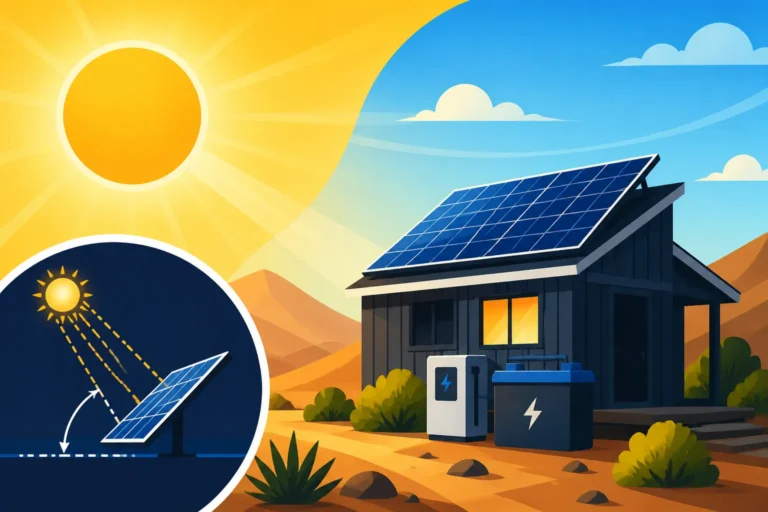
The biggest factor influencing how many watts of solar panels you need is the amount of effective sunshine your location receives. Solar panels are rated under "Standard Test Conditions" (STC), which means 1000 watts of solar irradiance per square meter at 25°C. In the real world, you rarely get perfect STC conditions.
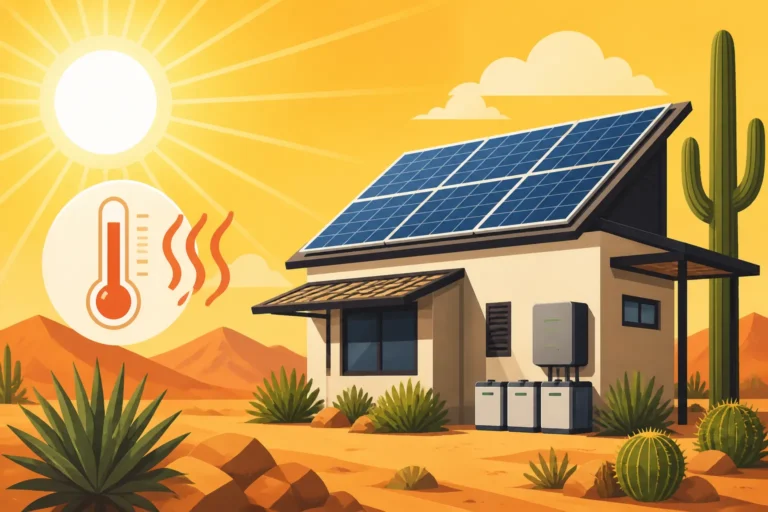
This is where "Peak Sun Hours" (PSH) come in. PSH is the equivalent number of hours per day when the sun's intensity averages 1000 watts per square meter. It accounts for varying sun angles, cloud cover, and seasonal changes. A sunny desert like Arizona might get 6-7 peak sun hours in summer, while a cloudy region like the Pacific Northwest might only see 2-3 in winter.
To calculate your required solar array size:
- (Total Daily Watt-Hours Needed) / (Local Peak Sun Hours) = Minimum Solar Panel Watts Required
Let's say your load analysis showed you need 1750 Wh per day. If your location gets an average of 3.5 peak sun hours per day in the darkest month (when you need the most power relative to available sun):
1750 Wh / 3.5 PSH = 500 Watts of solar panels minimum.
This 500 watts is your baseline. It's critical to use the lowest average PSH for your location if you plan on year-round off-grid living, especially if you want to avoid relying heavily on a backup generator during those cloudy stretches. You can find average PSH data for your specific location through various online resources or solar calculators. Understanding Peak Sun Hours Explained can really help clarify this concept.
Days of Autonomy and Battery Bank Size
Another crucial consideration is your desired "days of autonomy." This refers to how many days your battery bank can power your home or vehicle without any sunlight. If you live in an area prone to multi-day cloudy spells (think a week of winter gloom in the Appalachian Mountains), you'll need a larger battery bank to store more energy, and consequently, a larger solar array to recharge that bank once the sun returns.
A larger battery bank means your solar panels need to generate enough power not just for your daily consumption, but also to fully replenish the batteries after a period of cloudy weather. For example, if you want 3 days of autonomy for your 1750 Wh/day usage, you'd need a battery bank capable of storing 5250 Wh (1750 Wh * 3 days). Your solar array then needs to be large enough to recharge this significant amount of stored energy, plus cover your daily usage, within a reasonable timeframe once the sun shines again.
This often leads to oversizing your solar array beyond the minimum calculated wattage to ensure faster recharging and greater resilience. Many off-gridders aim for 2-5 days of autonomy, depending on their climate and risk tolerance. Remember, sizing your battery bank properly is just as important as sizing your solar panels; our article on How Many Batteries for an Off-Grid System goes into detail on this.
System Inefficiencies and Future Expansion
No solar system is 100% efficient. You'll lose some power at various stages:
- Panel Degradation: Solar panels slowly lose efficiency over time (typically 0.5-1% per year).
- Temperature Losses: Panels perform best at cooler temperatures; high heat reduces their output.
- Wiring Losses: Voltage drop in cables, especially over long distances or with inadequate wire gauge.
- Charge Controller Efficiency: MPPT controllers are generally 95-99% efficient, while PWM controllers are less so.
- Inverter Efficiency: Converting DC power from your batteries to AC power for your appliances involves losses (typically 5-15%).
- Dust and Shading: Accumulation of dirt, snow, or even partial shading from trees or structures can significantly reduce output.
A good rule of thumb is to factor in a total system loss of around 20-30%. So, if your calculations show you need 500 watts of output from your panels, you should actually aim for a panel wattage of around 625-715 watts (500 / 0.8 or 500 / 0.7) to compensate for these losses. This buffer is crucial for reliable power, particularly in variable conditions.
Moreover, it's wise to consider future expansion. Many off-gridders start with a basic setup and then realize they want to add more appliances or extend their usage. Designing an expandable system from the outset, perhaps by choosing an inverter that can handle more wattage than your current needs or ensuring your charge controller has room for more panels, can save you headaches and money down the line. Our guide on How to Design an Expandable System offers excellent advice on this.
Choosing the Right Solar Panel Wattage
Once you've done your homework on energy consumption, peak sun hours, autonomy, and system losses, you're ready to select the actual solar panels. This isn't just about the total wattage, but also the physical aspects, type, and quality of the panels themselves.
Calculating Your Final Panel Wattage Target
Let's consolidate the previous steps into a clear calculation:
- Calculate Total Daily Watt-Hours (Wh/day): From your detailed load analysis. Let's use our example of 1750 Wh/day.
- Determine Your Worst-Case Peak Sun Hours (PSH): For year-round reliability, use the lowest average PSH for your location during the least sunny season. Let's say 3.5 PSH.
- Calculate Baseline Panel Watts: Wh/day / PSH = 1750 Wh / 3.5 PSH = 500 W.
- Add System Loss Buffer: Divide the baseline watts by your efficiency factor (e.g., 0.75 for 25% losses). 500 W / 0.75 = 667 W.
- Consider Days of Autonomy & Fast Recharging: If you have 3 days of autonomy (5250 Wh battery bank), and you want to recharge it in, say, 5 sunny days after a 3-day cloudy spell, you'll need significantly more solar.
- Daily energy to replenish battery: 5250 Wh / 5 days = 1050 Wh per day additional solar production.
- Total required daily production: 1750 Wh (daily usage) + 1050 Wh (battery replenishment) = 2800 Wh.
- New panel wattage based on worst-case PSH and efficiency: 2800 Wh / 3.5 PSH / 0.75 efficiency = 1067 W.
As you can see, accounting for autonomy and efficiency can drastically increase your required solar panel wattage. In this scenario, you'd aim for roughly 1000-1100 watts of solar panels. This might translate to three to four 300W panels or five 200W panels, for instance.
Types of Solar Panels and Their Impact
Not all solar panels are created equal, and their characteristics can impact your overall system design and performance.
- Monocrystalline Panels: These are typically the most efficient, offering the highest power output per square foot. They're excellent if you have limited space (like on an RV roof or a small cabin). Brands like Renogy offer a range of high-efficiency monocrystalline panels that are popular for off-grid use. While often pricier per watt, their higher efficiency can mean fewer panels are needed to achieve your target wattage.
- Polycrystalline Panels: A bit less efficient than monocrystalline, meaning they require more space for the same wattage. They are generally more affordable, making them a good option if you have plenty of space for a larger array (like a ground mount for a homestead).
- Thin-Film Panels: These are flexible and can be a good choice for curved surfaces or situations where weight is a major concern (e.g., some RVs or boats). However, they are significantly less efficient than crystalline panels and require a much larger surface area to generate the same power.
- Bifacial Panels: These panels can capture sunlight from both sides, increasing overall energy yield. While not as common in smaller off-grid setups, they are gaining traction for ground-mounted systems where reflected light can be utilized.
When selecting panels, consider their physical dimensions, weight, and how they'll be mounted. A common mistake is buying panels without considering if they'll actually fit on your roof or mounting structure. For a deeper dive into panel selection, you might find our article on Best Off-Grid Solar Panels incredibly helpful.
Voltage Considerations: 12V, 24V, or 48V
The voltage of your off-grid system (12V, 24V, or 48V) doesn't directly change the wattage you need, but it significantly affects how you wire your panels and batteries, and which components you can use.
- 12V Systems: Common for smaller setups like vans, small RVs, or sheds. Easy to work with, as many small DC appliances are 12V. However, for higher wattages, you need much thicker, more expensive wiring to avoid voltage drop, and efficiency can be a concern.
- 24V Systems: A good middle ground for medium-sized cabins or larger RVs. Reduces wiring thickness and associated losses compared to 12V.
- 48V Systems: The preferred choice for larger off-grid homes. It allows for thinner wiring, greater efficiency, and higher power output from your inverter. Many high-capacity inverters and charge controllers are designed for 48V systems.
Your solar panels themselves will have specific voltage outputs (e.g., a "12V nominal" panel might put out around 18-22V at its maximum power point, or Vmp). You'll wire multiple panels in series, parallel, or a combination to match the optimal input voltage range of your MPPT charge controller and the overall system voltage. For example, if you have a 48V battery bank, you'll need to wire your panels to achieve a higher voltage input to your charge controller to efficiently charge those batteries. Understanding 12V vs 24V vs 48V: Which to Choose will be essential for your system design.
Real-World Wattage Scenarios
Let's look at some common off-grid scenarios and the typical solar panel wattages required to give you a more tangible idea. These are rough estimates and will always depend on your specific appliance usage and local climate.
Minimalist Cabin or RV (Basic Lights, Charging)
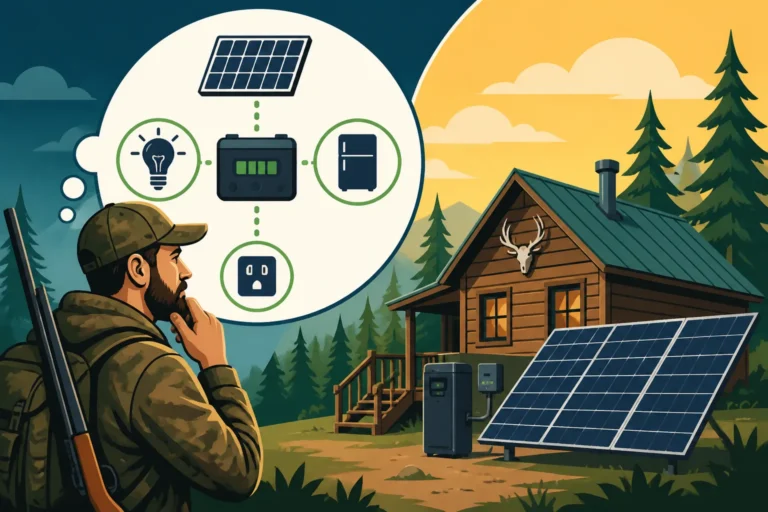
For someone living very simply, perhaps in a tiny hunting cabin or a weekend RV, where power needs are limited to LED lights, charging phones and laptops, and possibly a small 12V refrigerator or fan, you might get by with a relatively small setup.
- Daily Usage: ~500-1000 Wh/day
- Panel Wattage: 200W – 400W
- Example Setup: One or two 200W Renogy solar panels, a small charge controller, a 100Ah LiFePO4 battery, and a 500W pure sine wave inverter. This kind of setup can often be purchased as an easy-to-install kit from retailers on Amazon.
- Considerations: This is for truly minimal usage. Running a microwave or even a hair dryer would quickly drain such a system.
Moderate Off-Grid Living (Fridge, TV, Well Pump, Office)
This scenario covers many full-time RVers, smaller off-grid homes, or cabins with a few more creature comforts. You're running a full-size efficient refrigerator, lights, a TV, a water pump for a shower or well, and perhaps a dedicated workspace with a laptop and monitor.
- Daily Usage: ~2000-5000 Wh/day
- Panel Wattage: 800W – 2000W
- Example Setup: Four to eight 200W-250W monocrystalline solar panels, a robust MPPT charge controller (like a Victron Energy SmartSolar), a 400-800Ah LiFePO4 battery bank (often 24V or 48V), and a 2000W-4000W inverter charger.
- Considerations: Weather variations become much more critical here. You'll likely need to factor in several days of autonomy to avoid power anxiety during extended cloudy periods. The cost for such a system can be a significant investment, as outlined in guides like Off-Grid Solar Cost: Complete Breakdown.
Full-Scale Off-Grid Home (Air Conditioning, Electric Cooking, Washer/Dryer)
This is the dream for many, but it's also the most demanding on your solar system. If you want to run major appliances like an electric water heater, air conditioning, electric oven/stove, washing machine, and dryer, your wattage needs jump considerably. These appliances are massive power hogs.
- Daily Usage: ~10,000-30,000+ Wh/day (10-30+ kWh/day)
- Panel Wattage: 4000W – 10,000W+
- Example Setup: A large array of 15 to 30+ high-wattage (300W-400W) solar panels, multiple powerful MPPT charge controllers, a substantial 48V LiFePO4 battery bank (800Ah to 2000+Ah), and a large 5000W-15000W inverter (often two 7.5kW inverters stacked for 120/240V). Brands like Sol-Ark or Victron are popular choices for these larger systems.
- Considerations: These systems require careful design, often professional installation, and a significant budget. Energy conservation measures become even more paramount. Choosing energy-efficient appliances (e.g., propane dryer, heat pump water heater, mini-split AC) can drastically reduce your power needs. Our article on Sizing Solar for Air Conditioning specifically addresses this challenge.
Maintenance and Monitoring for Optimal Wattage Use
Once your off-grid solar system is installed, your work isn't entirely over. Ongoing maintenance and diligent monitoring are crucial to ensure your panels are producing the watts you need and that your system remains efficient and reliable.
Regular Cleaning and Inspection
Solar panels are remarkably robust, but they aren't maintenance-free. Dirt, dust, pollen, bird droppings, and even leaves can accumulate on the surface of your panels, significantly reducing their ability to capture sunlight. This directly impacts the wattage they produce. A layer of grime might reduce output by 10-20% or even more.
- Cleaning: For most environments, a quarterly cleaning is a good idea. In dusty areas or during dry spells, you might need to clean them more frequently. Use a soft brush or sponge and clean water (no harsh detergents that can leave a film) early in the morning or late in the afternoon when the panels are cool. Never spray cold water on hot panels, as this can cause thermal shock.
- Inspection: Periodically check your panels for any physical damage, such as cracks in the glass, loose wiring, or signs of rodent damage to cables. Ensure all connections are secure. Also, keep an eye out for any new shading sources – a tree that grew larger, a new structure, or even tall weeds. Even partial shading on one cell can significantly reduce the output of an entire string of panels.
These simple steps ensure that the wattage you've calculated and installed is actually being delivered to your charge controller and battery bank. Neglecting cleaning and inspection means you're effectively running on fewer watts than you paid for.
Monitoring System Performance
Modern off-grid solar systems, especially those using MPPT charge controllers and advanced inverters, often come with sophisticated monitoring capabilities. These systems can track your panel's output (watts and watt-hours), battery state of charge, and even appliance consumption.
- Battery Monitors: A good battery monitor (often a shunt-based system) is indispensable. It gives you an accurate "fuel gauge" for your battery bank, showing you the current state of charge, how much power is going in, and how much is coming out. This helps you understand if your solar array is adequately replenishing your batteries and if your usage aligns with your system's capacity.
- Inverter/Charge Controller Displays: Most quality inverters and charge controllers (e.g., models from Victron, EG4, or Outback Power) have display screens or Bluetooth/Wi-Fi modules that allow you to monitor real-time production and consumption from your phone or computer. Pay attention to the "PV input" readings to see how many watts your panels are generating throughout the day and compare it to expected output based on weather and peak sun hours.
- Data Logging: Many advanced systems can log data over time. This historical data is invaluable for understanding your seasonal energy patterns, identifying periods of low production, and confirming if your chosen wattage is meeting your long-term needs. This information can also help you pinpoint potential inefficiencies or identify if you need to consider expanding your system in the future.
By actively monitoring your system, you can quickly spot issues like underperforming panels, excessive consumption, or an imbalance in your system design. This proactive approach helps you maintain a reliable off-grid power supply and get the most out of every watt you've installed.
Disclaimer
The information provided in this article is for general informational purposes only and does not constitute professional advice. Off-grid solar system design and installation can be complex and involve electrical hazards. Always consult with qualified professionals and adhere to all local codes and regulations when planning or installing your off-grid solar system.