How Many Solar Panels for Off-Grid Living
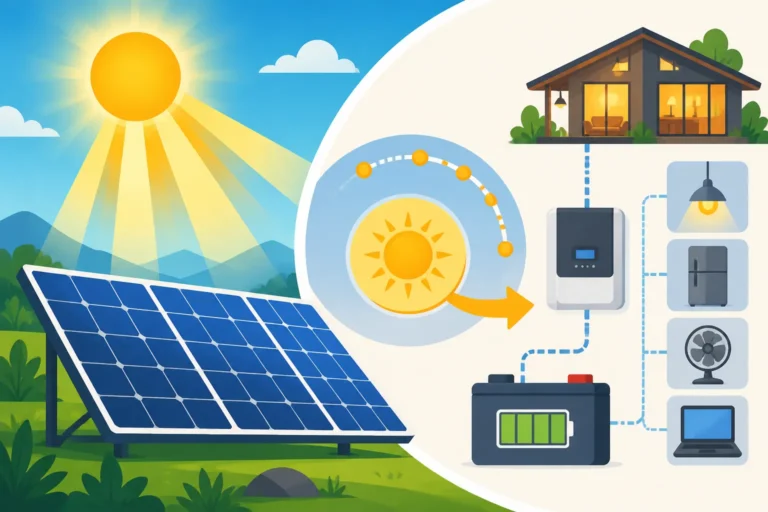
Figuring out exactly how many solar panels you need for an off-grid setup can feel like trying to solve a complex puzzle with missing pieces. It’s one of the biggest headaches aspiring off-gridders face, bringing with it concerns about cost, reliability, and whether you'll truly have enough power when you need it most. This comprehensive guide is here to walk you through every step, helping you confidently determine your solar panel requirements so you can enjoy consistent, worry-free power in your off-grid sanctuary.
Understanding Your Energy Footprint: The First Step to Sizing
Before you even start looking at solar panels, you absolutely have to know what you’re trying to power. It's like building a house – you wouldn’t just guess at the size of the foundation, right? Your energy footprint is the bedrock of your off-grid solar system. Skipping this crucial step is one of the most common reasons people end up with an undersized, or sometimes even an oversized, system that costs more than it needs to. Take the time here, and you’ll save yourself a world of frustration (and money!) down the line.
Conducting a Comprehensive Load Analysis
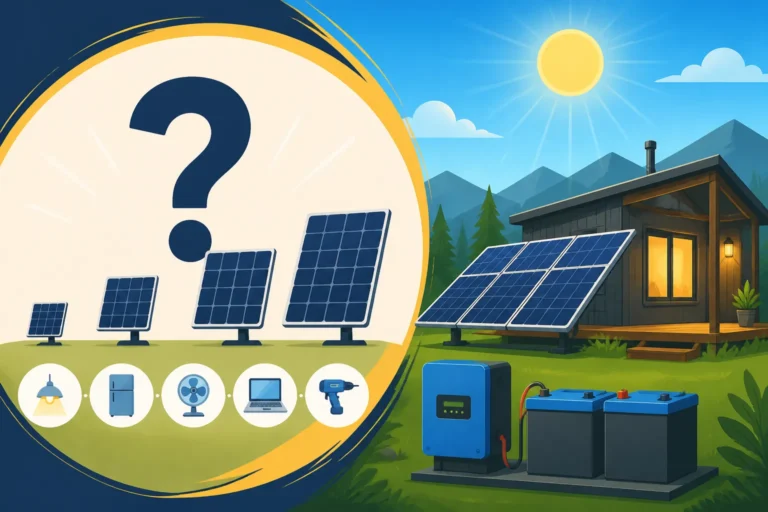
A load analysis is simply a detailed inventory of every single electrical appliance and device you plan to use, along with how much power they consume and for how long. Don't just eyeball it. Grab a pen and paper, or open a spreadsheet, and walk through your entire living space – or your envisioned space – listing everything that plugs in. Think about your coffee maker, your laptop, your lights, refrigerator, water pump, and even those little phone chargers. Every single item contributes to your overall daily energy demand.
For each item, you need two critical pieces of information: its wattage (how much power it uses at any given moment) and how many hours per day you expect to run it. You can usually find the wattage listed on the appliance itself, in the owner's manual, or often with a quick online search. For example, a modern LED bulb might draw just 8 watts, while a small microwave could draw 1000 watts for a few minutes. Don't forget to consider seasonal variations; you might use an air conditioner more in the summer and a heater more in the winter, which drastically changes your daily load. If you’re unsure about an appliance's exact draw, a kill-a-watt meter, easily found on Amazon, can give you real-time readings, providing invaluable accuracy for your planning.
Calculating Daily Watt-Hours (Wh)
Once you have your list, it’s time to crunch some numbers. The goal here is to determine your total daily energy consumption in watt-hours (Wh). A watt-hour is essentially wattage multiplied by time (hours). So, if your 8-watt LED light runs for 5 hours a day, that’s 8W * 5h = 40 Wh. Do this for every single item on your list. This isn't just a hypothetical exercise; this is where you gain a true understanding of your energy needs.
Let’s say you have a small off-grid cabin. Your refrigerator might run for 8 hours a day, drawing an average of 100 watts (800 Wh). Your laptop might be on for 4 hours, drawing 50 watts (200 Wh). Add in a few LED lights, a phone charger, maybe a small well pump for 30 minutes, and suddenly you're looking at a cumulative daily total. This cumulative figure is your average daily watt-hour usage, and it's the most critical number for sizing your entire off-grid solar system, including your battery bank. If you want a deeper dive, our guide on How to Calculate Daily Energy Usage can walk you through the process step-by-step.
Distinguishing Between Peak and Continuous Loads
It’s important to understand the difference between peak loads and continuous loads, as this impacts not just your panel sizing but also your inverter choice. Continuous loads are appliances that run for extended periods, like your refrigerator or constant lighting. These contribute steadily to your daily watt-hour total. Peak loads, also known as surge loads or starting watts, are those appliances that draw a very high amount of power for a short burst when they first kick on. Motors, for instance, in things like well pumps, power tools, or even some refrigerators, can draw 3 to 7 times their running wattage for a few seconds.
Your inverter needs to be able to handle these peak loads without tripping or failing. While these brief surges don't add significantly to your daily watt-hour consumption, they are critical when considering the instantaneous power output your system needs to deliver. If your well pump draws 1000 watts continuously but has a 3000-watt surge when it starts, your inverter must be capable of handling that 3000-watt surge, even if only for a moment. This distinction ensures your system can actually start and run all your necessary appliances without issue.
Factors Influencing Solar Panel Requirements
Once you have a solid grasp of your energy consumption, it’s time to look at the other side of the equation: how much power your solar panels can realistically generate. This isn't just about the stated wattage on the panel; several environmental and system design factors play a huge role in how many panels you'll actually need.
Sunlight Availability and Peak Sun Hours
One of the most significant factors determining your solar panel needs is the amount of effective sunlight your location receives. This isn’t just about how many hours the sun is technically above the horizon, but rather "peak sun hours." Peak sun hours represent the average number of hours per day when the intensity of sunlight reaches 1,000 watts per square meter (kW/m²). This is the standard measurement used to rate solar panel output. So, if a 100-watt panel is exposed to 5 peak sun hours, it’s expected to produce 500 watt-hours (100W * 5h) of energy that day.
The number of peak sun hours varies dramatically by geographical location, season, and even local weather patterns. A property in sunny Arizona might get 6-7 peak sun hours in winter, while a cabin in the Pacific Northwest might only get 2-3. You can find average peak sun hour data for your specific location through various online resources, often provided by national renewable energy labs. This information is absolutely critical because it directly dictates how many panels you’ll need to generate your calculated daily watt-hour needs. For more details on this, check out our article on Peak Sun Hours Explained.
System Voltage: 12V, 24V, or 48V
The voltage of your off-grid solar system – typically 12V, 24V, or 48V – is another foundational design choice that influences your panel configuration. This decision largely depends on the scale of your power needs. Smaller systems, like those for an RV or a tiny shed, often start with 12V because many common DC appliances (like LED lights, phone chargers, and some small pumps) are designed for 12V operation. However, as your energy demand grows, a 24V or 48V system becomes much more efficient.
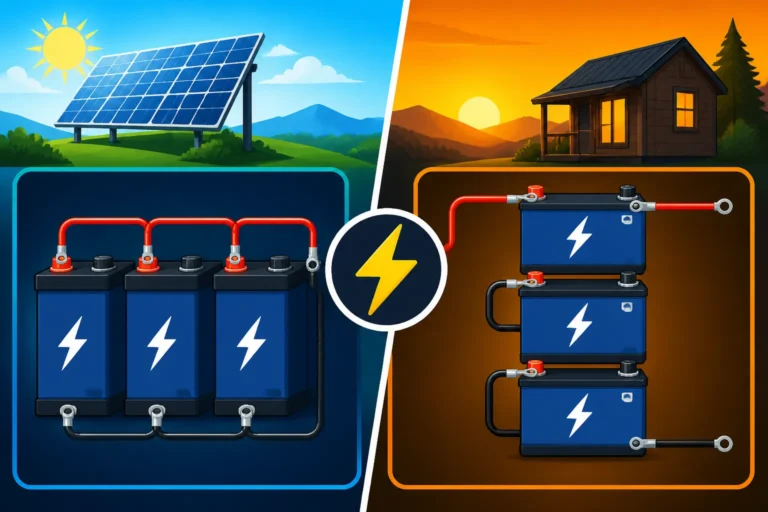
Higher voltage systems allow you to transmit power with less current, which means you can use smaller, less expensive wiring, reducing voltage drop over longer distances. For example, a 1000-watt load at 12V requires roughly 83 amps, while at 48V, it only needs about 21 amps. These lower amperages mean less heat generation and greater overall system efficiency. This is particularly important for larger residential off-grid setups. While you can use any panel with any system voltage (via a charge controller), pairing panels in series to match or exceed your system voltage (e.g., wiring two 12V panels in series for a 24V system) is a common practice that optimizes charge controller performance. Our guide on 12V vs 24V vs 48V: Which to Choose offers a deeper dive into this important decision.
Efficiency and Type of Solar Panels
Not all solar panels are created equal, and their efficiency ratings will directly impact how many you need to install. Modern solar panels typically fall into two main categories for off-grid use: monocrystalline and polycrystalline. Monocrystalline panels are generally more efficient, often ranging from 17% to 22% efficiency. This means they convert a higher percentage of sunlight into electricity, making them a great choice if you have limited roof space or want to maximize output from a smaller array. They also tend to perform better in low-light conditions.
Polycrystalline panels are typically a bit less efficient, usually in the 15% to 17% range, and generally cost less per watt. While they might require slightly more physical space to achieve the same total wattage as monocrystalline panels, their lower price point can make them attractive for installations where space isn’t a primary concern. The key takeaway is that a higher efficiency panel, like some of the robust options offered by Renogy, will produce more power per square foot, potentially reducing the number of physical panels you need to hit your target watt-hour production. Always look at the panel's power output (e.g., 300W) and its efficiency rating when making your selection.
Calculating Your Solar Array Size
With your energy consumption known and the environmental factors understood, it’s time to bring it all together and figure out the total wattage your solar panel array needs to generate. This isn't just about adding up panel wattages; it involves accounting for various inefficiencies and ensuring you have enough headroom for cloudy days.
Determining Total Watts Needed
Let’s revisit your daily watt-hour (Wh) requirement from your load analysis. This is the amount of energy your panels need to produce each day, on average. Now, you need to factor in your location's peak sun hours. The basic formula is:
Total Panel Wattage (Wp) = (Daily Watt-Hour Need (Wh) / Peak Sun Hours (h)) / System Efficiency Factor
The "System Efficiency Factor" is crucial. No solar system is 100% efficient. You’ll experience losses from your inverter, charge controller, wiring, temperature, dust on panels, and even the conversion process itself. A good rule of thumb is to assume a combined system efficiency factor of around 0.7 to 0.8 (70-80%). This means if you need 3000 Wh per day and have 4 peak sun hours, and you assume a 75% efficiency factor:
Total Panel Wattage = (3000 Wh / 4 h) / 0.75 = 750 Wh / 0.75 = 1000 Wp
So, you would need roughly 1000 watts of solar panels. If you chose 200-watt panels, you'd divide 1000 by 200, meaning you’d need 5 panels. This calculation provides a solid baseline, but it's often wise to slightly oversize your array, especially if you live in an area with inconsistent weather or want a buffer for future expansion. For a more comprehensive breakdown of these calculations, consider reading our article on How Many Watts of Solar You Need.
The Role of Charge Controllers and Inverters
While solar panels generate the power, the charge controller and inverter are the unsung heroes that manage and convert it for your appliances. The charge controller is responsible for regulating the voltage and current coming from your solar panels to charge your battery bank safely and efficiently. There are two main types: PWM (Pulse Width Modulation) and MPPT (Maximum Power Point Tracking). MPPT controllers are significantly more efficient, especially in colder temperatures or when panel voltage is higher than battery voltage, often capturing 10-30% more energy than PWM controllers. This means that with an MPPT controller, you might potentially need slightly fewer panels or get more out of your existing array.
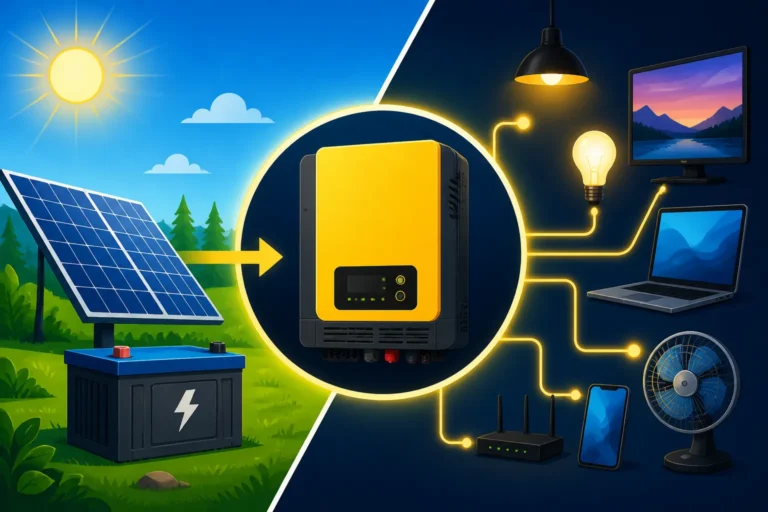
The inverter converts the DC (Direct Current) power stored in your batteries into AC (Alternating Current) power, which is what most household appliances use. The size of your inverter (rated in watts or kilowatts) needs to be sufficient to handle the combined instantaneous wattage of all the AC appliances you plan to run at the same time, including any surge loads. If your total simultaneous AC load (plus surge) is 2500 watts, you'll need at least a 2500-watt inverter. Choosing a quality inverter, like those from Victron or Outback Power, ensures reliable power conversion and often offers advanced monitoring capabilities that are essential for an off-grid setup.
Accounting for System Losses and Future Expansion
It’s easy to calculate ideal panel output, but real-world conditions introduce various losses. We already touched on the general system efficiency factor, but let's break down some common culprits:
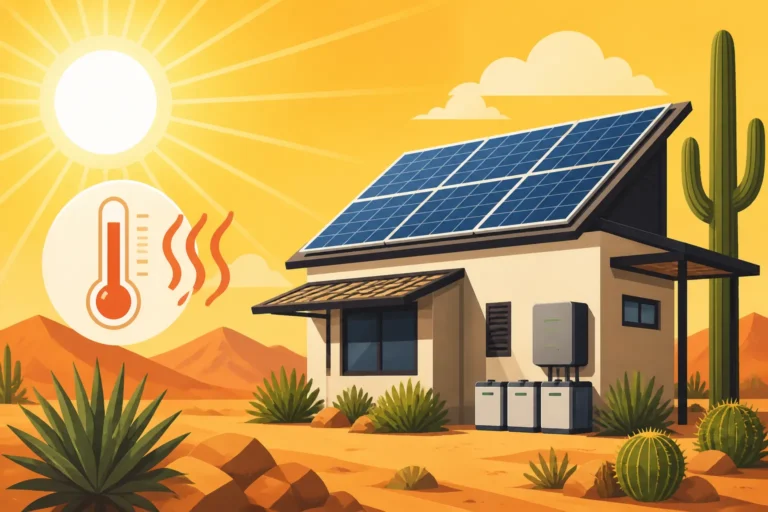
- Temperature Losses: Solar panels operate best at around 77°F (25°C). As panel temperature increases, their efficiency drops. In hot climates, this can significantly reduce output.
- Dust and Shading: Accumulated dust, dirt, or even partial shading from trees or nearby structures can severely impact panel performance. Even a small amount of shade on one cell can dramatically reduce the output of an entire string of panels.
- Wiring Losses: Longer or undersized wires can lead to voltage drop and energy loss.
- Battery Charge/Discharge Efficiency: Batteries themselves aren't 100% efficient. Lead-acid batteries can be around 80-85% efficient, while lithium (LiFePO4) batteries are much closer to 95-99%.
Beyond these operational losses, it's always a smart move to factor in future expansion. Your energy needs might grow over time. Perhaps you add a new appliance, or your family grows, requiring more power. Building in a 10-20% buffer beyond your calculated minimum ensures you won't immediately outgrow your system and have to make costly upgrades sooner than expected. This foresight is part of designing a robust and reliable off-grid system, as outlined in our Off-Grid Solar System Design Basics guide.
Selecting the Right Solar Panels for Off-Grid Life
Once you know how many total watts you need from your solar array, it's time to choose the actual panels. This involves more than just looking at the wattage rating; physical characteristics, durability, and manufacturer reputation are all crucial for a long-lasting off-grid setup.
Monocrystalline vs. Polycrystalline Panels
When you’re browsing panels, you’ll primarily encounter two types for typical residential and cabin off-grid systems:
- Monocrystalline Panels: These are made from a single crystal of silicon, giving them a uniform dark appearance. They are known for their high efficiency (17-22%) and better performance in low-light conditions. This means they can generate more power from a smaller footprint, which is a huge advantage if you have limited roof space on a tiny home or RV. They tend to be more expensive per watt than polycrystalline panels but offer superior performance and a sleeker look. If you're serious about maximizing your output in a compact area, monocrystalline is often the way to go.
- Polycrystalline Panels: These panels are made from multiple silicon fragments melted together, giving them a characteristic blue, mottled appearance. They are generally less efficient (15-17%) than monocrystalline panels and perform slightly less well in extremely hot conditions. However, their main advantage is cost-effectiveness. If you have plenty of space for your array and budget is a primary concern, polycrystalline panels can offer good value. Many reliable brands, including Renogy, offer both types, allowing you to choose based on your specific needs and budget.
Physical Size, Weight, and Mounting Considerations
The physical dimensions and weight of your chosen panels are incredibly important, especially for mobile applications or installations with structural limitations. A standard 100-watt rigid panel might be around 40×20 inches and weigh 15-20 pounds, while a larger 400-watt panel could be over 70×40 inches and weigh 40-50 pounds. Consider the available space on your roof, ground mount, or vehicle. Can you safely lift and secure these panels? Will they fit?
For RVs, vans, or boats, flexible solar panels are sometimes an option, allowing them to conform to curved surfaces. However, they are typically less efficient and have shorter lifespans than rigid panels due to heat dissipation issues. Rigid panels, whether monocrystalline or polycrystalline, require robust mounting hardware. Think about how you'll mount them: roof mounts (flush or tilt-adjustable), ground mounts (fixed or tracking), or pole mounts. Each mounting method has its own structural requirements, costs, and installation complexities. For example, a ground mount might offer easier access for cleaning and optimal tilt adjustment, but it requires more space and often more extensive trenching for wiring.
Brand Reputation and Warranty
Investing in solar panels is a long-term commitment, so choosing a reputable brand with a solid warranty is paramount. Look for manufacturers that offer strong performance warranties (guaranteeing a certain percentage of power output after 20-25 years) and product warranties (covering defects for 10-12 years). Brands like Renogy, REC Solar, LG, or Canadian Solar are well-established in the industry and have proven track records. While you might find cheaper, generic panels on platforms like Amazon, researching the seller and checking reviews is crucial to ensure you're getting a reliable product with adequate support.
A good warranty gives you peace of mind, knowing that your investment is protected. It also speaks to the manufacturer's confidence in their product's durability and performance. Don't be swayed solely by a low price; the long-term reliability and support are often worth a slightly higher upfront cost for panels that will power your off-grid life for decades.
Practical Examples: Sizing for Different Off-Grid Setups
Let's move from theory to some real-world scenarios. Sizing an off-grid solar system isn't a one-size-fits-all situation; it heavily depends on your specific lifestyle and power demands. Here are a few examples to illustrate how panel requirements can vary.
Small Cabin or RV Setups
For a small, seasonal cabin or an RV, your energy needs are generally modest. You might be looking to power some LED lights, charge phones and laptops, run a small 12V refrigerator, and perhaps a water pump for short periods.
Example Scenario: A weekend cabin user needs approximately 1000 Wh per day.
- Mini-fridge: 40W x 10 hours = 400 Wh
- LED Lighting: 20W x 4 hours = 80 Wh
- Laptop Charging: 50W x 3 hours = 150 Wh
- Phone Charging: 10W x 5 hours = 50 Wh
- Water Pump (intermittent): 100W x 2 hours (total run time) = 200 Wh
- Other small electronics: 120 Wh
- Total Daily Wh: ~1000 Wh
Assuming 5 peak sun hours in the area and a 75% system efficiency:
Total Panel Wattage = (1000 Wh / 5 h) / 0.75 = 267 Wp
You could easily achieve this with two 100-watt solar panels and one 100-watt panel, or perhaps three 100-watt panels (total 300W) to give you a small buffer. These systems often operate on a 12V or 24V system voltage, utilizing compact components. Our guide on How to Size an Off-Grid System for a Cabin or Off-Grid Solar Cost for an RV can provide more specific details for these applications.
Tiny Homes and Moderate Off-Grid Residences
As you move to full-time living in a tiny home or a moderately-sized off-grid house, your energy demands naturally increase. You're likely running a full-size refrigerator, television, microwave, multiple lights, and various power tools or small appliances.
Example Scenario: A tiny home resident needs approximately 4000 Wh per day.
- Energy-efficient refrigerator: 60W x 16 hours = 960 Wh
- Lighting: 50W x 6 hours = 300 Wh
- TV and entertainment: 100W x 5 hours = 500 Wh
- Laptop & electronics: 60W x 8 hours = 480 Wh
- Microwave (intermittent): 1000W x 0.5 hours = 500 Wh
- Well Pump/Water Heater (intermittent): 300W x 3 hours = 900 Wh
- Other loads: 360 Wh
- Total Daily Wh: ~4000 Wh
Assuming 4 peak sun hours (to account for shorter winter days or less ideal conditions) and a 70% system efficiency:
Total Panel Wattage = (4000 Wh / 4 h) / 0.70 = 1000 Wh / 0.70 = 1429 Wp
For this setup, you'd be looking at roughly four to five 350-watt solar panels (total 1400W to 1750W). This size system typically warrants a 24V or 48V configuration for efficiency, larger batteries, and a more robust inverter.
Full-Scale Off-Grid Homesteads
Running a larger homestead completely off-grid means powering a standard household with multiple occupants, often including energy-intensive appliances like washing machines, dishwashers, larger well pumps, and potentially air conditioning or electric heating.
Example Scenario: A family homestead needs approximately 15,000 Wh (15 kWh) per day.
- Full-size refrigerator/freezer: 150W x 20 hours = 3000 Wh
- Washing machine (hot water): 500W x 2 hours = 1000 Wh
- Dishwasher: 1200W x 1 hour = 1200 Wh
- Well pump: 800W x 2 hours = 1600 Wh
- Lighting (multiple rooms): 150W x 8 hours = 1200 Wh
- Computers/entertainment: 200W x 10 hours = 2000 Wh
- Small AC unit (seasonal): 1000W x 4 hours = 4000 Wh
- Cooking appliances/misc: 2000 Wh
- Total Daily Wh: ~16,000 Wh (16 kWh)
Assuming a conservative 3.5 peak sun hours (accounting for winter and cloudy stretches) and a 65% system efficiency (due to larger array complexities):
Total Panel Wattage = (16000 Wh / 3.5 h) / 0.65 = 4571 Wh / 0.65 = 7032 Wp
For a full homestead, you'd need approximately twenty to twenty-four 350-watt solar panels (total 7000W to 8400W). This system would almost certainly be 48V, require a very large battery bank (see How Many Batteries for an Off-Grid System), a high-capacity inverter, and likely a robust MPPT charge controller like those from Victron Energy or Sol-Ark. Backup generator integration would also be highly recommended for extended periods of low sun.
| Appliance Type | Average Wattage (W) | Avg. Daily Run Time (Hours) | Daily Watt-Hours (Wh) |
|---|---|---|---|
| LED Light Bulb | 8 | 5 | 40 |
| Smartphone Charger | 10 | 3 | 30 |
| Laptop | 50 | 4 | 200 |
| Small RV Refrigerator | 40 | 10 | 400 |
| Full-Size Refrigerator | 150 | 16 | 2400 |
| Microwave | 1000 | 0.25 (15 min) | 250 |
| TV (LED 40") | 60 | 4 | 240 |
| Well Pump (1/2 HP) | 750 | 0.5 (30 min) | 375 |
| Washing Machine | 500 (run cycle) | 1 | 500 |
| Coffee Maker | 800 | 0.25 (15 min) | 200 |
| Mini-Split AC (9000 BTU) | 800-1200 | 6 (seasonal) | 4800-7200 |
Note: Wattage and run times are averages and can vary greatly by model and usage habits. Always check your specific appliance ratings.
Optimizing Your System for Maximum Performance and Longevity
Installing a solar array is just one part of the equation. To truly get the most out of your investment and ensure reliable power year-round, you need to optimize the entire system, especially considering your battery bank and how your panels interact with their environment.
Battery Bank Sizing and Autonomy
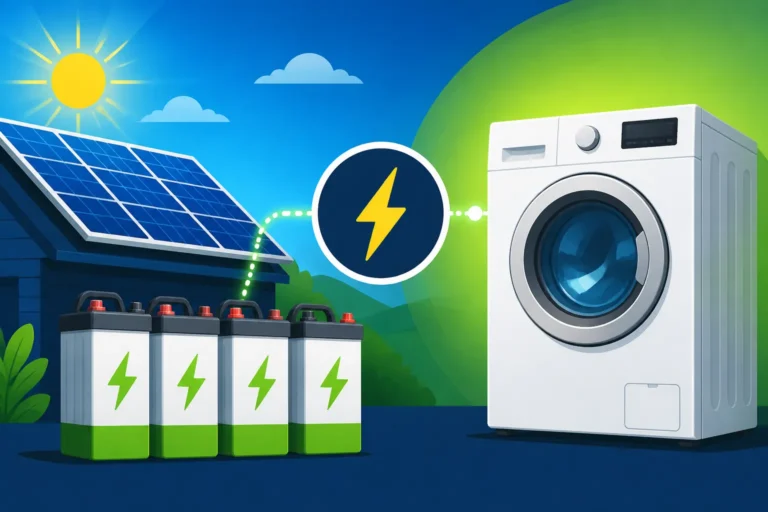
Your solar panels generate power during the day, but what happens after the sun sets, or on cloudy, rainy days? That's where your battery bank comes in. Without adequate energy storage, your panels are essentially useless during non-generating hours. Your battery bank needs to be sized not just to meet your daily energy needs but also to provide "days of autonomy" – how many days your system can power your home without any new input from the solar panels. For critical off-grid setups, aiming for 3-5 days of autonomy is often recommended to bridge gaps during extended poor weather.
Calculating battery capacity involves your daily watt-hour needs, your system voltage, and the depth of discharge (DoD) of your chosen battery chemistry. For example, lead-acid batteries should generally only be discharged to 50% DoD to maximize their lifespan, while lithium iron phosphate (LiFePO4) batteries can safely be discharged to 80-100% DoD. This means you need significantly less actual storage capacity with LiFePO4 for the same usable energy. For a detailed guide on this, refer to How to Calculate Battery Amp-Hours Needed and How Many Batteries for an Off-Grid System. The better you size your battery bank, the less pressure is on your solar panels to generate every single watt-hour every single day, providing a crucial buffer.
Panel Placement, Tilt, and Shading Mitigation
The physical placement and orientation of your solar panels are just as important as their wattage. Panels should be placed in an area that receives the maximum amount of direct sunlight throughout the day, ideally facing true south (in the Northern Hemisphere) or true north (in the Southern Hemisphere). The tilt angle is also crucial; a general rule of thumb is to set the tilt angle equal to your latitude for year-round production. However, many off-gridders adjust their tilt seasonally: a shallower angle in summer for the higher sun, and a steeper angle in winter to catch the lower sun's rays more effectively.
Shading is the enemy of solar power. Even a small shadow on a single cell of one panel can drastically reduce the output of an entire string of panels if they're wired in series. Before installation, carefully observe your chosen location throughout the day and across different seasons for potential shading from trees, buildings, or other obstructions. Trim branches, consider higher mounting options, or space your panels to minimize shading. If shading is unavoidable, consider micro-inverters or power optimizers, which allow individual panels to perform independently, minimizing the impact of partial shading on the rest of the array.
Integrating Backup Power Solutions
Even the most meticulously designed off-grid solar system can face challenges. Extended periods of cloudy weather, heavy snow cover, or unforeseen system issues can deplete your batteries faster than your panels can recharge them. This is where backup power solutions become invaluable for true peace of mind.
A fossil fuel generator (propane, gasoline, or diesel) is the most common backup. These can be wired into your system via an automatic transfer switch or manually to charge your batteries or directly power your home during emergencies. Many modern inverters, like those from Sol-Ark, have integrated generator inputs and can even automatically start and stop a generator when battery levels drop too low. Having a reliable generator ensures that you're never left completely in the dark, providing an essential safety net for your off-grid lifestyle. For larger systems, a standby generator can provide hundreds of hours of reliable power. Our article on Cost of Adding a Generator to Off-Grid Solar delves into the considerations for integrating this vital component.
Common Mistakes to Avoid When Sizing Your Off-Grid Solar Array
Even with the best intentions, it's easy to make mistakes when planning an off-grid solar system. These missteps can lead to frustrating power outages, premature equipment failure, or unnecessary expenses. Being aware of these common pitfalls can save you a lot of grief.
Underestimating Energy Needs
This is, hands down, the most frequent and costly mistake off-gridders make. People often grossly underestimate their actual daily watt-hour consumption. They might forget about standby power draw from always-on devices, seasonal spikes in usage (like heating or cooling), or simply the cumulative effect of many small appliances. A common scenario is someone moving from a grid-tied home and assuming their off-grid needs will be drastically lower without truly auditing their usage.
The consequence of underestimation is an undersized system – not enough solar panels to recharge your batteries adequately, and a battery bank too small to carry you through the night or cloudy days. This leads to constantly depleted batteries, which significantly shortens their lifespan, especially for lead-acid types. You'll find yourself constantly running a backup generator, defeating the purpose of solar independence. The solution is a thorough, honest load analysis, as discussed earlier, and then adding a healthy buffer (10-20%) for unexpected needs and future growth. It's better to slightly oversize than to chronically undersize.
Ignoring Seasonal Variations
The amount of sunlight you receive isn't constant; it changes dramatically with the seasons. In winter, days are shorter, the sun is lower in the sky, and weather can be cloudier, all leading to significantly fewer peak sun hours. If you size your system solely based on summer sun, you'll find yourself severely power-limited in winter.
Conversely, if you size exclusively for the worst winter day, your system will be significantly oversized for summer, potentially costing you more upfront than necessary. The best approach is to size for your "shoulder" seasons (spring and fall) and then calculate adjustments for the extremes. For winter, you might need more panels or rely more heavily on a generator. For summer, you might have excess power you can use for "opportunity loads" like running a fan, heating water, or charging an electric vehicle. For year-round off-grid living, you absolutely must factor in the lowest solar insolation periods for your location, otherwise you'll be asking for trouble during the dark months. Our guide on How to Design for Year-Round Off-Grid Power provides strategies for this.
Overlooking System Components Beyond Panels
It’s easy to get fixated on just the solar panels, but they are only one part of a complex system. Neglecting the proper sizing and quality of your other components can compromise your entire off-grid setup.
- Battery Bank: An undersized or poor-quality battery bank is a common point of failure. It needs to match your daily energy needs and provide sufficient autonomy.
- Charge Controller: A charge controller that is too small for your array or isn't the right technology (e.g., PWM instead of MPPT for larger systems) will either be inefficient or potentially fail.
- Inverter: An inverter that can't handle your peak surge loads or your total continuous load will trip or burn out, leaving you without AC power.
- Wiring and Protection: Using undersized wiring leads to voltage drop and fire hazards. Skipping fuses and breakers is a recipe for disaster.
- Mounting and Racking: Flimsy or improperly installed mounting hardware can lead to panels flying off in high winds.
All these components work together. A chain is only as strong as its weakest link, and an off-grid solar system is no exception. Investing in high-quality components and ensuring they are all properly sized and installed, perhaps even considering an integrated system like the EcoFlow Power Kits, will give you a reliable, safe, and efficient power system for years to come.
Maintenance and Monitoring for Sustainable Off-Grid Power
Once your off-grid solar system is installed and humming along, your job isn't quite done. Regular maintenance and diligent monitoring are crucial to ensure your system performs optimally, extends its lifespan, and continues to reliably provide the power you depend on. Think of it like taking care of your vehicle; a little preventative care goes a long way.
Routine Panel Cleaning and Inspection
Solar panels are remarkably durable, but they aren't maintenance-free. Over time, dust, pollen, bird droppings, leaves, and even snow can accumulate on their surfaces, significantly reducing their efficiency. A dirty panel can easily produce 10-20% less power than a clean one. For some, like those living in dusty desert environments, this can be even more pronounced.
Regular cleaning, typically with just water and a soft brush or squeegee, is essential. For most residential setups, a quick rinse every few months is sufficient, but after a major dust storm or heavy pollen season, you might need to clean them more frequently. Beyond cleaning, conduct visual inspections: check for any physical damage to the glass or frames, loose wiring, or signs of corrosion on the connections. Pay attention to any animal nests under the panels, as they can cause shading or damage. This proactive approach helps catch minor issues before they become major problems. Our comprehensive Off-Grid Solar Maintenance Guide offers more practical tips on keeping your system in top shape.
Monitoring System Performance
One of the greatest assets for any off-grid system owner is the ability to monitor their system's performance. Most modern charge controllers and inverters come with digital displays or smartphone apps that provide real-time data on battery state of charge, current flowing from panels, daily energy production, and consumption. Brands like Victron Energy are particularly renowned for their robust monitoring capabilities, offering detailed insights into every aspect of your system.
By regularly checking these metrics, you can quickly identify if something isn't quite right. Is your array producing less power than usual on a sunny day? It might be dirt on the panels or a wiring issue. Are your batteries draining faster than expected? Perhaps an appliance is drawing more power than anticipated. Consistent monitoring allows you to understand your system's behavior, anticipate potential issues, and make informed decisions about your energy usage. It's not just about troubleshooting; it's about gaining a deeper connection to your energy source.
Seasonal Adjustments and Troubleshooting
As mentioned earlier, seasonal changes impact solar performance. Beyond simply cleaning panels, you might consider adjusting their tilt angle to optimize for winter or summer sun. In winter, a steeper angle helps shed snow and catch the lower sun's rays more effectively. In summer, a shallower angle can maximize production when the sun is higher overhead. While fixed mounts are common, adjustable tilt mounts offer flexibility for those willing to put in the seasonal effort.
Troubleshooting is an inevitable part of off-grid living. Batteries might not hold a charge, an inverter might throw an error code, or panels might not be producing. When issues arise, start with the basics: check all connections, ensure breakers aren't tripped, verify panel cleanliness, and consult your component manuals. Often, simple problems have simple solutions. However, for more complex electrical issues, knowing when to call in a professional electrician or solar technician is crucial for safety and effective resolution. Being prepared with basic tools, a multimeter, and a clear understanding of your system's wiring diagram can make all the difference when troubleshooting.
Disclaimer
The information provided in this guide is for general informational purposes only. While we strive to offer accurate and comprehensive advice, off-grid solar system design and installation can be complex and should ideally be undertaken by or with the guidance of certified professionals. Electrical work carries inherent risks, and improper installation can lead to property damage, injury, or death. Always consult with qualified electricians and adhere to all local codes, regulations, and safety standards. The author and publisher are not responsible for any actions taken based on the information presented herein.