Best Off-Grid Solar Kit for a Off-Grid Home
Trying to piece together an off-grid solar system for your homestead can feel like you're staring at a giant, confusing puzzle with no picture on the box. It's incredibly frustrating to know you want energy independence for your home but feel completely overwhelmed by the sheer number of components, calculations, and choices involved. This comprehensive guide is here to walk you through everything you need to know about selecting the best off-grid solar kit for your off-grid home, helping you confidently choose a system that meets your unique power needs and aspirations for self-sufficiency.
Understanding Off-Grid Solar Kits for a Home
Living off the grid in your own home is a dream for many, offering unparalleled freedom and a smaller carbon footprint. But powering that dream requires a robust and reliable solar setup. While building a system from scratch, component by component, offers maximum customization, it can be a steep learning curve. This is where off-grid solar kits step in, aiming to simplify the process by packaging essential components together.
What Defines an Off-Grid Home Solar Kit
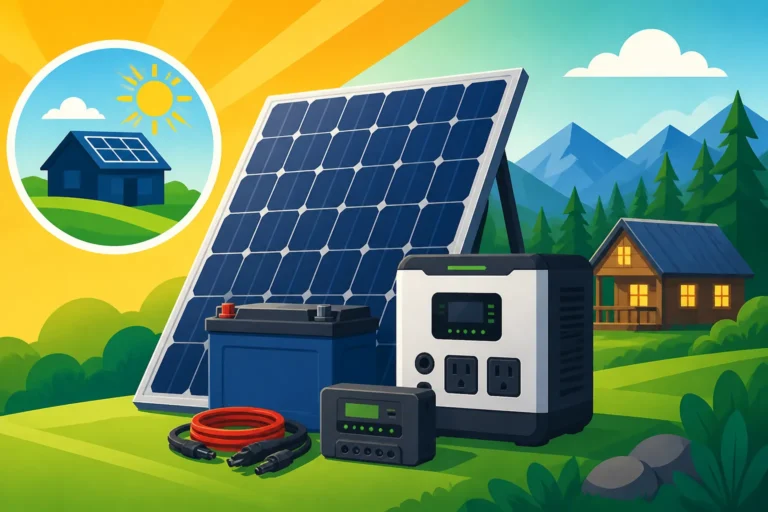
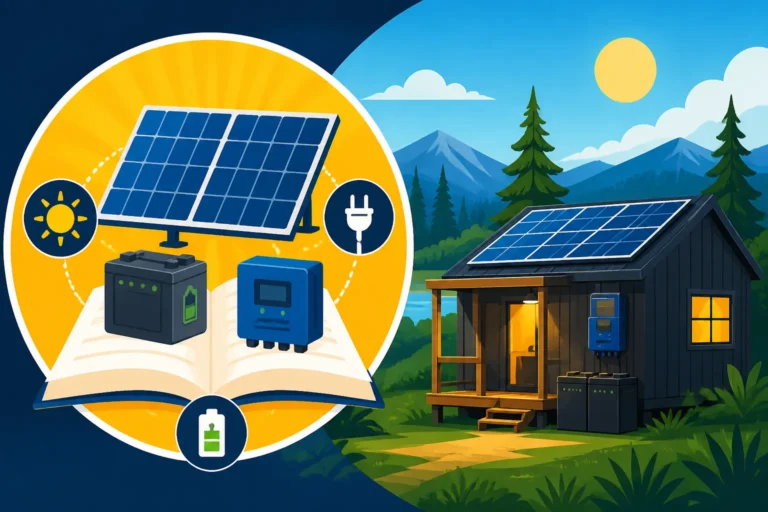
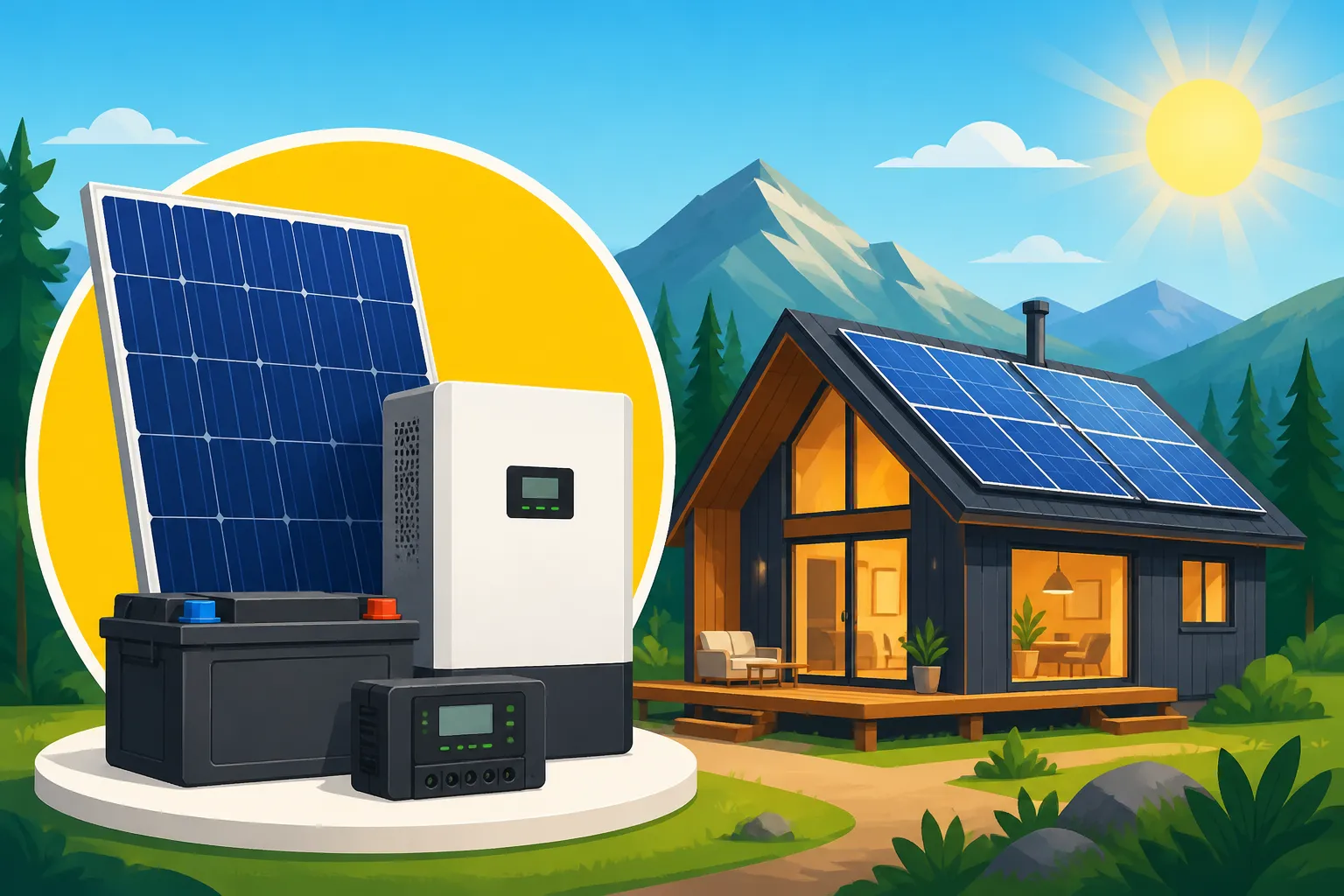
An off-grid home solar kit isn't just a handful of solar panels; it's a complete ecosystem designed to generate, store, and deliver electricity to your dwelling without relying on the utility grid. At its core, any good off-grid kit will include the fundamental pieces needed to make electricity from the sun work for your home. You're typically looking at solar panels to capture sunlight, a charge controller to regulate the power coming from those panels, a battery bank to store the energy for use when the sun isn't shining, and an inverter to convert the stored DC battery power into usable AC power for your household appliances. Some kits also bundle in essential wiring, mounting hardware, and safety components like fuses and breakers, making them a more complete package.
The size and complexity of these kits vary dramatically. A smaller kit might be perfect for a tiny home or a cabin with minimal electrical needs, powering just lights, a small refrigerator, and charging electronics. On the other hand, a larger, more comprehensive kit for a full-sized off-grid home would need to support heavy-demand appliances like well pumps, washing machines, and even air conditioning units, requiring a much larger array of panels, a substantial battery bank, and a powerful inverter. The goal is to provide a cohesive solution that minimizes the guesswork, especially for those who might not have an advanced electrical engineering degree.
Why a Kit Versus a Custom Build
Deciding between an off-grid solar kit and building a custom system from individual components is one of the first major hurdles many aspiring off-gridders face. Both approaches have their distinct advantages and disadvantages. A custom build offers maximum flexibility, allowing you to hand-pick every single component to perfectly match your home's specific energy profile, climate, and personal preferences. You could, for instance, opt for high-efficiency bifacial solar panels, pair them with top-tier lithium iron phosphate (LiFePO4) batteries from a brand like Battle Born, and integrate an advanced inverter-charger from Victron Energy. This level of customization can often lead to a more optimized and efficient system in the long run, and potentially even save money if you're savvy enough to find deals on individual parts.
However, the custom route demands a significant investment of time, research, and technical knowledge. You'll need to understand concepts like How to Calculate Off-Grid Solar Needs If you're not comfortable with electrical schematics, wire sizing, and compatibility issues between different brands and technologies, the custom build can quickly become overwhelming, leading to costly mistakes or an underperforming system. This is precisely where a good off-grid solar kit shines. Kits are designed to be relatively straightforward, with components that are pre-selected and guaranteed to work together seamlessly. This reduces the complexity, cuts down on research time, and can make the installation process much more manageable, especially for DIY enthusiasts or those with limited electrical experience. While a kit might not offer the absolute peak of optimization, it provides a reliable, vetted solution that gets you up and running with less headache.
Key Factors When Choosing an Off-Grid Home Solar Kit
Choosing the right off-grid solar kit for your home isn't about picking the biggest or cheapest option; it's about finding the perfect match for your unique energy footprint. It's a bit like choosing a vehicle – you wouldn't buy a semi-truck to commute across town, nor would you expect a compact car to haul heavy lumber.
Your Home's Energy Demands
This is, hands down, the most critical factor. Before you even look at a single panel or battery, you must have a clear understanding of your home's daily energy consumption. This isn't just about how many lights you have, but how much wattage each appliance draws and for how long. Think about your refrigerator, well pump, microwave, television, computer, and even smaller items like phone chargers. Every device that plugs in or uses electricity adds to your total daily watt-hour (Wh) or kilowatt-hour (kWh) requirement. This process is often called a load analysis, and it involves meticulously listing every electrical item you intend to power, its wattage, and how many hours per day you expect to use it. You can find detailed guides on How to Size an Off-Grid Solar System to help with this.
Ignoring this step is a recipe for disaster. If your kit is too small, you'll constantly run out of power, leading to frustration and potential damage to your batteries. If it's vastly oversized, you'll have spent unnecessary money and resources. For example, a home that relies on a well pump for water, uses electric cooking appliances, and has an air conditioning unit will have drastically different needs than a cabin primarily used on weekends with a gas stove and minimal electronics. It's also vital to consider seasonal variations; your energy needs might skyrocket in the summer if you rely on fans or AC, or in the winter for electric blankets or heating systems. Getting this calculation right ensures your system can consistently meet your demands, providing true energy independence.
Battery Bank Capacity and Chemistry
Your battery bank is the heart of your off-grid system, storing the solar energy generated during the day for use at night or on cloudy days. Its capacity determines how long your home can run without any new input from the sun or a backup generator. When evaluating kits, you'll primarily encounter two main battery chemistries: lead-acid (which includes flooded lead-acid, AGM, and Gel) and lithium iron phosphate (LiFePO4). Lead-acid batteries are generally less expensive upfront but have a shorter lifespan, require more maintenance (especially flooded types), and can only be discharged to about 50% of their capacity without significantly shortening their life. This means you need double the rated capacity compared to lithium to get the same usable energy.
LiFePO4 batteries, on the other hand, are a game-changer for off-grid living. While they have a higher initial cost, they boast a much longer lifespan (often 10-15 years or more), can be discharged deeper (typically 80-100% daily), charge much faster, and require virtually no maintenance. They also perform better in extreme temperatures and are significantly lighter. For an off-grid home, the long-term value, reliability, and reduced hassle of LiFePO4 batteries often outweigh the higher upfront cost. Many high-quality kits now feature LiFePO4 batteries as standard. You'll want to dive into How Many Batteries for an Off-Grid System to truly understand the calculations needed here, and consider reviewing Best Off-Grid Solar Batteries for reliable brands and types.
Inverter Size and Type
The inverter is the unsung hero of your off-grid system, converting the DC power from your batteries into the AC power that most of your household appliances use. Getting the inverter size right is critical. It needs to be able to handle the continuous running wattage of all the appliances you might operate simultaneously, plus account for the much higher surge wattage or starting wattage of certain appliances like refrigerators, microwaves, and power tools. These devices often draw a momentary spike of power when they first kick on, which can be several times their running wattage. If your inverter isn't robust enough to handle these surges, it will trip or fail, shutting down your power.
Beyond size, the type of inverter is also crucial. For any off-grid home, you absolutely want a pure sine wave inverter. Modified sine wave inverters are cheaper but produce a "choppier" waveform that can damage sensitive electronics, reduce the efficiency and lifespan of motors in appliances, and cause buzzing or humming. Pure sine wave inverters replicate grid-quality power, ensuring your appliances run smoothly and last longer. When choosing a kit, pay close attention to the inverter's continuous power rating and its surge rating, often listed for a specific duration (e.g., "6000W continuous, 12000W surge for 10 seconds"). Understanding How to Size an Off-Grid Inverter will be invaluable in making this selection.
Solar Panel Wattage and Quantity
The solar panels are your energy collectors, converting sunlight into electricity. The wattage of the panels (e.g., 100W, 200W, 400W) indicates their power output under ideal conditions. The quantity of panels in a kit, combined with their individual wattage, determines your total solar array capacity. When evaluating kits, you need to consider how many "peak sun hours" your location receives on average throughout the year. Peak sun hours are the equivalent number of hours per day when solar irradiance averages 1,000 watts per square meter. A location with 5 peak sun hours can produce more energy with fewer panels than a cloudy region with only 3 peak sun hours.
Panel efficiency is also a factor. More efficient panels convert a higher percentage of sunlight into electricity, meaning you can get more power from a smaller footprint – useful if roof space is limited or you're optimizing for a ground mount. Most kits for homes will include monocrystalline panels, known for their higher efficiency and sleek black appearance. Consider also the physical dimensions and mounting options included or recommended. Are they rigid panels meant for permanent installation on a roof or ground array, or perhaps more flexible panels for unique surfaces? This selection directly impacts how much energy you can generate daily, which in turn feeds your battery bank and ultimately powers your home.
Charge Controller Technology
The charge controller is the unsung hero that sits between your solar panels and your battery bank. Its job is to regulate the voltage and current coming from the panels to ensure your batteries are charged safely and efficiently, preventing overcharging and extending their lifespan. There are two main types of charge controllers you'll encounter: PWM (Pulse Width Modulation) and MPPT (Maximum Power Point Tracking).
PWM controllers are simpler, less expensive, and generally suitable for smaller, less critical systems, or when the voltage of your solar array closely matches your battery bank voltage (e.g., 12V panels charging a 12V battery). They essentially "clip" the excess voltage from the panels, which can lead to some power loss, especially if there's a significant voltage difference. MPPT controllers, on the other hand, are far more advanced and efficient. They constantly track the maximum power point of the solar array, converting excess voltage into additional current. This allows them to harvest significantly more power, especially in cooler conditions, during partial shading, or when your panel voltage is much higher than your battery bank voltage (e.g., 24V or 48V panels charging a 12V battery). For any substantial off-grid home system, an MPPT charge controller is highly recommended due to its superior efficiency, often delivering 10-30% more power than a PWM controller. This extra power translates directly into faster battery charging and more usable energy for your home.
Navigating Different Off-Grid Solar Kit Types
Beyond the individual components, off-grid solar kits themselves come in different formats, each with its own set of advantages depending on your specific needs and DIY comfort level.
All-in-One Power Stations Versus Component-Based Kits
This is a significant distinction when shopping for an off-grid home solar solution. Traditional "component-based" kits provide you with separate solar panels, a charge controller, an inverter, and a battery bank, sometimes along with wiring and mounting hardware. This approach offers flexibility to upgrade individual components later, and if one part fails, you can often replace just that single piece. However, it requires more wiring and setup know-how to integrate everything correctly, which can be daunting for novices. This is the classic way to build out an off-grid power system.
On the other end of the spectrum are "all-in-one power stations," often referred to as solar generators, which consolidate the inverter, charge controller, and battery bank into a single, portable (or semi-portable) unit. Brands like Jackery offer powerful units that can serve as the core of a smaller off-grid cabin or a backup power solution for a larger home. For example, a high-capacity Jackery Explorer model could power a mini-fridge, lights, and charge devices for a small, seasonal cabin, especially when paired with its compatible solar panels. These units are incredibly user-friendly; you simply plug in your solar panels to charge the unit, and then plug your appliances directly into the power station's AC outlets or DC ports. While extremely convenient and easy to set up, their capacity might be limited for a full-sized, energy-intensive off-grid home. However, for smaller off-grid homes, guest houses, workshops, or phased builds, a unit from Jackery or similar brands can be a fantastic, hassle-free starting point. They're also great for emergencies, providing reliable power when your main system might be down or undergoing maintenance.
Expandability and Scalability
When investing in an off-grid solar kit for your home, it's wise to think long-term. Will your energy needs grow over time? Do you plan to add more appliances, expand your living space, or eventually bring new energy-hungry equipment online? A truly "best" kit isn't just one that meets your current needs, but one that can gracefully accommodate future growth. Look for kits that are designed with expandability in mind. This often means choosing an inverter that has some headroom, allowing for additional solar panels or more battery capacity later on without needing to replace the core inverter.
Many modern charge controllers can handle a larger solar array than initially installed, and some battery systems are modular, letting you add more battery units as your demands increase. For instance, some premium off-grid kits offer scalable battery racks where you can easily add more LiFePO4 modules. If you start with a smaller kit, intending to scale up later, ensure that the inverter and charge controller you choose can support the higher loads and greater charging capacity you'll eventually need. For example, if you initially install 2000 watts of solar, but foresee needing 4000 watts within a few years, make sure your charge controller and wiring are rated for that future capacity. This foresight prevents you from having to replace major components down the line, which can be a significant unexpected expense. Explore concepts like Cost of Expanding an Off-Grid System to understand potential future expenses.
Practical Considerations and Installation Insights
Once you've narrowed down your kit options based on power needs and components, it's time to consider the practicalities of getting it installed and ensuring it serves you well for years to come.
Installation Complexity and DIY Potential
The dream of a DIY off-grid solar installation is alluring for many, promising cost savings and a deep understanding of your system. And for smaller kits, like those designed for RVs or tiny cabins, a DIY approach is often entirely feasible for someone with basic handyman skills and a willingness to learn. Many kits come with comprehensive instructions, and there's a wealth of online tutorials. However, for a full-sized off-grid home, the installation complexity ramps up significantly. This isn't just about bolting panels to a roof; it involves intricate electrical wiring, proper grounding, fusing, and often connecting into a home's existing AC breaker panel. Mistakes here can be dangerous, leading to electrical fires or equipment damage.
Consider the physical aspects: mounting heavy solar panels securely, running conduit for wiring, handling heavy batteries (especially lead-acid), and ensuring all connections are weatherproof and up to code. While some components in a kit are pre-wired or "plug-and-play," a complete off-grid home system often requires a certain level of electrical expertise, particularly with higher voltage systems (24V or 48V). If you're unsure about any part of the process, it's highly advisable to consult with or hire a licensed electrician who has experience with off-grid systems. They can ensure your system is installed safely, correctly, and in compliance with local regulations, even if you are managing the bulk of the work yourself. Guides like DIY Off-Grid Solar Installation Step by Step and Off-Grid Solar Installation Guide can help you assess the scope of work.
Maintenance and Longevity
An off-grid solar system, much like any other major home utility, requires ongoing care to perform optimally and last its expected lifespan. While modern solar panels are remarkably durable and generally require minimal maintenance—mostly just occasional cleaning to remove dust, dirt, or snow—the battery bank is the component that demands the most attention. Lead-acid batteries, for instance, require regular watering (for flooded types), checking of terminal connections, and periodic equalization charges. Even "maintenance-free" AGM or Gel batteries benefit from regular checks to ensure they're not overheating and that connections are secure.
LiFePO4 batteries, while requiring far less hands-on maintenance, still need to be monitored. Ensuring your charge controller and inverter settings are correctly calibrated for your battery chemistry is crucial for their longevity. Beyond the batteries, it's important to periodically inspect all wiring for signs of wear or damage, check that mounting hardware is secure, and ensure your inverter is free from dust and has adequate ventilation. Many kits now include remote monitoring capabilities, allowing you to track system performance, battery state of charge, and historical data from your phone or computer. This feature is invaluable for proactive maintenance and quickly diagnosing potential issues. A well-maintained system will serve your off-grid home reliably for decades, making the initial investment truly worthwhile. Don't forget to factor in Off-Grid Solar Maintenance Costs into your long-term budget.
Comparing Off-Grid Home Solar Kit Sizes
To give you a better idea of what to expect, here's a general comparison of typical off-grid solar kit sizes for homes. Keep in mind that specific brands and configurations will vary, but this table provides a useful framework.
| Kit Size (Approximate Solar Array) | Daily Energy Output (kWh) | Typical Battery Bank | Inverter Size (Continuous) | Best Use Case | Approximate Cost Range (Kit Only) |
|---|---|---|---|---|---|
| Small (1-2kW) | 4-8 kWh | 100-200Ah (48V LiFePO4) | 2000-3000W | Tiny homes, small cabins, weekend use with basic appliances, critical loads only. | $3,000 – $8,000 |
| Medium (3-5kW) | 12-20 kWh | 200-400Ah (48V LiFePO4) | 4000-6000W | Mid-sized cabins, remote homes with moderate energy needs (refrigerator, lights, well pump, occasional power tools). | $8,000 – $15,000 |
| Large (6-10kW) | 24-40 kWh | 400-800Ah (48V LiFePO4) | 8000-12000W | Full-sized off-grid homes, year-round living, includes heavier loads like washing machines, mini-split AC, electric water heater backup. | $15,000 – $30,000+ |
Note: These ranges are estimates for the kit components themselves and do not typically include installation costs, wiring beyond basic connections, or additional safety components like dedicated sub-panels, which can add significantly to the overall project cost.
Disclaimer
The information provided in this article is for general informational purposes only and does not constitute professional advice. Off-grid solar system design and installation can be complex and potentially dangerous. Always consult with a qualified solar professional or licensed electrician when planning, installing, or servicing an off-grid solar system for your home to ensure safety, compliance with local codes, and optimal performance.