How to Size an Off-Grid System for a Food Truck
Running a food truck brings immense freedom and the joy of sharing your culinary creations, but powering your operations often feels like a puzzle. Constantly relying on noisy, fuel-guzzling generators or searching for shore power can be a huge headache, impacting your bottom line and customer experience. This guide is designed to walk you through the precise steps to size a reliable off-grid solar system for your food truck, ensuring you have quiet, sustainable power wherever your wheels take you.
Understanding Your Food Truck's Energy Appetites
Before you can even think about solar panels or batteries, you need to become intimately familiar with every piece of electrical equipment in your food truck. This isn't just about making a list; it's about understanding the specific power demands each appliance places on your system. Think of it like a chef meticulously prepping ingredients – every detail matters for the final dish.
Identifying Your Core Appliances and Their Wattage
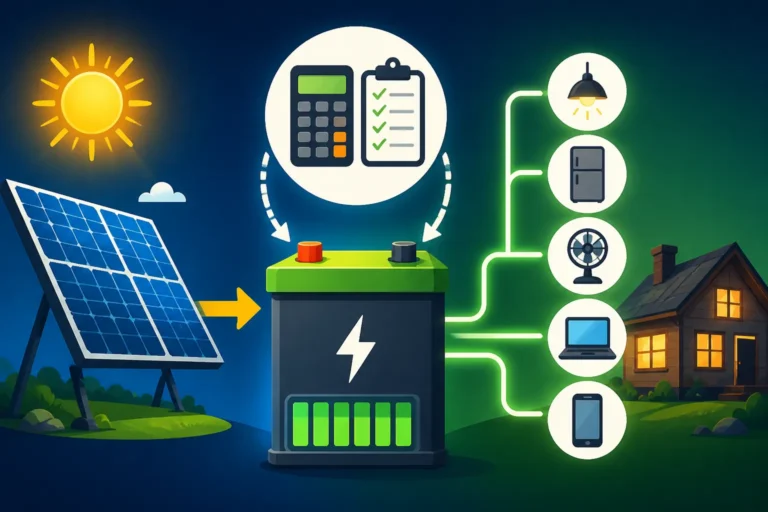
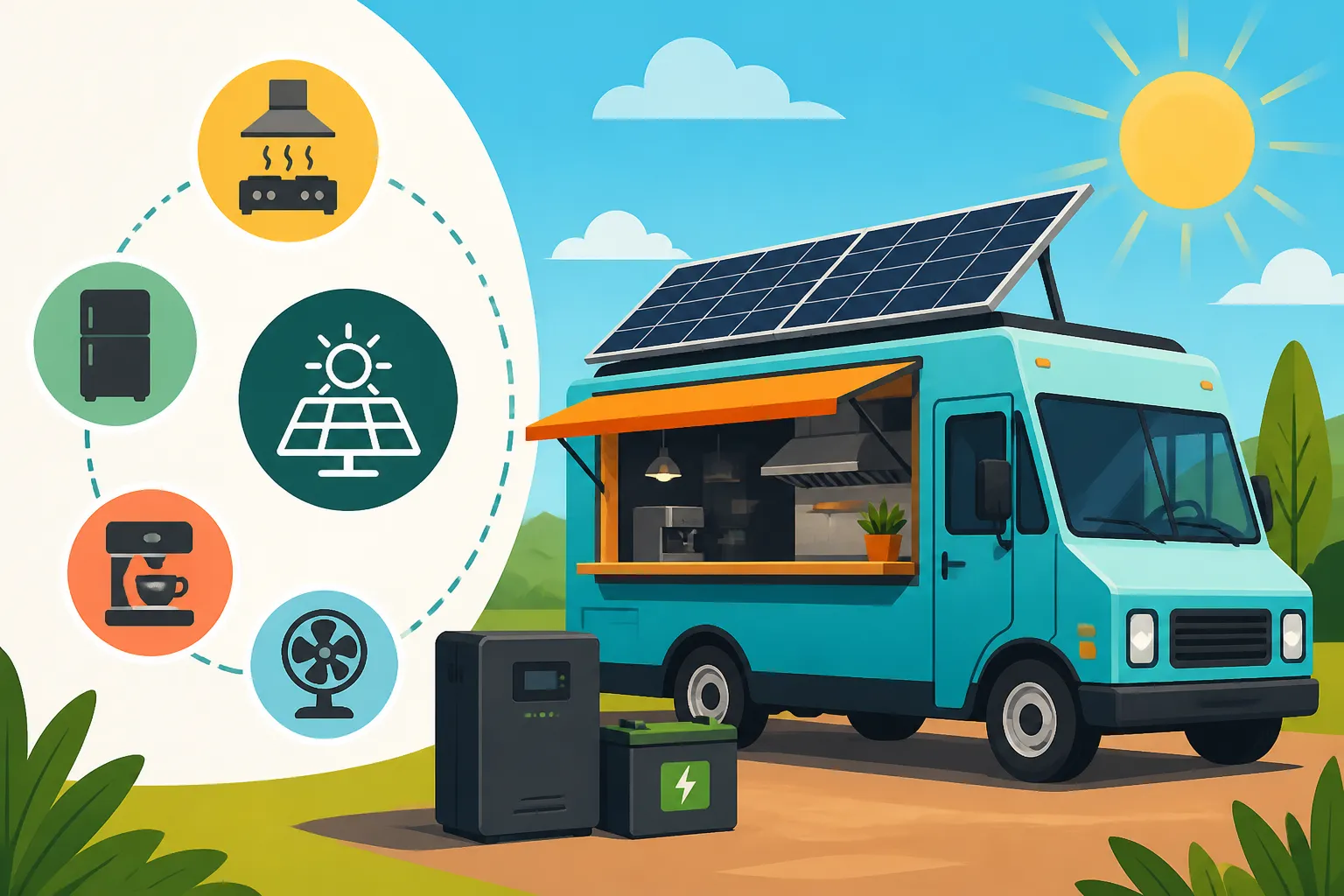
The first step in any off-grid solar design, especially for a mobile business like a food truck, is to perform a detailed load analysis. Grab a pen and paper, or open a spreadsheet, and list every single item that uses electricity. This includes everything from your industrial refrigerator and freezer to your griddle, fryers, espresso machine, lighting, exhaust fans, point-of-sale (POS) system, and even small chargers for phones and tablets. Don't forget any water pumps or purification systems you might have.
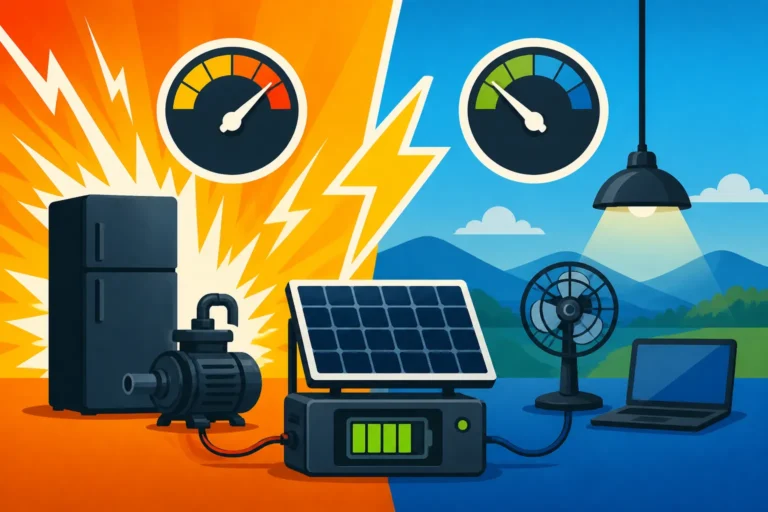
For each item, you need to find its wattage (W) or amperage (A) and voltage (V). Most appliances will have a label, usually on the back or bottom, that specifies these figures. If you see amps and volts, multiply them together to get watts (Watts = Amps x Volts). For example, a refrigerator might list 3 Amps at 120 Volts AC, which means it draws 360 Watts. It's crucial to differentiate between "running watts" (the power an appliance uses continuously) and "starting watts" or "surge watts" (the brief, higher power draw many motor-driven appliances need to kick on). A commercial freezer might run at 200 watts, but could briefly spike to 1000 watts when the compressor starts. Ignoring these surges is a common pitfall that can lead to an undersized inverter, causing your system to trip or fail just when you need it most.
Calculating Daily Watt-Hours Consumed
Once you have the wattage for each appliance, you need to estimate how many hours per day you'll use it. This part requires some realistic thinking about your typical operating schedule. Will your fridge run 24/7? Probably. Will your griddle be on for 8 hours straight, or only actively heating for 4 hours while you cook? Be honest with your estimates, as overestimating can lead to an unnecessarily expensive system, and underestimating can leave you powerless mid-rush.
To calculate the daily watt-hours (Wh) for each appliance, simply multiply its running wattage by the estimated hours of daily use. For example:
- Commercial Refrigerator: 360W x 24 hours = 8640 Wh (or 8.64 kWh)
- Griddle: 3000W x 4 hours (active cooking time) = 12000 Wh (or 12 kWh)
- LED Lights: 100W x 6 hours = 600 Wh
- POS System & Router: 50W x 10 hours = 500 Wh
Add up all these individual watt-hour totals, and you'll have your grand total daily energy consumption in watt-hours. This number is the bedrock of your entire off-grid solar system design. For more help with this critical step, refer to our detailed guide on how to calculate daily energy usage. Keep in mind that food trucks are often very energy-intensive, especially with cooking equipment, so your daily totals might be higher than a typical RV or cabin.
| Appliance/Use | Running Wattage (W) | Est. Hours/Day | Daily Watt-Hours (Wh) | Surge Wattage (W) (if applicable) |
|---|---|---|---|---|
| Commercial Refrigerator | 360 | 24 | 8640 | 1200 |
| Commercial Freezer | 250 | 24 | 6000 | 1000 |
| Griddle/Flat Top | 3000 | 4 | 12000 | 0 |
| Fryer | 1500 | 3 | 4500 | 0 |
| Coffee Maker | 1200 | 1 | 1200 | 0 |
| LED Lighting (Total) | 100 | 6 | 600 | 0 |
| Exhaust Fan | 150 | 8 | 1200 | 450 |
| Water Pump | 100 | 0.5 | 50 | 300 |
| POS System / Router | 50 | 10 | 500 | 0 |
| TOTALS (Example) | – | – | 34,690 Wh | ~2950 W (Largest Surge) |
Note: Surge wattage refers to the highest single surge you'd expect to occur. You wouldn't typically sum all surge wattages.
Designing Your Off-Grid Power Core: Panels, Batteries, and Components
With your energy consumption mapped out, it's time to build the engine room of your off-grid food truck: the solar array, battery bank, and crucial electronics that make it all work seamlessly. Each component must be carefully sized and selected to ensure your culinary operations never skip a beat.
Sizing Your Solar Panel Array for Consistent Power
Your solar panels are the workhorses, converting sunlight into electricity. To figure out how many panels you need, you'll first have to consider the amount of usable sunlight your location receives. This is commonly referred to as "peak sun hours." Peak sun hours represent the average daily hours where the intensity of sunlight is 1000 watts per square meter. This isn't the same as daylight hours; it accounts for the angle of the sun, cloud cover, and other atmospheric conditions. For a food truck, which might travel to different regions, you'll need to consider the worst-case scenario (e.g., winter in a northern climate) or average for your most frequent operating areas. Websites like the National Renewable Energy Laboratory (NREL) provide detailed solar insolation data by location. Let's say, for a particular region and season, you average 4 peak sun hours per day.
Now, to calculate the minimum panel wattage you need, you'll take your total daily watt-hours (from your load analysis) and divide it by your peak sun hours. So, if your food truck needs 34,690 Wh per day and you get 4 peak sun hours, you'd need roughly 8,672.5 Watts of solar panels (34,690 Wh / 4 hours = 8672.5W). However, this is just the theoretical minimum. You must factor in system inefficiencies. Things like wiring losses, temperature effects on panels, dust, inverter efficiency, and charge controller efficiency can easily reduce your effective output by 20-30% or more. Therefore, it's highly recommended to oversize your solar array by at least 25-30% to ensure you're always generating enough power, even on slightly cloudy days. In our example, 8672.5W * 1.30 (for 30% oversizing) = ~11,274 Watts. That's a lot of panels for a food truck, indicating that significant energy conservation or supplemental charging will be essential. You might find brands like Renogy offer a wide range of rigid and flexible panels that could fit various mounting scenarios on a food truck, from roof space to custom deployable arrays. When considering how many solar panels for off-grid living, especially for high-demand setups like food trucks, don't skimp on this crucial step.
Building a Robust Battery Bank for Off-Grid Operations
Your battery bank is the heart of your off-grid system, storing the solar energy collected by your panels for use when the sun isn't shining, like during evening service or on cloudy days. Sizing it correctly is paramount. You need enough capacity to power your truck during your longest operating periods without sun and to account for a few "days of autonomy" – backup power in case of consecutive cloudy days. For a food truck, even one day of autonomy might be challenging given the space and weight constraints, but it's a good goal to aim for.
The formula to calculate your required battery capacity in Amp-hours (Ah) is:
(Total Daily Watt-Hours Needed x Days of Autonomy) / (System Voltage) / (Usable Depth of Discharge) = Ah capacity.
Let's stick with our 34,690 Wh daily usage. If you aim for even 1 day of autonomy:
(34,690 Wh x 1 day) / (48V, a common system voltage for larger systems) / 0.80 (for LiFePO4 batteries, 80% usable DoD) = 903 Ah.
If you use 12V batteries, that would be 34,690 Wh / 12V / 0.80 = 3613 Ah. This shows why higher system voltages are often preferred for larger loads, as they require fewer amps and thus smaller, less expensive wiring.
When it comes to battery chemistry, you'll primarily be looking at Lithium Iron Phosphate (LiFePO4) or Absorbed Glass Mat (AGM) lead-acid batteries. LiFePO4 batteries, while having a higher upfront cost (check out the LiFePO4 vs Lead-Acid Battery Cost article), offer significant advantages for food trucks:
- Higher Usable Capacity: You can safely discharge LiFePO4 batteries deeper (typically 80-100% DoD) compared to AGM (around 50% DoD) without damaging them, meaning you need less physical capacity for the same usable power.
- Longer Cycle Life: LiFePO4 batteries last significantly longer, often 10+ years, making them a better long-term investment.
- Lighter Weight: This is a HUGE factor for mobile applications like food trucks, where every pound counts.
- Faster Charging: They can accept a faster charge, which is crucial for maximizing solar harvest during short operating windows.
For these reasons, LiFePO4 is almost always the recommended choice for a food truck, despite the initial investment. You can find excellent LiFePO4 battery options on Amazon from various reputable brands.
Choosing the Right System Voltage
The system voltage (12V, 24V, or 48V) you choose dramatically impacts the efficiency and cost of your wiring and other components.
- 12V Systems: Best for very small loads, like a few lights and charging devices. The current (amps) are higher, requiring thicker, more expensive wiring to avoid voltage drop. Not ideal for energy-hungry food trucks.
- 24V Systems: A good middle ground for moderate loads. Current is halved compared to 12V, allowing for thinner wiring. More efficient for systems up to around 3000-4000 watts.
- 48V Systems: The preferred choice for larger, high-power applications like a food truck. Current is quartered compared to 12V, minimizing voltage drop, allowing for much thinner and cheaper wiring, and increasing overall system efficiency. Most high-power inverters are designed for 48V systems. For detailed guidance, see our article on How to Choose System Voltage. Given the significant power demands of a food truck, a 48V system will likely be the most efficient and robust choice.
Selecting Your Inverter and Charge Controller
These two components are the brains and brawn of your electrical system, managing the flow of power.
Sizing the Inverter for Peak Loads
Your inverter's job is to convert the DC (direct current) power stored in your batteries into AC (alternating current) power that your standard appliances use. The inverter must be capable of handling the maximum instantaneous load your food truck will ever demand, including the starting surges of motor-driven equipment.
First, list all the AC appliances you might run simultaneously. Add up their running wattages. Then, identify the single largest surge wattage from any motor-driven appliance (e.g., refrigerator compressor, exhaust fan). Add this largest surge to the combined running wattage. This total represents your maximum peak load. For example, if your combined running wattage is 4000W and your largest surge is 1200W, you need an inverter rated for at least 5200W (4000W + 1200W). It's always a good idea to add a 20-25% buffer to this figure for safety and future expansion. So, a 6000W or 6500W pure sine wave inverter would be a suitable choice. Check out our guide on how to size an off-grid inverter for more in-depth calculations.
Crucially, you need a pure sine wave inverter. Modified sine wave inverters are cheaper, but they produce a "choppy" power wave that can damage sensitive electronics (like POS systems, computers) and cause motors in appliances to run less efficiently, noisier, and heat up, potentially shortening their lifespan. For a business, pure sine wave is non-negotiable. Many premium brands, including Victron Energy and Outback Power, offer robust pure sine wave inverters perfect for demanding applications.
Matching a Charge Controller to Your Panels and Batteries
The charge controller regulates the power coming from your solar panels to your battery bank, preventing overcharging and optimizing the charging process. For a food truck, a Maximum Power Point Tracking (MPPT) charge controller is the only way to go. PWM (Pulse Width Modulation) controllers are cheaper but significantly less efficient, especially in varying light conditions and when there's a large voltage difference between your panels and batteries. MPPT controllers can boost efficiency by 15-30% by intelligently finding the optimal voltage and current from your solar panels, which is vital for maximizing energy harvest on a mobile platform where space is at a premium.
Sizing the MPPT charge controller involves two main factors:
- Maximum Solar Input Voltage (Voc): The controller must be able to handle the open-circuit voltage (Voc) of your solar array, especially in cold temperatures when panel voltage increases.
- Maximum Solar Input Amperage (Isc): The controller must handle the short-circuit current (Isc) of your array, usually with a 1.25 safety factor.
Consult the specifications of your chosen solar panels. If you're running a 48V battery bank, you'll likely wire multiple panels in series to achieve a higher voltage array (e.g., 200V-300V) that is then stepped down by the MPPT controller to efficiently charge your 48V batteries. Reputable brands like Victron Energy and Renogy offer excellent MPPT charge controllers suitable for sophisticated off-grid systems.
Practical Installation and Optimization for Food Trucks
Beyond just sizing the components, getting an off-grid solar system to work flawlessly on a food truck involves unique practical challenges, from mounting panels to ensuring long-term reliability.
Space Constraints and Mounting Solutions
Food trucks are notorious for their limited space, both on the roof and inside. This presents a significant challenge for mounting solar panels and housing bulky batteries and inverters.
- Roof Space: You'll need to maximize every square inch. Rigid monocrystalline panels are efficient but heavy and fixed. Flexible solar panels, available from brands like Renogy, might be an option for curved roofs or weight-sensitive areas, though they are generally less efficient and have a shorter lifespan. Consider custom-built, low-profile racking systems that keep panels secure while driving and can withstand highway speeds.
- Panel Orientation: While fixed structures aim for south-facing, a food truck is mobile. You might sacrifice optimal tilt and azimuth for practical mounting. Consider portable or foldable panels that can be deployed when stationary, allowing you to chase the sun.
- Ventilation: Batteries and inverters generate heat. Proper ventilation is critical, especially for battery longevity and system safety. If you opt for lead-acid batteries (less likely for a food truck), you'll need external venting to dissipate hydrogen gas. Even LiFePO4 batteries require adequate airflow to prevent overheating, especially in enclosed battery boxes within a hot truck.
- Weight Distribution: A large battery bank can be incredibly heavy. Work with your truck's specifications to ensure your suspension and overall weight distribution can handle the added load. Improper weight distribution can affect handling, tire wear, and even vehicle safety.
Securing your system components properly to withstand the constant vibrations and movement of a food truck is paramount. Imagine losing power because a cable came loose on a bumpy road!
Backup Power and Energy Conservation
Even with a perfectly sized solar system, a food truck operating in varying conditions can benefit immensely from backup power and aggressive energy conservation strategies.
- Backup Generator Integration: A small, quiet inverter generator, like a Honda EU series, can be a lifesaver on perpetually cloudy days or when your energy demands spike unexpectedly. Your inverter can often be set up to automatically start the generator when battery levels drop too low, providing seamless power. This redundancy is crucial for a business where downtime means lost revenue. You might want to explore how to add a generator to your design for ultimate peace of mind.
- Shore Power Connection: While you're aiming for off-grid independence, having a standard shore power inlet is always a good idea. This allows you to plug into conventional grid power overnight to top off batteries or run high-demand appliances during prep, saving your solar array for peak operating hours.
- Energy-Efficient Appliances: This is where you can make a huge difference. Investing in highly efficient commercial refrigerators, LED lighting, and other low-draw appliances can significantly reduce your overall watt-hour demand, which in turn reduces the size and cost of your entire solar system. For example, a modern, energy-star rated commercial fridge might draw half the power of an older model.
- Operational Habits: Train your staff on energy-saving habits. Turn off lights when not needed, minimize opening fridge doors, and only run high-draw cooking equipment when actively in use. Even small changes add up over a busy day.
- Monitoring System Performance: Install a reliable battery monitor, often integrated with your charge controller and inverter (many Victron components offer this). This allows you to see exactly how much power your panels are generating, how much your batteries are holding, and what your current consumption is. Real-time data helps you understand your system's limits and make informed decisions on the fly, preventing unexpected shutdowns.
By combining careful sizing, robust installation, smart energy management, and a reliable backup, your food truck can achieve true off-grid independence, allowing you to serve up deliciousness anywhere the road takes you.
Disclaimer
Please be aware that the information provided in this guide is for educational and informational purposes only. Off-grid solar system design and installation can be complex and involve electrical hazards. Always consult with a qualified solar professional or licensed electrician for specific design recommendations, installation, and compliance with local codes and regulations. Incorrect installation can lead to property damage, injury, or fire.