How to Read Appliance Wattage Labels
One of the biggest hurdles when you're first dipping your toes into the world of off-grid solar, or even just trying to understand your home's energy consumption, is making sense of those often-cryptic labels on your appliances. It's frustrating to stare at a sticker full of numbers and symbols, wondering what they actually mean for your battery bank or inverter. This guide is here to demystify those wattage labels, showing you exactly what information you need and how to use it to plan a reliable off-grid power system without pulling your hair out.
Why Understanding Appliance Wattage is Absolutely Crucial for Off-Grid Living
When you're connected to the utility grid, most of us don't give a second thought to how much power our toaster or refrigerator is actually drawing. We just plug it in, and it works. But when you're managing your own power supply with an off-grid solar setup, every watt counts. Seriously, every single one! Miscalculating your appliance needs can lead to a system that's either woefully undersized, leaving you in the dark and frustrated, or unnecessarily oversized, costing you a lot more money than you needed to spend.
Estimating Your Daily Energy Usage
The first and most fundamental step in designing any off-grid solar system is getting a rock-solid grasp on your daily energy consumption. This isn't just about how many watts an appliance uses at any given moment, but how many watt-hours (Wh) or kilowatt-hours (kWh) it consumes over an entire day. Imagine a standard coffee maker that might draw 1000 watts while brewing for 10 minutes. That's a significant draw, but it’s only for a short burst. Compare that to an energy-efficient LED bulb that draws a mere 10 watts but might be on for 5 hours every evening. The coffee maker has a higher instantaneous draw, but the light might contribute more to your overall daily energy budget. This distinction is vital, and it starts with accurately reading those wattage labels. Without this precise information, trying to figure out "how many kWh does an off-grid home need" becomes a pure guessing game, which is something you definitely want to avoid when planning your self-sufficient lifestyle.
Preventing System Overload and Headaches
There’s nothing quite like the disheartening click of an inverter shutting down because you asked it to do too much. Or worse, tripping a breaker on a perfectly sunny day because your system couldn't handle the sudden surge from starting up a well pump or an air conditioner. Appliance labels provide the critical data for the "Off-Grid Solar Load Calculation Explained" that helps you avoid these scenarios. They tell you not just the continuous power draw, but often also the maximum current or starting wattage. Knowing these numbers allows you to select an inverter that can comfortably handle the combined continuous load of all your running appliances, plus the potentially much higher surge required by motors and compressors when they first kick on. Ignoring these details is a surefire way to introduce instability and frequent power interruptions into your off-grid experience.
Accurate Battery and Inverter Sizing
Your battery bank is your energy reserve, and your inverter is the workhorse that converts that stored DC power into usable AC power for most of your appliances. The size and capacity of both these crucial components are directly dictated by your load analysis, which, you guessed it, relies heavily on accurate appliance wattage data. If you underestimate your power needs, you might find yourself with a battery bank that drains too quickly, leaving you with insufficient power during cloudy days or evenings. Conversely, an inverter that's too small won't be able to power your larger appliances at all, even if your batteries are full. Learning "How to size an off-grid inverter" and "How to size an off-grid battery bank" correctly means meticulously going through each appliance, understanding its power profile, and then adding it all up. This foundational step is often overlooked by beginners, but it's the bedrock of a robust and reliable off-grid system.
Decoding Appliance Labels: What to Look For
Okay, let's get down to brass tacks. You've got an appliance in hand – maybe it's that old toaster, or a new mini-fridge you’re eyeing for your cabin. Where do you even begin to find the information you need, and what do all those terms actually mean? Don't worry, it's not as intimidating as it seems once you know what to look for.
Locating the Information: Nameplates and User Manuals
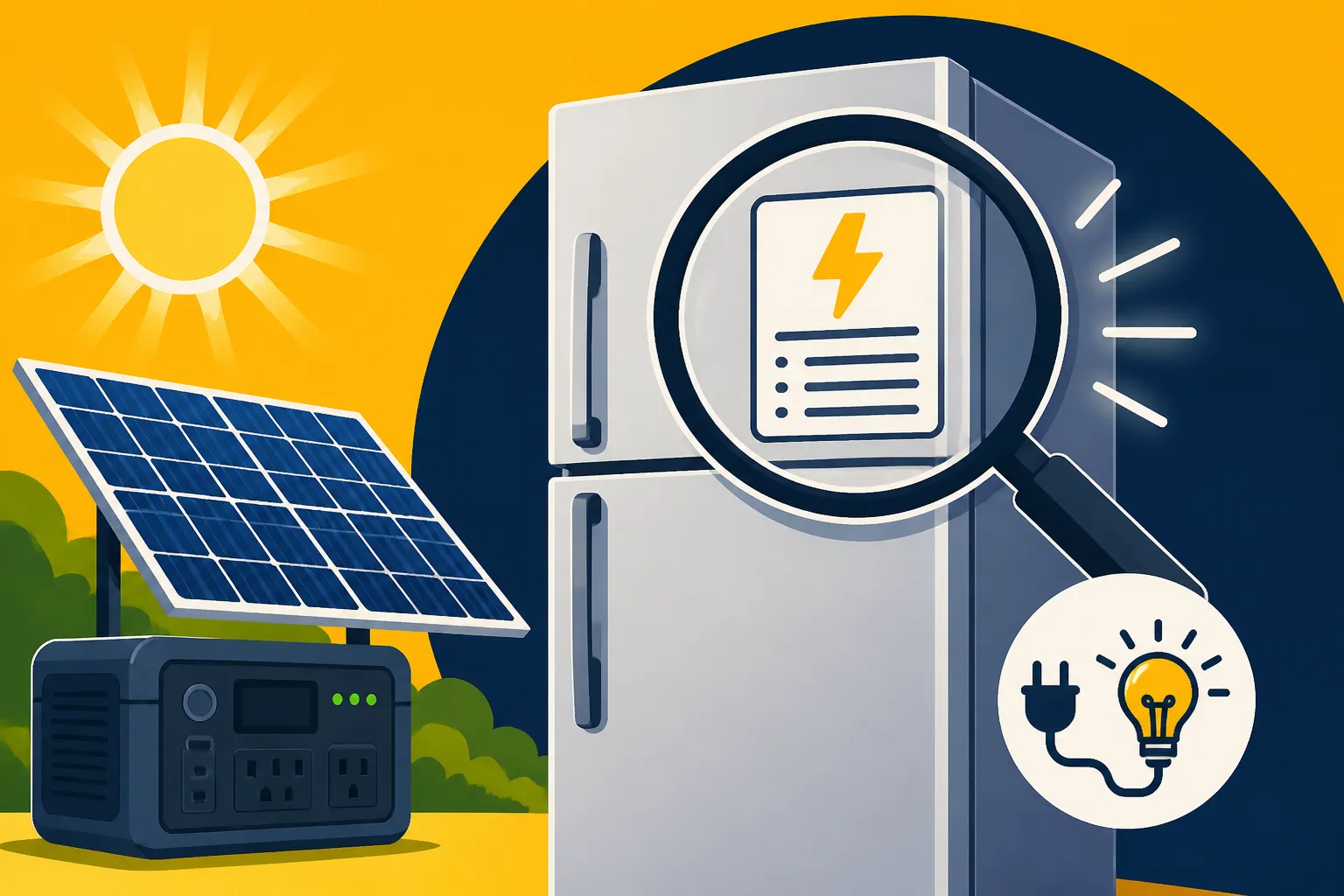
The first place to always look for appliance specifications is directly on the device itself. Most electrical appliances have a small sticker, often metallic or foil, somewhere on the back, bottom, or side. This is commonly known as the nameplate or rating plate. It's legally required to list certain electrical characteristics. For larger appliances like refrigerators, washers, or water heaters, it might be on the back, inside the door, or near the power cord entry point. For smaller electronics, check the bottom or the power adapter itself.
If the nameplate is missing, unreadable, or doesn't provide enough detail (which can happen, especially with older items), your next best bet is the user manual. Manufacturers typically include comprehensive specifications in these documents. If you don't have the physical manual, a quick search online for the appliance's brand and model number will often lead you to a downloadable PDF. When searching, try terms like "[Brand Name] [Model Number] specifications" or "[Brand Name] [Model Number] power consumption." Even general shopping sites like Amazon often list detailed electrical specifications for products in their descriptions, which can be a good starting point if you're planning a purchase.
Understanding Watts, Amps, and Volts
These are the big three, the fundamental units that tell you about an appliance's power appetite.
-
Watts (W): This is often the most straightforward number to find and understand. Watts represent the rate at which an appliance consumes energy at a specific moment. Think of it like speed. If an appliance is rated at 100 watts, it means it's drawing 100 watts of power right now. This is your primary measurement for sizing the continuous output of your inverter. For example, if you plan to run a few lights (10W each), a laptop (60W), and a small fan (30W) all at once, your continuous draw would be 10 + 10 + 60 + 30 = 110 watts. You'll want to ensure your inverter can handle this minimum continuous load comfortably.
-
Amps (A): Amperage refers to the flow of electrical current. While not directly watts, amps are often listed, especially for DC appliances (like those often found in RVs or boats). They are critical for sizing wires, fuses, and circuit breakers. The relationship between watts, amps, and volts is simple: Watts (W) = Volts (V) x Amps (A). So, if an appliance lists 120V and 5A, you know it draws 600W. Conversely, if you know the watts and volts, you can figure out the amps (Amps = Watts / Volts). This calculation is particularly useful when you're dealing with a mix of AC and DC loads in your system, as it allows you to standardize your measurements.
-
Volts (V): Voltage is the "pressure" or "force" behind the electrical current. For most household appliances in North America, this will typically be 120V AC (alternating current) or, for larger appliances like electric clothes dryers or some well pumps, 240V AC. Off-grid solar systems also have a DC (direct current) voltage, typically 12V, 24V, or 48V. Understanding the voltage is important because it directly impacts amperage. A 1200W appliance at 120V draws 10 amps. That same 1200W appliance at 12V would draw a whopping 100 amps! This is why larger off-grid systems often opt for higher voltages like 48V – it reduces the amperage, allowing for thinner (and cheaper) wiring and reducing energy loss over distances. If you're wondering "12V vs 24V vs 48V: Which to Choose", knowing your appliance voltages helps make that decision.
Differentiating Running Watts from Starting Watts (Surge)
This is perhaps one of the most critical, yet often misunderstood, aspects of appliance labels for off-grid users. Many appliances, especially those with motors or compressors, require a sudden, brief burst of extra power when they first start up. This is known as starting wattage or surge wattage, and it can be significantly higher than the running wattage (also called continuous wattage).
-
Running Watts: This is the power an appliance consistently draws once it's up and running. Your refrigerator, for example, might run at 150-200 watts. Your laptop charger might consistently draw 60 watts. This is the number you'll use for your daily energy calculations and for determining the continuous power capacity of your inverter.
-
Starting Watts (Surge): This is the peak power spike an appliance needs for a fraction of a second when it first turns on. A refrigerator, even an energy-efficient one, might have a starting wattage of 600-1000 watts. A microwave could surge to over 2000 watts for a moment. This surge is crucial because your inverter must be able to supply it, even if only briefly, to get the appliance going. If your inverter can't handle the surge, the appliance simply won't start, or your inverter will throw an overload error and shut down. Always check your inverter's specifications for its surge capacity, which is usually listed as a peak wattage for a very short duration (e.g., "3000W continuous, 6000W surge for 10 milliseconds"). If you're trying to figure out "What size inverter to run an air conditioner," the surge wattage will often be the deciding factor, not just the running wattage.
Sometimes, appliance labels won't explicitly list "starting watts." In these cases, you might see a "Maximum Current" (often in Amps) or a "Locked Rotor Amps (LRA)" value, especially for motors. This LRA value, when multiplied by voltage, can give you an idea of the surge. For instance, a small fractional horsepower motor on a pump might have an LRA significantly higher than its running amps, indicating a substantial starting surge.
Common Units and Conversions for Off-Grid Planning
Knowing the raw numbers on an appliance label is one thing, but translating them into actionable data for your off-grid system design is another. This is where a few simple conversions come in handy. Don't worry, you don't need to be a math wizard, just comfortable with basic arithmetic.
Watts (W) to Watt-hours (Wh)
This is the conversion that moves you from instantaneous power draw (watts) to total energy consumption over time (watt-hours). For off-grid solar planning, we're usually interested in daily consumption.
The formula is: Watt-hours (Wh) = Watts (W) x Hours Used (h).
Let's take an example:
- A 60W laptop that you use for 4 hours a day consumes: 60W * 4h = 240Wh per day.
- A 10W LED light that's on for 6 hours in the evening consumes: 10W * 6h = 60Wh per day.
You do this for every single appliance you plan to run. This detailed breakdown allows you to accurately calculate your daily energy usage, a vital component for figuring out "How many batteries for an off-grid system." Without knowing your total daily Wh, you're essentially flying blind when it comes to battery capacity.
Amps (A) to Amp-hours (Ah)
While watt-hours are generally preferred for overall system sizing because they are independent of voltage, amp-hours are still incredibly important, especially when dealing with DC circuits and battery capacity. Most off-grid batteries, particularly LiFePO4 batteries from brands like Renogy or Battle Born, are rated in amp-hours at a specific voltage (e.g., 100Ah at 12V).
The formula is: Amp-hours (Ah) = Amps (A) x Hours Used (h).
Or, to convert from watt-hours to amp-hours at a specific voltage: Amp-hours (Ah) = Watt-hours (Wh) / Voltage (V).
Let's say you have a 12V DC fan that draws 2A and runs for 8 hours:
- 2A * 8h = 16Ah per day.
If you know your daily total watt-hours (say, 3000Wh) and you've chosen a 48V system, your daily amp-hour draw would be:
- 3000Wh / 48V = 62.5Ah per day.
This conversion is key for comparing different battery options and determining "How to calculate battery amp-hours needed" for your specific voltage. It ensures you're looking at apples-to-apples comparisons when shopping for batteries.
Dealing with Kilowatts (kW) and Kilowatt-hours (kWh)
For larger loads or total household consumption, you'll often see measurements in kilowatts (kW) or kilowatt-hours (kWh). These are simply larger units to make the numbers easier to manage.
- Kilowatt (kW): 1 kilowatt = 1,000 watts. So, a 1500W microwave is 1.5kW.
- Kilowatt-hour (kWh): 1 kilowatt-hour = 1,000 watt-hours. Your monthly utility bill is typically measured in kWh. For a full-size off-grid home, your daily consumption might be several kWh, not just Wh. If you're planning for something substantial, like an off-grid cabin or a full house, you'll definitely be thinking in terms of kWh. For instance, if you're trying to figure out "How many kWh does an off-grid home need" per day, you'd likely aim for something in the range of 5-15 kWh depending on lifestyle.
The math is the same, just divided or multiplied by 1,000. It's simply a matter of scale. A typical refrigerator running continuously might use 1-2 kWh per day, which would be 1000-2000 Wh.
The Importance of Time in Energy Consumption
This might seem obvious, but it's where many people stumble in their off-grid calculations. An appliance's wattage rating tells you its power draw at any moment. But for sizing your solar panels and batteries, you need to know its energy consumption over a period, usually a day. This means accurately estimating how many hours each appliance will actually be turned on.
Consider a well pump. It might draw a substantial 1000 watts, but it only runs for 30 minutes a day to fill your water tank. That's 1000W * 0.5h = 500Wh. Now, compare that to a small, inefficient space heater that draws 500 watts but you leave it on for 8 hours in a chilly workshop. That's 500W * 8h = 4000Wh. Even though the well pump has a higher instantaneous wattage, the space heater contributes far more to your overall daily energy budget because of its run time.
Be realistic with your estimations. It’s always better to slightly overestimate your usage than to underestimate, especially for critical loads. Remember, the goal is reliable power, not just theoretical numbers.
Practical Examples of Reading Appliance Labels
Let's walk through a few common appliances and break down what their labels might tell us, and how that translates to your off-grid system needs. These real-world scenarios really help clarify why each piece of information is so important.
A Refrigerator Label: Continuous vs. Intermittent Loads
The refrigerator is often the largest continuous load in an off-grid home, but it's also an intermittent one. It doesn't run constantly; its compressor cycles on and off throughout the day to maintain temperature. This makes its power consumption a bit trickier than a simple light bulb.
Imagine you find a label on a mini-fridge that reads:
- Voltage: 115V AC
- Amperage: 1.5A
- Wattage: 172.5W (calculated as 115V * 1.5A)
- Energy Star Rating: 180 kWh/year
From this, you know the running wattage is approximately 172.5W when the compressor is actively running. For the surge, refrigerators typically need 3-5 times their running wattage when the compressor kicks on. So, for this fridge, you might estimate a starting wattage of around 517W to 862W (172.5W * 3 to 5). Your inverter needs to handle this surge.
Now, for daily energy consumption: The "180 kWh/year" Energy Star rating is a fantastic piece of information.
- 180 kWh / 365 days = ~0.49 kWh per day, or 490 Wh per day.
This 490 Wh/day is your average daily energy draw for the refrigerator, taking into account its cycling. This is the number you'd use in your total daily load calculation. However, you still need to factor in the surge wattage for your inverter choice. When thinking about "Cost to run a refrigerator on off-grid solar," this label provides all the key data points.
A Microwave Label: High Surge Loads
Microwaves are notorious for their high power draw and are usually the highest single appliance load in many homes. They also present a continuous, rather than intermittent, load during their short run time.
Let's say a microwave label shows:
- Input Power: 1500W
- Output Power: 900W
- Voltage: 120V AC
- Amperage: 12.5A (calculated as 1500W / 120V)
Here, the "Input Power" of 1500W is your running wattage. This is what the microwave pulls from the wall. The "Output Power" (900W) refers to the actual cooking power delivered to the food, which is less due to inefficiencies. So, for your off-grid system, you care about the 1500W input.
The good news is that microwaves generally don't have a massive starting surge like motors do, as they use a magnetron. However, 1500W is still a substantial continuous load that your inverter needs to handle for the minute or two it's running. If you plan to run other appliances simultaneously, your inverter must be able to handle the sum of all running loads, including that 1500W microwave. If your "How to size an off-grid inverter" calculation shows your continuous inverter capacity is 2000W, and you run a 1500W microwave plus a 500W water pump, you're at the very limit. Careful planning is essential!
A Laptop Charger Label: Low Continuous Load
Laptop chargers are a great example of a low, continuous load, but they also highlight the difference between AC and DC power in a system.
A typical laptop charger might have a label like:
- Input: 100-240V AC, 1.5A
- Output: 19V DC, 3.42A
- Output Wattage: 65W (calculated as 19V * 3.42A)
For off-grid purposes, you're interested in the power it draws from your AC outlets, which is the "Input" section, specifically the watts. If the wattage isn't explicitly stated for the input, you can use the voltage and amperage range. A reasonable estimate for this charger would be around 60-75W (running wattage) from the AC side. It doesn't have a significant surge.
However, notice the "Output" is DC. Many off-gridders choose to use DC-to-DC chargers for their laptops, which bypasses the inverter and its inefficiencies. For example, if your system is 12V and your laptop needs 19V, you could use a 12V-to-19V DC-DC converter. This makes your system more efficient because you're not converting 12V DC (from batteries) to 120V AC (for inverter output), and then back to 19V DC (by the laptop charger). This efficiency gain can add up, especially for frequently used electronics.
What to Do When Wattage Isn't Clearly Labeled
Sometimes, you just can't find that perfect label, or the numbers are too vague. Maybe it's an older appliance, or the sticker wore off. Don't despair! You're not stuck guessing. There are still effective ways to determine an appliance's power consumption for your off-grid system.
Using a Kill-A-Watt Meter
This is arguably the single best tool for any off-grid enthusiast or someone serious about understanding their energy usage. A Kill-A-Watt meter (or a similar power meter) is an inexpensive device that you plug into a standard wall outlet, and then you plug your appliance into the meter. It will then display real-time information such as:
- Volts (V)
- Amps (A)
- Watts (W)
- Kilowatt-hours (kWh) consumed over time
- Frequency (Hz)
- Power Factor
This meter gives you actual, real-world data for your specific appliance. You can see the running wattage of a refrigerator as its compressor cycles on, and importantly, you can measure the total kWh it uses over a day or a week. You can also monitor the peak surge wattage for those motor-driven appliances. Many models are available, and you can usually find reliable options on platforms like Amazon for a very reasonable price. This tool provides invaluable data for your "Off-Grid Solar Load Calculation Explained" and helps you refine your daily energy usage estimates with precision.
To get the most accurate data, monitor the appliance for at least 24 hours, ideally a few days, especially for intermittent loads like refrigerators. For appliances with a clear on/off cycle, measure the wattage while it's running, and then multiply by your estimated daily run time.
Estimating Based on Similar Appliances
If a Kill-A-Watt meter isn't immediately available, or for a quick preliminary estimate, you can often find average power consumption figures for similar appliances online. Websites dedicated to energy efficiency, appliance manufacturers, or even other off-grid forums often publish lists of typical wattage for common household items.
For example, if you have an older, unlabeled microwave, a quick search for "average wattage of microwave" might tell you they typically range from 600W to 1500W. You might then err on the side of caution and assume the higher end for your sizing. This method is less precise than using a meter but can give you a ballpark figure to start with. Just remember, older appliances tend to be less efficient than newer, Energy Star-rated models, so factor that into your estimations.
Checking Online Databases and Manufacturer Specifications
Beyond a general web search, many manufacturers maintain detailed product databases on their websites. If you have the brand and model number, going directly to the source can yield very accurate specifications, including power factor (which can affect inverter sizing slightly for AC loads) and more detailed energy consumption figures.
For a broader overview, government agencies or energy efficiency organizations (like Energy Star in the U.S.) often have online databases where you can look up appliances and their rated annual energy consumption. These numbers are excellent for determining the daily Watt-hour (Wh) usage of cyclical appliances like refrigerators or freezers. Remember the calculation: Annual kWh / 365 days = Average Daily kWh (or Wh if you multiply by 1000). This helps you figure out "How many Watt-hours you use per day" for these specific items, providing reliable data points to build your comprehensive load analysis.
Typical Off-Grid Appliance Power Consumption Estimates
Here's a handy table summarizing typical running watts, estimated surge watts (where applicable), and average daily watt-hours for common appliances. Remember, these are averages; always check your specific appliance's label or use a power meter for the most accurate data.
| Appliance | Typical Running Watts (W) | Estimated Surge Watts (W) | Average Daily Watt-Hours (Wh) | Notes |
|---|---|---|---|---|
| LED Light Bulb (9W) | 9-10 | N/A | 30-60 (3-6 hrs/day) | Highly efficient. Run time dictates daily Wh. |
| Laptop (charging) | 45-90 | N/A | 180-360 (4 hrs/day) | Use DC-DC charger for better efficiency. |
| Smartphone (charging) | 5-15 | N/A | 10-30 (2 hrs/day) | Very low draw, but adds up for multiple devices. |
| Mini-Fridge (3-5 cu ft) | 50-150 | 300-600 | 300-600 | Cycles on/off. Energy Star rated models are best. |
| Standard Refrigerator | 100-250 | 600-1200 | 700-2000 | Varies greatly by size, age, and efficiency. |
| Microwave (1000W) | 1000-1500 | N/A (continuous load) | 50-150 (3-9 mins/day) | High momentary draw, short usage. No motor surge. |
| Toaster (2 slice) | 800-1200 | N/A (continuous load) | 40-60 (3-5 mins/day) | High momentary draw, short usage. |
| Coffee Maker | 800-1200 | N/A (continuous load) | 40-100 (3-5 mins/day) | High momentary draw, short usage. Brewing cycle. |
| Electric Kettle | 1000-1500 | N/A (continuous load) | 50-150 (3-6 mins/day) | Very high momentary draw, short usage. |
| Fan (oscillating) | 30-75 | N/A | 120-300 (4 hrs/day) | Relatively low, but can run for long periods. |
| Well Pump (1/2 HP) | 750-1500 | 2000-4000 | 500-1500 (30-60 mins/day) | Critical load with significant surge. Requires careful inverter sizing. |
| Small TV (32-40 inch) | 40-80 | N/A | 80-320 (2-4 hrs/day) | Modern TVs are quite efficient. |
| Washing Machine | 500-2000 (peak) | 1000-3000 | 200-1000 (per load) | Varies wildly by cycle (cold vs. hot water, spin). High surge for motor. |
| Mini-Split AC (9000 BTU) | 800-1500 | 2000-4000 | 4000-12000 (4-8 hrs/day) | Major load. Variable speed (inverter) models have lower surge. |
| Hair Dryer | 1200-1800 | N/A (continuous load) | 60-90 (3-5 mins/day) | Very high momentary draw, short usage. |
| Router/Modem | 10-20 | N/A | 240-480 (24 hrs/day) | Small continuous load, but runs constantly. |
By taking the time to truly understand your appliance wattage labels and translate that into daily energy consumption, you're laying a solid foundation for your off-grid solar journey. It's the essential first step that informs nearly every other decision, from how many panels you need to whether you should consider "Best Off-Grid Solar Kits for Beginners" versus a custom build. This careful planning ensures that when you flip that switch, your lights come on, your coffee brews, and your fridge keeps humming, giving you the reliable off-grid power you're aiming for. It's truly a rewarding experience to see your system humming along perfectly, knowing you built it on a foundation of accurate data, not guesswork.
Disclaimer
Please remember that this guide provides general information for educational purposes only. While we strive for accuracy, individual results and system requirements may vary widely based on specific appliances, usage patterns, geographic location, and component choices. Always consult with certified electricians or solar professionals for specific system design, installation, and compliance with local codes and regulations. Working with electricity can be dangerous; proceed with caution and prioritize safety.