How to Choose Off-Grid Solar for a Off-Grid Home
The dream of living off-grid, free from utility bills and reliance on the power company, is incredibly appealing. However, when it comes to choosing the right off-grid solar system for a permanent home, the sheer number of components, calculations, and considerations can feel overwhelming, leaving many wondering where to even begin. This comprehensive guide is designed to cut through that complexity, providing you with clear, actionable steps to design and select an off-grid solar solution perfectly tailored to your unique home and lifestyle.
Understanding Your Home's Energy Needs
Before you can even think about solar panels or batteries, the absolute first step in choosing an off-grid solar system for your home is to intimately understand your energy consumption. This isn't just about guessing; it's about getting down to the nitty-gritty details of every appliance, light, and electronic device you plan to use. Without an accurate assessment, you risk building a system that's either woefully inadequate or needlessly oversized and expensive.
Conducting a Detailed Load Analysis
A load analysis is essentially an energy audit for your future off-grid home. It might sound tedious, but trust me, it's the foundation upon which your entire system's success rests. Start by listing every single electrical device you use or intend to use. For each item, you need to find two crucial pieces of information: its wattage (how much power it consumes when running) and how many hours per day you expect to use it. Many appliances have their wattage listed on a label, often on the back or bottom. If not, a quick online search for the make and model usually provides the data.
Think about your daily routines. Will you be running a well pump twice a day for 30 minutes? Is there a deep freezer that needs to be on constantly? Do you envision using power tools in a workshop for several hours on weekends? Don't forget the smaller items like phone chargers, LED lights, and even your trusty coffee maker. Convert everything into watt-hours per day. For example, a 100-watt television used for 4 hours a day consumes 400 watt-hours (100W * 4h = 400Wh). Summing all these up will give you your total daily energy consumption in watt-hours (Wh) or kilowatt-hours (kWh). This total is your baseline, the minimum amount of energy your system needs to generate and store daily. For a deeper dive, check out our guide on how to calculate daily energy usage.
Accounting for Seasonal Variations and Future Growth
Once you have your baseline, it's time to get realistic. Your energy needs aren't static; they fluctuate significantly throughout the year. Winter, for instance, often means shorter daylight hours and potentially less solar production, but a higher demand for heating-related loads (even if your primary heat source isn't electric, pumps for hydronic systems or circulation fans still draw power). Conversely, summer might bring longer sun exposure but increased demand for air conditioning or fans. Your load analysis needs to consider these seasonal peaks and troughs. What's your maximum likely daily usage? That's the number you should design around, perhaps with a buffer.
Beyond seasons, consider the future. Are you planning to add more appliances down the line? Maybe a new workshop, an electric vehicle charging station, or expanding your family? It's often more cost-effective and less disruptive to design a system with some room for expansion, or at least with components that can be easily upgraded. This foresight can save you a lot of headaches and money later on, preventing the need for a complete system overhaul. It's a common mistake to size a system to the bare minimum, only to find yourself constantly struggling for power a year or two later.
Key Components of a Home Off-Grid Solar System
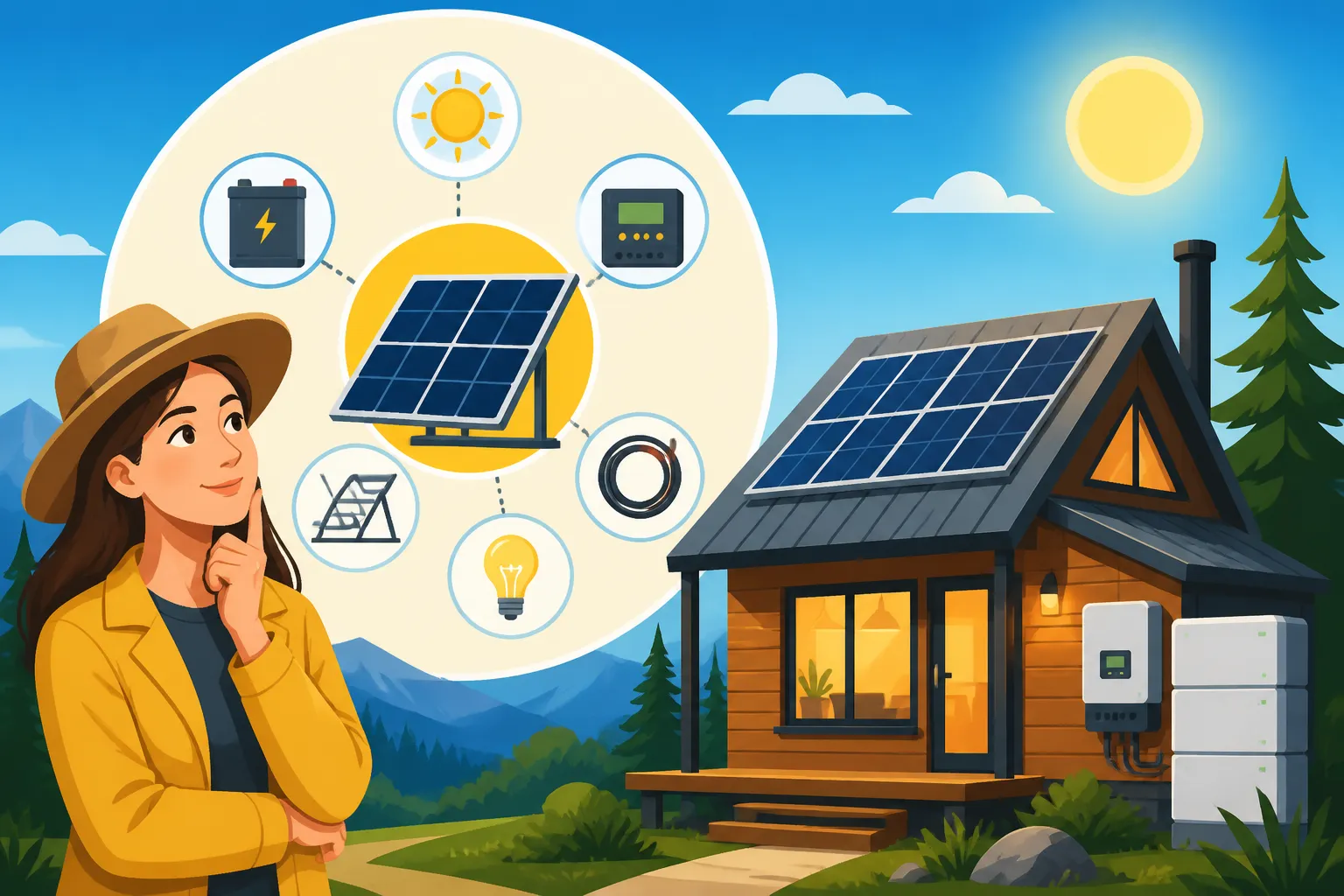
An off-grid solar system for a home isn't just a collection of solar panels. It's an intricate dance of several critical components working in harmony to capture, convert, store, and deliver power. Understanding each piece is vital to making informed decisions for your homestead.
Solar Panels: Types and Considerations
The solar panels are your energy gatherers, the workhorses converting sunlight into electricity. For a permanent off-grid home, you'll typically be looking at rigid monocrystalline panels. These are the most efficient and durable option, offering excellent performance even in lower light conditions, which is crucial when you're relying entirely on the sun. While flexible panels or smaller portable units like those from Jackery might be great for an RV or a temporary camping setup, they aren't suitable for powering a whole house.
When selecting panels, consider their wattage, physical size, and voltage. Higher wattage panels can generate more power in a smaller footprint, which is beneficial if you have limited roof or ground space. The tilt angle and orientation of your panels are also paramount. In most Northern Hemisphere locations, panels should face true south (not magnetic south) and be tilted at an angle roughly equivalent to your latitude for optimal year-round production. However, you might adjust this for seasonal optimization – steeper in winter for lower sun angles, flatter in summer. A good off-grid system design often accounts for varying sun hours throughout the year, as detailed in our comprehensive guide on how to size an off-grid solar system.
Battery Bank: The Heart of Your Off-Grid Power
The battery bank is arguably the most critical component of an off-grid home solar system. This is where all the power generated by your panels is stored for use when the sun isn't shining – at night, on cloudy days, or during extended periods of bad weather. Without a robust battery bank, you simply won't have consistent power.
There are two primary battery chemistries you'll encounter:
- Lead-Acid Batteries: These are the traditional choice, including flooded lead-acid (FLA) and sealed absorbed glass mat (AGM) or gel batteries. FLA batteries are the most economical upfront but require regular maintenance (checking and topping off water levels) and must be vented due to off-gassing. AGM and gel batteries are maintenance-free but cost more and are less tolerant of deep discharges. Lead-acid batteries generally have a shorter lifespan (3-7 years) and lower usable capacity (you shouldn't discharge them below 50% to maximize their life).
- Lithium Iron Phosphate (LiFePO4) Batteries: These are the modern gold standard for off-grid applications, like those offered by Battle Born or EG4. While they have a higher upfront cost, their benefits often outweigh it in the long run. LiFePO4 batteries are maintenance-free, offer a significantly longer lifespan (10-15+ years), can be discharged almost completely (up to 80-100% depending on the manufacturer) without damage, are lighter, and perform better in a wider range of temperatures. They also charge much faster. When considering the cost to replace off-grid solar batteries over the system's lifetime, LiFePO4 often proves more economical.
Your choice will heavily influence your budget and system performance. Here's a quick comparison:
| Feature | Lead-Acid Batteries (FLA/AGM) | Lithium Iron Phosphate (LiFePO4) |
|---|---|---|
| Upfront Cost | Lower | Higher |
| Lifespan (Cycles) | 500-1500 cycles | 3000-8000+ cycles |
| Usable Depth of Discharge | 50% | 80-100% |
| Maintenance | High (FLA), Low (AGM/Gel) | Very Low/None |
| Charging Efficiency | ~80-85% | ~95-99% |
| Weight | Heavy | Lighter |
| Temperature Tolerance | Sensitive to cold, can off-gas (FLA) | Good, some have low-temp cutoff |
| Self-Discharge Rate | Higher | Lower |
The size of your battery bank (measured in amp-hours or kilowatt-hours) needs to be large enough to carry your home through several days of cloudy weather without sun production. This is known as "days of autonomy." For a full-time off-grid home, aiming for at least 3-5 days of autonomy is a sensible goal, though some prefer more for peace of mind. Our guide on how many batteries for an off-grid system can help you calculate this precisely.
Inverters and Charge Controllers: The Brains of the Operation
These two components are the intelligent managers of your off-grid power system.
-
Charge Controller: The charge controller sits between your solar panels and your battery bank. Its primary job is to regulate the voltage and current coming from the panels, ensuring your batteries are charged safely and efficiently. Overcharging can severely damage batteries, and the charge controller prevents this. You'll typically choose between two types:
- PWM (Pulse Width Modulation): These are simpler and less expensive but also less efficient, especially in colder temperatures or when the panel voltage significantly exceeds the battery voltage.
- MPPT (Maximum Power Point Tracking): MPPT controllers are more advanced and significantly more efficient, converting excess panel voltage into additional charging current. This means more power makes it into your batteries, especially beneficial for larger systems and in varying weather conditions. For a permanent off-grid home, an MPPT charge controller is almost always the recommended choice due to its superior efficiency and ability to maximize your solar harvest.
-
Inverter: Your solar panels and battery bank produce direct current (DC) electricity. However, most household appliances and electronics run on alternating current (AC). The inverter is the device that converts DC power from your batteries into usable AC power for your home.
- Pure Sine Wave Inverters: These are essential for powering sensitive electronics like computers, medical equipment (such as CPAP machines), and modern appliances. They produce a clean, consistent waveform similar to grid power.
- Modified Sine Wave Inverters: These are less expensive but produce a "choppier" waveform that can cause issues with certain electronics, reduce the efficiency of motors, and potentially shorten the lifespan of some appliances. For a full off-grid home, always opt for a pure sine wave inverter to protect your valuable electronics and ensure reliable operation.
The inverter's size (rated in watts or kilowatts) needs to be large enough to handle your largest continuous loads plus any surge loads (the momentary high power draw when an appliance like a refrigerator or well pump starts up). It's crucial to correctly size your off-grid inverter to prevent overloading and system shutdowns.
System Sizing and Configuration Strategies
Once you know your energy needs and the roles of the main components, it's time to put it all together. This stage involves the crucial calculations that determine the actual size and configuration of your off-grid solar setup.
Calculating Your Solar Array Size
Your solar array (the total wattage of your panels) needs to be large enough to replenish your battery bank daily, even after accounting for system losses and varying sunlight. The key here is understanding your "peak sun hours." This isn't just how many hours the sun is visible, but how many hours of direct, intense sunlight your location receives on average per day. This number varies greatly by geography and season. For instance, northern states might get 2-3 peak sun hours in winter, while southern states could get 5-6 or more.
To calculate your array size, you'll divide your total daily energy consumption (in Wh) by your average daily peak sun hours. Then, you'll need to factor in system losses (due to temperature, wiring, inverter inefficiency, etc.), which can typically range from 20-30%. So, if your home needs 10,000 Wh per day and you get 4 peak sun hours, you'd initially need 2500W of panels (10,000 Wh / 4h = 2500W). Then, accounting for a 25% loss, you'd need approximately 3125W (2500W / 0.75 = 3333W, let's round for simplicity) of solar panels to meet your needs reliably. It's often wise to slightly oversize your array, especially if you live in an area with frequent cloudy weather, to ensure your batteries stay topped off.
Determining Battery Bank Capacity
The battery bank capacity, as mentioned, depends on your daily energy usage and your desired days of autonomy. If your home uses 10,000 Wh per day, and you want 3 days of autonomy, you need a gross capacity of 30,000 Wh (10,000 Wh/day * 3 days). However, remember the usable depth of discharge. For LiFePO4 batteries, you can use 80-100%, so 30,000 Wh might be your net requirement. If you choose lead-acid, where only 50% is usable, you'd need a gross capacity of 60,000 Wh (30,000 Wh / 0.50) to achieve those three days of usable power. This illustrates why LiFePO4 batteries, despite their higher initial cost, can often lead to a smaller, more efficient, and longer-lasting battery bank. Our detailed guide on how to calculate off-grid solar needs goes into these calculations with more depth.
Choosing the Right System Voltage
Off-grid solar systems typically operate at 12V, 24V, or 48V. While 12V systems are common for small RVs or shed setups, they're generally inefficient and impractical for a whole home. Higher voltages reduce the current flowing through your wires, which means you can use thinner, less expensive wiring and experience less power loss over distance.
- 24V Systems: These are suitable for smaller off-grid homes with moderate energy demands, perhaps running 2,000-3,000 watts of inverter power.
- 48V Systems: For larger off-grid homes with significant power demands, especially those running multiple high-wattage appliances (well pumps, large refrigerators, mini-splits), a 48V system is almost always the most efficient and cost-effective choice. It allows for higher power inverters with smaller gauge wiring, reducing overall costs and improving system efficiency. Most premium off-grid inverters, like those from Victron or Sol-Ark, are designed for 48V systems. Deciding on the appropriate system voltage is a crucial early design choice, as it impacts everything from wire sizing to component selection.
Practical Considerations and Installation Insights
Choosing the right components and sizing your system correctly is a monumental task, but the journey doesn't end there. Bringing your off-grid vision to life involves practical hurdles and important decisions regarding installation and ongoing management.
Permitting, Codes, and Safety
It's a common misconception that because you're off-grid, you're exempt from all regulations. While it's true you might not need permits related to utility connection, most jurisdictions still have building codes and electrical codes that apply to any electrical installation, whether grid-tied or off-grid. These codes are in place for safety, protecting you and your property from fire hazards and electrical shock.
Before you start digging or wiring, check with your local county or municipal building department. They can inform you about specific requirements for solar installations, battery storage, and general electrical work. You might need permits for structural elements (like ground mounts) or for the electrical system itself. Ensuring your system adheres to codes like the National Electrical Code (NEC) is paramount for safety and could be a factor if you ever decide to sell your property or if you need to involve electricians for future maintenance. Proper grounding and bonding, circuit protection (fuses and breakers), and appropriate wire sizing are non-negotiable safety elements. Many off-grid specific electrical solutions often incorporate robust safety features and adhere to these standards.
DIY vs Professional Installation
The question of whether to "DIY" your off-grid solar installation or hire professionals is a significant one, often boiling down to your skill set, time, and budget.
- DIY Installation: If you're handy, have a solid understanding of electrical principles, and are meticulous about following instructions and safety protocols, a DIY approach can save you a substantial amount on labor costs. There's a wealth of information available online, and many off-grid solar kits come with detailed instructions. However, it's a complex undertaking that requires specialized tools, a good deal of physical labor, and a deep commitment to learning. Mistakes can be costly, dangerous, and time-consuming. You'll be responsible for all troubleshooting and system design aspects. For instance, carefully reading the manuals for a charge controller or inverter, understanding wiring diagrams, and ensuring all connections are solid are critical steps. Our article on how much cheaper is DIY off-grid solar elaborates on the cost savings and challenges.
- Professional Installation: Hiring experienced solar installers, especially those with off-grid specific experience, offers peace of mind. They handle everything from system design and permitting to installation and commissioning. They know the codes, have the right tools, and can typically complete the job faster and more efficiently. While the upfront cost is higher, it includes expertise, labor, and often a warranty on their work. This is particularly appealing for complex whole-home systems where reliability and safety are paramount. Even if you plan a DIY approach, consulting with a professional for the design phase or for final inspection can be a wise investment.
It's also worth noting that if you opt for a professional installation, the overall cost of an off-grid solar system will be higher, but you might gain access to better warranties and professional support.
Backup Solutions and Monitoring
Even the most robust off-grid solar system for a home can encounter periods of low solar production (extended cloudy spells, heavy snow cover) or unexpectedly high usage. This is where backup solutions come in handy.
- Generator Backup: A reliable generator is a common and highly recommended backup for off-grid homes. It can be set up to automatically kick on when battery levels drop below a certain threshold, providing power to your home and recharging your batteries. Propane or diesel generators are popular choices. This adds another layer of security, ensuring you never truly run out of power. When considering a generator, size it to handle your major loads during an emergency, such as a well pump, refrigerator, or water heater. You can learn more about the cost of adding a generator to off-grid solar.
- Portable Power Stations: While not a primary backup for a whole home, a quality portable power station, like a Jackery Explorer series unit, can be a fantastic supplementary tool. It's perfect for powering small, critical loads during maintenance on your main system, charging electronics when you want to conserve your main battery bank, or even taking power away from the main house for an outdoor task. They're quick to deploy and can be easily recharged via small solar panels.
- Monitoring Systems: Modern off-grid systems often include sophisticated monitoring capabilities. These systems allow you to track your solar production, battery state of charge, energy consumption, and even individual component performance from a digital display or a smartphone app. This data is invaluable for understanding your system's health, optimizing your energy usage, and troubleshooting potential issues before they become major problems. Many high-end inverters and charge controllers from brands like Victron Energy integrate seamlessly with advanced monitoring platforms, giving you real-time insights into your off-grid independence.
Having a comprehensive plan for energy generation, storage, conversion, and backup, along with a keen eye on monitoring, will empower you to live comfortably and confidently off the grid in your home.
Disclaimer
The information provided in this article is for general informational purposes only and does not constitute professional advice. Off-grid solar system design and installation can be complex and potentially dangerous. Always consult with qualified solar professionals and electricians, and adhere to all local building codes and regulations before undertaking any off-grid solar project.