Best Off-Grid Solar Kit for a Workshop
There’s nothing quite like the satisfaction of having your own workshop, a dedicated space where you can tinker, build, and create. But that dream can quickly turn into a headache when you realize just how challenging it is to get reliable power out there, especially if your ideal workspace is tucked away from the main house or completely off the beaten path. This comprehensive guide is here to help you navigate the often-confusing world of off-grid solar kits, ensuring your workshop stays powered up and productive, no matter where it's located.
Why a Dedicated Off-Grid Solar Kit for Your Workshop Makes Sense
For many of us, the workshop is a sanctuary, a place where the hum of machinery is music to our ears. But when that machinery relies on a finicky generator or extension cords snaking across the yard, the peace quickly dissipates. An off-grid solar kit offers a liberating solution, providing consistent, clean power directly to your workspace.
The Frustration of Limited Power Access
Let's be honest, we've all been there. You're in the middle of a crucial cut or a delicate sanding job, and the power flickers, or worse, cuts out completely. If you’re relying on a gas generator, you’re constantly battling the noise, the fumes, and the endless trips to refuel. It’s disruptive, expensive, and frankly, takes away from the joy of working on your projects. Imagine trying to concentrate on fine detail work with a roaring engine just outside your door! Or perhaps your dream workshop is so far out in the woods that extending grid power would cost tens of thousands of dollars, making it an entirely non-starter. This is a common frustration, and it's precisely why so many are turning to solar. You want to be able to fire up your miter saw, run your air compressor, or keep the lights on without worrying about the utility bill or disturbing the peace and quiet of your surroundings.
Tailoring Power to Your Workshop's Specific Needs
One of the greatest advantages of a dedicated off-grid solar kit for your workshop is the ability to perfectly size the system to your unique power demands. You don't need to try and stretch a small system meant for basic lighting to run heavy-duty power tools, nor do you need to invest in an oversized, expensive whole-home system just to power your drill press. Your workshop likely has specific peak loads—think the surge of an air compressor kicking on or a table saw starting up—that need to be carefully accounted for. By focusing solely on the workshop, you can optimize your investment, ensuring you have enough juice for your sanders, routers, chargers, and diagnostic equipment without wasting money on excess capacity you don't need or, more commonly, suffering from insufficient power. It's about getting the right amount of power for your tools, not some generic estimate.
Key Components of an Off-Grid Solar Kit for a Workshop
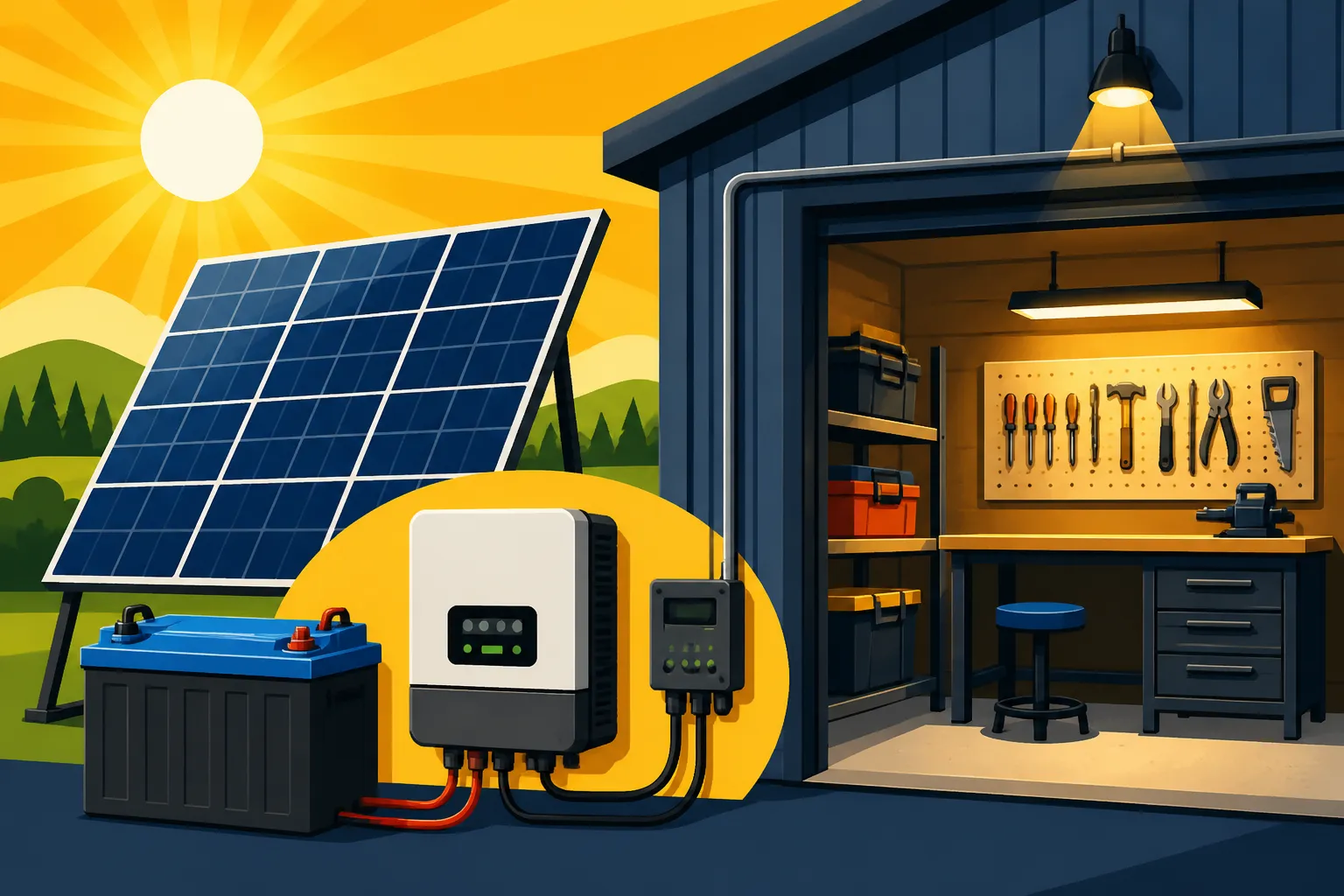
Understanding the individual parts of an off-grid solar kit is the first step toward building or buying the perfect system for your workshop. Each component plays a vital role in harvesting, storing, and delivering power.
Solar Panels: Your Workshop's Energy Harvesters
The solar panels are the frontline workers of your off-grid system, converting sunlight into usable electricity. For a workshop, you'll typically be looking at rigid monocrystalline panels, which are known for their efficiency and durability, making them a solid long-term investment. They hold up well to various weather conditions, which is crucial for a structure that might not be constantly monitored like a home. You'll need to consider how you'll mount them: will they go on the workshop roof, on a ground mount nearby, or perhaps on a pole mount for optimal sun tracking? For example, a workshop nestled under trees might benefit from a ground mount in a sunny clearing, allowing you to maximize those precious peak sun hours. The number and wattage of the panels will directly relate to how quickly you can recharge your batteries and how much power you can generate on a sunny day.
The Battery Bank: Storing Your Sunshine
While your panels are making power, your battery bank is where that power gets saved for later use – especially when the sun isn't shining, or you need a big surge for a power tool. For a workshop, you'll want a robust and reliable battery solution. Lithium iron phosphate (LiFePO4) batteries are incredibly popular these days, and for good reason. They offer superior cycle life (meaning they last for thousands of charge/discharge cycles), can be deeply discharged without damage, and maintain a consistent voltage, which is excellent for sensitive electronics and power tools. While they have a higher upfront cost than traditional lead-acid batteries, their longevity and performance often make them more cost-effective in the long run. If you want to learn more, our guide on LiFePO4 vs Lead-Acid Battery Cost offers a deeper dive. The capacity of your battery bank (measured in amp-hours, or Ah) will determine how long you can run your tools and lights without new solar input, giving you critical days of autonomy.
Inverter and Charge Controller: The Brains of the Operation
These two components are absolutely crucial for converting and managing the electricity within your off-grid workshop system. The charge controller sits between your solar panels and your battery bank. Its job is to regulate the voltage and current coming from the panels, ensuring your batteries are charged efficiently and safely, preventing overcharging and extending their lifespan. MPPT (Maximum Power Point Tracking) charge controllers are generally recommended for larger systems and offer higher efficiency compared to PWM (Pulse Width Modulation) controllers, especially when dealing with varying light conditions.
The inverter is what takes the DC (direct current) power stored in your batteries and converts it into AC (alternating current), which is what most standard workshop tools and appliances use. For sensitive electronics, and importantly, for motor-driven tools like saws, drills, and air compressors, you'll absolutely want a pure sine wave inverter. Modified sine wave inverters are cheaper but can damage certain tools and cause motors to run hot and less efficiently. The inverter's wattage rating needs to be able to handle the surge power required when motors start up, which can be several times higher than their running wattage. Choosing the right inverter is critical, so be sure to consider How to Size an Off-Grid Inverter carefully based on your tools.
Essential Accessories and Safety Gear
Beyond the main components, a well-rounded off-grid solar kit for your workshop includes several crucial accessories and safety features. You’ll need appropriate wiring and cables, carefully sized to prevent voltage drop and ensure safe current flow. Fuses and circuit breakers are non-negotiable for protecting your equipment from overcurrents and preventing electrical fires. A proper grounding system is also essential for safety, protecting both your equipment and yourself from electrical hazards. Many kits will also include a battery monitor, which gives you real-time information on your battery's state of charge, voltage, and current, allowing you to manage your power consumption effectively. Don't overlook these smaller, but incredibly important, parts of the system – they ensure reliability and safety for your creative space.
Sizing Your Off-Grid Solar Kit: What Power Does Your Workshop Really Need?
This is where the rubber meets the road! The "best" off-grid solar kit for your workshop isn't a pre-packaged, one-size-fits-all solution; it's the one perfectly tailored to your tools and usage habits. Getting this step right ensures you have reliable power without overspending or constantly running out of juice.
Auditing Your Workshop's Power Demands
Before you can even think about buying a kit, you need to understand exactly what you plan to power. Grab a pen and paper (or a spreadsheet, if you're like me!) and walk through your workshop. List every single tool, light, charger, radio, fan, or anything else you intend to run. For each item, look for its wattage rating. Most power tools will have both a running wattage and a higher "surge" or "starting" wattage. This surge is critical because your inverter needs to be able to handle that momentary spike when a motor first kicks on.
For example, a typical 10-inch table saw might run at 1800 watts but could surge to 4000-5000 watts for a split second upon startup. Your LED shop lights might only be 20 watts each, while a cordless tool charger could pull 100 watts. Don't forget those smaller but consistent loads like a mini-fridge if you like cold drinks while you work, or a computer if you do design work in your shop. Be honest about how long you'll run each item per day. Will you use the table saw for 30 minutes? The lights for 4 hours? This detailed inventory is the foundation of your entire off-grid system. We have a great guide on How to Estimate Appliance Power Draw that can help with this crucial step.
Calculating Your Daily Watt-Hour Needs
Once you have your list, it's time to crunch some numbers to figure out your total daily energy consumption in watt-hours (Wh). For each item, multiply its running wattage by the number of hours you expect to use it per day. Add all these figures together, and you'll get a rough estimate of your daily watt-hour needs.
Let's do a quick hypothetical:
- Table Saw: 1800W x 0.5 hours = 900 Wh
- Drill Press: 800W x 0.25 hours = 200 Wh
- Shop Lights (4 x 20W): 80W x 4 hours = 320 Wh
- Radio: 50W x 3 hours = 150 Wh
- Cordless Tool Charger: 100W x 1 hour = 100 Wh
- Total Estimated Daily Usage: 900 + 200 + 320 + 150 + 100 = 1670 Wh
Remember, this is just for running watts. You also need to identify your largest single surge load to correctly size your inverter. If that table saw hits 5000W for a second, your inverter needs to be able to supply that. Getting this calculation right is the difference between a functional workshop and one where the power constantly trips. Our article on Off-Grid Solar Load Calculation Explained goes into even more detail about this process.
Matching Components to Your Calculations
Now that you know your daily energy consumption and your peak surge load, you can start matching these figures to specific components.
- Battery Bank Sizing: You'll want enough battery capacity to cover your daily usage, plus some extra for cloudy days or extended work sessions. This is often referred to as "days of autonomy." If you want 2 days of autonomy for your 1670 Wh workshop, you'd aim for roughly 3340 Wh of usable battery capacity. Remember, LiFePO4 batteries typically allow for 80-100% depth of discharge, whereas lead-acid batteries are best kept above 50%, so usable capacity differs greatly between chemistries. For an in-depth look at battery sizing, check out How Much Battery Capacity You Need.
- Solar Array Sizing: To recharge those batteries, you need enough solar panels. You'll take your daily watt-hour consumption and divide it by your "peak sun hours" (the equivalent hours of full sun your location gets per day, often 4-6 hours depending on season and geography). For example, if you need 1670 Wh and get 5 peak sun hours, you'd need roughly 334 watts of solar panels (1670 Wh / 5 hours = 334 W). Always oversize your panels by at least 20-30% to account for less-than-ideal conditions, panel degradation, and future expansion. For more on this, our article How Many Watts of Solar You Need is a fantastic resource.
- Inverter Sizing: As mentioned, your inverter needs to handle your largest single surge load. If your table saw surges to 5000W, you'll need an inverter rated for at least that much, or ideally, a bit more. It's often safer to choose an inverter that can comfortably handle the highest expected surge rather than pushing one to its limit.
Here's a simplified table to illustrate sizing for common workshop needs:
| Workshop Type/Tools | Estimated Daily Watt-Hours (Wh) | Recommended Solar Panels (W) | Recommended LiFePO4 Battery Bank (Ah @ 12V/24V) | Recommended Inverter (Pure Sine Wave) | Example Heavy Load |
|---|---|---|---|---|---|
| Small Bench/Hobbyist | 500 – 1000 Wh | 200 – 400 W | 100 – 200 Ah @ 12V | 1000 – 1500 W | Drill, small sander, lights |
| Medium Woodworking/DIY | 1500 – 3000 Wh | 600 – 1200 W | 200 – 400 Ah @ 24V | 2000 – 4000 W | Table saw, miter saw, air comp. |
| Heavy-Duty/Professional | 4000 – 8000+ Wh | 1500 – 3000+ W | 400 – 800+ Ah @ 48V | 5000 – 8000+ W | Welder, large compressor, kiln |
Note: Battery Ah ratings are approximate. Actual sizing depends on system voltage (12V, 24V, 48V) and desired days of autonomy.
Top Considerations When Choosing a Workshop Off-Grid Solar Kit
Picking the perfect off-grid solar kit isn't just about raw power; it's also about fitting your specific workshop environment, your budget, and your future plans. These considerations will help you make a smart, informed decision.
Portability vs. Permanent Installation
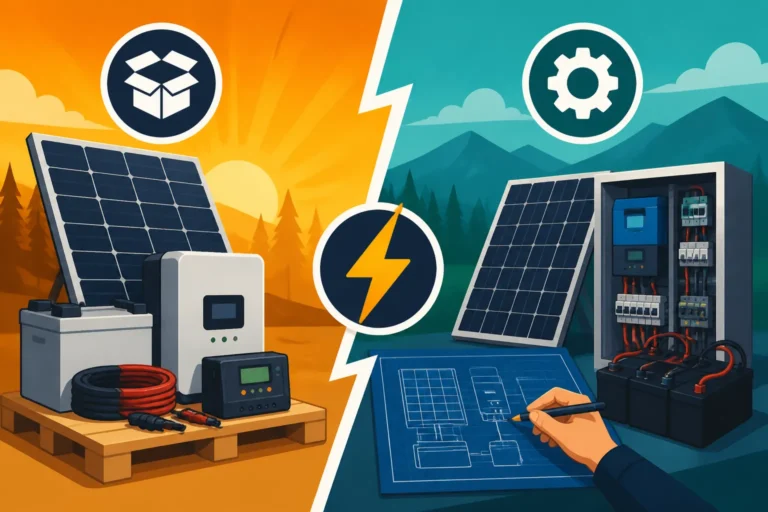
Your workshop's nature greatly influences whether you opt for a portable or permanently installed solar solution. If your workshop is a fixed structure—a backyard shed, a detached garage, or a dedicated building on your homestead—a permanent installation with roof-mounted or ground-mounted solar panels and a stationary battery bank makes the most sense. This setup provides maximum power and efficiency, seamlessly integrating into your workspace. It's designed for long-term, heavy-duty use, allowing you to run those power-hungry tools day in and day out.
However, if your workshop is mobile, like a tool trailer for on-site jobs, a mobile repair van, or even a temporary setup for a specific project, then portability becomes paramount. In these cases, a robust solar generator like the offerings from Jackery or similar brands, paired with portable solar panels, might be the ideal choice. These "all-in-one" units integrate the inverter, charge controller, and battery into a single, often wheeled, package, making them incredibly convenient to move and set up. While they might not power a full-blown industrial workshop, they are fantastic for smaller tasks, charging cordless tool batteries, running lights, or even a smaller air compressor on the go. Many users find a portable power station can augment a larger permanent system for flexible power needs outside the main workshop.
Budgeting for Your Workshop Power
Let's be realistic: going off-grid isn't always cheap upfront, but the long-term savings and independence are invaluable. Your budget will play a significant role in the size and quality of components you choose for your workshop kit. Solar panels themselves have become quite affordable, but the costs can add up quickly when you factor in batteries, inverters, charge controllers, mounting hardware, wiring, and safety components. Lithium batteries, while superior, represent a substantial portion of the initial investment.
When budgeting, consider not just the upfront purchase price but also the lifetime cost. A cheaper lead-acid battery bank might save you money today, but you could be replacing them every 3-5 years, whereas a quality LiFePO4 battery might last 10-15 years or more. Think about how much you spend on gasoline for a generator annually, or how much you’d pay to extend grid power. Often, an off-grid solar system for a workshop quickly pays for itself in avoided fuel costs and the sheer convenience. Our article, How to Budget for an Off-Grid Solar System, provides excellent guidance on breaking down these costs. Don't forget to look into potential local or federal incentives, though off-grid systems sometimes have different eligibility requirements than grid-tied setups.
Expandability and Future-Proofing
Workshops have a funny way of growing. You start with a few hand tools, then acquire a drill press, then a table saw, and pretty soon, you're eyeing a dust collection system or a small CNC machine. When choosing your off-grid solar kit, it's wise to think about future expansion. Can you easily add more solar panels later if your power needs increase? Is your charge controller oversized enough to handle additional panel wattage? Can your inverter handle a larger load if you upgrade tools, or will you need to replace it entirely?
Some systems are designed with modularity in mind, allowing you to add more batteries in parallel or expand your solar array without replacing core components. For instance, brands like Victron Energy or EG4 offer modular inverter-chargers and battery systems that are easily scalable. Even if your current budget is tight, planning for expandability means you won't have to scrap your entire system down the road. Consider choosing a charge controller with extra capacity and an inverter that's slightly larger than your immediate needs. This foresight can save you significant money and hassle as your workshop evolves. A great resource for planning this growth is our guide on How to Design an Expandable System.
Disclaimer
The information provided in this guide is for general informational purposes only and does not constitute professional advice. Off-grid solar system design and installation can be complex and involve electrical hazards. Always consult with a qualified electrician or solar professional before installing or modifying an off-grid solar system. Adherence to local codes, regulations, and safety standards is essential.